All posts by: UMBC News Staff


UMBC faculty provide insight and analysis during Maryland’s primary election

On Tuesday, April 26, hundreds of thousands of voters in Maryland headed to the polls to cast their ballots. The U.S. Senate and presidential races were expected to draw significant attention to the primary election, and more than 125,000 people participated in early voting. As the returns came in on Tuesday, UMBC professors Donald Norris and Kimberly Moffitt provided insight and analysis on races across the state.

Norris, professor and director of the School of Public Policy, joined WJZ-TV’s extensive coverage on primary day and discussed how voter turnout was expected to impact the election and explained how it would be especially important in the Baltimore mayoral and U.S. Senate races.

“Voter turnout is always important, and sometimes it’s more important for some candidates than for others. They have to get their people out to vote. If they don’t, they don’t win,” explained Norris.

After the polls closed, Norris reflected on the results and described what lies ahead for the candidates as they turn toward the general election in November. “I think the citizens have some good choices,” Norris explained.

Norris was also quoted in The Washington Post about the Senate race and The Wall Street Journal about the influx of cash in the race to succeed Rep. Chris Van Hollen in the House.

American Studies Associate Professor Kimberly Moffitt joined WYPR’s election coverage in the week leading up to primary day and also provided analysis as the returns came in on Tuesday night. Leading up to the election, she discussed how the U.S. Senate race was particularly interesting from a media coverage perspective.

“This is an important seat. Mikulski has held this seat for a number of years, and it’s pretty much been her’s and now it’s up for grabs. I do think the need for these two candidates to get cantankerous with each other is about them saying I want this spot because it’s so important to us as a state as a whole,” Moffitt explained.

On election night, Moffitt joined Mileah Kromer, political science professor and director of the Goucher Poll, to provide perspective on the impact of races across the state.

For complete coverage, see below:

Expert Don Norris weighs in ahead of final Maryland primary numbers (WJZ-TV) 
Political expert Don Norris weighs in after a busy Maryland primary (WJZ-TV) 
Lesson from Edwards’s loss: ‘It shouldn’t be about race…We don’t go by gender’ (Washington Post) 
House candidate David Trone spent $12 million to finish second in Maryland primary (The Wall Street Journal) 
How Freddie Gray’s death changed Baltimore, and its election (The Christian Science Monitor) 
Election roundtable: Sizing up the 2016 campaigns (WYPR) 

Image: Photo by Jay Baker, CC by 2.0.  
Biologist Jeff Leips explains model organism research on Capitol Hill in support of federal funding

Federally-funded science researchers have tightened their belts in recent years, as budgets for federal research agencies have decreased in many core areas. Concerned at the prospect of future research funding cuts, particularly for model organism and basic research, the Coalition to Promote Research and Coalition for National Science Funding gathered scientists and representatives of funding agencies to present a Congressional Poster Exhibition and Reception.

Held on April 13, 2016 at the Russell Senate Office Building in Washington, D.C., the event gave legislators and their staff a greater understanding of the value of research currently supported by the federal government and the processes for selecting grant recipients. UMBC biological sciences professor Jeff Leips, a federally-funded scientist who uses the fruitfly (Drosophila) to study traits associated with aging, attended the event to discuss the importance of research using this workhorse model organism.

“Much of what we know of biology comes from model organisms,” Leips says. He explains that fruitflies share about 60 percent of their genes with humans, and about 75 percent of disease-causing genes in humans have a parallel gene in flies, so studying the tiny critters is a cost-effective, practical, and ethical way to learn about human disease. Labs that use model organisms also provide ample opportunities to train the next generation of scientists.

Leips spoke with Senate staffers at the meeting who were “very open to listening,” he says. While some of the onus is on politicians to take time to learn the intended purpose of research in context, Leips suggests, scientists and research institutions “could do more.” He recommends organizing similar events on university campuses and inviting local legislators. He also suggests helping scientists become more aware of how scientific language can have different meanings in a lay context, to prepare them for speaking with the media and general audiences.

To learn more about Jeff Leips’ experience at this event, read his post on the Genetic Society of America‘s blog.

Header image: Jeff Leips at the Congressional Poster Exhibition. Photo by Charles Votaw.

Alumna Zainab Alkebsi admitted to Bar of the U.S. Supreme Court in historic ceremony

On Tuesday, April 19, Zainab Alkebsi ’09, political science, was among 13 members of the Deaf and Hard of Hearing Bar Association (DHHBA) sworn in and admitted to the Bar of the United States Supreme Court.

Zainab Alkebsi. Photo credit NAD.

With Supreme Court Bar admission, Alkebsi will now be able to argue cases before the nation’s highest court. Admission to the Supreme Court is only granted if an attorney is sponsored by two current members of the bar and has been in good standing for at least three years.

The event was the first time that the DHHBA participated in a group swearing-in ceremony, which typically occurs most days the Supreme Court is in session. The 13 attorneys is the largest group of deaf and hard of hearing lawyers to be admitted to the Supreme Court Bar.

“It was incredible to be part of the historic swearing-in ceremony with twelve outstanding deaf and hard of hearing attorneys,” says Alkebsi. “The cherry on top was seeing Chief Justice Roberts grant our motion in American Sign Language, which was a first from the Supreme Court bench! It was a very pleasant surprise and it was very thoughtful of him to acknowledge our group the way he did. I hope that the ceremony has inspired others who are deaf and hard of hearing to pursue a legal career.”

At UMBC, Alkebsi was a political science major and was a member of the Honors College and Sondheim Public Affairs Scholars Program. She is currently policy counsel for the National Association of the Deaf (NAD) and is a graduate of University of Baltimore School of Law.

Read news coverage of the event below:

Supreme Court Chief Justice learned sign language to swear in deaf lawyers (Washington Post) 
A “view” from the Court: Making accommodations for the deaf and hard of hearing (SCOTUS blog) 
Alumna sworn in to Supreme Court Bar with 12 deaf colleagues (UB School of Law updates) 
DHHBA members to be sworn into United States Supreme Court Bar (DHHBA News)

Header Image: U.S. Supreme Court. Photo by Chris Phan, CC by 2.0. 

Roy Meyers discusses the political likelihood of reforming the federal budget process

Political science professor and federal budgeting expert Roy Meyers has been in the news recently discussing federal budget issues as the U.S. Senate has held hearings on reforming the budget process and an emergency spending bill to combat the Zika virus is being debated in Congress.

Roy Meyers (UMBC)

On April 13, Meyers testified before the U.S. Senate Budget Committee during a hearing on “Budgeting for Outcomes to Maximize Taxpayer Value.” The hearing was the second in a series focused on fixing the budget process and highlighted how outcome-based budgeting could improve congressional budget decisions.

On April 18, Brookings published a brief by Meyers titled “How to make budget process reform politically feasible.” In his paper, Meyers addressed what can be done to overcome barriers to budget reform that are still high.

“For advocates to overcome these barriers, they must describe how reforms will create results that politicians value. The reforms suggested in this report would increase the ability to establish strategic priorities and allocate resources towards those priorities, and that greater capacity would promote fiscal sustainability,” Meyers stated in the introduction.

In a USA Today article about the $1.9 billion emergency spending bill, Meyers commented on rhetoric surrounding the bill and how it is being perceived.

For complete coverage, see below.

April 13 hearing on Fixing Broken Budget Process (United States Senate Committee on the Budget) 
How to make budget process reform politically feasible (Brookings) 
Obama’s $1.9 billion Zika request: ‘Slush fund,’ or needed flexibility? (USA Today) 

Image: U.S. Capitol. Photo by Kevin Burkett, CC by-SA 2.0.

UMBC public historian Denise Meringolo and alumnus Joe Tropea discuss crowdsourcing history on WYPR

A year after the Baltimore Uprising of 2015, UMBC’s Denise Meringolo and alumnus Joe Tropea recently joined WYPR’s “Midday” program to discuss their work to gather and preserve a diverse range of perspectives and experiences from the events of last year.

Meringolo, an associate professor of history and director of public history, and Joe Tropea ’06, history, ’08 M.A., historical studies, are collaborating on a project to archive materials from the Baltimore Uprising through a website that was launched last year. Since the project began, there have been thousands of submissions from community members.

“It’s really the work of public history to be working with communities, not just for them, and not just producing historical interpretations with the eye of having publics read them, but really working with people to develop interpretations that help them think about who they are, what’s going on around them, and how the tools of history can help them arrive at a deeper understanding and achieve their personal goals,” Meringolo explained during the segment.

Meringolo described how the website was launched quickly last year when her students wanted to be responsive to narratives that were being shared in the national news about the events surrounding Freddie Gray’s death. They wanted to find a way to represent the complexity of what was happening and to allow community members to control their own narratives and represent how they were feeling.

Joe Tropea, who is now digital projects coordinator at the Maryland Historical Society, heard about the website and collaborated with Meringolo on the project.

“We sensed the importance of what was going on. It was obvious to us that this was something people will study years from now, so we made a decision to get proactive about it,” Tropea shared.

Listen to the complete segment “Crowdsourcing History” on the WYPR website. Read more about the Preserve the Baltimore Uprising 2015 Archive Project.

Image: Denise Meringolo. Photo by Marlayna Demond ’11 for UMBC. 

Valedictorian Katelyn Seale heads to medical school with sensitivity to diversity and a strong research background

Katelyn-Seale-1569

Katelyn Seale
B.S. Biochemistry and Molecular Biology
Summa Cum Laude
Hometown: Ellicott City, Maryland
Plans: M.D., University of Maryland School of Medicine

With every conversation and interaction, I have had the opportunity to learn something new about people…I know that I am equipped to succeed in a medical career because of these experiences at UMBC.

Katelyn Seale, UMBC’s Class of 2016 valedictorian, is a future doctor determined to be sensitive to the diverse needs and life experiences of all of her patients.

Like many students in her medical school cohort, Seale will begin her program with a strong academic background in chemistry and biology, and robust hands-on research experience. “My hours in the lab struggling to explain or duplicate results have made me a stronger student and problem-solver,” she says.

She’ll also come in with a more unique skill set of building relationships beyond the lab, planning events, and connecting with people from many different communities, after three years on the executive board of UMBC’s Student Events Board and service through the Shriver Center. “With every conversation and interaction, I have had the opportunity to learn something new about people,” she says, sharing that her broader perspective “will be incredibly valuable in a medical field.”

Seale earned the Student Recognition Award for the chemistry and biochemistry department and was admitted into both Phi Kappa Phi and Phi Beta Kappa honor societies. Her UMBC education was supported by a President’s Scholarship.

Images: Through her work on UMBC’s Student Events Board, Seale planned the UMBC Color Run, a fun and healthy event for students; photo courtesy of Katelyn Seale. Portrait by Marlayna Demond ‘11 for UMBC.

Salutatorian Ashby Henningsen to pursue a public service career dedicated to human rights

Ashby Henningsen
B.A., Political Science; B.A., Global Studies
Summa Cum Laude
Hometown: Parkville, Maryland
Plans: Intern, International Justice Mission

My friends in the Sondheim Scholars program represent the many individuals who have helped me grow, both intellectually and personally. They embody the best that this community has given me and taught me over the course of these past four years.

During his time at UMBC, Ashby Henningsen has developed lasting friendships with fellow Sondheim Public Affairs Scholars thanks to a shared commitment to personal growth and public service. For Henningsen, UMBC’s Class of 2016 salutatorian, that commitment focuses on human rights issues.

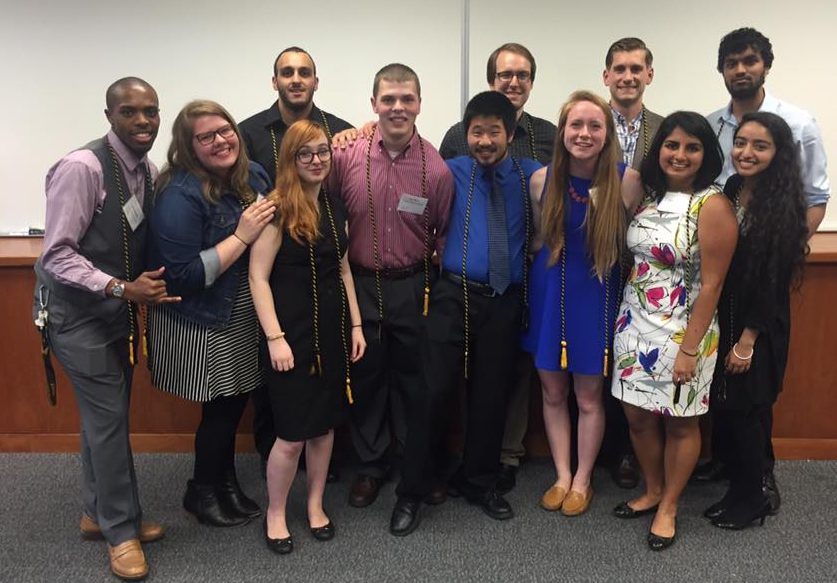
Ashby Henningsen poses with other UMBC Sondheim Public Affairs Scholar

Henningsen has volunteered with the Refugee Youth Project and The Choice Program at UMBC’s Shriver Center. He has also interned for two nonprofit organizations in Baltimore, Advocates for Survivors of Torture and Trauma and the Next One Up Foundation, and served as assistant news editor for The Retriever Weekly.

In 2015, Henningsen participated in the Public Policy and International Affairs Junior Summer Institute at Princeton University, a seven-week program structured to introduce and strengthen skills in economics, statistics, policy analysis, writing, and public speaking. Through experiences inside and outside the classroom, he’s also further developed the critical analysis, professional writing, and speaking skills he’ll need to pursue a career in international affairs and public administration.

Henningsen graduates with a 4.0 GPA and Outstanding Scholar accolades from both political science and global studies. He will complete an internship with the International Justice Mission in Washington, D.C. in summer 2016, during the review period for his application to the Peace Corps.

Images: Ashby Henningsen poses with other UMBC Sondheim Public Affairs Scholar; photo courtesy of Ashby Henningsen. Portrait by Marlayna Demond ‘11 for UMBC.

Sayo McCowin to pursue M.D./Ph.D. after transformative experience researching HIV

Sayo-McCowin-1479

Sayo McCowin
B.S., Biochemistry and Molecular Biology
Cum Laude
Hometown: Arlington, Virginia
Plans: M.D./Ph.D., University of Virginia School of Medicine

I know that upon leaving this university I will be able to thrive in any environment. The faculty, students, and staff of UMBC have shown unrivaled support and continue to inspire me as I prepare to embark on this new chapter in my life.

The UMBC experience challenged Sayo McCowin to “perform better not just as a student, but also as an all-around human being,” he says.

In addition to pursuing substantial research as a Meyerhoff Scholar, Howard Hughes Medical Institute Scholar, National Institute on Drug Abuse Scholar, and Department of Energy Scholar, McCowin served as a leader in the campus community. His experiences include service as an Academic Integrity Board member, undergraduate program board member, and Lambda Chi Alpha president.

While McCowin’s work on the three-dimensional structure of components of the HIV-1 virus in Michael Summers’s lab grew his passion for research, his service on campus broadened his connections with students across the university.

McCowin credits the support he found at UMBC for enabling him to pursue the M.D./Ph.D. degree he has long aspired and worked toward.

Images: Participating in the Summers lab at UMBC enabled McCowin to pursue his passion for medical research; photos by Marlayna Demond ‘11 for UMBC.


Biology grad Corey Carter named 2016 Baltimore County Public Schools Teacher of the Year

Corey Carter ’08, biological sciences, ’10 M.A.T., has been selected as 2016 Baltimore County Public Schools (BCPS) Teacher of the Year. The recognition was announced during an April 20th ceremony at George Washington Carver Center for Arts and Technology in Towson.

Carter currently teaches science and co-founded the My Brother’s Keeper Mentoring program at Old Court Middle School in Pikesville. He previously taught for three years at Rayner Brown Elementary Middle School in Baltimore.

“Corey Carter sets a wonderful example of what teaching in Baltimore County looks like,” BCPS Superintendent Dallas Dance said in a news release announcing the award. “He concentrates on the whole child and fosters relationships with each and every student who comes through his door. Not only that, but he gives students the tools and confidence they need to be in charge of their own learning, and places an emphasis on critical thinking.”

Corey_TOY_2016

Corey Carter with Rehana Shafi after receiving the award.

“Every day, teachers must blend life lessons, content, assessments, feedback, and a sprinkling of high-fives all in pursuit of impacting a young life. But the true impact of educating others is as much about sharing knowledge as it is learning from them,” Carter said in the news release. “In fact, teaching has been most rewarding when showing others what they have taught me. My students push me to listen more, celebrate more, and to show them why I love what I do.”

At UMBC, Carter was a Sherman Scholar and is an active alumnus and member of the Sherman Program Alumni Advisory Board. As BCPS Teacher of the Year, he will compete for the honor of Maryland State Teacher of the Year.

“Corey’s journey is a wonderful example of why the support provided by the Sherman Scholars Program, both during a student’s time at UMBC and during their first few years teaching, is so important,” explained Rehana Shafi, director of the Sherman STEM Teacher Scholars Program.

For more information, read “Baltimore County names Teacher of the Year” in The Baltimore Sun.

Earlier this month, Shalonda Holt ’07 biological sciences, teaching certificate in education, was named the 2016 Washington Post Teacher of the Year and Howard County Teacher of the Year.

Update: Carter was featured in an Education Post article on June 6, 2016. 

Gaurav Luthria to pursue bioinformatics Ph.D. at Harvard after intensive research experiences at UMBC

Gaurav Luthria
B.S., Bioinformatics
Summa Cum Laude
Hometown: Laurel, Maryland
Plans: Ph.D. in Bioinformatics and Integrative Biology, Harvard

UMBC has opened the doors to so many new opportunities. Working on various research projects, participating in hackathons, and learning from my professors at UMBC has been invaluable in shaping my career aspirations.

During his years at UMBC, Gaurav Luthria has used bioinformatics to explore a variety of research fields. At an internship at the University of Pennsylvania School of Medicine he studied genetic relationships among ancestral African populations, and at the Health Sciences and Technology Division (a joint initiative between MIT and Harvard) he used social media data to study neurodevelopmental disorders. Here at UMBC, Luthria developed algorithms to elucidate the structure of RNA molecules.

As a Meyerhoff and MARC U*STAR scholar Luthria received key mentorship that helped him establish and achieve his goals. He was also inducted into the academic honor society Phi Beta Kappa and the Carson Scholars Hall of Fame, and he received a Barry Goldwater Scholarship honorable mention.

Luthria gave back to the UMBC community by serving as a chemistry tutor and genetics teaching assistant.

Images: Luthria presents research at the end of his freshman year; photo courtesy Gaurav Luthria. Portrait by Marlayna Demond ‘11 for UMBC.

Grace Choi, heading to biostatistics Ph.D., balances academics and commitment to community

Grace Choi
B.S., Mathematics and Statistics
Summa Cum Laude
Hometown: Ellicott City, Maryland
Plans: Ph.D. in Biostatistics, University of Pennsylvania

The support from faculty and availability of undergraduate research opportunities have helped me gain vital work experience and discern my passions and skills. The rigor of UMBC classes helped me grow academically and highlighted the importance of group studying.

Choi emceeing an InterVarsity large group meeting, an activity that helped her broaden her perspectives; photo courtesy Grace Choi. Portrait by Marlayna Demond ‘11 for UMBC.
Images: Choi emceeing an InterVarsity large group meeting, an activity that helped her broaden her perspectives; photo courtesy Grace Choi. Portrait by Marlayna Demond ‘11 for UMBC.

Grace Choi is an outstanding example of the UMBC student drive to pursue academic excellence at its highest levels while also taking time to support communities and causes of personal resonance.
Graduating with a 4.0, Choi has been admitted into the Phi Beta Kappa National Honor Society and placed on the UMBC President’s Academic List. She has received numerous departmental awards, including the Outstanding Learning Assistant in Physics and Outstanding Graduating Senior in Statistics. She also received support from the UMBC Centennial Award Scholarship and Sinha Endowment for Excellence in Statistics.

Beyond the classroom, Choi has served as mission and advocacy chair for UMBC’s Relay for Life and was the secretary and large group coordinator for InterVarsity Christian Fellowship. This role involved leading discussions on topics such as faith, race, and social justice.

Arti Deore Choudhary, heading to Amazon, thanks cybersecurity faculty for honing her leadership skills

Arti Deore Choudhary
Master’s in Professional Studies, Cybersecurity
Summa Cum Laude
Hometown: Pune, India
Plans: Cloud Support Engineer, Amazon Web Services

This UMBC cybersecurity master’s program has helped me to sharpen my professional, as well as management skills in a most demanding field. Without my degree and UMBC’s support I would not have been able to reach out to professionals and grow as a cybersecurity professional.

Arti Deore Choudhary arrived at UMBC with an impressive academic and professional background, including a B.S and M.S. in computer science from Pune University in India and years of experience as an IT professional, and she graduates from her cybersecurity master’s program with a 4.0 GPA. She has been actively involved in sharing her knowledge and experience with others in the fields of computer science and cybersecurity, particularly through mentoring.

Choudhary partnered with UMBC alumnus and co-founder of LKA Computer Consultants, Larry Aikins ‘14, M.P.S. cybersecurity, to lead Teens in Technology, a seven-day cybersecurity workshop designed to educate high school students about tech security. She also competed in the Maryland Cyber Challenge in 2015, with her UMBC team making it to the semifinal round.

Arti Deore Choudhary leads a UMBC workshop for aspiring cybersecurity and technology students

Choudhary has received an Ethical Hacker Certificate and has interned with Ridgeback Network Defense, a startup technology company at bwtech@UMBC. She will soon begin a position as a cloud support engineer at Amazon Web Services.

Images: Arti Deore Choudhary leads a UMBC workshop for aspiring cybersecurity and technology students; photo courtesy of Arti Deore Choudhary. Portrait by Marlayna Demond ‘11 for UMBC.