All posts by: Johanna Alonso '20


Take the transit tour!

By Johanna Alonso ’20 and Kennedy Lamb ’20, UMBC Magazine’s 2019 editorial interns
In the era of expensive ride-share apps, it can be easy to forget that UMBC offers a shuttle system that is completely free to all students and staff, with buses that can take you to the Arundel Mills Mall, downtown Baltimore, Catonsville, and beyond. Riding the shuttle is easy; simply use the schedules on the UMBC Transit website to figure out when and from which stop your shuttle is leaving, and show your ID card to the driver when you step onto the bus.
What’s a little more challenging is figuring out where you want to take the shuttle in the first place. So, we traveled along different shuttle lines to find out which spots were must-visits for any UMBC student. 

A CUP OF CATONSVILLE

We spent our first day exploring the Catonsville Line, getting on the bus at the Poplar Avenue stop (right across the street from True Grits) precisely at 12 p.m. The ride to our first stop, Mellor Ave. and Frederick Rd., took only 10 minutes, and was less than half a block away from our destination: Atwater’s Cafe. Even among the many enticing eateries on Frederick Rd., Atwater’s sticks out as one of the only coffee shops in the area, making it the go-to off-campus spot for students looking for their daily caffeine fix.

Close-up of a mug full of creamy latte with students sitting in the background.
Treat yourself to a latte served in a handcrafted mug at Catonsville’s Atwater’s Café!

After we finished our coffees, we decided we needed something to eat. Though Atwater’s does offer an extensive menu, we thought it might be fun to check out another lunch spot, one that’s a favorite of UMBC students since its opening in 2010: Grilled Cheese and Co.
Grilled Cheese and Co.’s  signature sandwich, the Crabby Melt—a crispy, toasted sandwich stuffed with crab dip and topped with Monterey Jack cheese—is particularly popular. And best of all, it’s right on the shuttle line; the bus stop at Harlem Lane and Edmondson Ave. is literally only feet from the restaurant’s front door. This is especially important considering there aren’t always enough spots in the restaurant’s small parking lot to accommodate their usual lunch rush.

TAKE A HIKE

After we ate, we wanted to take a short afternoon hike. So, we returned to campus to switch to the Arbutus Line, getting on once again at the Poplar Ave. stop, which we took to Sulphur Spring Rd. and Selford Rd. From there, we followed Sulphur Spring Rd. and South Rolling Rd. on foot about half a mile northwest until we reached the Patapsco State Park Soapstone Trailhead.  
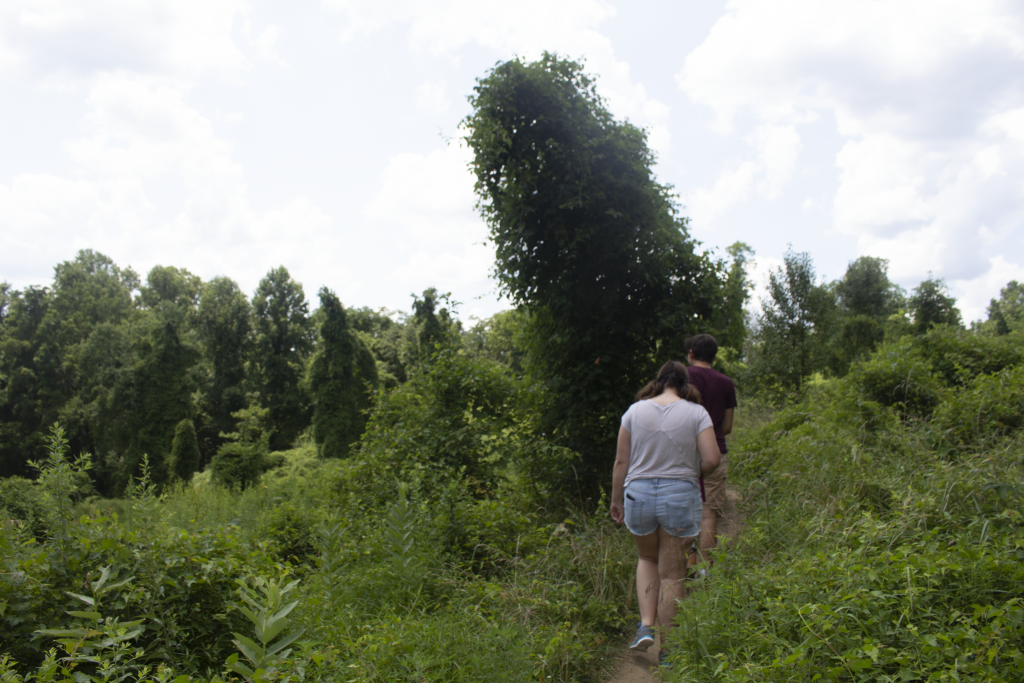
Students walking along a path amongst a lot of greenery on a bright but cloudy day.
Expansive, lush views are some of the best parts about hiking in Patapsco State Park.

With over 200 miles of trails, Patapsco State Park is one of Maryland’s greatest natural landmarks. And it’s located less than three miles from UMBC! Soapstone, a 1.7 mile long hiking trail, is one of the most accessible to UMBC students thanks to its proximity to campus. The hike itself was so beautiful that it easily made up for the fact that there wasn’t a shuttle stop directly at the trailhead.

CHARGE INTO CHARM CITY

Dragon-shaped boats floating next to a small bridge walkway. Triangular glass buildings in the background of the Baltimore harbor.
“Chessie” paddles boats are a beloved staple of the Inner Harbor.

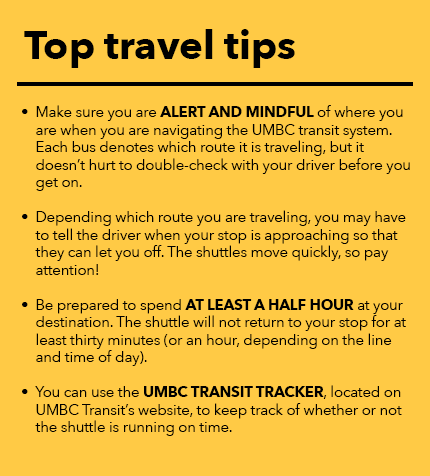
The second day, we decided to venture into downtown Baltimore where (perhaps it goes without saying) there’s no shortage of things to do. Though this shuttle line makes fewer stops then some of the others, the stops it does make are in prime areas of the city, full of museums, theatres, stores, and restaurants, as well as jumping off points to connect with Baltimore’s other transportation systems.
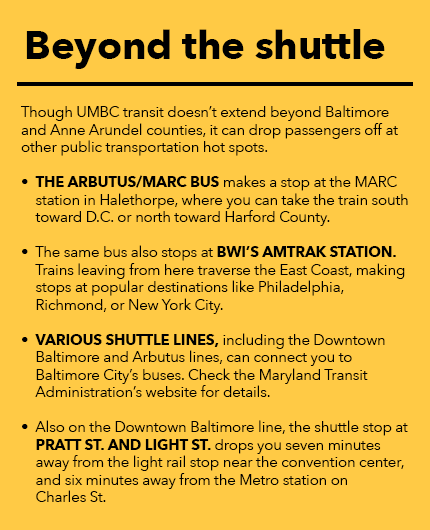
Camden Yards is one of the most recognizable attractions you can get to on the Downtown Line. Just get off at Pratt St. and Howard St., and you’ll be only about four blocks away from the park’s entrance. Camden Yards is best known as the Orioles’ stadium, but as of Billy Joel’s concert this July, it’s also a concert venue! Just keep in mind that the last shuttle leaves Baltimore at 10:55 p.m., so if you’re planning to attend an event that may run later than that, the shuttle won’t be able to take you back to campus. 
If you’re looking for something to do prior to an Orioles game—or you just want a way to spend your Saturday—there’s always something to do at the Inner Harbor, located immediately adjacent to the shuttle stop at Pratt St. and Light St. Most Marylanders have been to the Inner Harbor, but in case you need a refresher, the area includes The National Aquarium, theMaryland Science Center, and several shopping options, including The Gallery Mall, located across Pratt Street from the Harbor. You can also spend the day on the Harbor itself, riding around on an iconic Chessie pedal boat or taking a sightseeing cruise.

LOCAL FLAVORS

After spending most of our day at the Inner Harbor, we headed back to campus, switched once again to the Arbutus line, and went out for dessert! Ice Cream Cottage is the go-to spot for any UMBC student looking for a sweet treat on a hot day. 
Ice Cream Cottage can be found less than a block away from the shuttle stop at Linden Ave. and East Dr. Located in the heart of Arbutus, it’s the perfect place to stop on your way back to campus after grabbing a bite from nearby eateries like Cactus Silvestre or Oak Creek Café, or after catching a flick at Hollywood Cinema 4.

A cup of vanilla butterscotch ice cream atop a wooden checkerboard table. Beside it is a wooden box of black and red checkers pieces.
Ice Cream Cottage is known for its distinctive checkerboard tables.

On the same street as Ice Cream Cottage is OCA Mocha, an upcoming coffee shop that was conceptualized by UMBC students as a way to bring UMBC spirit to the surrounding Arbutus area! OCA Mocha (the “OCA” stands for “Opportunities for Community Alliances”) is more than just a typical café—itis also slated to feature conference spaces, live performances, and other exciting ventures. This is sure to be the newest off-campus hotspot, so keep an ear out for the date of its grand opening; the UMBC Shuttle will be sure to stop there often!
After our whirlwind week of transit, we were excited to gain familiarity with the free shuttles UMBC offers. Many of us are pro-alternative transportation in theory, but rarely practice what we preach. We think we’re lucky that our university provides students and staff with a sustainable travel options, but the system will only get better the more people use the shuttle. If more UMBC students and staff take transit, the more incentive Transit will have to add more stops, times, and destinations!
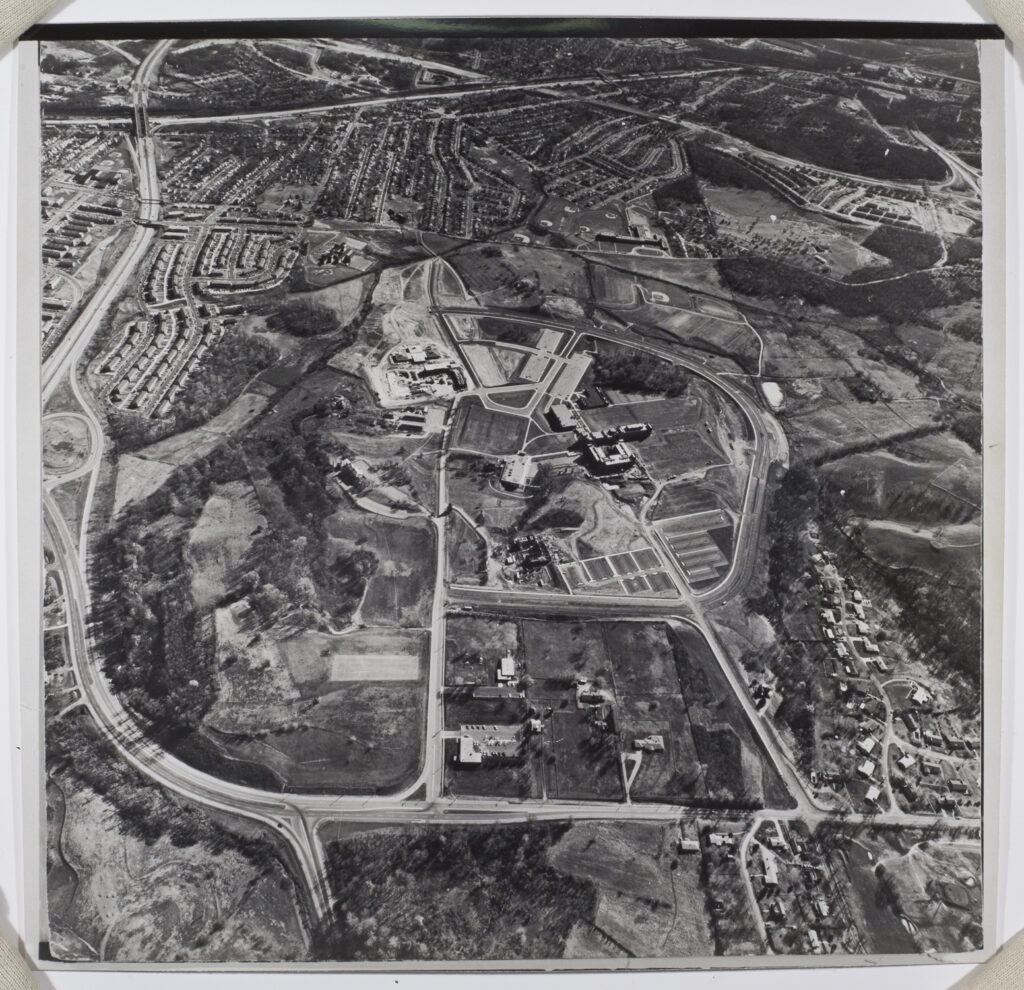
Change of Scenery—Then & Now

Looking at aerial photos from UMBC’s first several years—in this case, 1969—it’s hard not to think, “But where is everything?” Most of the distinctive landmarks of today’s campus are missing, and even our ubiquitous Hilltop Circle (then called Loop Road) is only half there.

As different as campus looks now, most of the buildings in this early photograph still serve their original function. This picture was taken the year after the opening of the library’s first wing—or “Phase I,” as it was called at the time, a nod to the planned expansion. Over the years, the building would be extended by two more phases, the last of which was completed in 1995.

In the upper-left-hand corner of campus, you can spot the school’s first dormitories under construction. The first residential hall was completed the year after this photo was taken and was named, unceremoniously, Dorm I. It, along with Dorms II and III, were finally given their current names—Susquehanna, Chesapeake, and Patapsco, respectively— in 1979.

Though the landscape of our campus has changed to be almost unrecognizable from this 1969 image, it has also been altered considerably in just the past few years. The aerial photo of UMBC in 2019 shows two new landmarks that did not exist in 2016, when members of this year’s graduating class were freshmen.

The Interdisciplinary Life Sciences Building and the UMBC Events Center are only the latest additions to UMBC’s landscape. It’s likely that by the time today’s first-year students have their commencement in 2023, UMBC’s skyline will have shifted once more, making our “now” their “then.”

Stay Golden, Retrievers

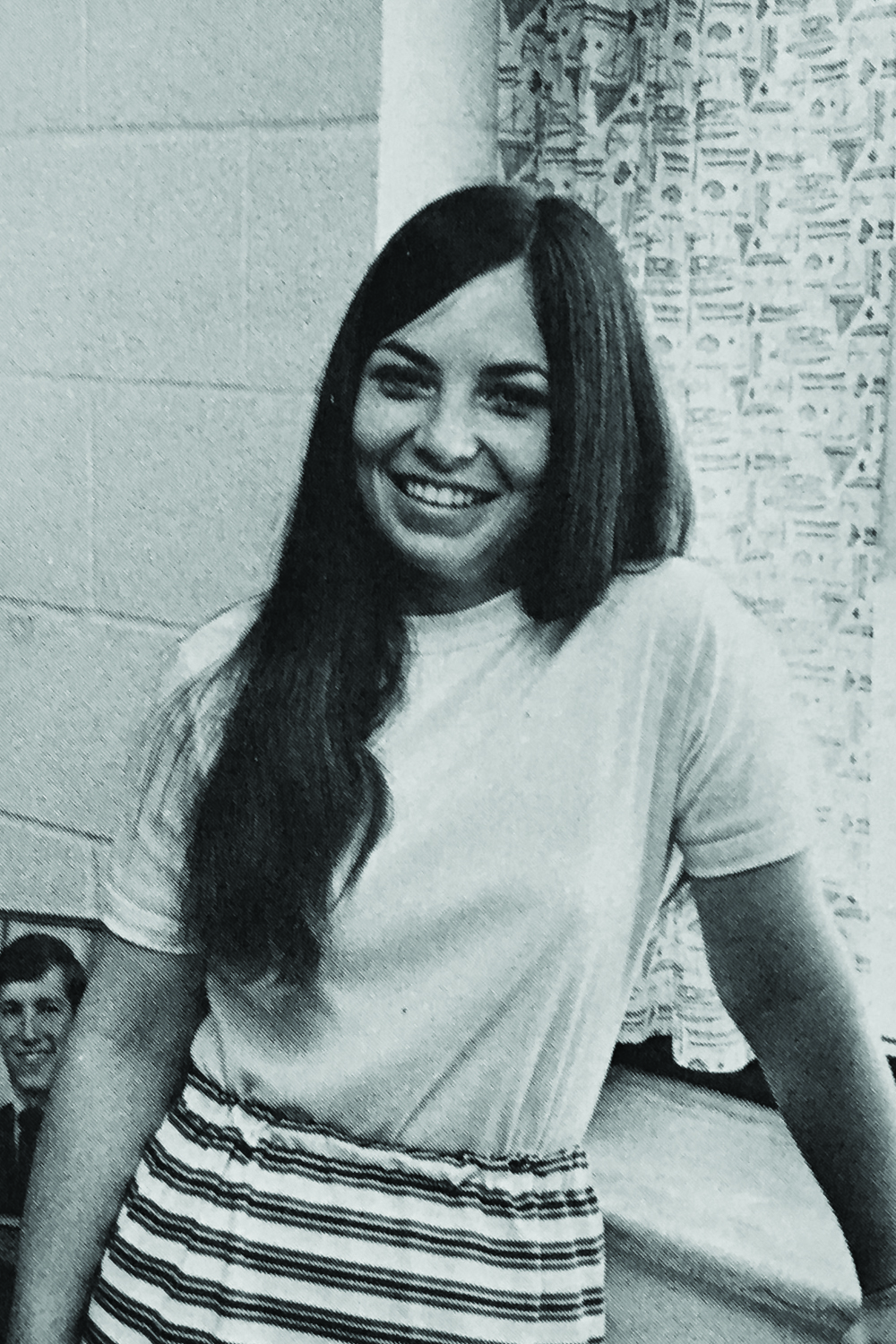
Fifty years ago, UMBC’s very first class crossed the stage for the university’s inaugural Commencement ceremony. Among the faces of the 239-member founding class captured in black and white in the Skipjack 1970 yearbook are men and women eager to explore their world. Together with brand-new faculty and staff, they helped set the foundation of UMBC as a true community of inquiring minds. 

Although they are decades apart, the graduating Class of 2020 has made just as indelible a mark on UMBC. Like their 1970 counterparts, they have contributed fresh takes on timeless conversations, challenged norms for the public good, created timely scholarship of all types, and pioneered entirely new ways of learning. 

As we celebrate UMBC’s Golden Commencement, we hope you will enjoy these conversations between members of the Classes of 1970 and 2020 and take pride in what it means to be a Retriever—and how those principles have remained consistent year after year.

https://www.facebook.com/111748990906/videos/3030304543698378/

Timeless Teammates—Louie & Kaya

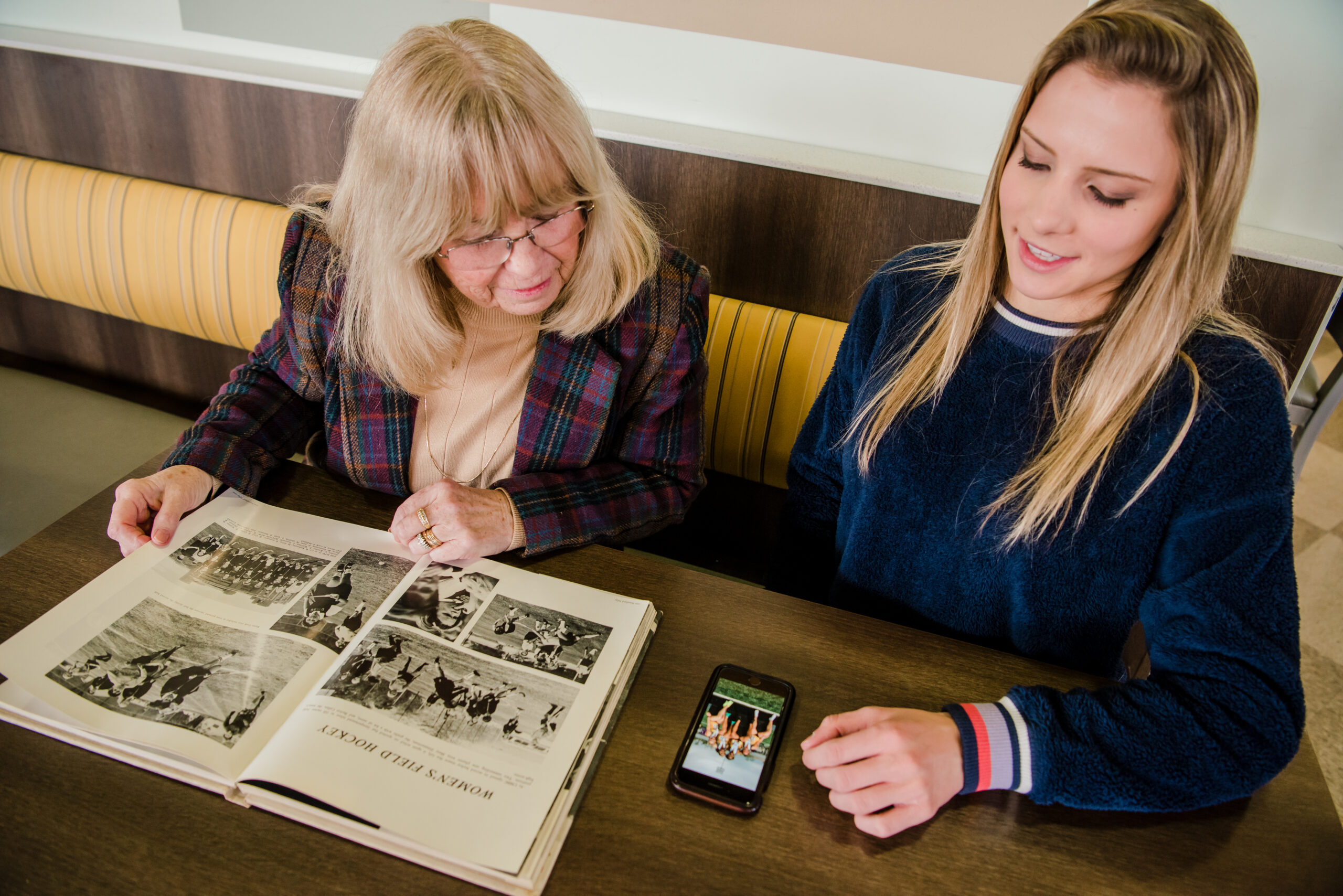
For decades, many students’ UMBC experiences have been shaped by the teams they cheered for and the championships they competed in. But when Linda “Louie” Sowers ’70, American studies, first arrived at UMBC in the school’s inaugural year, athletics were hardly a blip on the map of the school’s three-building campus—and women’s sports did not exist at all. It was Sowers herself who made the change. 

Formerly a high school volleyball player, she approached the school’s athletic director and struck a deal: If she could gather enough interest, the school would sanction a women’s volleyball team.

In the end, sixty-six women—around a tenth of the school’s entire population—signed on, demanding women’s athletics. A volleyball team was formed, followed by field hockey and basketball, and the rest is history.

“I often wondered what would’ve happened if I hadn’t…said, ‘hey, we have girls that are interested in playing,’” Sowers told Kaya Knake ’20, computer science, a member of the Track and Field team, over lunch at True Grit’s early last semester. “How many years would’ve gone by with no women’s sports here?”

The women’s teams at the time had few resources at their disposal; they initially practiced in their gym uniforms, had difficulty finding schools to compete against, and were relegated to practicing in the late evening, once the boys were done using the field. 

Even once they did get their own uniforms, girls who played more than one sport got only one uniform that they used year-round—including Sowers, who wore lucky number 13 for all three teams. You can spot the jersey scattered across the pages of UMBC’s 1970 yearbook, which Knake and Sowers flipped through together as they chatted.

Now, 50 years later, women’s athletics at UMBC not only persists but thrives, with eight NCAA teams, including basketball and volleyball; field hockey, sadly, did not stand the test of time. 

Sowers and Knake at True Grit’s looking at photos of UMBC’s women sports teams from 1970 and today.

Knake, who will graduate this semester into a new career at Northrop Grumman, is one of the many students whose UMBC experience is inextricably tied to athletics. After all, Knake is a Michigan native who would not have heard about UMBC if she hadn’t been recruited by the university’s Track and Field team.

Unlike in Sowers’s time, Knake’s team has never had any dearth of schools to compete against. One of the most memorable experiences she has had as part of the Track and Field team, she said, was when UMBC hosted the America East Outdoor Track and Field Championships at the end of her sophomore year, bringing nine teams and tons of fans to campus. There, Knake won two events and even set an America East record for the outdoor 800 meter. But it was the support of the community that really made the occasion special, Knake told Sowers while sharing some of the team photos she keeps on her phone

“It meant a lot because my parents came down from Michigan, and then some people from UMBC came to watch, and we had a ton of alumni who came out as well,” Knake explained. “It was really special to have everyone here and feel like a big team.”

A World to Discover—Dale & Pat

It might come as a surprise to today’s UMBC students to learn that study abroad has been a part of the university’s fabric since almost the very beginning. In 1969, UMBC’s third year, a group of 42 students traveled abroad as part of a winter session course (then called the “mini-mester”), traversing Europe and visiting important historical landmarks.

Dale Gough ’70, American studies, was not on that trip. He did, however, end up going abroad after his senior year, but it was not for a class, nor for a vacation. At the time—the tail end of the Vietnam War—there was a draft lottery, in which young men were selected based on their birthdates to serve in the military. When Gough realized he was going to be drafted, he decided to get ahead of the curve by going to the military recruitment office, resume in hand, in hopes of getting placed somewhere other than active duty.

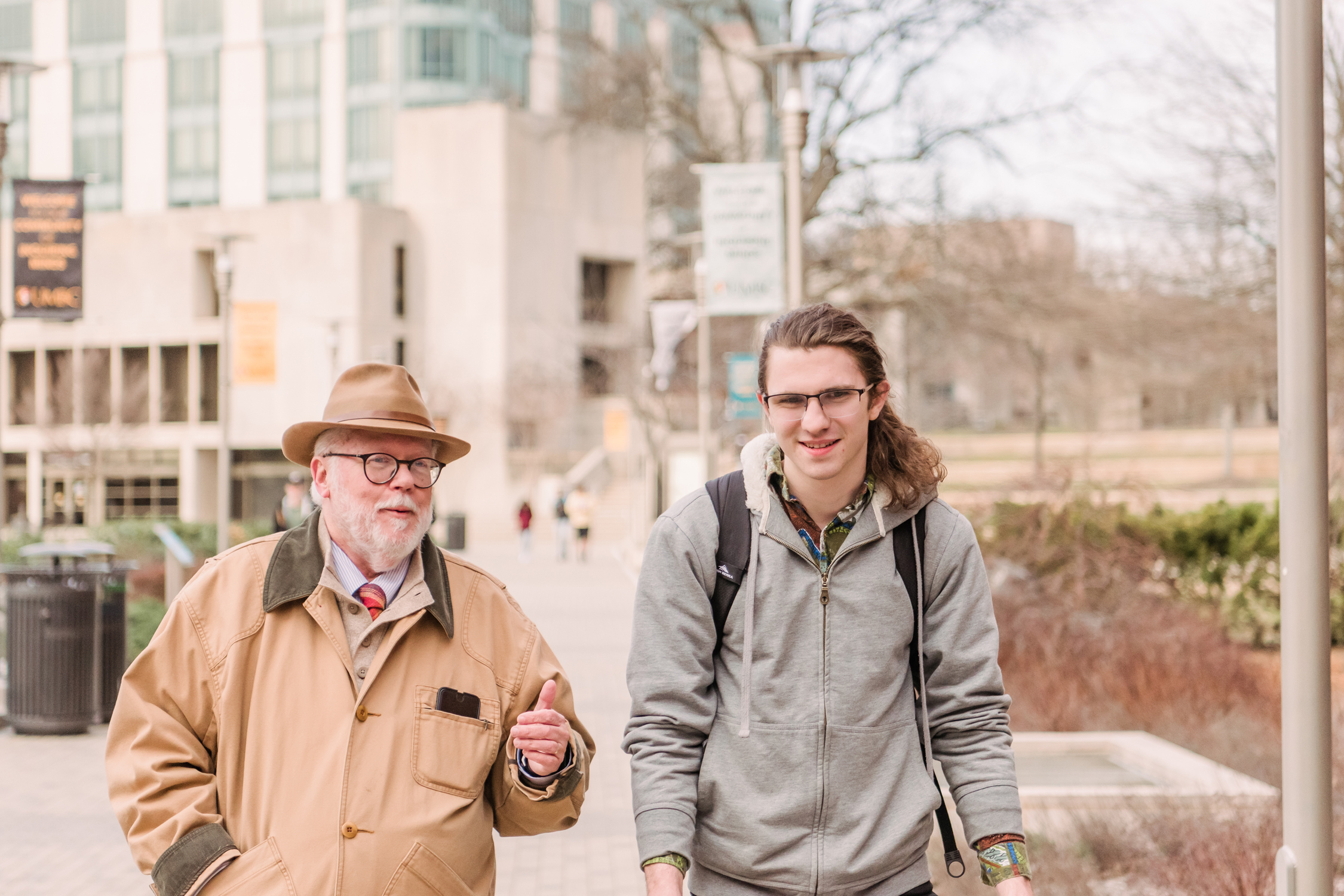
“[The recruiter] said, ‘Well, have you ever considered military intelligence?’ And I said, ‘Oh, you mean like James Bond?’” Gough recalled as he and Pat Michael ’20, mathematics and global studies, took a walking tour of campus together this spring.

On a walk around campus in early 2020, Gough and Micheal discuss the benefits of having experiences abroad.

Thus began Gough’s assignment in Panama, where he worked as the non-commissioned officer in charge of source administration and research analysis. Since then, he has visited six times and has become quite well-versed in Panamanian politics, culture, and history, as evidenced by the stream of facts and anecdotes he related to Michael as the duo turned off of Academic Row and made their way across the quad towards the Interdisciplinary Life Sciences Building.

Now, the class of 1970 is donating $25,000 to support international education in hopes of boosting the number of UMBC students who are able to study abroad — the Education Abroad Access Fund. Even though Gough did not personally have the opportunity to study abroad while in school, his time in Panama taught him that immersing oneself in another culture “fundamentally changes your DNA.”

The sentiment was echoed by Michael, who studied abroad in Colombia—which shares a border with Panama—during their junior year at UMBC. “It rocks your world,” said Michael, who described their experience in Colombia as that of a “investigator,” constantly trying to gain a deeper understanding of the country’s customs and culture over the course of their semester-long experience. 

While Michael managed to get used to some aspects of Colombian culture, like the blunt way the people talk with one another and the nation’s proclivity for long days that start early in the morning, they know that they still have much to learn. They plan to return someday soon and even applied to teach there as a Fulbright Scholar.

Gough and Michael ended their campus tour in The Commons, where they sat below the colorful swath of international flags that hang from the ceiling. There, Michael told Gough about working as a peer advisor in the Education Abroad Office. Part of the job of a peer advisor involves explaining to their fellow students what study abroad was like—a duty that has turned out to be mutually beneficial.

“Talking about my experience has helped me ground it, but it has also inspired other people,” Michael says. “It’s fun to see some people’s faces when they light up.”

Supplemental Learning—Donna & Kara

When Donna Helm ’70, French, came to UMBC, she wasn’t entirely sure what she wanted to study; the career options at the time were limited for women, she recalls, but she did have an interest in teaching. Luckily, though, she wasn’t alone in her uncertainty. Most of the professors who taught her were playing it by ear, as well.

“Many of our professors were brand-newly minted Ph.D.s who had never taught, and this was their chance to sort of figure it out, too,” Helm said in a phone call with Kara Gavin ’20, an English major and Humanities Scholar. 

This led to a sort of camaraderie between the professors and students, who worked together to navigate the beginnings of a brand-new school; there was a sense that everyone on campus was constantly trying new things, learning from mistakes, and improvising. 

“They had requirements, but we had a certain amount of freedom to design … what we wanted to do,” Helm said.

This led to a handful of educational experiences that may strike today’s students as a little bit unusual. Some of the most notable were the weekend excursions Helm—along with her professor and twenty classmates—used to take to an off-campus estate called the Donaldson Brown Center, located in Cecil County on the Susquehanna River. 

There, the students would fully immerse themselves in the language. “It was an opportunity to just speak French and to interact on a different level with our professors because we weren’t at the school,” Helm says. “That was really a lot of fun.”

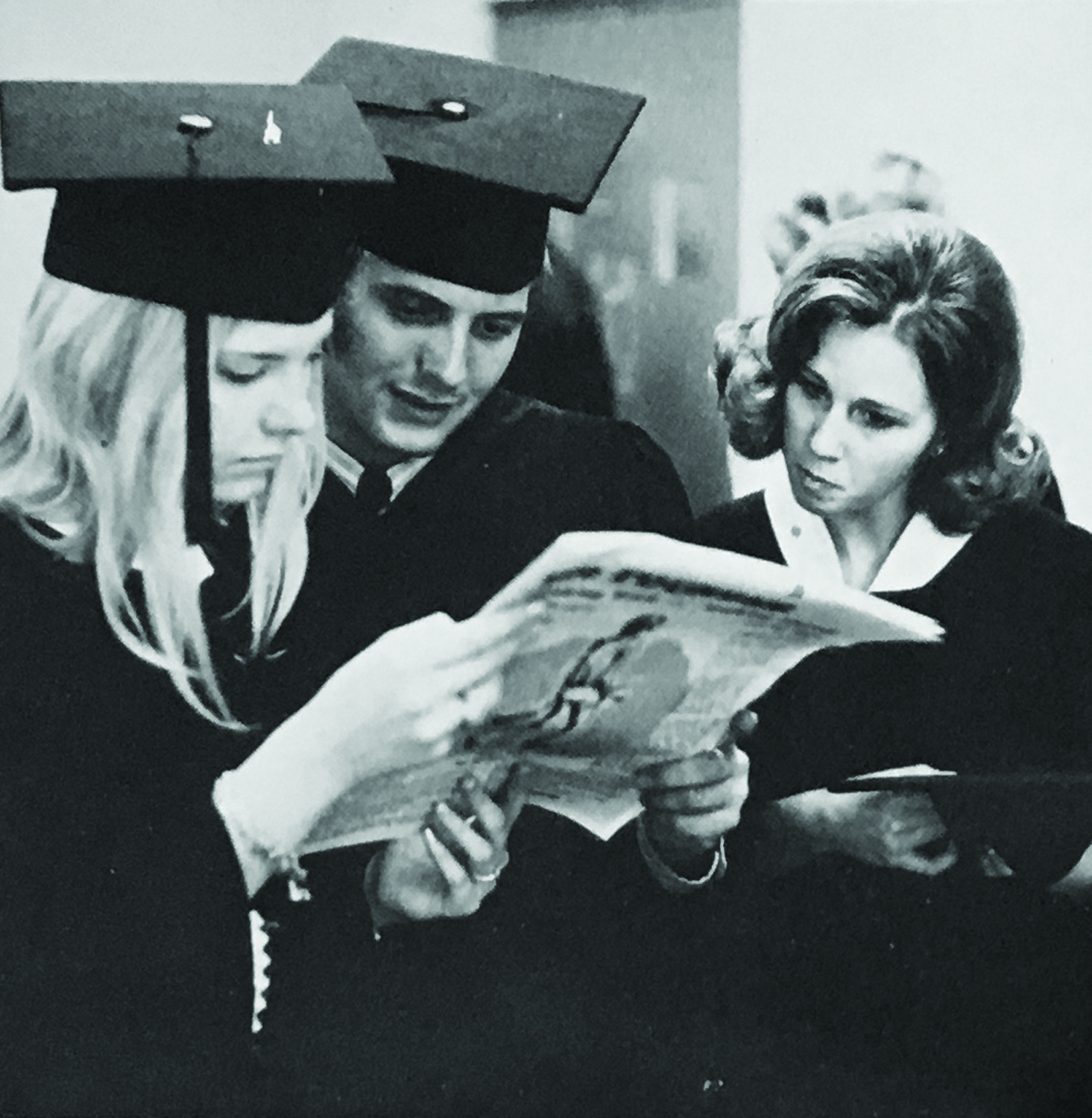
Members of the graduating class of 1970 read an issue of The Retriever.

After the COVID-19 pandemic forced universities to switch to distance learning this spring, UMBC’s students and professors faced moments of uncertainty and improvisation not unlike what Helm’s class experienced in the school’s first year. 

Just as Helm’s professors tried to find interesting ways to engage their students, Gavin’s professors have had to completely rearrange their courses to accommodate the new online environment. The professor for her costuming class altered the final project so that students who do not own a sewing machine can either create a costume design plan, including budget and materials, or write a research essay.

Degree requirements were also somewhat looser when Helm was a student, mirroring the temporary changes to grading policies this semester to afford students an unprecedented amount of flexibility for completing their graduation requirements under the stress of a pandemic.”

And just as Helm and her professors supported one another through the often-challenging work of building a university from the ground up, Gavin said her professors have been more than understanding of what their students are going through in this difficult time.  

“My teachers also have been helpful just by asking, ‘How are you guys doing?’ In the first Zoom session of my English Technical Communication course, we spent the first 15 minutes just talking about how we were, how our families were,” Kara said. “As often as I can, I try to make sure to thank my teachers for how they have helped us in this transition.”

*****

All 1970s images are from the university’s 1970 Skipjack. All other photos by Marlayna Demond ’11, except for Kara Gavin’s image, submitted by the subject. Infographic designed by Layla Thompson-Koch.

Read more stories about the Class of 2020.

Rewriting the Rules of Academia in the Age of COVID-19

Some classes translate better to remote learning than others. There was no way for students in Adam Mendelson’s advanced lighting design class to emulate the experience of programming and running massive lighting rigs from their homes. But, as it turns out, there are lessons about lighting design to be learned even in one’s own bedroom.

Mendelson, a senior lecturer in the Theatre Department, and his students discovered this after one of their projects—design lights to accompany a reading of a poem—had to be transferred to online. Students were given the option to complete the project using online simulation software or take a hands-on approach by using the lights sources available in their house.

The DIY students used whatever materials they had on hand, from Christmas lights to flashlights to simply opening or closing the blinds of a window. About half of the class went this route, enlisting the help of family members and housemates to flip switches or plug lights in on cue, one even used their dog as a lighting model. 

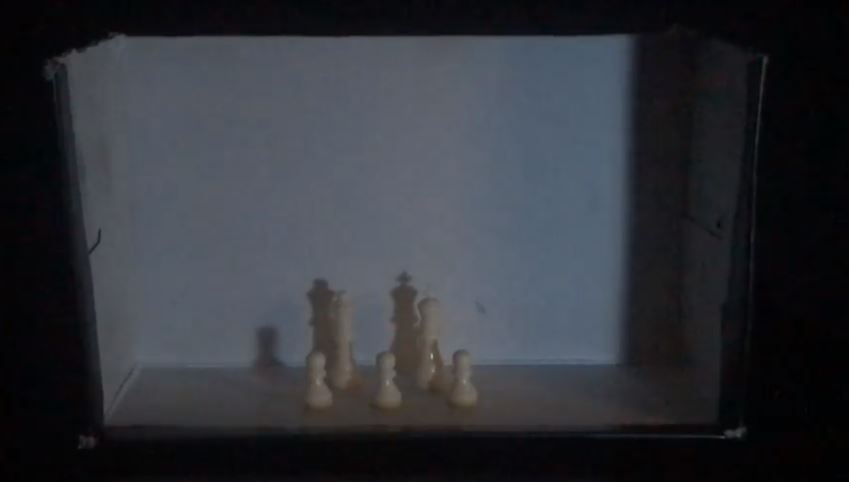
This experimental assignment has proven successful; Mendelson was pleased with the creativity and innovation his students have shown. “One person used three or four different desk lamps that they put different colored light bulbs in,” he says. Another student used t-shirts and papers to change the colors of flashlights. “He took apart a shoebox and he put five chess pieces in it and that was the surface he was lighting,” Mendselson says. “It was really beautiful.”

“As a lighting designer for a theatrical or a live event, every single thing that lights up is in your purview,” says Mendelson as a takeaway from the at-home version of this assignment. “Sometimes it’s something you can control and sometimes it’s not,” he explains, using green “exit” signs in a space as an example of something that the lighting designer might have to account for. “The key to lighting design is controlling the light and putting the light where you want it to go.”

Other assignments have been more challenging to translate to a distance-learning format; traditionally, students in the class have the opportunity to light a live dance performance, but those shows were canceled. Nothing can replace that live experience, says Mendelson. “That objective of being in the room and having to make quick decisions and all of that is practically impossible to recreate.” Instead, he is asking students to attend a supplemental webinar or online class to help fill in the knowledge gaps left behind by the sudden pivot to online learning.

Testing the Waters

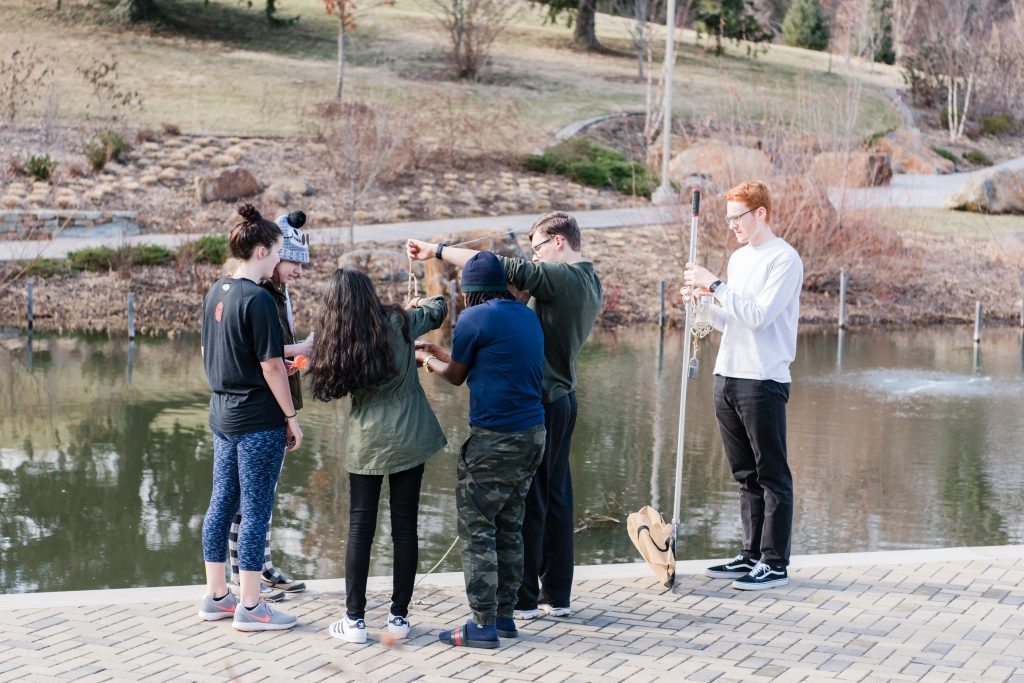
Suzanne Braunschweig, a senior lecturer in the department of Geography and Environmental Systems and director of the Interdisciplinary Science Program, has also faced the challenge of transferring hands-on lessons into a digital space. Science 100: Water, An Interdisciplinary Study, the GEP lab science course she teaches, usually involves traveling to the creeks and streams on campus to collect data, but, because of the dangers of COVID-19, many students can no longer even go into their backyards to collect data.

The solution, Braunschweig has found, is to give her students virtual lab assignments that mirror the course’s in-person labs as closely as possible. One assignment, for instance, typically involves going to a nearby stream to find and identify benthic macroinvertebrates—small organisms that live in the bottoms of lakes and streams. In the virtual lab, students will still go through the same steps of identification that they would in person, albeit using high-quality photographs rather than real organisms.

In a typical Science 100 class, like this one in Spring 2018, students test the water in the Library and Pig Pen ponds. Photo by Marlayna Demond ’11.

According to Braunschweig, the analysis aspect of the lab will also be essentially the same as it would be in a traditional classroom setting: “Based on the assemblage of critters that you find, you can then make conclusions about the quality of the stream from which they would’ve come.” Usually, she notes, students are excited to find that the streams on campus are “in good shape.”

Transitioning to running online labs has been far from a solo project—Braunschweig’s colleague Susan Schreier and several teaching assistants have assisted with finding virtual materials and making sure the labs run smoothly. She has also utilized a number of invaluable online resources, such as data collected by local nonprofit Blue Water Baltimore. 

As part of its mission to restore the quality of Baltimore’s waterways, Blue Water Baltimore maintains a database of information about the health of Baltimore’s rivers and streams. This data has proven to be a “godsend,” says Braunschweig, replacing data students would have sampled from streams around the Baltimore area.

“It’s not doing hands-on work, but they still have the ability to analyze data, and put things in context for the greater Baltimore area in terms of water quality,” Braunschweig says.

Braunschweig knows that most of her students take Science 100 to fulfill a general education requirement, but she’s found that they are still giving their all, even remotely.

 “They show up, they stick around, they actually try to work through the lab material during their lab time,” Braunschweig says. “I really admire them for sticking to that because it’s hard, under the current circumstances.”

Lending a (Virtual) Hand

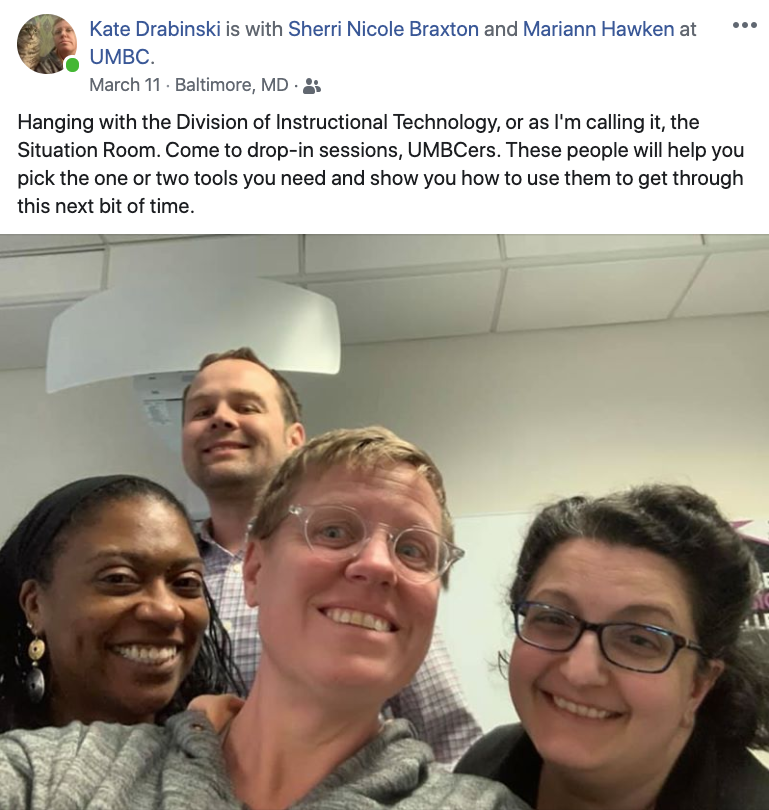
While instructors of hands-on courses knew from the start how difficult this pivot would be, Kate Drabinski, lecturer of Gender, Women’s, + Sexuality Studies, never could have anticipated how much she still had to learn about online teaching. After all, she had years of experience with teaching online and hybrid courses, and had even signed up to help train her fellow professors how to use various distance learning technologies.

But the technical side of things didn’t turn out to be the biggest challenge for faculty to navigate, Drabinski says. “The faculty I worked with needed to know that what they were planning to do was a good idea and would work,” she explains. “They needed to hear that we could do this, that we were all unsure of what our new classrooms would look like, and that we would be able to find strategies that would work to keep us and our students moving forward in a time of great uncertainty.”

For Drabinski’s own classes, the strategy has been to decrease the amount of work students have to complete. “We don’t all have equal access to technology, workspaces, time, or other resources to learn best, and my workload has to respect those differences,” she says. She also knows that it can be difficult for students to give schoolwork their full attention when they are contending with the realities of the COVID-19 pandemic, such as losing their jobs or having to take care of sick family members.

She has also opted to use a synchronous learning approach paired with recorded lectures. That way, she meets with her students in Blackboard Collaborate during her regularly scheduled class times but each student can decide whether they prefer to come to class or watch the video later.

“This approach builds structure for those who need it while recognizing that others have different needs,” Drabinski explains.

Continuing Connections

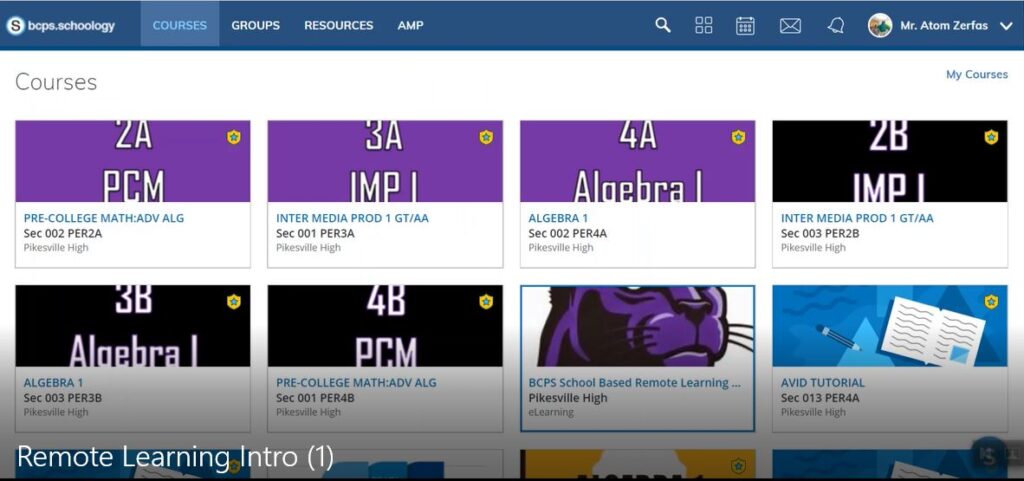
UMBC professors aren’t the only ones leading the charge into remote learning. Atom Zerfas ’13, mathematics, M.A., ’14, education and teaching, a math teacher at Pikesville High School, played a pivotal role in introducing the students at PHS to how the final quarter of the school year would play out. He created a video to help guide students through what their new class schedule would look like, how they would access online materials, and how they would get in contact with their instructors.

He decided to make the video after seeing how stressful the transfer to remote learning was on the teachers’ end. “It was extremely overwhelming for us, functioning adults who are supposed to be able to ‘be the calm’ for our students,” he explains. “I couldn’t imagine what it would have been like to be a student in any grade, wondering what this means for them. I wanted to provide as many answers that I could, as soon as I could.”

A screen grab from Zerfas’s remote learning instructional video.

Zerfas originally made the three-and-a-half minute video for the students in his classes, but then restructured it so that the entire school could use it as a resource. Later, he found out that teachers at other high schools were using his video, despite it being tailored to how PHS, specifically, was restructuring its curriculum.

Online teaching isn’t entirely new to Zerfas. He has been uploading recorded lectures for a few years now in an effort to support students who missed class or just need a refresher on the material. The videos he is making now, however, have a purpose beyond education; he wants them to be a beacon for his students. 

Video lectures give Zerfas the chance to say “Hi,” he says, and “let my students know that I’m thinking about them, and show them that I’m here if they need me for anything. I know a number of other teachers are dressing up, wearing wigs, or trying to make it as fun as they can. It really comes down to use trying to reconnect with our students, support them, and restore a sense of normalcy and joy.”

In addition to keeping in contact with his students, Zerfas has also been making sure to maintain another important connection these past few weeks: “I’m lucky to have been part of UMBC’s Sherman program because I’ve been connecting with a lot of my cohort members recently, and we’ve just been checking in with each other and being as supportive as we can.”

Making Permanent Change

Though distance learning will not always be necessary, instructors at UMBC and beyond are proving that they are capable of delivering online lessons that are compelling, stimulating, and sometimes even fun for students. Perhaps this unusual semester will give way to lasting, innovative teaching practices, from providing recorded lectures to maintaining more open lines of communication between professors and students.

Ultimately, though, the biggest takeaway lies not in any particular teaching strategy or technological tool. Rather, what we all must learn from this pandemic is that the UMBC community is strong enough to overcome great adversity—but only when we are able to be patient and understanding of each other’s unique challenges and circumstances.

“Not all students have the ability to study or do their [homework] in peace. It’s just more noticeable now,” Zerfas says. “That doesn’t mean to stop offering resources or to stop pushing your kids to do more, but to differentiate lessons more and not to penalize the kids who couldn’t do it.”

*****
Header image: Pig Pen Pond, a common Science 100 site, sits between campus and bwtech@UMBC.

Keeping Pace with Theatrical Intimacy 

If you’ve ever watched a movie with anything higher than a PG rating, chances are you’ve seen two actors perform an on-screen kiss. Perhaps at the time, you didn’t think much about what went into staging that kiss. But in reality, staging intimacy—which includes everything from holding hands to simulated sex—can be one of the most challenging parts of producing a play. 

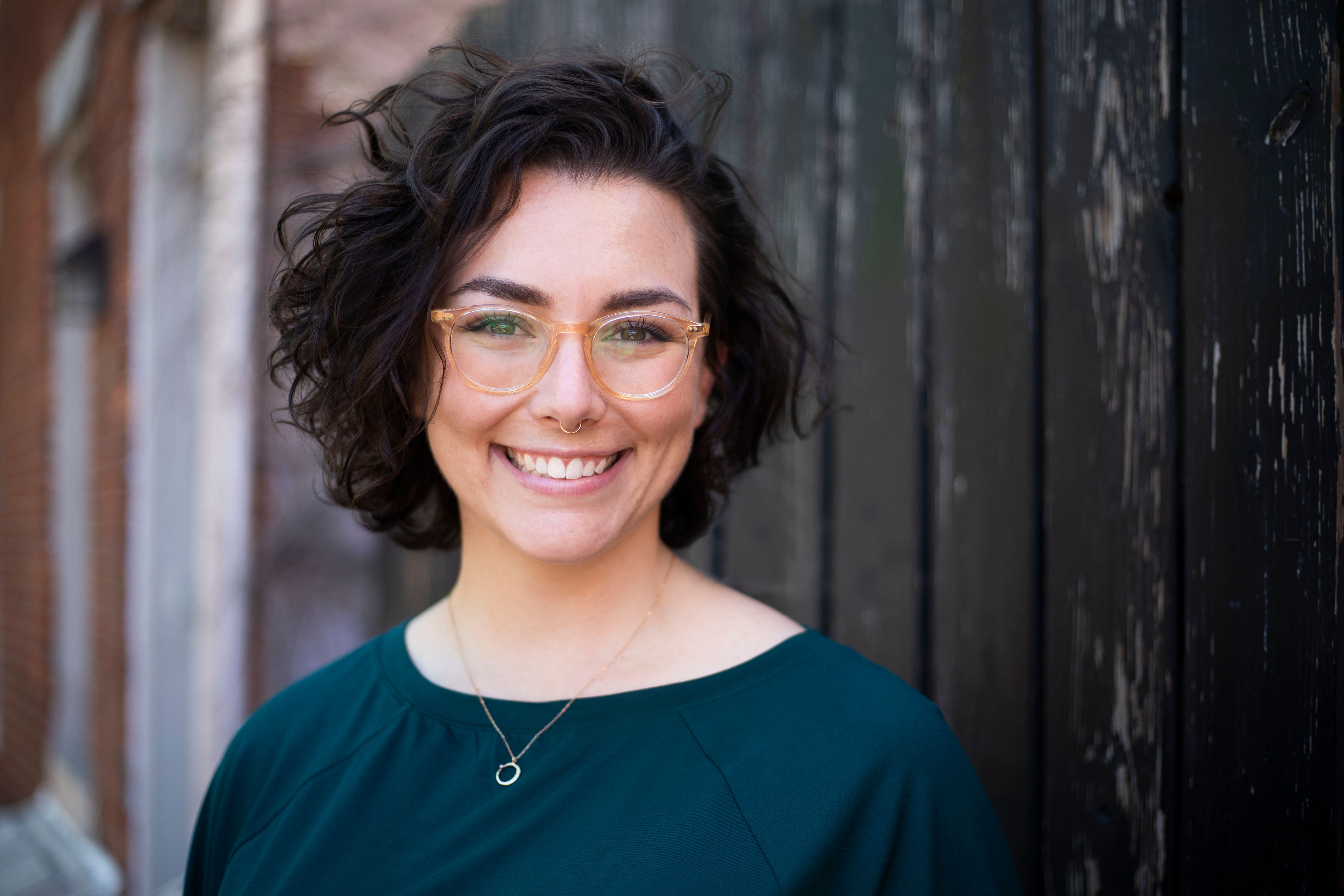
“There seems to be a lot of opportunity for miscommunication, misunderstanding, and, in the very worst cases, abuses of power,” Chelsea Pace, assistant professor of theatre, explains. Pace is one of the founding members of Theatrical Intimacy Education, a consulting group that helps theatre and film companies develop their best practices for staging intimacy. TIE usually does this not by staging the intimacy themselves, but by conducting workshops and trainings to teach those who are already a part of the company how to direct intimacy.

Chelsea Pace. Photo courtesy of Shealyn Jae.

“If we can make the people who are already in the room better at being in the room,” Pace says, “then we’re actually working towards a cultural change in our industry.”

Pace originally took an interest in how intimacy was directed when she noticed that directors shied away from staging intimate scenes, leaving it up to the actors to figure out for themselves. It seemed, to her, to be the only part of the creative process that didn’t have a designated designer or director. 

That lack of direction impacts the performance, says Pace. “Directors would just ask two actors, ‘okay, do the kiss, do the make-out,’” Pace says. “And if the actors didn’t know how to do that, or they did something weird, you were stuck with it.” 

Pace has studied theatrical intimacy for over 10 years and has been helping the UMBC Theatre Department develop their own best practices for staging intimacy since she began working here in 2017. Not only has she conducted trainings and workshops with theatre students and faculty, but she also worked with the department to develop their new Theatrical Intimacy and Instructional Touch Policy. 

Formed from the input of students, faculty, and staff in the department, the policy aims to set standards for touch in the classroom, including obtaining consent and making it clear that there are alternative practices for students who don’t want to be touched. “That’s a really large part of a lot of pedagogical systems for teaching theatre. There’s a lot of contact,” Pace says, explaining the need for such standards. “We have a lot of needs in this department because of what we do that you may not necessarily discover in a physics department.”

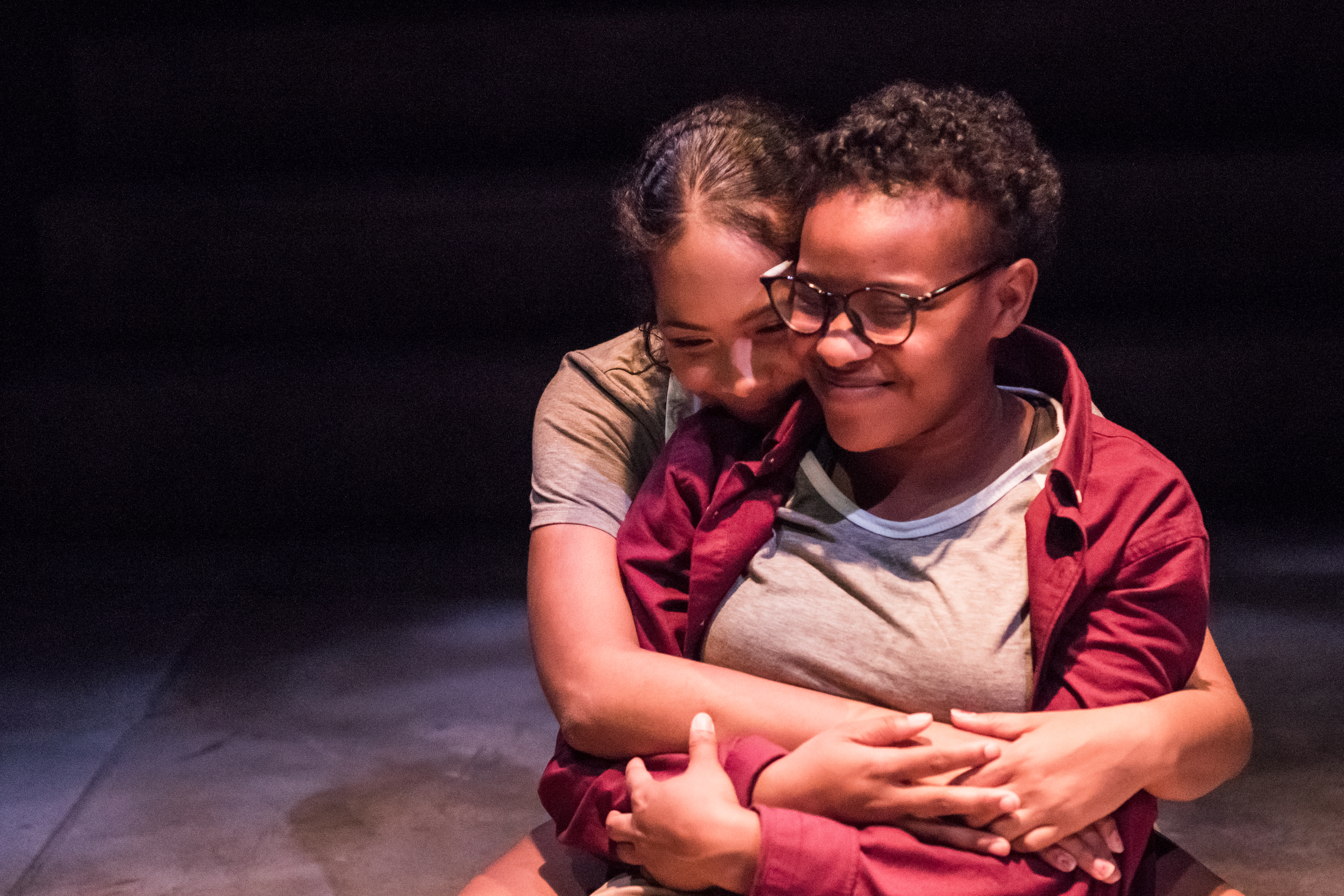
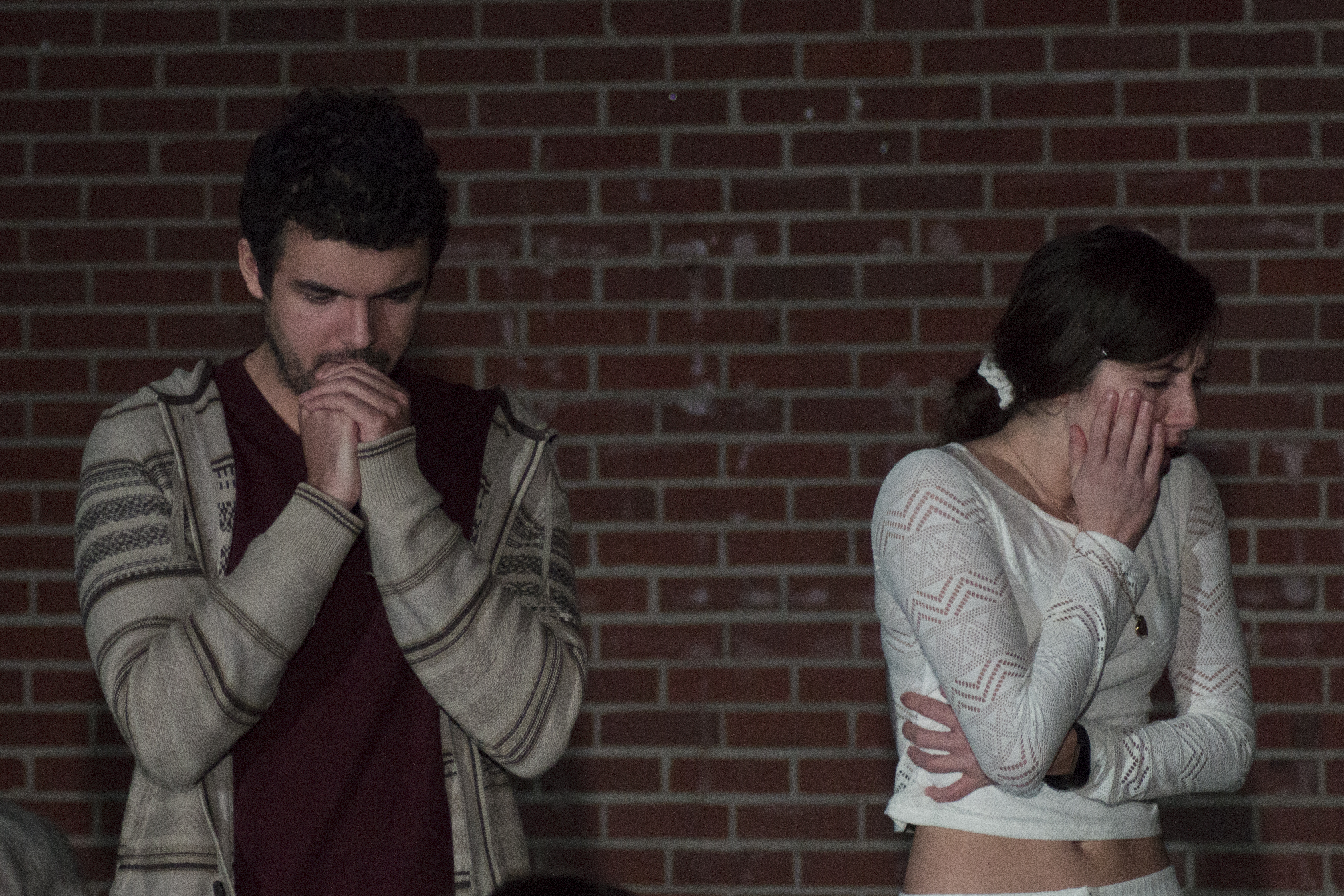
One of the four UMBC shows Pace worked on last year, She Like Girls, featured a young woman discovering her sexuality. The show handled both moments of intimacy as well as instances of sexual violence; in one scene, a character named Andre, played by Lloyd Ekpe ’20, acting, attempts to coerce his friend into having sex. 

Majenta Thomas '21 and Maria Marsalis '20 in a scene from

According to Ekpe, Pace’s methods made staging such a dark moment infinitely easier. “The initial meeting with Chelsea at rehearsal is going through the best practices for touching and initiating contact, and with that comes the language of contact—the distance, the levels of touch, the lines and shapes,” he explains. When it came time to stage the assault, “one thing [Pace] kept hammering into my head was: It’s just choreography. It’s just choreography. You’re just closing the distance, you’re just lifting her up here, you’re just putting her down there.”

Divorcing the motions of the scene from the feelings of the actor are an important part of Pace’s practices for staging intimacy. “In stage combat, it’s very clear that I’m not punching my scene partner in the face. When you’re staging a kiss? Your faces actually go on each others faces,”  Pace says. “And that creates a lot of muddiness between what is real and what’s just real in the scene.” 

Purposefully, carefully choreographed intimacy helps to clear up that muddiness by creating what she calls a “container of technique” that separates the movements of the scene from real-life emotions.

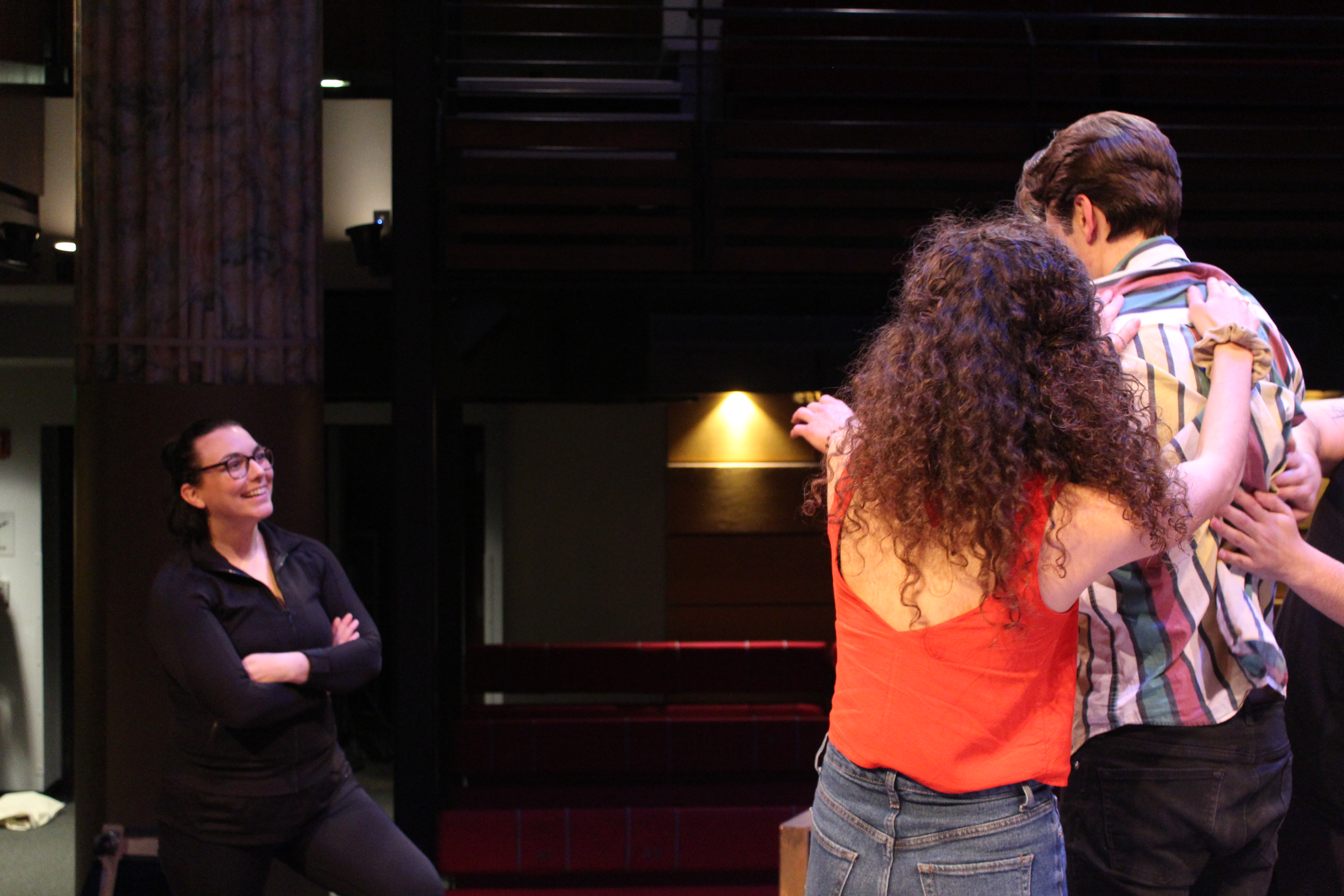
Pace observes a rehearsal for

All of the best practices Pace has developed with TIE and as part of her own research will soon be catalogued for other educators, students, and professionals in her upcoming book, Staging Sex, which is forthcoming from Routledge Publishing. Like TIE’s workshops or the theatre department’s new Theatrical Intimacy and Instructional Touch Policy, Staging Sex is yet just another step in changing the theatre industry to be a more ethical and consent-driven space. 

“We can do a lot [of] good if every undergraduate coming out of a BFA program across the country comes out knowing how to establish their boundaries with a scene partner…and every student director coming out of these programs starts asking actors questions about their boundaries,” Pace says. “That’s going to create a cultural change a lot faster than just insisting every production needs an intimacy choreographer.”

*****

Header image: UMBC Alumnae Sanjana Taskar ’19, acting and sociology, and Hannah Kelly ’17, acting, pose for the cover of Staging Sex. Photo courtesy of Shealyn Jae.

Alumni Playwrights Produce Proxy and The Possible Place

Writing duo Alex Reeves ’16, acting, and Nell Quinn-Gibney ’17, acting, originally teamed up to create a parody of the Nickelodeon cartoon Kim Possible, performed in a lecture hall in the Information Technology and Engineering building. “That was our first toe-dip into writing together,” says Reeves.

Now, two of their shows opened the same weekend: Proxy, a science fiction play about a world in the near-future where people’s consciousnesses can be immortalized by AI technology, premiered at Baltimore’s Rapid Lemon Productions on October 11. The very next day, The Possible Place, a play about mental health and coping mechanisms, opened as a part of Charm City Fringe Festival. Both shows will run through October 20.

“It’s one of those things where, when you’re telling people about it, unless they’re in theatre, they don’t understand how exciting it is to have your play produced,” Reeves says. “It’s extremely exciting because we wrote [Proxy] and we thought the only people who would care about it would be us and our friends.”

In actuality, their work has garnered far more attention than they anticipated, especially Proxy. Like The Possible Place, Proxy started as a one-act written for Charm City Fringe Festival. The process of writing took a month, only for Quinn-Gibney and Reeves to find themselves a week away from auditions with no idea how the show would end. Eventually, they scrapped the whole thing and started a new draft, finishing it within a week. That is the version that was performed at Fringe Fest, with many UMBC alums rounding out the cast.

A scene from Proxy at the 2018 Charm City Fringe Fest, starring Mason Catharini ’16, English, and Hannah Kelly ’17, acting. Photo by Jason Fowler ’18, psychology and theatre.

“We call our little Fringe group Out of Ink Productions,” Quinn-Gibney explains. “Because we tend to do a lot of very last minute, very intensive, very fast writing.”

But the pair knew there was more to be done with the story. They submitted a portion of the script to a local podcast called Inkubator News Works, which subsequently helped produce a staged reading of the show. Quinn-Gibney and Reeves used this opportunity to add a second act. It was the director of that reading that later brought the script to Rapid Lemon Productions.

But Proxy’s reach has extended even beyond Maryland—its first act is being performed at Gadfly Theatre’s Final Frontier Festival in Minneapolis this November. Quinn-Gibney described Final Frontier as “a queer, science fiction theatre festival. What a niche that we happen to fill!”

Though the productions at Rapid Lemon and in Minneapolis have been fairly hands-off for Reeves and Quinn-Gibney, they’ve been spending much of their time working towards the opening of The Possible Place. They spent the months of August and September writing the show, and began rehearsals in September, while edits were still being made to the script. 

Now that the show has opened, those months of hard work have finally come to fruition. Quinn-Gibney calls opening night “a blast. Extremely high energy, lots of nerves, and an amazing, fun show.”

In the cases of both Proxy and The Possible Place, most of Reeves and Quinn-Gibney’s cast and technical teams are composed of friends they made doing theatre at UMBC—both in the theatre department and in various student organizations. In club theatre, Quinn-Gibney says she “definitely built a really tight core of people who wanted to make the same kind of art as I did.”

Ali Mark ’17, mechanical engineering, originally met Quinn-Gibney and Reeves doing shows with them in student organizations like the Musical Theatre Club. Now, she works with the pair regularly; she designed props for both Proxy and The Possible Place, and is also starring in the latter show. 

For Mark, her long-standing friendships with Reeves and Quinn-Gibney are a big part of what makes it so easy to create theatre with them. “We have all seen each other at our best and worst, which makes the production feel like a safe space where we can throw out any idea and see where it takes us,” she says.

A scene from Proxy at the 2018 Charm City Fringe Fest, starring Hannah Kelly ’17 (left) and MaryBeth Kerley ’17, acting (right). Photo by Jason Fowler ’18.

Creative collaboration was a prominent theme of Reeves’s and Quinn-Gibney’s years at undergraduates at UMBC. Reeves was strongly influenced by her time in the Linehan Scholars Program. “The first seminar you take within that program is wonderful because you’re working with so many artists from so many different mediums, and you learn to be a really good collaborator,” she says. 

And those expert collaborating skills reach their peak when she is working with Quinn-Gibney. Both of them describe their writing styles as opposite, but complementary. Reeves is a planner, skilled at mapping out a workable story arc, while Quinn-Gibney can write a scene with impressive speed. 

“We balance each other out really well,” Quinn-Gibney shares with a smile.

Both productions run through October 20. Find tickets and information about Proxy at Rapid Lemon Productions. Tickets and more information about The Possible Place can be found at Charm City Fringe Festival.

*****
Header image: A scene from Proxy at the 2018 Charm City Fringe Fest, starring Hannah Kelly ’17, Mason Catharini ’16, and MaryBeth Kerley ’17. Photo by Jason Fowler ’18.

Part-Time Novelist Wins New York Times Praise

If you saw a senior engineering student sitting on a bench on Academic Row, furiously typing away on his laptop, you might assume he was working on a lab report or a capstone presentation. If that student was Zack Smedley ’17, chemical engineering, though, you’d be wrong. While his peers were fretting about classes, finals, and post-graduation plans, Smedley spent the first half of his senior year working on the manuscript that eventually became his debut young adult novel, Deposing Nathan.

Garnering praise from the likes of Kirkus and the New York Times since its May 2019 publication, Deposing Nathan centers around Nathan and Cam, two high school-aged boys from very different backgrounds whose tumultuous relationship eventually results in a brutal fight, leaving Nathan stabbed in the stomach. As Nathan delivers a deposition about the events leading up to the fight, he unveils a year-long story of friendships, adventures, secrets, and tragedies, eventually revealing the unexpected truth of his injury.

Smedley has been surprised and moved by the effect his book has had on readers. “Every week, I get really, really long emails from a few readers saying it helped them,” he says. “I wasn’t expecting that kind of a response.”

The composition of Nathan’s deposition

The idea for his debut novel didn’t come to Smedley all at once; he describes it instead as an amalgam of several smaller ideas. He knew that he wanted to write a “courtroom drama that was a little less soap opera-ish,” which is how he got the idea to use a deposition as a framing device. He also knew that he wanted to write a book about LGBTQ+ teenagers. A bisexual man himself, Smedley felt that a lot of mainstream young adult LGBTQ+ literature was fluffy and unrealistic, and wanted to come up with a story that was more gritty and complex. From there, he began working to construct a story that incorporated each of these ideas. 

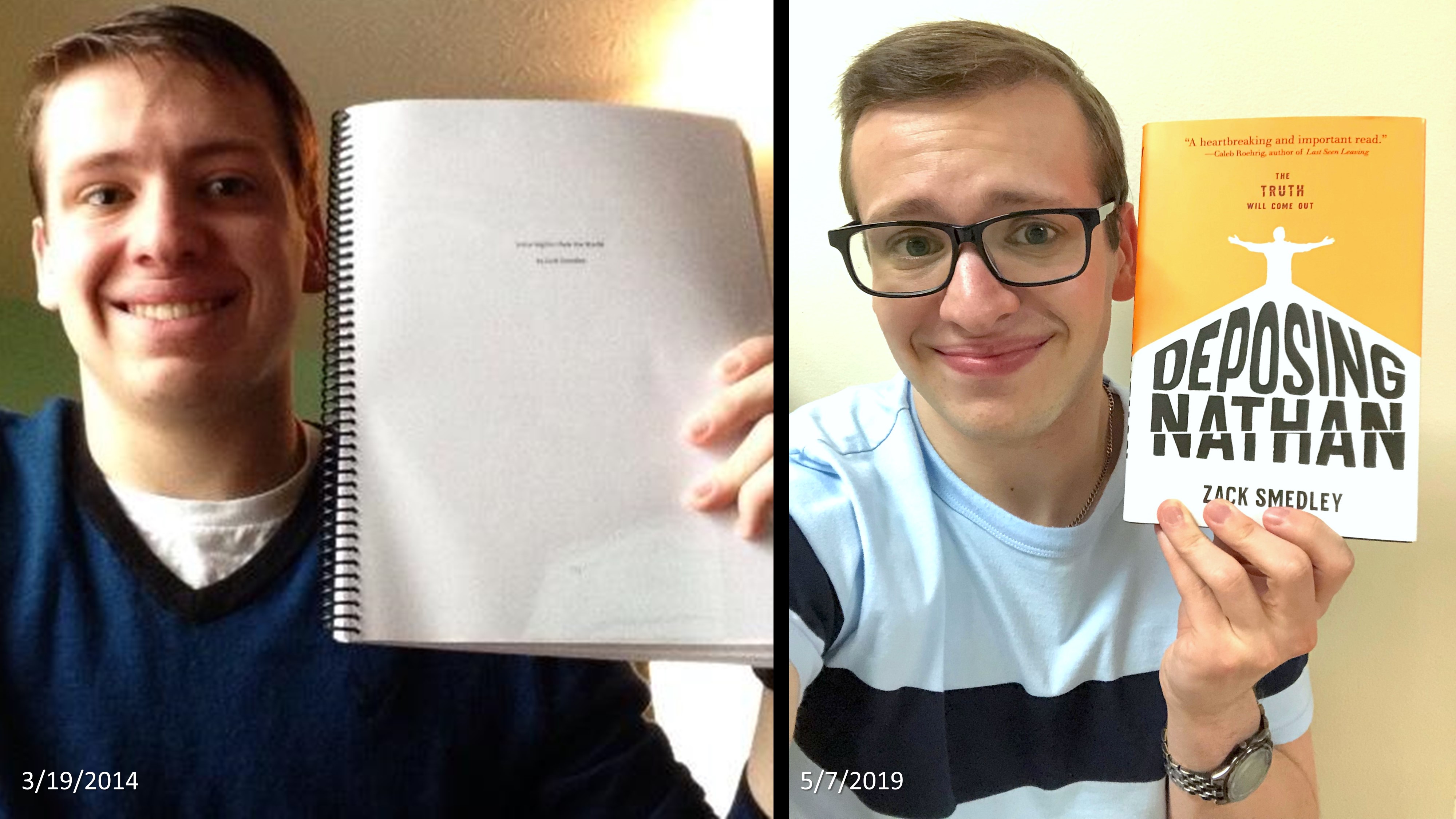
The process began with almost six months of outlining and conducting research—including taking both a biomedical engineering class and a medical terminology class at UMBC in order to better write the character of Cam, a self-taught genius of all things medicine. After completing the manuscript, he started sending query letters to literary agents over winter break. The daunting process was old hat to Smedley; he had queried agents before, once for one of the many novels he wrote in high school, and again for a project he completed during his freshman year at UMBC. However, Deposing Nathan was his first successful venture—he received an offer of representation from an agency just after graduation

You never know where inspiration will strike

UMBC was the perfect place for Smedley to launch his writing career; he credits the campus’s environment as a huge motivator for starting Deposing Nathan. In high school, he explains, writing was more of a hobby than something he wanted to seriously pursue. But that changed when he came to UMBC. “The atmosphere it established, I’m convinced, is what helped pull this book out of me,” he says. “I still think of it, a little bit, as my home.” 

Though Smedley didn’t study English or creative writing at UMBC, he did take one screenwriting class the summer before his junior year. That class ended up being a favorite of his—and it was a major source of inspiration during the book’s early stages. “[Deposing Nathan] actually started in my head as a screenplay,” Smedley explains, but he later decided to write the story as a novel instead.

Zack Smedley '18 shows the progression from manuscript to publication. Photo courtesy of Smedley.

The course’s professor, John Carillo, also played an important role in the novel’s early stages. “He took a look at my opening book pages and gave me feedback on them and encouragement,” Smedley says. “That was the summer I had started writing the book, so it definitely had an influence on me.”

Other than Carillo, Smedley also cites two of his chemical engineering professors, Taryn Bayles, who now works at the University of Pittsburgh, and Mariajose Castellanos, senior lecturer and undergraduate program director of chemical engineering, as great supporters of his creative work. “During my senior year, [Castellanos] knew I was writing a book, and she kept saying, ‘Hey Zack, some day, when it’s published, be sure to give me a signed copy,’” he recalls. Two years later, he received a Facebook message from her asking for that signed copy. Smedley replied, “I’ll do you one better. You’re in the acknowledgements.”

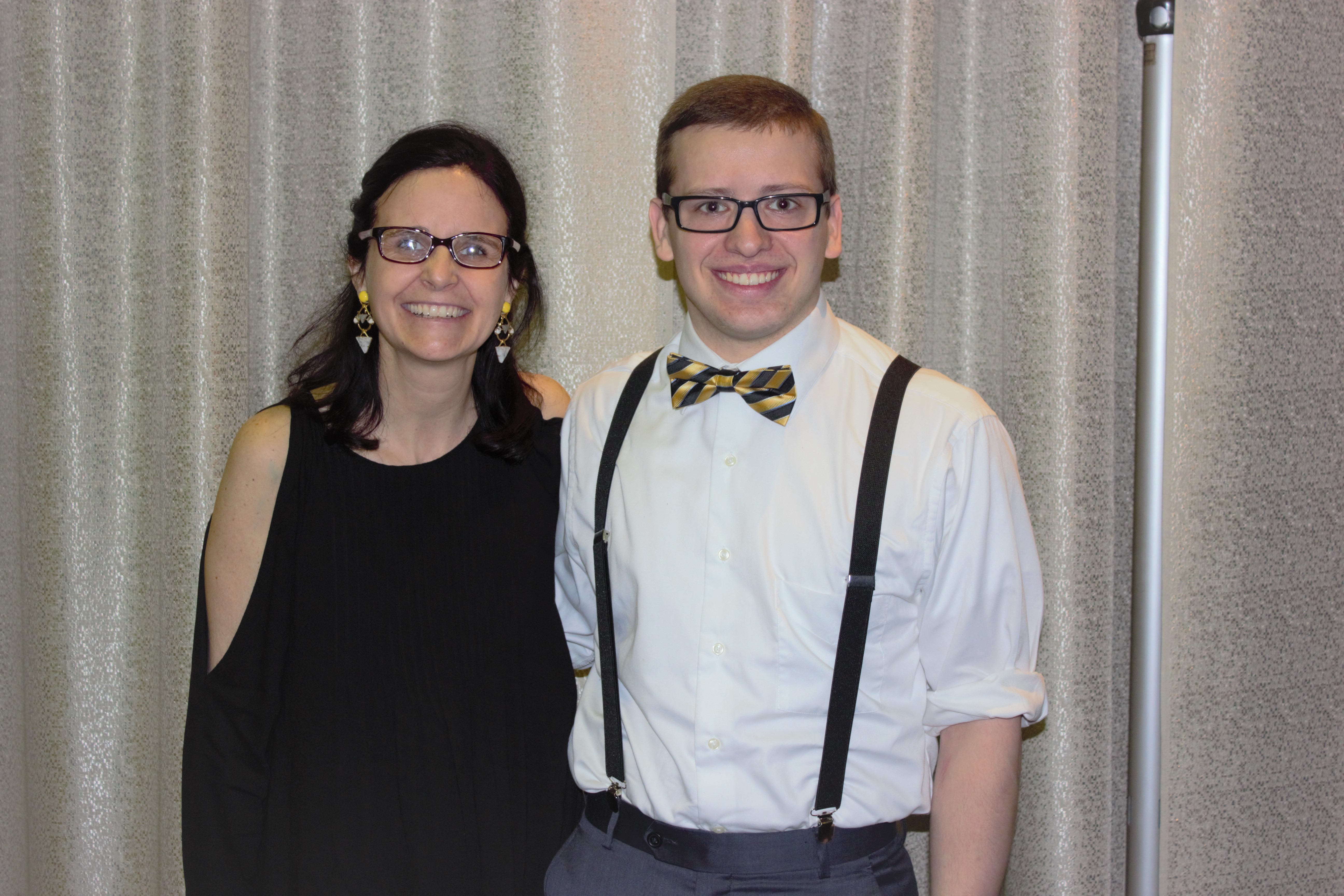
Smedley celebrates the end of college and the forthcoming publication of his novel with Mariajose Castellanos.

“My engineering students have such full schedules that when I learned that Zack was writing a book, it floored me!” Castellanos says, explaining that while many of her students have creative hobbies and interests, Zack was unique in his ability to balance his studies with his writing. “That, I don’t see very much, and I’ve been teaching here for 15 years.”

Post-publication plans

Since Deposing Nathan’s publication, it has received enthusiastic responses from readers and reviewers alike. The Kirkus Review gave it a coveted starred review, and it appeared on lists published by Book Riot and Publisher’s Weekly. It even received a glowing review in the New York Times’ list of “Y.A. Novels That Let Teenage Boys Be Vulnerable,” where it was called “a superb story, told in an original and masterly way.” 

Zack Smedley '18 signs copies of his book. Photo courtesy of the author.

But the most fulfilling feedback Smedley gets is from his fans themselves, many of whom are moved by the book’s depiction of a young Christian boy from a strict family struggling to understand his sexuality. “I got an email one day that was four paragraphs long that said, ‘This is the book I’ve been waiting for. This is like the missing piece in my life,’” he says. Since then, he’s received many similar emails from fans expressing their gratitude.

So, what does the future hold for this emerging author? Originally, he hadn’t planned to start another book right away, but after Deposing Nathan accrued so much positive attention, he and his agent agreed that he should put out another in order to avoid losing momentum. Now, he’s working diligently to complete the first draft of what will eventually become his sophomore novel, all while working full-time as a chemical engineer. His fans are sure to be waiting eagerly to see what he comes up with.

Smedley and his book will be available at the Homecoming Carnival at the Bookstore Pop-up which will be located next to the Alumni Tent from 1 p.m to 4 p.m.

*****

Header image: Zack Smedley ’17 celebrates graduation with True Grit. All photos provided by Smedley.