
All posts by: Dinah Winnick


Dean Julia Ross receives “Outstanding Chemical Engineer” honor

Purdue University has honored Dean Julia Ross of UMBC’s College of Engineering and IT as one of six Outstanding Chemical Engineers for 2015.
Dean Ross is an alumna of Purdue and received her PhD in chemical engineering from Rice University in 1995. She has served as dean of COEIT since August 2014, and is also UMBC’s Constellation Professor of Information Technology and Engineering.
Prior to her appointment as dean, Ross served as special assistant to the provost for inter-institutional research initiatives, 2012-14, and was instrumental in enhancing research collaborations between UMBC and the University of Maryland, Baltimore.
Among her current projects, Dean Ross has collaborated with colleagues Jon Singer and Chris Rakes from UMBC’s department of education, and Richard Weisenhoff from Baltimore County Public Schools, on developing curriculum and training resources to integrate engineering into high school biology and technology classrooms. Most recently, NSF supported UMBC-BCPS Inspires through a $3 million grant in 2014.
As dean, Ross has contributed to several important national initiatives, including signing on to a letter of commitment to improve the inclusiveness of engineering education at the first White House Demo Day, hosted by President Barack Obama in August 2015.
Joining Dean Ross are fellow award recipients Norm Kidder, CEO of Lomar Corporation; John Klier, a global R&D director at Dow; Seung Bin Park (PhD ’88) a vice president at the Korea Advanced Institute of Science and Technology; Charles E. Smith, president and CEO of Countrymark; and Vijay Swarup, vice president of R&D for ExxonMobil Research and Engineering Company.

Nobel Prize winners recognize alumni Benyam and Isaac Kinde as “Bright Young Minds”

When Science News asked 30 Nobel Prize winners to name early-career scientists who have caught their attention, two UMBC alumni stood out from the crowd. Brothers Benyam Kinde ’10, and Isaac Kinde ’05, both biological sciences, made the top ten list of “Bright Young Minds”—inspiring scholars who are “up-and-coming stars” completing high-caliber research.

Science News highlights Benyam’s work on how genetic changes affect brain cell activity in Rett syndrome, a disorder marked by developmental delays and seizures, and Issac’s work to create technology to detect cancer very early, giving patients a better chance at survival.

Benyam Kinde“We still don’t know very much about how individual cells in the brain coordinate the activity of higher-level function that defines us as humans,” says Benyam. It’s this mystery that drives his passion for neurobiology. Benyam got his first neuroscience research experience as a Meyerhoff Scholar at UMBC, prior to becoming an MD and PhD student at Harvard Medical School and MIT.

Isaac KindeIsaac Kinde also discovered his passion for research as a Meyerhoff Scholar at UMBC, before going on to receive his MD and PhD at Johns Hopkins. Today he is chief scientific officer at PapGene, a biotech startup in Baltimore that is producing innovative technology to detect cancer at very early stages, before tumors can be detected through imaging or symptoms.

As a graduate student Isaac studied with cancer researcher Bert Vogelstein, who told Science News, “He’s not only devised a technology that is groundbreaking in terms of its ability to detect rare mutations…he’s also been able to implement that technology and show that it can be useful…in patients.”

Learn more about these “Bright Young Minds” in their Science News profiles (Benyam Kinde and Isaac Kinde). See also a 2013 UMBC Magazine profile of Isaac Kinde to learn more about his UMBC experience and his path as a cancer researcher.

Image:  Benyam Kinde.

Renetta Tull shortlisted for GEDC Airbus Diversity Award

Renetta Tull, associate vice provost for graduate student development and postdoctoral affairs, is one of ten impressive candidates shortlisted for this year’s GEDC Airbus Diversity Award.

The GEDC Airbus Diversity Award honors people and projects worldwide that “have encouraged students of all profiles and backgrounds to study and succeed in engineering.” This year’s shortlist includes scholars from Germany, South Africa, Australia, Canada, the United Arab Emirates, and the United States.

Tull’s profile in the GEDC/Airbus announcement reads:

Renetta Tull leads the PROMISE Alliance for Graduate Education and the Professoriate (AGEP), a program that has grown to include a global STEM diversity and inclusion initiative. This aims to build a global engineering workforce capacity through focused attention on increasing the numbers of future engineering faculty from underrepresented groups.


Partnering with programs like ADVANCE for women faculty, and programs that broaden participation in engineering, PROMISE trains undergraduate and graduate students, postdoctoral fellows, and early-career faculty. The initiative has resulted in a significantly increased pipeline of underrepresented alumni and engineering program participants.

Learn more about Renetta Tull’s work and #ThinkBigDiversity through her blog, and watch Tull’s nomination video to learn more about her inspiration:

[youtube https://www.youtube.com/watch?v=A8xFZv9dPSw&w=560&h=315]

The Global Engineering Deans Council (GEDC) is an international network of engineering deans working to advance engineering education, research and service. The organization notes, “The importance of diversity and inclusion in the engineering education community is a consistent theme in the GEDC’s conversations on improving the quality of engineering and engineering education.” Airbus Group is a global leader in aeronautics, space and related services, and is a corporate member of the GEDC.

Three finalists will be selected from the shortlist and announced at the IE Reinventing Higher Education conference in Madrid, Spain, October 19-20, 2015. They will also be invited to present their project before a distinguished jury at the annual GEDC conference, on December 1, 2015, in Adelaide, Australia.

Image:  Renata Tull

UMBC joins National STEM Collaborative supporting opportunities for underrepresented girls and women

Philip RousResponding to the underrepresentation of minority women in STEM fields, UMBC has joined a new national collaborative committed to supporting educational opportunities for girls and women of color in STEM.

The White House Council for Women and Girls announced the formation of the National STEM Collaborative at a special event at the White House on September 15, 2015 (watch video).

In addition to UMBC, the consortium, led by Arizona State University, consists of 19 institutions of higher education and nonprofit partners, including Amherst College, City College of New York, Diné College, Maricopa Community Colleges, Spelman College, University of Alabama, University of California-Riverside, and Harvard University.

In response to the announcement Provost Rous said, “Our participation in the consortium reflects UMBC’s established national reputation for supporting students from all backgrounds. At the national level, it provides an opportunity to share the best practices and innovative ideas we have developed to promote greater educational opportunities for women of color who are underrepresented in many fields, including the STEM disciplines.”

Over the next 3-5 years the collaborative will focus on providing analysis and information on best practices to support women and girls in STEM in educational settings; develop networking resources to help talented students enter and persist in STEM programs; and determine best practices to support women of color transitioning from community college to four-year university STEM programs.

The National STEM Collaborative emphasizes, “Our mission is not to simply populate the STEM pipeline with more women of color. Rather we seek to provide institutions, students, leaders, corporations, and organizations the skills and resources to change the pipeline to be more equitable for more underrepresented women.”

Dean Julia Ross outlines UMBC’s commitment to increasing diversity in engineering at White House Demo Day

The Engineering Deans Council of the American Society for Engineering Education (ASEE) seized the opportunity to outline tangible steps to improve the inclusiveness of engineering education at the first White House Demo Day, hosted by President Barack Obama on Tuesday, August 4, in the White House East Room.

UMBC Dean Julie Ross, College of Engineering and Information Technology (COEIT), is one of more than 100 deans who signed on to the ASEE letter of commitment to diversity presented at Demo Day, which was designed to highlight “why we need to give every American the opportunity to pursue their bold, game-changing ideas.”

The deans’ powerful statement outlines specific steps to increase the participation and success of women and underrepresented minorities in engineering and IT degree programs.

Julie Ross 1“The world’s most challenging technological problems demand creative solutions,” Ross shares. “Our best hope is to foster inclusive excellence in our engineering and IT schools and to bring to bear the diverse perspectives, ideas and talents of our nation’s youth.”

Her words echo the spirit of the ASEE letter, which emphasizes that innovation is core to engineering, and “diversity and inclusiveness are essential for the development of creative solutions to the world’s challenges.” The letter continues, “While gains have been made in the participation of women, African-Americans, Hispanics, and Native Americans in engineering in recent decades, significant progress is still needed to reach a level where the engineering community fully embraces all segments of our increasingly diverse and vibrant society.”

Engineering Deans Diversity Initiative_logo_stackedUMBC and the other signing colleges and universities specifically commit to develop and implement: (1) a diversity plan for engineering programs, including priorities, goals, and assessment plans to ensure accountability; (2) activities partnering with K-12 schools and/or community college to increase the diversity of students in the engineering education pipeline; (3) strong partnerships between research-intensive engineering schools and non-PhD granting engineering schools serving populations underrepresented in engineering; and (4) proactive strategies to increase the representation of women and underrepresented minorities as engineering faculty.

UMBC’s numerous new and longstanding STEM collaborations with K-16 partners form a strong basis for this work. One example is the Transfer Scholars in Information Technology and Engineering (T-SITE), funded by NSF to support the success of students transferring from Maryland community colleges to UMBC to study computer science, computer engineering and information systems.

Ross has received a multi-million NSF grant for the project INSPIRES: Increasing Student Participation, Interest and Recruitment in Engineering and Science. Collaborating with education faculty Jon Singer and Chris Rakes, she is helping Baltimore County high school biology and technology teachers feel prepared to effectively integrate engineering into their teaching.

Ross’s motivation for engaging talented students from all backgrounds in the field of engineering is simple: “We must work to ensure equal opportunity and access to all who seek it if we are to find the creative solutions we need.”

After the tragedy in Charleston: A message from Dr. Hrabowski

A message to the UMBC community from President Freeman Hrabowski:

More than 50 years ago, the nation was shocked when the 16th Street Baptist Church in my home town of Birmingham was bombed and four little girls—my friends—were killed. People of all races were in disbelief that hatred could be so strong. Today we find ourselves again in complete shock as a nation, struggling to understand how an event as tragic as the shooting of nine people in a South Carolina church could happen in 2015. None of us can say how to put this in perspective.

In times like this, it is important that we reach out and give support to others, think out loud about the importance of community, and reflect on those values that make us decent human beings: our capacity for caring for each other and respect for the dignity of life itself.

UMBC is a special community in which we believe in supporting one another, working to understand and appreciate differences, and endeavoring to learn as much as possible about those qualities that make us human. I encourage faculty, staff, and students to take the time to discuss the challenges we face in this country and beyond involving race, discrimination of all types, inequality, and other social challenges.

When my friends were killed in 1963, some of us didn’t know how we could ever move forward. It was only through coming together and pledging to each other that their lives would not be in vain that we gained strength and hope. We vowed we would never forget. I challenge all of us to do the same.

UMBC Chess Team Recognized as #4 in the Nation

The UMBC Chess team has been named fourth in the nation among university chess teams after competing in the President’s Cup at the New York Athletic Club, March 27–29, 2015. They qualified to compete in the Final Four competition through the Pan-American Intercollegiate Chess Championships, held in December.

UMBC’s team at the President’s Cup (pictured below) included captain Niclas Huschenbeth, Tanguy Ringoir, Akshayraj Kore, and Levan Bregadze—all either international grandmasters or international masters. Nazi Paikidze, an international master who is ranked sixth in the nation among female players, attended as an alternate. Paikidze will represent UMBC at the invitation-only U.S. Women’s Chess Championship in St. Louis, March 31–April 13, 2015. CSEE Professor Alan Sherman directs the UMBC chess program and Joel DeWyer, associate director of The Commons, serves as business manager.

FullSizeRender

This recent competition has led to another flurry of media attention for the team, known for its long history as a national chess powerhouse. That includes major features in Baltimore Magazine and on WYPR, as well as coverage in The New York Times.

For more details on the competition, see http://umbcchess.tumblr.com.

UMBC Participates in National Engineering Education Initiative Announced at White House

UMBC is among more than 120 U.S. engineering programs leading a transformative movement in engineering education announced at the White House today.
In a letter presented to President Barack Obama, UMBC and peer institutions committed to establish special educational programs designed to prepare undergraduates to solve “Grand Challenges.” These challenges are complex yet achievable goals to improve national and international health, security (including cybersecurity), sustainability, and quality of life in the 21st century.
Together, the schools plan to graduate more than 20,000 formally recognized “Grand Challenge Engineers” over the next decade.
Dean Julia Ross, of UMBC’s College of Engineering and Information Technology (pictured below), will represent UMBC at a special meeting of the White House and National Academy of Engineering to discuss this commitment on March 24, 2015.
For more information, see NAE.edu.

Women’s Lacrosse Program: A Message From Pres. Hrabowski and Provost Rous

President Freeman Hrabowski and Provost Philip Rous share the following message with the UMBC community regarding the women’s lacrosse program:

We want to provide the campus with information about the recent matter involving our women’s lacrosse team. (Our Student Affairs colleagues and others have been managing this matter throughout spring break.)

On March 6, women’s lacrosse coaching staff learned of a troubling situation within the team. Leaders in Athletics and Student Affairs moved quickly to examine the matter, support the students affected, and ensure the safety and well-being of all involved. On March 11, five players were suspended indefinitely from the team for a violation of team rules. Efforts to resolve this complex situation continue.

On March 17, Athletics Director Tim Hall appointed Amy Slade as head coach of our women’s lacrosse program. Tony Giro, who had shared co-head coaching responsibilities with Slade, is on leave from the University. Coach Slade, a four-time all-American and national champion, is now in her third season with the Retrievers, and we are confident in her ability to move the team forward.

In matters of student well-being, our primary focus is always on attending to the needs and rights of students and upholding our community standards of safety, health, respect, and integrity. Support for students, fairness, and applicable laws often limit the details that are appropriate to share with the campus community and the public.

We want to thank everyone who has been supporting our students as we work through this challenging situation. We also want to thank our colleagues, our students and their families, alumni, and friends for all they contribute to the caring, civil, respectful environment we work to build every day at UMBC.
Umbc_retriev_logo

Pres. Hrabowski reflects on Dr. King’s vision in Simon Initiative distinguished lecture at Carnegie Mellon University

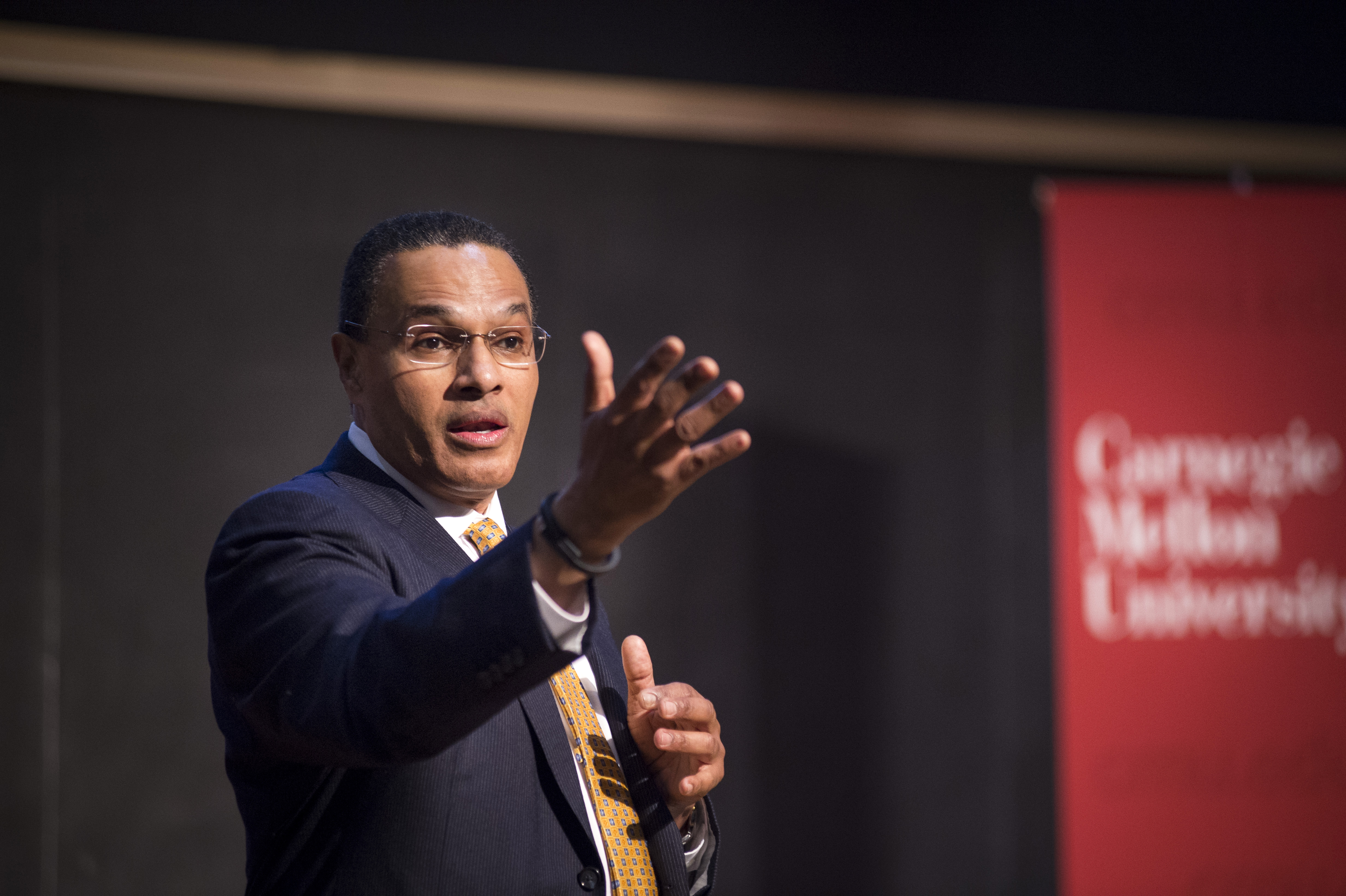
UMBC President Freeman Hrabowski delivered an evocative, impactful talk on Dr. Martin Luther King’s vision of equal opportunity for all people to an audience of 300 at Carnegie Mellon University on Monday, January 26, 2015.

MC, IM, Simon Initiative Lecture Series, Freemand Hrabowski, January 26 2015

Dr. Hrabowski’s address was introduced by CMU President Subra Suresh as part of the Simon Initiative Distinguished Lecture Series — a “forum for thought leaders focused on scientific advancement and disruptive innovation in the field of education.” Richard Scheines, dean of CMU’s Dietrich College, moderated a Q&A session following the talk.

MC, IM, Simon Initiative Lecture Series, Freemand Hrabowski, January 26 2015

Dr. Hrabowski reflected on how central a strong sense of self is to achievement, and how universities can cultivate and strengthen that confidence and drive in students from all backgrounds through high expectations and support. He challenged Carnegie Mellon to “become a leader in the world in producing students from underrepresented groups who will then transform the world.”

“Whether we are talking about a strength in STEM or the humanities or social sciences, the real question for the American university is: How do we reach out to students who are different?” Dr. Hrabowski said. “How do we create a culture in the spirit and dream of Dr. King that welcomes those students, embraces their differences and expects the most — both from them and from ourselves?”

[youtube https://www.youtube.com/watch?v=P1vwNmqtYQ0]

UMBC and Carnegie Mellon have a strong, collaborative relationship. UMBC has been a partner of CMU’s Open Learning Initiative (OLI) for over five years, offering OLI courses in statistics, biology, psychology and computing. UMBC faculty work with CMU researchers to refine approaches to technology-enhanced learning. We are also proud to have welcomed several CMU alumni as UMBC faculty, including Manil Suri, mathematics; Michele Osherow, English; and Amy Hurst, information systems.

President Hrabowski in Chronicle of Higher Education “On Leadership” Video Interview

The Chronicle of Higher Education‘s Sara Lipka speaks with President Freeman Hrabowski in a new video interview that focuses on how universities can help students succeed.

Dr. Hrabowski discusses the success and replication of the Meyerhoff Scholars Program, as well as similar programs across the disciplines, including the arts, humanities and social sciences. He emphasizes the importance of helping students build supportive peer communities and learn to collaborate with one another.

“We believe the work should be very rigorous, whether in literature or in biochemistry,” Dr. Hrabowski says. “And we believe that we, as professionals, as educators, should be as supportive of those students as possible.”

Click here to watch the video.