All posts by: Dinah Winnick


UMBC Swimming & Diving wins second straight America East championship

UMBC women’s swimming and diving defended their America East Championship on Sunday, February 14, 2016, with high-energy, record-setting performances.

Emily Escobedo ’17, psychology, received her third straight Most Outstanding Swimmer award and has been named College Swimming’s National Athlete of the Week, after winning the 200 breaststroke by more than 12 seconds, setting a UMBC, meet, and conference record of 2:06.21. With the fastest time in all of the NCAA this season—called a “monster swim” by Swimming World Magazine—Escobedo has qualified for the NCAA Championship in March.

“We are so proud of Emily, ” says head coach Chad Cradock, noting, “Everything she has accomplished is through her hard work and dedication.”

Kayla Lilly ’17, interdisciplinary studies, took second in the 200 breaststroke with a time of 2:18.28. Laura Massicotte ’19, mechanical engineering, took second in the 1,650 freestyle with a time of 17:01.25. Aleasha Knight ’19, psychology, earned silver in the 200 backstroke with a time of 2:00.77.

Catherine Frediani ’16, financial economics, ended her final America East Championship meet with a win in the 200 fly at 2:02.66. Hannah Sutherland ’17, biological sciences, took silver in that event with a time of 2:02.96.
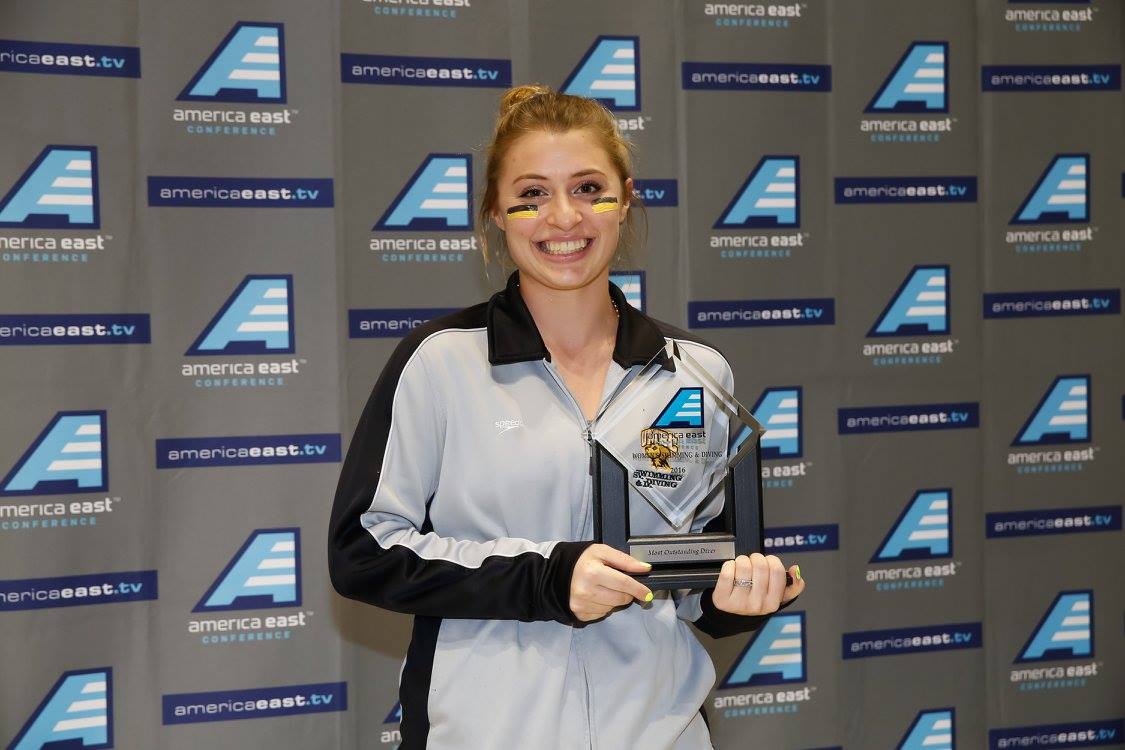
Coco Darelius ’16, biological sciences, earned Most Outstanding Diver of the meet after winning the 3-meter dive and placing second on the 1-meter board.


Coco Darelius ’16 earned Most Outstanding Diver of America East championship meet 2016.
As the Retrievers claimed their second league title, with 885.5 points, Cradock spoke of his pride in the team. “They believed in us as much as we believed in them. Ultimately, they won the championship because they believed in each other,” he said.

America East TV caught the swimmers’ reactions to their individual and team wins in a video recap of the meet:

Video
Several UMBC swimming and diving team members will next compete February 26-28 at the Eastern Collegiate Athletic Conference Championships held in Annapolis.

See the UMBC Athletics and America East websites for details on the America East championship. Additional coverage appears in Swimming World Magazine and on  SwimSwam.com

Images: UMBC Swimming & Diving America East Championship team (top),  swimmer Emily Escobedo (middle), and diver Coco Darelius (bottom). Photos by Greg M. Cooper for America East
Pres. Hrabowski celebrates UMBC’s 50th and discusses issues in higher education on MPT

UMBC President Freeman Hrabowski celebrated UMBC’s upcoming 50th anniversary and reflected on current major issues in higher education during an interview with Jeff Salkin on MPT’s “Direct Connection,” on February 1.

The conversation touched on topics from helping students afford college, to supporting communities in Baltimore that are struggling economically, to advising youth who may not yet be ready for college but are still seeking career opportunities that will enable them to be financially secure.


Salkin asked Hrabowski about a new op-ed published in USA Today, coauthored by JPMorgan Chase & Co Chairman and CEO Jamie Dimon, on how the four-year college experience, while tremendously important, is not the only path to career readiness for all Americans seeking meaningful employment. Hrabowski responded:

We need to give students opportunities and options. As a research university president I wanted to be on the record as saying I care about my students, who are high achievers, who come in to do the great things, going for PhDs and MD/PhDs, but I should also be concerned about young people who may not be as advantaged as the students we are getting at UMBC.

After a caller asked about hope for Baltimore communities facing economic disinvestment and limited opportunities, Hrabowski discussed the impact of university collaborations. He detailed a new $1.6 million UMBC partnership with Northrop Grumman and Baltimore City Public Schools that expands on UMBC’s long-term commitments “to build the skills of children…Pre-K on up, and to work with their families and give them support in many ways.”

This public-private partnership work also has tremendous benefits for UMBC, Hrabowski shared:

What we do at UMBC is to prepare leaders through a liberal arts education, which will allow them to work with young people and to start programs to help more families and children to succeed.

Ultimately, Hrabowski said, universities, K-12 schools, and other partners must work together to send a message to students of all ages that they have high expectations for them, confidence in their potential, and will provide them with the tools they need to succeed.

We have to understand the importance of high expectations for all of our students and giving them the support to do well, whether it is in learning mathematics, or learning a language, or becoming the best artist possible.

“Our students…are amazingly hungry for the knowledge” and they know that “nothing takes the place of hard work,” said Hrabowski. He signed off, “Grit and greatness…at UMBC. We are the House of Grit. Hard work makes the difference.”

Image: UMBC President Freeman Hrabowski. Photo by Marlayna Demond ’11 for UMBC.

Baltimore Dance Project presents innovative new works by UMBC choreographers

As Baltimore Dance Project rehearsed for their upcoming performances at UMBC’s Proscenium Theatre, directors Doug Hamby and Carol Hess took time out to discuss the new program featuring premieres by both artists as well as Sandra LacyThe new works that will appear on stage February 4–6 reflect the interdisciplinary approach the company is known for and a deep sense of connection among the artists, all UMBC dance faculty, built over years of collaboration.

“For this season,” said Carol Hess, “I decided to re-construct Image in Red, a beautiful solo that was choreographed on me by Janet Soares in 1980. It has been thrilling to revisit this work and set it on Franki Trout.” Trout ’13, dance, now teaches dance in Anne Arundel County’s first Performing and Visual Arts Magnet Program at Annapolis High School.

Doug Hamby created one dance with a commissioned score, Second Nature, by associate professor of music Anna Rubin. He will also will premiere Duet, which includes a live performance by Umbilicus, conducted by associate professor of music Tom Goldstein. He shared, “UMBC is a wonderful community of artists and I really enjoy collaborating with everyone here.”

The program also includes the premiere of Sandra Lacy’s mysterious new solo Lost and the company premiere of Untitled, choreographed by instructor Desiree Koontz-Nachtrieb ’11, dance, with music, Walk, by Ludovico Einaudi and performed by guest dancers Eric Holmes ’17, dance and biology, and Koontz-Nachtrieb. Additional works include Carol Hess’ Dolled Up, examining the interiors of five women in fancy dresses, with an original score by sound artist and visual arts professor Timothy Nohe; dance instructor Adrienne Clancy and Sandra Lacy’s quirky and playful duet, Stalked by Time; and The Lights from The Heavens are Called Stars, choreographed and performed by dance instructor Erica Rebollar with sound by Charlie Campagna.

Baltimore Dance Project is a professional modern dance company dedicated to presenting the creative work of Doug Hamby and Carol Hess, described as “two of the most exciting choreographers in Maryland.” Formed in 1982 under the name Phoenix Dance Company, the company is known for its edgy collaborations with composers, directors, sound artists and visual artists, and for infusing visual media and technology into riveting dance performance. This will be their 32nd annual performance at UMBC.

The company features outstanding professional dancers and has been honored with numerous grants and awards. Hamby, Hess, and company veteran Sandra Lacy have received a total of twelve individual artist awards from the Maryland State Arts Council, and their work has appeared in theaters and film festivals across the United States.

Complete performance information and tickets are available through the UMBC Arts & Culture Calendar.

Image: Baltimore Dance Project performance. Photo by Marlayna Demond ’11 for UMBC.

UMBC featured in Princeton Review’s 2016 “Colleges That Pay You Back”

UMBC is among the the nation’s best colleges for students seeking an exceptional education with great career preparation at an affordable price, according to an announcement today by Princeton Review.

Princeton Review In the 2016 edition of Colleges that Pay You Back, Princeton Review highlights the top 200 universities from across the U.S. that “give you the best bang for your tuition buck,” balancing superb academics, affordability, and “getting their graduates out the door to satisfying and rewarding careers.”

Princeton Review’s profile of UMBC notes:

Arguably the “best public college in Maryland,” UMBC is an “extremely diverse school” that manages to maintain a “small community feel.” And from the moment you set foot on campus it’s evident that the university is focused on “providing exceptional education and research opportunities for students.”

The profile highlights a broad range of strong undergraduate programs at UMBC, from education and interdisciplinary studies to engineering, biology and chemistry. It also describes how:

Inside the classroom, students are greeted by “very knowledgeable professors” who typically devote “most of the class time to real world discussion[s].” And, perhaps most importantly, professors at UMBC push students to “learn as much as [they] can, work as hard as [they] can and really think outside the box.”

With a focus on value, “Colleges That Pay You Back” gives particular attention to career support for students and alumni. Princeton Review writes:

Thanks to UMBC’s amazing Career Center, undergrads here are able to enter the job market with confidence. Starting from freshman year, the office works to empower students and help them plot their career goals.

The publication goes on to highlight UMBC’s recruiting and networking events as opportunities to meet with representatives from top employers, interviewing workshops, and writing seminars for resumes and cover letters.

UMBC has appeared on this “best value” list several times in the past, including in 2008, 2009, 2011, 2013, and 2014. Four other Maryland universities are included this year: Johns Hopkins University, the U.S. Naval Academy, Loyola University of Maryland, and University of Maryland, College Park.

A few weeks ago, UMBC was also again named a Best Value College for 2016 by Kiplinger’s Personal Finance, appearing on both the Best Value Public University list and “top 300” national Best Value University list.

Images: UMBC library, by Marlayna Demond ’11 for UMBC, and “Colleges That Pay You Back” (2016 edition) cover, courtesy of Princeton Review.

Pres. Hrabowski’s Martin Luther King Day message offers inspiration and a challenge for the future

Salon marked Martin Luther King Day 2016 by sharing a powerful essay by UMBC President Freeman Hrabowski on how growing up during the civil rights struggle in Alabama shaped his outlook on education and opportunity. Excerpted from Pres. Hrabowski’s book Holding Fast to Dreams, the essay details his experience marching in the Children’s Crusade of May 1963—an event that profoundly impacted his life and the course of the civil rights movement.

“My students often ask me, ‘Doc, what was it like to be twelve and black in Birmingham?’” President Hrabowski begins. His complex answer draws on memories of growing up in a family and community that empowered children and treasured education, combined with “a harsher set of messages that told us we were second-class” through segregation and discrimination.

Dr. Hrabowski writes:

I received the message again in second grade when the teacher handed out books with brown paper concealing the covers. Our teacher told us not to remove the paper cover but, overtaken by curiosity, I peeled it back and discovered the name of a white school underneath. I went to her and asked, “Why do they give us their books when they throw them away?” The first thing she said was, “Boy, I told you not to peel that paper off that book.” Then she was embarrassed. She looked at me and said, “Yes, the book is second-rate, but you are a child of God. You’re first-rate. Get the knowledge. You don’t have time to be a victim.

Ultimately, Pres. Hrabowski focuses on the necessity for equity in education and the power of resilience, including how teachers and families can support students as they work through the struggles they face in life:

The experience of marching in the Children’s Crusade in May 1963 taught me that even children can make decisions that have an impact on the rest of their lives, and that they know the difference between right and wrong. It also taught me that children can struggle to overcome challenges and be stronger as a result. When children have support, any struggle, whether it’s standing up for civil rights or learning to read or solving math problems, can teach lessons about the importance of persistence. We all face struggles throughout our lives. What’s important is how we respond. As children confront different problems and learn to handle them, they develop confidence. Success breeds success.

In addition to the Salon article, the Chicago Tribune published a moving feature on Pres. Hrabowski’s talk at Valparaiso University’s 27th annual convocation honoring the legacy of Martin Luther King, Jr., with the theme “Facing the Challenge of Change.” His address focused on both how much progress our nation has made and how much work remains, particularly increasing access to higher education for children in low-income families.

“You must come to see the light in every child,” Pres. Hrabowski told the crowd, “how you want to make a difference in that child’s life.”

Image: Pres. Hrabowski speaks with a student at Baltimore’s Lakeland Elementary/Middle School, January 2016. Photo by Marlayna Demond ’11 for UMBC.

University Business magazine chronicles UMBC’s growth as a leading research university

A new feature story in University Business magazine chronicles UMBC’s rise as a major national research university and a destination for top students from around the world.

Published on the eve of UMBC’s 50th anniversary, the article digs into the history of the institution, founded in 1966 with a diverse faculty and student body and as an academic powerhouse with high standards from the start.

Today, President Freeman Hrabowski shares, “We have a special place in American higher education” as an institution that encourages students to go beyond their comfort zones and build relationships with people different from themselves. “We believe in this fundamental purpose of higher education,” he says.

In an extensive interview with journalist Matt Zalaznick, Pres. Hrabowski describes UMBC’s distinctive emphasis on “inclusive excellence,” where diversity and high academic standards go hand-in-hand.  The university’s core concerns, says Pres. Hrabowski, are “what we’ve taught [students] and the quality of the education: Are they good thinkers, do they have values that we want to see in educated American citizens?”

To describe how the university approaches this goal, the article dives into UMBC’s focus on civic engagement, the bwtech@UMBC research and technology park, and how academic innovation happens. Through redesigning classrooms to promote more engaged, collaborative learning, says Pres. Hrabowski, “People see that no student can sit back and be passive—every student has a role.”

“[UMBC] used to be a great option for education within Baltimore, now it’s a great option for a superior education and career-launching point for youth throughout the world,” says Tom Sadowski ’89, political science, president and CEO of the Economic Alliance of Greater Baltimore. “It’s grown by an order of magnitude.”

This growth is evident across the university, the article notes, as Zalaznick winds his way from UMBC’s national reputation as a STEM leader through strengths in the arts, humanities, and social sciences. He pauses with Hrabowski to hear a moving student recital in the new Performing Arts & Humanities Building. The president shares, “We need arts and humanities to put our lives in perspective, to express what we’re thinking and feeling.”

Read the full article in University Business.

Image: Flags in the UMBC Commons. Photo by Marlayna Demond ’11 for UMBC.

UMBC’s MDQuit researchers celebrate ten years of progress toward a smoke-free Maryland

Nearly 250 health professionals and researchers will gather in Ellicott City this month to mark a major milestone: ten years of dramatically reducing tobacco use across the state.

The Maryland Quitting Use and Initiation of Tobacco (MDQuit) program was founded a decade ago when state leaders approached UMBC about creating a resource center for tobacco control to support the Maryland Quitline. Carlo DiClemente, professor of psychology, worked to establish MDQuit as a resource hub for healthcare providers to access evidence-based tools for smoking cessation programs and to connect with one another to share best practices. Since MDQuit was created, with funding from Maryland’s Department of Health and Mental Hygiene and other organizations, the state’s smoking rate has declined from 23.4 percent to under 17 percent.

As director of MDQuit, DiClemente leads a team of researchers and undergraduate and graduate students who provide trainings, identify trends and challenges in smoking, and share best practices for tobacco cessation.

“One of the great benefits of locating this resource center in an academic setting is the academic and community partnerships,” shares DiClemente. “People look to us for quality training and information.”

Option 2

MDQuit had a major impact early on through supporting the Maryland Clean Indoor Air Act of 2007, as well as other smoke-free policies. More recently, it has focused on a coalition-building approach to address smoking cessation, including collaborating with the University of Maryland Francis King Carey School of Law Legal Resource Center.

UMBC students working in the MDQuit program provide training to doctors, nurses, counselors, and other health professionals on the most effective tools for smoking prevention and research new trends in smoking, such as e-cigarette use and policies.

While moving these research and training initiatives forward, the students also sharpen their clinical, community, and behavioral medicine research skills by learning how to approach interventions effectively from multiple perspectives. For example, MDQuit demonstrates particularly effective ways to encourage people to quit smoking by working with their family members or broader social networks.

“There are still a number of people who smoke,” explains DiClemente. “There are networks of smoking. If you’re a smoker, one of the best things you can do to be a model to the rest of your network that smokes is to quit. We have data that says if one person in a network quits, then five years from now most of the people in that network will quit. Quitting is contagious.”

DiClemente is encouraged by dramatic changes in smoking rates over time. He also recognizes that tobacco products and consumption practices are always changing.

“There’s a lot of money in promoting tobacco and smoking,” DiClemente says. “While we’re trying to get everybody to quit, they’re trying to get people to smoke.” To get Maryland to be “as smoke-free as possible,” he points out, MDQuit and other leaders in smoking cessation must continue to adapt.

Image (l-r): Krystle F. Nickles, MDQuit project director; Carlo DiClemente, professor of psychology and director of MDQuit; and Terri Harold, MDQuit center coordinator. Photos by Marlayna Demond ’11 for UMBC.

UMBC honors over 1,000 new graduates at 2015 Winter Commencement

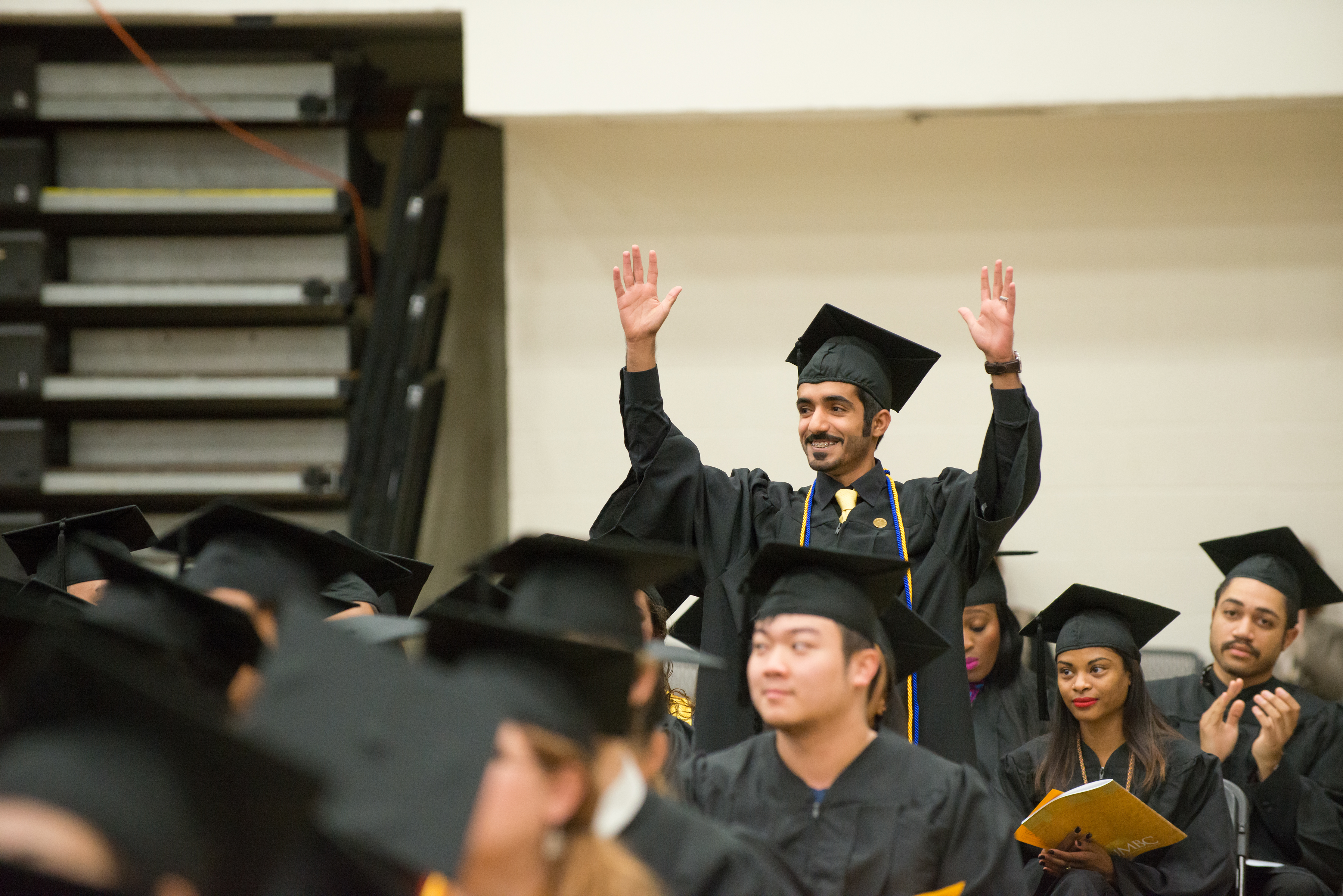
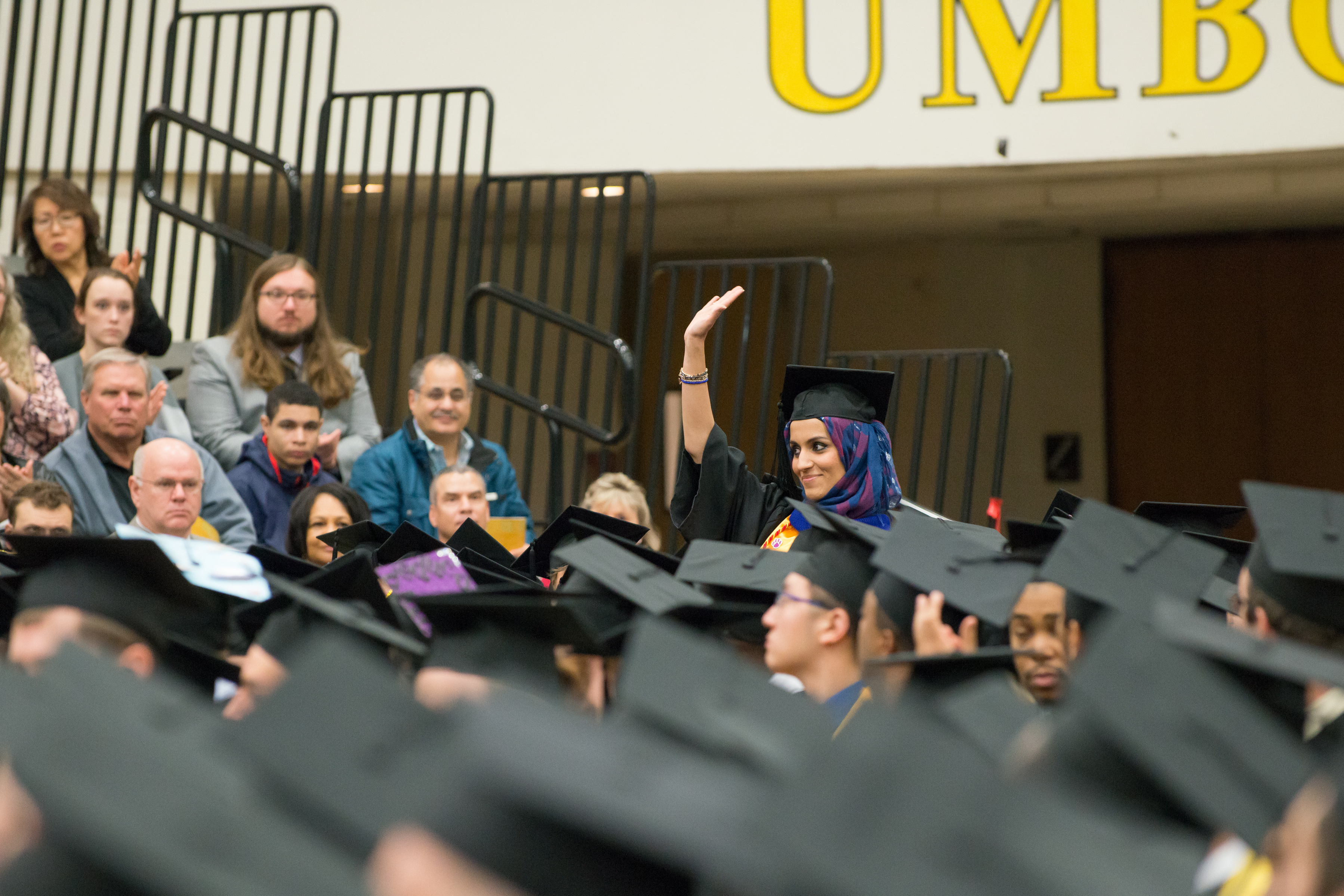
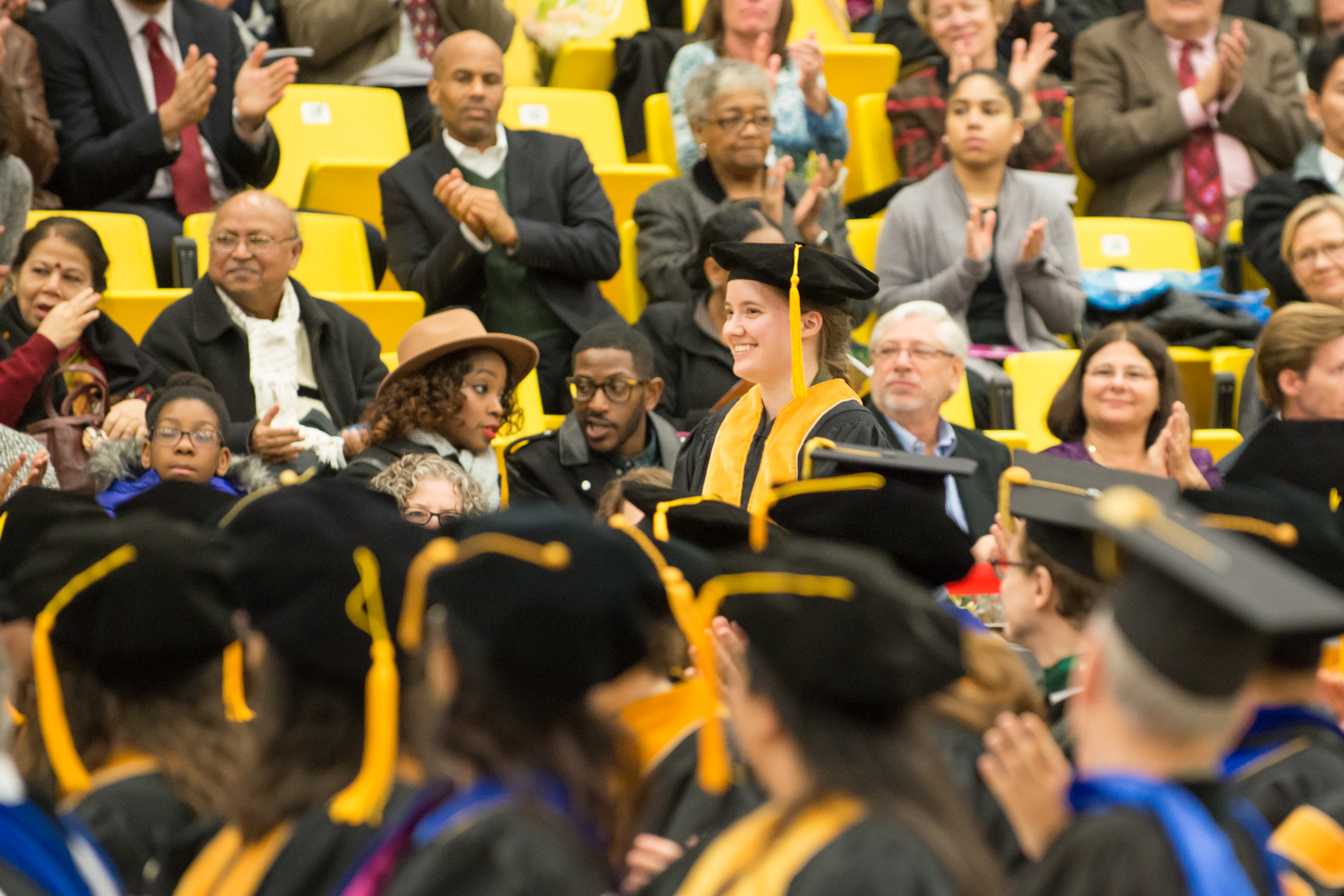
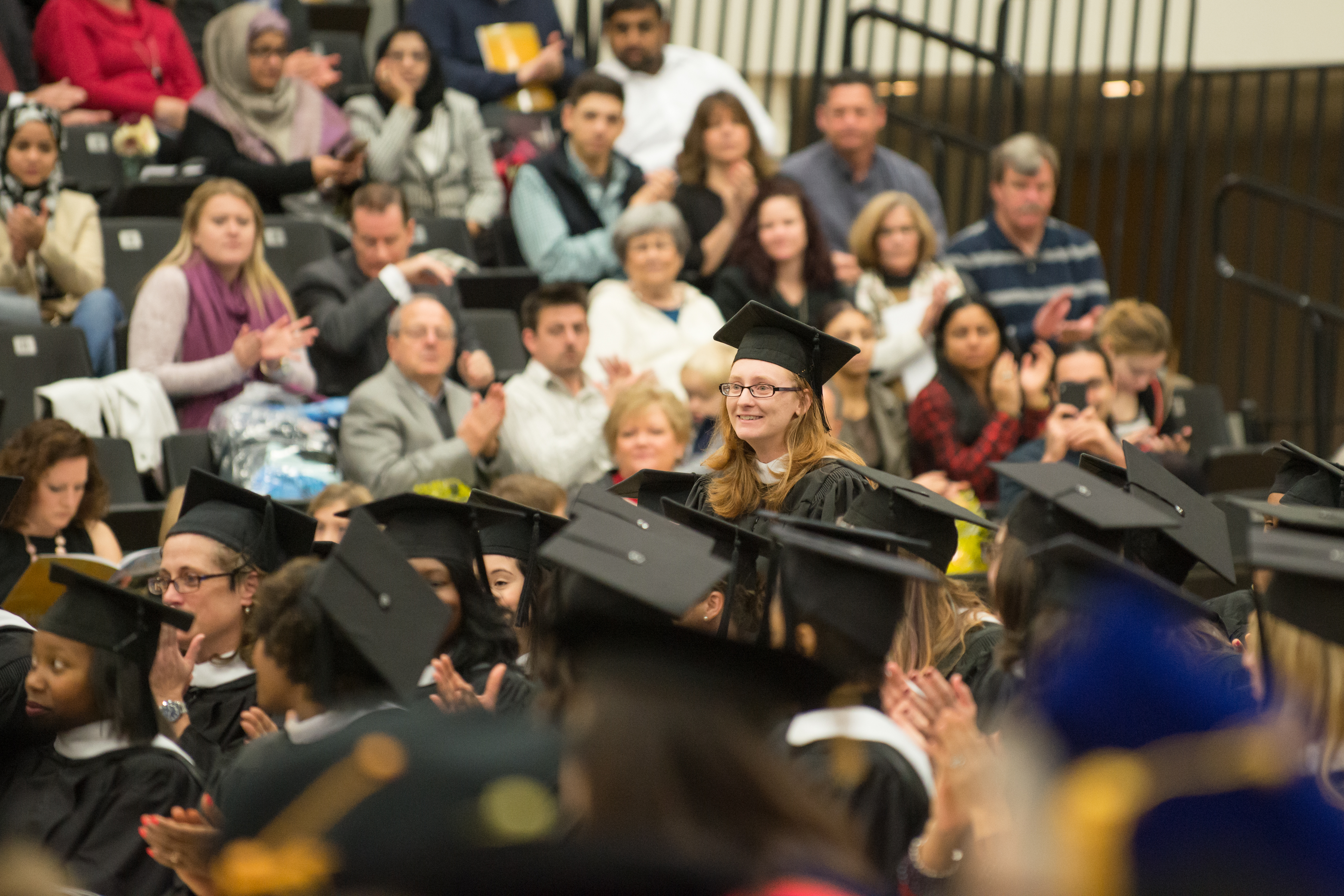
UMBC celebrated the accomplishments of over 1,000 new Retriever alumni at 2015 Winter Commencement, with a graduate ceremony held on December 16 and undergraduate ceremony on December 17.

The ceremonies included representatives from UMBC faculty, staff, student, and alumni leadership, as well as the University System of Maryland Board of Regents. UMBC President Freeman Hrabowski shared more than a dozen inspiring stories of accomplishment, highlighting graduates who have achieved great things, often despite significant challenges in their lives and while balancing personal and professional commitments.

These graduates included students like Muntadar Al-Luwaim ’15, design, a deaf student from Saudi Arabia who welcomed the challenge of mastering two new languages, English and American Sign Language. He has helped build a welcoming community at UMBC for other deaf and hard of hearing students, and plans to develop his own design studio in Saudi Arabia.

Muntadar Al-Luwaim '15, design, is recognized by Pres. Hrabowski during Undergraduate Commencement

Fellow graduate Wafa Raja ’15, information systems, came to the United States with her family eight years ago to pursue an education, but felt pressure to marry and return to Pakistan. Yearning to continue her education, she returned to the U.S. and enrolled in community college, while working and raising her young daughter. She soon transferred to UMBC, where she became both a Cyber Scholar and a Newcombe Scholar, and has shown a remarkable commitment to mentoring other students. She will work for Northrop Grumman as a cyber intelligence analyst.

During the UMBC Graduate School commencement, President Hrabowski recognized Erika Nesvold ’15 Ph.D, physics, who “spends her days thinking about asteroids smashing into each other.” She has accepted a post-doctoral fellowship at the Carnegie Institute of Washington and, in her free time, is a volunteer firefighter and EMT.

Erika Nesvold is honored by Pres. Hrabowski during Graduate Commencement.

Nichole Zang Do ’15 M.A., history, has explored the history of the juvenile justice movement in Baltimore, focusing on understanding the use and misuse of juvenile reform institutions. She will support UMBC’s upcoming 50th anniversary celebrations through alumni outreach.

Nichole Zang Do is recognized by Pres. Hrabowski during Graduate Commencement.

“The point of these stories is that every one of you indeed has a story,” President Hrabowski reflected, sharing that for each student the path to their degree “has not been easy.”

UMBC is proud to honor all of the students who received graduate and undergraduate degrees in Winter 2015.

Videos of the ceremonies will be available soon on the UMBC Commencement website. The ceremonies were also live-tweeted @UMBC, with posts available through #UMBCgrad. For additional photos, see our Undergraduate and Graduate Commencement galleries on Facebook.

Images: All photos are by Marlayna Demond ’11 for UMBC.

Kiplinger again names UMBC a “Best Value College” for strong academics and affordability

UMBC has again been named a Best Value College for 2016 by Kiplinger’s Personal Finance, appearing on both the Best Value Public University list and “top 300” national Best Value University list.

Kiplinger has recognized UMBC as a Best Value College for seven consecutive years. This ranking recognizes affordable four-year schools with outstanding academics. It is based on a combination of factors, including admission rates, student-faculty ratio, four-year graduation rates, and financial aid.

See Kiplinger’s UMBC profile for details.

This follows U.S. News rankings announced earlier in the fall that again recognized UMBC as a national leader in undergraduate teaching, tied with Yale at #6 and ranked ahead of Stanford and Duke. In a new ranking of “Most Innovative Schools,” U.S. News named UMBC #4 in the nation, joining MIT and Stanford in the top five.

Recently, the university has also been named a top U.S. and global university by the Round University Ranking (RUR), in partnership with Thomson Reuters. The RUR is a world university ranking measuring performance of 750 leading world universities across key measures in teaching, research, international diversity, and financial sustainability.

See UMBC’s “Best Colleges” website for more rankings news.

Image: True Grit statue during December 2015 graduate commencement. Photo by Marlayna Demond ’11 for UMBC.

Goalkeeper Billy Heavner ’17 receives top academic honor in U.S. college sports

UMBC goalkeeper and men’s soccer co-captain Billy Heavner ’17, financial economics, has been selected to the 2015 Academic All-America Division I Men’s Soccer First Team by the College Sports Information Directors of America (CoSIDA).

Heavner is the second UMBC men’s soccer player to receive this top academic honor, following in the footsteps of fullback Liam Paddock ’13, psychology and sociology, who earned the distinction in 2012. He is the seventh student-athlete in Retriever history to earn first team honors and the 22nd UMBC athlete to be cited by CoSIDA since 1977.

Heavner is a phenomenal scholar-athlete, exceptional on the field and in the classroom. He led the America East league with eight shutouts in 2015 and with the highest save percentage (81.1), while earning a 3.93 grade point average. He is currently ranked 25th nationally in save percentage.

Heavner repeated as an America East All-Academic Team member this fall, and also earned Second Team All-Conference honors. Last year, when the UMBC men’s soccer team won four straight games in four different stadiums against nationally ranked opponents to earn their place in the NCAA Division I Men’s Soccer Championship, Heavner received the NCAA’s Elite 89 award for top scholar-athletes.

Image: UMBC Men’s Soccer Goalkeeper Billy Heavner ’17, financial economics. Photo courtesy of UMBC Athletics.

Hassan Omar becomes UMBC’s first cross country All-American

UMBC’S Hassan Omar ’16, mechanical engineering, concluded a phenomenal cross country career with the Retrievers by finishing 27th at the NCAA Championships on Saturday,  November 21. Omar is an exemplary scholar-athlete — a Meyerhoff Scholar recognized as an All-Academic runner, who is now UMBC’s first cross country runner to be named an All-American.

UMBC Athletics reports that Omar completed the 10k course in a time of 30:16, besting his NCAA Mid-Atlantic Regionals time by 31 seconds. His NCAA Championship time is a new UMBC record, breaking the previous record Omar set in 2013.

This achievement is the latest in a long list of accomplishments throughout his cross country career. Omar was also the first Retriever to win an individual championship in the America East and finished in third place in the NCAA Mid-Atlantic Regionals earlier this month. He has been named an All-Conference selection three times in his career.

Hear Omar discuss his approach to racing in this video from the America East 2015 Indoor Track & Field Championships, also featuring Mercedes Jackson ’15, psychology:


Image: Hassan Omar ’16, mechanical engineering, at America East Cross Country Championships. Photo courtesy of America East.

Times Higher Education recognizes UMBC as a top world university in 2015-16 rankings

Times Higher Education (THE) has named UMBC one of world’s top universities for the fourth consecutive year.

THE World University Rankings “judge world class universities across all of their core missions—teaching, research, knowledge transfer and international outlook,” utilizing metrics in 13 categories.

THE World University RankingsThe 2015-16 list of top 800 global universities includes 147 in the United States and highlights three in Maryland: UMBC, Johns Hopkins University, and the University of Maryland, College Park. Universities in the United Kingdom, Germany, the Netherlands, and Switzerland were also well represented in the 2015-16 list.

In addition to the World University Rankings, UMBC has appeared in Times Higher Education‘s “100 Under 50” ranking for four consecutive years — one of seven U.S. universities to be recognized this year.

THE’s “100 Under 50” ranks the top 100 universities worldwide under 50 years old. Editor Phil Baty has noted that universities on the list “are a truly exciting and dynamic group of institutions which should serve as a lesson to the rest of the world – that the traditional global world order is not unassailable and visionary young universities can break through.”