All posts by: Catalina Sofia Dansberger Duque


Oyinlola Oluka ’25, political science and philosophy, sees no limits for herself

For Oyinlola Oluka, political science and philosophy, doing the right thing is not just a mantra but a career path. A law school hopeful since middle school, Oluka, a first-generation Nigerian American, has a keen interest in the efforts of African countries to move from political instability toward accountability for human rights violations. She knows that holding governments accountable is a lofty task, but fear is not in her vocabulary—justice is. At UMBC, she found a kindred spirit in Jeffrey Davis, a political science professor whose passion for human rights and politics began at 12 years old after joining Amnesty International. Oluka delved deeply into the complexities of international law in Davis’s classes, inspiring her to shift her ambitions toward becoming an international human rights judge—someone committed to upholding human rights at the highest level.

Q: What motivated you to come to UMBC?

A college student carries her sister in celebration of her graduating college
Oyinlola Oluka carrying her sister Atinuke Oluka at her graduation. (Image courtesy of Oluka)

A: My sister, Atinuke Oluka, is a Retriever. She graduated in 2022 with degrees in psychology and biological sciences. I saw how many opportunities UMBC gave her—how she felt like she belonged and how smoothly she transitioned from high school to college. I don’t see limits for myself either, so I decided to follow in her footsteps. The opportunities I’ve had at UMBC have changed the way I approach life. 

Q: In what ways do you live out your ‘no limits’ philosophy?

A:  I am a first-generation Nigerian American. My family inspires me. They experienced Nigeria’s instability, but did not let it limit their future. I knew I wanted to be a lawyer in middle school. So, once I came to UMBC, I took advantage of opportunities to help me learn more about being a lawyer and due process, such as civil rights, criminal justice, and international law classes. As part of UMBC’s Legal Internship Program, I worked at the Baltimore City Juvenile Justice Center under the mentorship of the Honorable Judge Nicole K. Barmore, an associate judge in Baltimore City’s Circuit Court. 

I chose philosophy as my second major and completed a certificate in philosophy, law, and politics, another in French, a minor in law and justice, and participated in Philosophers Anonymous, which serves as a council of majors. My hard work earned me memberships in Pi Sigma Alpha, the National Political Science Honor Society, and Phi Beta Kappa Society, an academic honor society. 

Oyinlola Oluka, a college student, stands holding a manila folder and completing a form in a room with people sitting at tables
Oyinlola Oluka assists with a client intake at UMBC’s first Expungement Clinic in partnership with Maryland Legal Aid. (Image courtesy of Molly Timko, UMBC’s pre-law academic advisor)

Giving back to UMBC is also important to me. I am a tutor at UMBC’s Writing Center and a teaching assistant for ENGL 393 Technical Communication. All of this while working as a certified pharmacy technician. UMBC’s Black Student Union, the African Student Association, and Philosophers Anonymous allowed me to help foster a sense of community on campus.

Simply put, I don’t limit myself—not to one field, skill, or experience. I always make sure that what I’m doing now aligns with my long-term goals. If I can see myself succeeding where I am, then I know I can succeed elsewhere, too. I will be the first person in my family to pursue a career in law.

Q: How did you choose to add a philosophy major?

A: When I applied to UMBC while I was at Towson High School, the application asked what other major I might consider, which I interpreted as a backup in case my first choice didn’t work out. I chose philosophy because of my passion for the law. It offered a safe, inquisitive space to explore and understand fundamental questions about the world around us. To my surprise, I was admitted as a dual major. I decided to keep it, and it turned out to be one of the best decisions of my life. 

In 2024, the Department of Philosophy nominated and voted to award me the Evelyn Barker Book Prize for superior academic performance by a senior. I am proud to receive this award because it demonstrates that my contributions to the department and the discipline, as a whole, made an impact. Even though picking this major was initially unintentional, it proved to be a discipline that fit perfectly with the person I strive to be. This award shows me that I am taking the necessary steps to actualize my dreams and aspirations. My experience in the department has been phenomenal, and I would absolutely make the same choice again. 

Q: Is there someone who has served as a mentor for you?

A: My favorite classes were taught by Jeffrey Davis, professor of political science, because they deepened my interest in criminal justice and international human rights law. His teaching style left a lasting impression on me. He influenced my time at UMBC not only through what he taught, but also how he taught. He was always encouraging, never condescending, precise, yet never rigid.

Jeffrey Davis’s classroom was a space where ideas could be explored freely, and where every student’s voice was heard. He helped shape not only my academic path but also my sense of purpose as a future legal scholar and advocate. I will always be grateful for his mentorship.

Oyinlola Oluka ’25

political science and philosophy

Q: What excited you about being a student researcher for UMBC’s 2024 Battleground Exit Poll?

A: In the American voting behavior class, led by Ian Anson, the associate director of UMBC’s Institute of Politics, I learned how voting behavior reflects public opinion and policy. We gauged the attitudes of 1,119 Baltimore County voters who cast their ballots in person during early voting and on Election Day. The poll asked voters about their views on the presidential and congressional races, state constitutional amendments like “The Right to Reproductive Freedom,” and broader issues like the economy.

Oyinlola Oluka, a political science and philosophy, college students stands next to a research poster about voting behavior
Oyinlola Oluka at UMBC’s 14th annual Pi Sigma Alpha Research Conference. (Image courtesy of Oluka)

This hands-on project taught me so much about public opinion research, voter behavior, and the challenges of conducting fieldwork in real time. I used the information from this course to create a final paper, which I presented at UMBC’s 14th annual Pi Sigma Alpha Research Conference. I was honored with the award for best presentation and speech, a validating milestone in my academic journey.

Q: Where do you see yourself in a decade?

A: My ultimate goal is to become a judge because it is one of the most direct ways to improve the lives of people charged with a crime. A judge has the responsibility and the power to decide what happens next for that individual. My internship at the Baltimore City Juvenile Justice Center immersed me in the complexities of juvenile justice. I engaged in legal research, drafted memos on post-conviction issues and child welfare cases, and presented my findings directly to Judge Barmore. Through this experience, I developed my research, analytical, and oral communication skills, particularly in breaking down legal arguments clearly and persuasively. It also strengthened my professional network, as I interacted with judges, administrative staff, and law clerks.

By observing Judge Barmore, I also saw how a judge can be nurturing and compassionate toward defendants while also holding them accountable for their actions. She was efficient and effective in addressing the needs of the children in the system, their parents, and their unique family circumstances. These processes helped me understand how crucial it is for a judge to manage their emotions so they can remain clear, consistent, and fair under pressure. 

This opportunity was especially valuable because I’m still exploring whether I want to practice law in government, at a firm, or within a nonprofit organization. With the help of UMBC’s Pre-Law Society, I met law school admissions counselors, reviewed mock applications, and connected with lawyers—all of which are helping me prepare for the Law School Admission Test and narrow down the law schools I want to apply to.

Q: Now that you are the second Retriever in your family, how do you reflect on your UMBC journey?

A: The classes at UMBC taught me how to think, how to ask the right questions, and how to engage with the world around me. Whether it was a lively debate in a politics class or a professor’s encouragement after a class, every moment shaped my understanding of what it truly means to learn. I carry that with me, not just the knowledge I’ve gained at UMBC, but also the curiosity and courage to keep learning wherever I go.

Read more Commencement 2025 stories.

Public law for public good

On a fall Saturday morning, Mohammad Arshad, an information systems senior, greeted clients arriving at the Erickson School of Aging Studies looking for a fresh start with the help of UMBC’s first Expungement Clinic. After completing the intake forms, Arshad passed the files to pro bono lawyers and staff from Maryland Legal Aid and pro bono lawyers from the Baltimore County Bar Association. They carefully reviewed each client’s criminal records to determine eligibility for clearing or sealing certain charges or offenses that can create barriers to jobs, housing, and education

When Jessica Cook, associate director of the Sondheim Public Affairs Scholar Program, noticed that Loyola University has this program, she connected with Molly Timko, UMBC’s pre-law academic advisor, and discussed bringing the program to UMBC. They established the clinic with funding from UMBC’s Center for Democracy and Civic Life. As soon as a call was made for 20 student volunteers, the response was overwhelming.

A group of nine pre law college students and one staff member working with Maryland Legal Aid stand in front  a black and gold quilt that hangs on the wall of an office at an expungement clinic for pre law students
Expungement clinic volunteers (l-r): Damilola Khadijat Yusuf, a philosophy sophomore; Oyinlola Oluka, a political science and philosophy senior; Desta’nae Nicole Wilson ’24, psychology; Jessica Cook, associate director of the Sondheim Public Affairs Scholar Program. (center); Jean Kim, a global studies junior; Thara Pillai, a political science sophomore; Samantha Kennedy ’25, a social work senior; Cooper; Garret Miller, a financial economics sophomore; and Arshad. (Image courtesy of Timko)

Sometimes it’s hard to get internships as an undergraduate student, notes Timko. “The exposure to public interest law—doing law for the greater good—and to network with lawyers in various fields broadens students’ understanding of what being a lawyer can look like beyond arguing in a courtroom,” says Timko, a licensed attorney in Maryland, Washington, D.C., and New York. In her role at UMBC, Timko provides career pathway counseling and law school application support for UMBC students of all majors, as well as alumni.

“It was the first time I saw a law-related volunteer opportunity on campus,” said Arshad. He serves as the senate president of the Maryland Student Legislation (MSL), a model Maryland General Assembly. Currently, there are 15 college delegations, governed by the Council of States, a group of six college students elected by MSL members. Arshad serves as the lieutenant governor.

A screen shot of an Instagram reel of two men in business suits standing having a conversation in an office
Mohammad Arshad (l) with Maryland State Delegate, Christopher Michael Griffith. (Image courtesy of Arshad)

This experiential learning experience teaches students how to draft original legislation and debate bills, navigate parliamentary procedures, and understand the legislative process. At the end of the year, all of the legislation adopted by the students is shared with members of the Maryland General Assembly for their review. “As someone interested in the legal field, I saw the Expungement Clinic as a meaningful way to deepen my understanding of the legal process.”

A college student stands next to a seated client filling out forms
Oyinlola Oluka assists with a client intake at the Expungement Clinic. (Image courtesy of Timko)

The expungement clinic was streamlined to assist as many clients as possible. No appointment was needed. Lawyers arrived equipped with laptops and printers, prepared to complete and file paperwork. Angus Derbyshire, director for Pro Bono at Maryland Legal Aid, who spearheads expungement clinics across Maryland, reported that 14 clients were served at the UMBC Expungement Clinic, and 10 of them had cases that were deemed potentially eligible for expungement. “This resulted in the preparation of 24 expungement petitions, which is a meaningful outcome for both the clients and the community,” said Derbyshire.

As a first-generation college student, Arshad had never seen the legal process in action firsthand, let alone been part of it. What surprised him most was the collaboration and community focus. “I had always assumed legal work was mostly done behind the scenes. This clinic showed me how much personal interaction and empathy are involved,” said Arshad. He plans to practice intellectual property law defending the rights of inventors, entrepreneurs, and developers. “It also gave me a better understanding of expungement and how access to legal resources can significantly improve someone’s future opportunities.”

All majors to the legal field

Despite the overwhelming response from volunteers for the expungement clinic, Timko has noticed that many students still assume a political science major is required to pursue a career in law. Like Arshad, Timko is a first-generation law student with a major outside of political science. She majored in anthropology and art history, with a minor in Italian, but wasn’t sure if she wanted to pursue a Ph.D. in either field. “During my master’s program in higher education and student affairs administration, I studied abroad in South Africa and took a course on social reform in post-apartheid South Africa. It sparked my interest in education and advocacy law,” says Timko. 

One of Timko’s bigger goals is to help students discover their spark. “It’s important for students to know you can major in anything. There are so many ways to be a lawyer. There’s the stereotypical trial lawyer, but there are also lawyers focused on research and writing that never set foot in a courtroom,” says Timko who is also the advisor for UMBC’s Pre-Law Society that helps student prepare for the Law School Admissions Test (LSAT) and network with area schools. “You don’t have to be super extroverted or argumentative to be a really good lawyer.” There is also no expiration date on when you can decide to pursue a legal career.

This is why she was excited when Shannon Ziegler ’14, fine arts, and Alexander Langsam ’22, biology, reached out to her for guidance on applying to law school. Both had initially worked in their respective fields, which unexpectedly led them in new directions—Ziegler in the financial technology industry and Langsam in civil service, which then spurred in them an interest in law.

After completing the pre-med track at UMBC, Langsam dove into studying for the Medical College Admission Test and worked as a medical assistant. When he saw firsthand the challenges faced by providers and patients, he pivoted and decided to pursue a master’s in public health policy instead, while continuing to work in civil service. There, he spent time learning about the work of the general counsel, which confirmed for him the impact lawyers can have at the federal level.

“I had never considered law school before, so when I began to think of it as a possible career, I looked up UMBC pre-law advising and emailed Molly out of the blue. She guided me through the law school application process,” said Langsam. “If you can, expand your career options beyond your degree because there are so many things you can do in this world that may not be obvious in undergrad.” He will complete his masters in May and continue to the University of Baltimore Law School in the fall.

Ziegler is about to finish her first year of law school at the University of Maryland Francis King Carey School of Law. In the decade before law school, she balanced being a business manager for Baltimore’s Center Stage by day and acting by night. She then checked off living in Chicago from her bucket list, where she worked at Venmo, launching a career at the crossroads of financial regulation and technology, the topic of her law school admissions essay. 

Timko is on the Law School Admission Council directory as an undergraduate pre-law school advisor and receives an alert when an alum takes the LSAT. As soon as she was sent Ziegler’s results, she touched base with her. “It had been so long since I left UMBC that I didn’t think of reaching out. Molly gave me great advice on how to focus my application better and what to prioritize in my search,” said Ziegler. “She helped me slow down to think about what my goals are. I found that reframing really helpful.”

Making the LSAT accessible

A college student wearing her cap and gown and honors cords stands outside next to a statue of a Chesapeake Bay retriever.
Megumi Fukuzawa. (Image courtesy of Fukuzawa)

The mission of the pre-law advising programming is to create a supportive community. One where UMBC’s law school hopefuls can develop the skills, strategies, and confidence to navigate the various steps between studying for the LSAT and the first year of law school. This spring, Megumi Fukuzawa ’23, political science, who is currently studying for the LSAT, understands the need for support. Like many undergraduate students, Fukuzawa’s schedule was jam-packed. Whenever she carved out time to study for the LSAT, she felt lost and discouraged. “I needed help understanding the materials and advice about how to study effectively,” said Fukuzawa, a research assistant at the Howard County Historical Society’s Archives and Historical Center. “The only flyer I saw on campus was during my junior year, advertising a $1,000 introductory LSAT course. At that point, the LSAT felt like a massive wall I couldn’t break through.” 

Thanks to a professional development grant from the American Studies Department, she was able to access study materials during her senior year. This spring, Fukuzawa asked Timko if she could lead an LSAT preparation information session. “I want to offer an LSAT prep information session, free tutoring, and an online study community for UMBC LSAT students. I hope this will make LSAT prep, and by extension, a legal education, more accessible to UMBC students and alumni,” said Fukuzawa. Arshad is also championing the need to help fund LSAT preparation materials for Fukuwaza, himself, and other pre-law students who can’t afford expensive study aids. Arshad is collaborating with peers and community members on a long-term solution to establish a UMBC partnership with an LSAT coaching provider to offset LSAT preparation costs. 

Advocacy and fairness are Arshad’s core values. They have defined his student work as well as his career plans to practice intellectual property law. “My background in systems and data gives me a unique perspective on how legal services, like the Expungement Clinic, can be streamlined and made more accessible through innovation,” said Arshad. “Volunteering at the expungement clinic made me think about how I can apply my tech skills to create more efficient and equitable legal solutions.”


Learn more about UMBC’s Expungement Clinic and pre-law advising.

Julie Granruth ’25, financial economics—For the love of numbers

Math is Julie Granruth’s love language. It has bookmarked her life, starting as a student at Towson High School, where her master tutoring skills made what sometimes looked like a labyrinth of numbers accessible and fun for other students. This caught the attention of Donatella Spigarelli, a mom of one of the students—and a certified public accountant and an audit and accounting principal at Baltimore-based accounting firm Ellin & Tucker. Spigarelli was so impressed with Granruth that she encouraged her to apply to the firm’s college internship program. After three years and an accounting internship, Julie is graduating with a degree in financial economics, a 4.0 GPA, and a job as a tax and audit associate at Ellin & Tucker. 

Q: What led you to study at UMBC?

A: My journey to UMBC, I would say, was a little bit different. When I was about 10 or 12, my middle brother was very interested in chess and played in many tournaments at UMBC. I came with him throughout middle school and high school, experiencing UMBC at a very young age. When I applied to colleges, I discovered that UMBC had a great financial economics program. Combined with my experience of UMBC’s community as a kid, it became one of my top picks. 

Q: Is your love of math a family affair?

Julie Granruth with her brother and sister stand next to each other with a picture of a large historic sailing ship in the background
Granruth with her brother. (Image courtesy of Granruth)

A: Growing up, our parents always taught us to save all of our money and only buy what we needed. I took that to heart and became interested in math, especially in the global impact of the actions of individuals on the economy. There was a direct application to the real world. 

I chose financial economics because the passion with which my economics professors taught and how they applied it to their research made me passionate about it, too. I enjoyed watching them express their enjoyment of economics. It helped me better understand my enjoyment of it as well.

Q: What’s an unexpected thing you love about your major?

A: I’m a very technical and analytical person. I now love working in Excel, especially for my accounting classes. In my first accounting class, I was assigned a group project to create a company and work out its financial statements. That’s when I learned the most about how to work in Excel. I developed the skills and cool tricks that made spreadsheets work fast and efficiently. Last semester, in advanced accounting, I analyzed the financial ratios of different companies and used the Excel skills I learned to compare their performance.

I visualized everything and organized things in a way that made sense to me and then explained it to someone else in a way that they understood it. That’s why, after graduation, I want to continue my education and become a Certified Public Accountant. I’ve always been interested in it, but I wasn’t always 100 percent sure until last summer during my accounting internship. Helping people save money on their company taxes or their personal taxes is something I’m really interested in doing.

Q: What advice do you have for students interested in financial economics or becoming a CPA but aren’t sure it’s for them?

A: I have frequently heard students say that a lack of confidence in math is the main reason they don’t pursue either of these paths. My advice is to take advantage of all the opportunities you have. Never be afraid to ask for help. The professors are very welcoming and kind and will be able to help you in any way they can. A big part of economics is relating it to the real world. If you’re interested in talking about theories and policies, which is why I chose economics, math is just one piece of the equation. I don’t think there’s a ceiling, even if numbers aren’t your best friend!

Q: Where did you find the most sense of community while at UMBC?

A: I have had a passion for economics since high school and was eager to join a group of people with similar passions. The Economics Council of Majors was a community that welcomed me during my freshman year. I came to love this community, and as treasurer and then as president,  I helped shape and lead the future of this group I loved.

I also enjoyed the Student Events Board (seb). I was grateful to have so many amazing friends who inspired me to put myself out there and join this community. I became the vice president of internal programming; I had never taken on such a large role in my community—I was intimidated. However, once I realized the impact I could have, I never felt more comfortable surrounded by peers who shared my interests. 

Julie Granruth with four other college students stand under a bright yellow events tent behind a table holding up glass jars filled with glass tea leaves
Granruth (second from right) with (seb) welcoming new students at the fall 2024 Retriever Fest. (Image courtesy of Granruth)

During events, when I spoke with attendees about our related hobbies, watched groups of strangers become friends over a shared interest, and collaborated with other campus organizations, I was inspired to pursue new passions. These experiences revealed something I hadn’t originally considered. While the events we created were intended to form the UMBC community that we wished to see, I have also felt the warmth of this community as those around me expressed their heartfelt enjoyment of my programs. I felt so welcomed by the leaders of seb in my freshman year, and I felt honored that I had a role in the way new and returning students experienced UMBC and its beautiful community.

Q: How have you dealt with challenging moments at UMBC? 

A: Despite new classes that seemed impossibly difficult, changes in my social sphere and goals, and my peers seeming farther ahead than I was, one thing that has never changed is my persistence and passion.

When I first faced defeat, I felt not only the fear of that defeat but also the fear of future defeats. However, through my persistence, defeat became somewhat of a friend, someone I turned to as I reclaimed my footing and approached the problem time and time again, unafraid to ask for help to do my best. I take my defeats as starting points for future growth. I now hold onto them as fond memories and stories of strength.

This is why, since the spring of my freshman year, I worked hard every semester as a teaching assistant. I understood how easy it was to let academic troubles envelop me and how it seemed easier to seal this envelope than to change the script and deliver a new message. Having gone through this myself, I became passionate about helping students bring out the best in themselves. I showed them that one defeat was not just a defeat. It was an opportunity for greater future success. 

Q: Carry over the one. What place have numbers had in your community service?

A: One of the students I tutored at Catonsville Elementary School was very numbers-oriented. The first question she asked me when I met her was, ‘What’s six times six?’ Talking about our love of numbers opened a way for me to communicate with her during the mentoring process. 

Since my freshman year, I have volunteered as a Shriver Living Learning Community mentor at Catonsville Elementary School. I acted as someone between a friend and an adult they could look up to, yet also relate to. I encouraged my students to take pride in who they were and reminded them that they only had one chance in life to be who they are, so they might as well own it. 

As the student leader for this site, I supervised the registration, onboarding, evaluation, and weekly attendance of 20 UMBC student volunteers throughout the year. This meant staying organized—it always came back to spreadsheets!

The best part of my UMBC experience was the privilege of engaging with so many communities and giving back to them with my time. I believe that service to those beyond ourselves is part of what makes our lives so fulfilling, and I can not imagine a life without it.


Read more Commencement 2025 stories.

Gathering a humanities research tool kit to understand a fascinating world

Sean Silverman began his UMBC journey as a computer science major. After taking several programming classes in high school, he was ready to pursue a career in data science while also enrolling in history courses to foster his love of history. However, by his second semester, Silverman’s passion for history inspired him to switch majors during his sophomore year. It is a common misperception among incoming students that they must commit to one path, but UMBC is a place where students can explore careers across disciplines and have the support needed to shift gears and equip themselves with the tools to succeed academically. 

Silverman’s initial interest in history was sparked by his older sister’s trips to Kazakhstan and other Central Asian countries and then by the deep dive into that region’s intricate past. At UMBC, he found a mentor in Brian Van Wyck, assistant professor of history, who shared a similar academic trajectory. During the fall semester of his senior year, Silverman completed his 30-page history capstone research paper on the Tokyo War Crimes Trials of 1946 – 1948. As he looks forward to graduation, Silverman reflects on how he rose to meet the challenge of his successful capstone project with the support of Van Wyck.

A college professor walks between student desks as he lectures in a classroom with a yellow brick wall in the background
Brian Van Wyck’s fall 2024 senior capstone class on Nazi Germany. (Marlayna Demond ’11/UMBC)

Learning the skills as you go

Van Wyck, who has been at UMBC for nearly five years, shares Silverman’s enthusiasm for learning about places, events, and languages vastly different from his own experiences and history. Like Silverman, he did not travel abroad or become fluent in a second language during his undergraduate years. It wasn’t until after college, when Van Wyck worked and lived in Turkey, that he began learning Turkish and German. These skills flourished through the Fulbright U.S. Student Program in the Turkish immigrant community of Detmold, in northwestern Germany, and the support of the Turkish Critical Language Scholarship. Van Wyck’s willingness and curiosity to immerse himself in Detmold’s linguistic, cultural, and political crossroads shaped the trajectory of his research and influenced his teaching, including Silverman’s capstone course.

“I like the complexity and challenge of research, putting different kinds of sources in different languages in conversation with one another to find surprising answers to important questions relevant to understanding problems and injustices in our contemporary world,” says Van Wyck, who promoted opportunities for UMBC, faculty, and students to study and research in Germany as a 2023 – 2024 DAAD Research Ambassador.

(right)While conducting research at the Atatürk Library in Istanbul, Van Wyck consulted a 1966 news article from the Cumhuriyet, the oldest Turkish daily newspaper, about Turkish migrant workers’ attempt to organize religious services in West Germany. (Image courtesy of Van Wyck)

A diverse tool kit for humanities and social science research

Silverman’s capstone class first learned about the post-WWII Nuremberg Trial of 1945 – 1946 and the Tokyo War Crimes Trials of 1946 – 1948, then students chose an aspect of one of the trials for further research. With Silverman’s keen interest in Asian history, the Tokyo War Crimes Trials intrigued him. His passion and dedication helped him find elusive dates, names, references, and footnotes, which led to a domino effect of ideas about the 11 presiding judges representing 11 countries from North America, Europe, and Asia that shaped his thesis, “Presupposed Justice: How Orientalism Affected the Tokyo Trial.” An Orientalism framework analyzes how the West negatively perceives, stereotypes, and exerts power over the East, often through colonialism, racism, and the sexualization of Asian people.

For students with little experience researching international topics, Van Wyck’s expertise in international and multilingual research helped bridge that gap. He has spent over a decade studying migration from Turkey to West Germany, starting in the 1960s. His current research was spurred by a long-forgotten banned Turkish public school textbook, created by Germany, to teach Turkish students their language and culture without input from Turkey.

“There was little information, but I found some copies. I spent a great deal of time reading and coding the information and conducting a quantitative analysis of the topics according to geography, the authors in each section, and those cited,” says Van Wyck who also took advantage of UMBC’s interlibrary loan service to access law books in Dutch from the 1980s, original pamphlets in German from the 1970s, and Turkish-language memoirs written by imams and theology professors. “I used government documents and archives. Then, I tracked down the project’s administrators and authors and conducted in-depth interviews. By using humanities and social science research methods, I was able to tell the story of this unique and broad textbook project that was, in the end, canceled.”  

Silverman faced similar obstacles in his research throughout the semester. “The Tokyo Trials are not covered as well as the Nuremberg Trial and less so through an Orientalism framework,” says Silverman. To help students move beyond the general knowledge of the trials, Van Wyck noted databases and archives that were less familiar to students. He first pointed Silverman to the University of Virginia Law School International Military Tribunal for the Far East Digital Collection. Then, Silverman navigated the databases of the Library of Congress and the University of Hawaiʻi at Mānoa’s  War Crimes Documentation Initiative

“Professor Van Wyck suggested a document written in French that related heavily to the Tokyo Trials and Orientalism. He knows some French and helped me translate it.” Silverman also made the most of his budding Japanese skills to further his project. He was in search of the dissent by the only judge who wanted to acquit all the Japanese leaders charged with war crimes. “I couldn’t find much in English. My one semester of Japanese came to the rescue,” says Silverman. “I found the dissent by looking up his last name in Japanese, which ended up being in the title of a book.”

A humanities college student sits at a desk looking through a book in front of a computer screen open to a text document
Sean Silverman at UMBC’s Albin O. Kuhn Library and Gallery. (Marlayna Demond ’11/UMBC)

The trail didn’t end there. Silverman struck gold among the 690,000 physical books in the Albin O. Kuhn Library, where he found two books in the political science and international law sections that profoundly shaped his paper. The Tokyo Trial and Beyond: Reflections of a Peacemonger is a collection of interviews with one of the sitting judges and the Sugamo Prison, Tokyo: An Account of the Trial and Sentencing of Japanese War Criminals in 1948, by a U.S. Participant, describes life inside the American-guarded prison. With a wide array of resources, Silverman began to write. 

Writing history

After the research is complete, students begin analyzing the facts. However, this part of the process shifts from a solitary task to a communal experience. Students read each other’s papers, ask questions, and suggest changes several times before Van Wyck gives feedback. Four to five drafts later, students turn in a final product—Silverman received an A. It’s a moment Silverman didn’t foresee when he started at UMBC.

“Switching to a history major two years into my college career, I felt a little behind for a while, especially with my research skills. Wanting to go to graduate school, I knew I needed to work on that and build the skills over the years,” says Silverman. “The extensive research and synthesizing writing skills have been the most valuable skills I’ve gained, not just in this class but from all my history classes at UMBC. They will serve me well as I continue further into my academic career in graduate school and make plans to travel to Asia.”

“I became a historian because the questions that interested me take place predominantly in the past,” says Van Wyck. He will return to Germany this summer as a visiting research fellow at the Leibniz Center for Contemporary History Potsdam and at the International Youth Library. “I think it’s important for historians and undergraduate history majors to gain access to a broad and diverse toolkit.”


In fall 2025, Van Wyck will teach HIST 372: Nazi Germany, HIST 210: Migration in World History, a new course he developed.

Learn more about the UMBC History Department‘s degree programs, faculty research, and events.

UMBC’s Virtual Tandem Conversation project with German universities is changing the way students see Germany and the U.S.

During a recent trip to Normandy, France, UMBC student Rebecca Smith hopped over to Lüneburg, a historic town in northern Germany, to visit Gertrud Krause-Traudes, her partner in UMBC’s Virtual Tandem Conversation project. After three semesters of virtual conversations in German and English, Smith was more than happy to go the extra kilometer (plus a few hundred more) to meet her in person. Krause-Traudes, a professional tour guide, was excited to show Smith Lüneburg’s historic sites. 

A woman wearing a long black winter coat and a white scarf stands in an ornate historic room. Virtual Tandem Conversation Project
Gertrud Krause-Traudes giving Smith a tour of Lüneburg’s historic town hall. (Image courtesy of Sutton)

The Virtual Tandem Conversation project was created by Susanne Sutton, a teaching professor of German, and Talke Macfarland, a visiting lecturer of German in UMBC’s Department of Modern Languages, Linguistics, and Intercultural Communication. They established the program during COVID-19 to help UMBC students learning German and German students learning English socialize while continuing to improve their language skills.

“I asked the director of the International Center at Leuphana University Lüneburg to post a call for participants on their listserv,” says Sutton, who, while visiting her hometown, had met the director in nearby Lüneburg to discuss UMBC study abroad credit equivalencies. “That generated 35 applicants! It just grew from there,” Sutton says. Now, Sutton is managing partnerships and recruiting collaborators from two additional institutions: University of Kassel and BBS-1 Wirtschaftsgymnasium, a business vocational high school.

Smith, who is a professional harpist, enrolled in UMBC’s Golden ID Program at the beginning of the pandemic to continue taking classes with Macfarland, whom she first met at Anne Arundel Community College. “To my delight, faculty and students warmly welcomed me into their German classes,” says Smith, who was returning to take classes and rekindle her love of German after raising her family and pursuing her music career. “In 2023, I became involved with the tandem program, where my German counterpart, Gertrud, and I instantly developed a friendship through our mutual love of music and foreign languages.”

“How fortunate and privileged I feel to be part of this vibrant international community at UMBC, who seek not only to advance their students’ language abilities, but even more importantly, to build bridges between the two countries, one person at a time—diplomacy at its best!” says Smith.

Getting to know you

Macfarland and Sutton grew up in the state of Lower Saxony in northern Germany. Their joy for teaching their heritage language is a key reason the program has grown from one semester to a sequence of three semesters, each with increasing difficulty and 35 – 40 tandem participants per year. 

A group of 16 people including teachers and students stand in front of a building holding a banner with German words. Virtual Tandem Conversation Project
Sutton (front left) visits Rudolph Gawor (front right), team lead in English at BBS-1, and BBS-1 students, teachers, and American guests in Lüneburg, Germany. (Image courtesy of Sutton)

The tandem project is now a required component of the German course sequence to increase proficiency in reading, writing, speaking, and listening, emphasizing intercultural communication and global awareness. However, the actual tandem meetings are entirely student-driven and take place outside of the classroom—each tandem pair arranges virtual meetings according to their schedule. UMBC students keep a weekly diary, where they document their conversations. During the first three weeks, partners learn about each other, exploring their respective cities and universities.

“I provide questions that relate to what we currently do in class,” says Macfarland. “For instance, when we read about an exhibit by German visual artist Gerhart Richter, I asked partners to discuss art: Do you visit museums? What interests you? What’s nearby? Are you artistic? What art or work resonates with you and why?” The journal also allows instructors to monitor and give feedback on students’ weekly meetings. Some of these conversations have led to more personal exchanges, such as discussing video games they play or playing together, sharing the latest music, or exchanging photos.

“My students take what their tandem partners say seriously, and it sticks better than when we just cover the grammar in class. I think it is because they really get to experience the language in action and receive feedback from someone their age who can confirm (or deny) what they have learned in class,” says Dawn Nichols, a tandem faculty partner and lecturer of English at the University of Kassel in central Germany, an official UMBC exchange partner. “Their partners also add a little bit of context and experience to specific language choices and give them 1:1 attention, which is not always easy to do in every lesson.”

Overcoming linguistic and cultural barriers

Two women wearing winter coats stand side by side inside a historic tower overlooking a city. Virtual Tandem Conversation Project
Grosko, left, and Heinrich met in Munich, Germany, while Grosko was in Europe to visit family in Italy. (Image courtesy of Grosko)

The Tandem Conversation Program has evolved to be a vehicle for dismantling stereotypes and misconceptions about the United States and Germany. Liana Grosko, a geography and environmental systems junior with a German minor, was apprehensive about participating in the project. “German was halting for me, and no matter how much I prepared for it, there was always a learning curve when interacting with a native German speaker,” says Grosko. “My German fluency has much improved since we started talking, as well as my knowledge and appreciation of my culture’s place in the world and, of course, my friendship with Malin Heinrich, my tandem partner. I ended up getting to meet her in person in Munich early last year.”

Nichols attests to the improvement in fluency and accuracy, but also more unexpected benefits like a decrease in anxiety some German students experience when speaking English. She continues to be excited each time she hears students learn day-to-day language that is sometimes left out of textbooks and knowledge that helps them better understand American culture and critique their system. 

Two women in an airport lean into each other for a photo while holding a large pretzel
Smith (r) with classmate and former German teacher Doris Hoelscher-Stanley at the airport in Hamburg, Germany. (Image courtesy of Smith)

The program continues to have far-reaching effects. Smith has taken four classes with Macfarland and six with Sutton to date. She plans to visit Vienna this summer, where she hopes to connect for a second time with classmate and former German teacher Doris Hoelscher-Stanley, an MMLIC senior currently living in Hamburg, Germany. She first visited Hoelscher-Stanley in Hamburg on her trip to meet Krause-Traudes. Smith is not the only tandem participant to go beyond the virtual classroom. Last summer, Sutton and Macfarland had their own exchange in Leipzig, Germany, four hours from Lüneburg, where they attended a workshop on teaching German as a foreign language in the U.S. 

a woman stands outside with an umbrella in a German Christmas market with a red mug
Gebhard at the Weihnachtsmarkt in Wiesbaden, Germany. (Image courtesy of Gebhard)

The tandem program inspired Emma Gebhard ’23, a psychology major with a German minor, to apply to the Congress-Bundestag Youth Exchange for Young Professionals program to study and work in Germany. She was one of 74 Americans chosen as a 2024 – 2025 fellow. Desire Hayes ’24, an English major with a German minor, put her skills to work studying abroad at Leuphana University Lüneburg, where she met Nele-Sophie Bauer, her German 202 tandem partner.

Other partners are making more plans to meet. “Now that the project has concluded for me, I can confidently say that it was a success. I have learned a great deal about American culture, and I feel much more confident in my English abilities. I no longer hesitate to start speaking English in everyday situations without any prior preparation,” says Heinrich, who was paired with UMBC student Liana Grosko. “The greatest success has been forming a friendship with Liana. We still communicate weekly, and I eagerly look forward to meeting her again in person this spring.”

“This tandem has put Baltimore on the map for some of my students, who generally only know something about California, Florida, and New York,” says Nichols at the University of Kassel. “Putting a very human and relatable face to the abstract concept of the United States—it’s normal to have some (mis)conceptions about people we don’t know. One part of this exchange that cannot be overvalued is how it helps our students see each other as real people and not just some image they see or read somewhere.”


Learn more about UMBC’s Modern Language, Linguistics, and Intercultural Communication German track options.

New scholarship offers Japanese high school students an admissions pathway to UMBC and increases Japanese opportunities on campus

As Sister States, Maryland and Kanagawa Prefecture, Japan, (south of Tokyo) have collaborated in various initiatives in business, education, healthcare, and culture exchange programs since 1981, including ongoing partnerships at UMBC. For the past six years, UMBC has proudly partnered with the Kanagawa Association of Private Junior/Senior Schools, welcoming their teachers and students for UMBC’s spring break and summer Intensive English Program and TESOL certificate programs. Likewise, UMBC students who are learning Japanese have participated in the Teach Abroad: Kanagawa Internship, an internship program with schools in Kanagawa Prefecture. 

Following the great success of their education exchanges, UMBC’s Center for Global Engagement (CGE) has signed a Memorandum of Understanding with the Kanagawa Association of Private Junior/ Senior Schools to establish the annual Global Achievement Scholarship. This new partnership creates an undergraduate admissions pathway for up to 10 high school students from Kanagawa Prefecture beginning in fall 2026.

Career opportunities in Japan

A middle-high school in Kanagawa Japan scholarship
Kumon Kokusai Middle-High School where William worked. (Image courtesy of Mo)

For students like William Mo, a senior majoring in modern languages, linguistics, and intercultural communication with a concentration in Japanese, opportunities to immerse in the Japanese language and culture help build an invaluable professional and social network in preparation for the international job market. Mo, whose goal is to live and work in Japan, had the opportunity to participate in the Teach Abroad: Kanagawa Internship, which offered him three months of teaching middle school students while living in a student dorm. 

This was Mo’s first internship and real work experience beyond his part-time job as a peer advisor in UMBC’s Education Abroad Office. “I participated in this internship to help make a stronger case for myself when I apply to JET [Japanese Exchange and Teaching Program], to satisfy my own desire to sightsee in Japan, and experience what it is like to teach English,” says Mo. He had to balance work and online classes as well as co-lead activities like English conversation cafes, where Japanese students practiced their conversational English. “All my skills related to communicating and interacting in Japanese strengthened greatly since I regularly talked to the office staff, students, and anyone I needed to talk to.” 

Keeping Japanese language skills sharp

Upon returning to UMBC, Mo found new ways to maintain his new level of proficiency. Last summer, when nearly 60 high school students and teachers from Kanagawa Prefecture arrived for the Intensive English Program and TESOL certificate programs, he volunteered in Japanese conversation cafes with the visiting students while playing board games. He also served as a guide and chaperone for the students’ trips to Washington, D.C., Baltimore City, and Annapolis. 

A large group of Japanese high school students hold up a large mask of an oriole mascot at a baseball game scholarship
High school students and teachers from Kanagawa Prefecture, Japan, at an Orioles game. (Image courtesy of CGE)

Similar to Mo’s experience in Japan, some of the participants shared that the summer programs gave them important insights into what it would be like to live and work in the United States and study at UMBC. As the Global Achievement Scholarship gets underway in 2026, UMBC will be home to more Japanese students who will join the nearly 2,000 international students and those from the United States, who have entrusted UMBC with their desire to create extraordinary possibilities for themselves and their communities.


Learn more about UMBC’s Center for Global Engagement international exchange programs.

For more information about UMBC’s Teach Abroad: Kanagawa Internship contact Tomoko Hoogenboom, teaching professor of Japanese language and culture, at tmkhgnbm@umbc.edu.

UMBC and the U.S. Department of Health and Human Services partner to create pathways for a more diverse and inclusive workforce

UMBC and the U.S. Department of Health and Human Services (HHS) have signed a memorandum of understanding (MOU) establishing a strategic partnership to increase public service career awareness and diversify workforce opportunities. This collaboration can include internships, mentorships, shadowing experiences for UMBC students, and joint outreach events to boost awareness of HHS as an employer of choice.

“We work very hard to make sure that we do not just have a culture that is great, but we also have representation in places where students can see themselves and imagine who they can be and what they can contribute,” said Cheryl R. Campbell, the assistant secretary for administration for HHS.

HHS’s mission is to enhance the health and well-being of all Americans by providing effective health and human services and fostering sound, sustained advances in the sciences underlying medicine, public health, and social services. This MOU will enhance recruitment efforts, support career development programs, and share resources to broaden federal employment pathways for UMBC students, particularly in public health, research, and engineering. 

Ten people stand behind two people seated at a table who are holding up an MOU between UMBC and Health and Human Services
(l-r): Cheryl R. Campbell, the assistant secretary for administration for HHS, and UMBC President Dr. Valerie Sheares Ashby. (Marlayna Demond ’11/UMBC)

“When you talk about how do we change the conversation, how do we change and improve the health disparities? Well, you have to have people at the table that come from those environments,” said Campbell. “That’s why it’s critically important that we sign these memorandums of understanding to bring the next generation of Black and brown professionals into government service. Because if you want to affect change, you have to have a seat at the table to impact policy.”

This news is inspiring for Michael Ack. He joined UMBC as a Meyerhoff Scholar and earned a John H., Sr. and Althea Griner Scholarship for outstanding first-year undergraduate students committed to the advancement of minorities in the sciences and who intend to pursue biological sciences as a major. Ack is now a junior and in his second year at the National Institutes of Health Undergraduate Scholars Program (UGSP), which is part of HHS. Ack notes how these programs provided him access to invaluable financial support, mentorship, and a strong community of peers, faculty, and alumni. Last summer, Ack shadowed researchers working on understanding the development and continued survival of cancer cells. After graduation, Ack will complete his UGSP service obligation by working as a full-time NIH employee in an NIH Intramural Research Laboratory.

A college student wearing a black suit and gold tie stands at a podium speaking into a microphone about Health and Human Services.
Michael Ack. (Marlayna Demond ’11/UMBC)

“This MOU will serve as a pathway for UMBC students to pursue meaningful careers in public service and make meaningful contributions to our society,” said Ack. “And through the various opportunities that this partnership promises, more UMBC students will be able to see the benefits of working for HHS, such as I have, and will empower more of us to dream big.”

For more internship and career information visit UMBC’s Career Center and listen to their UMBC Careers Unleashed podcast.
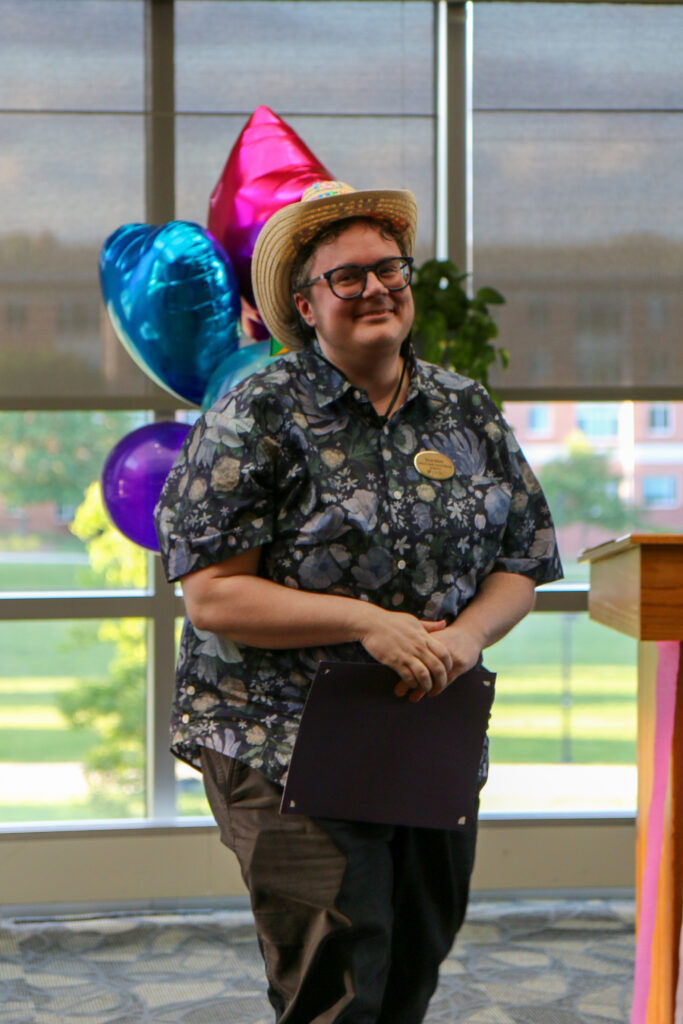
Nardos Amanuel Kebede, second Retriever to receive the Charles B. Rangel International Affairs Graduate Fellowship

Nardos Amanuel Kebede has dreamed of receiving the Charles B. Rangel International Affairs Graduate Fellowship since high school. The competitive fellowship provides up to $42,000 annually over two years to complete a two-year master’s degree in international affairs. Upon completion, fellows have a five-year appointment as a Foreign Service Officer in the Foreign Service of the U.S. Department of State. While managing her senior-year fall midterms, Kebede received the exciting news that she is one of 45 recipients nationwide of this prestigious fellowship. 

“This is a dream come true. I’ve always been a lifelong public servant. I started serving at a non-governmental organization when I was 11,” says Kebede, who follows in the footsteps of Vivian Ekey ’11, political science and modern languages and linguistics, the first Retriever to receive this fellowship in 2011. Kebede spent the last two summers in the U.S. Foreign Service Intern program.

This unique experience gave her academic and professional training in Washington, D.C., an opportunity to work in a policy office at the U.S. Department of State, and a 10-week assignment at the U.S. Embassy in Addis Ababa, the capital of Ethiopia, where she was born. 

Understanding public service

Nardos Amanuel Kebede with a floral dress stands in a stone breezeway with large stone arches in Jerusalem
Kebede in the Old City of Jerusalem in September 2024. (Image courtesy of Kebede.)

Kebede’s interest in international diplomacy began during a high school project, where she researched mental health policies and outcomes for young people in Ethiopia and across Africa. This foundation led her to UMBC’s Sondheim Public Affairs Scholars Program, where she further developed her understanding of public service, civic engagement, and research-based policy and diplomacy. During her first year, Kebede joined UMBC’s McNair Scholars Program, a graduate school mentorship and preparation program, to explore earning a Ph.D. that would lead to becoming a diplomat. Her plans changed during the U.S. Foreign Service Internship Program when she met current Rangel Fellows.  

“I wasn’t sure I wanted to go to graduate school. I thought I’d be a diplomat the conventional way where I take the Foreign Service Officer Test after undergrad—even though at one point, I considered going straight into a Ph.D. program for comparative politics,” says Kebede. “What changed is that I wanted to become a diplomat first. I would love to work for a number of years as a generalist and then consider transitioning to become a regional specialist. I have always been interested in the East African region.” The Rangel Fellowship gives her the chance to start her foreign service training following a Congressional and U.S. embassy internship and graduation. 

“I am thrilled for Nardos and thrilled for our country to have such an exceptional scholar and citizen as Nardos on track to represent us in the foreign service,” says Laura Antkowiak, director of the Sondheim Public Affairs Scholars Program. “Nardos stands out for so many wonderful qualities, such as her intellectual maturity, her poise and communication skills, her care about what’s happening in the world, her enthusiasm for research that makes an impact, her extensive volunteer and mentorship work on and off campus, and her empathy, integrity, and kindness.”

Strength in numbers

Receiving this award is the culmination of years of hard work, determination, dedication, and being willing to accept help. With funding from the McNair Scholar Research Institute, Kebede had the opportunity to visit Jerusalem to meet prominent Ethio-Israeli leaders and conduct interviews for her independent and ongoing research project titled, “The Generational Evolution of Cultural Identity Amongst Ethiopian Israelis and Its Impact on Integration,” under the mentorship of Brigid Starkey, teaching professor of political science.

people sit in chairs in a white room
Kebede, right, interviewing prominent Ethiopian-Israeli journalists and activists for research at the Ta Tarbut Faitlovitch, a cultural center in Tel Aviv, Israel, in October 2024. (Image courtesy of Kebede)

Kebede is paying it forward as a McNair Scholars Teaching Fellow, teaching a research methods course, and supporting new scholars. She notes that each step along the way has been shaped by the guidance, encouragement, and collaboration of faculty and peers across the social sciences and the Honors College including UMBC’s Rangel Fellowship advisor, April Householder, director of undergraduate research and prestigious scholarships, who advised Kebede through the application process.

“To end up at this point where I have a direct way to my dream job as a public servant, as a diplomat traveling the world, and representing the United States and the ideals of democracy, free and fair elections, and human rights, it’s a dream come true,” says Kebede. “I have to pinch myself sometimes because I can’t believe I made it to this point.”


Learn more about UMBC’s prestigious scholarships.

UMBC’s Ethics Bowl team earns spot in national championship two years in a row

UMBC’s Ethics Bowl team won third place at the 2024 Chesapeake Regional Ethics Bowl competition in December. The team competed at UMBC against 15 teams from the Mid-Atlantic region, all vying for one of three qualifying spots in the 2025 Association for Practical and Professional Ethics Intercollegiate Ethics Bowl National Competition. UMBC will join Virginia Tech, first-place winner, Salisbury University, second-place winner, and 33 qualifying teams across the country at the national competition in February 2025.

“Activities like the Ethics Bowl engage students to think more critically about their own values and decisions, and thereby be better able to engage with those whose views differ,” says Jessica Pfeifer, associate professor of philosophy and department chair. “This will make them better scientists, doctors, programmers, entrepreneurs, lawyers, parents, and citizens.”

Six weeks before the competition, teams receive detailed information about the topics they will discuss, allowing them to prepare and strategize their arguments. Students must be ready to answer judges’ questions and defend their responses to the opposing team in just a few minutes. Each team competes in four preliminary rounds to advance to the semifinals and finals.

Greg Ealick, a philosophy lecturer, has coached the undergraduate team 15 years. He meets with the team year-round to hone their critical thinking skills, debate challenging ethical issues across all disciplines, and develop strategies for conveying their research respectfully and succinctly. Ealick knows what it takes to make it to the top. In 1988, Ealick ’89, philosophy, helped lead UMBC’s debate team to number one in the United States and to the Parliamentary Debate Association world finals in Australia, where he was ranked as the number one American speaker. Over the 15 years Ealick has coached the Ethics Bowl team, UMBC has qualified for nationals seven times, most recently in 2023 and 2020.

A business professional wearing a grey suit sits outside a building with the Washington Monument in DC in the background. Ethics Bowl.
Tafat Boudif. (Image courtesy of Greg Ealick.)

“Qualifying means a lot since it is a testament to all our hard work throughout the semester. We spent several hours each week preparing for these cases, which were sometimes incredibly difficult to hash out,” says Tafat Boudif, a political science junior. Boudif helps Retrievers engage with government, politics, and policy-making as a political engagement intern at UMBC’s Center for Democracy and Civic Life. She also serves on the Student Government Association’s Appeals Board. “There are also so many additional things that we have to take into account, such as tone, confidence, etc. So I’m super proud of our team for being able to juggle all these things against some pretty tough teams!”

This year’s achievement comes shortly after UMBC’s new Center for Ethics and Values, home to the UMBC Ethics Bowl team, announced it would be a new host in the national line-up for the Association for Practical and Professional Ethics regional competitions. The event was co-hosted by UMBC’s Department of Philosophy and made possible with over 50 former Ethics Bowl team members and community members who helped to run, moderate, and judge the tournament, which took place on December 7, 2024, in the Performing Arts and Humanities Building. 

This is what keeps former Ethics Bowl team member Stephanie Ferrone ’09, physics, returning to UMBC—her role as a coach. She notes that the skills she developed in Ethics Bowl continue to guide her thinking and communication as a physicist at the Underwater Electromagnetics Sensors branch of the Naval Surface Warfare Center.

“Coaching Ethics Bowl has been a joy; past the highs and lows of competition, there is a true delight in sitting in a room in the PAHB every week to help students talk through all aspects of Ethics Bowl, from Beauchamp’s principles of biomedical ethics to the importance of signposting in public speaking,” says Ferrone. “It’s even more meaningful of an experience to know how deeply this is likely to affect these students—this type of experience is one that shapes a college career and crafts friendships and connections that truly last.”


Learn more about UMBC’s philosophy department.

Political science students conduct 2024 UMBC Battleground Exit Poll, gauging attitudes of 1,119 Baltimore County voters

Elections can tell us the number of people who voted for a candidate or ballot initiative, but not how those voters made up their minds. To understand voting behavior, experts turn to exit polling, a careful and methodical process of surveying voters as they leave polling places. For the 2024 election, many Baltimore County voters were greeted outside their polling place by UMBC students conducting the UMBC Battleground Exit Poll, a hands-on educational experience created by Ian Anson, an associate professor in political science. 

For students, this was an opportunity to participate in the high-stakes world of Maryland politics. For their professor, it was an opportunity to see his students successfully draw on classroom skills as they engaged with the community.

“Students really found their voices,” says Anson. “Students who I felt were pretty reserved and quiet in class were reaching out to voters in very bold ways and finding that perfect pitch to get them to take the poll. “ 

A college student wearing a grey UMBC sweatshirt stands outside a voting station holding a sign with a QR code for the Battleground Exit Poll
(l-r): Trevon Chambliss, Allison Smock, and Connor Morris. (Marlayna Demond ’11/UMBC)

Going beyond the classroom context

Anson, who also serves as associate director of the new UMBC Institute of Politics (IoP), collaborated with students to design and implement the Battleground Exit Poll. He worked with over 50 undergraduate students enrolled in his upper-level American voting behavior class to develop bias-free questions for the survey. The Battleground Exit Poll is the second exit poll Anson has developed with undergraduate students. During the 2018 midterm primaries, Anson’s voting and polling class students designed the UMBC Retriever Exit Poll.

“My guiding philosophy is to create applied-learning projects that have legs—that go beyond the classroom context,” said Anson. “I want students to experience how political science theories and applications impact communities.”

A group of seven college students wearing black and gold shirts stand with two faculty members in front of a public voting location behind a vote here sign. Battleground Exit Poll
(l-r): Anson with students from his American voting behavior class. Emnet SamuelPrecious NwannaAndrew ElbonRyan HolmAllison SmockJack Henschen,
and Mileah K. Kromer, director of the Institute of Politics. (Marlayna Demond ’11/UMBC)

Understanding the data

The poll gauged the attitudes of 1,119 Baltimore County voters who cast their ballots in person during early voting and on Election Day. Voters answered questions about various topics, including the presidential, U.S. Senate, and congressional elections; adding “The Right to Reproductive Freedom” amendment to the Maryland Constitution; and the economy. 

Among the findings, the data showed that the top five issues Baltimore County voters said they considered when making their voting decisions were abortion, inflation, the trustworthiness of politicians, civil rights, and immigration. 

There were some surprising results hidden beneath the surface of these toplines—Anson’s students discovered in their conversations with voters a shared sense of values—regardless of party preference or votes cast (60 percent of Baltimore County voters voted for Kamala Harris and Tim Walz and 36 percent for Donald Trump and J.D. Vance).

“Everybody I talked to—both for Harris and for Trump—were saying similar things for what they wanted for the country,” says Ayaan Rizvi, a first-year student in UMBC’s Sondheim Public Affairs Scholars program, who plans to major in political science. “It’s really interesting to see the mental calculus that goes on in people’s brains when they make a choice of how they will vote.”

Rizvi says most voters said they wanted themselves and others to live comfortably and to be able to live peacefully in their communities.

Three college students stand outside a voting station sharing a sign about a survey with voters.
(l-r): Ryan Holm, Andrew Elbon, and Jack Henschen. (Marlayna Demond ’11/UMBC)

A highlight for Anson is watching his polling students gain a perspective into elections that goes deeper than what they can get in the classroom or from watching the news.

“We often see ourselves as this very divided country,” says Anson. “But when you go to the polling place and stand there for four hours, you get a much different glimpse. I think students really left the experience feeling the warmth of that.”

The UMBC Battleground Exit Poll was covered widely by state and local news outlets, including CBS, ABC DC News Now, Fox 45 News, and WBAL-TV.

Learn more about UMBC’s Department of Political Science.

UMBC’s 2024 International Education Week celebrates globally-minded Retrievers

Now in its fifth year, UMBC’s 2024 International Education Week (IEW) hosted by the Center for Global Engagement (CGE), celebrated UMBC’s commitment to international education. Events throughout the week highlighted international opportunities such as education abroad experiences, prestigious fellowships like the Fulbright U.S. Student Program, as well as international career prospects and intercultural initiatives on campus. 

IEW is a nationwide event that’s a joint initiative of the U.S. Department of State and the U.S. Department of Education. This year’s first UMBC International Education Expo featured keynote speakers from the Maryland Higher Education Commission leadership—Secretary Sanjay K. Rai and vice chair Chike Aguh—who shared some of their personal international education experiences with a packed room of international students, faculty, staff, and community members.

International Education Week A government official stands at a podium speaking into a microphone to a group of people at UMBC's International Education Week (IEW)
Chike Aguh. (Jenny O’Grady/UMBC)

“I’m from a very small town in Nigeria. My parents received scholarships to study in the United States of America at public universities like UMBC. Without international education I would not be here,” said Aguh, who was appointed by President Joseph Biden to serve as chief innovation officer at the U.S. Department of Labor. 

“I ask you to recognize that this is a shared world and that your people have a right to live on it just like mine do,” said Aguh. That’s a very basic understanding, but it’s one that we don’t have enough of today. And many of you who are here right now are going to be the ones who hopefully help remind the rest of us of that. Maryland, America, and the world has need of you.”

According to David Di Maria, associate vice provost for international education, UMBC currently hosts 2,127 international students from nearly 100 countries. These students contribute valuable knowledge in research, performing arts, athletics, and community engagement.

One example is Ridwan Islam Sifat, an M.P.P. graduate student pursuing a doctoral degree at UMBC’s School of Public Policy who is researching healthcare disparities among intersex individuals in the United States. Sifat joined UMBC as an international student after earning both a B.S. and M.S. from the Bangladesh University of Professionals. 

UMBC also has many international partnerships, including this year’s collaboration with the American Statistical Association to organize its annual African International Conference on Statistics. Additionally, UMBC’s Academic Success Center holds one of six Learning Center of Excellence designations from the International College Learning Center Association. The impact of a globally-minded campus is vast.

President Valerie Sheares Ashby also shared a personal story of her first time studying abroad and the lifelong impact that made on her.

“I spent one year doing a postdoc in Germany and it changed my life,” said Sheares Ashby at the IEW event.  

“I think it made me a better teacher and it certainly made me a better researcher. And it definitely made me a better human. I think about the world globally in a way that I did not before I had that experience. So when I say we are better because you [international students] are here, it is 100 percent the truth.”

Learn more about the Center for Global Engagement.

Intercultural conversations: Exploring politics in a global context, even at home

Middle school sweethearts, Ellyn Fennema and Joseph Patarini came to UMBC to pursue global studies (her) and geography and environmental studies (him). Despite their busy schedules, they were able to squeeze in a wedding between their sophomore and junior years, followed by a two-week van camping trip around Iceland. While it wasn’t their main goal for the trip, their majors seemed to align perfectly with learning about a new country and its geography. It wasn’t until Joseph found himself sitting outside Ellyn’s Research Methods in Global Studies and Approaches to Globalization classes with Felipe Filomeno, associate professor of political science and director of UMBC’s global studies program, that his interest was piqued by how to connect both their fields in a real-world setting.

“We used to carpool, so while I waited for her, I could hear Filomeno’s lecture,” says Joseph. “I was like, ‘Oh, he’s really cool and the discussions they have are really interesting.” Ellyn felt this was an excellent way to deepen his knowledge of the world. “Professor Filomeno makes learning these topics interactive and fun.” 

A couple traveling in the mountains of Iceland during the spring
(l-r): Joseph Patarini and Ellyn Fennema. (Image courtesy of Joseph Patarini)

When Joseph learned about Filomeno’s 2024 Collaborative Online International Learning (COIL) Brazil project on climate change, he quickly enrolled. It equips students with the technical and interpersonal skills to thrive in professional online international and intercultural environments. COIL makes international scholarship and intercultural learning accessible by removing barriers of cost and travel while preparing students with essential skills for future in-person exchanges. COIL Brazil was part of Filomeno’s spring Global Citizenship class in collaboration with former colleague Clarissa Dri, a professor of international relations at his alma mater, Universidade Federal de Santa Catarina (UFSC, the Federal University of Santa Catarina), in southern Brazil. 

Dri’s expertise includes Brazilian foreign policy, international cooperation, and human rights. “Clarissa and I teamed up because we value intercultural exchanges. We were both international students,” says Filomeno. “Clarissa earned a Ph.D. from the University of Bordeaux in France. I earned mine at Johns Hopkins Hopkins as a Fulbright Scholar.”

A screen shot of a global studies professor in Maryland and a professor in Brazil talking to each other about an intercultural class
(l-r): Felipe Filomeno and Clarissa Dri. (Image courtesy of Filomeno)

The program enrolls Retrievers and Brazilian students to enhance their intercultural competence and knowledge of human rights, democracy, and climate change policy advocacy. Spring 2024 was its third iteration with plans of future offerings 

“COIL has become another major pedagogical tool I use for active global learning,” says Filomeno, noting along with Dri the growing interest in COIL from one day in the first year to four weeks in spring 2025 “The students are very interested and happy with the intercultural interactions, exploring cultural differences, and the possibility to interact in English,” says Dri. “They are amazed by the concrete possibility of talking to someone who is in the U.S. right now and to listen to what they think of our country.” 

Politics without borders

Ellyn saw COIL as a way for Joseph to combine his ongoing GES research with a global studies perspective. “Since Brazil holds the lungs of the earth—the Amazon rainforest—getting the ideas and perspectives of Brazilian students would be valuable for his future career.” Before participating in COIL, Joseph’s understanding of Brazil was at a more physical level. At the GES research lab, he tracked forest plantations, deforestation, and land use change using global satellite imagery. COIL was an extra opportunity to develop a personal, qualitative understanding of land-use change, deforestation, and Brazilian environmental policies.

Filomeno and Dri coordinated the classes on Webex to align with the one-hour time difference. Students implement online social science research methods to gather and analyze data in 10 to 30-minute increments before sharing their findings. Each group schedules time outside of class to further their research and final presentations.

In Joseph’s class, students took on roles from various U.S. and Brazilian constituents including political parties, worker’s unions, philanthropic organizations, and Brazilian indigenous rights groups. Teams researched their constituents’ climate stance and proposed two goals for the their country to pursue at the 2025 United Nations Climate Change Conference. Joseph’s group proposed that the Bill and Melinda Gates Foundation focus on developing and deploying green technologies in agriculture and biodiversity preservation in Brazil.

Courage in politics

Gustavo Peres, a first-year international relations student at UFSC, believes it takes courage to actively engage in international political discourse. Initially, Peres was hesitant to apply to COIL Brazil 2023 because of the English language requirement but he was intrigued by the subject material which focused on democracy in the context of the presidential elections in the U.S. in 2020 and in Brazil in 2022.  

A Brazilian college student standing in front of a blue and gold directional sign with the name of a university global
Gustavo Peres. (Image courtesy of Peres)

“I could have just seen the email and said, ‘No, it’s not for me because I felt a little bit intimidated to be judged about how I speak,” says Peres, a native Portuguese speaker and English language learner. He followed his COIL experience with an internship in international trade. “I can lose a big opportunity to practice English and also know more about other people, their culture, and other things that are very valuable to our life. The West can provide a lot of things to other countries, but I think the other countries can also give a lot to the West.”

UMBC students were surprised by Brazil’s universal public healthcare and free public education without student loans or copays to receive medical care. UFSC students were intrigued that the U.S. lacks compulsory voting. “In Brazil, if you are 18, you have to vote or pay a small tax,” says Peres. “But it’s good that in both Brazil and the U.S. you can vote. I think the voting process is something very important and valuable for democracies.”

Paths to global understanding

Filomeno says students in the U.S. often think about democracy in procedural terms—free and fair elections, the rule of law, etc. “Brazilian students tend to emphasize substantive aspects of democracy—people’s right to education and health care, equality of economic opportunity, etc.,” says Filomeno. “Through dialogue, they realize their understanding of democracy is culturally specific.” 

Filomeno is all too familiar with these cultural differences. When he left Brazil for graduate school in the U.S., he became aware of his way of being. “My ancestors came from Portugal, Lebanon, Italy, and other countries. These cultures appeared in my family’s cuisine, language, and traditions,” says Filomeno. “I realized that the food I was used to eating was not just food but Brazilian food, that the way I greeted people in hallways was not just how people greet each other but how Brazilians greet each other.”

A couple in Rabat, Morocco stand on a balcony with a village behind them
The Patarinis celebrating their wedding anniversary in Rabat, Morocco. (Image courtesy of Joseph Patarini)

The Patarinis were inspired to fulfill Ellyn’s global studies education abroad requirement together—spending their senior summer in Morocco and Spain. “I felt very excited and fortunate,” says Ellyn. “Many things had to line up to make it happen; however, we put a lot of effort into the application for the CAHSS Dean’s Education Abroad Scholarship process, which made it all possible.”

The Patarinis celebrated their first anniversary in traditional Moroccan style with their friends and host family in Rabat the capital of Morocco during their UMBC faculty-led Intercultural Communication in Morocco and Spain education abroad classes. COIL and education abroad lay the groundwork for students to continue learning and engaging with the world beyond the U.S. Even with busy careers, Ellyn and Joseph plan to continue making time for travel. “Reading and studying global issues is one thing, but experiencing them firsthand offers an entirely new perspective—it ignites a deeper understanding and fuels a powerful drive to create meaningful change,” says Ellyn.


Register for Global Studies Spring 2025 classes.
Learn more about UMBC’s political science department and global studies program on Instagram @global.umbc.