We use cookies for analytics and, unless you opt out, advertising.
You can opt out of advertising at any time.UMBC uses essential cookies to run this site. With your permission we would also use analytics cookies (to understand how the site is used) and advertising cookies (to measure and target our ads on other platforms). Nothing else loads unless you accept. You can change your choice any time from Cookie Settings in the footer.Privacy Policy
EssentialRequired for the site to work (login, security, your cookie choice). Always on.
When UMBC founded the Institute of Politics (IoP) in fall 2024, the new politics research center housed in the College of Arts, Humanities, and the Social Science outlined a clear mandate: to produce public-facing and community-engaged research and events on political, policy, and social issues for the betterment of Maryland, and to include UMBC students every step of the way.
Two years on, the IoP and its signature research product, the UMBC Poll, have already become indispensable to policy makers and the press and are garnering a reputation for accuracy and up-to-the-minute relevancy. Thanks to covering such hot button issues as Gov. Wes Moore’s approval ratings and the Key Bridge rebuild, the UMBC Poll has garnered over 400 mentions in the press so far in 2026.
True to the IoP’s founding mission, students are centered in the work. IoP Director Mileah Kromer and Associate Director Ian Anson are committed to giving their students hands-on experience in developing, conducting, analyzing, and publicizing high-visibility political polls. That commitment kicked up a notch as spring semester came to an end. The IoP held two events that brought policy-minded Retrievers together with state and local leaders to share visions for a better future–and to learn from each other how to bring those visions to fruition.
Students share UMBC Poll results on parks and recreation use
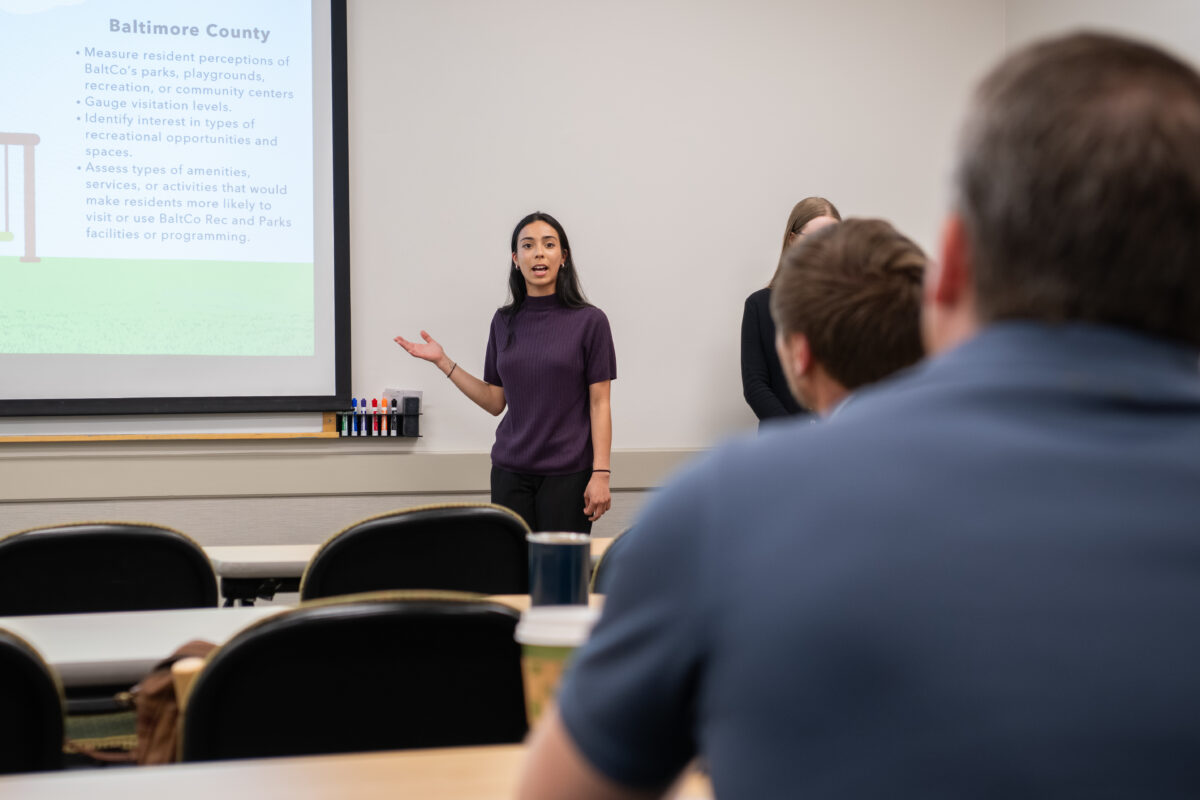
Institute of Politics student research assistant Sofia Cabrera presents IoP research to state and county officials (Brad Ziegler/UMBC)
On April 29, IoP research assistants Trisha Sirsat, Audrey Grutzik, and Sofia Cabrerapresented results from the IoP’s March statewide poll and April poll of Baltimore County. Each poll included an array of questions that gauged residents’ opinions toward parks, recreation, and public lands. The audience of state and county leaders included Maryland Department of Natural Resources Secretary Joshua Kurtz and Baltimore County Director of Recreation and Parks Bryan Sheppard. The students’ presentation provided analysis regarding visitation, preferred activities, and areas for expansion and improvement. When the leaders peppered the students with questions, the students were prepared.
“I was really impressed with the quality of the analysis,” said Kurtz, who appreciated how the student’s youthful perspective added to the value of the research. “Having our young people who are about to step into the professional world and be the next set of leaders doing this research is critically important.”
AAPI event connects students with careers in politics
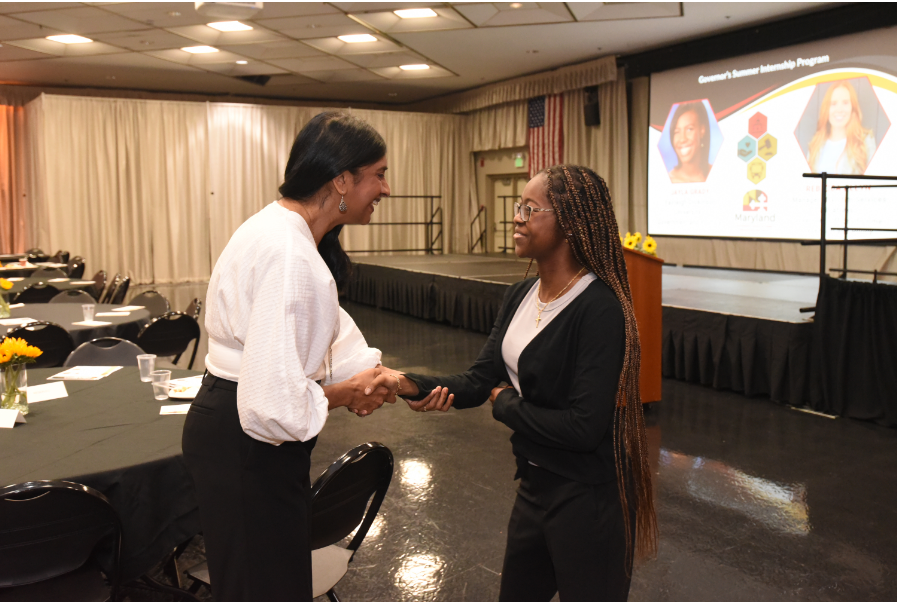
Lt. Governor Aruna Miller hugs Institute of Politics student research assistant Trisha Sirsat (Maryland GovPics)
A week later, the IoP brought another set of leaders to campus to engage with students, this time to mark Asian American and Pacific Islander Heritage Month. Politics Everywhere: Understanding the AAPI Vote was co-moderated by Sirsat and UMBC alum Del. Mark Chang ’99 and kicked off with a keynote by Lt. Gov. Aruna Miller followed by a panel including Dels. David Moon, Kris Valderrama, and Harry Bhandari, Ph.D. ’21, and Sushant Sidh, principal at Capitol Strategies.
The event was inspired by Del. Chang, who worked with Sirsat to develop questions for the panelists. The panelists shared similar stories of having been written off, undervalued, or discriminated against early in their careers until learning that they deserved to have their voice heard—a lesson they urged the assembled students to take to heart.
“Volunteer, work on a campaign. And when the time comes, run for office. Don’t ever keep that off your list of things to do, said Lt. Gov. Miller, who added this incentive: “When any of you decide to run, give me a call. I would love to be able to be the first one that writes you a check for your campaign.”
The students say working on critical policy research and engaging with local and state leaders shows them how government actually works and helps them make connections for the future.
“It was really exciting and fulfilling to see leaders so invested and interested in our work,” says Sirsat, a junior majoring in political science. “I think it’s really valuable to meet and have conversations with experts in positions you may want one day.”
Kromer says the recent events, and all of the IoP’s work, are key to living up to the IoP’s commitment to its public-facing mission. “I want to elevate the voices of everyday Marylanders and provide policymakers useful information about how they can better serve the residents of the state,” says Kromer, who adds that students can look forward to more exciting opportunities in the fall.
Caring for others has always been central to who Maleeha Ahmed ’26 is. As the oldest of five children, she naturally stepped into caregiving roles early in life, supporting both family members and older adults in her community. Over time, she began to recognize that the work she had been doing informally for many years reflected the values and responsibilities of professional social work.
Balancing caregiving responsibilities and helping manage an accounting business with her husband of 26 years made returning to college challenging, and for many years her education was interrupted by family obligations. However, during the COVID-19 pandemic, Ahmed realized how important it was to complete her degree and build long-term stability for herself. With renewed determination, she returned to school at the Community College of Baltimore County (CCBC), where supportive faculty encouraged her to continue her academic journey.
Ahmed was introduced to social work during UMBC orientation by Kenneth Baron, assistant vice provost for academic advising and student success, who helped her see how the profession aligned with both her experience and her career goals. With his guidance, she chose to pursue social work alongside psychology and ultimately completed both majors after transferring to UMBC.
At UMBC, Ahmed found a welcoming community, especially among other adult learners balancing education with family responsibilities, especially within the social work program. Ahmed will continue her education at Salisbury University this fall in the Master of Social Work program, where she plans to focus on work with older adults and end-of-life care and counseling.
Q: How did you come to be at UMBC?
A: UMBC was always my first choice because it is close to home, which was important since I am a caregiver for my mother and needed to be available if she required support. I had started college several times over the years but had to pause because of caregiving responsibilities and family obligations. During the COVID-19 pandemic, I realized how important it was for me to complete my education and build long-term stability for myself. That experience strengthened my motivation, and when I returned to school, I approached my studies with greater focus and determination. I completed my associate degree at CCBC and then transferred to UMBC to pursue a double major in psychology and social work.
Q: What was different this time?
A: This time I returned to school with a clear purpose and stronger self-confidence. Earlier in my life, caregiving responsibilities, especially caring for my father, made it difficult to continue my education. I also faced challenges as an ESL student returning to college after many years away. However, I eventually recognized that I had already developed strong problem-solving and leadership skills through running a business and supporting my family. That realization helped me believe in my academic ability and stay committed to completing my degree.
Q: How did your professors show their support?
A: At CCBC and UMBC, I was very fortunate to have professors who were supportive and encouraging throughout my academic journey. Their guidance helped me build confidence and stay motivated. I actually began by taking just one class at CCBC in 2022, but the encouragement I received from my professors made me feel capable and excited about learning again. That support played an important role in helping me stay committed and continue my education full time.
Ahmed is presented with the Tina D’Angelo Memorial Scholarship by Nancy Kusmaul, social work. (Photo courtesy of Ahmed)
Q: What has your community been like here at UMBC?
A: I found the campus community to be welcoming and supportive across different age groups and backgrounds. As an adult learner, it was especially meaningful to connect with other returning students who understood the challenges of balancing school with family responsibilities. We encouraged each other and became an important source of support throughout my time at UMBC.
Q: Why did you choose social work?
A: I have always felt drawn to helping others, but earlier in my life I did not realize that social work was a professional field I could pursue. Through my involvement with my mosque, I supported several refugee families and saw firsthand the importance of family support and counseling services. That experience motivated me to return to school and begin working toward a degree in psychology at CCBC because I was interested in becoming a family therapist.
During orientation, I met Dr. Kenneth Barron, who introduced me to social work as a profession and explained that it would allow me to reach my goal of becoming a therapist more quickly. As an adult learner, time was an important consideration, and his guidance helped me see how social work aligned with both my experience and my career goals. With his encouragement, I added social work as a second major. His mentorship played an important role in my academic journey.
Q: Tell me about your social work field work placement.
A: I am completing my field placement at Vantage Point, a continuing care retirement community in Columbia. It has been a very meaningful experience, and I have been fortunate to work with two supportive supervisors, one in a clinical role and one in a community-based social work role. This has allowed me to gain exposure to different aspects of practice across the continuum of care for older adults. Through this placement, I have been developing skills in assessment, collaboration with interdisciplinary teams, and supporting residents and families during transitions.
Q: What do you see your career being like when you get your MSW?
A: After completing my MSW, I hope to continue working with older adults, particularly in hospice or end-of-life care. My field placement at Vantage Point has strengthened my interest in aging services and has helped me better understand the importance of providing emotional support to residents and families during times of transition and serious illness. Through this experience, I have seen how meaningful it is for individuals to feel supported, respected, and not alone during vulnerable stages of life.
My interest in hospice work is also shaped by personal experience. I once cared for a refugee woman with cancer in my home when her family was unable to provide support, and I stayed with her until she passed away. I have also been present with three people in my life at the time of their death. Those experiences helped me become more comfortable with end-of-life care and showed me how important it is for someone to be present and provide dignity and companionship during that time.
Q: What benefit do you get from the close contact with people you’re caring for?
A: Working closely with people has always felt meaningful to me because I value helping others feel supported, respected, and understood, regardless of their background or life circumstances. Social work feels like a natural fit for who I am because it allows me to combine compassion with practical support and advocacy. It gives me a strong sense of purpose to know that I am contributing in a way that makes a real difference in people’s lives.
Q: How are you preparing yourself to prioritize self-care in order to undertake a career like this?
A: Earlier in my life, I often focused on caring for others without paying enough attention to my own well-being. Over the past two years at UMBC, I have learned how important it is to recognize my limits and take time to recharge so I can remain effective in supporting others. I now make space for activities such as walking, prayer, and quiet reflection, which help me manage stress and prevent burnout.
Q: How do you hope to look back on your working years?
A: I would like to continue working for as long as I am able because helping others gives me a strong sense of purpose. Most importantly, I hope I will have encouraged people to be resilient, believe in themselves, and continue moving forward even during difficult times.
Q: What would you tell people who think it’s too late to go back and finish their education?
A: It is never too late to return to school. During my time at UMBC, I met many adult learners who were balancing family responsibilities and other life commitments while attending school full time, and their dedication was a constant source of encouragement for me.
I also experienced how powerful mutual support can be. For example, a close friend and study partner I met at CCBC had been taking classes only occasionally, but seeing my commitment encouraged her to continue her education. She is now preparing to pursue her nursing degree. Experiences like this have shown me that people can inspire each other at any stage of life, and that with determination and support, it is always possible to move forward.
Dionne Cole, a native of Montgomery County, came to UMBC expecting to pursue a career in biology. But after a few semesters, she found her true calling lay in the intersection of social work, public health, and social justice. Guided by her faith as well as the support of her family and the community she built at UMBC, Dionne took on a dual degree, combining her newfound passion for social work with biology. She did her social work field placement at Retriever Essentials—a partnership advancing food access at UMBC—this year and became an advocate for students experiencing food insecurity, impressing everyone with her hard work and determination to make a difference. She plans to take time next year to work, before returning to school to get her master’s in public health.
Q: What made you decide to come to UMBC?
A: During the college application process, I was actually looking to go overseas because I love traveling and also because my family is from London. But I ended up coming to UMBC because I received a good award package, and I saw how they really valued community. That was a value that I cultivated in high school that I wanted to continue fostering in college. And then, because I was interested in being a bio major, seeing how research-oriented UMBC seemed, was also appealing as well. I think I made the right choice.
Q: Did you find the community you were looking for?
A: Yeah, in a big way. My faith is a big aspect of my life, so a lot of that community that I was looking for came through a group I joined called Bethel Campus Fellowship. Just being able to be around people who are like-minded and can also support and encourage you while you are a college student—that’s a lot. I also found community in the Social Work Student Association and the Public Health Council of Majors where I was able to connect with people who had similar interests. That was empowering because I wanted to go into a field that really valued public service and valued people. Being a member in those two clubs really reinforced that for me. And my internship at Retriever Essentials, which I am just wrapping up now, has been within itself a community of people who really care about other people and want to serve.
Q: How did you choose to be a dual degree student?
A: I came in as a bio major and early on, I started realizing that I was being prepared to either go into STEM research or medicine. Those are great fields, but that’s not really what I want to do. I talked with my cousin about the healthcare field, and she explained to me the value of social work. And then I talked to a social worker at my mom’s workplace and started doing my own research, and I was like, “okay, this is a field that has what I’m looking for.”
Cole shakes hands with Aruna Miller, Lt. Governor of Maryland. (Photo courtesy of Cole)
I didn’t switch right away. I took two intro to social work classes just to see if I would like it. I fell in love with the core values, particularly social justice. I am social justice-oriented, so once I learned more about social work, I thought: This is it for me—I’m going to add social work to my degree plan and start pursuing opportunities that are more in line with that. But I still kept the bio background because I love biology.
Q: How did you end up at Retriever Essentials and what was that like for you? What did you learn?
A: I started at Retriever Essentials as a community liaison with Maryland Food Bank, largely doing SNAP [Supplemental Nutrition Assistance Program] outreach on campus. When it came time to choose my field placement for the social work curriculum, I chose Retriever Essentials. I learned how prevalent food insecurity is on college campuses and how much of a public health issue it is. I found out food insecurity is more prevalent on college campuses than it is among the general population because of the cost of higher ed and all of these other compounding factors.
I think that was probably the biggest thing that I learned. I didn’t know it was a public health issue when I originally came in. Through managing their Save-a-Swipe program, I met with students who were experiencing food insecurity and I assessed their situation. And that was a very interesting experience, just sitting with students and hearing them talk about all the ways in which food insecurity affects them. A lot of the students I met with were international graduate students and their stories impacted me a lot because they traveled all this way—they’re coming here to advance their education—and yet their basic needs aren’t being met. And that was just really hard to hear. But the one thing I will say about social work is that it teaches you how to take the things that you see that are very frustrating to you or heartbreaking to you, and use them as fuel to try and advocate and make things better.
Q: Did you find places at UMBC to make your voice heard?
A: Yes. I have a friend [Emmanuella Osei’26, public health] who was also interested in food insecurity, and she had her own research project just surveying the prevalence of it on this campus. Mine was evaluating Retriever Essentials and how it’s doing at helping students overcome food insecurity. We decided to merge our projects and, with the help of my field instructor—Sue Poandl, who is also her McNair Scholar mentor—we actually got a meeting that is next week with Dr. Renique Kersh, the vice president of Student Affairs to talk about that research.
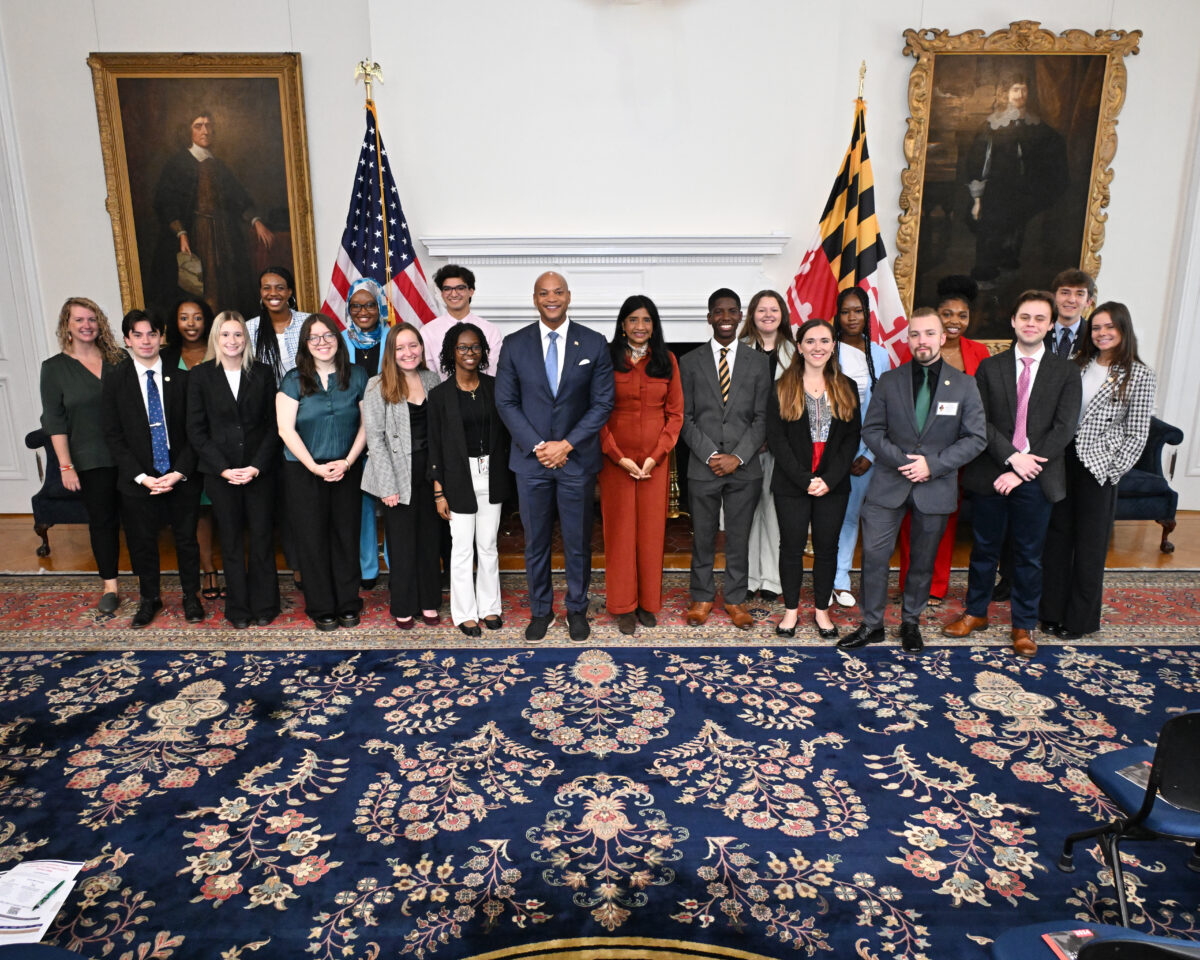
Cole with Governor Wes Moore (just left of him in the white pants and black jacket) during the closing ceremony of the Governor’s Summer Internship Program (GSIP). (Photo courtesy of Cole)
UMBC listens because when we went to my field instructor and the leaders of Retriever Support Services and Retriever Essentials about what we wanted to do, they were very much supportive and said: How can we help you get this in a place or in front of a person who can actually do something about it?
Q: Social work can be very emotionally demanding. What have you learned about self-care while you’ve prepared yourself for a career in social work and public health?
A: My field instructor says to lean on your people. I had a lot of days where, after meeting with a bunch of students, I would feel the weight of their stories and it would be very hard for me to process and think. And that goes back to having community, particularly in my faith,and being able to go to my friends who are not social work majors. They can only understand what I’m going through to a certain degree, but just being with them makes me feel lighter—even if I’m not necessarily talking about what’s bothering me. And verbally processing with them, just being able to be in their presence and have their prayers and stuff like that—it was really helpful.
Q: What impact do you think you contributed to UMBC that will be here after you are gone?
A: I would hope that it’s community—the same value that I came in wanting to foster. I hope it’s the same value that I leave behind: valuing community in every way. Because you don’t get to the finish line without your community. And community can come in so many different forms. What I get out of my fellowship community is not necessarily the same that I got out of my Retriever Essentials community. But they both helped me, and they both did their part in getting me to the finish line, and also taught me so many things that have helped me grow as a person.
Cole during a Maryland Public Service Scholars Program interview. (Marlayna Demond ’11/UMBC)
I really hope that people see from me the value of the community that is around them academically. There are so many professors and staff and faculty who took jobs at a university because they wanted to help and empower students to fulfill their dreams: lean on that. Some professors might seem scary, but lean on them because most of them just want to help. Same thing with student orgs. The people who run them don’t only enjoy the interest that the club is for, but genuinely believe in the gathering of people. And yeah, I hope that I’ve added to the value of community that this university already had.
UMBC has launched two exciting new Election 2024 resources that affirm the university’s commitment to civic engagement and benefit both our campus community and the greater Maryland region.
UMBC Poll
As a public university, UMBC takes pride in providing high quality research and analysis that serves the greater good. In August, UMBC launched the Institute of Politics (IoP) to bring more political research and insights into Maryland elections. The inaugural UMBC Poll, released in two parts on October 8 and 9, surveyed residents and voters in the Baltimore metro region and statewide, and gauged the attitudes of Maryland adults and voters on topics critical to the coming election such as candidate preferences for U.S. Senate and Presidential matchups, job approval ratings for Governor Wes Moore, key economic indicators, and issues and reasons driving voter choices.
Featuring the expertise of IoP Director Mileah Kromer, the inaugural UMBC Poll was covered widely in state and national news outlets, including the New York Times, Baltimore Sun, the Washington Post, and Fox News.
Election Central
Also in October, UMBC launched Election Central, a website that provides visitors with relevant information to participate in the coming election. The site includes links to voter registration, guidelines about exercising free speech on campus, and a civic engagement toolkit where students and others can find voting information, mail-in ballot drop-off locations on campus, and more.
The civic participation information on Election Central is largely the work of UMBC’s Center for Democracy and Civic Life, a student-facing campus organization that helps individuals and groups develop the knowledge, skills, and dispositions needed to contribute to a thriving democracy.
Election Central also contains resources for the news media, with information on UMBC faculty, staff, and students who are ready to speak to reporters about election-related issues.
Students like Vunnathi Ankem, a psychology major, Sondheim Public Affairs Scholar, and vice president of the Honors College Council, says projects like Election Central help students take their rightful seat at the public affairs table.
“College students have access to a wealth of knowledge,” saysAnkem, “It is both our right and responsibility to serve our communities when we can.”
UMBC announces partnership with national nonprofit College Track, a national organization dedicated to supporting the academic and personal growth of first-generation and other less-advantaged students as they navigate through high school, college, and beyond.
The agreement gives College Track a public higher education partner in the Baltimore region and builds on the April announcement by the Baltimore Ravens, the Stephen and Renee Bisciotti Foundation, and M&T Bank of a $20 million donation to establish a College Track center in Baltimore to support Baltimore City Public Schools.
By combining College Track’s innovative 10-year commitment to wraparound services with UMBC’s proven success at delivering equity-based educational outcomes, the collaboration between the research-oriented public institution and the nonprofit is an exciting step forward for inclusive academic excellence in the Baltimore region and reflects UMBC’s deep commitment to advancing knowledge, economic prosperity, and social justice by welcoming and inspiring inquisitive minds from all backgrounds.
“UMBC’s tradition of academic and scholarly achievement is rooted in our understanding that there can be no excellence without inclusion; providing opportunities for students from all backgrounds is central to our core mission,” said UMBC President Valerie Sheares Ashby. “Partnering with College Track will allow us to ensure that first generation students and students from underserved communities have all the tools they need to reach their full potential.”
College Track currently serves more than 4,000 high school and college scholars in California, Colorado, Louisiana, and the D.C. metro area. Ninety percent of College Track scholars are first-generation college students, and 84 percent are from underserved communities. They earn their bachelor’s degrees at more than two and a half times the rate of their first-generation peers. UMBC, a historically diverse university that is a national and global leader in education, research, affordability, and community engagement, is the nation’s number one producer of Black undergraduates who go on to complete a Ph.D. in the natural sciences or engineering, and number one for Black undergraduates who complete an M.D./Ph.D.
“
Partnering with College Track will allow us to ensure that first generation students and students from underserved communities have all the tools they need to reach their full potential.
Valerie Sheares Ashby
President
Under the terms of the partnership agreement, UMBC will guarantee admissions each year for eligible College Track Scholars from Maryland with a priority on students from Baltimore City schools. UMBC will provide funding for the full demonstrated financial need of these College Track scholars up to the cost of attendance for up to five years of full-time enrollment. UMBC will also invite all College Track scholars to participate in the Summer Bridge program, a 6-week residential program that prepares students for academic life, with costs covered by UMBC.
“At UMBC, we do not just talk about equity and social justice, we make it happen in real, tangible ways that improve people’s everyday lives,” said Sheares Ashby. “Combining our academic strengths with College Track’s effective support model will empower promising students in Baltimore and across Maryland to pursue their dreams and contribute meaningfully to their communities.”
UMBC President Valerie Sheares Ashby joined a group of Maryland business and higher education leaders in Annapolis on September 25 to welcome King Abdullah II of Jordan, the first foreign head of state to visit the Maryland State House on official business. Led by Governor Wes Moore, the Maryland leaders engaged the King and his delegation in a roundtable to explore economic development and partnerships between Jordan and our state.
“Today, we are here to talk about ways to work together toward common goals,” said Governor Wes Moore, as he officially welcomed the delegation on behalf of the state. “We have brought together leaders from across the state to engage in this historic visit and we look forward to a vibrant discussion about our people, our economies, and our futures.”
Maryland presents attractive possibilities for any nation looking to grow its economy. According to Governor Moore’s office, the State of Maryland has a wider variety of business incentive programs than any other state in the country, providing nearly 100 grant, tax credit, and loan programs—including those targeted toward international businesses. Maryland also ranks first in the nation for the proportion of university graduates with science and engineering degrees and fourth in the nation for the percent of its workforce employed in STEM careers.
During the roundtable, President Sheares Ashby took the opportunity to highlight UMBC’s strengths in STEM and the exceptional, diverse talent it cultivates. She pointed to key university strengths, specifically those designed for working professionals, helping them earn certificates and upscale their abilities in emerging disciplines such as cybersecurity, software systems, AI, and data science. She also underscored the significance of global collaborations and the vital work UMBC is doing in the areas of information and technology.
“I want to thank Governor Moore for his leadership and deep commitment to improving the lives of Marylanders through higher education,” said Sheares Ashby. “We would not be able to do what we do without such a great partner in our governor.”
University of Maryland, Baltimore County (UMBC) is a top-ranked national university with an inclusive culture that connects innovative teaching and learning, research across disciplines, and civic engagement.
Noted Maryland poll founder Mileah Kromer will be center’s inaugural director.
University of Maryland, Baltimore County (UMBC) President Valerie Sheares Ashby announced today the founding of the UMBC Institute of Politics (IoP)—an academic, political research, and public outreach center that will harness the university’s robust research capacity and civic-focused public mission to provide a regional base for local, state, and national political analysis.
The IoP will open with the start of the fall 2024 semester on August 28, and will begin public opinion polling and other public-facing initiatives on issues related to the 2024 general election and the upcoming 2025 Maryland state legislative session. The IoP’s most important purpose will be to provide UMBC students with unique opportunities for experiential learning and to build career-ready skills.
Mileah K. Kromer, will serve as the IoP’s inaugural director. She will join UMBC’s Department of Political Science as an associate professor and teach courses on American politics, Maryland state politics, and survey research methodology. Kromer previously served as director of the Sarah T. Hughes Center for Politics at Goucher College and founder of the influential Goucher College Poll.
“There has never been a more crucial time in our democracy for credible, high-quality research and information on our political systems and electoral processes,” said Sheares Ashby. “As a public R1 institution located in the greater Washington, D.C., region, UMBC is ideally situated to enrich political understanding, elevate the level of public discourse, and better prepare our students to be active, engaged citizens of our state, our nation, and our world. We are delighted to welcome Mileah Kromer to the UMBC family and excited to add the Institute of Politics to our campus community.”
The IoP will be housed in UMBC’s College of Arts, Humanities, and Social Sciences and will build on the civic engagement, public affairs, and social science research work already being done by the university’s Center for Democracy and Civic Life, Sondheim Public Affairs Scholars Program, and Center for Social Science Scholarship. Ian Anson, associate professor of political science, will serve as associate director.
“I’m thrilled to have the opportunity to build an Institute of Politics at UMBC. As a first-generation college graduate, I know firsthand that public institutions like UMBC—with their focus on inclusive excellence—have the power to change the lives of students from all backgrounds,” said Kromer. “I’m excited to build an institute that supports learning opportunities for the next generation of policymakers and builds on the already excellent work done by faculty in the College of Arts, Humanities, and Social Sciences.”
About the inaugural director
Since 2012, Kromer has led the Sarah T. Hughes Center for Politics at Goucher College, where she founded and directed the Goucher College Poll. She brings with her nearly two decades of public opinion polling and teaching experience from Louisiana State University, Elon University, and Goucher College.
Kromer is a recognized expert on Maryland politics and public opinion polling. Her opinion writing has appeared in POLITICO Magazine, CNN, The Washington Post, The Hill, The Baltimore Banner, Maryland Matters, and The Baltimore Sun. She is a frequent guest on state and local public affairs programs like WYPR’s Midday with Tom Hall, WBAL-TV’s 11 TV Hill, and MPT’s State Circle, among others.
Kromer is the author of Blue State Republican: How Larry Hogan Won Where Republicans Lose and Lessons for a Future GOP (Temple University Press, 2022). Her work has also appeared in Gender & Politics, Survey Practice, Social Science Quarterly, and the Social Science Journal. Her forthcoming article in State and Local Government Review examines how academic-based survey centers can play a role in real-time state and local political discourse.
Kromer earned her B.A. in economics from Indiana University of Pennsylvania in 2003 and a Ph.D. in political science from Louisiana State University in 2008.
University of Maryland, Baltimore County (UMBC) is a top-ranked national university with an inclusive culture that connects innovative teaching and learning, research across disciplines, and civic engagement.
On July 1, UMBC welcomed Manfred H. M. van Dulmen as our new provost and senior vice president. What is a provost exactly, and how does van Dulmen interpret his role on campus? He answered these questions and more in a Q&A as he took a break from moving into his new office on the 10th floor of the Administration Building.
Van Dulmen comes to UMBC after two decades at Kent State University in Ohio, where he has held many leadership positions including, most recently, senior associate provost and dean of the Graduate College. With an academic background in social, developmental, and adolescent psychology—increasingly focused on people in their twenties—van Dulmen brings a unique perspective to UMBC leadership that promises to further our campus commitment to student all-around well-being.
Q: What is the simplest way to describe the role of a provost at a university like UMBC?
A: The provost is responsible for overseeing the academic enterprise at an institution and providing the vision and mission for that academic enterprise. That’s the short answer. I think the longer answer is that the role of the provost at many universities has shifted significantly over the past 10 to 20 years. It’s become more inclusive of other tasks across the university, particularly for institutions that see academics as the center of campus. All other areas intersect with the academic areas, so the provost is somebody who develops close relationships with all other divisions on campus to really make sure that students can succeed.
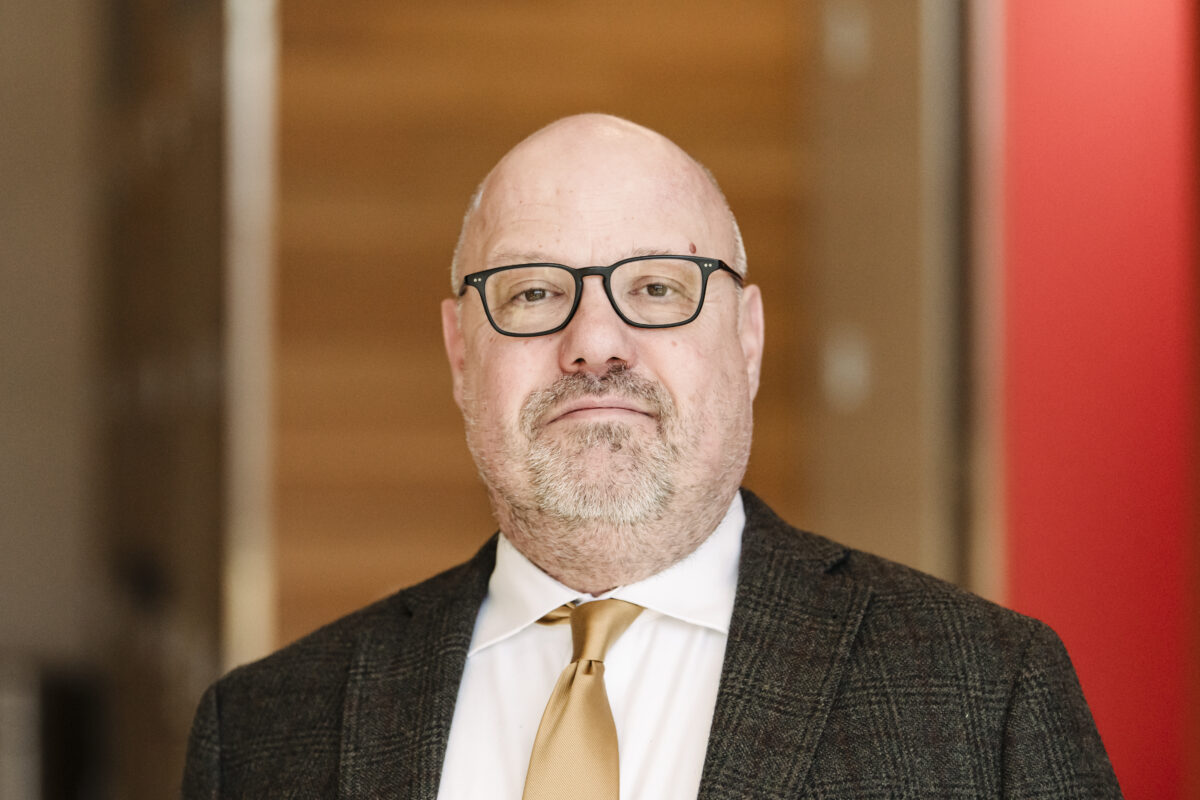
Headshot of Manfred van Dulmen. (Marlayna Demond ’11/UMBC)
Q: What drew you to UMBC?
A: UMBC’s legacy and reputation in higher education as a leader in inclusive excellence, particularly at the undergraduate level, certainly appealed to me. UMBC is known as an institution that has really led the country in how to do inclusive excellence well. I’m very passionate about access and inclusion and making sure that all students can succeed and that an institution is a place where faculty and staff can thrive. So, for me, this seemed like an incredible opportunity that I couldn’t pass up.
As I interviewed and had conversations with the search committee, faculty, and other stakeholders, it became increasingly clear to me that the people at UMBC are at the heart of all that UMBC does and does well. Also, I was drawn to the combination of being excellent in research and teaching, whereas I think at many institutions, it’s an either/or. A university that has demonstrated it can excel in both areas was really appealing to me.
Q: How do you think a provost can shape the academic experience for students?
A: A provost can have an impact by working with faculty, chairs, and deans to provide opportunities to innovate the curriculum to meet students where they are and also where faculty see that their fields are going. As provost, it’s important both to make sure that faculty can see what is possible and not focus on what the barriers are to innovation so that students have a curriculum that is exciting and innovative.
In terms of the student experience, a provost can have an impact by being an advocate of student success services and support that reflects best practices in the country. And there are many amazing people at UMBC who are involved in that work.
Q: How did your path in academia lead you to this point?
A: I’ve always been interested in and committed to service. One of the reasons I wanted to work in higher education was to improve the way that we live our lives and the communities where we live our lives. And as a psychologist, much of my work has really centered on why some people succeed while others struggle. Why do people succeed in the presence of great trauma or great challenges in life? I have increasingly focused on individuals in their twenties. So, for me, a university is a natural place to work in supporting student success.
“
As I interviewed…it became increasingly clear to me that the people at UMBC are at the heart of all that UMBC does and does well.
Manfred van Dulmen, provost and senior vice president
Q:In what ways do your research and your fields of study specifically impact our current student population?
A: I think in every way possible it does. Even aside from the COVID-19 pandemic, the rates of mental health problems in the United States and many other countries have increased substantially over the past 20 years. We know that many behavioral health issues present themselves first in late teens and twenties. And so, helping students succeed and really think about their needs and where we can meet them is more important than ever.
At my previous institution, I was involved in developing the student mental health strategy, where we reallocated $2 million to better support the behavioral health needs of students, and we hired many more counselors to reduce waitlists on campus. We developed telehealth options that went well beyond what we previously had done. I’ve also learned that when we think about supporting students around their mental health needs, it means having community partners that you can work with when students’ needs go beyond what the university can provide.
Q: What excites you about working with UMBC’s faculty?
A: There’s so much exciting research going on and such a commitment to student success—I really want to continue to understand better what our current strengths are and how we can make sure that the world knows about all the great things happening at UMBC. I want to understand how we can further elevate the great work that’s already happening and make sure that faculty have the resources to continue to do their great research and be excellent teachers in the classroom.
But I also want to think how we can further elevate and be a leader in the country. Where are the United States and the world going to be 10, 15 years from now? And how can we help prepare our students for that new world?
Q: How do you see yourself supporting UMBC’s mission of academic and research excellence, inclusion, and community engagement?
A: I think by listening to faculty, staff, and students, while respecting the past and growing to understand the culture, I can help people see what’s possible while making sure there is room for everyone to have a voice and be heard.
Q: What’s your impression of the UMBC campus so far?
A: It’s very serene and calm. The combination of trees and buildings and space has a very good vibe about it. And I really like seeing and feeling the diversity of the student body when I walk around campus. You can just see how much people feel at home and feel connected, and that is really a warm and safe space that supports all members of the UMBC community to be successful.