All posts by: Magazine Editor


Battlefield of Bits and Bytes

How UMBC is pushing the frontiers of research and training in cyber security – and keeping its own networks safe from attacks.

By Joab Jackson ’90
Photo Illustrations by Aaron Goodman

Defending UMBC from web attacks is a more than a full-time job. It’s a 24/7/365 undertaking.

Earlier this year, for instance, Mike Carlin ’96, biological sciences, Ph.D. ’09 information systems, was driving to New York. UMBC’s assistant vice president of Infrastructure and Support paused to check his Blackberry at a rest stop in New Jersey when he received what looked to be an official UMBC e-mail, informing him that his UMBC account password was about to expire, and that he should log in and re-register immediately.
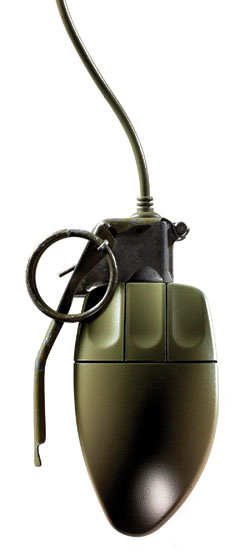
battlefield_subimage1The missive had a UMBC logo. And the link at the bottom of the page seemingly took the recipient to a UMBC Web site. But Carlin, who oversees network security at the university, would have known if there was system-wide reset of passwords.

The spammers had sent their e-mail to one of the people at UMBC who knew definitively that it was a fake.

But Carlin also knew that thousands of other UMBC faculty, staff and students who likely got identical phony dispatches might not know. Some would take the bait, be led to a fake Web site and unwittingly submit their passwords and other information. The spammers could then log into these user accounts and send out millions of spam messages to the rest of the cybersphere.

Carlin and his department responded swiftly. First, they alerted all UMBC e-mail account holders about the fake notices, and followed up with a campus-wide blog post providing more information. They also blocked the Web address of the fake UMBC log-on, so people on campus couldn’t access the site – and alerted the university’s help desk to respond to incoming inquiries.

For Carlin and his colleagues in the university’s Office of Information Technology, this sort of fakery is nothing new. But each new attack is a bit more sophisticated than the one before, and each round of potentially devastating e-mails is more polished and more personalized.

“This has been going on throughout higher education,” said Jack Suess ’81 mathematics, M.S. ’95 operations analysis, vice president of information technology and chief information officer at UMBC. Suess and others in the division acknowledge that spammers see higher education as a prime target. Universities have open networks. They have good bandwidth. Universities also boast powerful servers and a fresh crop of new students each year who may know little of the spammers’ scheming ways.

The payoff for such scams can be immense. Andy Johnston, network security coordinator for UMBC, discovered that in one case alone, over six million e-mails were sent from a single account. It’s very doubtful that this was a legitimate use of this account, he adds.

UMBC is not alone in battling electronic intruders seeking profit, secure data, or even a bit of mischief. Network security has become a key demand for almost every organization – and the stakes for getting it right only grow.

As knowledge and the economy become more global and more connected via the Web, organizations and individuals grow increasingly reliant on computers for essential tasks such as online banking, shopping, and even basic information. Computer security has assumed a more critical role in civilization.

The good news is that UMBC is playing offense as well as defense in this increasingly critical arena. The university also helps government, business and other organizations keep the bad guys at bay through research and training that provide expertise and tools to secure the online world today and in the future.

The nascent but growing practice of electronic voting is just such a frontier. The benefits are manifold: ease, expense, speed of counting and even the potential to increase turnout by allowing voting from one’s computer or phone. The downside, however, is that the integrity of democracy demands that the system be foolproof. Every participant must have absolute faith that the system is immune to fraud. Witness the furor over the hanging chads in the 2000 U.S. presidential election.

UMBC associate professor of computer science Alan Sherman has been part of an effort to create such a foolproof electronic voting tabulation system. Noted cryptologist David Chaum originated the idea, and Sherman and fellow researchers from the Massachusetts Institute of Technology, George Washington University, the University of Ottawa and Waterloo University have all pitched in to try and make it a reality.

“The reason voting is hard is that you must have both outcome integrity and ballot privacy,” Sherman says. “If you drop either one of those constraints it becomes easier,” Sherman said.

In a functioning democracy, no one wants to make the choice between getting the count right and the right to cast one’s vote privately in the sanctity of the ballot box. But Sherman and his fellow researchers think they’ve cracked the problem. Last November, they tested Scantegrity – a prototype electronic voting system – in Takoma Park in a local election.

For a voter in Takoma Park or elsewhere, Scantegrity works almost the same as any other optical scan ballot. Voters mark choices by filling in bubbles on a printed form, which are then scanned into a machine for tabulation.

What’s different, however, is that the voter casts a vote with a special pen that holds invisible ink. A pen stroke reveals a unique code in the bubble where the mark was made. The voter can write down the code on a receipt. Later, in the privacy of their home, the voter can check the code on a Web site to verify that a vote with this code has been tallied.

The code doesn’t reveal the nature of the vote; only that it was properly counted. Through the use of encryption, voting officials and even third parties can audit the integrity of the vote count without revealing personal details – an approach known as zero-knowledge proof.

About 66 of the 1,700 Takoma Park voters who used the system checked their votes online. The next step is to try the system state-wide, Sherman says.

Voting is just one aspect of modern life that is being moved into the electronic realm. Banking, health records, online shopping, education and official record-keeping all have moved into the realm of cyberspace.

So it’s not surprising that the federal government sees network security as a matter of national security, and believes that attacks on our networks will be thought of as acts of war in the future.

Recently the search engine company Google found that its own servers were being attacked by computers in China, putting the search service we use every day at risk of being disrupted. Google’s corporate officers weren’t the only ones who were alarmed; U.S. Secretary of State Hillary Clinton also pressed the Chinese government for an explanation for the apparent attack.

Though the ultimate creators of the Google attacks remain hidden in the murk of cyberspace, the message is clear – aggression can be unleashed in virtual space as well as in real space. And the effects can be nearly as devastating.

“As the most wired nation on Earth, we offer the most targets of significance, yet our cyber defenses are woefully lacking,” wrote ex-National Security Agency (NSA) director Mike McConnell in a recent opinion piece in The Washington Post.

UMBC is lending a hand in this battle, as well. Though the university does presently offer a specialized degree in computer security, Sherman says that the fundamentals it teaches its students should give future security professionals the solid basis in computer science which will allow them to quickly formulate knowledgeable responses to future threats. “Computer science is evolving very rapidly,” said Sherman. “It is very important that our priorities are on the fundamental skills and teaching students how to learn to keep up with things.”

A UMBC education in computer science also offers students interested in the battlefields of cyberspace some experience with what may await them. Sherman is also the director for the UMBC Center for Information Security and Assurance, which seeks to bring together the best cyber security practices from across the school’s different academic disciplines. One of the center’s programs is the Cyber Defense Lab, which was set up with the help of a grant from the Defense Department.

The lab runs a mobile cyber defense exercise. Thirty laptops are loaded on a cart, which can be wheeled around from classroom to classroom. On the laptops are pre-configured scenarios covering many of the typical attacks of the day: buffer overflows and wireless intrusions. The students work through the exercises to get a better feel of how to handle an attack.

“Students learn more efficiently when they are in more hands-on exercises,” says Sherman.

UMBC students are also motivated enough to find those experiences for themselves. A group of undergraduates recently created a team to compete in various intercollegiate cyberwarfare competitions. Teams are assessed on their ability to reduce vulnerabilities to cyber attacks and to keep systems running, and UMBC’s contingent took first place overall in the qualifying rounds of the 5th Mid-Atlantic Regional Collegiate Cyber Defense Competition.

Proximity is also a UMBC advantage. The university is close to the headquarters of the National Security Agency (NSA) – an agency which is on the front lines of the cyber battlefield.

The federal government’s Base Realignment and Closure (BRAC) plan is helping to settle an influx of 60,000 military people moving into the area to work at the U.S. Army’s Fort George G. Meade. Among those reassigned will be those who will need to defend the country on its computer networks, both public and private. And last December, the state of Maryland awarded UMBC an $83,000 grant to help train this workforce.

The university will use the money to set up a Center for Cyber Security Training as an extension of UMBC’s Training Centers. The centers already offer technical, scientific and professional non-degree training programs to working professionals – and even specialized programs in information security and “ethical hacking.”

The new grant money will go towards expanding those offerings and developing 15 new programs that will meet the specific needs of the NSA and Defense Department, says Kent Malwitz ’92, information systems, vice president of the UMBC Training Centers. Some courses will be taught at UMBC. Others will be designed to allow employers the chance to offer the courses at their offices or other remote sites.

Already about 25 percent of the courses taught at the center are cyber security related. Thanks to this grant, that number will increase.

“You will see thousands of people coming into the area, people coming out of the military and looking to get retrained with the G.I. Bill and then go back into careers in the computer field – those will all be big drivers for us,” says Malwitz.

In order to train the most pertinent personnel – those on the front lines of cyber warfare – the center is also undergoing a certification process set up by the Department of Defense (DOD). This certification will allow the center to develop educational materials more specific to military cyber defense.

“We can really dive into addressing what is the mission you are ultimately trying to accomplish, not just what skills you need,” adds Malwitz.

The UMBC Training Centers are also gaining valuable input in this effort from a security advisory group made up of members of some of the largest Defense Department agencies and contractors who work closely with them – including Lockheed Martin and Northrop Grumman.

These days, such specified help is sorely needed. The military has a long backlog of workers who need to get security clearances. So those who do have them need to be trained on the latest cyber-security measures. Right now, one contractor will pilfer workers from another contractor, which keeps the entire U.S. military and security establishment weaker as a whole.

Whether it is cyber warfare, electronic voting or just making sure a university’s networks stay up so its students can continue to learn, the message is clear: Cyber security is becoming an increasingly vital part of the nation’s well-being. And UMBC is making sure that its students and the larger community have the tools and expertise to meet the challenges ahead.


Up On The Roof – Summer 2010

UMBC President Freeman A. Hrabowski, III takes your questions.

Q. Many UMBC students are finding that internships are an integral part of the university experience. What’s your view about the benefits of internships for students, employers and the university?

— Richard Byrne ’86, English Editor, UMBC Magazine

A. It’s a very important part of a UMBC education. Large numbers of students across disciplines are engaged in experiences that give them the chance to explore the relationship between what they’re studying and how what they’ve learned can be used in real situations.

UMBC students in the arts and humanities may go to CenterStage or to the Walters Art Gallery. Students in engineering may go to BG&E. And students in the social sciences may work at Medicare and Medicaid Services or the Social Security Administration.

As a university, we have worked to build strong relationships with potential partners in the larger community. And these employers say that getting a chance to know students before they graduate can help them decide who they may want to hire.

I hear all the time about the quality of our students as interns. That they’re not only good thinkers, but also good people. They work well with others. They are dependable. And I talk regularly with students who have internships with companies who have been offered full-time jobs where they are working.

When we talk about internships, we also have to broaden our definition. How are students gaining work experience? They’re also doing it through regular jobs, part-time work and research experience. I recently testified to the Maryland Legislature that over 2,000 students work on our campus each year. Think about it: 2,000 students. And all of it is hands-on experience.

Q. What is UMBC doing to educate all students, not just those in environmental majors, about sustainability?

— Mark Stewart ’03, psychology

A. We’re very proud of our faculty members who focus on these issues at UMBC, particularly our Geography and Environmental Systems department. Their teaching and cutting-edge research give us an excellent foundation for wider outreach to students and others in the campus community on the urgent need to become a more sustainable planet – starting right here at UMBC.

Our primary way to reach all UMBC students about sustainability issues is an annual Teach-In, which we held again in February of this year.

This two-day event draws upon the expertise of faculty members who deal regularly with these issues in their research. There were classes that focused on how global warming is affecting population patterns, what physics teaches us about climate change, and how we use mathematics to model its effects.

Our teach-in is a cross-disciplinary program that also draws in the social sciences and humanities. Our economists spoke about the roots of climate activism in the philosophy of John Stuart Mill. UMBC literary scholars examined how the media tackles the subject. Our public policy experts weighed in on what the proper role of government in addressing the problem should be. It was an event that offered everyone at UMBC something to think about regarding sustainability as they pursue their own studies.

We also educate through our approach to campus issues. As we grapple with the challenges posed to our campus traffic and parking patterns by a desire to create a more sustainable campus and construction on UMBC’s new Performing Arts and Humanities building, we’re bringing students into the discussion of how we design and implement plans to reduce the number of single-occupant vehicles on campus.

The university’s Climate Change Task Force and its Transportation Work Group are ways that students collaborate on initiatives that improve access to public transportation, increase use of bicycles and ride-sharing programs, and upgrade campus walkways.

Reducing our carbon footprint is an important goal. But learning about the challenges as we reach that goal is also part of the UMBC experience.

2009 UMBC Alumni of the Year & Distinguished Service Award Winners

Each year, the UMBC Alumni Association presents awards to honor alumni for their professional and personal achievements and service to the University.   Learn more about our past award winners.

ENGINEERING AND INFORMATION TECHNOLOGY

Dr. James P. Clements ’85, ’91 & ’93, Information Systems, was recently appointed President of West Virginia University in Morgantown, WVa. He is the first UMBC alumnus to lead a major university. Prior to his appointment, Dr. Clements was Provost and Vice President of Academic Affairs at Towson University. A TU employee since 1989, he also served as a faculty member, Vice President for Economic and Community Outreach and Chairman of the Department of Computer and Information Sciences. Dr. Clements has published and presented more than 70 papers on management, information systems and technology. The fourth edition of his project management book is used in more than 20 countries and published in four languages.

HUMANITIES

Jeffrey “Duff” Goldman ’97, History, is known for turning traditional confections into out-of-this-world creations on his Food Network show “Ace of Cakes.” After completing his UMBC degree, Goldman attended the Culinary Institute of America in Napa Valley, Calif. His company, Charm City Cakes, has baked cakes for events including the “Kung Fu Panda” premier and the Maryland Zoo’s annual Zoomerang gala. In 2000 he was a featured speaker at UMBC’s Alex Brown Center for Entrepreneurship. He also holds a Guinness Book record for baking the world’s largest cupcake, created in March 2008.

NATURAL AND MATHEMATICAL SCIENCES

Dr. Crystal Watkins ’95, Biological Sciences, studied at the Johns Hopkins University School of Medicine. She received the David E. Rogers Award for the highest standards of professionalism, medical ethics and community leadership. Dr. Watkins’ graduate research was featured in the Wall Street Journal and led to a U.S. patent for a treatment of diabetic disorders. She has also traveled to Ghana and worked with the Princess of Ada and Ministry of Health to implement HIV/AIDS health education and prevention programs.

SOCIAL AND BEHAVIORAL SCIENCES

The Honorable Jon S. Cardin M.P.P. ’96, Policy Sciences, represents residents of northwest Baltimore County in the Maryland House of Delegates where he serves on the Ways and Means Committee. Much of his legislation focuses on election, tax and education reform. In February he was awarded the Humane Society of the United States’ Humane Legislator Award for developing legislation that gives shelters access to drugs needed to properly sedate animals prior to euthanasia. Cardin also serves as a member of the Board of Directors/Advisors for the Baltimore Shakespeare Festival, the Camp Shohola Scholarship Fund, Baltimore Hebrew University, UMBC Hillel, The American Council of Young Political Leaders, Institute for Progressive Leadership and the Maryland Public Interest Law Project.

VISUAL AND PERFORMING ARTS

Laura Pasquini ’98, Visual Arts, is the director of Youth and Family Programs at the Corcoran Gallery of Art in the Washington, D.C. She oversees the operation of all classes, programs and camps for children and their families. In her time there she has redefined the overall vision and mission of the Corcoran’s after school program, Corcoran ArtReach. She installed and supported fundraising efforts for the annual ArtReach exhibit. At UMBC, Pasquini worked in the Center for Art, Design and Visual Culture as an undergraduate intern where she worked to make art exhibits accessible and interesting to public school students through a series of creative projects based on gallery exhibits.

DISTINGUISHED SERVICE AWARD

Gustavo Matheus, Esq. LLC ’90, Biological Sciences, is always thinking of new ways to connect with UMBC alumni and is particularly interested in engaging alumni in the Washington, D.C. area. He is intimately involved in growing and maintaining the Esperanza Endowment, which supports and inspires current and future UMBC students of Latino or Hispanic ancestry and/or students who are committed to the advancement of minorities. Matheus, who practices law in Rockville, Md., mentors student members of the scholarship committee and has been instrumental in connecting with alumni who choose to support the fund.

RISING STAR AWARD

Alicia Wilson ’04, Political Science, is an associate at Gordon Feinblatt, Rothman, Hoffberger and Hollander, LLC. Prior to her position the firm’s Litigation Practice Group, she served as a clerk for the Honorable David Young for the Circuit Court of Baltimore City. Wilson spent her third year of law school at Susan Leviton’s Juvenile Law, Children’s Issues and Legislative Advocacy Clinic. She also coached the Mock Trail team at the Baltimore Freedom Academy – a high school with curriculum and culture focused on social justice and activism.

Up On The Roof – Winter 2009

Q. We’ve named this feature “Up on the Roof” because taking visitors up to the very top of the Administration Building is one of your trademarks as UMBC’s president. How did it begin?

– Richard Byrne ’86, English
Editor, UMBC Magazine

A. Actually, I’ll tell you the first person to take me there – and it’s a special memory. (Former president of UMBC) Michael Hooker took me there. He talked about the fact that the campus – prior to his coming – had been far more oriented towards Washington than Baltimore. The real question was: What should be our focus? And we decided at that time to balance the areas of focus. To talk about the fact that we are, in many ways, in the center of the corridor. When we go to one end of the roof, we see downtown Baltimore. When we go to the other end, we’re looking right into the driveway of the airport that is only 40 minutes from Washington. We had a conversation about the advantages of being connected to both metropolitan areas. Connected with the corporate community, with the cultural institutions, with the national science and health-care infrastructure, with the schools throughout the region.

So it became clear to me that the tour to the roof gave me the chance to make the point about our central location. To make the point about the development of the campus. To make the point about the connection between the campus and the broader community. And finally, going to the roof allows us to dream about the possibilities for UMBC.

Q. Do you remember the first person you took up there as president?

A. The Baltimore Sun. The day I was appointed president. They had been hearing that I said it was a great place to be, and they wanted to go up there and get a picture with me and the Baltimore skyline. And the photographer asked me to get on top of the ledge. And I was so young and naïve, and excited, that I began to climb up to the top of the ledge. And as I was getting ready to get over there, I thought about it and said: What am I doing? Because I’m really afraid of heights, by the way. And I said, “I will do many things for UMBC, but this is not one of them… This is taking it too far. It was a great lesson for me. It’s great to be enthusiastic, but don’t let your enthusiasm get in the way of your reason.

When alumni go there, they are able to put our recent development in perspective.

Sometimes, if alumni have not been back to campus recently, they can be somewhat disoriented. Where’s the old gym? And when we go up on the roof, I can point out the Commons, which is built on top of the roof of the old gym. Or they can see where the new engineering building is in relationship to buildings they knew when they were here. And once they become oriented, they begin to connect to the past. This is the place where I was. And people are excited by the growth on campus. The development. The investment.

Q. “Will the state’s financial issues interfere with the funding of the new Fine Arts building?”

– Anne Lepore Burger ’87, English

A. First, we have received the money for the planning of the Fine Arts building. We are scheduled to get the money for construction in the next legislative session in 2010. We are ready to put the shovel in the ground, and we will be reminding people this year in preparation for next year. That building will cost about $150 million. And that process will involve our receiving approximately 80 million for the first half of the building in 2010.

Q. “As an educator and alum I continue to be concerned with the repeated cuts in higher education across the UM system. Beyond writing letters, what can we — as individuals — do to more effectively communicate to decision makers that critical infrastructure is being disproportionately affected with every cut?”

– Darniet K. Jennings ’98, ’99 M.S., ’03 Ph.D., information systems management and ’03 computer science

A. The budget cuts have meant that we have had to have a hiring freeze. And we have cut operating budgets. Our goal is to insure that we continue to protect people on the campus and the academic program. That means supporting students and faculty and staff, and making sure that we provide a first-rate education, even when we decide not to do things that can enhance the institution. In many cases, it’s a matter of delaying or postponing initiatives, and not necessarily stopping them completely. Or taking three years to do what we had hoped to do in two years.

Alumni can help us in several ways. Number one, coming back to campus and knowing people here can be helpful. Building relationships. Especially when alumni are working in places that may be hiring. This is a period for… “friend-raising” is what I call it. We want people who care about the university to help us support students in terms of jobs and internships. Opportunities for alumni to come back and speak to classes, or mentor students. Because jobs for students are as good as money. If students have jobs, they can stay in school. If you help the student, you help the university.

Alumni can also help by sending us well-prepared students: their own sons and daughters and relatives, or their students in classes, or their neighbors. When alumni tell their stories to friends – their stories related to their experiences at UMBC – people are impressed.

Q. UMBC has made great strides in its programs and its physical campus over the past 20 years, mainly under your leadership. What is your vision for UMBC over the next 10 years?

– Kellie M. McCants-Price ’95, interdisciplinary studies

A. I want alumni to know as much as possible about UMBC. Because by knowing about UMBC – and the world beyond UMBC – they can help us in shaping the vision for our future.

I’m certainly hoping that the Obama administration, along with our state leadership, will continue to build public universities and invest in them, and build the infrastructure of public universities.

The name of the game, the theme in America, will be greater access to higher education. And that greater access may lead to us being slightly larger than we are if we can get the money to grow. We’re at 12,000 students right now. It would be good if we receive the enrollment growth funds, in this next ten year period, to grow to 14 or 15,000 students. That would make us more comparable to many of our peers in size.

We will be continuing to build the academic program. People know we’re strong, but success is never final. We’ll continue to build the athletic program. We’ve gotten stronger than ever, but, again, success is never final. We’ll be building national visibility. It’s great to be in the Up and Coming list: Top 10 at Top 5. It’s great to be one of the best values in public universities. But that reputation will be enhanced. We’ll be known for our strong programs. We’ll be known for our excellence in diversity. We’ll be known for caring deeply about our students. The best is yet to come.

To You – Winter 2009

Welcome to UMBC Magazine!

The university has created this magazine to make connections. And, more specifically, reconnections. I can modestly put myself forward as one of those reconnections. I graduated from UMBC in December 1986 with a degree in English. I spent a lot of time away from the university’s orbit – in St. Louis, Prague, Sarajevo, Belgrade – pursuing a career in journalism and creative writing. And while I valued the education that UMBC gave me, I had essentially disconnected.

A few years ago, I moved back to this area and went to work at The Chronicle of Higher Education. In the course of my work there, I came back to UMBC for a visit and was bowled over by the changes that had occurred on campus in the 15 years since I had graduated.

The UMBC I left in 1986 was a good state university that catered largely to commuters – many of whom had the gumption and tenacity to obtain their degrees as they worked full or part-time jobs. It had a terrific (and underrated) faculty and staff, but it also had self-esteem issues. It was rare, for instance, to see students wear UMBC gear around campus. The UMBC that I saw on my return earlier this decade had impressive new buildings – and a soaring reputation for excellence in research, teaching and diversity. On-campus life was more vibrant. I heard multiple languages in the Commons. I saw lots of black and gold.

In short, I was proud that I had attended UMBC and proud of what it had become. And when the opportunity to edit this magazine came to my attention last summer, I jumped at it. I reconnected.

If you’re holding this publication, you are likely one of our growing number of alumni.

The university has invested in this magazine to reconnect with you. We want to tell you what’s going on here at UMBC right now: plug you in to the university’s research, teaching and student life. We also want share some of the pride in the university’s past accomplishments and its future endeavors.

But reconnection is never a one-way street. We have provided numerous spaces – in the magazine itself and on our Web site – for you, our alumni, to tell us your stories in class notes and in first-person essays, and to give us the feedback and ideas that will be so crucial to this publication’s success.

We hope you enjoy UMBC Magazine. And we hope it spurs you to use this place to reconnect: Ask questions. Get involved. Find old friends – and make new ones – across years and across colleges and departments. Let the reconnection begin!

— Richard Byrne ’86

The News – Winter 2009

Q&A: Provost Elliot Hirschman

On July 1, Elliot Hirshman became the new Provost and Senior Vice President for Academic Affairs at UMBC. Hirshman has a strong cross-disciplinary background (undergraduate degrees in economics and mathematics from Yale University, and a Ph.D. in cognitive psychology from UCLA) and brings with him notable successes as a research and administrator – including a position as Chief Research Officer at George Washington University. UMBC Magazine asked Hirshman a few questions about his first few months on the job and how he traveled a path from a career as a researcher to the position of chief academic officer at UMBC.

Q: What attracted you to UMBC?

A: UMBC is an extraordinarily exciting university. The university has a strong focus on student’s personal, professional, and intellectual development, faculty members who are leading their fields in research and creative activity, and dedicated, hard working staff. Together, students, faculty and staff combine to create a supportive community that is focused on academic excellence. This combination of academic excellence and communal spirit is why UMBC was recently rated one of the top 5 up-and-coming national Universities by U.S. News & World Report.

Q: Why transition from a successful career as a researcher into academic leadership?

A: My primary motivation for becoming an educator and researcher was recognition of the transforming power of the university. For students, the university creates possibilities for personal, professional and intellectual development that dramatically enhance and alter the trajectory and purpose of students’ lives. Similarly, as one of our society’s central institutions for the creation and dissemination of knowledge and creative work, the University plays a critical role in enhancing economic development, cultural experiences, and the functioning of our democratic political system.

As with many academic leaders, my transition from a faculty role, emphasizing my personal role as an educator and research, to a leadership role, encompassing a broader purview, was spurred by personal mentoring. Dr. Michael Hooker, former President of UMBC and, at the time, Chancellor of the University of North Carolina at Chapel Hill, encouraged me to pursue an academic leadership role. Observing Michael’s dynamism and innovative perspectives helped me understand the role that academic leadership can play in advancing our educational and research missions. His example, and those of other mentors and friends, continues to provide motivation and encouragement on a daily basis.

Q: Most people know the provost is a very high-ranking job at UMBC, but might be at some loss to describe it specifically. How do you view the job of the provost?

A: The provost is responsible for the academic program, including instruction, research and academic services. In this context, the Provost plays a critical role in facilitating academic planning and budget development. I view the position as a highly collaborative one in which the provost works closely with the president, vice-presidents, vice-provosts, deans, chairs, directors, faculty, staff and students to coordinate the development and advancement of the academic program and other important University initiatives.

Q: Undergraduate research is increasingly important to students – as a selling point for prospective students and a key element in educating current students. What role does it play at UMBC?

A: I am very excited about the many opportunities UMBC offers for undergraduate research and creative activity. In addition to formal programs such as the Undergraduate Research Awards and the Undergraduate Research and Creative Activity Day, undergraduate students participate as research assistants on externally-funded faculty projects, in theatrical, dance, musical, and visual arts performances and exhibitions, and as leading authors on scholarly and creative works that are published in the UMBC Review and Bartleby. In addition, our location in the Baltimore-Washington corridor provides many opportunities to conduct research in collaboration with federal government agencies and USM partners such as the downtown medical campus. Participating in research and creative opportunities as an undergraduate provides critical preparation for graduate and professional studies, as well as participation in economic development that is increasingly focused on information and bio-medical technology. We began a pilot project to expand our undergraduate research and creative activity programs this year and I look forward to the further development of these programs.

Behind the Rankings

The August release of U.S. News & World Report’s annual Best Colleges Guide is one of the most-eagerly awaited dates in higher education. So when UMBC found itself at number five in a new category in the guide – “Up-and-Coming National Universities” – the sense of pride at the university was palpable.

The lofty ranking even spawned a promotional slogan: “You Knew It All Along!” What you might not know, however, is just how and why U.S. News created the category in the first place.

To find out, UMBC Magazine went straight to the source: Robert Morse, the director of data research for U.S. News. Put simply, Morse is the guru of college rankings and the other educational rankings that U.S. News creates. He also writes a blog called “Morse Code” that demystifies the methodologies behind the numbers.

Morse says that the “Up-and-Coming” list has its roots in the critiques of the overall rankings in the Best Colleges Guide. He says that some observers believe “that the peer survey doesn’t capture rapid movements or changes at a school, and that it doesn’t change much on the upside or the downside. So we wanted to come up with another way of recognizing schools that are changing rapidly and making improvements that the regular rankings don’t pick up.”

The “Up and Coming” category was created from nominations made by administrators and academics in an annual survey that U.S. News sends to universities. Morse says that the magazine is considering making the list “more granular” by breaking it down further into categories such as “academic innovations” or “facilities.”

Morse says that achieving a high place in the new category does give the primary consumers of Best Colleges Guide – high-school students and their parents – an important message. “It tells them that the school isn’t sitting still,” he says.

“And, assuming they understand how we did it, that other top academics think that [school] is innovative and that they are coming up with new ways of education.” It’s especially useful, he says, “if people are interested in schools that are trying new things and being innovative in programs and not just sticking with the tried and true.”

— Richard Byrne ’86

Diversity & Dollars

Diversity and value are hallmark qualities of the UMBC experience. But ranking them can be difficult.

The Princeton Review is one organization that tries to do just that. And the nation’s preeminent education services and test preparation company has ranked UMBC in the upper tiers of its recent rankings of diversity and “bang for the buck” in higher education.

In The Princeton Review’s annual guide to The Best 368 Colleges: 2009 Edition, UMBC was ranked second on the list of schools with the “Most Diverse Student Body.” Only Baruch College – part of the City University of New York system – ranked higher than UMBC. At present, the minority population of the student body at UMBC stands at 37 percent: 18 percent Asian, 15 percent African American and 4 percent Hispanic and Native American.

“UMBC has met with tremendous success in attracting a diverse student body,” says Yvette Mozie-Ross ’88, assistant provost for enrollment management.

And in January, UMBC figured highly in another Princeton Review project: its annual examination of the “100 Best Value Colleges,” published in collaboration with USA Today. The university was among the 50 public universities listed as a great value.

In writing about UMBC, the Princeton Review noted that “Seventy-three percent of UMBC students receive some form of financial aid in the form of scholarships, loans, and grants.”

The Review’s conclusion was succinct: UMBC is a great value for the price.

— Kaitlin Taylor ’09 and Richard Byrne ’86

Regents Awards

The annual University System of Maryland’s Regents Awards are the most important benchmark of excellence for employees at the state’s higher education institutions. So the news that UMBC staffers took five of the six 2007-08 Regents Awards on offer this year is a big deal on campus.

The recipients include:
Catherine Bielawski ’77, director of undergraduate student services for the College of Engineering and Information and Technology – “Outstanding Service to Students in an Academic or Residential Environment.”

Patricia Martin, program management specialist, Student Support Services, and Dennis Cuddy, manager of administration and facilities, Department of Chemistry and Biochemistry – “Exceptional Contribution to the Institution and/or Unit to Which a Person Belongs.”

Earnestine Baker, executive director, Meyerhoff Scholars Program, and Karen Sweeney-Jett, executive administrative assistant, Office of Institutional Advancement – “Extraordinary Public Service to the University or to the Greater Community.”

“UMBC has a system-wide reputation for doing well,” says Beth Wells ’74, assistant vice provost and chairperson of the university’s nomination board. “That can be accounted for in two ways: we have some awfully good staff, and we have made a commitment as an institution to put resources into promoting these awards, making it as convenient as possible to pause and recognize staff members.”

All five UMBC Regents Awards winners will be honored at a ceremony in the University Center Ballroom on April 1.

— Joseph Cooper ’08

The Joy in Discovery – Paula Whittington ’01, biological sciences

Talk to Paula Whittington ’01, biological sciences, and you might not guess she’s a researcher who’s getting potentially life-saving results. Modest and soft-spoken, the former Meyerhoff Scholar recently published the findings from experiments that could help thousands of women with breast cancer.

In her research, Whittington has shown that a form of vaccination using DNA can treat breast cancers that are resistant to other drugs. Her research was done on mice, but if the vaccine works similarly in people, it could give hope to women whose cancers either did not shrink when treated, or whose cancers have come back despite initial treatment success.

Whittington did that research at Wayne State University, where she is a student in the M.D./Ph.D. program. She published it along with her co-workers and her advisor, Wei-Zen Wei, in September in the journal Cancer Research. Whittington defended her dissertation in late 2007 and is now finishing her medical degree – which she hopes to complete in 2010.

The joy in discovery is not just in the brainstorming, says Whittington, but in the process of testing and winnowing that accompanies it.

“I like the creative aspect of research, the idea of coming up with something and then testing it to prove it right or wrong. Then it’s really cool that you might actually see a benefit in patients,” she says. “Even just the hope of it is really cool.”

Whittington already has impressed other scientists with her persistence and intelligence. “She’s a very hard worker,” says Suzanne Ostrand-Rosenberg, a professor of biological science at UMBC. “She just keeps trying and going for things. She’s smart and things work out for her.”

Whittington did research as an undergraduate in the laboratory of Angela Brodie, a professor of pharmacology at the University of Maryland Greenebaum Cancer Center. Brodie says that Whittington “had a spark about her” and impressed her by keeping in touch even after finishing her laboratory work.

“Paula has a lively, thinking mind,” agrees her dissertation adviser, Wei. “She has a lot of interesting ideas.”

It was during her work in Wei’s laboratory that Whittington decided to take a cancer vaccine that her adviser has been working on since 1996 and see whether it works for tumors that are resistant to other treatments.

The vaccine is simply DNA injected into a muscle. The cells of the organism – mouse or human – then go to work making the protein encoded by the DNA, thereby alerting the immune system to the protein. Since it is the same protein that is overproduced by cancer cells, the organism’s immune system then attacks any cells that have that protein.

About a quarter of breast cancers produce too much of a protein called Her2, which instructs the cancer cells to grow. Tumors that produce Her2 grow and spread more quickly than do other breast cancers, and patients with so-called Her2-positive tumors tend to die sooner.

Their best treatment option is a drug called Herceptin, which shuts down the Her2 protein. But Herceptin works for only a small fraction of Her2-positive tumors – and even those tumors that do shrink sometimes come back after the cancer cells become resistant to the treatment.

So Whittington, Wei, and their co-workers were delighted to discover that a DNA vaccine saved mice that had breast-cancer cells injected into their sides, regardless of whether the cells were resistant to other therapies.

Wei’s vaccine has already undergone one small clinical trial, performed by researchers in Sweden, to test its safety. It had no adverse effects, Wei says. “They are planning another trial as we speak.”

But Whittington has moved on – for now – to patient care in medical school. As she learns about internal medicine, surgery, and other specialties, she now ponders her future options.

“There are an infinite number of paths you can take,” she says. “Strictly clinical? Strictly research? Both? Which field?”

Regardless, she’s not likely to lose touch with faculty members that have discussed her research with her, mentored her, or taught her. Good at making scientific allies, Whittington keeps them abreast of her work, even from afar.

“I want them to know how I’m doing and that I’m working really hard,” she says. “As appreciation for them taking the time to invest in me.”

– Lila Guterman

Spectrum Storms

What is science telling us about autism?

By Joel N. Shurkin

Few medical disorders engender as much controversy as autism, or as it is now known, autism spectrum disorder or ASD.

The term describes a range of behaviors. But what all people with ASD share is difficulty in social interaction, problems with verbal and nonverbal communication, and repetitive behaviors or narrow obsessive interests. The “hallmark,” according to the National Institutes of Health, is impaired social interaction. About 75 percent of autistics are mentally retarded (“low functioning”). But the spectrum is broad, and includes people like Ari Ne’eman; the scientist Temple Grandin; British mathematician Richard Borcherds (“high functioning”), and the actress Daryl Hannah, who was diagnosed as borderline autistic as a child. The spectrum also includes children so violent, deranged and uncontrollable they have to be institutionalized.

According to most studies, the number of children diagnosed with autism has exploded in the last 30 years, perhaps by a factor of ten, to four to six children per 1,000. Autism advocates call it an “epidemic,” but that is not necessarily so, largely because the definition of autism has been expanded. Children who were not considered autistic before now fall under that rubric, which has expanded the numbers.

For instance, when autism was first described by Leo Kanner of Johns Hopkins in 1943, about two thirds of children we now consider autistic would not have fit into his definition. Since then, the definition has been modified at least four times, each time adding children that would not have been included previously. That explains much, but not all, of the increase in diagnosis.

Increased awareness also plays a role. Pediatricians and therapists believe they now can clearly identify ASD in children, although misdiagnoses—as happened to Ari Ne’eman in high school­—once were common. Parents are likely the first to notice something odd about their child and pediatricians can now spot a problem. Is the child not learning language normally? Does the child avoid eye contact? Is the child obsessive about minor things? Unusually inflexible?

A series of tests has been developed to pin down the diagnosis, all based on observation. One test, developed in England by Simon Baron-Cohen, is the standard for picking up signs as early as 18 months of age.

There are no chemical or biological tests at present, although many scientists are researching them, often using animal models. Scientists in Philadelphia, examining autistic children with magnetoencephalography, found that their brains respond a fraction of a second more slowly than those of healthy children to vowel sounds and tones. That is just one test with a small number of children but is the kind that might well lead to a clinical diagnosis.

BATTLEGROUNDS ABOUND

The hunt for the cause of autism also is wrought with contention. Despite the passion and volume of the discussion, scientists now agree on the general cause, even if they don’t know the complete etiology. They certainly agree on what does not cause the disorder: In 1967, the famed psychoanalyst Bruno Bettelheim blamed “refrigerator mothers” and cold parenting for autism. That theory has been discredited.

The hypothesis now generating the most heated debate is that childhood vaccinations cause autism. Yet it is a controversy that seems to exist largely in the minds of parents who are wedded to the vaccine theory, and some newspaper writers.

The science about that hypothesis is unambiguous. An Advanced Google Scholar search of the scientific literature shows more than 800 scientific papers on the origin of autism since 2000, virtually none of which demonstrate a link between childhood vaccination and autism. And Sanjay Gupta­—the physician and CNN medical reporter recently nominated for the post of Surgeon General by President Barack Obama, used PubMed, the medical data research tool, to find 404 papers that specifically rejected the vaccine argument. The Institute of Medicine at the National Academy of Sciences and the American Academy of Pediatrics also agree vaccines are not the cause of the syndrome.

This rejection has not diminished the fervor of some parents of autistic children who charge a vast conspiracy by the scientific establishment. Nonetheless, there is no scientific evidence that vaccinations are in any way responsible­—and much solid evidence they are not. Autism begins well before children receive standard vaccinations.

The scientific consensus is that genetics is responsible for 90 percent of autism cases (not including Asperger’s, which may in fact be an entirely different disorder). Some researchers have even narrowed the location of the mutations involved on chromosome 11. That’s the good news. The bad news is that there are 160 genes in that chromosome, and since autism is highly unlikely to be caused by a mutation to a single gene, the mechanics are not close to being worked out. At least 10 genes are likely involved. (The cause of Asperger’s is still unknown.)

The evidence for a genetic factor is compelling. If one child in a family has autism, the odds of a sibling also having autism increases by two to eight percent, much higher than expected in the general population but not as great as if only one gene were involved. Identical twins are superb test platforms for studying genetics, and that is true of ASD as well. If one identical twin has classical autism, the odds are 60 percent that the other twin will as well. And if the other twin does not have autism he or she is likely to have learning or social disorders. Not so in fraternal twins. Boys are three to four times more likely to have ASD as girls.

One Yale study – of a small sample – found that the placentas of children later diagnosed with ASD were abnormal. The growth pattern of the cells was different from the placentas of children who never developed ASD. If so, that would further the belief that ASD was planted on conception, not after birth. That also could lead to prenatal testing for autism, raising exactly the moral issue that Ari Ne’eman finds so frightening.

THE CONUNDRUM OF CURE

There is no “cure” for autism, and because, as most experts believe, every case is unique, there is not likely to be one cure. There are treatments and about the only thing everyone agrees on is that the earlier such treatment begins, the better. The Internet and mass media are full of stories about miraculous treatments, often involving animals, usually horses or dolphins. The non-verbal relationship between the child and the animal is believed to ameliorate the symptoms. There is anecdotal evidence behind some of them, but the plural of anecdote is not data.

Generally accepted treatments fall into two categories: education and behavioral interventions, and medications. The behavioral approach involves highly structured and very intensive training sessions to help the child develop communication and social skills. Medications include antidepressants to counter anxiety, depression or obsessive-compulsive behavior. In extreme cases, anti-psychotics and anti-seizure drugs also are prescribed. Occasionally, stimulants like Ritalin help when attention deficit disorder is involved. There is no scientific evidence to support anything else.

Joel Shurkin is a Baltimore-based freelance writer and the author of nine books, mostly on the history of science and medicine and on human intelligence. He was science editor of the Philadelphia Inquirer and part of the team that won a Pulitzer Prize for covering Three Mile Island. He has taught journalism at Stanford University, the University of California, Santa Cruz, the University of Alaska Fairbanks, and is currently an adjunct at Towson University.

Soldiering On – Michael Graham ’84, M.P.S.

Last year, Michael Graham ’84, M.P.S., was thinking about retirement as an intelligence officer in the U.S. Naval Reserves. After more than two decades in the reserves, Graham had risen to the rank of commander. And he did so as he built a successful career as a senior lobbyist for the American Dental Association.

The Navy, however, had other ideas.

“Last spring,” recalls Graham, “when I announced that I was about to retire, they said. “No, not quite. We’ve got one last trip for you. You’re going to Iraq.”

Graham was deployed to Iraq in May of 2008 as an intelligence officer, but quickly found a new position at the Joint Task Force on Law and Order – a collaborative effort between the U.S. military and the Department of Justice to help build the capacity of Iraq’s government to investigate cases involving terrorism and major crimes and then bring them to trial. Building that capacity, Graham says, involved working closely with judges and introducing contemporary investigative techniques – including the capability to gather and analyze forensic evidence and use it in trials.

The task force also had another ambitious goal: clearing an immense docket of thousands of Iraqi detainees arrested over the past few years by Iraqi and U.S.-led coalition forces. Graham says that the acceleration in the tempo of adjudicated cases has led to faster due process, a substantial number of acquittals, and a rise in public trust in the new Iraqi courts.

As chief of staff of the task force, Graham was the third-ranking officer in the effort, which has its headquarters at a U.S. military base five miles from the international “Green Zone” in central Baghdad. The compound is situated on the edge of the volatile Sadr City neighborhood, which is a stronghold of the radical Shiite cleric Moqtada al Sadr.

“There are only two ways to get there – you get in a heavily armed convoy or you take a helicopter,” he says. “It’s a fairly dangerous place.”

Graham says that the task force worked long hours seven days a week (with time off on Sundays for religious services). As chief of staff, he split his time with judges – who were also housed on the base for their own safety – and with investigators.

“We had quite a few judges living there in what we called the Laguna Apartments,” he says. “They worried for their lives. There had been – soon before my arrival – five assassination attempts on judges, two of which were successful.”

Graham’s work with Iraqi investigators often took him out onto the mean streets of Baghdad.

“You were traveling with various [military police] units to go to police stations, sites where incidents occurred to look at the area, and even to collect evidence.”

Graham’s deployment with the task force ended in November of last year. In his six months in Iraq, he says that he saw immense progress in both the justice system and in public attitudes to investigations.

“As time went on,” he says, “we saw the level of cooperation increase dramatically. It has to do perhaps with the Iraqi people being a little tired of their lives being in danger from day to day. They’re tired of war. They’re tired of a foul economy.”

Graham also says that momentum had been gained in building an infrastructure for Iraq’s legal system. A new courthouse on the compound where he was stationed began hearing cases ahead of a scheduled ribbon-cutting ceremony for its opening.

“They took complete ownership of that,” Graham observes. “There’s a lot of pride… Iraqis say that we don’t need you to hold our hand.”

On the U.S. side, Graham points to a successful trial and guilty verdict in a high profile case that involved the kidnapping, killing and mutilation of two U.S. soldiers in 2006. The guilty verdict and death sentence for one of the three suspects arrested in the case that came down from an Iraqi court in late October was a milestone in Iraqi justice, he says, in part because of the key role that the new investigative techniques played in the conviction. Forensic evidence, he observes, “helped find the individual who was responsible for this crime.”

Graham believes that the work accomplished in Iraq will not fall apart as the United States withdraws its combat forces in the next few years.

“You can’t force Iraqis,” he observes. “It’s their country. But you can show the benefits of improving the justice system, and making it more streamlined, more efficient, and eventually more effective.”

– Richard Byrne ’86

Over Coffee – Winter 2009

For two decades, the Honors College at UMBC has offered select students an intensive and interdisciplinary approach to undergraduate education. As the college celebrated its 20th anniversary last fall, UMBC Magazine asked Mark Tyler ’99, history – an Honors College alumnus who is now an assistant state’s attorney in Anne Arundel County – and a current Honors College student, Allison Seyler ’11, to reflect on their experiences in the program.

Q: What attracted you to the Honors College?

Mark: It represented an opportunity to have a more up-close and in-depth interaction with peers and professors. I didn’t join the Honors College until my sophomore year, and throughout my first year and part of my second year, I was noticing that I was not getting as much of a chance as I wanted to have that interaction. Some friends of mine in the Honors College told me about their experiences – and that’s exactly what they were getting.

Allison: Through joining the Honors College, I got a sense of community that I didn’t think was here. UMBC is not a huge school, but it’s a bigger school. And I felt that in the Honors College, I wouldn’t be swallowed up. You get to know your professor personally. You know everybody personally.

Q: What Honors College courses had the most influence on you?

Mark: The Enlightenment Course I took with (Victor) Wexler of the history department. We went through many of the great political writers of the modern era: Voltaire, John Locke. I also took a course on Industrial Britain with Dan Ritschel of the history department. Out of the Industrial Revolution came lots of socialist writings like Karl Marx and the traditional liberal arguments. I feel I am better able now to put all the different political arguments from our government leaders into better perspective. What they are borrowing from when they say we need to cut taxes on the bottom 90 percent. People are borrowing and picking and choosing from all these different philosophers.

Allison: One of the courses I’m taking right now is a Chinese literature course. Honestly, I never thought I would have any interest in Chinese literature. But I have had my eyes opened. I think it’s incredible to have that kind of diversity in your academics. I’ve never read poetry by Du Fu and Su Shi before. It’s been eye-opening because there’s this universality of struggle with politics and struggle with society. It’s a great course.

Mark: The Honors College helps to facilitate an important facet of undergraduate experience: the willingness to branch out, to go out of your comfort zone, and try something that you wouldn’t have necessarily tried, solely for the chance that what you do you might actually enjoy, or that it will spark in you a new intellectual interest.

Q: How has travel fit into the Honors College experience?

Allison: I went to France this past year with the Honors College. They sponsored a trip to Normandy and Brittany, and we ended up in Paris. It incorporated my interest in the French language and in history. That was my first time flying. That was my first trip out of the country. I had to get my passport and all that stuff. For me, it was amazing. I did so much there in two weeks. I saw all these things I’ve been learning about for years in my history classes and my French classes. It confirmed for me that all these things I’m learning are actually out there and actually happened. One of my goals is to join the Peace Corps, so I want to experience as much culture and as much difference as possible.

Mark: I took a trip to Kiplin Hall, which was the ancestral home of Maryland’s Calvert family, up in Yorkshire. It was a survey of British history, culture and literature. We read everything from Tacitus to Jane Austen. It was my first time abroad. We had great meals every night cooked by an English lady – Mrs. Glue – but after she left we were alone in the house, and we wrote a murder mystery. I think some people may have dressed up a bit. But we took turns writing it, and we acted out the characters and let ourselves get lost in the experience of staying at this wealthy manor house and acting out this whodunit fiction that we wrote up. It was a blast!

Night Shift in the War Room – Benjamin Lloyd ’05, M.P.P.

A UMBC Public Policy grad talks about his view of the 2008 campaign from the nerve center of Republican nominee John McCain’s headquarters.

By Richard Byrne ’86

Benjamin Lloyd ’05 M.P.P. public policy, did better than get in on the ground floor of Arizona Sen. John McCain’s rollercoaster ride to the Republican nomination. He got involved at the very nadir of the campaign, when a nearly-toxic combination of financial profligacy and low poll numbers had nearly buried McCain’s presidential hopes.

In August 2007, Lloyd climbed aboard McCain’s “Straight Talk Express” when the press had already written off the candidate as a serious competitor. Thus, Lloyd was both a witness to – and an active player in – the improbable resurrection of McCain’s candidacy, his triumph over a host of rivals for the GOP nomination and a topsy-turvy general election campaign which ultimately ended in defeat for McCain.

And Lloyd himself? He rose from volunteer to a paid position in the campaign as the manager of the night shift in McCain’s “war room” – monitoring news coverage, blasting out press releases and taking the pulse of the media’s posture toward the candidates.
Lloyd, who took his undergraduate degree from Towson State University, also works for Harford County government as an agricultural marketing assistant. But he’s optimistic that his experiences are going to help launch a career in electoral politics in the near future. He talked with UMBC Magazine in late November about his wild ride with a maverick presidential candidate.

How and when did you get involved in McCain’s campaign?

August 2007. It was right after the campaign had fallen on dead times and spent all their money and had fallen to the low single digits (in the polls). I had always been a fan of McCain’s, and with me not doing much at the time – odd jobs and actually working on my family’s farm – I figured that I’d just help him out for awhile. I still thought he could pull through.

What was the atmosphere like when you walked in the door?

The media was on a death watch. Is he going to drop out? When I started, you could tell that a lot of stuff had been packed up. A lot of people had left. There had been 100 people working there, but when I showed up it was 20 or 30.
The people who remained were definitely McCain loyalists. We still thought we could pull it out. It was a long shot, as far as him getting the nomination, but the people who were left were the true believers. Pretty much everybody was unpaid, just offering their time.

What was your first assignment?

I started right off working in the war room, doing media monitoring on the campaign. I was watching all the TV, reading pretty much every newspaper in the country. Getting that information to the senior staff… Of course, when I started it was more bad news than good. But over time, as we started creeping up in the polls, it got much better.

First thing we would do in the day is put together what we called the “morning matrix” — all the newspaper articles from that morning relating to the campaign, and other big time national stories and international stories. It had maybe 200, 300 stories, with hyperlinks to the text of it. That’s pretty much the first e-mail that everyone in the campaign would get – around 5 a.m.

We’d be doing this every night. Then through the day, we’d also send out individual e-mails about stories that popped up during the day, blogs, and TV segments. Our operation would send out what we called “McCain News Alerts” – about 300 of those a day. We sent out over 500 on a debate day. It was a 24-7 operation.

What were the hours like?

Towards the end of the campaign, I managed the overnight shift, which was from 11 p.m. to 7 in the morning. So then I’d come home, sleep for a couple hours, and then I was also working part-time for Harford County government, so I put in about 3 hours a day there, and then I’d head back down (to Crystal City, Va., where the McCain headquarters was located.) It was like one long day. It was tough to tell when one day ends and the next begins. It was rough.

When did you start thinking that McCain could pull it off?

It was when we started creeping up (in the polls) in New Hampshire that people really started to notice. We didn’t really compete much in Iowa, but we tied for third with Fred Thompson, which was enough to get us good press.

The day after Iowa, we had a big event in New Hampshire, and we got really good press that day. We could all tell the tide was turning. And the night we won New Hampshire, we knew we were in this thing.

We had been favored in New Hampshire. But the moment I knew we could do it was when we won South Carolina – which McCain had lost in 2000 to George W. Bush, and it was pretty ugly. I knew then that we were probably going to do this thing.
After we locked it up, we slowly started getting more staff. We had more money coming in. People started getting paid who hadn’t been paid for a long time. Myself included.

When did you start getting paid?

I started getting paid in May. I never stopped working for Harford County – 20 hours a week. And I was doing 50 or 60 hours down in D.C.

We started getting more people on staff: people who came in from other campaigns and from the RNC. It was interesting to watch the dynamics of that. People who weren’t entirely loyal to McCain interacting with the McCainiacs. Usually it was fine. You heard stories that it wasn’t always good, but that I think you see that in any campaign when the party comes together and new people come in.

You worked in the war room, monitoring all the press coverage. McCain always called the media “his base” and gave the press tremendous access. But press coverage of his candidacy did get rougher as the year progressed – and access to the candidate tightened. It was sort of a “chicken/egg” question as to which came first. When did you notice a change in the tone of press coverage?

We saw an immediate turn after we had wrapped up the nomination. I know that a lot of people think it was senior staffers putting the clamp on (press access) and certain aspects of that. But I don’t think it was that at all. It started well before that. I think a lot of people felt that despite the access that we were giving, we weren’t getting fair press at all in a lot of areas.

Was it a matter of the press being negative to McCain, or just too positive about Obama?

I don’t necessarily think it was a lot of negative stuff. It was looking at how the press was covering Obama. We were getting more scrutiny than he was. Our senior staff felt that the press should be looking at certain aspects of Obama’s record, and they didn’t feel that the press was looking at Obama hard enough.

If you had to give the media a grade, what would it be?

I would give them an incomplete. I’m not saying that they had to be negative about Obama. I just don’t think they looked at his record nearly as much as they did John McCain’s — or any major party nominee that I can remember… His votes, his record, his policies for the future of America.

Were you as in the dark about the selection of Sarah Palin as the vice-presidential nominee on the day after the Democratic convention as everyone else?

We didn’t know it was going to be her until that morning.

I was excited about the pick and it really did give us a bump. Especially after her speech at the convention. You look at that period from the first week of September until September 18, when the economy fell apart. And then that was it. As hard as we could fight after that, there really wasn’t anything we could do.

How did headquarters react to the Palin pick?

The day after the (Democratic) convention, there were some snap polls that showed that (Obama) had opened up a double digit lead – a convention bounce. The rollout of Palin really quelled their bounce. In terms of the way we rolled her out, it was brilliant, really.
It not only energized conservatives. It at last got us good press and good news. It caused people to give us a second look.

What was your take on the press coverage of Palin – especially the close guarding of her interviews?

You have to put her out to the press. You can’t keep her under wraps. And, in my position, I got to see not only the national interviews that everyone saw, but also the one-on-ones she did with local TV. She would do sometimes three of four of those a day in smaller markets in swings states. She’d sit down with a reporter from Dayton, Ohio or Tallahassee, Florida, and she did great. I really wish we could have exchanged those for the ones she did with (ABC’s Charles) Gibson and (CBS’s Katie) Couric.

(Palin) really knows her stuff. She’s quick with policy. In some of those first big national interviews, maybe she was trying to measure her words too much. And she came out garbled. She really is better than she came across in the Gibson and Couric interviews.

What effect did the three debates between Obama and McCain have in your view?

Obama is such a better speaker. I think even McCain would say that Obama is a better speaker, is more eloquent. We knew we weren’t going to win a debate on style…. Maybe Obama did a little better in the three debates but that was mostly on style. On substance, I thought that all three debates were a draw.

What was the atmosphere like at the end of the campaign?

I think everybody thought that we were the underdogs, but that we could still somehow pull it out. It felt like it was out of our hands at that point. We were having to hope for Obama to really screw up. We thought we had something with Joe the Plumber and “spreading the wealth around,” but nothing seemed to stick.

How did you spend Election Day?

We were hoping for the best, but ready for the worst. We watched the returns come in, sent out our news alerts. We were also on the lookout for voter fraud, voter suppression stories.

About 11 p.m., when they called it for Obama, we started breaking out the whiskey, I guess. We had whiskey and champagne on hand, and the whiskey’s what got drank.

I think everyone felt good about what we’d done. We didn’t feel like we could have done anything else, especially with the economy. The script was written for us.

And then the next day, we just trickled in and helped packed up. Turn in all our keys. It wrapped up fast.

What are your reflections on the entire experience?

Being part of the campaign was the best thing I’ve ever done. I’m glad I did it.

My advice to anyone who wants to get in on a campaign is to get in early. That’s how you can really get to know people and move up. I started out unpaid. An intern, really. And by May, I was a manager of the war room, which is a really cool job. Probably the best job in the whole campaign as far as I’m concerned. Especially if you’re someone who loves to watch the news and read newspapers.

You’re basically getting paid to do that, and to do that for John McCain, whom I’ve always admired. I voted for him back in 2000, in the first presidential campaign I could vote in. It was really a dream come true.

KAL on Campus

When renowned political cartoonist Kevin “Kal” Kallaugher came to UMBC, he wanted to push his craft into the digital age. He did that – and much more – by spurring innovative research and prodding a new generation of students to get involved in politics and media.

By Richard Byrne ’86
Images courtesy of the Imaging Research Center

After nearly three decades in the political cartooning business, Kevin “Kal” Kallaugher was looking for new frontiers. Someone less energetic might have reclined on their laurels. After all, Kallaugher’s work for the Baltimore Sun and British magazine The Economist has made him one of the most-celebrated cartoonists in the English-speaking world.

His style is instantly recognizable: highly-textural drawings and caricatures that brim with vigor and sharp wit. His work has won a place in art museums and numerous prizes – including three Thomas Nast Awards for political cartooning.

But Kallaugher was already pondering what the editorial cartooning of the 21st century might look like. And his success was shifting into restlessness, especially as the business climate for the newspapers and magazines where he’d forged his career grew chillier.

Kallaugher embarked on that successful career as a cartoonist in Britain at The Economist and other U.K. publications after graduating from Harvard University in 1977. Then, in 1988, he landed in Baltimore at the Sun. But three years ago, the cartoonist suddenly found himself on the sharp edge of print journalism’s cost-cutting frenzy when he was compelled to take a buyout at the Sun.

So he made a call in November 2005 to UMBC’s acclaimed Imaging Research Center (IRC) – which brings together artists, researchers, corporations and students to investigate new media technologies and create advanced works.

“My initial impulse was just to come and take some classes,” Kallaugher says. But when the university expressed interest in a deeper relationship, he took an “artist in residence” position at UMBC that he holds today. He’s used that opportunity at the university to create multiple projects combining animation, innovative web design and improvisational political comedy.

“There’s no doubt that the decision that I made that week back in 2005 was the right decision,” he says.

Dan Bailey, director of the IRC, says that Kallaugher is leaving an indelible impression on UMBC’s campus. Not only has the artist’s vision of political cartooning in a digital age spurred research, he says, but Kallaugher has been a valued teacher and mentor to the university’s students.

“It’s been a perfect match,” Bailey says.

Digital Dares

Talk to Kallaugher about his time at UMBC, and you hear about optimism and the future. It’s a much different atmosphere, the artist observes, than the newsroom of a metropolitan newspaper.

“The difference between a newsroom and a campus couldn’t be more acute,” he says. “You have a newsroom which is full of grumpy old cantankerous cynical folks – and maybe that’s part of the job description – who all believe the world was better 20 years ago generally.

“Then, you go to a campus, and it’s all about the future,” Kallaugher continues. “About optimism and hope. Possibility. And that’s such a wonderful place to be. For me, there’s no more exciting place to be than at a campus graduation. Because it’s like, for that golden moment, there’s this sense of possibility that is manifest in the air. And it’s spring, and there are all these youthful faces. We all remember our graduations. Of course, we’re all scared to death but as a society, we’re celebrating our future.”

Kallaugher plunged into his own future in his first collaboration with the IRC: an animated caricature of President George W. Bush that made its debut at an in-depth retrospective on Kallaugher’s work (“Mightier than The Sword: The Satirical Pen of KAL”) at the Walters Art Museum in June 2006.

The “Digital Dubya” project married Kallaugher’s aesthetic to the IRC’s capacity for cutting-edge research. First, the cartoonist molded a clay Bush head in his signature style as a model. Then, the model underwent intensive digital scanning, followed by the creation of a complex series of operations to make the image responsive to manual control gadgets such as joysticks and foot pedals.

By the end of the process, the digital image (with Kallaugher at the controls) possessed the ability to speak like Bush and make realistic facial expressions. A digital cartoon.

Participants also point out that the effort is even more amazing because of the high-stakes deadline under which it was created (three months) – and Kallaugher’s continual raise of the ante as the opening of his retrospective show approached.

Eric Smallwood ’03 visual arts, technical director of the IRC, was the center’s point man on the project. He recalls with a laugh the sprint to the finished animated “Dubya,” which was unveiled at a mock press conference with Kallaugher at the controls and a hired Bush impersonator to provide levity and contrast.

“He kept coming in and saying, ‘Now we’re gonna do it live,’” Smallwood chuckles. “And then, ‘Now we’re gonna do it live onstage.’ And then, ‘Now I’m going to hire my friend who’s a Bush impersonator.’ So it’s going to be the most highly-pressurized situation possible. And not only do we have to make the deadline, we have to make it good.”

Shane Lynch ’09, computer programming, who programmed much of the animation for “Dubya,” says that Kal pushed for “more exaggeration” in the 3-D Bush, “which is like his cartoon style, really.”

Kallaugher calls the project “an astonishing first step” in taking the cartooning art into the new century. “It’s a salute to the innovation and energy and creativity of the people [at the IRC] that we were able to pull that off. What I love about these guys is they respond. That’s why they’re here. They’re forward thinking.”

Smallwood says that “we pride ourselves here on being a scrappy team that can get anything done.” Digital Dubya, he says, “was probably the most enjoyable project that I’ve worked on since I’ve been here.”

Dan Bailey observes that the project created valuable and boundary-stretching research on animation – and demonstrated its reach to a broad audience. The IRC’s work literally freed Kallaugher’s animation so that it could be done “live” – and respond almost instantaneously to news events.

“What the IRC does is pilot-based research,” says Bailey. “This was that sort of research, done in an artistic context. Maryland Public Television did a documentary [on the project]. The synergy was great. It was research. To me, that’s what a university research center is all about.”

Rhetoric and Role-play

Kallaugher’s fondness for graduations and his determination to push new directions has also propelled his other main activities at UMBC: teaching and mentoring.

“You have so much knowledge and specialty that you’ve accumulated,” says Kallaugher, who will turn 54 in March. “To just go off into the sunset with all that stored up in your head is a waste to you. It’s a waste to someone who could benefit.”

That doesn’t mean that there haven’t been some adjustments for Kallaugher in moving from the sketchpad and the op-ed page to the dry erase boards of the classroom.

At the suggestion of John Jeffries, dean of the College of Arts, Humanities and Social Sciences, Kallaugher taught a class in spring 2007 (“Political Rhetoric in a Media Age”) in tandem with Thomas F. Schaller, associate professor of political science and author of the much-discussed book Whistling Past Dixie: How the Democrats Can Win Without the South.

The class yoked together two political junkies with high media profiles. (Schaller writes a column for The Baltimore Sun and appears regularly in other publications, and on television and radio.) Together, Kallaugher and Schaller led the students in the class through various forms of political rhetoric and its expression in print, broadcast and web media. They also took field trips and forays into the real world of political coverage – visiting a local TV news studio and creating a group op-ed and political cartoon, published in the Sun, about why so many students are unprepared for college.

“It was terrifically exciting,” Kallaugher recalls. “We tried to take each of the different types of media and show the tools that the creators have, how they manage those tools, and how they manipulate those tools.”

Schaller says that “I’m a very left-brain person and he’s very clearly a right-brain person. But we were a good team in that I could explain concepts and he could demonstrate them. Literally, in some cases.”

Kallaugher also played the role of teacher, mentor – and provocateur – in a seminar offered to students in the Imaging Research Center’s Fellowship program in spring 2007. Along with David Stroud, an assistant research scientist at the Goddard Earth Sciences and Technology Center (GEST), Kallaugher guided the fellows through an ambitious project: the creation of a 3-D animated film that explored themes of voting apathy among young adults.

The political cartoonist brought an added bit of urgency to the course, however. Kallaugher was cast in the role of a demanding client who was hiring the fellows as a production team. (Stroud took the role of producer in the seminar.) The element of good cop/bad cop was intentional, Kallaugher explains. “We said, ‘Let’s create a real-world environment, where [the fellows] really understand what it’s like out there.’”

Students in the course credit the cartoonist with being a charismatic and inspirational leader. But they add they were challenged by Kal’s vigorous role-playing as a demanding client with hard-to-achieve goals. One of the fellows, Ivy Flores ’08 visual arts, says that the class had its “difficult and stressful” moments, some of which were related to Kallaugher’s unfamiliarity with “the painstaking, time consuming and technical process of digital animation.”

Megan Willy ’08 visual arts, who also participated in the seminar, concurs with the high degree of difficulty that Kallaugher brought to the class. “We had a really small IRC Fellows class for the amount of work we were set out to produce,” she says.

Flores and Willy both say that the resulting film, dubbed “The Choice,” was a major accomplishment. And the two students received postgraduate fellowships to rework the freeflowing film that mixes fantasy, nightmare and satire into a more polished version completed in time for the 2008 general election.

Kallaugher concurs with the students’ assessment of the finished work. “What they achieved in a 3-D movie in ‘x’ number of weeks was phenomenal. It is a salute to them.”

He insists, however, that the real lesson of the seminar was found less in the “very creative and very ambitious” finished project than in the experience itself. “It was a crash course,” he says. “I mean, you can crash by yourself when you’re studying. But when you have to rally everyone else as a group, and show leadership, and keep going…If they’re left with anything at the end of that exercise, it’s what they’re capable of doing.”

Crazy for U.

Kallaugher’s latest project also mixes his distinctive style and wit with research and pedagogy. And it also showcases his role as a creative goad to artists, researchers and students at UMBC.

The US Democrazy Web site is interactive and interdisciplinary – drawing on students, faculty and staff with backgrounds in the social sciences, visual arts, and web design. The goal is to provide a dynamic (and funny) portal for students and others to enter into the very serious world of the democratic process and the very individual states that make up the American Electoral College.

“We wanted to make this a fun and enjoyable package,” says Kallaugher, “that will be useful to people not just during the election season, but continuously after that.”

Click on one of the states on the colorful US Democrazy Web site and you find a dizzying array of information and entertainment that captures unique elements of each state. Scroll your mouse over “Maryland,” for instance, and you see that Kallaugher and his team have renamed it “Crabcake.” Go deeper, and you find the state’s capital, population, state motto and date of accession to union.

There are also little surprises tucked away in the folds of the site. On Maryland’s page, you can click to see Kallaugher’s pop-up sketch of notable Marylanders John Wilkes Booth (actor and assassin of Abraham Lincoln) and John Waters (filmmaker). Booth holds a pistol; Waters a video camera. The drawing is titled: “Maryland’s Notorious Shooters.”

Schaller says that US Democrazy “is classic Kal: very cheeky, very fun, very visual, and very colorful. Anyone who’s been around Kal for five minutes knows he’s all those things.”

Constructing the site took much more than five minutes, however, and Kallaugher credits the team that assembled it with making the Web site seem at once organic and organized.

“This is just a huge amount of work,” he says. “But it’s amazing when, through a division of labor, the vision comes together.”

Bonnie Crawford-Kotula ’08, M.F.A., was the site’s main designer. Her experience was like many others who’ve worked with the moving target of Kallaugher’s ambitions for a project. “After moving into production stages,” she says, “Kal’s ideas kept coming! It was hilarious, because any day that Kal came in to meet with me, I never knew what the project would turn into by the time the meeting was over. He was constantly challenging me to try things I hadn’t considered, particularly in regards to user interaction.”

Another alumnus, Jamie Nola ’08, visual arts, was responsible for taking Kallaugher’s drawings and making them come alive for the Web, writing the codes and interfaces that make the site truly dynamic. “Kal has so many great ideas, and trying to keep up with him can be exhausting.”

Crawford-Kotula says that getting the site to reflect Kallaugher’s personality was a challenge that forced them to scrap a considerable amount of Nola’s initial hard work on the site – “the site was well-designed and had a cool, funky feeling to it, [but] it wasn’t Kal” – and get Kallaugher more involved in drawing.

“I felt very strongly that this project should have the flavor and feel of Kal’s illustrations,” she says, “because that’s what made our site different from other sites discussing politics – it was from the perspective of a political cartoonist. His drawings are beautiful. So, we used a lot of scanned images of Kal’s hand drawn work, and layered them into the site. The colors on the home page were mostly taken from blobs of color Kal had scribbled onto scraps of paper. We scanned those paint splashes, and sometimes changed the color of them in Photoshop, and then filled the states with the color.”

As the Web site grows and progress, she adds, it has the capacity to absorb all of Kallaugher’s brainstorms: “Whenever Kal gets a new idea, he can draw a funky cartoon, and it can be layered into the site.”

Kallaugher’s ideas seem to keep coming. He’s hoping to take US Democrazy “to the next level, even making it a dynamic community.”

There’s little doubt that Kallaugher has made UMBC a more dynamic community through his presence on campus. Part of that, says Dan Bailey, comes from Kallaugher’s easy rapport with all levels of the university hierarchy – ranging from UMBC’s Board of Visitors (to whom he demonstrated US Democrazy last autumn) to prospective undergraduates. “He really is egalitarian,” says Bailey, “from VIPs to high school students.”

Kallaugher’s even become a bit of an evangelist about the UMBC experience. “I’m very fortunate,” he says. “I travel a lot. I do a lot of public speaking. And I do get a lot of people who say, ‘You’re at UMBC.’ I am happy to tell them what an amazing place this is.”