



 UMBC Public Policy grad Benjamin Lloyd ’05, M.P.P., talks about his view of the 2008 campaign from the nerve center of Republican nominee John McCain’s headquarters.
Read more in the Winter 2009 issue of UMBC Magazine…
All posts by: Magazine Editor
Ballot Boxers
Four UMBC alumnae who have made careers in politics and government look back at an electoral cycle that held landmarks and heartbreaks for women candidates.
The year 2008 saw a momentous breakthrough for African-Americans in U.S. electoral politics. But it was a landmark year for women as well.
UMBC Magazine talked with four prominent political alumnae just after Election Day 2008. We asked them to reflect not only on the tumultuous political year, but also about gender and politics issues in their own careers.
And to add some scholarly perspective, Cheryl M. Miller, an associate dean in UMBC’s College of Arts, Humanities and Social Sciences and a professor of political science, examines how 2008 advanced historical trends for women’s presence in government at all levels. (See “Herstory Lessons”)
Collecting a Caucus
As late as the 1980s, fewer than 25 percent of the members of Maryland’s House of Delegates were women.
Today, however, that number stands at 40 percent – and it is growing. Delegate Adrienne A. Jones ’76, psychology, is not only a part of that fast-increasing contingent of women; she is among its leaders.
In January 2008, Jones was elected for the sixth time to the position of Speaker Pro Tem of the House of Delegates. She is the first African-American woman to serve in that position. Jones also sits on the powerful House Appropriations Committee, which wields significant authority over Maryland’s state budget.
“It is important that women increase their numbers,” says Jones. “Women have a different perspective.”
In 1997, Jones was appointed to the House of Delegates by Governor Parris Glendening, when Delegate Joan Parker’s death created a vacancy in the 10th District. She won the seat in the 1998 election and has held it since.
Jones grew up in Baltimore County and attended its public schools before coming to UMBC. Shortly after graduation, she was hired to work in Baltimore County government. For more than three decades, Jones has served as executive director of the county’s Office of Fair Practices and Community Affairs. (She was named UMBC Alumna of the Year in 2003.)
She believes that her strong grounding in local government prepared her well for her ascent to state politics – and led her to apply for appointment to the state legislature in 1997.
“I thought that my background, in local government, lent itself well for transformation over to the state level in terms of issues and concerns,” says Jones. A reputation as a hard worker and a team builder in Annapolis has also had an impact on her success.
“I don’t have a big ego,” says Jones. “I’m a consensus builder. What’s more important to me is the end result, as opposed to the means. I believe in looking at the potential for other members.”
As she surveys the growing power of women in Annapolis, Jones puts her finger on one key factor. “A lot of it is attributable to House leadership under this speaker, Mike Busch,” she observes.
Jones says that navigating her way through male-dominated state politics as a woman, especially early in her career, was made easier because of her background.
“I am used to dealing with men,” she says. “I have four brothers and two sons, so I’m used to a male-dominated atmosphere. It doesn’t bother me one way or another. You’ve got to get it done? You get it done.”
Having more women legislators in Annapolis obviously means more power for the women’s caucus – and a greater focus on women’s issues. “The numbers help you in terms of counting the votes, which is all important in the House,” observes Jones.
While women legislators do not operate in lockstep on some issues, including abortion, Jones says that “they’re all members of the caucus. Their philosophies may be different. But a lot of times when it comes to key issues affecting women, such as pay parity, we are all together.”
Jones was a strong supporter of Sen. Hillary Clinton in the Democratic primary. “I knew her. I met her. And I knew her positions, particularly on health care,” she says. But she was a strong supporter of Sen. Barack Obama in the general election.
“For me as a Democrat,” says Jones, “what is important is our agenda.”
Sen. John McCain’s hope that the selection of Alaska Gov. Sarah Palin might sway disaffected Democratic women, says Jones, was incorrect. “Just because you’re a woman doesn’t necessarily mean anything,” she says.
“What’s important is your ideology.” Jones says Clinton’s campaign created new momentum for women leaders in politics. “What Hillary was able to do, as you heard often from her, was to get those 18 million votes that she had,” she says. “That had a tremendous impact as far as breaking that glass ceiling.”
She also hopes Clinton’s example attracts young women to careers in public service. “We want them to go into science and engineering, but also don’t forget about public service,” says Jones. “That’s what I think Hillary’s candidacy brought to the American people.”
Climbing Up (Capitol) Hill
Some women come to politics later in life, but Patricia Clark Adora Taylor ’84, political science, had her first brush with ballots in 1958, when she was 16 years old and attending a Florida high school.
“I was just rocking along in high school, having fun, being a cheerleader, when I was chosen from my high school for Girls’ State,” recalls Taylor. Girls’ State – and its associated program, Boys’ State – are youth leadership programs run by the American Legion. The experience swept Taylor into a lifelong interest in politics. She was elected “governor” of her Girls’ State class and participated (as the only female representative) in a conference at the White House.
Gov. Leroy Collins also tapped Taylor for a state Youth Advisory Council to advise him on a most contentious issue of that era in the South. “He was interested in integration in public schools,” she says. “He had to be. It was a burning issue of the times in the late ’50s, and Florida was slow to do it. ”
After high school, Taylor married Chester Taylor, an engineer who had a long career with the U.S. Army Corps of Engineers. She traveled all over the world, including substantial travel in the Middle East and Israel – experiences that she wrote about in her self-published memoir, Unveilings: A Desert Journey 1973 to 1983.
But Taylor never gave up her interest in politics and education. When she and her family moved to Maryland, UMBC accepted college credits earned at various military bases and she finished her political science degree in Catonsville after spending her junior year at Tel Aviv University.
Taylor says that Louis Cantori, a professor in UMBC’s political science department who passed away last year, was a big influence on her world view. In particular, he urged her to investigate both sides of the Israeli/Palestinian divide.
“He said to understand the conflict, you must meet Palestinians and talk with them and understand about them as well,” she recalls. “And that was a good suggestion.”
After graduation, Taylor embarked on two busy decades working for legislators on Capitol Hill and for Ross Perot at Electronic Data Systems, as well as earning a graduate degree from Duke University. When Taylor took her first job on Capitol Hill in the mid-1980s, there was still a considerable gap between men and women in legislative offices.
“I had a friend who’d been there in the Kennedy years, and she said that there were almost no women on the Hill. Secretaries here and there. But women in decision-making roles? There were just about none. Then you get to the ‘80s, and women are on the Hill. Some are in legislative staff roles, but not many. They’re still mostly in scheduling, office management, that sort of thing.”
Her first job was working for Florida Rep. Charles Bennett, who served for over four decades in the House. As an aide to Bennett, Taylor wrote legislation that created the Timucuan National Preserve near Jacksonville. In later jobs on the Hill with Pennsylvania Rep. Marjorie Margolies-Mezvinsky and Florida Rep. Corinne Brown, she worked on health care and international issues.
“When you work on the Hill,” she observes, “your product is your legislation or your policy, and you always have to be selling.”
When Taylor moved from Washington to Jacksonville earlier this decade, she did not lose her desire to stay involved in politics. During the primary, she was a strong supporter of Hillary Clinton’s campaign. And while Taylor was disappointed in Clinton’s primary loss, she backed Obama in the general election.
“It took me about a week to get on board,” says Taylor. “You had to get on board, because there was no alternative for people like me who are lifelong Democrats.”
Taylor wrote talking points and speeches for local Obama surrogates, including Florida state representative Tony Hill. “By the end, I was just on street corners,” she says. “Handing out literature, doing everything that you could.”
The Republican Party’s selection of Sarah Palin as their vice-presidential candidate did not sway Taylor. Palin is “lovely and talkative, but she’s against Roe v. Wade. It was the biggest slap in the face. I don’t care if she cooks well, or juggles schedules well, or if she learns her world geography. If she’s against Roe v. Wade, then that’s declaring that women do not have a lifestyle choice.”
While she still admits to feeling “crushed” by Clinton’s loss, Taylor says that the imperative for change likely spurred many women to support Obama. “As disappointed as they must have been,” she says, “they realized they did not want four more years of the Republicans.
“If I stop and think about it,” Taylor concludes, “I could get angry, because I think the media did not treat [Clinton] right.”
Leader of the PAC
Money is the lifeblood of American politics, and a rich vein for such fundraising is the political action committee, or PAC. Various industries and interest groups use PACs to exert influence on elections and navigate a complex net of campaign finance laws.
But PACs have also been maligned for giving those groups outsized influence on American elections. Barack Obama, for instance, made a ban on the acceptance of PAC money a building block of his successful presidential campaign.
As the manager of the political action committee at national accounting firm Deloitte LLP, Courtney Mattingly ’01, history, is a rising figure in the PAC landscape. Deloitte is one of the so-called Big Four accounting firms, and its committee disburses approximately $2 million in contributions per election cycle – raised exclusively from senior partners and managers in the firm.
Despite Obama’s much-publicized move to restrict PACs in his campaign, Mattingly says that political action committees are still the best way for businesses and other constituencies to make their voices heard, especially after campaign finance reform enacted earlier in this decade restricted unlimited contributions (known as “soft money”) from donors to national political parties.
“I think that after the soft money ban, the number of PACs is growing, and it’s growing faster than it was 10 years ago,” says Mattingly. Less than a year after leaving UMBC, Mattingly found work as the political compliance officer for the PAC run by the National Federation of Independent Business (NFIB) in Washington, D.C. The federation represents American small business owners, and the job stoked Mattingly’s interest in electoral politics.
“NFIB is really where I cut my teeth in the political stuff,” she says. “I was not terribly politically active before.”
Mattingly moved to a job with Deloitte’s PAC in 2005. She was promoted to manager of the committee in 2007. The job requires a nimble touch in calibrating the lobbying needs of the firm with astute analysis of the political landscape. Though the PAC had a tilt toward Republicans during the years of GOP ascendancy in Congress, Mattingly says that “we’ve tried to make our ratio of Republicans to Democrats more at parity than it had been in the past…. In 2006, it was more in the 70 to 30 range. This year we’re looking at 55 to 45 Republican to Democrat.”
In 2008, Mattingly sought to identify key legislators who are not directly involved with financial industries as potential candidates for the PAC. “I took a lot of interest over the summer tracking the key races,” she says. “How many seats the Republicans would be losing, and looking at some open seats. I was able to recommend a couple Democratic open seat candidates.”
Navigating public attitudes toward PACs is also tricky, but necessary. “We were a little taken aback,” says Mattingly, “when after Obama got the nomination, he told the Democratic party not to accept any PAC contributions. I can understand the tide of animosity against lobbyists after Jack Abramoff. I think people are interested in seeing the amount of power held by K Street be reduced. But I think they’re in for a battle if they try to limit PAC contributions. It’s definitely something that the business community and others will fight as far as the First Amendment goes.”
Mattingly points to EMILY’s List – a political action committee formed in 1985 to help elect more women candidates – as an example of how PACs can be a positive influence for change. “I don’t think PACs are going away anytime soon,” says Mattingly. “And I don’t think their importance is going to be diminished. We will have to perhaps explain what we do and why we do it.”
Mattingly believes that the 2008 election held promises yet to be fulfilled for women. “I think it’s still a glass ceiling that needs to be broken,” she says. “It’s trending in the right direction, but we still have a long way to go.”
The recipe, says Mattingly, is more bottom-up movement. “We need to see a base of women getting involved in state legislatures, then moving their way up the ranks. We need to encourage women to keep trying. It might be a Republican woman who does it first.”
On the Move
For Lisa Dickerson ’78, political science, all politics is local. Local transit, that is.
Dickerson has spent much of her career as an executive and a consultant in the business of moving people to their destinations, including three years as the chief executive officer of the Maryland Transit Authority from 2004 to 2007.
“Where you lay tracks, people build communities,” says Dickerson. And transit jobs offer chances for advancement, she adds, particularly for women.
“Anyone can have a career in transit,” she says. “It’s an excellent career choice for women.”
Transit, observes Dickerson, is built on easily quantifiable data: on-time bus and train arrivals, fares collected. She also points out that over half of today’s MTA drivers are African-American females.
“If you can measure it,” she says, “you can achieve it.”
Dickerson’s career has been a varied one, including a job as president of a transit firm serving Baltimore and Washington, D.C. airports and a stint as manager of field operations for the National Association for the Advancement of Colored People (NAACP). She started her professional career working for Maryland Republican Congressman Newton I. Steers in 1976, even before she graduated from UMBC.
Dickerson says that those varied experiences were part of the reason that Gov. Robert Ehrlich appointed her to the top post at the MTA in 2004.
“I came into the agency with a background in private industry,” she says. “I had run ground transportation at National Dulles and BWI airports. I had implemented MetroAccess service for [Washington Metropolitan Area Transit Authority]. I believe that the Ehrlich administration was looking for someone with transit experience, and they were looking to have diversity in their executive leadership.”
Since leaving the MTA in 2007, Dickerson has been busy doing consulting work for MTA and other agencies, with a special emphasis on community outreach.
Dickerson holds two other UMBC distinctions: She was named UMBC Alumna of the Year in 2006. And she was the last woman to serve out a full term as president of the Student Government Association (SGA) at the university. She remembers attending a reunion of SGA officers and realizing that no other woman had yet to follow her as elected president of the body in the three decades since she held the position in 1976.
Dickerson says she grew up in a household that nurtured high expectations. “I’m from an all-female family,” she says. “Five girls, no boys. So we grew up being told that we could do anything and be anything that we wanted to be, if you applied yourself – and your Christian values – and got a good education.”
In Dickerson’s view, 2008 broke a lot of new ground for women, as well as African-Americans, in electoral politics. “As far as women and minorities, what we grew up being told, all children, was that any little boy can be president,” she says. “Now we know that anybody can be president. That the American dream is possible. Not just in theory. Not just a dream. But that it is possible for someone who looks like me.”
Despite Hillary Clinton’s narrow loss, Dickerson views her candidacy as a milestone, in particular for the way that it allowed women to confound the simple dynamic of having to seem tough enough for the job. She cites a well-publicized incident during the New Hampshire primary campaign in which Clinton showed her vulnerable and human side after a tough defeat in Iowa’s primary. It was a pivotal moment, says Dickerson, especially since the former New York senator rebounded to win the state.
“I think people respond to the truth,” says Dickerson. “It was a moment when she said, ‘I am myself and I am qualified and I feel.’”
Dickerson says that she felt considerable sympathy for Sarah Palin, too. “There have been so many moments when I thought I’d be asked a question I didn’t know the answer to,” she says with a laugh. “So I could identify with that.”
Dickerson is also bullish on the chances of a female in Oval Office in the near future. Reflecting on her own upbringing in New Orleans, she points out that Barack Obama broke a barrier that many thought would never be shattered in their lifetime.
“I think it will be soon,” she says. “I grew up in the segregated South. So I didn’t know if [Obama would win] until election night. Dickerson spent election night with her two nieces, aged 15 and 13 years, and asked them if they thought a woman would ever be president. “They said, ‘Why not?’ The fact that it is a ludicrous question to the next generation means that it is going to be sooner rather than later.
“Women,” she concludes, “have to envision themselves there.”
Abnormal Ambitions: Ari Ne’eman ’10
 Sondheim Scholar Ari Ne’eman ’10 has plunged headlong into the maelstrom of controversy over autism. His goal? To give autistics – including himself – a significant voice in the debate. Read more in the Winter 2009 issue of UMBC Magazine…
– Mat Edelson
Abnormal Ambitions: Ari Ne'eman '10
Sondheim Scholar Ari Ne’eman ’10 has plunged headlong into the maelstrom of controversy over autism. His goal? To give autistics – including himself – a significant voice in the debate. Read more in the Winter 2009 issue of UMBC Magazine…
– Mat Edelson
Top Mountaineer: James P. Clements ’85, M.S. ’91, Ph.D. ’93
UMBC alumnus James P. Clements, ’85 computer science and ’91 M.S. and ’93 Ph.D., operations analysis, ascends to the summit of West Virginia University.
By Richard Byrne ’86
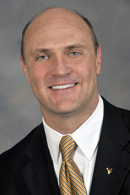 According to Google Maps, it takes a little over three hours to get from Catonsville to Morgantown, West Virginia.
For James P. Clements, ’85 computer science and ’91 M.S. and ’93 Ph.D., operations analysis, the journey has taken a little bit longer than that – about 27 years, in fact.
But the destination has been worth the drive, which also took detours through The Johns Hopkins University (where he took an M.S. in computer science in 1988) and Towson University, where he has served as provost and vice president for academic affairs for the past two years. On June 30, Clements will arrive in Morgantown to become West Virginia University’s 23rd president.
“I’m really excited,” Clements told UMBC Magazine in a recent interview. “I’m on the phone with them every day. On the weekends, I’m having discussions. I already have a couple visits planned.”
Clements also has fond memories of his time in Catonsville: “I loved everything about my undergraduate and graduate education at UMBC.”
It’s not hard to see why West Virginia University tapped Clements for the school’s top position. His career as a scholar and researcher took wing quickly after he received his Ph.D. from UMBC in 1993. He was tenured at Towson University only two years after receiving his doctorate. Six years later, he was named to lead Towson’s Center for Applied Information Technology. And in 2002, he was named Robert W. Deutsch Distinguished Professor of Information Technology.
His ascent in academic leader has been even more dizzying – a rapid itinerary that included stints as vice president of Towson’s Economic and Community Outreach division, as provost, and a key roles in devising and monitoring that university’s 2010 Strategic Plan.
Clements says that the first strides of his time on the fast track began at UMBC. Like many students of his era, he chose UMBC for factors of proximity and cost – and found an unexpectedly rich academic experience in Catonsville.
“My parents didn’t go to college,” he says. “My brother and two sisters, we were the first generation to go to college. We didn’t have a lot of money. There weren’t a lot of options. It was: ‘Where do you want to go in-state? And you’re going to be a commuter, because we don’t have the money, really, to let you live on the campus.’ So I really looked at UMBC and Towson, which are both great places. But for what I wanted at the time, which was computer science, UMBC was a great choice. The program was excellent. The professors were great.”
Clements says that he realized the quality of the education he got when he went out into the workforce. “When I came out, and went to work for industry – I worked for a company called General Physics, which is run by Robert W. Deutsch, who has been very generous to UMBC – I felt so prepared. I was working with people who’d been at some of the top institutions in the country, and I felt that I had an equal level of education to anyone in that building.”
The allure of the workforce and the chance to make money in the computer science field, which was burgeoning in the mid-1980s, did not sidetrack Clements from his dream of becoming a professor.
“My very first class at UMBC as a college freshman was a U.S. history class,” Clements recalls. “I walked into the class, I sat down, and the professor walked in. And it was like some great light went off. Then I knew that’s what I wanted to do. I wanted to be a professor. And I had never before that very minute even thought about it. Never really knew what professor was. What they did. But this person came in, and started talking to the class, and started teaching us things. And I knew that’s what I wanted to do. I knew wanted to go into higher education.”
Clements worked hard to make that dream a reality. “I started right away on graduate school,” he says. “I didn’t take a semester off.” But he did so at nights and on weekends as he joined the workforce – at one point even cutting a deal with his employer for reduced hours to obtain his Ph.D. at UMBC.
In a happy coincidence, Clements received his Ph.D. from UMBC on the same day – and in the same ceremony – that his brother Joseph H. Clements, Jr.’85 computer science and M.S and Ph.D., mathematics, received his doctorate. “We were side-by-side on the stage,” he recalls. “It was one of my mother and father’s happiest days.”
When Clements did finally end up in academia as a professor at Towson University, Clements says that he found it to be “probably the best job in the world. I love to teach. I love writing papers. I love doing research. I love working with the students.”
Yet he soon acquired the itch to try his hand at administration. It was exigency, rather than ambition, that lured Clements into academic leadership. In fact, he recalls, it came down to a lack of money for pencils and software and travel.
“When I was a junior faculty member, we didn’t have a lot of resources at the institution,” Clements says. “Once, I went to my administrative assistant and said, ‘Hey, can you order some pencils for me? I like the mechanical pencils.’ And the statement was: ‘Hey, we don’t have any money. You can only order the traditional-style pencils.’ Then I also said, ‘I need some software to do my research.’ And I was told, ‘We don’t have a lot of money to buy software for you to do your research.’ I remember going to a couple conferences to present papers, and the conference might cost $1000, and the university might give me $200. And I was, like, ‘Wow, this is costing me a lot out of pocket for me to do what is essentially my job.’
“All of a sudden,” Clements continues, “I took the view that I wanted to get into administration, so that I could bring resources to the campus. So I can help those faculty and students who follow me get the software that they need, or the computers that they need, or the research infrastructure they need, or the travel money they need.
Clements discovered that he had a knack for the coordination and fundraising that goes along with academic leadership – and also that he liked it. And those talents led him all the way to Morgantown.
The challenges of being president of any flagship state university are immense. They’ve been made even more difficult at West Virginia because of a scandal involving the improper awarding of a degree that rocked the university and forced the resignation of its president Michael S. Garrison last year.
Clements acknowledges those unique challenges in his new job. He also points to the success of West Virginia University’s interim president, C. Peter Magrath, in tackling the immediate fallout from the scandal as a springboard to his own efforts.
Clements says that Magrath’s status as “an icon in higher education” and a calming force” in Morgantown “has really given me an opportunity to come in and say, as I did when I interviewed on the campus: ‘WVU has been around since 1867. It has a great history. It’s going to have a great future. We just have to get past where we’ve been stuck right now and think about who we want to be in 10 and 20 years down the road.
“And then it becomes fun,” Clements continues. “Let’s start looking forward. And that certainly seemed to resonate well with the campus. They don’t want to be stuck in the headlines that they’ve read for the past two years. They want to move forward.”
Looking back at UMBC from across more than two decades (and across town from his perch at Towson University), Clements says he feels a lot of pride and appreciation at the growth of his alma mater over that time.
“Let me put it this way, every time I see [UMBC’s president Freeman A. Hrabowski, III], I thank him for raising the value of my degree,” Clements says with a laugh. “It’s true. Freeman is so dynamic and so charismatic. And it’s not just him. The institution has great faculty members. Great administrators. It has just continued to climb up and up and up. And for me, even though I work at Towson, I love UMBC. It’s been great watching it skyrocket into one of the hottest universities in the country.
“Trust me, when West Virginia called me, and I sent them my materials,” continues Clements, “and it has ‘UMBC: An Honors University in Maryland’ on it, with a president that everyone in the world knows, that helps me… It’s helped the region. Everyone is proud of UMBC.”
Originally published in the Summer 2009 issue of UMBC Magazine
Top Mountaineer: James P. Clements '85, M.S. '91, Ph.D. '93
UMBC alumnus James P. Clements, ’85 computer science and ’91 M.S. and ’93 Ph.D., operations analysis, ascends to the summit of West Virginia University.
By Richard Byrne ’86
According to Google Maps, it takes a little over three hours to get from Catonsville to Morgantown, West Virginia.
For James P. Clements, ’85 computer science and ’91 M.S. and ’93 Ph.D., operations analysis, the journey has taken a little bit longer than that – about 27 years, in fact.
But the destination has been worth the drive, which also took detours through The Johns Hopkins University (where he took an M.S. in computer science in 1988) and Towson University, where he has served as provost and vice president for academic affairs for the past two years. On June 30, Clements will arrive in Morgantown to become West Virginia University’s 23rd president.
“I’m really excited,” Clements told UMBC Magazine in a recent interview. “I’m on the phone with them every day. On the weekends, I’m having discussions. I already have a couple visits planned.”
Clements also has fond memories of his time in Catonsville: “I loved everything about my undergraduate and graduate education at UMBC.”
It’s not hard to see why West Virginia University tapped Clements for the school’s top position. His career as a scholar and researcher took wing quickly after he received his Ph.D. from UMBC in 1993. He was tenured at Towson University only two years after receiving his doctorate. Six years later, he was named to lead Towson’s Center for Applied Information Technology. And in 2002, he was named Robert W. Deutsch Distinguished Professor of Information Technology.
His ascent in academic leader has been even more dizzying – a rapid itinerary that included stints as vice president of Towson’s Economic and Community Outreach division, as provost, and a key roles in devising and monitoring that university’s 2010 Strategic Plan.
Clements says that the first strides of his time on the fast track began at UMBC. Like many students of his era, he chose UMBC for factors of proximity and cost – and found an unexpectedly rich academic experience in Catonsville.
“My parents didn’t go to college,” he says. “My brother and two sisters, we were the first generation to go to college. We didn’t have a lot of money. There weren’t a lot of options. It was: ‘Where do you want to go in-state? And you’re going to be a commuter, because we don’t have the money, really, to let you live on the campus.’ So I really looked at UMBC and Towson, which are both great places. But for what I wanted at the time, which was computer science, UMBC was a great choice. The program was excellent. The professors were great.”
Clements says that he realized the quality of the education he got when he went out into the workforce. “When I came out, and went to work for industry – I worked for a company called General Physics, which is run by Robert W. Deutsch, who has been very generous to UMBC – I felt so prepared. I was working with people who’d been at some of the top institutions in the country, and I felt that I had an equal level of education to anyone in that building.”
The allure of the workforce and the chance to make money in the computer science field, which was burgeoning in the mid-1980s, did not sidetrack Clements from his dream of becoming a professor.
“My very first class at UMBC as a college freshman was a U.S. history class,” Clements recalls. “I walked into the class, I sat down, and the professor walked in. And it was like some great light went off. Then I knew that’s what I wanted to do. I wanted to be a professor. And I had never before that very minute even thought about it. Never really knew what professor was. What they did. But this person came in, and started talking to the class, and started teaching us things. And I knew that’s what I wanted to do. I knew wanted to go into higher education.”
Clements worked hard to make that dream a reality. “I started right away on graduate school,” he says. “I didn’t take a semester off.” But he did so at nights and on weekends as he joined the workforce – at one point even cutting a deal with his employer for reduced hours to obtain his Ph.D. at UMBC.
In a happy coincidence, Clements received his Ph.D. from UMBC on the same day – and in the same ceremony – that his brother Joseph H. Clements, Jr.’85 computer science and M.S and Ph.D., mathematics, received his doctorate. “We were side-by-side on the stage,” he recalls. “It was one of my mother and father’s happiest days.”
When Clements did finally end up in academia as a professor at Towson University, Clements says that he found it to be “probably the best job in the world. I love to teach. I love writing papers. I love doing research. I love working with the students.”
Yet he soon acquired the itch to try his hand at administration. It was exigency, rather than ambition, that lured Clements into academic leadership. In fact, he recalls, it came down to a lack of money for pencils and software and travel.
“When I was a junior faculty member, we didn’t have a lot of resources at the institution,” Clements says. “Once, I went to my administrative assistant and said, ‘Hey, can you order some pencils for me? I like the mechanical pencils.’ And the statement was: ‘Hey, we don’t have any money. You can only order the traditional-style pencils.’ Then I also said, ‘I need some software to do my research.’ And I was told, ‘We don’t have a lot of money to buy software for you to do your research.’ I remember going to a couple conferences to present papers, and the conference might cost $1000, and the university might give me $200. And I was, like, ‘Wow, this is costing me a lot out of pocket for me to do what is essentially my job.’
“All of a sudden,” Clements continues, “I took the view that I wanted to get into administration, so that I could bring resources to the campus. So I can help those faculty and students who follow me get the software that they need, or the computers that they need, or the research infrastructure they need, or the travel money they need.
Clements discovered that he had a knack for the coordination and fundraising that goes along with academic leadership – and also that he liked it. And those talents led him all the way to Morgantown.
The challenges of being president of any flagship state university are immense. They’ve been made even more difficult at West Virginia because of a scandal involving the improper awarding of a degree that rocked the university and forced the resignation of its president Michael S. Garrison last year.
Clements acknowledges those unique challenges in his new job. He also points to the success of West Virginia University’s interim president, C. Peter Magrath, in tackling the immediate fallout from the scandal as a springboard to his own efforts.
Clements says that Magrath’s status as “an icon in higher education” and a calming force” in Morgantown “has really given me an opportunity to come in and say, as I did when I interviewed on the campus: ‘WVU has been around since 1867. It has a great history. It’s going to have a great future. We just have to get past where we’ve been stuck right now and think about who we want to be in 10 and 20 years down the road.
“And then it becomes fun,” Clements continues. “Let’s start looking forward. And that certainly seemed to resonate well with the campus. They don’t want to be stuck in the headlines that they’ve read for the past two years. They want to move forward.”
Looking back at UMBC from across more than two decades (and across town from his perch at Towson University), Clements says he feels a lot of pride and appreciation at the growth of his alma mater over that time.
“Let me put it this way, every time I see [UMBC’s president Freeman A. Hrabowski, III], I thank him for raising the value of my degree,” Clements says with a laugh. “It’s true. Freeman is so dynamic and so charismatic. And it’s not just him. The institution has great faculty members. Great administrators. It has just continued to climb up and up and up. And for me, even though I work at Towson, I love UMBC. It’s been great watching it skyrocket into one of the hottest universities in the country.
“Trust me, when West Virginia called me, and I sent them my materials,” continues Clements, “and it has ‘UMBC: An Honors University in Maryland’ on it, with a president that everyone in the world knows, that helps me… It’s helped the region. Everyone is proud of UMBC.”
Originally published in the Summer 2009 issue of UMBC Magazine
UMBC’s Champion Twirler – Stasi Kowalewski ’10 and Mardel Kowalewski ’81
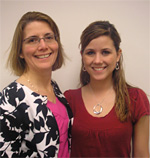 The grace of a ballerina. The poise of an equestrian rider. The flexibility of a gymnast.
Those are the qualities baton twirlers like Stasi Kowalewski ’10 need to have, according to Stasi’s mother Mardel Kowalewski ‘81. And Stasi, who is the world and national two-baton champion, possesses not only those traits but also a desire to learn.
“You need to have time and patience for this sport,” Stasi said. “You need to want it bad enough to learn it. It still takes me a long time to perfect my routines.”
Stasi, who regularly performs at UMBC men’s basketball games, has been twirling since age seven. She picked up the sport as an alternative to soccer, a game in which she naturally excelled. Always wanting a challenge, Stasi decided to give twirling a try instead. Her mother Mardel, both a former twirler and coach, supported Stasi’s decision.
“Being a former coach, I have the opportunity to help Stasi as both a mother and a coach. But learning when to be a coach and when to be a mom is important,” Mardel said. “Sometimes she just needs me to be her mom.”
Stasi took to twirling immediately and her once-a-week practices at age seven turned into 40 hours a week in the gym today, when she’s not in school. Her normal routine consists of stretching, working on “tricks” and running routines. When she’s not twirling, she works as a coach, providing individualized support to young twirlers. Her rigorous schedule and continuous dedication have resulted in her winning the title of World and National Two-Baton Champion not once – but three times, receiving awards in 2008, 2006 and 2005. She’s performed both in individual and group settings, winning awards throughout categories.
But twirling has its setbacks. Stasi has dislocated her knee three times and has literally lost her teeth in the gym. She once caught the baton and the momentum of the catch forced her hand directly to her mouth.
“I was standing there with my teeth in my hand,” Stasi said. “I was hysterical. It was one of the scariest things that ever happened to me.”
“I never pushed Stasi,” said Mardel. “But I always told her when you’re done, you’re done. She just kept on going.”
The continuous practice, recovery from injuries and love for the sport has only enforced Stasi’s dedication to perform – that and that fact that most twirlers “hang up their shoes” at the early age of 25. But both Stasi and Mardel have twirling plans for the future.
“One of the things we’re looking to establish is a scholarship for twirling,” said Mardel. “We need to get the sport out there.”
Stasi hopes to eventually pursue a law degree. She’s currently working on her bachelor’s in political science and American studies. When it comes to studies at UMBC, both Stasi and Mardel are in agreement.
“UMBC is the best kept secret in Maryland,” said Mardel. “It’s a public school with a private feel. You have to be smart to go to UMBC.”
“I came to UMBC because I wanted a challenge,” said Stasi. “You get what you want out of this school.”
But she also hopes to continue her work as a coach.
“Every twirler’s dream is to coach,” said Stasi. “I would love to pass on my knowledge and someday teach a national title holder.”
Stasi’s immediate plans for the future include twirling for the Washington Mystics and a AAA baseball team. She will also be competing with the seven-time reigning world championship team (the Dynamics) in the 2009 twirling competition in Belgium.
Originally posted February 2009
UMBC's Champion Twirler – Stasi Kowalewski '10 and Mardel Kowalewski '81
The grace of a ballerina. The poise of an equestrian rider. The flexibility of a gymnast.
Those are the qualities baton twirlers like Stasi Kowalewski ’10 need to have, according to Stasi’s mother Mardel Kowalewski ‘81. And Stasi, who is the world and national two-baton champion, possesses not only those traits but also a desire to learn.
“You need to have time and patience for this sport,” Stasi said. “You need to want it bad enough to learn it. It still takes me a long time to perfect my routines.”
Stasi, who regularly performs at UMBC men’s basketball games, has been twirling since age seven. She picked up the sport as an alternative to soccer, a game in which she naturally excelled. Always wanting a challenge, Stasi decided to give twirling a try instead. Her mother Mardel, both a former twirler and coach, supported Stasi’s decision.
“Being a former coach, I have the opportunity to help Stasi as both a mother and a coach. But learning when to be a coach and when to be a mom is important,” Mardel said. “Sometimes she just needs me to be her mom.”
Stasi took to twirling immediately and her once-a-week practices at age seven turned into 40 hours a week in the gym today, when she’s not in school. Her normal routine consists of stretching, working on “tricks” and running routines. When she’s not twirling, she works as a coach, providing individualized support to young twirlers. Her rigorous schedule and continuous dedication have resulted in her winning the title of World and National Two-Baton Champion not once – but three times, receiving awards in 2008, 2006 and 2005. She’s performed both in individual and group settings, winning awards throughout categories.
But twirling has its setbacks. Stasi has dislocated her knee three times and has literally lost her teeth in the gym. She once caught the baton and the momentum of the catch forced her hand directly to her mouth.
“I was standing there with my teeth in my hand,” Stasi said. “I was hysterical. It was one of the scariest things that ever happened to me.”
“I never pushed Stasi,” said Mardel. “But I always told her when you’re done, you’re done. She just kept on going.”
The continuous practice, recovery from injuries and love for the sport has only enforced Stasi’s dedication to perform – that and that fact that most twirlers “hang up their shoes” at the early age of 25. But both Stasi and Mardel have twirling plans for the future.
“One of the things we’re looking to establish is a scholarship for twirling,” said Mardel. “We need to get the sport out there.”
Stasi hopes to eventually pursue a law degree. She’s currently working on her bachelor’s in political science and American studies. When it comes to studies at UMBC, both Stasi and Mardel are in agreement.
“UMBC is the best kept secret in Maryland,” said Mardel. “It’s a public school with a private feel. You have to be smart to go to UMBC.”
“I came to UMBC because I wanted a challenge,” said Stasi. “You get what you want out of this school.”
But she also hopes to continue her work as a coach.
“Every twirler’s dream is to coach,” said Stasi. “I would love to pass on my knowledge and someday teach a national title holder.”
Stasi’s immediate plans for the future include twirling for the Washington Mystics and a AAA baseball team. She will also be competing with the seven-time reigning world championship team (the Dynamics) in the 2009 twirling competition in Belgium.
Originally posted February 2009
Making U.S. Democracy A Little Less “Crazy” – Jamie Nola ’08
 Confused about how an American democracy works? You are not alone.
A new Web site – www.USDemocrazy.net – designed by Economist magazine cartoonist Kevin “Kal” Kallaugher, artist-in-residence at UMBC, aims to demystify and explore America’s crazy 50-state democracy in a fun and engaging way.
Behind the scenes, recent alumnus Jamie Nola ’08, visual arts, spent the last year turning Kal’s black and white drawings into a colorful, interactive web experience, where talking fish discuss the economy and banners promising “crazy factoids” and “political mumbo-jumbo” are all the norm.
“It’s really cool,” said Nola, who joined UMBC’s Imaging Research Center as a student intern in the fall of 2007 and who now works there full time. “It’s exciting to see it up and getting some attention.”
An Interactive Way of Teaching
Designed and hand-drawn by Kal for the IRC, USDemocrazy.net was built and researched by an interdisciplinary team of UMBC students, including visual arts, web design and social sciences majors.
The site features in-depth portraits of all 50 states through exclusive Kal animations, offbeat trivia and factoids and local color from experts in each state. An animated “Uncle Sam” explains idiosyncrasies of America’s democratic system, such as the Electoral College. On the USDemocrazy.net blog, Kal, along with students and faculty from UMBC, will follow America’s electoral process through the presidential race and into the next administration.
On-the-job Training
For Nola, whose future interest lies in computer game programming, Kal’s project was a chance to hit the ground running. He took a course in web interactivity in spring 2007, and was recommended for an IRC internship thanks to his quick understanding of the web animation program Flash.
Under the tutelage of former IRC worker and UMBC alumna Bonnie Crawford-Kotula ’08, M.F.A., Nola learned how to turn Kal’s drawings into the back-end code that would allow for animation and interaction on the front end of the site. He also got plenty of first-hand experience at working with clients.
“It has been a great experience,” said Nola. “We went through so many prototypes. I really learned a lot over the last 13 or 14 months.
The interactive site is compiling first-hand portraits of each state from local experts in history, politics, journalism and humor through its “Crazy Talk” state survey. Click here to take the survey. A true work in progress, the site changes often as Nola receives updates and new features from the site researchers.
“They’re still gathering information,” he said. “We’ve got 32 states done, and 18 to go. There’s been a crazy push over the last month to get as much done before the election as possible. It’s been pretty exciting.”
Visit USDemocrazy.net to view Kal’s Mission Statement video.
Originally posted October 2008
Making U.S. Democracy A Little Less “Crazy” – Jamie Nola '08
Confused about how an American democracy works? You are not alone.
A new Web site – www.USDemocrazy.net – designed by Economist magazine cartoonist Kevin “Kal” Kallaugher, artist-in-residence at UMBC, aims to demystify and explore America’s crazy 50-state democracy in a fun and engaging way.
Behind the scenes, recent alumnus Jamie Nola ’08, visual arts, spent the last year turning Kal’s black and white drawings into a colorful, interactive web experience, where talking fish discuss the economy and banners promising “crazy factoids” and “political mumbo-jumbo” are all the norm.
“It’s really cool,” said Nola, who joined UMBC’s Imaging Research Center as a student intern in the fall of 2007 and who now works there full time. “It’s exciting to see it up and getting some attention.”
An Interactive Way of Teaching
Designed and hand-drawn by Kal for the IRC, USDemocrazy.net was built and researched by an interdisciplinary team of UMBC students, including visual arts, web design and social sciences majors.
The site features in-depth portraits of all 50 states through exclusive Kal animations, offbeat trivia and factoids and local color from experts in each state. An animated “Uncle Sam” explains idiosyncrasies of America’s democratic system, such as the Electoral College. On the USDemocrazy.net blog, Kal, along with students and faculty from UMBC, will follow America’s electoral process through the presidential race and into the next administration.
On-the-job Training
For Nola, whose future interest lies in computer game programming, Kal’s project was a chance to hit the ground running. He took a course in web interactivity in spring 2007, and was recommended for an IRC internship thanks to his quick understanding of the web animation program Flash.
Under the tutelage of former IRC worker and UMBC alumna Bonnie Crawford-Kotula ’08, M.F.A., Nola learned how to turn Kal’s drawings into the back-end code that would allow for animation and interaction on the front end of the site. He also got plenty of first-hand experience at working with clients.
“It has been a great experience,” said Nola. “We went through so many prototypes. I really learned a lot over the last 13 or 14 months.
The interactive site is compiling first-hand portraits of each state from local experts in history, politics, journalism and humor through its “Crazy Talk” state survey. Click here to take the survey. A true work in progress, the site changes often as Nola receives updates and new features from the site researchers.
“They’re still gathering information,” he said. “We’ve got 32 states done, and 18 to go. There’s been a crazy push over the last month to get as much done before the election as possible. It’s been pretty exciting.”
Visit USDemocrazy.net to view Kal’s Mission Statement video.
Originally posted October 2008
A Mathematical Mind: Kimball Martin ’99
 “But Mom, when am I going to use all this math stuff anyway?”
For parents, it’s a frequent refrain from kids of all ages, and sometimes in the age of spreadsheets and computer desktop calculators, it’s a question that’s as tough to answer as sample problems from the math section of the SAT.
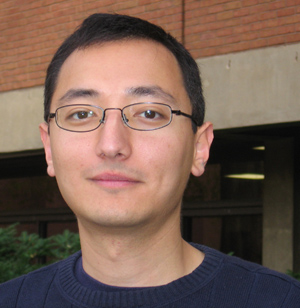
But don’t say that to Kimball Martin ’99, who has turned his inquisitive nature and love of challenges into a robust career as an assistant professor of mathematics specializing in number theory.
“Math is not about numbers, but about ideas and problem solving,” he said. “Doing math helps you learn how to think and solve problems in general. As all of us have to deal with problems or make decisions constantly, I believe mathematicians constantly use their mathematical experience in daily life.”
“Two of my friends have at some point run their own construction businesses,” said Martin. “The first was an engineer, and was quite good at math, but the other was not so strong. The first one told me about how he used trigonometry all the time, to figure out things like how many steps and what size they would need, or how long they should cut beams for the roof, and it was very easy and efficient.
“The other friend said they climb up on the roof and measure how long the beams should be, or experiment to see how many steps are needed, and as a result it took him and his crew much longer to finish their job. I believe having some proficiency in mathematics often comes up in surprising ways down the road. After all, life is full of surprises.”
Martin, a former Goldwater Fellow, was known for always pushing onward to the next challenge during his time at UMBC. A native of Mechanicsburg, Penn., he took college courses while still in high school and consistently surprised his UMBC professors with his desire to take and excel in advanced level courses. He went on to get his Ph.D. from Cal Tech, did his post-doc work at Columbia University and is now an assistant professor of math at the University of Oklahoma.
Martin specializes in the study of prime numbers – numbers such as 2, 5, 7 and 13, which are divisible only by one and themselves. “They’re a fundamental building block of arithmetic. There’s no apparent pattern to them. Somehow primes occur seemingly randomly but they also display statistical patterns.”
Martin initially wanted to be a visual art and computer science major as a freshman, but then settled into a double major in computer science and math. “By my junior year, I began to realize that most of the things I liked in computer science were the math aspects of it,” he said.
He interned at the National Security Agency for a summer, and was encouraged by the support and mentorship he received from the math department. “The math department here was small so I got to interact a lot with faculty. I spent most of my days here in the department, made a lot of friends there and in the dorms and apartments.”
To Martin, mathematics is a discipline that combines elements of art and science. While a math career may not be for everyone, to Martin there are certain traits essential for success in the field.
“You need curiosity, creativity and courage to be a mathematician,” he said. “Curiosity is first because mathematics is about understanding and discovering new things. Creativity, which is something that seems very mystical to me, is what allows us to see the new in things. Finally, courage is needed because math is not always easy. In fact, the interesting math is almost never easy.”
Martin recalls a particular homework problem from his post-doc days, which was assigned by his mentor, adjunct faculty member John Dillon. “Once you started, your formulas just started getting worse and worse, and you couldn’t see any way out of this hole you were getting yourself into. One of the students the class it was due said he couldn’t get it, he just wound up with these horrific equations, and Dillon said ‘Be brave. You have to be brave. If you just keep going, you’ll get the answer in the end.’ And he was right. I encounter and struggle with this sort of thing all the time in research.”
Martin is quick to point out that “A Beautiful Mind”-style stereotypes of the brilliant mathematician with poor social skills isn’t the reality. “Most of us are relatively normal with a slight tendency towards thoughtfulness,” said Martin. “Plus I like to play jokes,” he said. “I once hid live crabs in someone’s office. I had accomplices, though. I didn’t act alone.”
So what is the answer for the teenager who doubts that he or she will ever use this stuff?
According to Martin, math is like any other subject: you get out what you put in.
“Beyond basic arithmetic and algebra, most people probably won’t use what they learn in the textbooks after school. However, most college students don’t use the contents of their courses in their subsequent jobs either. Nevertheless, during the process of going through the course and learning the material and doing the assignments, I firmly believe you learn much more than what’s in the book. Furthermore, you often do use the content of a course in later courses in school, whose value is not to be underestimated.
Martin closed his interview with wise words for students of any subject. “If you treat one class as a waste of your time, then your subsequent classes will also be a waste of time, because you won’t be able receive what your teachers have to offer.”
– Chip Rose
Originally posted July 2008
A Mathematical Mind: Kimball Martin '99
“But Mom, when am I going to use all this math stuff anyway?”
For parents, it’s a frequent refrain from kids of all ages, and sometimes in the age of spreadsheets and computer desktop calculators, it’s a question that’s as tough to answer as sample problems from the math section of the SAT.
But don’t say that to Kimball Martin ’99, who has turned his inquisitive nature and love of challenges into a robust career as an assistant professor of mathematics specializing in number theory.
“Math is not about numbers, but about ideas and problem solving,” he said. “Doing math helps you learn how to think and solve problems in general. As all of us have to deal with problems or make decisions constantly, I believe mathematicians constantly use their mathematical experience in daily life.”
“Two of my friends have at some point run their own construction businesses,” said Martin. “The first was an engineer, and was quite good at math, but the other was not so strong. The first one told me about how he used trigonometry all the time, to figure out things like how many steps and what size they would need, or how long they should cut beams for the roof, and it was very easy and efficient.
“The other friend said they climb up on the roof and measure how long the beams should be, or experiment to see how many steps are needed, and as a result it took him and his crew much longer to finish their job. I believe having some proficiency in mathematics often comes up in surprising ways down the road. After all, life is full of surprises.”
Martin, a former Goldwater Fellow, was known for always pushing onward to the next challenge during his time at UMBC. A native of Mechanicsburg, Penn., he took college courses while still in high school and consistently surprised his UMBC professors with his desire to take and excel in advanced level courses. He went on to get his Ph.D. from Cal Tech, did his post-doc work at Columbia University and is now an assistant professor of math at the University of Oklahoma.
Martin specializes in the study of prime numbers – numbers such as 2, 5, 7 and 13, which are divisible only by one and themselves. “They’re a fundamental building block of arithmetic. There’s no apparent pattern to them. Somehow primes occur seemingly randomly but they also display statistical patterns.”
Martin initially wanted to be a visual art and computer science major as a freshman, but then settled into a double major in computer science and math. “By my junior year, I began to realize that most of the things I liked in computer science were the math aspects of it,” he said.
He interned at the National Security Agency for a summer, and was encouraged by the support and mentorship he received from the math department. “The math department here was small so I got to interact a lot with faculty. I spent most of my days here in the department, made a lot of friends there and in the dorms and apartments.”
To Martin, mathematics is a discipline that combines elements of art and science. While a math career may not be for everyone, to Martin there are certain traits essential for success in the field.
“You need curiosity, creativity and courage to be a mathematician,” he said. “Curiosity is first because mathematics is about understanding and discovering new things. Creativity, which is something that seems very mystical to me, is what allows us to see the new in things. Finally, courage is needed because math is not always easy. In fact, the interesting math is almost never easy.”
Martin recalls a particular homework problem from his post-doc days, which was assigned by his mentor, adjunct faculty member John Dillon. “Once you started, your formulas just started getting worse and worse, and you couldn’t see any way out of this hole you were getting yourself into. One of the students the class it was due said he couldn’t get it, he just wound up with these horrific equations, and Dillon said ‘Be brave. You have to be brave. If you just keep going, you’ll get the answer in the end.’ And he was right. I encounter and struggle with this sort of thing all the time in research.”
Martin is quick to point out that “A Beautiful Mind”-style stereotypes of the brilliant mathematician with poor social skills isn’t the reality. “Most of us are relatively normal with a slight tendency towards thoughtfulness,” said Martin. “Plus I like to play jokes,” he said. “I once hid live crabs in someone’s office. I had accomplices, though. I didn’t act alone.”
So what is the answer for the teenager who doubts that he or she will ever use this stuff?
According to Martin, math is like any other subject: you get out what you put in.
“Beyond basic arithmetic and algebra, most people probably won’t use what they learn in the textbooks after school. However, most college students don’t use the contents of their courses in their subsequent jobs either. Nevertheless, during the process of going through the course and learning the material and doing the assignments, I firmly believe you learn much more than what’s in the book. Furthermore, you often do use the content of a course in later courses in school, whose value is not to be underestimated.
Martin closed his interview with wise words for students of any subject. “If you treat one class as a waste of your time, then your subsequent classes will also be a waste of time, because you won’t be able receive what your teachers have to offer.”
– Chip Rose
Originally posted July 2008