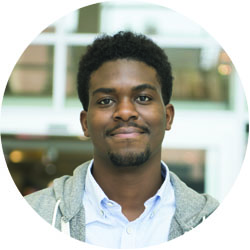
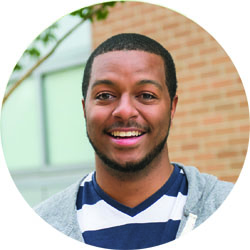
Student Government President Bentley Corbett-Wilson is a senior majoring in music education. He also plays the trumpet in UMBC’s Wind Ensemble and the UMBC Symphony Orchestra.




Student Government President Bentley Corbett-Wilson is a senior majoring in music education. He also plays the trumpet in UMBC’s Wind Ensemble and the UMBC Symphony Orchestra.
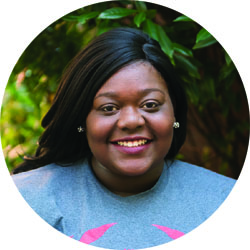
 Media and communications major Ashton Greenwood has spent much of her senior year gaining experience in the field as a sports production intern for WBAL-TV, and with the New Media Lab, which produces campus television programming. She also holds down a part-time off-campus job, is a member of Bartleby, UMBC’s literary magazine, and hosts an NFL podcast for WMBC, UMBC’s student radio station.
UMBC Students Offer a Glimpse into What it Means to be a Retriever in 2016.
We all remember certain highlights of our college days no matter how many years — or decades — we’ve put between ourselves and Commencement day. But what about the moments in between those highlights we hold so dear? Thanks to smartphone cameras and social media, current students are capturing it all — unfiltered — every single day for the world to see.
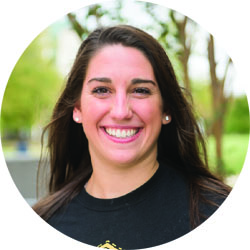
UMBC Magazine asked several current students to share moments from their everyday lives with us. No matter when you were a student, we think you’ll find something to relate to in the images that make up current Retriever life.
– Jenny O’Grady
|
|
|
|
|
|
|
|
|
|
UMBC’s history has its quirky sides as well. Associate professor of history George Derek Musgrove ’97, history, tackled the task of examining them with gusto in a presentation entitled: An Unofficial, Totally Tongue in Cheek, Slightly Zany History of Campus Culture at UMBC.
Musgrove identified three key eras of campus culture, and invited alumni who were key student figures in those moments – Steven K. Fedder ’72, American studies, Shari Elliker ’83, interdisciplinary studies, and Oliver J. Myers ’94, M.S. ’96, and Ph.D. ’07, mechanical engineering – to give their unvarnished views of those years at UMBC. Punctuated with videos by Stephen Karolenko ’13, visual arts, the anecdotes shared had the audience in fits of laughter, and elicited uninhibited tales from the audience as well.
Below are edited excerpts of the presentation.
— Laura Lefavor ’13
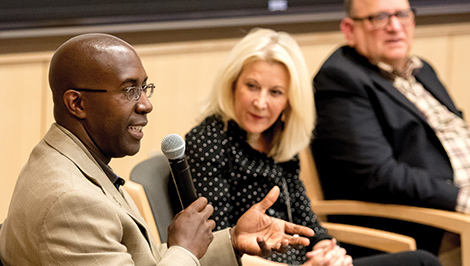
Derek Musgrove: Some of you may be asking yourselves: Why are we doing a history of campus culture here at UMBC? UMBC has no campus culture. This thing is going to be over really quickly…. UMBC does not have rich nd storied traditions. We have no centuries-old eating clubs and secret societies. No ivy-covered walls beneath which students hold annual recitations of Shakespeare. Our much ballyhooed tailgating parties are about as nonexistent as our football team. But traditions are not culture. And free of the strictures of tradition, UMBC students, faculty, and administrators have exercised creativity, intelligence, and, often, a good deal of reckless abandon in their efforts to fashion a campus culture here out of whole cloth….
Steve Fedder, you get here to campus in 1969. What was the campus culture like?
Steve Fedder: There was no campus culture, but there were, I don’t know, groups of people who came together around different things. I was political. There were hippies. There were artists. There were lacrosse jocks. The twain didn’t meet very much, but the hippies and lefties kind of got together and we had a pretty good time.
Musgrove: Let’s talk about your group, the “lefties,” the hippies, and the political folks. We saw a picture of Homer Schamp. Could you tell us what “Homer eats pie” refers to?
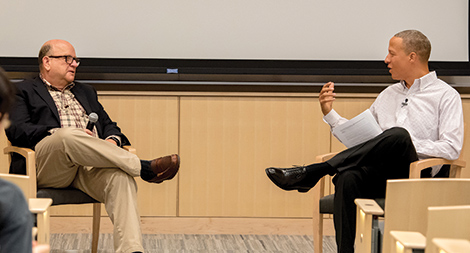
Fedder: We had a fair amount of fun in those days, even though we were pretty serious. It was the height of the Vietnam War. There were a number of professors…who were, we thought, terminated by [founding provost] Homer Schamp because of their left-leanings. I don’t know whether we were right or not in hindsight, but we loved these guys. There was a room, kind of like this, more like a theater, and, one day, Steve Taylor, one of my friends, said “Hey, I got an idea. I’m working in the back of the thing. We’re going to shut the lights off and we’re going to take pies and shove them into Homer Schamp’s face because we’re angry at him.”
And that’s exactly what we did. The lights went out. The pie went in his face. We disappeared before the lights went on…. T-shirts appeared all over campus, “Homer eats pie.” The mathematical sign. He wasn’t very happy, but we weren’t very happy with him, either. Those were the kind of antics that were influenced by people like Jerry Rubin and Abbie Hoffman…. We were kind of junior-league. [Chancellor Albin O. Kuhn], I think, said [we were] the JV team of the radicals. We did our best.
Musgrove: Shari Elliker…. What was the social life that you were introduced to when you got on campus? You must, by the way, tell – particularly the students who are here now – about The Ratt.
Elliker: Yeah, The Ratt…. The Rathskeller was up on this hill. I’d like you all to repeat after me. Okay? Remember, the drinking age was 18. That will come into play in a minute. The Ratt was a place, and it served beer, and you’d be rolling down the hill afterwards and everything.
I don’t know if Arbutus has become a rocking college town. Somehow I doubt it. But there really wasn’t anything to do. I mean, we were just stuck and had to make our own fun…. There was one night where somebody had a case of baby powder or toilet paper. We ended up throwing it on each other, and we had this massive, massive fight. We’re covered in toilet paper. We’re covered in baby powder. And there was this resident director who was the scariest person I ever met came busting through the door, and everybody else was more coordinated than me, so they all scattered, and I was the only one covered in baby powder and all that. And she said, “You have 30 minutes.” And I thought, “For what? Are you going to come back and kill me? What happens in 30 minutes? Will I be arraigned somewhere?” I had to get everybody together and nobody helped me clean up. But remember, the drinking age was 18. Yeah, that explains it.
Musgrove: Can you talk about where [the campus radio station] led you and what you tried to do once you got there?
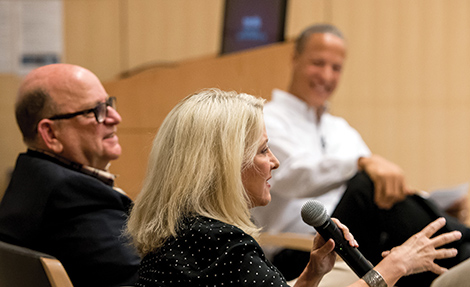
Elliker: I was the assistant manager for a while and then when the manager graduated, I ended up becoming the manager. I was so bummed out because nothing at UMBC felt normal…. Being terribly unsophisticated as I still am, I hated jazz music and the campus was playing jazz. At a college? Come on! I hated that! Right? I know, I know, and everybody likes jazz. Okay. Whatever. I hated it and I said, “We gotta change this. Let’s do something. It’s the ’80s, man. We gotta have some hair bands and things like that.” Overnight, I changed it from jazz to this popular, hot Top 20 type thing. Half the people liked it. Half the people didn’t like it because they wanted to hear Miles Davis all day.
What came out of it was that we started to have concerts and we started to have things that were bigger events and one of them was, we had a Molly Hatchet concert…. We had Quadmania. My personal best was, I was a big Peter Frampton fan. Anyone? Anyone? Thank you. Peter Frampton…. We got Peter Frampton to come and do an acoustic thing. Then, the best part was they had to sign shirts and stuff, and he used my back to do it…. That was it, I was done. It ended up working out okay.
Musgrove: Well, on Peter Frampton, I will let you drop the mic and walk away. Oliver Myers, you come here to campus in 1988 for interview weekend. Tell us what you expected, and then how that matched up with what you actually encountered.
Oliver Myers: First, when I heard “Freeman Hrabowski,” I’m thinking of an Eastern European gentleman. Okay, this is somebody that’s going to be working on advancing their career, but they want to bring in African Americans for STEM disciplines, so he’s trying to advance his career. Then, I arrive on campus, and this gentleman greets me at the door…. In my mind, I’m thinking of a very Caucasian gentleman, and all of a sudden here’s this African American, with the mustache, at that time, and he’s quoting Langston Hughes, Countee Cullen, Zora Neale Hurston, Maya Angelou. I’m saying, “Wait a second. This can’t be Freeman Hrabowski.”
Musgrove: I know a lot of Meyerhoffs, particularly early Meyerhoffs, speak about this paralyzing fear that they had of letting [Freeman] down. I would love it if you could talk about the study culture that you all bring to campus as a product of that fear.
Myers: We had a study culture such that even during our summer bridge programs, and even during picnics, we had our backpacks and we were studying. We had a hamburger in one hand and a pencil in the other, actually doing math problems on a picnic table. Doing chemistry and physics problems on a picnic table. We would get mad at each other when a drop of ketchup or mustard would fall on the paper because we had been working on this problem that traditionally by a professor’s standards only takes two lines, but it took us five sheets of paper. Then we had to go back and figure out what we had done. Friday night, it was not uncommon to see us studying in the lobby. Thursday night, everybody was watching The Cosby Show and A Different World, and that was our study break, then we would go right back to studying….
Musgrove: A lot more boring than the ’60s, ’70s or ’80s.
Myers: We were nerds, what can we say, you saw the pictures of our glasses. They were about this big on our faces.
Musgrove: I should actually apologize to you for this. I remember walking into Susquehanna on Friday nights and going past the common rooms and seeing you and some of the other Meyerhoffs in there and saying, “Nerds.”
Myers: Nerds get paid.
Musgrove: I do not believe my eyes, but we are on time, which means we have time for a couple of audience questions.
Beth Wells: My name is Beth Wells, class of ’74, so I lived in Dorm 1. I just want to tell you all one thing about that counter-cultural culture that was the nude run. Do you remember it? Picture this happening today. Bunch of guys, I don’t know, ten, twenty guys who lived in the residence halls wrapped in towels only, and maybe tennis shoes, would line up on the deck of Dorm 1 and, at the given signal, would run what there was of the loop, having dropped the towels at the bottom of the stairs. The campus police would give way, making sure none of them got hit. The really big scandal was the year that a woman decided she was going on the nude run, too. Watch An Unofficial, Totally Tongue in Cheek, Slightly Zany History of Campus Culture at UMBC in full at 50.umbc.edu/weekendroundup.
UMBC’s Mock Trial team spends a lot of time on the road. This academic year, they’ve already been to four invitational tournaments at schools across the Mid-Atlantic, with trips to UPenn and Georgetown coming up within the next several months. They’ve been able to travel the country, hone their rhetorical skills, and represent our school’s commitment to inclusive excellence thanks to donors like you, who helped the nationally-ranked Mock Trial team raise more than double their fundraising goal for this semester.
The financial support is vital to Mock Trial’s development as a group, says UMBC senior Dylan Elliott ’17, history, a pre-law student and Mock Trial’s current president. He says that more funding leads to more opportunities to attend tournaments, which means more time spent traveling together…”which can drive us crazy at times, but it’s also really good for us,” he says.
Mock Trial has proven popular both among students who plan to attend law school and those who do not, and attracts participants from a wide variety of majors. “I think people get different things out of it,” say Elliott, citing the public speaking experience, critical thinking skills, and competitive atmosphere as some benefits of the program.
For Elliott himself, Mock Trial was what confirmed his decision to continue on to law school: “I played sports from elementary school up through high school, and I realized after I did my first Mock Trial competition that I missed that kind of team competition, that camaraderie…which is something that Mock Trial gave me again.
“It helped me realize that I do enjoy the court advocacy [aspect], and helped me develop public speaking skills.”
Elliott also says that UMBC has one of the more diverse teams on the competitive mock trial circuit: “[We have] lots of different nationalities and ethnic backgrounds and religions, and I think that’s great because UMBC is like that.” With diversity in background also comes diversity in perspective, which comes in handy when coming up with ways to approach the cases they’re assigned each year.
“There’s a lot of different minds in the room,” Elliott says, “which makes us better.”
For more from our Mock Trial students, check out the video below…
You can help create student success stories like this through our crowdfunding site, GiveCorps.
After a series of stops and starts in her pursuit of higher education — up to and including marriage and children — Carrie Cleveland graduated from UMBC this past May with a degree in social work. During her time here, Cleveland was the recipient of multiple scholarships made possible by the Charlotte W. Newcombe Foundation, including the Susan Bernstein-Charlotte W. Newcombe Memorial Scholarship for returning students in the social work field. The Newcombe Foundation provides support to students over the age of 25, and has helped over 5,000 UMBC students achieve their goals since 1981. In her own words…
“What I appreciated about these awards is that these scholarships were meant to help a student who had additional challenges. Trying to manage three young kids while in school is challenging. I have the expenses of a working person, like daycare, but not the income that is needed to help pay for those expenses. These scholarships helped me to be able to afford my tuition and the cost of care for my children while I took classes or was in my social work field placement. If it was not for these funds, I would have had to take out more loans to cover the cost of care for my children. I am so appreciated of scholarships that look at not just the student, but their unique circumstances as well…
“[After graduation,] I will be attending University of Maryland, Baltimore as an advanced standing student at the School of Social Work. My clinical field instruction will take place at a school for middle schoolers who are federally classified as emotionally disabled.”
After a series of stops and starts in her pursuit of higher education — up to and including marriage and children — Carrie Cleveland graduated from UMBC this past May with a degree in social work. During her time here, Cleveland was the recipient of multiple scholarships made possible by the Charlotte W. Newcombe Foundation, including the Susan Bernstein-Charlotte W. Newcombe Memorial Scholarship for returning students in the social work field. The Newcombe Foundation provides support to students over the age of 25, and has helped over 5,000 UMBC students achieve their goals since 1981. In her own words…
“What I appreciated about these awards is that these scholarships were meant to help a student who had additional challenges. Trying to manage three young kids while in school is challenging. I have the expenses of a working person, like daycare, but not the income that is needed to help pay for those expenses. These scholarships helped me to be able to afford my tuition and the cost of care for my children while I took classes or was in my social work field placement. If it was not for these funds, I would have had to take out more loans to cover the cost of care for my children. I am so appreciated of scholarships that look at not just the student, but their unique circumstances as well…
“[After graduation,] I will be attending University of Maryland, Baltimore as an advanced standing student at the School of Social Work. My clinical field instruction will take place at a school for middle schoolers who are federally classified as emotionally disabled.”
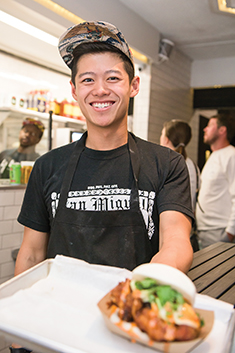
It all began during Spring Break 2010. Steve Chu, Nikhil Yesupriya, and Ephrem Abebe were building low-income houses for Habitat for Humanity. As they worked together, they discovered they had a shared passion for making, and eating, good food.
“Cook nights” followed when the three men came back to UMBC. The trio played with ingredients and dishes from every conceivable culture.
“UMBC is such an incredibly diverse community, and we had a great time with our friends cooking all the different things they ate growing up,” Yesupriya recalls.
Chu adds that the nights also taught them “about the power of bringing people together over great food. And, over time, we realized: ‘Hey, we want to keep going with this in the real world!’”
After graduation, Chu followed his lifelong interest in cooking and restaurants to stints in local kitchens like Petit Louis. A year later, when Abebe and Yesupriya completed their degrees, he pitched them the idea of going into the food business.
A few years of hard work, and the love of food that fueled cook nights now delights customers at Ekiben – the sleek and funky 10-seat restaurant the UMBC alums opened in March in Fells Point. How did they do it?
Step 1: Follow the Fun
 Finding partners who can share the joy as well as the labor was an important first step.
“Any kind of business startup is going to be hard work,” says Abebe. “But working with Nikhil and Steve was also definitely going to be fun. So I was in.”
Together, they settled on a menu of pan-Asian comfort food using impeccably fresh, locally sourced ingredients. The name Ekiben – bento box-style takeaway meals popular with Japanese train travelers – also struck a chord. The food needed to be as fun as the business.
Step 2: Be Flexible
The trio dreamed of a brick-and-mortar restaurant. They also looked into buying a food truck. Not ready for an $80,000 investment, they started smaller still.
“We bought a hotdog cart off eBay,” says Chu. “Something I would say is a definite ‘don’t do.’” (It turns out hotdog carts do not come pre-assembled). The food cart debuted in spring 2014, selling the partners’ innovative take on Asian street fare at local festivals and farmers’ markets.
“The cart wasn’t our original vision,” says Yesupriya. “But it forced us to be creative and allowed us to be responsive.”
Step 3: Forge Strong Relationships
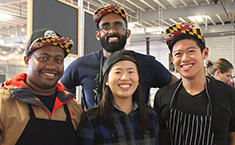 The trio bonded during their Habitat for Humanity days – and found they shared a work ethic as well as a taste for adventurous food.
The bonds they formed at UMBC also helped: “Our UMBC friends knew our food from all those cook nights, and they showed up. And told their own friends, who came out and brought more friends,” says Chu. “Those relationships were a huge part of our early success.”
Ekiben’s enthusiastic customer service is also about relationships: “We want to feed people and make them happy, not just take their money and hand them their order,” says Yesupriya. “That means getting to know who is on the other side of the counter and listening to their ideas and opinions – about the food, the space, anything.”
Step 4: Go All In
 The Ekiben team says they have put family and social lives on hold to focus solely on the business. In less than two years, they built a successful mobile food business, and now have that storefront restaurant they wanted. Their reputation for offerings including righteous bao (steamed buns stuffed with delectable fillings like Thai chicken meatballs or lusciously spice-infused braised pork) now lures diners from as far as Washington, D.C., and Philadelphia.
“We are in our early twenties,” says Yesupriya. “People we know are like: ‘Oh, we want to travel! We want to buy a cool car.’ We are putting all our resources and assets into this business.”
Ebebe says the sacrifice is worth it. “This is how we have been able to go so far in such a short time,” he observes.
Step 5: Don’t Give Up
The Ekiben team says tenacity and focus can help solve the unexpected problems and setbacks.
“Our first farmers market, we had exactly two customers who were friends from UMBC who came out to support us,” says Chu. “That was it. It was super hot. Nobody wanted steamed buns. Nobody knew who we were.”
But Chu, Yesupriya, and Ebebe kept plugging away, talking to customers and offering samples. Persistence paid off. Within weeks, the Ekiben cart was in the black.
— Michelle Gienow
(Ekiben is located at 1622 Eastern Avenue. ekibenbaltimore.com)

Current number of Ekiben menu items: 7 (5 entrees plus 2 side dishes)
Number of meatballs sold during Artscape 2015: 3,600
Number of hours it takes to slow-cook a batch of Ekiben’s “melts in yo mouth, sticks to yo fingers” Char Siu ribs: 48
Like many students before him who have studied in the Albin O. Kuhn Library, Joseph Hyman ‘11, mechanical engineering, found himself craving a fresh, hot cup of coffee to help the pages fly by.
Hyman pondered how to satisfy that immediate need for caffeine: Wouldn’t it be great if a travel mug could brew its own coffee? So he set out on a search for this mug of his dreams.
When he discovered that that no one was manufacturing that mug of his dreams, he decided to create it himself – along with a talented team of UMBC engineering students and alumni.
Fast forward more than four years, and the combined travel mug and coffee brewer that Hyman envisioned is now the first product of the MoJoe Brewing Co., backed by more than 700 supporters of an associated Kickstarter campaign. The team sought $20,000 through crowdfunding to jump-start production and ended up with more than $85,000 in pledges.
Hyman collaborated with fellow UMBC graduates Ezekial Kolajo ‘11, mechanical engineering and Jingrui Wang ‘16, Ph.D., mechanical engineering, as well as fellow developer Alexandre Wing, to develop the personal mobile brewer.
The MoJoe technology emphasizes convenience and craft. Users can put water of any temperature into the mug, which will then heat it to the 200 degrees Fahrenheit necessary to make great coffee or tea. The mug also has a reusable filter – and is powered by a variety of adapters or a rechargeable battery. Yet it is not a glorified instant coffee machine; coffee and water stay separate until the brewing process to ensure the best taste.
The MoJoe team faced the challenge of developing and launching the company’s first product while maintaining full-time jobs. “It’s exciting that after years of building a product, people actually want it. And that there’s a demand for it,” Hyman said. “It makes the sleepless nights worth it.”
Kolajo, co-founder and engineer for MoJoe, says self-belief and perseverance helped Hyman’s dream become a reality. “It’s been rather surreal to find ourselves in a position where an idea has come to life and is getting a lot of positive attention,” he says. “I never imagined I would find myself in a position like this.”
UMBC didn’t just provide the engineering training to create a mug that doubles as a brewer. Hyman and Kolajo credit their experience in the Meyerhoff Scholars Program with honing their collaboration skills and tenacity to succeed. Hyman adds that the help of the university’s Alex. Brown Center for Entrepreneurship gave him the confidence to create his own business.
“When it comes to entrepreneurship, it really can be you [who succeeds]. There is no special person who that can happen to. You just need to know the steps you need to take,” says Hyman.
–Megan Hanks
The opening ceremony of the 2008 Summer Olympics in Beijing lasted several hours, showcased thousands of performers, and featured an elaborate fireworks ceremony, wowing the many spectators who viewed it in person and on high-definition television. But what the viewers saw was not entirely real.
The song that accompanied the entrance of the Chinese national flag was lip-synched. The impressive fireworks display was pre-recorded. For one emerging cultural and media studies scholar watching on television, the ceremony helped illuminate a powerful research question. Fan Yang, an assistant professor of media and communication studies, was already exploring the complex struggle of fake versus real taking place within China’s economy. The Olympic spectacle brought that tension to a broader public.
Yang’s new book Faked in China: Nation Branding, Counterfeit Culture, and Globalization (Indiana University Press) closely examines China’s cultural dilemma as it deals with the competing visions for the nation’s economy that have battled since the country joined the World Trade Organization (WTO) in 2001 and signed the international Intellectual Property Rights Regime (IPR).
Faked in China traces the cultural interactions between Chinese government policies meant to enforce the idea that China should have a unified national culture and economy (including making its own goods to comply with the IPR) and a pervasive “counterfeit culture” of making, buying, and selling unauthorized products.
After living in several regions of the country and experiencing its vastly diverse landscape, Yang began to think critically about the idea of national culture as a unified notion. She started to push back against dominant Western perceptions of the Chinese economy as simply “fake.”
“That kind of discussion of culture to me is not the most helpful,” explains Yang. “Not only because it understands culture as a fixated idea that never changes, but also that it doesn’t take into account the fact that many other places in the world have had this reputation of faking.”
 Throughout the book, Yang cites examples that contradict this contested duality: Beijing’s Silk Street Market (a popular tourist destination); the cultural formation of the term “Shanzhai” (which refers to imitation and counterfeit brands and goods); and the larger concept of the Chinese Dream. Each of these phenomena illustrates the depths of the cultural dilemmas China is now experiencing as it weaves itself into the global economy.
“There is a need to think about what China really means not just for China, but for the world. China is a way for us to broaden the scope of cultural studies in the West,” Yang says.
In an increasingly globalized world, Yang hopes Faked in China will invigorate discussions about how China is viewed by Western nations.
“The imagined contention between superpowers of China and America is overly simplistic and doesn’t account for a lot of complexities,” she says. “This kind of analysis that I performed I hope will reorient our thinking of China as more of a third world problem versus this superpower discourse.”
–Max Cole
Interdisciplinarity has always been part of the UMBC landscape. But where is it headed? UMBC Magazine asked Carole McCann – special assistant to the provost for interdisciplinary activities and a professor and chair of gender and women’s studies – and Stephen Freeland, director of UMBC’s interdisciplinary studies program, to address interdisciplinary work at UMBC today.
UMBC Magazine: UMBC seems to have interdisciplinarity in its bloodstream.
Carole McCann: I actually would say “and in its bones.” A number of units at our founding were structured to be interdisciplinary. As just one of many examples, American studies was one of UMBC’s foundational departments. It is also a department which nurtured gender and women’s studies, media and communications, and some aspects of global studies. We also have interdisciplinary studies – and before that, Option II – which offers students the opportunity to create their own majors. We’ve had multiple ways in which our campus has been able to identify and nurture emerging and interdisciplinary fields.
Stephen Freeland: The world is changing at such a rate that no matter what we carve out into a new program, there will always be students who are telling us what’s next. We embrace this idea of the individualized major, where the students sometimes tell us what’s out there next in terms of careers and graduate programs. And if you can design a degree that makes you competitive for that, we’ll buy into it.
UMBC Magazine: Are interdisciplinary collaborations pushing into the curriculum?
McCann: Oh, absolutely. We have students saying: “This is a thing and I need to do it.” And we also have faculty saying: “Hey, this is a thing and I want to do it.” One example is [associate professor of American studies] Nicole King and [associate professor of visual arts] Steve Bradley and their Mapping Baybrook project, where students in an American studies class do the work of cultural mapping and understanding the neighborhood, and students in a visual arts class do the graphic design work to create visual representation.
Freeland: You can also look at the work that biology is partnering with mathematics right now.
McCann: We all bring our work in because it’s what excites us. So we talk about it – and it does get into the curriculum. The gender and women’s studies department is built out of a faculty initiative to bring into the curriculum things that weren’t there before.
That is the exciting thing about interdisciplinarity. Working together – across ways of seeing the world – produces a new frame for understanding.
UMBC Magazine: Does having interdisciplinarity in our bones help us?
McCann: The thing about bones is they’re kind of hard. So, figuring out how to take a physical campus designed for the mid-20th century and turn it into a campus that has the flexibility to offer different configurations, both in terms of classrooms, but also in terms of course scheduling and credit bearing activities, that’s a challenge. One of the things that the Provost’s Task Force on Interdisciplinary Activities has focused on is: How do we do that?
Interdisciplinarity is the ground of innovation. To identify and solve real world problems, we need to have places that incubate innovative thinking, right? That’s what’s going on with interdisciplinary activities. We need to strengthen that across college divides.
Freeland: I also see a really deep, meaningful bridge here between interdisciplinarity and applied learning. Any real world problem is inherently interdisciplinary. It’s myopic to think: “Oh, that’s a biological question.” It’s got a sociological dimension, a philosophical dimension, an artistic dimension. Interdisciplinarity is a place where we’ll be able to meet employers and graduate schools more effectively. Professional organizations now want students to do projects, where you actually see a task through. You learn project management. You learn the sociology of teamwork. The MCAT has just changed to demand sociology. And they don’t mean just learn the right answers to sociology. They mean think about your patient as a person, not just a chemical system that needs fixing.
We also find that the employers of the biologists and the computer scientists who come to do a “safe degree” that leads to a job that their parents like are saying: “We wish they could write better, think critically better…. “
McCann: And read.
Freeland: Everything the humanities is trying to teach. This is, really, I think, nothing short of the 21st century educational mode. It has to be.
—Richard Byrne ’86
Don Zimmerman coached championship men’s lacrosse teams at Johns Hopkins University, and his arrival at UMBC in 1994 took the program to new levels of success. But as he retired from the head coaching position on July 1, Zimmerman said the relationships built inside and outside the lines – with those he worked with and coached – are what he’ll miss more than anything else.
“When I look back at my career, it has really been all about the people,” says Zimmerman. “The players, their families, my assistants. You really become a family where everybody is working together.”
Zimmerman will continue to work in the university’s Athletics department, where he will teach physical education and continue to mentoring current students and former players.
The record Zimmerman compiled is impressive. He won 237 games as a head coach at Johns Hopkins and UMBC. His Johns Hopkins teams won three national titles, and Zimmerman led the Retrievers to six NCAA tournament appearances.
The task of continuing UMBC’s tradition falls to Ryan Moran – a rising star in men’s lacrosse coaching who was offensive coordinator and assistant coach for Loyola University Maryland’s NCAA semifinal squad in 2016. Moran also spent six seasons at University of Maryland, College Park, rising to the rank of associate head coach in his final two years.
“I am truly excited and truly honored for this opportunity to lead this great program,” says Moran.
– Jeff Seidel ’85
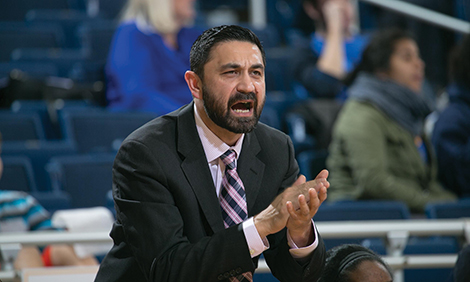
Faisal Khan ’99, social work was studying law at the University of Baltimore 15 years ago when his passion for basketball led him down a different path. He took an assistant coaching job for the women’s team at West Virginia Wesleyan College.
Khan’s journey in women’s hoops has led him to the position of associate head coach at Hofstra University. But it hasn’t been a quick and narrow path. He has worked in South Africa and Scotland, and even departed Hofstra in 2010 to make a sojourn to his father’s hometown in India, before returning to the school in 2012.
“You have to find through all of these experiences who you are as a human being,” says the peripatetic Khan. “If you are not comfortable in your own skin, and can’t find comfort in your own skin, you have problems. I am a firm believer in that.”
Khan, who was born in Libya and moved to the United States when he was 11 years old, has also worked at Shepherd University and UNC-Asheville with head coach Betsy Blose.
In his second stint at Hofstra, Khan has helped head coach Krista Kilburn-Steveskey guide the women’s team to its first Colonial Athletic Association title game and a bid to the women’s NIT.
Off the court, Khan leads efforts for Hofstra student-athletes to give back through work with groups including the Interfaith Nutrition Network – a Long Island-based food pantry – and Special Olympics.
– David Driver

Jen Dress, UMBC’s assistant director of student life, has extended her close working relationship with students to officiating at their weddings as alumni. She tells UMBC Magazine how it came about.
“I started creating wedded bliss a little bit by chance. I had a former student and a student-turned-staff-member from some pretty different family and religious backgrounds who said, Hey we got engaged, so can you marry us? And the internet said I could. Basically you can go online and submit your name to be able to file paperwork for folks and become an officiant. My first wedding was Sameeha Azeez Bricklemyer ’09, visual arts and Ryan Bricklemyer ’04, information systems, and M.S. ’06, information systems.
“I also officiated for Jay Lagorio ’08, computer science, and Cassie Surber Lagorio ’09, political science and psychology; Beth and Simon Reilly; and Morgan Simonds ’12, psychology, and John Privot ’12, psychology and environmental studies. I officiated for former staff member Stephanie Hemling and her husband Steven Palinkas as well. To be able to tell their stories in front of their families and friends really brings things full circle for me.
“The weddings are such a stumble down memory lane. I meet them when they are 18 and now they are headed down this path of marriage and family and all that goes with it. To see how their lives have unfolded and the UMBC friendships they have maintained speaks to the power of this place. They make friends here and sometimes meet their person here!”
– Julia Celtnieks ’13

Matt Frazier ’07, M.S., applied mathematics, ran marathons as a hobby. Eating right was a key element.
“I didn’t want to eat animals,” Frazier recalls. “But as an athlete, I was worried about getting enough calories and protein.”
Seeing a flier with graphic images of chickens being slaughtered pushed him to embrace vegetarianism. But could he keep running with the new lifestyle?
In 2009, Frazier started a blog to find some answers about being an endurance athlete on a vegetarian diet. He’s been blogging for a growing audience as the “No Meat Athlete” ever since.
“It turned out to be a good name,” says Frazier. Readers started asking for t-shirts – and for training advice. Within six months of giving up meat, Frazier accomplished his long-held goal of qualifying for the Boston Marathon by shaving 10 minutes off his finishing time.
The blog has blossomed into a website stocked with training tips, recipes, and podcasts. Frazier’s first published book, No Meat Athlete: Run on Plants and Discover Your Fittest, Fastest, Happiest Self (co-authored by Matthew Ruscigno) has sold 25,000 copies. A vegan cookbook – with chef Stepfanie Romine – will be published next year.
Cities including London, Moscow, and Tokyo now boast “No Meat Athlete” running groups. “It makes me feel good to see that take off,” says Frazier.
Frazier says his training in applied mathematics at UMBC taught him “a logical and analytical way of thinking that has been really valuable,” especially as an entrepreneur.
“There’s no map – especially with the blog and podcasts,” he adds. “It’s a new frontier.”
– Caitlin James ’01
Check out Frazier’s site at nomeatathlete.com

Microscope & Meter by Diana Zeiger ’01
Hurdles & Healing by David Glenn
Pining For The Past by Caitlin James ’01
Front Row Seat by Richard Byrne ’86