We use cookies for analytics and, unless you opt out, advertising.
You can opt out of advertising at any time.UMBC uses essential cookies to run this site. With your permission we would also use analytics cookies (to understand how the site is used) and advertising cookies (to measure and target our ads on other platforms). Nothing else loads unless you accept. You can change your choice any time from Cookie Settings in the footer.Privacy Policy
EssentialRequired for the site to work (login, security, your cookie choice). Always on.
If you thought workers’ hourly pay was finally rising, think again.
At first glance, the latest data – which came out on Feb. 7 – look pretty good. They show nominal hourly earnings rose 3.1% in January from a year earlier.
But the operative word here is nominal, which means not adjusted for changes in the cost of living. Once you factor in inflation, the picture changes drastically. And far from representing a “blue collar boom” – as the president put it in his State of the Union address – the real, inflation-adjusted data show most U.S. workers have not benefited from the growing economy.
As an economist who studies wage data, I think it’s paramount that we take a step back and look at what the data really show.
Business journalists and financial markets tend to focus on the monthly data. These figures are only reported in nominal or current terms because the inflation data doesn’t come out until later.
A more complete set of wage and pay data is reported quarterly. The latest release came out in December for the third quarter. These figures are not only adjusted for inflation but also include fringe benefits, which account for just under a third of total compensation.
At first blush, it makes sense to focus primarily on the first set. Newer data is, well, newer, and market participants and companies prefer the latest information when making decisions about investments, hiring and so on.
But the effect of inflation means that the same US$1 bill buys less stuff over time as prices increase.
From December 2016 to September 2019, nominal wages rose 6.79% from $22.83 to $24.38. But after factoring in inflation, average wages barely budged, climbing just 0.42% in the period.
Incorporating fringe benefits into the picture adds another wrinkle.
The inflation-adjusted or real value of fringe benefits, which include compensation that comes in the form of health insurance, retirement and bonuses, declined 1.7% in the three-year period.
Altogether, that means total real compensation slipped 0.22% from the end of 2016 to September 2019.
Of course, workers in different sectors have fared differently. The Trump administration has singled out manufacturing workers – who it says are the main beneficiaries of its trade war and other policies intended to support the sector – as having benefited from a “blue collar boom” in wages.
The nominal data for manufacturing workers hardly support a boom but they do show an increase of 2.22% since Donald Trump took office.
The adjusted data, however, make it look more like a bust, with wages plunging 3.88% in the period. And, again, the situation is worse when we add in fringe benefits, which brings the decline to 4.33%.
So next time you read a story about a rise in pay, try to see if it reports the wage data in nominal or real terms, and if it includes fringe benefits too. If it’s only nominal wages, the numbers may mean a lot less than they seem.
You’re trailing bits of personal data – such as credit card numbers, shopping preferences and which news articles you read – as you travel around the internet. Large internet companies make money off this kind of personal information by sharing it with their subsidiaries and third parties. Public concern over online privacy has led to laws designed to control who gets that data and how they can use it.
But it is technically challenging to determine in real-time whether a privacy violation has occurred, an issue that is becoming even more problematic as internet data moves to extreme scale. To make sure their systems comply, companies rely on human experts to interpret the laws – a complex and time-consuming task for organizations that constantly launch and update services.
My research group at the University of Maryland, Baltimore County, has developed novel technologies for machines to understand data privacy laws and enforce compliance with them using artificial intelligence. These technologies will enable companies to make sure their services comply with privacy laws and also help governments identify in real time those companies that violate consumers’ privacy rights.
Helping machines understand regulations
Governments generate online privacy regulations as plain text documents that are easy for humans to read but difficult for machines to interpret. As a result, the regulations need to be manually examined to ensure that no rules are being broken when a citizen’s private data is analyzed or shared. This affects companies that now have to comply with a forest of regulations.
Rules and regulations often are ambiguous by design because societies want flexibility in implementing them. Subjective concepts such as good and bad vary among cultures and over time, so laws are drafted in general or vague terms to allow scope for future modifications. Machines can’t process this vagueness – they operate in 1’s and 0’s – so they cannot “understand” privacy the way humans do. Machines need specific instructions to understand the knowledge on which a regulation is based.
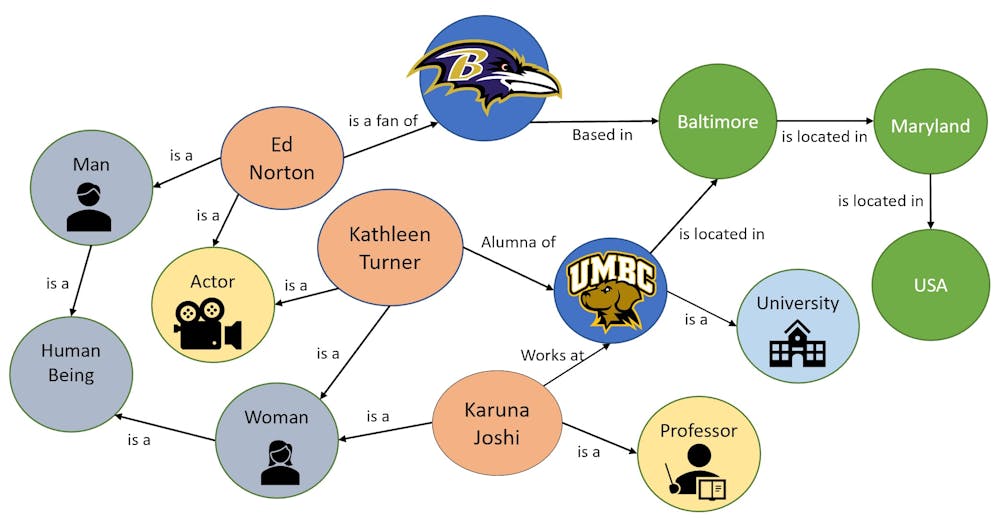
One way to help machines understand an abstract concept is by building an ontology, or a graph representing the knowledge of that concept. Borrowing the concepts of ontology from philosphy, new computer languages, such as OWL, have been developed in AI. These languages can define concepts and categories in a subject area or domain, show their properties and show the relations among them. Ontologies are sometimes called “knowledge graphs,” because they are stored in graphlike structures.
An example of a simple knowledge graph. Karuna Pande Joshi, CC BY-ND
When my colleagues and I began looking at the challenge of making privacy regulations understandable by machines, we determined that the first step would be to capture all the key knowledge in these laws and create knowledge graphs to store it.
Extracting the terms and rules
The key knowledge in the regulations consists of three parts.
First, there are “terms of art”: words or phrases that have precise definitions within a law. They help to identify the entity that the regulation describes and allow us to describe its roles and responsibilities in a language that computers can understand. For example, from the EU’s General Data Protection Regulation, we extracted terms of art such as “Consumers and Providers” and “Fines and Enforcement.”
Next, we identified Deontic rules: sentences or phrases that provide us with philosophical modal logic, which deals with deductive behavior. Deontic (or moral) rules include sentences describing duties or obligations and mainly fall into four categories. “Permissions” define the rights of an entity/actor. “Obligations” define the responsibilities of an entity/actor. “Prohibitions” are conditions or actions that are not allowed. “Dispensations” are optional or nonmandatory statements.
The researchers’ application automatically extracted Deontic rules, such as permissions and obligations, from two privacy regulations. Entities involved in the rules are highlighted in yellow. Modal words that help identify whether a rule is a permission, prohibition or obligation are highlighted in blue. Gray indicates the temporal or time-based aspect of the rule. Karuna Pande Joshi, CC BY-ND
To explain this with a simple example, consider the following:
You have permission to drive.
But to drive, you are obligated to get a driver’s license.
You are prohibited from speeding (and will be punished if you do so).
You can park in areas where you have the dispensation to do so (such as paid parking, metered parking or open areas not near a fire hydrant).
Some of these rules apply to everyone uniformly in all conditions; while others may apply partially, to only one entity or based on conditions agreed to by everyone.
Similar rules that describe do’s and don’ts apply to online personal data. There are permissions and prohibitions to prevent data breaches. There are obligations on the companies storing the data to ensure its safety. And there are dispensations made for vulnerable demographics such as minors.
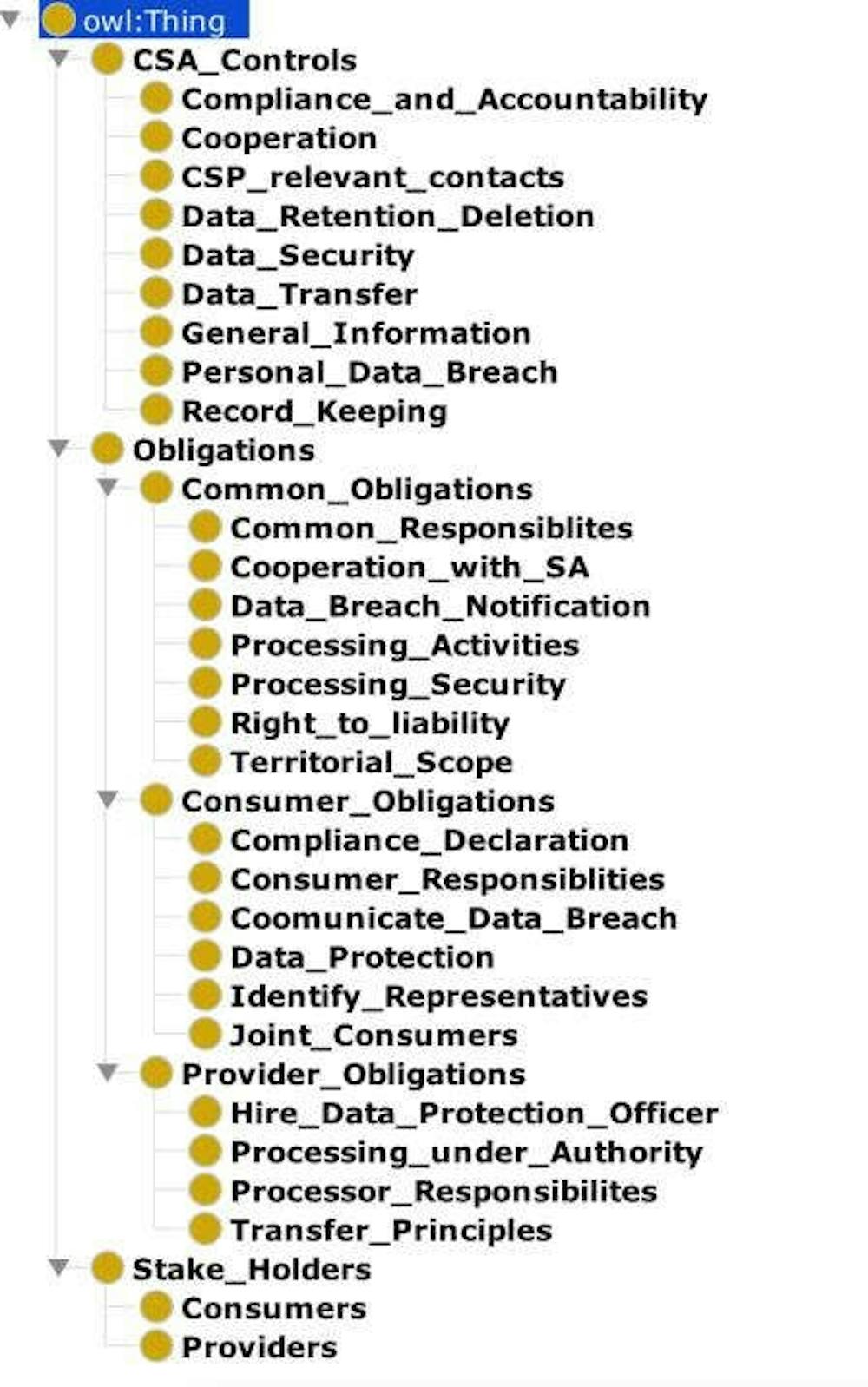
A knowledge graph for GDPR regulations. Karuna Pande Joshi, CC BY-ND
My group developed techniques to automatically extract these rules from the regulations and save them in a knowledge graph.
Thirdly, we also had to figure out how to include the cross references that are often used in legal regulations to reference text in another section of the regulation or in a separate document. These are important knowledge elements that should also be stored in the knowledge graph.
Rules in place, scanning for compliance
After defining all the key entities, properties, relations, rules and policies of a data privacy law in a knowledge graph, my colleagues and I can create applications that can reason about the data privacy rules using these knowledge graphs.
These applications can significantly reduce the time it will take companies to determine whether they are complying with the data protection regulations. They can also help regulators monitor data audit trails to determine whether companies they oversee are complying with the rules.
This technology can also help individuals get a quick snapshot of their rights and responsibilities with respect to the private data they share with companies. Once machines can quickly interpret long, complex privacy policies, people will be able to automate many mundane compliance activities that are done manually today. They may also be able to make those policies more understandable to consumers.
Five million users are middle and high school students. Some are as young as 11, although it’s illegal to sell vaping products to anyone under 21.
Especially for kids, much of the lure is flavor. E-cigarettes offer attractive smells and tastes. Fruit, mint, candy and dessert flavors are the favorites, and studies suggest they ignite the desire to vape. That’s why the Trump administration just banned the sale of those sweet flavors from cartridge-based e-cigs, the delivery method most popular with teens.
One of us (Weihong) is a chemosensory neurobiologist, and the other (Rakaia) is a research assistant in my lab. Put simply, we study how the sensory systems and brain react to chemical stimulation. With e-cigarettes, we are focusing on how the enticing flavors ensnare our children.
But our studies have shown that the effect of flavor goes beyond the pleasure they may bring – the flavorings themselves may actually harm tissue.
These ads extol the virtues of flavored cigarettes.
Flavors enhance e-cig appeal
The tobacco industry has long been using flavorings make their products more palatable; it added menthol to cigarettes nearly a century ago.
Today, the allure of flavors in e-cigarettes bring potential health consequences, and kids are particularly vulnerable. E-cigarettes can put adolescents at risk for respiratory, cardiopulmonary diseases, brain disorders and cancers.
About 20,000 flavored e-liquids are on the market – countless combinations of hundreds of flavoring molecules extracted from natural ingredients or artificially made. The vast majority are volatile odor chemicals, perceived not by taste, but by smell.
Your olfactory system, with far more sensitivity than your taste buds, can distinguish more than 10,000 smells. During vaping, a flavoring enters our nose, and like any agreeable scent, immediately evokes the fond memories and pleasant emotions associated with the aroma. Vanillin, a popular e-cigarette flavoring, smells like dessert; ethyl maltol, a flavoring used in many foods, has a candy-like odor. The user, comforted and calmed, savors the moment – then goes back for more.
But e-cigarette vapor also contains nicotine, heavy metals and formaldehyde, as pungent as they are harmful. Mixing in delectable flavorings disguises their unpleasantness, much like the cherry additive that camouflages the otherwise medicinal taste of children’s cough syrup.
Yet perceptions of irritation and pain in the nose, mouth, and throat serve as warning signals, the body’s cautionary bells and whistles evolved over millions of years. A bitter taste might originate from a toxic plant; irritation in the nose or respiratory tract indicates the inhaled substance is potentially harmful.
But now that flavorings in e-cigarette mask the warning signals, many consumers have been lulled into believing vaping is benign. They rate mint flavors as safer, though they are not. And instead of irritation from the e-cigarette prompting a cough – an action that removes harmful stimuli from the airway – the flavorings instead dampen the user’s sensory alarms and protective reactions. The risk of chemically induced injury, along with nicotine abuse, is increased.
How flavors themselves may be toxic
Although the U.S. Food and Drug Administration has acknowledged some flavorings as “safe for consumption,” its label dodges a critical distinction. Safe for consumption does not mean safe for inhalation. While scientists still haven’t confirmed the inhalation toxicity for all flavorings, the latest research reveals some disturbing evidence.
Flavor molecules, reacting with the propylene glycol in the e-liquid, can produce metabolites, or intermediate substances that are part of metabolic reactions, that are irritating to the respiratory system. Long-term exposure to irritants can lead to chronic cough; inflammation; hyper-reactive airway (wheezing, shortness of breath); edema (swelling in the arms, hands, legs or feet); and acute lung damage.
Some flavorings, inhaled chronically or at high levels, are already known to cause serious and sometimes deadly respiratory illnesses. Diacetyl, a buttery flavor used in processed foods – notably some popcorn products – causes “popcorn lung,” an irreversible disease that affects factory workers exposed daily to the compound.
Many e-liquids contain diacetyl; an analysis found the substance in 39 out of 51 tested e-cigarette samples. In about half the samples, the estimated daily consumption was above safety limits.
Patients with EVALI exhibit a significant number of these symptoms, and all were attributed to vaping. In one survey, users reported cough (40.0%); dry or irritated mouth or throat (31.0%); dizziness or lightheadedness (27.1%); headache or migraine (21.9%); or shortness of breath (18.1%).
Similar health problems have been reported by patients with chemically induced sick building syndrome. This implies that e-cigarette users share common health problems with those suffering from chemical exposure.
What about long-term vaping?
Ongoing chemical exposure, especially at high doses, can cause olfactory dysfunction, including a reduced sense of smell. This encourages chronic e-cigarette users to choose stronger-flavored e-liquids to receive a sufficient buzz. In turn, more potent e-liquids generate more irritation and damage to the nose, lungs and lower airway.
The health effects of e-cigarette exposure go beyond the sensory and respiratory systems. Mint and candy flavors are more than chemical accessories that enhance a harmless experience. They shape our behavior, perhaps for a lifetime.
Our government is making progress towards keeping teens away from e-cigarettes. Now, long-term research is needed to fully comprehend the adverse health effects and toxicity of flavorings and other chemical substances in the e-cigarette vapor to prevent the potentially catastrophic effects of vaping.
As scholars, we believe in the study, exchange and debate of ideas. But recently we have become concerned by the direction that the debate about what methods teachers should use to help kids learn to read has taken.
Phonics is a method of teaching reading that emphasizes getting kids to decode individual letters and groups of letters and to connect them with the sounds they make, such as connecting the letter “a” with the sound it makes in the words “cat” or “ate.”
This approach was developed in the mid-19th century by experimental psychologists who held that reading was a linear, bottom-up process involving rote learning of letters, sounds, words, sentences, then comprehension.
These days, phonics-first advocates call their favored approach “the science of reading.” They say it has been proven to work through rigorous scientific testing. They dismiss all other methods.
While phonics, or other teaching strategies, may work effectively in one context, it does not guarantee the same results with different teachers or students. For example, if a child does not learn in a linear way or have the visual or auditory processing skills needed to learn letters and sounds, phonics may not be a reliable approach.
These strategies include sounding out a word using phonics knowledge, looking at the pictures, skipping the word and coming back to it after reading the rest of the sentence, and thinking about what would make sense.
A comprehensive approach also includes providing time for studying spoken language, including vocabulary and spelling. It also calls for providing explicit comprehension instruction through having kids respond to texts through writing, talking, acting it out or drawing. Teaching higher-order critical thinking skills , such as prediction and reflection about stories, helps kids get the hang of reading as well.
Perhaps ironically and despite the decades-long and sometimes heated debate over what teaching methods work best, there are no reliable data about which methods U.S. teachers use most to teach kids.
A Dec. 3 EdWeek article by Madeline Will, for example, discusses former elementary teacher’s Mary Sacchetti’s experience using “an intensive phonics based program” to help a second grade student named “Juan.” The boy was identified as requiring special education.
Will indicates that Juan “knew about half of his consonant sounds and none of his vowels.” She reports that Juan made reading gains after phonics interventions, although she doesn’t share the specifics.
The article questions why Sacchetti and other teachers are not always prepared to offer phonics interventions since, Will writes, this approach to teaching reading is rooted in science.
Comprehensive approach
The answer is that other methods for teaching reading are also backed by ample evidence.
Similarly, the National Council of Teachers of English recently issued a Statement on the Teaching of Reading that brought together multiple research studies to define teaching reading as an evolving complex process that cannot be reduced to one skill or a linear set of skills.
This research underscores the important role that learning to understand texts based on your own experiences can play when kids learn to read. It also highlights the importance of a comprehensive approach that includes fluency, oral language, writing, spelling, phonics, vocabulary and comprehension – and that readers learn to read by reading widely.
In addition, kids benefit from reading different kinds of texts, including online, interactive content from web apps or e-books.
Just like each child, family and teacher grows over time, reading methods should too because there is more than one good way to teach a kid how to read.
When UMBC Men’s Soccer Coach Anthony Adams traveled to Canada for a former player’s wedding, he didn’t expect to come away from the trip with a significant donation to the team. But then again, he wasn’t all that surprised; his players usually found ways to give back.
The gift came from Liam Paddock ’12, psychology and sociology, who played soccer at UMBC from 2009 to 2012. After catching up with Adams at the wedding of teammate Milovan Kapor ’13, economics, Paddock asked if there was anything the team needed—after all, UMBC Men’s Soccer had made a huge impact on his life. “They backed me in hard times, connected me with the right people, and continued to give me opportunities throughout my years there,” he says. “So, now I’m in a position to, giving back to UMBC Men’s Soccer makes sense.”
Adams immediately thought of the VX system, a wearable piece of technology that helps players track their movements and their heart rates. Adams hoped to get his hands on the technology to better train his athletes.
“As much as we can, we want to be on the cutting edge. Science is a big part of sports, and this is information we didn’t have in the past,” Adams explains. “Monitoring systems [were] just the next logical step for us.”
The VX System, and others like it, has become invaluable to many soccer teams because it can be used to foresee possible injuries, says Adams. This technology, which players don under their jerseys during practice and games, lets coaches see important pieces of performance data, all of which are presented via simple, comprehensive metrics on the system’s custom software. An unusually high heart rate, for example, can indicate that a player may be fatigued and at greater risk for a muscular injury.
Ryan Becher, ’23, a midfielder, used the VX system as a part of another team, prior to coming to UMBC. “The training staff noticed my numbers were getting lower, so they started to talk to me,” he remembers. He ended up having some back problems and being unable to play for two months, but he believes the situation could have gotten much worse if his coaches hadn’t known to intervene so early.
On top of aiding with injury prevention, the VX system also helps players improve their gameplay. Though the UMBC team has only been using the technology since the start of this season, Ryan’s brother and fellow teammate, Jackson Becher, ’22, psychology, has already found these functions useful. “We get my max heart rate, how fast I’m sprinting, how often I’m sprinting, and how far I’m running,” he says. “So being able to look at that makes it easier for me to understand where I need to be and what I need to do to improve.”
Adams says that giving back is part of the soccer team’s DNA, and the coach doesn’t shy away from asking alumni to pitch in. This past season, the team needed a new couch for their locker room, but didn’t have the money to buy one. Adams sent out an email to soccer team alumni and, within 30 minutes, three alumni had replied, collectively donating enough to cover the cost of the couch.
But this relationship with alumni goes far beyond donations. For Paddock, the friendships he made while playing for UMBC became some of the most important in his life. “There is a genuine sense of family,” he explains. “And while I think that term gets thrown around, I feel it every time I go back to Baltimore.”
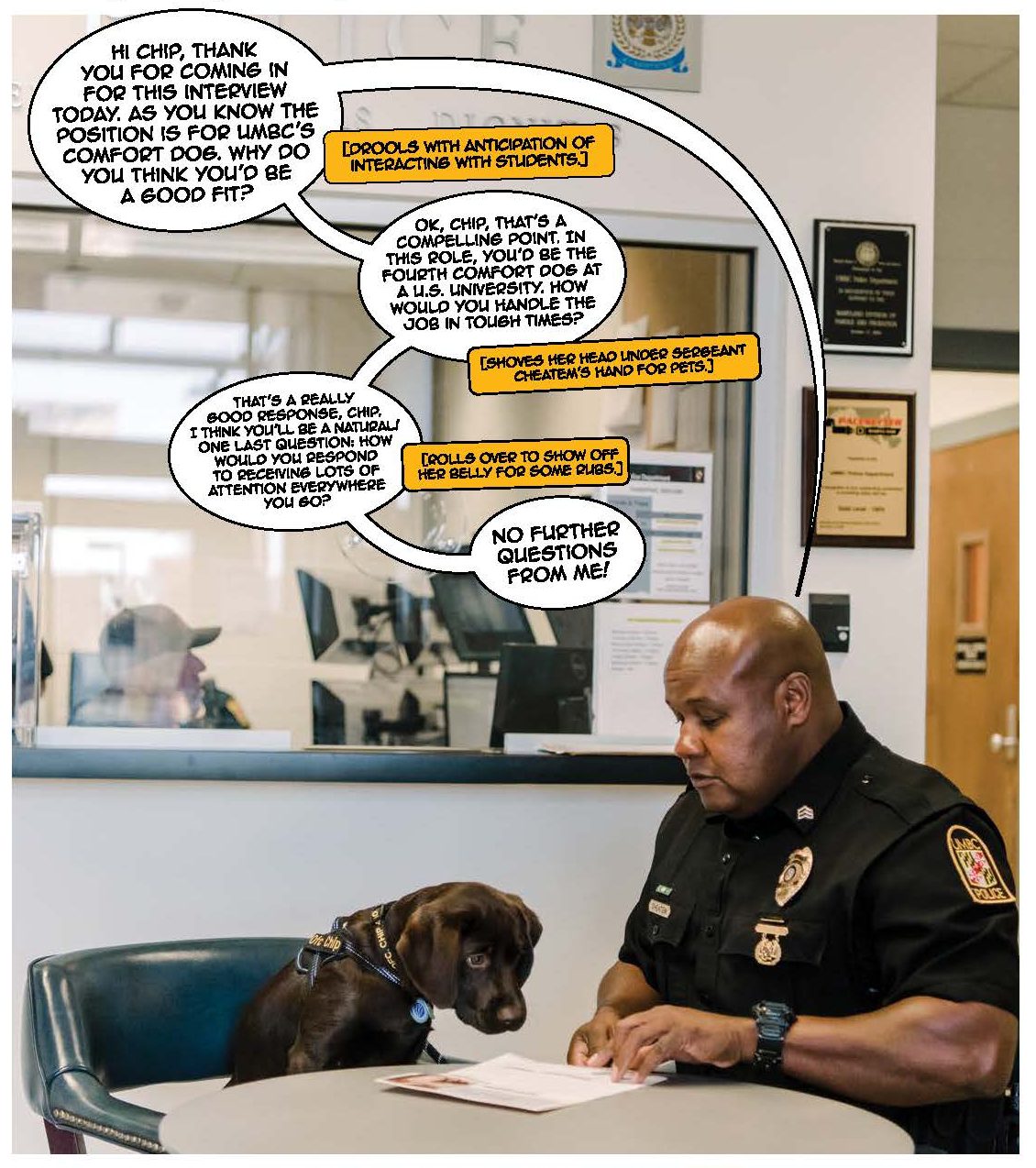
Earlier this year, Chip interviewed for the coveted position of campus comfort dog with UMBC Police Sergeant Jamie Cheatem.
There’s no denying that any day we get to interact with Chip is the best work day, so we were thrilled when Sergeant Cheatem agreed to let UMBC Magazine follow Chip around for a day on the job as a campus comfort dog. UMBC is the fourth U.S. campus to welcome a comfort dog, and we wanted to see what Chip’s day-to-day duties looked like.
Chip lives with Sergeant Cheatem and his family and gets a ride to the office with her favorite UMBC police officer.
Her day continues as Sergeant Cheatem completes necessary tasks at the police station before heading down to campus.
On the way to hang out with some students, Chip runs into someone who looks familiar and excitement ensues.
Chip loves her fellow Retrievers and they love her. They show their affection through Chip’s favorite activity—getting her belly pet.
Chip doesn’t make it very far down Academic Row before more admirers stop to say hi.
Although it may look like Chip’s on-campus duties involve getting the attention she deserves, she also attends events like the Retriever Courage Fall Gathering, which featured a variety of resource tables and a collection of updates about the steps the University is taking to improve its response to, and ultimately prevent, violence in our community.
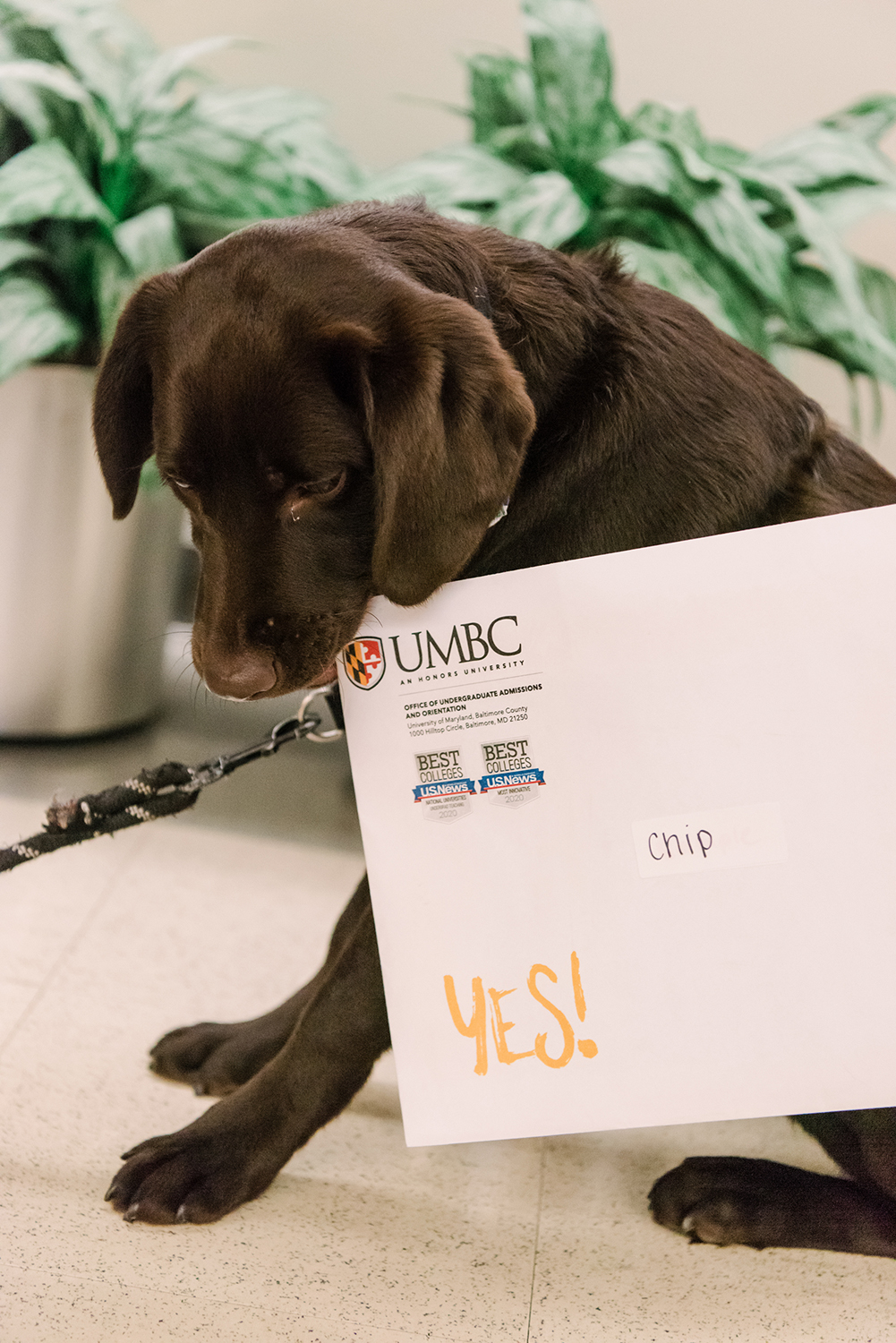
Chip also responds to requests from specific departments, like when Undergraduate Admissions wanted to let the incoming class of Retrievers know that their acceptance letters were on the way. Chip was the first in the class of 2024 to get her letter!
At the end of the day, Chip is still a young pupper and needs time to frolic and get her energy out.
****
All photos by Marlayna Demond ’11, featuring Sergeant Cheatem and Officer Chip.
If you’ve ever searched online for a place to eat in Baltimore, chances are Ekiben has popped up as a top destination again and again. Or, if you followed along with this year’s fried chicken sandwich feud between two fast food joints, you’ll have seen plenty of Baltimoreans resolving the issue by pointing to Ekiben’s classic Neighborhood Bird steamed bun. Yelp, Buzzfeed, and other national outlets reaffirm that this small storefront serving eclectic pan-Asian fare is worth the trip to Fells Point (with a second location in Hampden to open soon). Steve Chu ’12, economics, co-owner of the restaurant along with two other UMBC alumni, writes how the store owes its origins to UMBC and Baltimore City, and why these Retriever chefs care so much about the communities they serve.
Food has always been about community to me. My father worked endless hours running his Chinese restaurant, but on Mondays, he closed the restaurant and the whole family—aunts, uncles, grandparents—would go out to eat dim sum for breakfast. There’s be like 50 plates on the table. My relatives would urge me, eat, eat, try everything.
When Ephrem Abebe ’13, web development and information systems, Nikhil Yesurpriya ’13, M.S., ’16, biological science, and I started Ekiben in 2013 we wanted other people to enjoy food together, specifically this weird combination of Chinese/Taiwanese/Indian/Ethiopian cuisine. It was completely natural to us, coming from the food-focused cultures we came from, that food could unite disparate groups of people. The fact that Ekiben has been such a hit in Baltimore blows our minds, but is exactly what we hoped would happen.
When we met at UMBC—Nikhil and I through suitemates and Ephrem and I while volunteering for Habitat for Humanity in Baltimore City—I was studying financial economics, but it was so heavily focused on crunching numbers. I switched to a straight economics major early on after I realized that I wanted to learn more about how people thought and behaved with money. My background from UMBC has helped me tremendously in my career.
Gib Mason ’95, economics, taught a course on entrepreneurship that gave me the confidence that we could take this leap, buy a hot dog cart, and sell meatballs or spicy tofu at farmers markets, which is how we started out. He steered the class away from traditional homework assignments and asked us for our reasoning behind our answers instead. That still resonates with me as a business owner.
Gathering community around us has come as naturally as combining our love of food into affordable and delicious dishes. Fells Point has been like home to us, and Baltimore has supported us every step of the way. Even in unusual ways—getting the original food license for the hot dog cart as a couple of 20-somethings was so much easier than we anticipated. The licensing board was so supportive after we explained our vision, but that came as a complete surprise to us.
What came next could be surprising to some in the restaurant business, but in Baltimore, this seems par for the course. After struggling with our hot dog cart-turned eclectic Asian fare cart for about a year, we got invaluable support from other local chefs. Ekiben wouldn’t exist without the guys behind Black Sauce, Damian Mosley and Michael Singleton, and Ben Lefenfeld from La Cuchara. Our friendships with other local chefs led naturally into collaboration and guest chef takeovers.
The best example of that communal approach to food in the city is the Charm City Night Market—think of an Asian open air market, tons of people and amazing food—organized by Stephanie Hsu and the rest of the local Chinatown Collective. We were really proud to be a part of the inaugural year and subsequent events. It does what we want for the city. It brings people of all demographics together, and it’s always so densely packed, and there’s so much great energy in it.
We’ve partnered with so many excellent chefs from Baltimore and beyond, and this is another way we get to cross-pollinate with talented craftspeople. There’s this push for food to be “traditional” or “authentic” but at it’s best, food is art. And ultimately, we just want to make food that tastes good and build up the community while doing so. We start that goal in the restaurant, investing a lot of energy into developing leaders in the company. We have staff that’s been with us since the beginning. I hope the supportive culture that we built really just kind of oozes out, and it spreads.
Chu and Abebe take a moment to pause in their Fells Point storefront.
Abebe chats with a regular customer who brought some out-of-town friends.
And Baltimore has supported us every step of the way. Baltimore has raised us. Literally, this restaurant was built on every $7 meal we served at any market that would let us sell there. We didn’t have a Kickstarter page, we just had Baltimore showing up to buy our food.
At those family dim sum breakfasts, as communal as they were, my relatives were not encouraging me to start my own restaurant. They actually loudly and emphatically (to put it politely) tried to steer me in the opposite direction. They, like so many other immigrants, had come here with very little and worked so hard to break away from that poverty. They didn’t want to see me take that same road, I guess. But in the end, their harsh words really spurred me to succeed. How could I fail when they had given so much to make a successful life here?
—Steve Chu ’12
*****
Header image: Abebe and Chu work together in the small prep space where customers can watch their orders being created.All photos by Marlayna Demond ’11.
By Jason Loviglio, founding chair and associate professor of media and communication studies, UMBC
From its start half a century ago, National Public Radio heralded a new approach to the sound of radio in the United States.
NPR “would speak with many voices and many dialects,” according to “Purposes,” its founding document.
Written in 1970, this blueprint rang with emotional immediacy. NPR would go on the air for the first time a year later, on April 20, 1971.
NPR is sometimes mocked, perhaps most memorably in a 1998 “Saturday Night Live” sketch starring actor Alec Baldwin, for its staid sound production and its hosts’ carefully modulated vocal quality. But the nonprofit network’s commitment to including “many voices” hatched a small sonic revolution on the airwaves.
Saturday Night Live‘s “Schweddy Balls” sketch spoofed NPR.
This is NPR
One of the first voices to become associated with NPR’s flagship evening news program was Susan Stamberg. Hired in 1971, she soon became the first woman to co-anchor a national nightly newscast on radio or television in U.S. history.
William Siemering, the network’s first program director and the author of “Purposes,” wanted the voice of the network to communicate curiosity rather than authority.
Stamberg, 31 when she was hired, brought youthful exuberance to the job. And, in another departure from newscasting’s baritones, with their supposedly neutral midwestern accents, Stamberg’s voice was “nasal, quizzical, and unashamedly female,” as Lisa Phillips put it. It came she said, “with a hometown – New York – and an ethnicity – Jewish.”
The decision to stick with young and relatively unproven voices came at a cost, according to Jack Mitchell, the original director of the “All Things Considered” evening newscast.
In his account of NPR’s beginnings, “Listener Supported,” Mitchell later recalled how Siemering passed up Ford Foundation funding tied to hiring the proven and respected newscaster Edward P. Morgan, a white man originally from Walla Walla, Washington. Instead, NPR stood by the less “authoritative” and more engaging voices of Stamberg and her peers, even if they sometimes sounded “less than professional.”
“Masculine, commanding” voices were “exactly how we DON’T want to sound,” Siemering told his staff, as Stamberg later recalled in “This Is NPR: The First Forty Years.”
Early feedback on Stamberg from station managers around the country wasn’t encouraging. She sounded too New York, too Jewish, too off-putting, Mitchell wrote.
Siemering hid these negative reviews from Stamberg as she found her own broadcast voice, which helped her win many prestigious awards in broadcast and digital journalism. The network regards her as one of its “founding mothers.”
NPR has kept speaking with many voices that would sound out of place on the air anywhere else. Many, if not most, have been female. As hosts and anchors, correspondents and reporters, women have played a key role in giving NPR its distinctive sound.
Nina Totenberg, Linda Wertheimer and Cokie Roberts brought hard-nosed journalism and inside-the-Beltway sensibility to the fledgling network in the 1970s. In the process, these white women changed what the news sounded like.
By the time Wertheimer took over as an “All Things Considered” co-anchor in 1989, it was no longer controversial to hear women deliver the news of the day.
But on network television, most of the early stints for the women who were the first to anchor daily news programs were short-lived. Barbara Walters lasted two years in the mid-1970s as an “ABC Evening News” co-anchor. Diane Sawyer co-anchored the “CBS Morning News,” from 1981 to 1984 and Katie Couric spent five years, starting in 2006, as the sole “CBS Evening News” anchor.
Curating distinctive voices “rich with the rhythms and accents of their regions” was another explicit way in which “All Things Considered” initially sought to sonically mark its difference from what had come before, according to Stamberg.
A wider range?
NPR’s commitment to many voices included those who brought regional, as well as gender, diversity to the airwaves.
Occasional commentators Baxter Black, a cowboy poet from Texas; Vertamae Grosvenor, a culinary anthropologist born in the Gullah community of North Carolina; and Kim Williams, a naturalist, checked in during the late 1970s and early 1980s, with field reports from their corners of the country. Andrei Codrescu, a Romanian-American artist living in New Orleans, began to bring his thickly accented English and droll humor to NPR in 1983.
Putting these folks on air seemed to address the network’s vision of speaking in many voices and accents. The intent, Mitchell wrote, was explicitly democratic, to be “representative of the nation. That meant white, black, Hispanic, Asian and as many women as men.”
NPR’s growth led to the opening of foreign bureaus, even as print publications hemorrhaged these expensive positions. International coverage further expanded its vocal range.
Some of the women now working as the network’s anchors got their start as foreign correspondents. Doualy Xaykaothao spent years reporting from Asia and Lulu Garcia-Navarro covered Latin America and the Middle East for NPR.
Other women with nonconventional news voices, including Eleanor Beardsley in Paris, Sylvia Poggioli in Rome and Ofeabia Quist-Arcton in Dakar, are still overseas. Their signature approach to signing off with their name and locale is a sonic pleasure for many NPR fans.
Critics denounced a sense that the voices of NPR’s female journalists sounded “alike in their sober nasal condescension,” as the writer and actor Sarah Vowell put it – hinting at a class-related critique, along with a gendered one.
NPR’s women, some of these naysayers contend, have low-pitched voices that sound too much like men and that NPR voices in general sound more like each other than everyone else. Writer Scott Sherman calls it the “NPR drone.”
Even Stamberg said in a 2010 interview that one price of NPR’s success was that listeners weren’t “hearing great voices anymore.”
Another round of criticism, this one aimed primarily at young women, identified “vocal fry,” a low creaky way of speaking, as an irritating feature of public radio voices. The critique, which came mostly from men and older folks, suggested that despite what the critics were saying, NPR’s sound was not static but evolving.
NPR’s sonic palette and its range of voices has broadened in recent years, especially through its podcasts and on weekends – when Navarro, who is Latina, and Michel Martin, an African American woman, are two of the network’s main three news anchors.
Sam Sanders, an openly gay African American man, hosts a cultural talk show branded with his own name. Programs like “Alt.Latino” and “Radio Ambulante,” which are either in Spanish or in English punctuated with Spanish words, indicate that the network aims to serve new listeners.
As NPR looks forward to the next 50 years, its decisions over whose voices belong on the air will determine how well it lives up to its founding commitment to sound like America. And it is likely that criticism of how those voices sound will reflect dominant attitudes about who gets to speak.
By Amy Froide, chair and professor, Department of History, UMBC
In a recent interview with Vogue, actress Emma Watson opened up about being a single 30-year-old woman. Instead of calling herself single, however, she used the word “self-partnered.”
I’ve studied and written about the history of single women, and this is the first time I am aware of “self-partnered” being used. We’ll see if it catches on, but if it does, it will join the ever-growing list of words used to describe single women of a certain age.
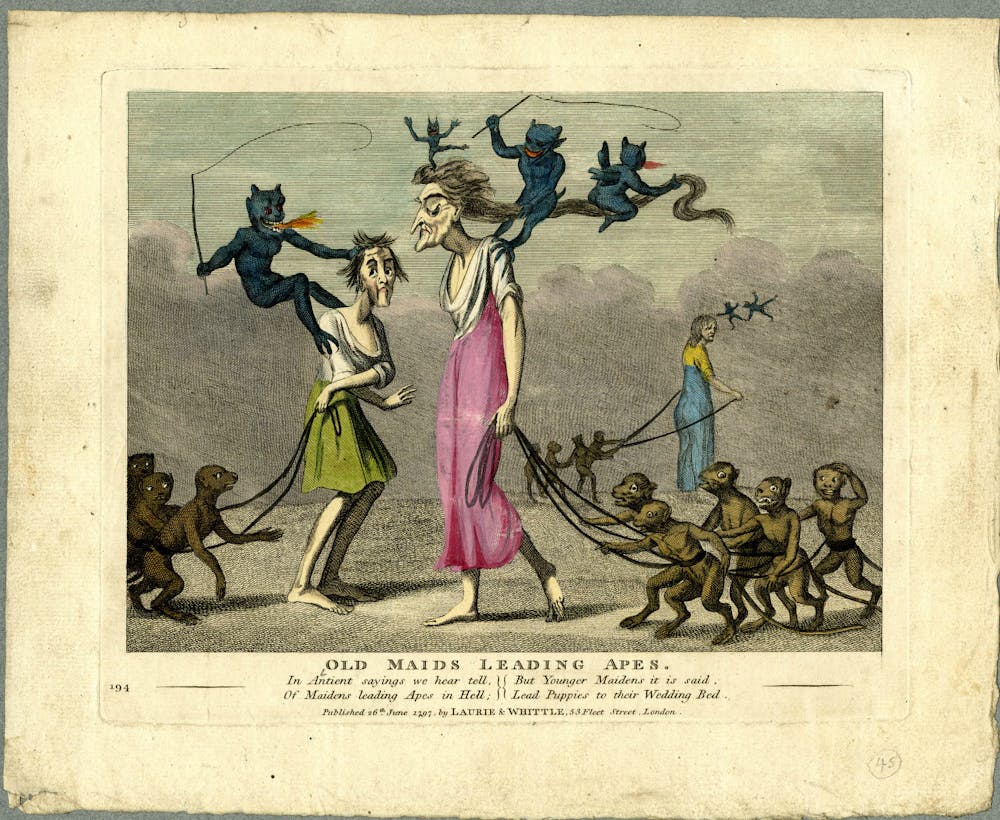
Women who were once called spinsters eventually started being called old maids. In 17th-century New England, there were also words like “thornback” – a sea skate covered with thorny spines – used to describe single women older than 25.
Attitudes toward single women have repeatedly shifted – and part of that attitude shift is reflected in the names given to unwed women.
The rise of the ‘singlewoman’
Before the 17th century, women who weren’t married were called maids, virgins or “puella,” the Latin word for “girl.” These words emphasized youth and chastity, and they presumed that women would only be single for a small portion of their life – a period of “pre-marriage.”
But by the 17th century, new terms, such as “spinster” and “singlewoman,” emerged.
What changed? The numbers of unwed women – or women who simply never married – started to grow.
In the 1960s, demographer John Hajnal identified the “Northwestern European Marriage Pattern,” in which people in northwestern European countries such as England started marrying late – in their 30s and even 40s. A significant proportion of the populace didn’t marry at all. In this region of Europe, it was the norm for married couples to start a new household when they married, which required accumulating a certain amount of wealth. Like today, young men and women worked and saved money before moving into a new home, a process that often delayed marriage. If marriage were delayed too long – or if people couldn’t accumulate enough wealth – they might not marry at all.
Now terms were needed for adult single women who might never marry. The term spinster transitioned from describing an occupation that employed many women – a spinner of wool – to a legal term for an independent, unmarried woman.
Single women made up, on average, 30% of the adult female population in early modern England. My own research on the town of Southampton found that in 1698, 34.2% of women over 18 were single, another 18.5% were widowed, and less than half, or 47.3%, were married.
Many of us assume that past societies were more traditional than our own, with marriage more common. But my work shows that in 17th-century England, at any given time, more women were unmarried than married. It was a normal part of the era’s life and culture.
The pejorative ‘old maid’
In the late 1690s, the term old maid became common. The expression emphasizes the paradox of being old and yet still virginal and unmarried. It wasn’t the only term that was tried out; the era’s literature also poked fun at “superannuated virgins.” But because “old maid” trips off the tongue a little easier, it’s the one that stuck.
The undertones of this new word were decidedly critical.
“A Satyr upon Old Maids,” an anonymously written 1713 pamphlet, referred to never-married women as “odious,” “impure” and repugnant. Another common trope was that old maids would be punished for not marrying by “leading apes in hell.”
At what point did a young, single woman become an old maid? There was a definitive line: In the 17th century, it was a woman in her mid-20s.
For instance, the single poet Jane Barker wrote in her 1688 poem, “A Virgin Life,” that she hoped she could remain “Fearless of twenty-five and all its train, / Of slights or scorns, or being called Old Maid.”
These negative terms came about as the numbers of single women continued to climb and marriage rates dropped. In the 1690s and early 1700s, English authorities became so worried about population decline that the government levied a Marriage Duty Tax, requiring bachelors, widowers and some single women of means to pay what amounted to a fine for not being married.
Still uneasy about being single
Today in the U.S., the median first age at marriage for women is 28. For men, it’s 30.
What we’re experiencing now isn’t a historical first; instead, we’ve essentially returned to a marriage pattern that was common 300 years ago. From the 18th century up until the mid-20th century, the average age at first marriage dropped to a low of age 20 for women and age 22 for men. Then it began to rise again.
There’s a reason Vogue was asking Watson about her single status as she approached 30. To many, age 30 is a milestone for women – the moment when, if they haven’t already, they’re supposed to go from being footloose and fancy-free to thinking about marriage, a family and a mortgage.
Even if you’re a wealthy and famous woman, you can’t escape this cultural expectation. Male celebrities don’t seem to be questioned about being single and 30.
While no one would call Watson a spinster or old maid today, she nonetheless feels compelled to create a new term for her status: “self-partnered.” In what some have dubbed the “age of self-care,” perhaps this term is no surprise. It seems to say, I’m focused on myself and my own goals and needs. I don’t need to focus on another person, whether it’s a partner or a child.
To me, though, it’s ironic that the term “self-partnered” seems to elevate coupledom. Spinster, singlewoman or singleton: None of those terms openly refers to an absent partner. But self-partnered evokes a missing better half.
It says something about our culture and gender expectations that despite her status and power, a woman like Watson still feels uncomfortable simply calling herself single.
Today’s 18 to 24-year-old college students are expressing anxiety, depression, suicidal ideation, and other related disorders at rates higher than previous generations, according to recent studies. The number of students treated by college counseling centers, according to the 2015 Center for Collegiate Mental Health Annual Report, has grown by more than five times the rate of institutional enrollment. The number of attended appointments has grown at more than seven times the pace of institutional enrollment. To address these changes on our own campus the last several years, UMBC has responded with a holistic approach to its health services and additional preventative and support resources for its students.
“We’ve begun integrating health and counseling with the goal of treating the whole person,” says Kim Leisey, UMBC associate vice president for student affairs. “We know some mental health issues manifest physically and vice versa, so our University Health Services (UHS) and Counseling Center staff work together to help students who may need support from both a physical and emotional perspective.”
This means, for example, therapists ask students when they had their last physical, and nurse practitioners screen for alcohol and drug disorders. Psychiatrists consult with both UHS and counseling staff, while case managers in each department work together on referrals and the insurance process.
The integrated approach will continue to expand and be implemented in a new combined health and counseling building, scheduled to open in 2021. In both formal assessments and individual interactions, UMBC students expressed strong desires to create integrated health structures that reduce stigma and promote self care. Vice President for Student Affairs Nancy Young says, “The new building will allow us to streamline and enhance services supporting the physical, behavioral, and emotional well-being of our students as a foundation for academic success.”
In a step beyond the traditional offerings, UMBC became the fourth U.S. university to add a trained comfort dog to its list of holistic services for students when Chip, a floppy-eared brown Labrador, joined the UMBC Police Department in fall 2019. The University’s Community Resource Sergeant, Jamie Cheatem, serves as the dog’s handler and says that one of Chip’s roles is to provide comfort to students during times of crisis and also during stressful periods during the academic year such as midterms and finals.
UMBC also began offering new recovery and sober living services to students this fall. The Haven at UMBC is part of a partnership between the Division of Student Affairs and The Haven at College, the leading national provider of treatment services and recovery support for college students with substance use and co-occurring disorders. At UMBC, Haven includes a recovery residence and outpatient center in separate locations near campus as well as mentoring and monitoring programs.
In addition to their traditional services, UHS and the Counseling Center offer a variety of support groups, workshops, and screenings to provide students with tools to cope with the stress of college life and managing emotions and distress. “We’re paying attention to wellness programs as well as in-person and online services that can help us reach a broader range of students,” says Bruce Herman, UMBC’s director of health and counseling.
Student peer health educators also assist in educating fellow students on a variety of physical and mental health issues. “Being able to go into the UMBC community and talk with different student groups about various behaviors and topics that impact their health is incredibly meaningful,” says Olivia Hardy ’20, health administration and policy, who works as a peer health educator.
“I love being able to actively contribute in minimizing students’ knowledge gaps,” continues Hardy. “We’re by no means professors or graduate students or staff—and in that, I think that we aren’t daunting. We’re just people students see in their classes, excited to help in any way we can.”
UMBC students, faculty, and staff have an opportunity to play a role in supporting students and other community members by participating in mental health training workshops offered by UHS and the Counseling Center. In addition to its support groups and resources, the Women’s Center offers workshops on supporting survivors of sexual assault and misconduct, while Campus Life’s The Mosaic: Center for Culture and Diversity launched a wellness series for students who identify as LGBTQ+.
UMBC community members who need help addressing situations where a person is displaying disruptive or threatening behavior can contact the interdisciplinary Behavioral Risk Assessment and Consultation Team, which includes Herman along with representatives from student affairs, psychology, human resources, UMBC police, and general counsel. Athletics’ new #RetrieverProject will work closely with student-athletes and members of the UMBC and Catonsville communities to help break stigmas associated with mental health through education and support.
Herman adds that campuswide involvement is critical for the university to address the growing need for mental health support and student success and focus on stigma reduction. “We have to see this work as not just about treatment but instead about co-creating an environment that supports students and their health, including mental health.”
To teach in a particularly challenging school, it might just help to have gone through a few challenges of your own. At least, that is the case for Jody Grandier ’17, American studies. The 39-year-old single mom went from living on the streets in downtown Baltimore to teaching first grade at the city’s North Bend Elementary School.
Last spring, she was recognized by Baltimore City Schools CEO Sonja Santelises, as one of three “Amazing Teachers,” an award given after the completion of the first year teaching.
“My number one goal in my classroom is to build relationships and bonds, not just with children but with their family and the communities,” says Grandier. She does that by helping the kids get what they need, from school supplies to socks, and making sure to not be judgmental about their circumstances. After all, her understanding of some of their hardships comes from first-hand knowledge.
Turning Point
Grandier says that when she was 18 she moved to Baltimore with a boyfriend and “once I moved down there I ended up getting into drugs and getting into a lot of trouble and living on the street and being in a lot of abusive relationships.” After moving home and spending time in rehab she began to recover–only to discover that she was pregnant. To provide for herself and her child, she decided to turn back to a childhood dream of being a teacher.
After a few years at Howard Community College, she says, “I went to visit UMBC and I loved it. I thought the campus was really beautiful. Everybody there was so nice and I just couldn’t have asked for a better experience.” She was eventually accepted into the Sherman STEM Teacher Scholars Program. Integral to her journey at UMBC was Nicole King, associate professor and chair of the Department of American Studies, and her classes on gentrification in Baltimore. “I really enjoyed her classes. I absolutely loved it. She’s one of the best human beings I’ve ever met in my whole life, actually,” says Grandier.
Soon after graduation, she got the job at North Bend in southwest Baltimore City. Now she spends her days helping kids from the city learn and grow as she did. Field trips, lunches with the kids, and other fun moments make it rewarding, she says. That said, her job presents unique challenges.
“I definitely am in situations that would prefer not to be in. But I think that it’s part of the job and that if we all said, we don’t want to be in danger, then who would be there teaching? It has to get done. Every child deserves an education,” she says.
Educational Advocate
The education that children get is not always equal, however. Grandier has a unique perspective since her own daughter, now 10, attends a better-funded Howard County school.
“They have brand new computers, [and] when you walk in the building it’s gorgeous. They have a lot of extra activities. We don’t have a lot of that in the city,” she says, where “the buildings are pretty dilapidated, they’re not very nice and they have bugs and they’re hot or they’re cold and we can’t drink the water. I can’t imagine many parents in the county being ok with that.”
On top of that, Grandier says that her students face other obstacles, like homelessness and hunger. “I don’t really know how you can come into a classroom and learn when you’ve been up all night because your parents are fighting or you’re homeless or you’re hungry. That, to a child, has to be completely devastating.”
Grandier advocates for more mental health opportunities for city kids as well as for better funding. Given the resources and a steady stream of dedicated teachers–as well as her unflinching faith in the nature of people–she says that she has hope for the city.
“I think it’s going to be a long road and a lot more people are going to have to be informed and get involved but I definitely believe that one day Baltimore City schools will be at the top,” she says.
– Karen Stysley
* * * * *
Header Image: Grandier (left) with Baltimore City Schools CEO Sonja Santelises.
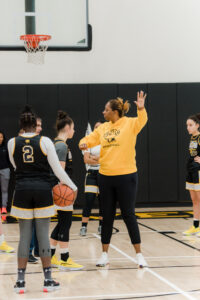
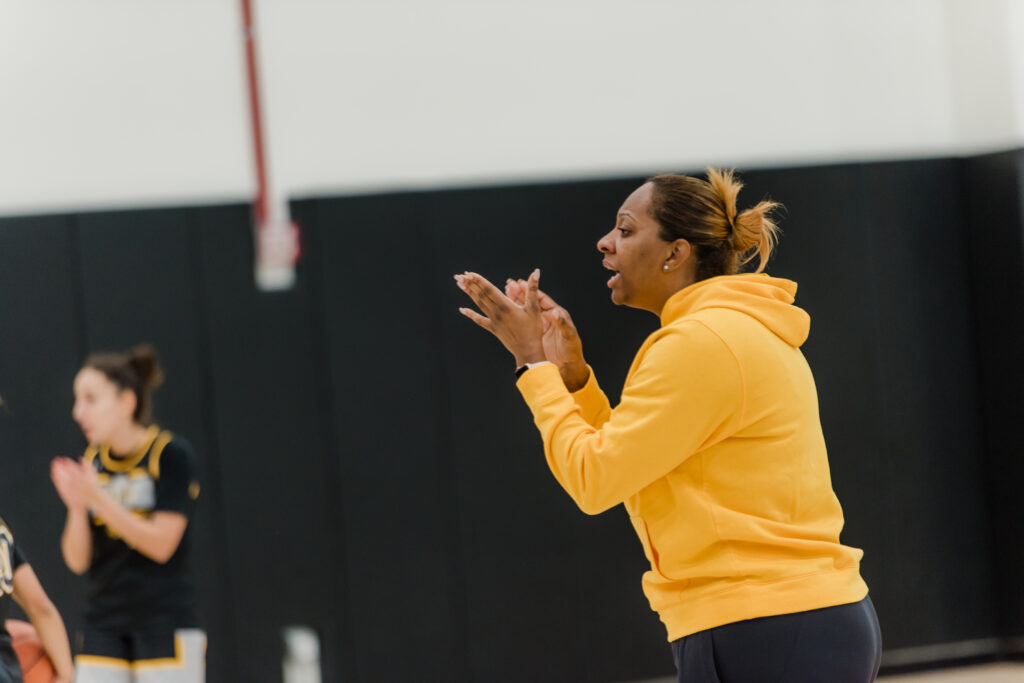
Any new coach at any college will want to make changes. New UMBC women’s basketball coach Johnetta Hayes hopes to do just that—but not only on the basketball court.
Hayes comes to the Retrievers from Texas Southern, where she posted a 115-73 record in six seasons and led that team to four post-season appearances, including a trip to the NCAA Tournament in 2017. UMBC is coming off a difficult 10-20 season, and Hayes is looking to turn things around on the court while creating a new culture of family within the program.
On the court, the Retrievers under Hayes will play a faster-paced game than in recent years. That is going to be a big difference. Off the court, Hayes wants the student-athletes in the program to feel the team is a family and that they can turn to teammates and others for help in any situation—regarding basketball or life.
“It’s really, really important for me,” Hayes said. “From the day I walked in here until now, I can see the difference. They had each other already. It’s a bond they’ll have forever at UMBC, and we want the four seniors to leave out of here in [the spring] feeling like the way we started and the way we ended was definitely different. Once they leave, they can always come back home.”
Hayes said she wants to create an environment where those who played for UMBC in the past can mentor those currently playing at the school. If a student-athlete needs contacts for jobs or career advice upon graduation, they could turn to one of the former players for help in that area.
Building this, though, takes time and effort.
“They are their own sorority, and when they leave here, they [will] feel like they have something to come back to every year,” Hayes said. “I want the four seniors leaving to know every year in October, we come back. We celebrate with our families, and we mentor the young ladies who are on the team.”
Right now, the biggest type of change probably involves Hayes and her coaching staff as all 14 Retrievers return from last year’s team, which is unusual in collegiate athletics. So the new coaching and operations staff needed to get to know and understand the players.
Acting athletics director Jessica Hammond-Graf has noticed Hayes working hard to connect with the student-athletes, not always an easy task for a new coach.
“She’s spending a lot of time with them outside of practice to get to know them…to help them grow,” Hammond-Graf said. “It’s not just about basketball with her. It’s the larger picture and helping everybody grow and develop and become future leaders. She had to come in and recruit the players that are already here.”
Senior guard Tyler Moore said there’s no question that Hayes is driving this team and trying to adjust their outlooks on basketball and other things. Moore said the Retrievers definitely appreciate it.
“I think I can speak for my team in saying that we love how she pushes us to be better than we were the day before,” Moore said. “Standards are high and we have no choice but to rise to them.”
Hayes said her biggest change involved the move from Texas and getting her two young daughters (ages 7 and 4) situated. Now, they often come to where their mother works and are growing comfortable as Retrievers.
So, the new coach, staff and players all have spent the off-season working on changing the way they play and the culture around the team. Hayes wants the student-athletes to understand and deal with change in basketball and life—after all, the games don’t go on forever.
“You’re going to get a new boss,” Hayes said. “Things will change. How do you adjust? How do you adapt? Change is good. It may not feel good at first, [but] it can be [later on].”
– Jeff Seidel ’85
***
All photos, including header, by Marlayna Demond ’11.