All posts by: UMBC News Staff


President Hrabowski joins new panel to examine future of undergraduate education

President Hrabowski will serve as a member of the Commission on the Future of Undergraduate Education, a panel of experts tasked with studying the impact and effectiveness of the nation’s existing educational systems and identifying the challenges and opportunities facing higher education.

The panel, formed by the American Academy of Arts and Sciences, will use research drawn from higher education institutions across the country to forecast the future of the nation’s education needs and offer recommendations to ensure undergraduate education remains accessible for students from all backgrounds.

The three-year initiative, led by co-chairs Michael McPherson, President of the Spencer Foundation, and Roger Ferguson, TIAA-CREF President and CEO, includes expertise of national leaders in education, business, and government. The commission is funded with $2.2 million from the Carnegie Corporation of New York.

Tinoosh Mohsenin receives NSF grant for wearable biomedical computing tech

CSEE Professor Tinoosh Mohsenin received a $212,000 grant from the National Science Foundation for a three-year project that will develop a heterogeneous ultra low-power accelerator for wearable biomedical computing. The work will be done in collaboration with researchers at George Mason University and students in the UMBC Energy Efficient High Performance Computing Lab.

With the rapid advances in small, low-cost wearable computing technologies, there is a tremendous opportunity to develop personal health monitoring devices capable of continuous vigilant monitoring of physiological signals. Wearable biomedical devices have the potential to reduce the morbidity, mortality, and economic cost associated with many chronic diseases by enabling early intervention and preventing costly hospitalizations. These low-power systems require to have the capacity to provide fast and accurate processing and interpretation of vast amounts of data and generate smart alarms only when warranted. The project will build the foundation of the next generation of heterogeneous biomedical signal processing platforms that can address the current and future generation energy-efficiency requirements and computational demands.

Image: Tinoosh Mohsenin and research team. Photo courtesy CSEE.

Roundup: UMBC in the News

One of the things that makes UMBC great is how wonderful our alumni, students, faculty, and staff are. Because of these amazing people, UMBC often finds itself “in the news,” so each week, we’ll be sharing with you a round-up of the most newsworthy achievements from our community.

For more UMBC news, head to the Insights blog!

Helping kids with asthma breathe easier

UMBC team to develop wearable system to track asthma triggers in pediatric patients.

An innovative team of researchers working across engineering fields has received a nearly $2 million award from the National Institutes of Health (NIH) PRISMS program to develop a comprehensive system to monitor critical environmental asthma triggers and physiological status indicators for pediatric asthma patients.

Living with asthma, a chronic disease caused by the inflammation of the airway, can substantially impact a person’s well-being and, if not controlled, can be life threatening. Asthma prevalence has increased over the past decade to now impact 25.7 million adults and 7.1 million children in the United States, with disproportionately high rates of asthma and low levels of asthma control among children in urban and minority groups.

The grant is led by UMBC’s Center for Advanced Sensor Technology (CAST). UMBC PIs Yordan Kostov and Govind Rao, assistant director and director of CAST, respectively, teamed up with Southern Methodist University psychology professors and asthma experts Thomas Ritz and Alicia Meuret, as well as UMBC computer science and electrical engineering (CSEE) faculty Ryan Robucci and Nilanjan Banerjee, and chemical, biochemical, and environmental engineering (CBEE) faculty Xudong Ge and Chris Hennigan.

The wearable asthma monitoring system they are developing will include technology that measures environmental triggers, such as air pollution, pollen, dust, smoke and pet hair, and a monitor that measures physiological triggers, such as level of physical activity and emotional stress. Both types of triggers can exacerbate asthma symptoms. Studies on existing oxygen and carbon dioxide sensors will be analyzed and applied to the development of this technology.

The monitoring system will be small enough to be worn by the patient in the form of a pendent, explains Yordan Kostov, research professor in CBEE and adjunct professor in CSEE. He notes that although simple asthma trigger monitoring systems do exist, they have had limited success due to the need to measure a great variety of potential asthma triggers.

“A wide range of sensors are being developed as part of this project, including breathing rate detection sensors, particle monitoring sensors, and carbon dioxide and oxygen sensors,” Banerjee explains. “Using them together, for the first time, we will be able to accurately determine reliable triggers of asthma amongst children.”

The researchers anticipate these highly accurate measurements will have a significant impact on pediatric asthma patients’ well-being. As Kostov describes, “The monitoring system will help patients objectively determine when and why they experienced the asthma symptoms.”

Children with asthma and their parents can have difficulty noticing or recalling environmental factors that have triggered asthma attacks. Kostov notes that this problem increases families’ anxiety, as it can make attacks less predictable and more frequent, and that’s where this new technology can help. The monitoring system will enable asthma patients and physicians decode correlations between asthma symptoms and environmental factors, improving their ability to prevent future attacks and decreasing their anxiety around anticipating those attacks.

Ryan Robucci, assistant professor of CSEE, hones in on a major factor, behind the scenes, that makes this team’s work so innovative and compelling. The project’s integrated, interdisciplinary approach allows the research team to explore scientific questions that require new sensors, systems, data collection, analytics, and domain expertise to find answers.

“The strength of this NIH project is in its diverse team,” says Nilanjan Banerjee, assistant professor of CSEE. “We have experts in chemical engineering, electrical engineering, computer science, and experts who work closely with individuals suffering from asthma.”

What unites them all, explains Chris Hennigan, assistant professor of CBEE, is the gratification and high motivation they feel in working on a problem that affects so many children. Govind Rao, professor in CBEE agrees. His definition of success for this work is ultimately developing “a suite of sensors that help children better manage chronic asthma and lead better lives.”

Image: UMBC asthma monitor research team from the departments of chemical, biochemical, and environmental engineering (CBEE) and computer science and electrical engineering (CSEE), with student researchers. Photo by Marlayna Demond ’11.

Lisa Gray discusses the role of education, awareness, and empowerment in raising young girls to be politically and socially conscious

lisa_gray_2015Following the #BlackLivesMatter and #SayHerName movement over the past year, WEAA’s The Marc Steiner Show hosted a panel discussion on how parents and educators are incorporating the living history of the events which sparked these two social movements into lessons for their children and students, especially young girls of color.
Lisa Gray, director of student life for cultural and spiritual diversity, participated in the discussion and shared her experiences as a leader for cultural diversity on campus, and as a mother of an 11 year-old daughter growing up in an era where these social justice issues are quickly rising to the surface.

During the program, Gray described the importance of connecting her daughter with her professional work and exposing her to powerful black female leaders who can serve as role models. “I think we have to be intentional about really digging for those role models that are there,” said Gray.

Listen to the full segment »

Spotlight on bwtech@UMBC

Alumni Delali Dzirasa ’04, computer engineering, and Andrew Mavronicolas ’14, information systems, were recently featured in a SmartLogic video promoting bwtech@UMBC. Both alumni run companies based in the research park: Dzirasa is the president of the software company Fearless Solutions, and Mavronicolas is co-founder of Backpack ‘Em, an online intra-campus exchange platform. Ellen Hemmerly, executive director of bwtech, is also featured. Watch the whole clip here:

Lynne Schaefer, administration and finance, named chair of EACUBO

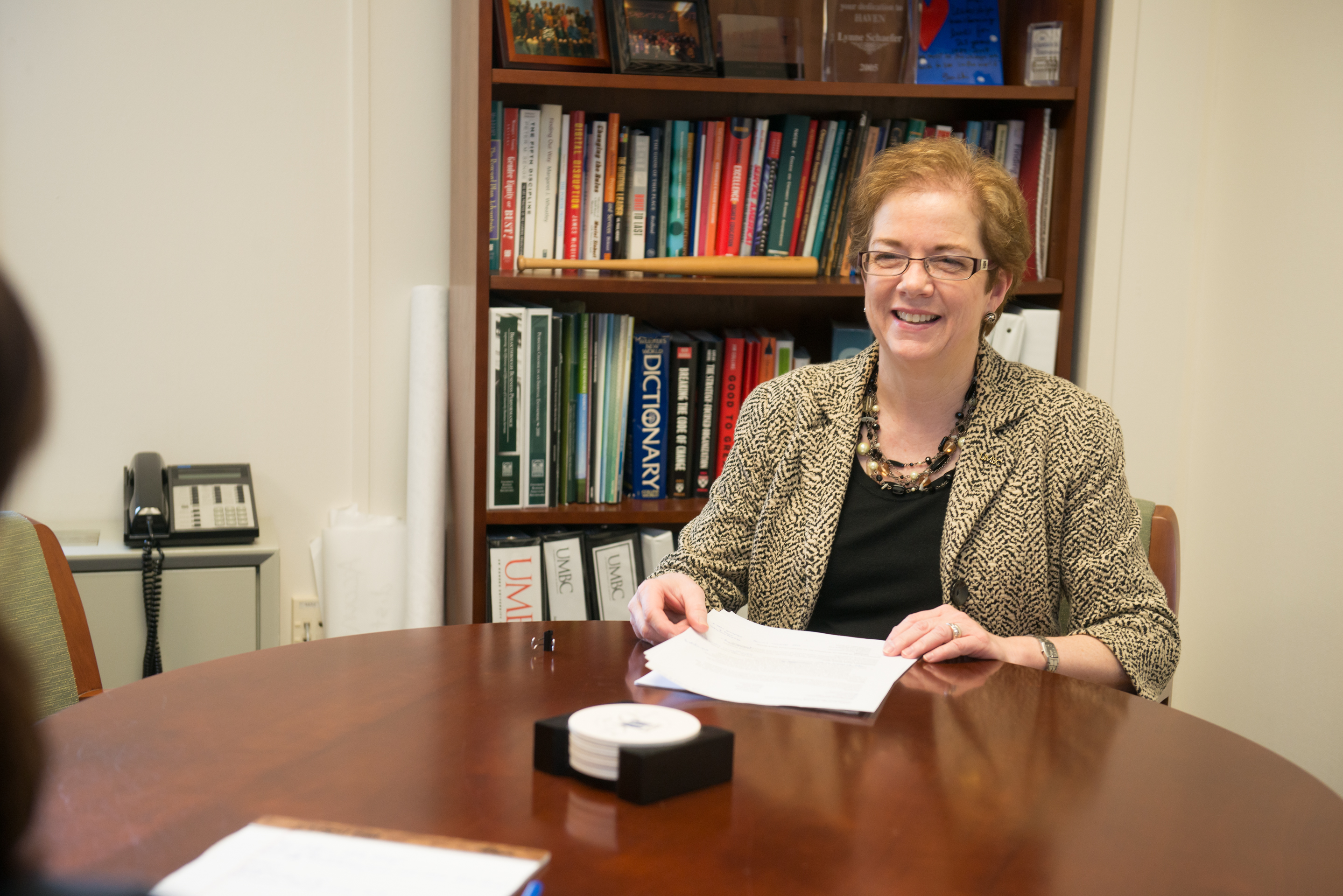
StrategicPlanning-4949Lynne Schaefer, Vice President, Administration and Finance, has been named chair of the Eastern Association of College and University Business Officers (EACUBO), effectively October 13.

Schaefer has been actively involved in the association for nearly 10 years, previously serving as chair of the region’s Research Universities Constituent Council. In 2010, she was elected to the board of directors, where she helped to develop and implement a mentoring program for senior finance and administration leaders. She has also represented the region’s chapter as part of the national Research Universities Council, where she helped develop special programming relevant to business officers at research universities.

“I am honored to serve as chair of this organization of my peers and colleagues. This is a time when our profession is increasingly challenged to support and assist our institutions to strategically find a way forward through a rapidly changing environment and increasing unknowns,” said Schaefer.

She rose to chair of EACUBO after being elected as vice chair in 2013. The leadership position is a two-year commitment.

EACUBO is an affiliate of the NACUBO. Its mission is to foster the professional development of its membership through educational programs, committee activities, and informal exchanges on current issues. Membership includes public and private colleges, universities, and other post-secondary institutions, as well as other agencies and for-profit organizations affiliated with or serving with higher education.


President Hrabowski discusses how his experiences during the Civil Rights movement inspired his career in education

In a recent interview on PBS’s Tavis Smiley Show, President Hrabowski shared how his experiences as a young boy during the Civil Rights movement shaped his future in higher education and inspired his pursuit of STEM achievement for students of all backgrounds.

Much of the discussion revolved around topics addressed in Dr. Hrabowski’s latest book, Holding Fast to Dreams.

Dr. Hrabowski recounted meeting Martin Luther King, Jr. and participating in a peaceful march, which led to his arrest. He also commented on how the experience compelled him, and many others, to take a more active role supporting the community and each other. “We Americans have the right to say when we think something is wrong, and that we can make a difference,” said Dr. Hrabowski.

During the interview, Dr. Hrabowski also addressed public perception of standardized tests, noting that while we need to be mindful of the limitations of test scores as a measure of success in student achievement, they serve an important role in the educational process.

“We want to make sure we’re not simply testing and penalizing children, but tests are important,” he said.

Dr. Hrabowski also emphasized the importance of increased support for all students. “We have to make sure we’re giving children, families, and teachers the support they need in ensuring that the child learns how to do well on standardized tests,” he said.

fah-tavis-smiley-video

Roundup: UMBC in the News

One of the things that makes UMBC great is how wonderful our alumni, students, faculty, and staff are. Because of these amazing people, UMBC often finds itself “in the news,” so each week, we’ll be sharing with you a round-up of the most newsworthy achievements from our community.

Read more at UMBC Insights!

New solar-powered charging tables on campus

The campus has finished installation of its innovative and sustainable solar-powered charging stations. These off-the-grid power systems serve as solar-powered tables, where community members can charge their devices while working or relaxing outside. In addition to providing sustainable, wire-free power, components of the stations are made from recycled plastics.

The tables are located in the Admin Plaza, Commons Plaza, and Harbor Hall courtyard area. The tables were made available through a partnership with the student “Prove It” program, Facilities Management, The Commons, and Residential Life.

Billy Heavner Named to CoSIDA Academic All-District Team

UMBC junior goalkeeper Billy Heavner has been named to the College Sports Information Directors of America (CoSIDA) Academic All-District Men’s Soccer Team, as the organization announced all of its men’s and women’s regional recipients.

Heavner earned First Team All-District honors for District 2. First-team Academic All-District™ honorees advance to the CoSIDA Academic All-America® Team ballot, where first-, second- and third-team All-America honorees will be selected later this month.

John Rennie Short weighs costs and benefits of new “urban resurgence” in cities across the globe

On United Nations’ World Cities Day, School of Public Policy Professor John Rennie Short published a column in The Conversation about what he calls the “Third Revolution,” or urban resurgence of cities around the world and its uneven impacts on social and economic progress. He wrote that while some cities are seeing strong population growth, others are failing to attract new investment.

John Rennie Short“Industrial cities such as Baltimore or Detroit, unable to replace the defunct industrial and manufacturing jobs, continue to lose population and fail to attract investment. And housing affordability in the most desirable cities is a worrisome trend that threatens to exacerbate social inequalities,” Short explained.

In his column, Short also pointed to the decline of household sizes and the attraction of cities with more job opportunities and amenities, but balanced with economic costs: “Because we are now expected to do more in less time, time itself becomes more highly valued, adding to cities’ allure. The city is being turned inside out as the poor are displaced to the suburbs to spend more of their time commuting while the wealthier can devote more of their time to work and leisure such as visiting the gym.”

Even with many cities experiencing growth, Short wrote that there are many negative economic impacts to go along with it, especially as home prices and rents continue to climb: “The most obvious is the displacement of the poor from central cities, the suburbanization of poverty and the creation of cities divided by class and income as the rich take over the central city and the poor and middle-income are displaced to the suburbs…We should be building cities that are productive, competitive, sustainable, livable and fair. On World Cities Day, we should commit to building a more humane city.”

Read “Cities are booming but progress is uneven and, to some, too costly” in The Conversation.

Image: Baltimore Inner Harbor. Photo by Marlayna Demond ’11.