All posts by: UMBC News Staff


Sari Bennett Receives Nat’l Council for the Social Studies Award

Sari Bennett Receives National Council for the Social Studies Award

“How can students be citizens of the world if they don’t have the background they need to know about its people and its places?” asks Sari Bennett, clinical associate professor of geography and environmental systems and a longtime advocate for strengthening the teaching of geography at the K-12 level.

On December 2, Bennett, coordinator for the Maryland Geographic Alliance–which has worked with over 12,000 K-12 teachers since 1989–will receive the National Council for the Social Studies (NCSS) Outstanding Service Award. It honors exceptional service in support of K-16 social studies at the national and local levels.

A member of the National Council for the Social Studies and the Maryland Council for the Social Studies (MDCSS), Bennett has made contributions to the social studies profession at the local, state and national levels. She has been a member of MDCSS for more than 20 years and has served as its president and executive director. At the state level, she has served on numerous committees including the Social Studies Taskforce of the Maryland State Department of Education and has worked on the development of social studies content standards and the Voluntary State Curriculum. At the national level, Bennett has been a three-time program co-chair for the NCSS Annual Conference.

The Maryland Geographic Alliance, jointly funded by the State of Maryland and the National Geographic Society, develops lesson plans and other materials for teachers to use in their classrooms, and presents workshops and summer institutes.

Currently, Bennett and the Maryland Geographic Alliance are working with Sultana Projects, Inc. on lesson plans for the John Smith Four Hundred Project, which will retrace Captain John Smith’s 1608 Chesapeake expedition. In addition, they were asked by the Maryland State Department of Education to create educational materials and lesson plans for this year’s 300th anniversary of the Port of Baltimore. Previous projects include a collaborative project with Tom Rabenhorst, senior lecturer in geography and environmental systems at UMBC, and his students on a digital atlas of Maryland for 4th graders.

(11/28/06)

© 2006-07 University of Maryland, Baltimore County • 1000 Hilltop Circle, Baltimore, MD 21250 • 410-455-1000 •

Monitoring the Health of Vulnerable Populations

Monitoring the Health of Vulnerable Populations

Working in the nation’s capital changed Todd Eberly ’06 , Ph.D. public policy, from a political scientist to a specialist in poverty and public health. The shift seems to be a good fit, as Eberly recently won the National Association of Schools of Public Affairs and Administration’s dissertation award for his work on how managed care affects services received by enrollees in Medicaid, the nation’s health insurance program for low income individuals.

After receiving his bachelor’s degree from Pennsylvania’s Clarion University, Eberly went to work in Washington, DC analyzing federal health policy. “I saw good policy options ignored and bad policy options embraced,” Eberly said. “I realized that I wanted a better understanding of the policy process.”

The experience drew Eberly to UMBC’s Department of Public Policy in a quest for a way to make a real-world difference. “The UMBC program goes beyond theory and really deals with practical application.,” he said. “Political Science is still my passion – but I feel that the interdisciplinary approach of the UMBC program made me a better political scientist.”

Maryland started the HealthChoice managed care program eight years ago as a way to control costs for over half a million state residents receiving Medicaid, including 30 percent of Maryland’s children. However, researchers were unsure whether managed care met the needs of socially vulnerable populations, particularly racial and ethnic minorities.

Eberly’s study of before-and-after data on Maryland Medicaid recipients found that the program increased preventive care receipt by black, white and Hispanic children and adolescents, along with black and Hispanic adults. “The improvements for minority youth were particularly noteworthy, because children are especially vulnerable,” said Eberly. “Access to preventive care is key to the promotion of good heath and quality of life.”

Eberly now continues his work as a senior research analyst at UMBC’s Center for Health Program Development and Management (CHPDM) and as an affiliate assistant professor in public policy and an adjunct professor in political science and sociology.

“I’m still very interested in the politics of poverty and social policy design,” Eberly said. “It has the potential to impact so many lives, so I want to know whether policies are working to make lives better or just perpetuating inequalities.”

(11/15/06)

© 2006-07 University of Maryland, Baltimore County • 1000 Hilltop Circle, Baltimore, MD 21250 • 410-455-1000 •

UMBC: An Honors University in Maryland

Happy Birthday, UMBC

style>

Just 40 years ago, on September 19, 1966, UMBC officially opened its doors and began its rapid rise as one of the most diverse and dynamic universities in the nation.

UMBC has gained the attention and respect of many older, well established higher education leaders. Cambridge, founded in 1209, has invited UMBC’s Darwin scholar Sandra Herbert to serve as a visiting professor this year. Harvard, founded in 1636, recently recruited three of our graduates – one to a faculty position and two to doctoral and medical programs – from the lab of Michael Summers, the only Howard Hughes Medical Institute Investigator at a Maryland public university. And Princeton, founded in 1746, is collaborating with UMBC to create a multi-million-dollar Engineering Research Center focused on sensor technology.

“The fact that we have achieved so much so quickly is a reflection of the quality and entrepreneurial spirit of our faculty, students and staff,” said President Freeman A. Hrabowski. “Ours is an exceptional community, where the life of the mind is paramount.”

“It is exhilarating to think about our future,” Hrabowski added. “At 40, the campus is young enough that all of us are still pioneers, building UMBC’s foundation.”

At noon on September 19, UMBC will begin celebrating some of the students, faculty, and staff – past and present – who make UMBC Exceptional by Example. The celebration includes birthday cake, the debut of the University’s alma mater, a talk by Carnegie Foundation President Lee Shulman, and a reception hosted by President and Mrs. Hrabowski to honor faculty and staff.

Please note that the 3 to 5 p.m. faculty/staff reception is being moved to the University Center Ballroom due to expected rainy weather. All other Sept. 19 events will continue at their originally scheduled locations.style> For more information, please visit www.umbc.edu/40th/events.html.

UMBC alumni, parents and the general public are invited to join the campus community for UMBC’s 40th Anniversary Homecoming and Family Celebration October 20-21. For more information, please visit www.umbc.edu/40th/events.html.

9/18/06

UMBC is an Equal Opportunity and Affirmative Action Institution

UMBC: An Honors University in Maryland

UMBC Students Exhibit with Leading Contemporary Artists at the Baltimore Museum of Art

An outdoor installation by recent UMBC Undergraduate Research Award (URA) recipients Christina Ralls and Katie Better was selected to be part of siteMaryland, an exhibition presented by the Baltimore Museum of Art (BMA) and the Maryland State Arts Council.

“It is exciting to see emerging artists like Christina and Katie recognized with a URA,” said Steve Bradley, associate professor of visual arts, who is advising them on their project. “Now we see another testament to their creativity and hard work with siteMaryland awarding their continuing collaboration with a highly competitive and prodigious commission.”

siteMaryland is a free, month-long juried exhibition by the state’s leading contemporary artists, now on view through November 5. Designed to change venues each year, the inaugural exhibition features artwork that reinvents the BMA’s gardens and grounds. In addition to Ralls and Better, siteMaryland includes work by UMBC visual arts faculty Calla Thompson and Rick Dulaney.

Ralls and Better used their URA award to create and install their interactive sculpture, Traum Baum (Dream Tree). Visitors are invited to write their dreams, goals and aspirations on the banners of the colorful maypole-like structure. Small figures of children hold on to the banners.

“We initially wanted to ask ‘What do you want to be when you grow up?’ using the childhood notion that we can be anything we want to be,” said Ralls, a senior animation major and Imaging Research Center Fellow who is studying abroad at Schwäbisch Hall in Baden-Württemberg, Germany during the fall 2006 semester. “We want to give people a way to interact with art that can inspire them to continue reaching for their dreams despite adversity.”

Both Ralls and Better’s interest in community art grew out of their participation in a spring 2005 visual and performing arts class, which brought together UMBC students, the Liz Lerman Dance Exchange and residents of nearby Charlestown Retirement Community. “It was a real learning experience, to see how everyone can enjoy art from different perspectives and come together so nicely… and it was a lot of fun,” said Ralls.

“It introduced us to a new kind of art,” added Better, a junior animation major. “So when the time came to apply for the URA, we decided to create a community art piece.”

As part of their research, Ralls and Better studied environmental artists such as Christo. They also worked with inner-city school children in the College Gardens after-school program, who helped paint the figures of children on Traum Baum and wrote their goals and dreams on the banners. They will continue their research by chronicling the creation, installation and response process, and hope Traum Baum will travel to other venues.

Ralls and Better will be among the presenters at UMBC’s Undergraduate Research and Creative Achievement Day on April 25, 2007. URA and URCAD are just two programs offered by UMBC’s Office of Undergraduate Education, which strives to present an honors university experience for every UMBC undergraduate.

(10/9/06)

UMBC is an Equal Opportunity and Affirmative Action Institution

A Closer Look at the Inner Space of Disease

A Closer Look at the Inner Space of Disease

Dan Fabris, associate professor of chemistry, became fascinated with the machinery of life at an early age. Now his passion for understanding the inner workings of cells is bringing UMBC a powerful new tool in the fight against diseases like cancer and AIDS.

Fabris was recently honored as one of just 14 U.S. researchers and the leader of the only lab in Maryland to receive a National Institutes of Health National Center for Research Resources (NCRR) High-End Instrumentation grant. With the $1.5 million grant, UMBC has purchased an extremely powerful, high-resolution, mass spectrometer known as a hybrid, 12 Tesla quadrupole-Fourier transform ion cyclotron resonance or Q-FTICR.

The Q-FTICR allows researchers to see molecular-level biochemical reactions that impact drug resistance by HIV, other retroviruses and cancer. UMBC will soon become one of just a handful of U.S. institutions and only three on the east coast to have such a powerful mass spectrometer.

When the custom built instrument arrives in the spring 2007, it will be in high demand by biomedical researchers at UMBC and from across the region. Fabris’s lab will share the Q-FTICR with colleagues in similar research fields like Michael Summers (HIV), Lasse Lindahl (antibiotic resistant germs), Kathleen Seley-Radtke (antibacterial and antiviral drugs) and James Fishbein (cancer).

Fabris’s interest in the machinery of life started as a boy. “I used to drive my parents crazy by taking appliances apart to look inside them, save for being unable to putting them back together afterwards,” Fabris said. “Cells are the most amazing example of how molecular machines work together to accomplish the complex tasks that sustain life.”

(11/8/06)

© 2006-07 University of Maryland, Baltimore County • 1000 Hilltop Circle, Baltimore, MD 21250 • 410-455-1000 •

UMBC: An Honors University in Maryland

Getting Ready for a Birthday Bash for Darwin

When UMBC history professor Sandra Herbertstyle> first saw the Charles Darwin Archives at Christ’s College, Cambridge as a graduate student, “It was like finding out Shakespeare had left unpublished plays behind,” she said.

This fall, Christ College will welcoming Herbert as a Distinguished Visiting Scholar for the 2006-2007 academic year, an international honor recognizing her expertise on the University’s most famous and controversial alumnus, Charles Darwin.

Herbert travels to Cambridge in September, where she will help with plans for the 2009 celebration of Darwin’s 200th birthday and 150th anniversary of his seminal work “On the Origin of Species” while continuing her studies of Darwin’s geological specimens from the 1831-1836 voyage of the H.M.S. “Beagle.”

Like most students, Herbert, an expert on the history of science, first studied Darwin in high school. “Back then his work was buried in our textbooks,” she said. “I became interested in how evolution affects all things, especially human nature.”

While writing a graduate school paper, she came across one of Darwin’s notebooks. Her curiosity grew, leading to a Ph.D. dissertation and finally a trip to Cambridge to see other Darwin manuscripts.

Along the way she was surprised to find that the naturalist often most associated with biology was actually more of a geologist as a young man. This discovery led to Herbert’s recent book “Charles Darwin, Geologist,” which was well reviewed by the Times Literary Supplement and many other publications. In November, the Geological Society of America will give Herbert the 2006 Mary C. Rabbitt Award, bestowed annually for outstanding contributions in geological sciences history.

“Sandra is simply one of the world’s leading authorities on Darwin and one of UMBC’s preeminent scholars,” said John Jeffries,style> Dean of Arts, Humanities and Social Sciences at UMBC.

Herbert is excited at her upcoming stay at Cambridge, where she will give one of the Lady Margaret Beaufort lectures. “It’s an honor to be invited, especially since I’m an American,” she said. “Darwin is a source of national pride for the British, so it’s a wonderful feeling to be welcomed to a place where he did so much remarkable work.”

When asked her thoughts on Darwin’s lasting legacy and the ongoing challenges to his theories across the globe, Herbert referred to one of her favorite Darwin writings from his 1838 “Notebook B.” In it, Darwin refers to animals as “our fellow brethren” and muses that “we may be all netted together.”

“Darwin is seen as a hero and a villain,” she said. “The reason we react so strongly is because of the profound implications of his work on our understanding of human nature. I agree with his sentiment that we are all netted together. We are closer to animals than we sometimes think.”

UMBC is an Equal Opportunity and Affirmative Action Institution

UMBC: An Honors University in Maryland

Designing the Future of Animation

Shane Lynch,style> a senior computer science major, and Chad Eby ’06,style> MFA, imaging and digital arts, are members of a UMBC research design team responsible for the newest development in editorial cartoons. Led by famed-cartoonist Kevin “KAL” Kallaugher, Lynch, Eby and staff from UMBC’s Imaging Research Center designed a 3-D virtual bust of President George W. Bush.style>

The project’s concept, making a three-dimensional caricature talk, walk and interact with the public in real-time, is considered unprecedented for animation.

The digital bust is the brainchild of Kallaugher, a cartoonist for the Economist and former cartoonist for the Baltimore Sun, who came to UMBC in January 2006 as an artist-in-residence, a position sponsored partly by the Robert W. Deutsch Foundation.

Lynch and Eby each had their own responsibilities for the project. Lynch programmed the coding for the 3-D cartoon, making it work in real-time. The stately figure can move its mouth in various directions, furrow its eyebrows and pop out its ears. Eby arranged the hardware interface, chose the equipment and programmed the software that operates the movements of the virtual puppet.

The project took four months to complete and required the diverse skills of the team members, which also included Dan Bailey,style> the Center’s director, and Eric Smallwood,style> technical director of the IRC.

Lynch and Eby both agree working with KAL and learning about the man behind the satirical cartoons was exciting and rewarding.

“We are pretty far ahead of the curve,” said Eby, who is beginning his first year as an assistant professor in Florida State University’s Art Department. “I have no doubt this is the future of animation.”

To view the design stages and to track the project’s progress, visit http://www.irc.umbc.edu/kal/.

(8/29/2006)

UMBC is an Equal Opportunity and Affirmative Action Institution

UMBC: An Honors University in Maryland

A Destination for Cultural Life:
UMBC hosts world-renowned speakers

UMBC will host The Maryland Forum, a new speaker series featuring Ehud Barak, former prime minister of Israel; Bob Woodward, Pulitzer-prizewinning journalist; Cal Ripken, Jr., record-breaking former Baltimore Oriole; and former Vice President Al Gore. The series is presented in partnership with the Annapolis and Anne Arundel County Chamber of Commerce, Inc.

“UMBC’s mission as a public research university includes stimulating the intellectual and cultural life of the region,” said President Freeman Hrabowski. “We are pleased that our partnership with The Maryland Forum will continue to build the University as a destination for cultural programming. I am particularly excited that our students will have the opportunity to attend these lectures and learn about the experiences of former leaders of nations and leading figures from other fields who also have shaped our national story.”

Lectures will be presented in the Retriever Activities Center. UMBC students, faculty and staff may purchase discounted tickets for $5 (one ticket per UMBC ID). Tickets will go on sale Monday, October 9 at The Commons Information Desk.

The Maryland Forum 2006-07 schedule:

Tuesday, October 24, 2006
Ehud Barak, former prime minister of Israel, will discuss how national politics, international events, terror and the economy all influence national and international relations. He will also speak about economic development issues facing nations today.

Wednesday, November 8, 2006
Bob Woodward, who, along with Carl Bernstein, received the Pulitzer Prize for reporting on the Watergate scandal, will discuss his latest book, The Secret Man, and his journalism career.

April 2007 (To Be Confirmed)
Former Oriole Cal Ripken, Jr., who broke Lou Gehrig’s streak of 2,131 consecutive games by 500, will speak about leadership, loyalty, patience and perseveranceóqualities that lead to success in baseball and in business.

Tuesday, May 8, 2007
The Honorable Al Gore, former U.S. Vice President, will give a special multimedia presentation of An Inconvenient Truth, which examines environmental issues and their impact on our global civilization. He also will discuss how physical changes in the planet will influence our global economy and key opportunities and challenges for the democratization of technology.

Tickets for the general public can be purchased online or by calling 1-866-49-FORUM. A discount is available to UMBC alumni. For more information about the Maryland Forum, visit www.themarylandforum.com.

(10/2/06)

UMBC is an Equal Opportunity and Affirmative Action Institution

UMBC: An Honors University in Maryland

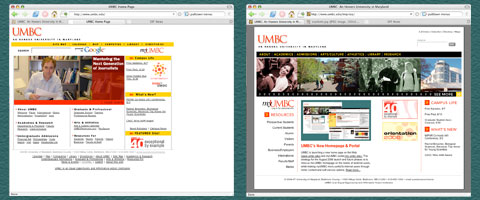
UMBC’s New Homepage & Portal

UMBC is launching a new home page on the Web (www.umbc.edu) and (http://my.umbc.edu). The strategy for the August 2006 launch and future phases is to refocus the UMBC homepage on the needs of external users, while making myUMBC more useful to internal users through richer content and self-service options.

The redesign, a collaborative effort between the Offices of Institutional Advancement (OIA) and Information Technology (OIT), reflects input gathered over the last three years during talks with prospective undergraduate and graduate students, and UMBC students, faculty and staff.

UMBC website screenshots

UMBC’s enrollment goals play an important role in the homepage design. In order to attract prospective undergraduate and graduate students, it will be important to use the homepage as a marketing tool, promoting campus life and student success stories, for example. Site users and prospective students said that information on both the old homepage and portal was hard to find and the homepage did not give a sense of the campus or what it is like to attend UMBC.

The new design by Jim Lord ’99, OIA’s associate director of creative services, features an upgraded navigational scheme that highlights audience-specific resources (prospective students, parents, alumni, etc.), a collage of campus photos and more room for events and feature stories. The new homepage and portal will also highlight our 40th anniversary and upcoming capital campaign.

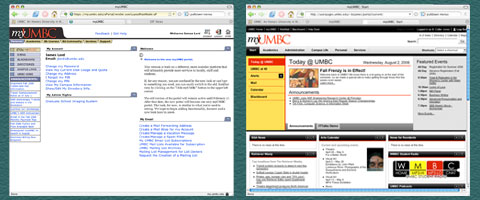
myUMBC screenshots

The new myUMBC was designed by UMBC’s new campus portal architect B. Collier Jones in OIT. The redesign changes the look and feel of the campus’ internal site, which provides access to tools and utilities faculty, staff and students need to do their work and live on campus. For now, most of those functions remain the same; the presentation, however, has changed.

For the fall 2006 launch, the new portal is particularly focused on the needs of students and will be a one-stop shop for news about what’s happening on campus. The Start Page features announcements, information about upcoming events and news of interest to undergraduate and graduate students, such as student government, information about registration and commencement, residential life, arts and athletics.

In the next year, faculty and staff will have their own Start Pages, but the new portal currently features a front-page “dashboard” with access to most popular applications for faculty, staff and students – blackboard, e-mail and Oracle Calendar (for faculty and staff).

This facelift is just the beginning of plans to improve UMBC’s Internet presence. The OIA and OIT Web team, collectively known as “Emedia,” calls it “a down payment” on the future sites. In addition to Jones and Lord, the team includes John Fritz, director of instructional technology and new media and Jackie Ward, campus Web architect from OIT and Eleanor Lewis, associate director of internal and digital communications from OIA.

Read more about the new features on UMBC’s homepage and portal and next steps for a site-wide redesign.

Please send your comments and suggestions on the new homepage and myUMBC to helpdesk@umbc.edu.

UMBC is an Equal Opportunity and Affirmative Action Institution

UMBC: An Honors University in Maryland

Capturing Distant Sounds: Fulbright Winner Tim Nohe

Tim Nohe,style> associate professor of visual arts, has received a Fulbright Scholars award, one of the nation’s most notable and highly competitive grants. Nohe will use the award in hopes of drawing awareness to the often ignored sounds of Australia’s Botany Bay.

Nohe’s research, entitled, “Sounding Botany Bay,” explores the sonic environment of one of Australia’s richest cultural and natural attractions. Nohe will record sounds from the city of Botany Bay, Sydney Airport and the Botany Bay National Park. He will edit and compose these sounds to create an “immersive surround-sound audio experience.”

“Sonic works challenge us to hear anew what we have chosen to filter out as we move through a noisy world,” said Nohe. “I hope to shape the rich voices and sounds of Botany Bay into an aural tapestry that will heighten and contrast what is and has been there.”

Nohe conducted similar research in 1998 when he participated in the Wendover, USA exhibit, which featured photographs, video and sound installations of the Wendover region. This area includes Wendover, Utah, home to the Bonneville Salt Flats and Wendover Army Air Field, a base that played a key role in the development of atomic weapons during World War II, and West Wendover, Nevada, host to a cluster of gambling casinos. Nohe made numerous samples of the region’s artifacts, including a sound exhibit.

Nohe will present “Sounding Botany Bay” and teach two sound-art courses at the University of Wollongong in New South Wales through June 30, 2007. He hopes to install a sound exhibition at various venues in the city of Botany Bay and create DVDs of the presentation.

Nohe won three Maryland State Arts Council awards and serves as a board member and composer for the performance art group Fluid Movement. His other works have appeared in local venues and international locations such as The Museum of Contemporary Art, Sydney and the Inter-Society of Electronic Arts, Paris.

(UMBC’s other Fulbright Scholar, John Stolle-McAllister,style> associate professor of modern languages and linguistics, is currently investigating indigenous political movements in Ecuador. A homepage feature story on his research is forthcoming.)

9/11/2006

UMBC is an Equal Opportunity and Affirmative Action Institution

UMBC: An Honors University in Maryland

A Presidential Honor

UMBC biologist Rachel M. Brewsterstyle> recently made a short drive to Washington, D.C. that was a big leap forward for her and the University. She received the nation’s top honor for promising young scientists, the Presidential Early Career Award for Scientists and Engineers (PECASE), at a White House ceremony in July.

The PECASE provides up to five years of financial support to the honored scientists for research and community outreach. Awardees must be nominated by a participating federal agency or department. Brewster was one of just three U.S. biologists nominated by the National Science Foundation (NSF) who were selected for the PECASE. A total of 60 researchers from a variety of fields were honored at the ceremony.

Brewster will use her PECASE funding to involve high school, undergraduate and graduate students from diverse backgrounds in her lab’s research. Brewster’s specialty is genetic analysis of zebrafish embryos to better understand the causes of birth defects of the brain and central nervous system, the most common of which is spina bifida, the leading cause of childhood paralysis in the United States.

“It’s certainly an amazing honor to receive this award,” said Brewster. In her acceptance speech, she thanked UMBC President Freeman A. Hrabowskistyle> as the catalyst for the University’s Meyerhoff Scholarship Program, which has become known as a national model for drawing talented minority students into research careers.

“I have been very fortunate to work with Meyerhoff students in my lab,” said Brewster. She singled out UMBC alumna and former Meyerhoff Scholar Keisha John ’06,style> who now attends the Watson Graduate School of Biological Sciences, as instrumental in producing some key pieces of data which made the award nomination possible.

“Rachel Brewster is a wonderful colleague, an inspiring role model and a dedicated mentor to many students at UMBC,” said Lynn Zimmerman,style> vice provost for academic initiatives and professor of biological sciences at UMBC. “She is a tremendous asset to UMBC’s biological sciences department and we are delighted to see her receive this well deserved recognition.”

9/5/2006

UMBC is an Equal Opportunity and Affirmative Action Institution

Tom Schaller Whistles Past Dixie

A New Map for American Politics

As an associate professor of political science specializing in the U.S. electoral system, Tom Schaller is usually excited come Election Day. But Nov. 7 will bring added anticipation as Schaller celebrates the publication of his latest book, “Whistling Past Dixie: How Democrats Can Win Without the South” and waits to see how his strategic map for Democrats’ electoral success holds up to the will of the people.

The book argues that religion and race have already swung the South irrevocably to the GOP and “values voters.” Schaller advises the Democrats to focus on the Midwest and Interior West states, made more receptive to Democratic messages thanks to pocketbook issues and changing demographics.

“Dixie” was published by Simon & Schuster and edited by the legendary Alice Mayhew, who also works with best-selling authors Jimmy Carter, Bob Woodward and Stephen Ambrose. The New York Times, The Baltimore Sun, Kirkus Reviews, The Economist, and The Chicago Tribune have given “Dixie” good reviews. The Times seems to like Schaller’s writing, as he recently began an election-year columnist stint for Times Select, the paper’s premium online content.

According to Schaller, “Dixie” began as a conventional wisdom-challenging conversation with a former graduate school colleague. “He said, so matter-of-factly, that the Democrats could win without the South,” said Schaller. “I thought about it a lot, started looking at the historical numbers and the more recent data, and realized the case could be made — and made easily.” Schaller traveled to five states – part of what he calls the “Democratic Diamond”: Ohio, Wisconsin, Montana, Colorado and Arizona – plus South Carolina, to research the book.

Unlike many Washington pundits, Schaller is up front about his longtime loyalty to Democratic causes and candidates. “I think it’s important to be transparent about my partisanship and personal preferences as a way to mitigate media bias,” said Schaller.

One of Schaller’s former students, Sean Latanishen (Political Science, ’02) worked as a research assistant and one-man ideological check-and-balance system during the writing of “Dixie.” “Sean is brilliant, and has an encyclopedic grasp of modern American politics,” Schaller said. “That he is a conservative only helped, because he’s a natural skeptic of many of my arguments. He is that rare student who keeps me on my heels with his tough questions and challenges.”

The midterm elections will offer no respite for Schaller, whose analysis will be in high demand by regional and national media. In the past three years, he’s written 20 columns for the Washington Examiner, over 30 pieces for a variety of newspapers and magazines, and has blogged for The Gadflyer and the American Prospect. Despite this prolific resume, Schaller doesn’t plan to become a full-time author anytime soon.

“The sum total is that I’ve really written two books in the past three years, while editing and publishing a co-authored third book,” said Schaller. “So all I really want to do after the election is to go into hiding for a while and spend some time with my wife and dog.”

Schaller will discuss “Dixie” on Tuesday, Nov. 14, at 4 p.m. in the Albin O. Kuhn Library Gallery as part of UMBC’s Social Sciences Forum.

(10/23/06)

© 2006-07 University of Maryland, Baltimore County • 1000 Hilltop Circle, Baltimore, MD 21250 • 410-455-1000 •