We use cookies for analytics and, unless you opt out, advertising.
You can opt out of advertising at any time.UMBC uses essential cookies to run this site. With your permission we would also use analytics cookies (to understand how the site is used) and advertising cookies (to measure and target our ads on other platforms). Nothing else loads unless you accept. You can change your choice any time from Cookie Settings in the footer.Privacy Policy
EssentialRequired for the site to work (login, security, your cookie choice). Always on.
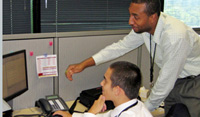
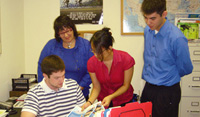
When UMBC students stepped out of the classroom this summer to begin their internships, many had the University’s alumni looking out for them. For mechanical engineering major Yehuda Baumer, that someone was Zozscha Bomhardt ’94, who served as a mentor in her role as an engineering quality leader at GE Healthcare.
Working alongside an alumni mentor in the workplace offers students the opportunity to learn from a member of the UMBC community while on the job. Students grasp the link between theory and practice and gain valuable job-related habits and skills. “Learning how the corporate world works and being able to incorporate what I’ve learned in my studies into the workplace has been invaluable,” said Baumer.
While alumni provide an important contribution to their alma mater by connecting with and mentoring current students, the relationships can benefit them as well. Many find student interns to be outstanding potential new employees offering fresh insights into the job. “Interns provide us with a fresh perspective on technical issues,” explained Bomhardt.
Over the past 15 years, The Shriver Center at UMBC has coordinated nearly 18,000 quality internship, cooperative education and service-learning arrangements for UMBC students. According to Christine Routzahn, associate director of internships and co-ops, “UMBC alumni are outstanding advocates for our students, and both students and alumni find internship arrangements to be worthwhile and fulfilling. By complementing classroom instruction and research with internship and co-op experiences, we can better prepare our students to be tomorrow’s leaders.”
UMBC Mentor/Alumnus: Karen J. Carpenter President/Artistic Director eCity Corporation
“I like providing opportunities for interns to apply classroom and creative knowledge in a real-world environment.”
Year of Graduation: 2002 Major(s)/Degree: Ph.D. in Language, Literacy and Culture; area: Visual Literacy Favorite Course at UMBC: Classes on new media, merging of word and image and multiculturalism
Intern: Nikki Jahangiri eCity Corporation
“The most valuable part of my internship experience was learning how to establish a strong corporate identity to ensure the business success of our clients.”
Expected Graduation: May 2010 Major: Graphic Design with a Minor in Art History Favorite Course at UMBC: Foundations in Leadership
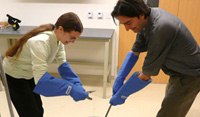
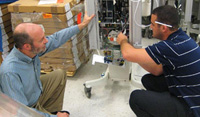
Triangle Universities Nuclear Lab at Duke University
UMBC Mentor/Alumnus: Michael Ronquest Post-Doctoral Fellow Triangle Universities Nuclear Lab
“I love teaching and the chance to pass on what I’ve learned.”
Year of Graduation: 2000 Major(s)/Degree: B.S. in Physics Other Education: Ph.D.; University of Virginia Favorite Course at UMBC: Quantum Mechanics
“I have learned a lot from this internship. Perhaps the most valuable part of my experience has been gaining knowledge of LabVIEW and learning how to write complicated programs in LabVIEW to control the motion of stepper motors.”
Expected Graduation: 2010 Major: Physics Favorite Course at UMBC: Modern Physics
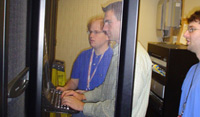
CSC, Innovations Center
UMBC Mentor/Alumnus: Michael Panichello Senior Systems Administrator CSC, Innovations Center
“When students have the ability to work in a professional environment prior to graduation, it gives them the opportunity to embark on a successful career.”
Year of Graduation: 2006 Major(s)/Degree: B. S. in Information Systems Management B. S. in Geography and Environmental Sciences Certificate, Geographic Information Systems Favorite Course at UMBC: Business Management
UMBC Mentor/Alumnus: Michael Tavener Software Developer II CSC, Innovations Center
“Interns are always extremely eager to learn. Working alongside an intern means working alongside a highly motivated individual. This, in turn, means that interns are always fun to work with.”
Year of Graduation: 2008 Major(s)/Degree: B. S. in Computer Science Favorite Course at UMBC: Scripting Languages
Intern: Scott Barasch CSC, Innovations Center
“I come to work every day and address dynamic challenges that are unique to the workplace environment as well as the cutting edge of advanced computing and information science methods, practices and theories.”
Expected Graduation: May 2009 Major: Computer Science Favorite Course at UMBC: Data Structures
Intern: Adam M. Kutzko CSC, Innovations Center
“In addition to gaining work experience, particularly valuable is the opportunity to work with colleagues who understand the intern experience and what its like to juggle work, school, family and social lives at the same time.”
Expected Graduation: May 2010 Major: Information Systems Favorite Course at UMBC: Introduction to Computer Programming
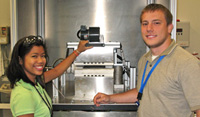
Lockheed Martin Nanotechnology IRAD (Internal Research and Development)
“Sometimes when you get so focused on your day-to-day work, it is really easy to narrow your vision and dismiss new ideas. Interns provide extra insights that are not normally considered. These insights challenge conventional points of view and open paths for innovation and creativity. Each of the interns I have been privileged to work with has continually provided this insight, making them an invaluable addition to our team.”
Year of Graduation: 2006 Major(s)/Degree: B.S. in Mechanical Engineering Other Education: Currently in UMBCs Masters in Mechanical Engineering Program Favorite Course at UMBC: Machine Design
Intern: Carla de Castro Lockheed Martin, Nanotechnology IRAD
“A UMBC alumni mentor is a wealth of knowledge on two legs. I believe that my mentor can truly relate to my experiences, having endured the same difficult engineering courses and participated in similar extracurricular activities. When I was unsure about working part time at Lockheed Martin through the school year, my mentor utilized those insights to advise me accordingly. I feel that those levels of understanding and support are highly beneficial, and I am thankful that I can count on my UMBC alumni mentor to provide them.”
Expected Graduation: May 2009 Major: Mechanical Engineering Favorite Course at UMBC: The Structure and Properties of Engineering Materials
Northwestern Mutual Financial Network
UMBC Mentor/Alumnus: David Picket Operations Manager Northwestern Mutual Financial Network
“I like giving someone the opportunity to gain real-world experience, while allowing them to apply what they have learned from UMBC.”
Year of Graduation: 2007 Major(s)/Degree: B.S. in Financial Economics Favorite Course at UMBC: Analysis of Derivative Securities
Intern: David A. Indek Northwestern Mutual Financial Network
“I found gaining real-world experience in a working environment the most valuable aspect of my internship. It also provided me with more insight into what career I will pursue upon graduating.”
Expected Graduation: May 2009 Major: Financial Economics & Political Science Favorite Course at UMBC: Money and Capital Markets
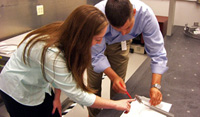
ATK Space Systems
UMBC Mentor/Alumnus: Michael DeIuliis Program Manager ATK Space Systems
“Kristin is an excellent worker. She is a quick study, a good problem solver and she makes a genuine contribution to the work we do here at ATK Space Systems. Kristin has engaged herself in our engineering and manufacturing processes in such a way that she alleviates a lot of the every day support tasks that would normally pull me away from my work. We hope to add her to our engineering staff when she graduates next year.”
Year of Graduation: December 2006 Major(s)/Degree: B.S. in Mechanical Engineering Favorite Course at UMBC: Elements of Aerospace Engineering and Design
Intern: Kristin Crizer ATK Space Systems
“I support product engineers in the manufacturing process of heat pipes. I find the hands-on work to be the most valuable. I get to see heat pipes in different parts of the manufacturing process, watch different procedures and tests, help to solve problems as they arise and support a project from start to finish. Mike is a great hands-on mentor because he spends a lot of time explaining the concepts of heat pipes to me using heat pipes and sketches for clarification.”
Expected Graduation: May 2009 Major: Mechanical Engineering Favorite Course at UMBC: The Structure and Properties of Engineering Materials
Second Language Testing, Inc.
UMBC Mentor/Alumnus: Justin Kelly Language Aptitude Coordinator Second Language Testing, Inc.
“I love that interns are eager to learn about my area of specialization and can contribute in important ways to the research mission that is the foundation of our organization.”
Year of Graduation: 2000 Major(s)/Degree: B.A. in Spanish/Applied Linguistics (MLL) Other Education: M.S., Theoretical Linguistics, Georgetown University, 2006; Ph.D. Candidate (ABD), Theoretical Linguistics (Syntax-Semantics Interface), Georgetown University Favorite Course at UMBC: Don Quijote de la Mancha and Syntax
Intern: Yujung Son Second Language Testing, Inc.
“I loved helping produce language tests in various formats throughout the intern experience. Also, creating language aptitude items in Korean allowed me to learn the difference between my native language, Korean, and English, which I found a great asset for my future studies.”
Expected Graduation: December 2008 Major: Instructional System Development concentration on ESOL/Bilingual Favorite Course at UMBC: Grammar of American English for ESOL teachers
Intern: Sunyoung Park Second Language Testing, Inc.
“By creating Korean version aptitude tests, I am getting keen on my own language in terms of its grammar and standard written structures, which I didnt really care about that much before. It helps me figure out that teaching a language requires a special training regardless of being a native speaker of the language. Connecting this experience to my career after graduation, I am becoming more confident in teaching English as a qualified language teacher.”
Expected Graduation: December 2008 Major: Instructional System Development concentration on ESOL/Bilingual Favorite Course at UMBC: Human Learning and Cognition
Vision Systems & Technology
UMBC Mentor/Alumnus: Clinton Totten Software Engineer Vision Systems & Technology, Inc.
“An intern brings a lot of positive energy to the workplace and new out-of-the-box thinking. It gives me a chance to share my ideas and knowledge with a student and work on my own leadership skills. Also, I am able to get a non-biased and fresh perspective on workflow.”
Year of Graduation: 1999 Major(s)/Degree: B.S. in Biological Sciences Favorite Course at UMBC: Genetics
Intern: Stephen Kawata Vision Systems & Technology, Inc.
“With my experience at VSTI, I value the knowledge Ive gained from the various areas of expertise in the company. I get to learn how IT is used in the real business world. I am able to learn useful information from my mentor as well as other co-workers. I value the opportunity to be part of a team working on a specific project and be part of the VSTI employee team as a whole.”
Expected Graduation: May 2009 Major: Information Systems Favorite Course at UMBC: User Interface Design
GE Healthcare
UMBC Mentor/Alumnus: Bruce Berlage Mechanical Engineer GE Healthcare
“I enjoy the enthusiasm interns bring. I also enjoy helping them learn and aiding them in any way that I can. Its a great chance to help out others in their career development.”
Year of Graduation: 1997 Major(s)/Degree: B.S. in Mechanical Engineering Other Education: Enproco Design and Drafting Institute 2-year Mechanical Design and Drafting course Favorite Course at UMBC: Advanced Material Science
Intern: Kevin Hooper GE Healthcare
“I am working on systems that will help premature babies who are sick become well. This is very rewarding. I also value the relationships that I am building with the employees here and the vast positions that they hold. It is a very friendly and open environment.”
Expected Graduation: December 2008 Major: Mechanical Engineering Favorite Course at UMBC: Mechanics of Materials
Cera Products, Inc.
UMBC Mentor/Alumnus: Charlene Riikonen (Charlene Dale at UMBC) President/CEO Cera Products, Inc.
“Interns bring new ideas, energy and fresh approaches to ways we have been accustomed to presenting our image to the world. For example, our visual art interns have taken our old art and re-shaped it so that our products look fresher and more timely. Our production engineer, who was an intern for several months before coming on full time, is coming up with ways to streamline steps in manufacturing, which should help us produce more efficiently and possibly save money in the process. This is a win-win approach, where the interns learn but we do, too!”
Year of Graduation: 1980 Major(s)/Degree: B.A. in American Studies Other Education:Some masters work in business; various technical courses in manufacturing and production Favorite Course at UMBC: Southern American Literature and Photography
UMBC Mentor/Alumnus: David Dunn Production Engineer Cera Products, Inc.
“I like being able to guide the interns when I can and learn from them”
Year of Graduation: 2008 Major(s)/Degree: B.S. in Chemical Engineering Favorite Course at UMBC: Chemical Engineering
Intern: Jennifer Hong Cera Products, Inc.
“This internship provided real-world, practical experience in my field. Also, I was fortunate to be working in such a close environment, where the president of CERA was available right down the hallway. This made it easier for me to stay in close contact with her in case any problems or issues came up.”
Expected Graduation: May 2009 Major: Graphic Design with a Minor in Art History Favorite Course at UMBC: Introduction to Art and Media Studies
Intern: Matthew Curtin Cera Products, Inc.
“Gaining real world experiences and working with clients has been a very valuable experience for me.”
Expected Graduation: May 2009 Major: Visual Arts – Graphic Design and Media Communications Favorite Course at UMBC: Introduction to Art and Media Studies
UMBC Physics Professor Co-Authors Science Paper on Human Impact on Clouds, Climate
Researchers at UMBC, NASA-Goddard Space Flight Center and the Weizmann Institute in Rehovot, Israel have found evidence that the connection between human impact and climate change may be in the clouds.
Aerosols – the tiny particles that make up dust, soot, smoke and ocean spray – play an important but puzzling role in cloud formation and rainfall. Aerosol-rich clouds are more spread out by wind, last longer and trap more solar heat in the atmosphere, all of which makes cloud growth and rain less likely. But aerosols’ impact is inconsistent, causing more cloud cover over the Atlantic Ocean while reducing clouds in the Amazon basin.
In a study published in the Aug. 15 issue of the journal Science, the international research team, including UMBC associate professor of physicsVanderlei Martins, may have found an answer. The team used NASA’s Terra satellite to focus on the 2005 dry season in the Amazon region, a good test case since the only aerosols being released at the time were caused by brushfires on the ground.
The end result of the research was a mathematical and analytical model that should help better understand how aerosols impact weather and climate across the globe.
“As we’d expected in applying our model, increased smoke from the fires created clouds rich with human-caused aerosols that absorbed sunlight, warmed the local atmosphere, and blocked evaporation. This led to reduced cloud cover over the Amazon,” said Martins in a NASA press release. “It’s encouraging to know the science behind our model should stand no matter the region.”
Students come to UMBC to achieve ambitious goals, knowing they will receive the education and support they need to be successful and compete with the best. Recently, UMBC alumni won three of 100 prestigious Gates Cambridge Scholarships, for a total of four such Scholarships in the past two years.
Considered one of the world’s most selective academic awards, the Gates Cambridge Scholarship fully funds one to four years of graduate study in any field at Cambridge University. Other U.S. winners for 2008 included students from Harvard, Yale, MIT, Princeton and other prestigious universities. The award was established in 2000 by the Bill and Melinda Gates Foundation.
Simon Stacey, associate director of UMBC’s Honors College, said, “UMBC starts with two advantages in the hunt for prestigious scholarships: we produce students of the caliber of Philip, Simon and Ian, with the potential to win these very competitive awards; and we have faculty genuinely committed to student success and prepared to do everything necessary to support their efforts.
“At the Honors College, we oversee the application process from start to finish. We identify promising students and work with them to ensure that their applications and letters of recommendation and nomination show them in their best light. If they become finalists, we arrange mock interviews to help them prepare for the interview process,” Stacey said.
UMBC’s 2008 Gates Cambridge recipients:
Ian Ralby ’02 has received his second Gates Cambridge Scholarship in as many years. He graduated with both a B.A. in Modern Languages and Linguistics and a M.S. in Intercultural Communication from UMBC and was Class of 2002 valedictorian. Ralby’s first Gates Cambridge award funded his M.A. in International Relations; he will now pursue a Ph.D. in International Relations. While completing his J.D. at the College of William and Mary in 2005, he was part of a legal team that worked with the U.S. Department of Justice to provide legal research and support for the Iraqi High Tribunal as it prepared its legal case against Saddam Hussein.
Philip Graff ’08, physics and mathematics, will enter Cambridge’s Ph.D. in Physics program. As an undergraduate at UMBC, Graff created a computer model of quasar radiation and worked with one of the world’s most sensitive scientific instruments, the Laser Interferometer Gravitational-wave Observatory (LIGO), during a National Science Foundation fellowship at Caltech. His quasar work is the topic of a research paper currently under refereeing with the Astrophysical Journal.
Simon Gray ’08, chemical engineering, will pursue a M. Phil. in Advanced Chemical Engineering. Gray finished high school early and then came to UMBC, where he finished his bachelor’s degree in three years and was named Class of 2008 valedictorian. As an undergraduate, Gray was involved in numerous research projects, including an National Science Foundation-funded program in China. After completing his studies at Cambridge, Gray plans to attend medical school and earn a M.D./Ph.D.
Providing undergraduate and graduate students with community service experiences is a vital part of UMBC’s culture. The University has recently been named to the President’s Higher Education Community Service Honor Roll with Distinction, which “recognizes colleges and universities nationwide that support innovative and effective community service and service-learning programs.” The Honor Roll is a program of the Corporation for National and Community Service, and is sponsored by the President’s Council on Service and Civic Participation, the USA Freedom Corps and the U.S. Departments of Education and Housing and Urban Development. The only other Maryland institution to receive this designation award is Loyola College.
The honor recognizes UMBC’s commitment to community service and service-learning, as expressed in the University’s mission and vision. According to Michele Wolff, director of the Shriver Center, “We sought this recognition as a means to bring national attention to the extraordinary work and real, positive changes that result from the sustained and effective collaborations UMBC faculty, staff and students engage in with our non-profit, community and school-based partners locally, throughout our region and across the nation. These partnerships address issues identified by community members in issues areas such as illiteracy, juvenile delinquency, access to health-related resources and achievement gaps among underserved K-12 students in science and mathematics.
“It’s not only the external community that benefits from these efforts,” adds Wolff. “Preliminary assessment suggests that UMBC students who engage in these types of outreach initiatives succeed in college at higher rates than students who did not participate in similar applied experiences.”
Examples of UMBC community service programs include:
K-16 Partnerships: UMBC was one of six University System of Maryland institutions that were part of an inquiry-based science NSF-funded program in Montgomery County high schools. Faculty and students worked with teachers in and out of the classroom on a variety of projects. For example, Manil Suri, professor of mathematics, assisted by his students, worked with a teacher to develop a lesson plan about chaos theory. Other students in science, technology, engineering and mathematics (STEM) programs worked with teachers in the classroom, bringing ideas for lessons and helping with labs. As a result of their experiences, several UMBC students decided to become teachers.
Field Trips: K-12 students, many of whom have never been on a college campus before, are regularly invited to come to UMBC to learn more about the college environment and that it is feasible that they can attend college. Students participate in hands-on labs, attend lectures and panel discussions, tour the campus and eat in the Dining Hall and The Commons.
Baltimore City STEM Partnerships: UMBC students assist National Academy Foundation-Baltimore High School students in preparing for assessment tests in algebra and English. The program is funded by Citi. At Federal Hill Preparatory, UMBC students assist teachers in incorporating more science content instruction and science enrollment programs into the school. The program at Federal Hill Preparatory receives funding from NASA-Goddard Space Flight Center.
Spring Break Trips: UMBC students travel to a variety of cities to help residents in need. Students spent a week in New Orleans, helping to build homes, removing debris, participating in outreach programs in elementary schools and volunteering at an animal shelter in the ongoing relief effort after Hurricane Katrina. Service trips such as this one are supported by UMBCServes, a campus-wide service organization coordinated through UMBC’s Office of Student Life, the Office of Residential Life, The Shriver Center, various student organizations, Athletics and Off-Campus Student Services.
Peaceworker Program:The Shriver Peaceworker Program supports a select group of returning Peace Corps volunteers as they pursue graduate degrees at UMBC, engage in community service and participate in ongoing ethical reflection and development. The goal is to educate and train a new generation of citizen leaders who are able to critically, creatively and responsibly address the complex economic, social and cultural problems confronting the United States—and in particular its cities—today. While nearly 85 percent of Peaceworkers Fellows originally come from outside the Baltimore region, 60 percent have settled and remain engaged in service careers in local communities.
On Friday, July 11, UMBC junior Joshua Michael was sworn in as the University System of Maryland’s (USM) student regent.
Michael, who is studying political science and secondary education, says he has a passion for public education and has already served as a student representative or intern at a variety of institutions. He was the UMBC representative to the USM Student Council, a student commissioner on the Maryland Higher Education Commission and a student member of the Maryland State Board of Education. Michael also spent two summers as an intern in the Maryland State Department of Education’s Office of Academic Policy.
“We are extremely proud of Josh,” said President Freeman Hrabowski. “It is a tremendous honor to be named student regent, and Josh has demonstrated exceptional leadership skills and dedication to academic issues. He will be a strong advocate for all USM students.”
As a member of the Board of Regents, Michael will be directly involved with a number of issues, including accessibility and affordability in the USM. He is excited about working with student leaders at campuses throughout the System. “It is important to ensure that all students have a voice and access to resources,” he said. “We need to present a unified student voice on System and statewide issues.”
Michael added that he was pleased with the student response to the letter writing campaign to legislators during last year’s Special Session. “Students realized they can make an impact. It will be important to continue to express the needs of students to our representatives.”
After graduation, Michael says he would like to teach social studies and mathematics at a Baltimore City middle school. A member of UMBC’s Honors College and Pi Kappa Phi fraternity, this summer he is working as an intern at UMBC’s Shriver Center and coaching lacrosse for an intramural team of 9th and 10th graders.
Michael was nominated to the Board of Regents by Governor Martin O’Malley and confirmed in March by the Maryland Senate. He will serve a one-year term. As USM’s governing body, the Board of Regents is responsible for the system’s academic, administrative, and financial operations. In addition, the board formulates policy and appoints the USM chancellor and the presidents of the system’s 13 institutions.
What do your credit history, medical records and Flickr photo streams have in common with the 9-11 Commission?
A new, six-campus research effort, led by UMBC and funded by a five-year, $7.5 million Department of Defense grant sponsored by the Air Force Office of Scientific Research, hopes to turn the 9-11 Commission’s recommendations for better sharing of classified intelligence data into a workable, secure technology network.
What makes the project unusual is that the researchers hope their work will both help prevent future terror attacks and boost information security and privacy for average citizens.
Many pieces of the 9-11 plot puzzle weren’t recognized until after the attacks due to inability or reluctance by intelligence agencies to share information. The 9-11 Commission Report recommended that the traditional U.S. intelligence culture of “need to know” be shifted to “need to share.” The challenge is getting the right information shared with the right people or agencies, while making sure that classified intel doesn’t fall into the wrong hands, foreign or domestic, or be misused.
The project is led by principal investigator and UMBC computer science professor Tim Finin, whose ebiquity research group specializes in deep data mining, security, privacy and new research frontiers of the Web, blogs, Twitter, social media and other areas. According to Finin, the new project should prove useful beyond the DOD sphere.
“There are plenty of real-world problems that we can work on that are not classified, such as balancing patient privacy with making sure the right doctor in an emergency can quickly access their medical records,” Finin said.
“Many of the principles of this research can apply to everyday scenarios where information is shared with the right people and protected from the wrong people, such as your location as determined by your cell phone, pictures from the family photo albums on Flickr or the details of your credit history.”
The UMBC team is partnered with researchers from the University of Illinois Urbana-Champaign, Purdue University, University of Michigan, University of Texas at San Antonio and University of Texas at Dallas. The grant was awarded as part of the Department of Defense’s Multi-disciplinary University Research Initiative (MURI) program.
“We want to create the science behind the idea of need to share,” said Anupam Joshi, a key member of the ebiquity group and frequent research partner of Finin. “We’ll be weighing what should be shared with whom and asking if we can balance the utility of sharing something with the risk of its getting disclosed,” said Joshi.
The project will develop new ways for organizations and individuals to express policies for sharing information that can be automatically understood and enforced by information systems. Such policies will go beyond existing data access control mechanisms and ‘digital rights management’ schemes in their power to include a wider range of situational constraints and the ability to specify limitations on how the data can be used.
The first graduating class of Gender and Women’s Studies majors has gained critical skills and leadership experience essential to the 21st century.
“Our program helps prepare students – both men and women – for a world that has to understand gender in all of its strengths and complexities,” said Anne Brodsky, director of Gender and Women’s Studies and associate professor of psychology. “In addition, our classes stress that gender is just one important identity and that ethnicity, race, class, sexual orientation and disability are all critical elements as well.”
The Gender and Women’s Studies program is interdisciplinary, with affiliate faculty and staff from across the University, and emphasizes skills in critical thinking and writing. In addition to their academic endeavors, students get involved in a vast range of activities such as Women Involved in Leadership and Learning, the Student Government Association, the Women’s Center, Freedom Alliance and the Women’s Collective, among others. Students also participate in internships with a variety of organizations, such as the International Rescue Committee, and have an opportunity to study abroad to explore issues of gender and culture throughout the world.
Formerly known as women’s studies, the program also offers a minor, as well as undergraduate and post-baccalaureate certificates. “Gender and women’s studies has been a popular program at UMBC for 25 years,” said Brodsky. “We have students who have gone on to a variety of fields, including law, health, social service, public policy, activism and media.”
Jodi Kelber-Kaye, Gender and Women’s Studies faculty member and director of WILL, said, “The students in our first class have been committed to the program throughout their time at UMBC — some even delayed graduating so that they could obtain the major. They are intelligent and articulate on issues of structure and equality, and I know they will continue to be leaders in the field.”
All of the students in the first Gender and Women’s Studies cohort are interested in pursuing graduate degrees now or in the future. Nardos Bellete, for example, will attend Loyola College of Maryland’s Master’s in Clinical Counseling program. Erin Fox will continue to work in the legal advocacy department at the Domestic Violence Center of Howard County, while Tavia Wright is an assistant and project manager in the honors program at the Community College of Baltimore County. Kate Furek and Martine Richards hope to obtain positions with non-profit organizations.
Bellette said, “The Gender and Women’s Studies program taught me to know and analyze the world around me and its inequalities, know those inequalities are changeable and find ways to make things better. The faculty see promise in students and turn them into agents of change, and this is what I hope to be as a therapist to individuals in need.”
First Class Graduates from Unique Media and Communication Studies Program
As communication becomes increasingly digital, interactive and pervasive, knowledge of new media technology is essential. The first graduates of the Media and Communication Studies program have received a strong foundation not only in new media, but in critical media literacy and intercultural communication.
“Our program is unique in that it doesn’t just prepare students for a job in media and communication fields,” said Jason Loviglio, director of Media and Communication Studies and associate professor of American studies. “The program is grounded in the liberal arts tradition, with a strong emphasis on written and oral communication skills. Students learn to critically decode the media, communicate across lines of cultural differences and be comfortable with using new media technologies.”
Media and Communication Studies students have taken advantage of opportunities to gain experience both on and off campus. David Etzel is the co-winner of UMBC’s first-ever ProveIt competition, which provides up to $50,000 to the student(s) who come up with the best idea to improve campus life. Etzel’s project, Green Space, will be a public outdoor space next to the Fine Arts Building where members of the UMBC community can gather, rest and study. Etzel also was a marketing intern in the Office of Student Life, and is planning a career in internet communication or television broadcasting.
Last summer, Scott Gajewski was an editorial intern at Smart CEO, where he gained experience in both administrative and editorial work for a humanities-focused business magazine. Gajewski also works at Absolute Quality in Hunt Valley, Maryland, where he tests games for cell phones. He hopes to continue his career in the video gaming industry.
Jazzmon Morgan worked in the Office of Residential Life at UMBC and completed a marketing and sales internship with University Directories. She plans a career in public relations and wants to attend graduate school.
Kacie Smith interned with the Maryland Film Festival and is applying to master’s programs in film studies. She received an Undergraduate Research Award to study representations of women in Swiss media, and presented her work at Undergraduate Research and Creative Achievement Day. Her study was published in the 2008 UMBC Review: Journal of Undergraduate Research and Creative Works. Smith also is applying for a Fulbright Scholarship to continue her studies abroad.
Smith said, “The Media and Communications Studies program has not only introduced me to theoretical concepts of media, but has provided me with the opportunity to learn applied skills as well. I also was placed in an internship with the Maryland Film Festival, which was an extremely fulfilling experience because I got to witness almost every stage of festival planning.”
Meyerhoff Scholar Carla Valenzuela, a sophomore with a 4.0 GPA, is one of 321 students receiving 2008 Goldwater Scholarships, considered the most prestigious U.S. award for undergraduates in mathematics, science and engineering.
The Goldwater Scholarship program honors outstanding students committed to pursuing careers as research scientists. The Scholars were selected on the basis of academic merit from a field of 1,035 students.
Valenzuela, a biological sciences major, hopes to obtain a MD/Ph.D. in neuroscience and conduct research on the potential of stem cells to serve as therapeutic tools for neurodegenerative disorders. She became interested in the field as a sophomore in high school, when she had the opportunity to work in a neuroscience laboratory.
This summer, Valenzuela will travel to Tokyo, Japan for a research internship at the Nutrition Metabolism, Metabolic Disorders Department at the Tsukuba Research Institute, Banyu Pharmaceutical Co., Ltd. She currently conducts research in the laboratory of Margaret M. McCarthy at the University Of Maryland School of Medicine, where she studies the effect of estradiol on glial cell genesis and function in the development of the hippocampus. She has been a member of Temple University’s Physician Scientist Training Program since her sophomore year in high school, which enabled her to participate in internships across the nation, including Temple University’s Center for Stem Cell Technology, the National Institutes of Health and Banyu Pharmaceutical Co., Ltd. this summer. She also has interned at Wyeth Pharmaceutical Company.
Valenzuela also is a National Science Foundation S-STEM Scholar and a member of the Phi Kappa Phi honor society and the National Society for Collegiate Scholars.
“I feel so honored to have received the Goldwater Scholarship,” said Valenzuela. “It really motivates me to continue working hard towards getting my M.D./Ph.D. in neuroscience and someday becoming a leader in my field.”
Puffins: the flighted, more stylish-looking cousins of the penguin. To the island nation of Iceland, they are as culturally significant as blue crabs are to Maryland. Now a Fulbright-funded documentary film made by Maria Frostic of UMBC’s Goddard Earth Sciences and Technology (GEST) Center, to be broadcast nationally by PBS on July 23, may help spotlight how climate change could impact the unique birdsí future.
Shot on location in Iceland’s Westman Islands, a shorter version of Frostic’s 13-minute documentary “Plight of the Puffins” will air on PBS’s “Wild Chronicles” series on July 23. The full film will routinely screen at the Project Puffin Visitor Center in Maine, and will be submitted to several science and wildlife-themed film festivals.
Originally from Richmond, Va., Frostic arrived at the GEST Center last year after receiving a master’s degree in natural history filmmaking from Montana State University. An earth science film producer at GEST, Frostic makes short, research-oriented videos for the Web. It’s another extension of her many interests and unusual career path.
An avid outdoorswoman, she did her undergraduate studies in biology, English language and literature, and environmental science at the University of Virginia. A two-time alumna of the National Outdoor Leadership School (NOLS), Frostic spent a semester backpacking the Grand Canyon, winter camping in Yellowstone, caving in Big Horn National Forest and later joined a NOLS sea kayaking expedition in Baja, Mexico.
Her experience with NOLS sparked a lifelong interest in biology and ecology. Frostic has also worked as a teacher, park ranger, newspaper reporter and researcher.
“I look back at my career and it all makes perfect sense, even though it seemed disjointed at the time,” said Frostic. “I always had a foot in both the arts and the sciences, and when I found science filmmaking, it enabled me to combine my many interests: research, writing, travel and ultimately communicating science in a creative way.”
In July 2007, Frostic loaded up her high-def film equipment and journeyed to Iceland, known for its otherworldly landscapes and harsh winters. Icelanders have a close historical and cultural tie to puffins. Long ago, smoked puffin was relied upon as a winter survival staple. But today puffins are more like the Icelandic official mascot, their images displayed on street signs, murals, shot glasses and sweaters.
Frostic’s film shoot coincided with the launch of a research study by noted Icelandic biologist Erpur Hansen on how climate change may be impacting the puffinís food source. Puffins rely on a tiny fish known as the sand eel or sand lance, and the abundance of this fish in Icelandic seas have made the Westman Islands the largest breeding ground for Atlantic puffins in the world.
In recent years the fish have became scarce, and puffin reproduction is plummeting. “Islanders have seen puffin parents try to feed their young (known as pufflings) with larger fish like herring, but they were too large for the juveniles to swallow. Many pufflings have starved to death,” said Frostic.
A recent analysis of the 2007 field data revealed that climate change is being felt in many global ocean ecosystems. “Some of the effects are obvious, and others are more complex and harder to understand,” Frostic said. “What I’m gathering is that every part of the marine ecosystem is affected, starting with phytoplankton and working through the food chain to larger organisms.”
Frostic hopes that “Plight of the Puffins” will hold equal appeal to environmental activists and film lovers. She’s submitting her work to several film festivals while exploring potential tie-ins with Barbara’s Bakery, Inc. — which donates a percentage of profits from its Puffins brand cereal to conservation groups and other charities — and the
UMBC’s Visual Arts Imaging Research Center (IRC) Fellows recently won an animation competition presented by the Brooklyn Philharmonic Orchestra. The Fellows created a video to accompany a five-minute contemporary violin composition, Try to Believe, by Randall Woolf, that was screened during the Orchestraís performances in New York in April.
Over 28 paper, foam core and mixed media sculptures were created to make a dizzying, surreal accompaniment to Woolf’s composition. The 10 Fellows in the Visual Symphony course, taught by Eric Dyer ‘95, assistant professor of visual arts, mixed the concept of the zoetrope – a pre-cinema optical toy – with digital video technology for this form of “live” animation. The visual content loosely follows a modern-day “Alice” through a dream-like landscape – a narrative that, like Woolf’s music, is a balance between abstraction and the familiar.
“The IRC Fellows ran with this project from the start and they poured an enormous amount of smart creativity and enthusiasm into it,” said Dyer. “They managed to successfully visualize the music of a great contemporary composer while maintaining their own distinct artistic voice. We’re proud of them – the public presentation of their video in New York City is a well-deserved award.”
In addition, the Fellows will perform the animations live at the Baltimore Creative Alliance on May 13. They will be accompanied by violinist Martin Shultz of the Peabody Conservatory.
The Visual Arts Imaging Research Center (IRC) Fellows Program is a unique fellowship designed to recognize, reward and encourage students who have displayed exceptional talent and skill in art and technology during their first two years as undergraduate art majors. Each semester, students in the program participate in a small specially designed seminar style course that focuses on aspects of emerging technologies, media criticism and related themes. These courses usually serve as electives within the student’s degree requirements. Often, the courses are unique offerings developed exclusively for IRC Fellows. For more information on the program, visit www.irc.umbc.edu/ircfellows/.