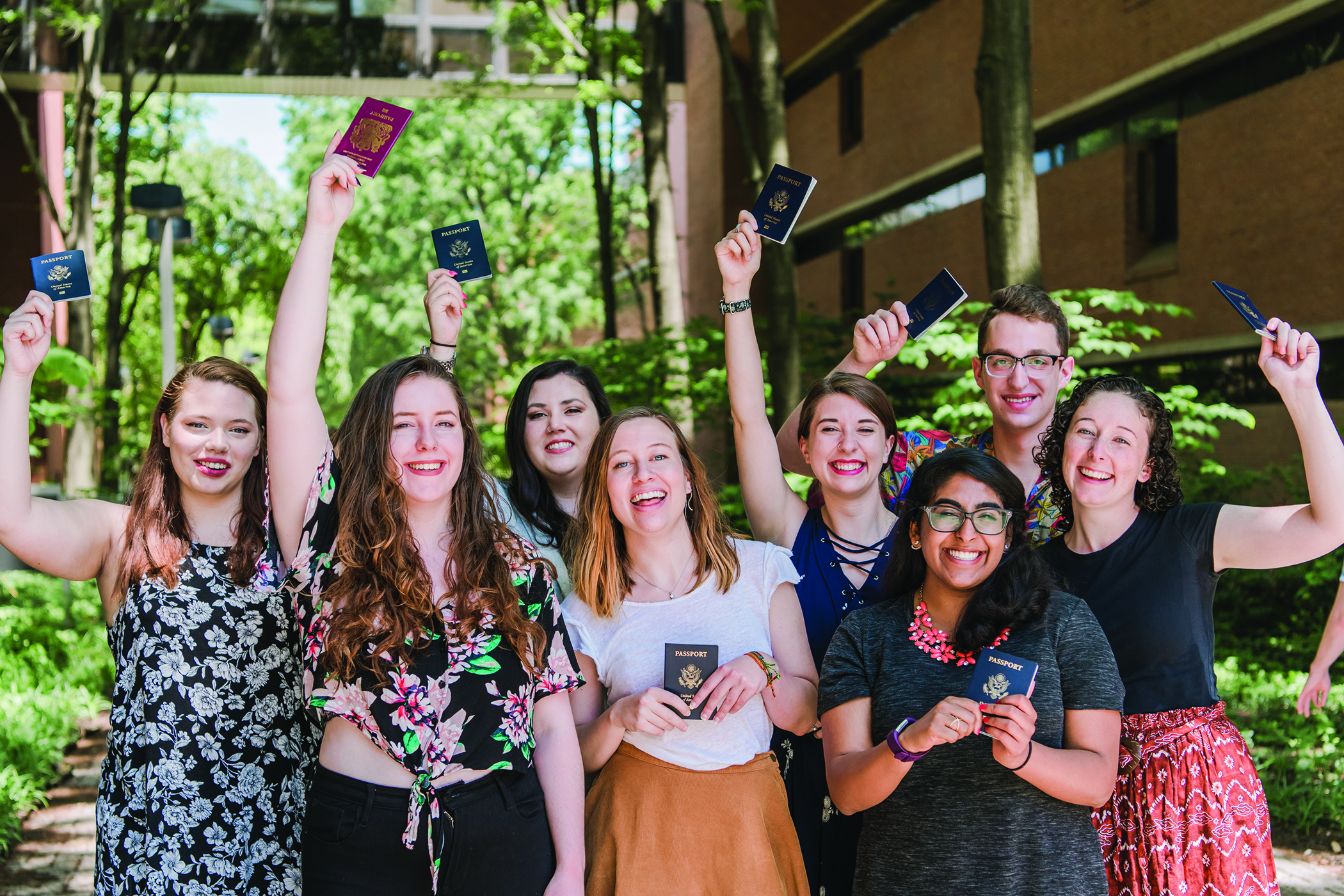
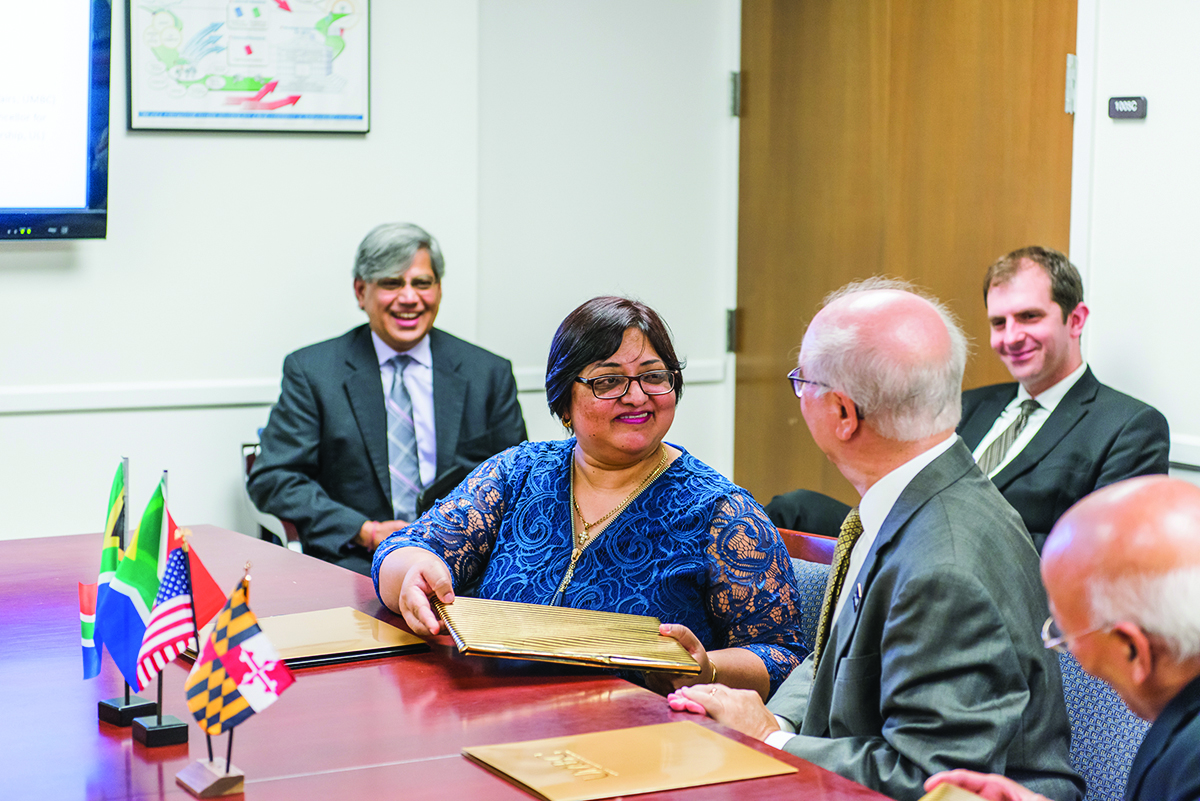
All posts by: Catalina Sofia Dansberger Duque


Amy Bhatt shines light on gender and immigration policy in new book High-Tech Housewives

“I am interested in the human face of policy,” says UMBC’s Amy Bhatt. “I want to share the personal narratives of immigrants few people hear about—highly skilled workers—and help us understand their experience as they face questions of citizenship, belonging, and community.”
Bhatt, an associate professor of gender and women’s studies, and affiliate associate professor in the language, literacy, and culture, and Asian studies programs, has made headlines nationwide by providing research-based expertise on contemporary U.S. immigration policy. She’s bringing the conversation to UMBC through a Humanities Forum talk on her new book, High-Tech Housewives: Indian IT Workers, Gendered Labor, and Transmigration, on Wednesday, December 5, 2018, 4 – 5:30 p.m., in the Albin O. Kuhn Library Gallery.

“Now more than ever, Professor Bhatt’s research is crucial in helping all of us understand the everyday impact of high-skilled immigration,” shares Jessica Berman, professor of English and director of the Dresher Center for the Humanities, which organizes the Humanities Forum. “Thriving academic research communities are enriched by the knowledge and expertise highly-skilled international faculty, staff, and students bring and share.”
H-1B and H-4 visa programs allow skilled workers from South Asian countries to travel with their families to the U.S. to fill needed temporary positions in corporations, hospitals, and universities. Bhatt explains, “U.S. consumers depend on the global flow of goods and services in the tech, healthcare, and higher education sectors.” She notes, “In a global high-tech economy it is important to acknowledge the value that immigrants bring to our lives and how they are being threatened by immigration policy.”

Bhatt’s work focuses on gender as an important and understudied factor at the intersection of immigration law and global economy. She notes that 85 percent of H-1B visa holders are men. Their spouses can join them in the U.S. under the H-4 visa program, but, even if those spouses are themselves highly skilled, they are unable to apply their expertise in the paid workforce. Instead, they often become “high-tech housewives” due to the constraints of immigration law, rather than choice.

“People tend to think about H-1B visa issues as problems that only affect men,” failing to consider the often highly skilled spouses who come with them to the U.S.,” says Bhatt.

“Women’s abilities to migrate—flexibility in foregoing their own careers at times, and work to manage family demands, cultural transmission, connection to home country, and building local relationships—allow their spouses to take highly skilled jobs in the United States,” explains Bhatt. Her research explores how the current visa system not only limits the employment of highly skilled women, but also impacts their identities and day-to-day experiences in other significant ways.

In addition to her recent book, Amy Bhatt has recently published three widely read articles on U.S. and international policy issues and gender through The Conversation, including “Why Trump’s plan to forbid spouses of H-1B visa holders to work is a bad idea.” In that article, Bhatt writes, “H-4 women face a triple burden if they are able to start working again, particularly in technology: race, gender and long gaps in their resumes.”

Whether sharing her work through academic publications or news media like the Seattle Times, Bhatt’s overall message is the same.

“It is an urgent call for all of to pay attention,” she says, “to changes in immigration trends, globalization, how businesses are thinking about labour pools, and how we think of gender and women in the family in these economic and political processes.”


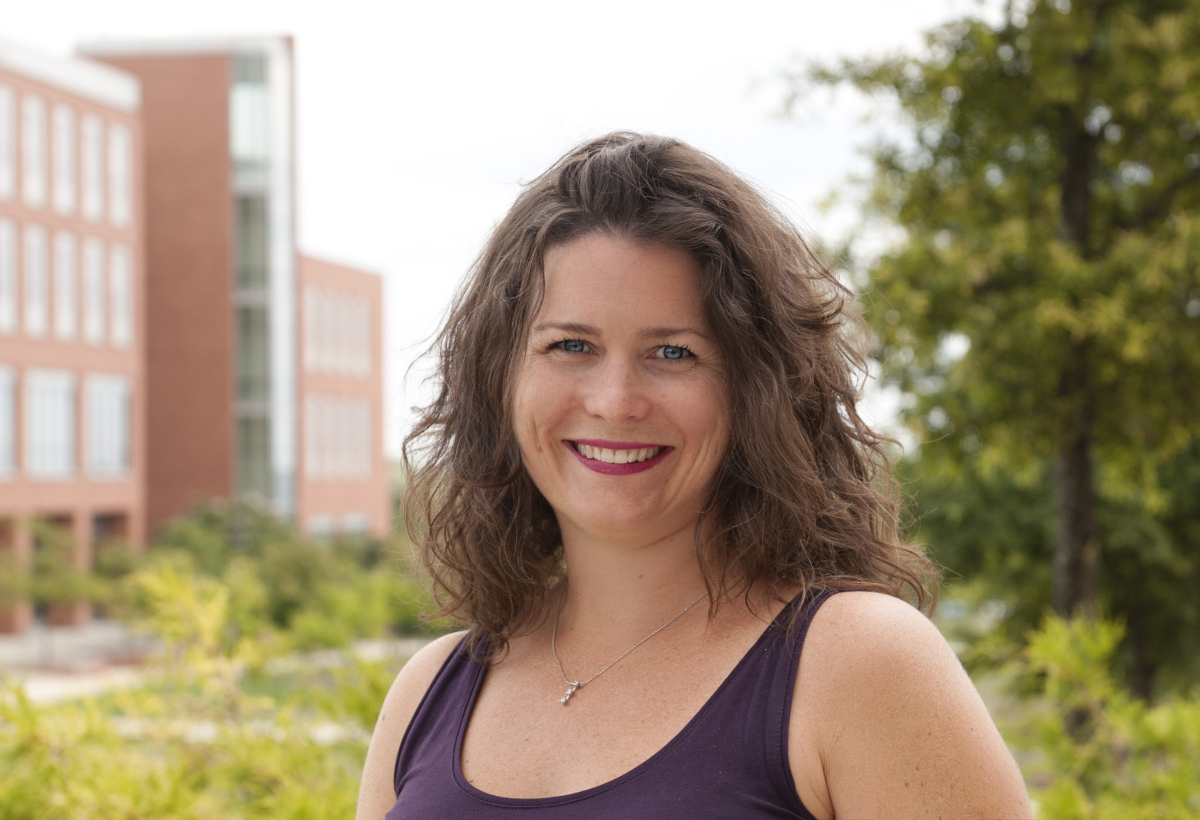
Banner image: Amy Bhatt. Photo courtesy of Amy Bhatt.


The Power of a Shared Meal

This time of year, students, faculty, and staff are rushing about preparing travel plans to meet with friends and loved ones. Kitchens are brimming with the scents of family recipes and the sounds of laughter as sneaky hands try to taste the Thanksgiving dishes before they debut on the table. Coming together to sit around a table with family and friends is a simple but very powerful way of making a pure human connection we try to recreate all year long.

The act is so powerful, it becomes an act of thanks in itself as we indulge in loving company, conversation, and familiar (and sometimes new) dishes.

It was through this extending of hands and pulling together as a community that on Saturday, November 10th our UMBC family, represented by the Shriver Center, Transportation Services, Off-Campus Student Services/Veteran Services, and alumni, joined forces with Tabrizi’s Restaurant, and a myriad of community partners to serve more than 220 military veterans experiencing homelessness. All came together to share the power of a community meal to value each others’ experiences, stories, and memories. Because in the end, it is not what we share or how we share, but more importantly that we take the time to share with as many at the table as possible.

Turning a meal into a movement

Volunteers from UMBC and the community prepare to serve more than 220 homeless veterans Thanksgiving dinner.

Michael Tabrizi, owner of Tabrizi’s Restaurant and wedding venue in Baltimore’s Inner Harbor, understood the power of this exchange year-round from interactions with the vast number of homeless people around his place of business. Thinking about how he could provide the power of a shared meal, three years ago Tabrizi hosted a “Homeless Restaurant Week,” inviting those experiencing homelessness to the restaurant in lieu of hosting traditional restaurant week meals. He then started A Chef’s Table Foundation with an aim of one day opening a restaurant that provides training opportunities for homeless individuals. Last year, he hosted a Thanksgiving meal for military veterans experiencing homelessness. He served 162 veterans with limited transportation.

“All I wanted is to make the homeless people feel some dignity, hope, and believe that there is still much good in the world. The homeless feel forgotten; not acknowledged as a person, a life, a human being, and that is very sad,” said Tabrizi to Food Newsfeed. “I hope this will restore some respect and dignity. I owe that to them.”

When Hannah Schmitz, assistant director of applied learning and community engagement at the Shriver Center, heard about this vision she knew that it was an opportunity to do what the Shriver Center does best – leverage the resources of the university to connect with the community.

“I was speaking with Michael Tabrizi one night while I was at his restaurant and he mentioned these events and that transportation is the greatest barrier for getting people in poverty to come to the dinners. I kicked into work mode and thought about the resources that UMBC has and how we could potentially partner,” says Schmitz. Over the past two years she has volunteered as the event coordinator, managed volunteers, worked with organizations serving military veterans who are homeless, and spearheaded fundraising for gifts and raffle prize donations.

Serving humanity

The call was heard far and wide. Along with other members of the Shriver Center, Daniel Teage ’09, health administration and policy, associate director of transportation services, and Joe Regier, executive director of UMBC transit and community connections, provided UMBC shuttles to transport veterans from various locations. “Many people assume that UMBC Transit is just about buses and shuttles but they are really committed to community engagement and bridging the campus and community through transit,” explains Schmitz.

Antonio Silas, director of off-campus student services/veteran services, was also on board to engage UMBC’s student veterans and students from military families to greet, serve, and dine with the guests. And Winston Zhou ‘19, visual arts, volunteered his talents as a photographer.

“My mom is a retired Marine and my dad and step-dad are both former Marines, as well,” reflects Donnya Stagg ’19, global studies, who volunteered as a server. “Military personnel give up a lot and often don’t get much in return. I wanted to help veterans see how appreciative people are of their sacrifices. Giving my time at the dinner was one small way I could do that.”

Mary Slicher ’73, sociology, executive director and co-founder of Project PLASE (People Lacking Ample Shelter & Employment), was happy to participate in this special Thanksgiving meal. The Maryland Center for Veterans Education and Training; The Baltimore Station; and Loch Raven VA Community Living and Rehabilitation Center also participated. Under Armour donated hundreds of clothes, hats, and shoes, making it possible for each guest could choose up to three items.

“There are vets who did not have a great transition out of the military. There are some who did not retire but who did a tour in Iraq but did not finish or finished and did not have the support, resources, and help that we have today,” Donovan S. Garrett ’19, business technology administration; undergraduate assistant for Veterans Student Services and the Adult Learner Network; and six- year active duty Air Force veteran, currently in the reserves., “It was so nice to be able to sit with another vet and have the time to connect and to listen to their experience and reestablish a human element, a bond, build understanding — that is the most important thing about a shared meal.”

Photos by Winston Zhou ‘19 for UMBC Magazine.

UMBC joins innovative ACE Internationalization Lab, expanding commitment to global engagement

UMBC is expanding and deepening its long-term commitment to internationalization as a member of the American Council on Education (ACE) Internationalization Laboratory program. UMBC is one of just 12 higher education institutions nationwide to participate in the 16th cohort of this selective program, which supports universities in broadening internationally-focused strategies.

“This is a tremendous, unmatched opportunity for these institutions to share lessons and challenges as they undergo a cultural transformation over the coming months,” said Robin Matross Helms, director of ACE’s Center for Internationalization and Global Engagement.

Over the next 16 months, faculty and staff will work in leadership teams to develop strategic plans for the future of research, learning, working, and living in a fully global campus. UMBC will share its unique perspective with other universities in the cohort and take part in a series of opportunities to gain insight into how other institutions are implementing their strategic plans for internationalization.

Each participating institution’s strategic process will be led by an ACE lab advisor and coach. UMBC will work with Anthony Pinder, assistant vice president of academic affairs, internationalization and global engagement, at Emerson College. His first visit to UMBC will be on December 13.

“UMBC’s participation in this year’s cohort of the ACE Internationalization Laboratory is a key component in our work to create the university’s first-ever internationalization roadmap,” shares Tony Moreira, vice provost for academic affairs. “Given today’s global landscape for higher education, universities need to implement international, intercultural, and global elements in all areas of the institution to ensure that they stay relevant and continue to provide a high-quality education to all students.”

UMBC celebrates 40 years of the W. E. B. Du Bois Lecture with talk on genetics, race, and racism

UMBC has a long tradition of honoring and promoting thoughtful analysis of diverse scholarship and continues this focus through the annual W. E. B. Du Bois Distinguished Lecture. This year marks the 40th anniversary of the event, created by UMBC’s Africana studies department to honor the depth and range of applied scholarship for which Du Bois was known. Each year, the department invites a distinguished scholar or activist to share their work, to mark progress towards dismantling inequalities and to identify the work that remains on the path toward achieving full equality for people of African descent.

This year, Dorothy E. Roberts, professor of law and sociology and Raymond Pace and Sadie Tanner Mossell Alexander Professor of Civil Rights at the University of Pennsylvania, will serve as the distinguished speaker. Her lecture will take place on Wednesday, November 14, 2018, 6:00 7:30 p.m. in the University Center Ballroom. She will critically examine collaborations between biological and social scientists involved in sequencing the human genome and linking social outcomes to genetic traits. Her talk will propose “a more just way for social and biological scientists to study race and racism.”

In addition to providing a space to learn about and discuss Roberts’s research, the lecture will also offer an opportunity to reflect on the legacy of Du Bois “as a preeminent and influential intellectual, scholar, public figure, writer, and ardent Pan-African activist” through the lens of contemporary research about race and racism, says Gloria Chuku, professor and chair of Africana studies.

W.E.B. Du Bois was a sociologist, historian, and social activist, and the first African American person to earn a Ph.D. from Harvard University. His scholarship (including The Philadelphia Negro: A Social Study) is foundational to today’s research on the health, economic, and social impacts of racism.

In addition to scientific scholarship Du Bois, became famous for writing The Souls of Black Folk, published in 1903, which became a foundational text of American literature and history of sociology, including poetry, autobiographical essays, historical articles, and memoir. Du Bois also founded the Niagara Movement and was among the founders of the NAACP. He was adamant about the importance of education to provide access and freedom for African Americans, other people of African descent, and women.

UMBC’s annual W.E.B. Du Bois lecture series “provides an important platform for intellectual dialogue on crucial aspects of African American experiences and those of peoples of African descent,” says Chuku. “It offers us an opportunity to draw inspiration from Du Bois’s scholarship and activism.”

Banner image: W. E. B. Du Bois. Photo from creative commons. 

UMBC’s Ashe and Berry-McCrea earn national honors for doctoral research addressing inequities

UMBC doctoral student Jason Ashe and new Ph.D. recipient Erin Berry-McCrea have been selected for notable national honors as emerging leaders in work to address inequalities, in health care and in educational and professional spaces.

The Robert Wood Johnson Foundation (RWJF) has selected Ashe, a human services psychology doctoral student, for its prestigious Health Policy Research Scholar leadership development program. The program is designed for second-year doctoral students from underrepresented populations and disadvantaged backgrounds who want to apply their work to policies that advance equity and health. RWJF seeks to build a diverse field of health policy research leaders who reflect our changing national demographics.

Berry-McCrea, who successfully defended her dissertation in language, literacy, and culture this fall, received the 2018 National Council of Teachers of English (NCTE) Early Career Educator of Color (ECOC) Leadership Award. Barry-McCrea’s research focuses on how millennial Black women create and utilize digital spaces and tools in navigating professional and educational experiences. The award she received recognizes educators of color in the first years of their faculty careers, providing two years of mentorship to support research development, and funding to attend the ECOC Institute and the 2018 NCTE Annual Convention.

Intersection of health and faith

Ashe is focused on applying his research on Black religious beliefs, spirituality, and racial and ethnic health disparities to develop more inclusive and responsive medical practices and to reduce health inequities.

As a first-generation American, Ashe witnessed his parents face major challenges in everyday life in The Bronx, New York, during the 1980s. Both came to the United States from Antigua in search of more opportunities. His father gained citizenship through the Navy and his mother worked as a housemaid. Growing up, Ashe recalls his parents dealing with doctors who laughed at their accents and disregarded their ailments and their belief systems.

“When I was studying pre-med chemistry, I had a lot of existential questions of life and death that I could not find answers for. At divinity school I was able to take Christian bioethics, which led me to ask more questions about people who don’t have the choice to die peacefully,” explains Ashe. “I understood then that I wasn’t interested in being a physician and focusing on palliative care, but on answering more systemic-level questions about health and dying, specifically in Black communities.”

That is what led Ashe to UMBC’s psychology Ph.D. program. “I wanted to understand the psychology of religion and health identity,” he says. “What does advocacy look like and how do we use our scholarship so that erroneous claims are not made to justify inequities in communities of color?”

Ashe found a mentor in Danielle L. Beatty Moody, psychology. The Human Services Psychology program she leads presented an avenue for him to apply his research, ideas, and innovative perspective. Moving forward, he hopes to create real change in communities of color and the medical community.

“Jason came with little exposure to psychology but came here with such a depth in math and science from MIT and two master’s degrees in theology and divinity from Duke. He wanted to bring those pieces together to create understanding around the health of Black folks,” explains Beatty Moody. “Jason was ready for the challenge of what it takes to move the needle so that we are not just talking to other academics, but applying our research to improve people’s lives.”

Creating supportive digital spaces for and by Black women

Berry-McCrea is applying her research in digital and media literacy to bring awareness to the online linguistic practices of Black women who create brave spaces to manage professional and social issues unique to their experiences.

Berry-McCrea’s graduate mentor, Christine Mallinson, professor of language, literacy and culture, and director of the Center for Social Science Scholarship, describes her work as essential for anyone concerned with educational justice and wanting to help, work with, and engage students of color in developing agency as engaged communicators.

“There’s no question that language shapes, and is shaped by, our social identities—both online and offline,” says Mallinson. “Erin’s work gives us a student-centered and culturally informed understanding of what factors shape Black collegiate women’s linguistic choices, both in terms of how they navigate the complex landscape of higher education, as well as how they find and create spaces—often online—where they can communicate in ways that are authentic to themselves.”

Berry-McCrea’s experiences in higher education both as a student and as an educator have given her a window into the many contradicting messages that Black women receive. “As I climbed the ladder of academia I saw less people like me and more people that made negative assumptions about who I was because I was Black,” she says. “I’ve also had my Black female students share their own experiences with professors that placed negative labels and expectations on them. It was very clear that to be a professional academic for Black women meant deleting any trace of themselves in the way they spoke, looked, and carried themselves.”

These experiences have led Black millennial women to create unique digital spaces, Berry-McCrea notes, and these spaces have formed the basis of her research. Berry-McCrea found that Black millennial women often seek refuge, support, and resources through the immediacy and wide geographic net of social media.

Berry-McCrea defending her dissertation at UMBC this fall.

“Black collegiate women could post their experiences on social media and immediately receive validation of their experience, support from peers, and resources to move from isolation to finding a place to succeed even within these parameters without having to give up what was authentic to them,” she explains.

Berry-McCrea recently published this research in the journal Meridians, through the article “‘To My Girls in Therapy, See Imma Tell You This for Free …’: Black Millennial Women Speaking Truth to Power in and across the Digital Landscape.” She is now an assistant professor of media and communication studies at St. Augustine University in North Carolina.

Banner image: Ashe at UMBC’s 2017 Fall Opening Meeting. Photo Marlayna Demond ’11 for UMBC.

New Fulbright Accelerator connects CAHSS faculty with international opportunities

“My Fulbright experience changed the course of my life and my career,” remembers Eugene C. Schaffer, professor of education.

Early in his career, Shaffer earned a Fulbright Scholar award to bring his knowledge of curriculum development and teaching practices to a collaboration with Taiwanese educators for two years. “There is always so much to learn and understand about history and how different cultures work together to hope for peace,” he says. “My work in Taiwan helped me to see the need for sharing research on innovative and effective curriculum practices globally.” Shaffer went on to travel the world and lived and worked with educators in the UK and Japan. Recently, he earned another Fulbright to work with educators in Kosovo. “The most salient takeaway of my Fulbright experiences is how much the cultures and the people gave to me. I am a better teacher and a better person for trying to understand another cultural form,” shares Shaffer.

UMBC’s College of Arts, Humanities, and Social Sciences (CAHSS) is working to connect more faculty with Fulbright opportunities, particularly given CAHSS faculty’s long and successful history of transformative international research and teaching. UMBC faculty have already completed Fulbrights on every continent except Antarctica, and there’s great interest in expanding their international work even further.

“We have had tremendous success with the Fulbright U.S. Student Program,” says Brian Souders, Ph.D. ’09, language literacy, and culture, and Fulbright Program advisor. “We hope that by promoting this opportunity with CAHSS faculty, we can encourage similar success with faculty awards.”

UMBC’s Office of International Education; Center for Social Science Scholarship; Center for Innovation, Research and Creativity in the Arts (CIRCA); and Dresher Center for the Humanities are partnering with the Council of the International Exchange of Scholars (which sponsors the Fulbright Scholar Programs) to host the first CAHSS Fulbright Accelerator. All CAHSS faculty are invited to attend the session on Monday, November 5, at noon, in Performing Arts and Humanities Building room 216.

Through the Fulbright Accelerator, faculty will learn more about semester- and year-long fellowships, short-term research stays, teaching visits, and postdoctoral scholarships the Fulbright Program offers. Along with Schaffer, former CAHSS Fulbright Scholars across the arts, the humanities, and the social sciences will share their experiences.

Charissa Cheah, professor of psychology, just returned from her Fulbright experience in Italy this summer and will present at the Fulbright Accelerator. She worked with groups of Tunisian Muslim adolescents to try to understand how they and their families adapted to Italian culture. “The more I immersed myself in the community,” says Cheah, “the more questions I had about how these adolescents navigate their intersecting religious, ethnic, and national identities across family, school, community, particularly with the current socio-political climate in Italy.” She hopes these insights will help her gain some comparative insights with her work with Muslim adolescents in Maryland.

Charissa Cheah in Italy Fulbright Program celebration.

John Stolle-McAllister, associate dean of CAHSS, will share his experience as a Fulbright Scholar in Ecuador researching indigenous identity. “I was able to bring my wife, my son, and daughter. By the end of our year we all were more fluent and part of the local community,” remembers Stolle-McAllister.

“The most profound part of my Fulbright experience was being open to letting go of assumptions and go deeper into my research in a way I could not have done at home,” Stolle-Mcallister says. “What I found were more complex questions and layered answers that helped me to gain a broader perspective.”

John Stolle-McAllister in Ecuador Fulbright Program.

Tim Nohe, professor of visual arts and director of CIRCA, will represent the visual arts Fulbright experience along with Eric Dyer, associate professor of animation and interactive media who will share his scholarship in Denmark. Nohe’s work engages with traditional and electronic media in public spaces and in daily life, and he has worked in close collaboration with artist colleagues in Australia. In one video produced in collaboration with composer Warren Burt and broadcast across Australia by the ABC Classic network, Nohe worked under the iconic Sydney Harbor Bridge:

Through international work, says Nohe, “Scholars transform their teaching and scope of experience and share that with UMBC faculty and students. The perspective and broad scope of references is truly invaluable, and we as scholars serve as ambassadors for our institutions abroad.”

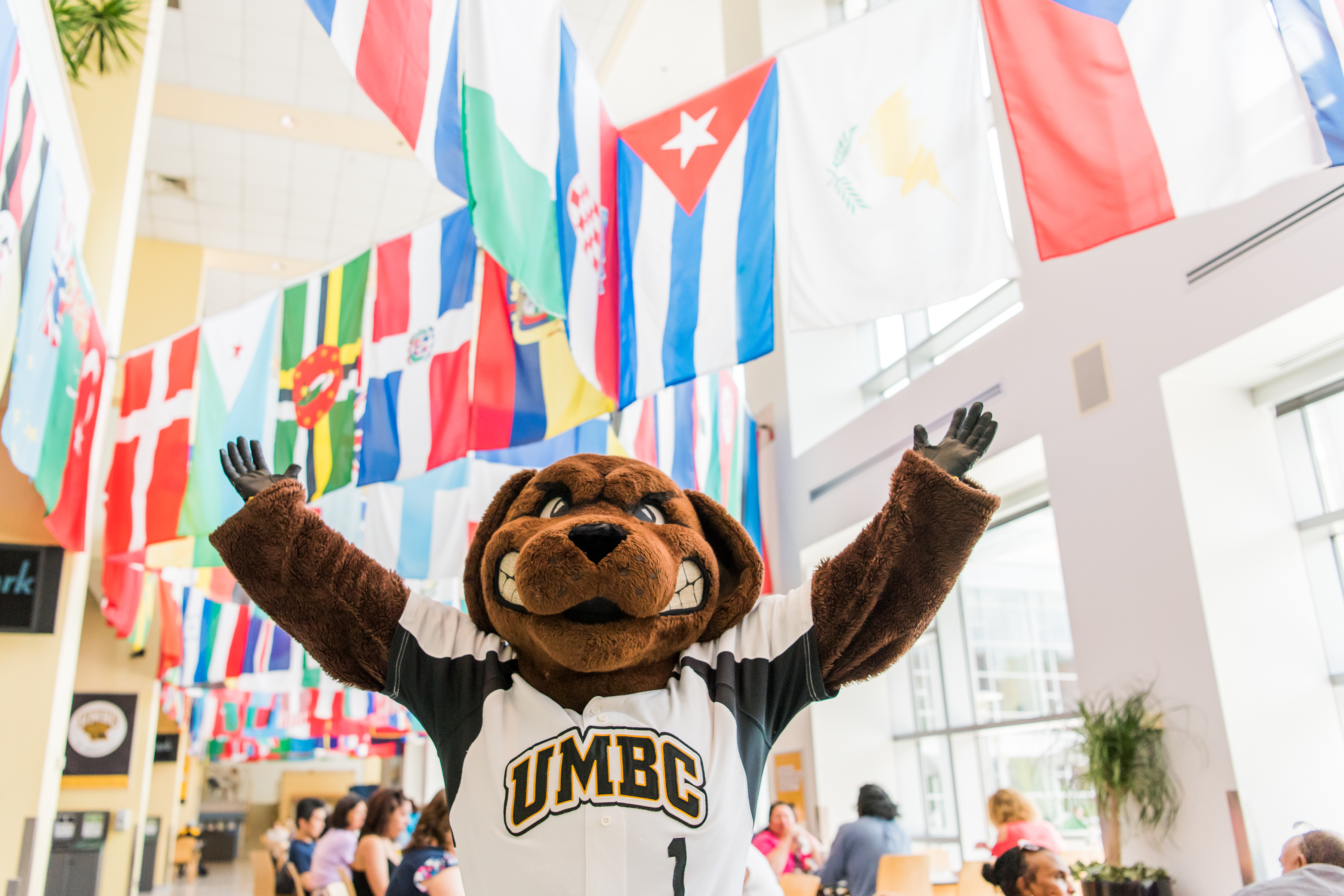
Featured image: International flags in the UMBC Commons. Photo by Marlayna Demond ’11 for UMBC.

UMBC welcomes Dana Bradley as new dean of the Erickson School for Aging Studies

Dana Bradley, the new dean of the Erickson School for Aging Studies, considers herself an accidental gerontologist. Many leaders in aging services are inspired to work in the field through personal experiences with family members aging, but Bradley’s interest emerged in the classroom. She began to pursue research on programs and services for older adults and their families as a graduate student through curiosity about big questions and a passion for innovation across disciplines.

“I knew I would always find an interesting job in the field of aging,” says Bradley. “I came to UMBC because the Erickson School’s focus is on leading and being on the edge through engaged scholarship with endless possibilities.”

Bradley holds a Ph.D. in applied history and public policy from Carnegie Mellon University and has served in faculty and leadership positions at the University of North Carolina-Charlotte and Western Kentucky University, where she directed the Center for Gerontology. At UMBC, in addition to serving as dean of the Erickson School, she is a professor of sociology, anthropology, and health administration and policy, and serves on the advisory board The Hilltop Institute, which focuses on healthcare policy.

Addressing the process of aging

Throughout her career, Bradley’s goal has been to help people understand the process of aging. “We are all aging,” she explains. “The better we understand how people manage life as they age the better products, services, and living environments we can create, with a lasting impact for our families and communities.”

This spirit of empowerment about how we think of aging led Bradley to become a founding member of the Global Aging Research Network and leader in the Age-Friendly Cities movement. In recognition of her decades of contributions to the field, she was elected a fellow of the Gerontological Society of America and the Academy for Gerontology in Higher Education.

Bradley is energized by the breadth of expertise in the Erickson School, and the opportunities available through UMBC ’s entrepreneurial and collaborative culture, and close proximity to Washington D.C. “The Erickson School covers a lot of policy issues and issues that are not related to long-term care,” she shares. “We are developing programs and research collaborations looking at how we support and maintain people as they age in the workforce, whether that may be out of choice or because they may not be able to afford retirement. We want to innovate solutions for a workforce that is engaged much longer than ever before.”

Calling all innovators

Innovation, engaged research, and collaboration all have one thing in common, Bradley points out — questions. “The questions are mind-boggling,” she says. It isn’t just how to serve an aging workforce that keeps her busy but looking beyond. Bradley believes, “This is a world where engineers, designers, coders, visual artists, musicians, writers, mathematicians, economists—you name it—they are all needed to design living, working, and transportation spaces that are responsive to how humans age. This is a collective question that needs answers from all fields.”

For the year ahead, Bradley is particularly excited about the Erickson School’s annual summit for leading researchers in memory care at Disney World. Even in the “Happiest Place on Earth,” Dr. Bradley is applying research to help create inclusive experiences. “This year we are focusing on creating environments which are supportive for people with dementia,” she says. “We are spending some time behind the scenes at Disney World, understanding how they as a company think about that issue with their guests.”

Whether it’s in the classroom, at an academic conference, or working with a company or a community, Bradley explains, “Our work is always about supporting engaged conversations to discuss aging given the resources and tools to plan and act accordingly, to be responsible and ethical citizens, to be engaged with people of many different ages in their lifetime.”

Banner image: Dean Bradley outside of the Performing Arts and Humanities Building. Photo by Marlayna Demond ’11 for UMBC.

UMBC’s McNair Scholars Program prepares the next generation of leading researchers

What does it take to be a professor? That is exactly the type of question the McNair Scholars Program wants students to ask early on in their undergraduate years. The national program prepares talented students who are first-generation and low-income, or from other underrepresented groups, for doctoral study. Over 200 McNair Scholars from UMBC and other universities across the nation recently gathered at UMBC for a McNair Scholars National Research Conference to share their work and connect with faculty mentors and each other.

The McNair Scholars Program was created in memory of Ronald E. McNair, physicist and NASA astronaut who lost his life on the Challenger mission. UMBC has carried on McNair’s legacy for 26 years through a highly active McNair Scholars chapter. Over 300 UMBC students have tapped into the academic, social, professional, and personal support the national program offers via workshops, trainings, conferences, and networking events. Students traditionally enter the program their junior year, but applicants are welcome to apply earlier so they can benefit even more.

The conference experience

As a first-time conference participant, Luwam Gebreyesus ‘19, health administration and policy, was in awe of the diversity of research and thought among her peers. “I joined my junior year and I wish I knew about the program earlier. I always knew that I would pursue a doctorate degree,” says Gebreyesus, who studies trauma and sound. “McNair has been a catalyst for opening my eyes to how much preparation goes into getting ready for a Ph.D program, connecting me to resources, and developing in me the agency to embrace being ambitious and successful.”

While the conference is a platform for UMBC student scholars to share their own research, it also offers them important opportunities to gain skills organizing and hosting an academic conference. Networking is also a fundamental part of the experience. Students value the opportunity to connect with peers with similar backgrounds, and also practice the skills involved in building professional relationships.

Blake Hipsley ‘19, physics and math, presented a poster on his research on different materials that can maximize imaging frequencies in fields like medicine. “Neither one of my parents earned a college degree. I didn’t have anyone I could relate to tell me how to get into graduate school,” says Hipsley. “McNair helped me access a network of people to help me develop research skills and manage the graduate school application process. Now I tutor other students in math to help them with their graduate school entrance exams.”

The impact of mentors

Mentorship is crucial to the success of McNair Scholars. Faculty, staff, and alumni can become McNair Mentors or Faculty Research Mentors, to support students as they navigate the graduate school preparation process.

Maria Sanchez, mechanical engineering, and director of education and outreach for the College of Engineering and Information Technology, was drawn to the McNair mission and offered inspiring words for the attendees as the keynote speaker. “As a woman in mechanical engineering, I always struggled with feeling out of place,” Sanchez reflected. “After I came to the United States to attend graduate school and became part of another underrepresented group, I understood that I have a responsibility to other women and Hispanics that are trying to do the same.”

Sanchez sees a direct link between faculty sharing their journeys and students feeling like they are not alone in a challenging yet rewarding path. “I know now that we need to embrace the differences that we bring and recognize them as assets and advantages,” she shared with the group. “I hope that by participating in events such as the McNair conference, I could give strength to those that are struggling in the same way that I did.”

The conference also offered an opportunity for faculty who were themselves McNair Scholars as undergraduates to share their journeys with today’s students. UMBC’s Earl Brooks, assistant professor of English, and Christine Hawn, assistant professor of geography and environmental systems, moderated a conference panel. “The McNair program was critical for me, and it was awesome to experience being on the other side of things as a faculty member,” said Brooks. “The conference is such a great opportunity for students to gain the experiences of presenting their research.”

Participating students also spoke to the profound impact that mentorship can have. Damarius Johnson ‘19, Africana studies, transferred to UMBC from the Community College of Baltimore County Essex, where he learned about the McNair Scholars and about UMBC as a place to help him prepare for his Ph.D. aspirations.

“I would not have been able to come to UMBC and be in this program if not for the fact that I had mentors who made it possible for me,” said Johnson. “If I can do that for other people that would be a very powerful thing because I am the first in my family to get a college education. The mentors have helped me see that my dreams are possible.”

Future scholars

As assistant director of the McNair Scholars Program at UMBC, Michael Hunt ‘06, mathematics, Ph.D. ‘25, language literacy and culture, sees the program’s impact both in the opportunities it creates for students and in the value of scholarship those students produce. “McNair scholars are doing important work in math, science, the humanities, and the arts,” he notes.

Hunt hopes to continue to grow the program and is working to connect with eligible students as early as possible in their UMBC careers. He emphasizes, “There should not be any student that limits their aspirations because they are unsure how to pursue a Ph.D. or because of financial constraints.”

Current and prospective UMBC students can learn more about the McNair Scholars Program by completing this brief interest form at any time. The application window is December 1 February 8. Faculty and staff interested in mentoring can contact program staff at any time through the McNair Scholars website

Banner Image: McNair Scholars induction ceremony with Peter DeCrescenzo, project coordinator (L))  and Michael Hunt, assistant director (right). All photos by Eric Stocklin.

Jasmine Abrams receives an NIH grant to reduce HIV/AIDS stigma in Haiti

UMBC’s Jasmine Abrams, assistant professor of psychology, is working to increase pregnant women’s access to healthcare and HIV prevention resources in Haiti through a $390,000 award from the National Institutes of Health via the Fogarty International Center. Abrams will focus on creating new ways to reduce HIV/AIDS stigma impacting low- and middle-income pregnant women in Haiti. The grant is part of a $3 million Fogarty International Center program focused on reducing HIV/AIDS stigma in six African countries, as well as Haiti, India, Nepal, and Ukraine.

“Poverty and HIV stigma of pregnant women in Haiti encourages women to avoid hospitals and have babies at home or in other locations without proper access to healthcare,” says Abrams. “This stigma results in increased risks for infant and maternal morbidity and mortality.”

Abrams further explains that due to HIV stigma, HIV positive women are less likely to access treatment, which can put them at greater risk of passing on HIV to their children and can make it harder for them to keep their viral load low enough to avoid transmitting HIV to their partners. To overcome these challenges, she says, the bottom line is that “we need to grant more access to quality prenatal and maternal healthcare.”

Foundational collaborations

Abrams has worked in Haiti since 2014, initially focusing on developing prenatal and maternal health interventions with the organization Midwives for Haiti. Her new multilevel intervention project continues her partnership with Midwives for Haiti, and forges new collaborations with the Haitian Ministry of Public Health, the Caris Foundation (a research organization), USAID, and Zanmi Lasante, the Haitian branch of Partners in Health and the largest non-governmental healthcare provider in Haiti.

Abrams in Haiti with members of the Haiti-based research team and the Community Advisory Board.

Abrams’ work in community-based health psychology is rooted in her goal to tackle the health disparities she has found in her research among Black women in the United States and abroad. “On almost every indicator of health, Black women are disproportionately impacted by various illnesses and more likely to die from chronic illnesses,” Abrams says. “I want to change this.”

An integral part of this grant is to improve healthcare access for Haitian women in the longer term by strengthening the capacity of Haitian researchers to collect, analyze, and report their own data. “The intervention will be developed by a group of Haitian HIV prevention experts, healthcare providers, and community members and will be used to train Haitian healthcare workers and community members to reduce, and hopefully eliminate, stigmatizing attitudes and behaviors,” says Abrams.

Jasmine Abrams (right) with Joanne Gaillard (left), project manager, and Denis Joseph Jean Baptiste (center), director of the Ministry of Public Health for the Central Plateau.

Building bridges across the Caribbean

Abrams also plans to foster structures that support Haitian-based research by establishing an exchange between UMBC faculty and students, and healthcare professionals and medical school students in Haiti, as well as other Caribbean countries.

Abrams has already taken steps to expand her work to other nations in the Caribbean, including the Dominican Republic and, most recently, Cuba. In the spring of 2018, she earned a Pedagogy and Teaching Award from UMBC’s College of Arts, Humanities and Social Sciences to travel to Cuba, where she received training in Spanish and Cuban culture and developed a course that examines the intersections of psychology and culture. Her new Psychology and Culture (PSYC 230) class in Cuba is scheduled to debut in  May 2019.

Banner image: Jasmine Abrams, psychology, in UMBC’s Academic Row. Image by Marlayna Demond ’11 for UMBC. All other photos courtesy of Abrams.

UMBC inaugurates new center to serve as hub for social science research

UMBC’s Center for Social Science Scholarship has opened its doors this fall with Christine Mallinson, professor of language, literacy and culture, as its inaugural director. The new center, which will promote faculty, student, and alumni research across multiple fields of study, is the result of many years of cultivating deep levels of scholarship on campus as well as collaboration and planning by the social science faculty.

“The Center for Social Science Scholarship answers a longstanding need at UMBC: to provide a hub, a connector, and a microphone for our extraordinary work on critical issues facing communities and societies today,” explains Scott Casper, dean of the College of Arts, Humanities, and Social Sciences (CAHSS).

The Center will emphasize areas of research such as civic and political participation, global patterns of labor and migration, educational access, the relationship between humans and the environment, human behavior and health equity across the lifespan, the social context of technology, and policy impact.

Mallinson, who joined UMBC in 2006, researches the context of and mechanisms involved in communication within major social institutions, including education, the workplace, and the legal system. By working with teachers, lawyers, and judges to better understand how perceptions cause bias, Mallinson’s has developed research-based strategies to remove inequalities and barriers.

“Christine Mallinson’s innovative, collaborative scholarship has influenced academic debates, informed policy, and empowered communities. I look forward to her leadership on behalf of UMBC’s social science research community,” says Casper.

Through her interdisciplinary work in language, literacy, and culture, Mallinson said she has immersed herself in multiple campus partnerships and experienced first hand the extent of dynamic social science research happening across UMBC.

Banner image (l-r): Mejdulene B. Shomali, gender, women’s, & sexuality studies; Carole McCann, gender, women’s, and sexuality studies; Christine Mallinson, director of the Center for Social Science Scholarship; Charissa Cheah, psychology. All images by Marlayna Demond ’11 for UMBC.

UMBC inaugurates new center to serve as hub for social science research

UMBC’s Center for Social Science Scholarship has opened its doors this fall with Christine Mallinson, professor of language, literacy, and culture, as its inaugural director. The new center, which will promote faculty, student, and alumni research across multiple fields of study, is the result of many years of cultivating deep levels of scholarship on campus as well as collaboration and planning by the social science faculty.

“The Center for Social Science Scholarship answers a longstanding need at UMBC: to provide a hub, a connector, and a microphone for our extraordinary work on critical issues facing communities and societies today,” explains Scott Casper, dean of the College of Arts, Humanities, and Social Sciences (CAHSS).

The center will emphasize areas of research such as civic and political participation, global patterns of labor and migration, educational access, the relationship between humans and the environment, human behavior and health equity across the lifespan, the social context of technology, and policy impact.

Mallinson, who joined UMBC in 2006, researches the context of and mechanisms involved in communication within major social institutions, including education, the workplace, and the legal system. By working with teachers, lawyers, and judges to better understand how perceptions cause bias, Mallinson has developed research-based strategies to remove inequalities and barriers.

“Christine Mallinson’s innovative, collaborative scholarship has influenced academic debates, informed policy, and empowered communities. I look forward to her leadership on behalf of UMBC’s social science research community,” says Casper.

Through her interdisciplinary work in language, literacy, and culture, Mallinson said she has immersed herself in multiple campus partnerships and experienced first-hand the extent of dynamic social science research happening across UMBC.

“What I am most excited for with the Center for Social Science Scholarship is the ability to spotlight the depth and breadth of the social science research that our faculty and students commit to on a daily basis,” says Mallinson.

MIPAR grant workshop.

As part of these efforts, current social science programming—such as the research-based events and assistance offered by the Maryland Institute for Public Policy and Research (MIPAR), and the Social Science Forum lecture series—will be housed in and managed by the Center for Social Science Scholarship. Located in the Public Policy building, the center will also serve as a partner in connecting and sharing key insights and perspectives of social science alumni and community partners.

Mallinson sees this collaborative work as a continuation of UMBC’s values and commitment to applied research. “This is an opportunity at a pivotal time in our country,” she says, “to tackle some of the big picture questions that are significant in the social sciences, but that also have applicability to other fields, are relevant across UMBC, and matter to our communities.”

Featured image: Christine Mallinson. All photos by Marlayna Demond ‘11 for UMBC

As Lakeland sees continued gains in math scores, UMBC expands local school partnerships

Teachers at Lakeland Elementary/Middle School celebrated another year of impressive gains in math performance when Baltimore City published the Partnership for Assessment of Readiness for College and Career (PARCC) standardized test scores on August 28. UMBC’s Sherman STEM Teachers Scholars program was by their side to celebrate, as the team enters the sixth year of a comprehensive partnership that includes transformative professional development with math teachers.

UMBC staff and students have been working alongside Lakeland teachers to build a model for success that can be replicated at other schools through the Zone Math Project. Teachers at Lakeland Elementary/Middle regularly meet to analyze and utilize data from PARCC, other summative school-based assessments, and curriculum and classroom-based assessments to improve student learning.

In these professional development sessions, Lakeland teachers articulate a data story for each student. The profiles inform teachers as they develop individual plans for enrichment, extension, and support. These discussions also guide how to structure planning time and the development of lesson plans to meet individual needs.

Professional development success

Carly Harkins, a fifth-grade teacher at Lakeland and a 15-year veteran of Baltimore City Public Schools, sees great value in taking all the information she has at her disposal to create individualized success plans for her students. I was able to see, in a very visual and concrete way, which students understood major content, which students were successful at problem-solving, and, conversely, which students had gaps in those areas and, as a result, create actionable plans.”

What is even more cause for celebration is that Lakeland is not alone in its success. In the past year, this model of support has expanded to Mary Rodman Elementary and Liberty Elementary, both in Baltimore City. The three Zone Math Schools have experienced an average annual growth of 7.5 percent in PARCC math scores. Over the past two years, Lakeland’s scores have improved by 11.7 percent. Over the past year, Liberty’s scores moved up 4.3 percent and Mary Rodman, which experienced the fastest growth in the region, saw scores increase by 14.6 percent.

Josh Michael ’10, political science and education, assistant director of UMBC’s Sherman STEM Teachers Scholars Program, attributes this growth to two things. “Teachers are the key lever to student success in the classroom,” Michael says. “By developing their vast skill set in data analysis and engaging in changes to classroom practice, teachers can facilitate learning that creates a strong foundation for long-term success.”

The Zone Math Project will expand to James McHenry Elementary School, Federal Hill Preparatory School, and Maree G. Farring Elementary School over the 2018 – 2019 academic year.

Inside the classroom

Creating individualized learning plans for students can pose challenges, but teachers in the Zone Math Project have found successful approaches.

Emily Phillips, a third-grade teacher at Mary Rodman Elementary, describes this process: “With three groups of students, I taught the main concept to the entire class,” she says. “The class then went into differentiated learning groups. The highest group worked on advanced and independent problem-solving with critical thinking, often multi-step problems focusing on the standards-based lesson.”

This progression in a math lesson allows students to have multiple opportunities to learn information, evaluate it, share it, and create with it, minus the fear of failure. Through the Zone Math Project, teachers also aim to increase the time that students are engaging in material. Students are placed in fluid groupings and receive ongoing feedback about their growth, allowing them to gain confidence and move between groups depending on the skill they are working to develop.

At the core of this work are the goals of creating more pathways to success for teachers and students, and making sure they feel supported in their growth. Teachers have noticed exciting results not just in test scores, but also in their classrooms.

“Students began to step up and take ownership of their work from start to finish. This was where I saw the most progress with students,” says Phillips. “Motivation and participation sky rocketed.”

Featured image: UMBC Hour of Code. All photos by Marlayna Demond ’11 unless otherwise noted.