All posts by: Anna Lee '22


Non-Linear Paths to Leadership

Francisco Cartagena describes his academic journey as unorthodox. Now an employee for the City of Gaithersburg, Cartagena started his educational path as an undocumented student. While charting numerous challenges, Cartagena ’19, political science, M.P.S. ’22, cybersecurity, also found ample opportunities for growth along the way, becoming an effective leader of social change at UMBC at The Universities at Shady Grove.

Cartagena arrived with his family from El Salvador as a preteen. In 2009, he graduated from high school and set out to Montgomery College to pursue his associate’s degree in general studies—a goal that would take him a decade to accomplish because of his legal status. There, Cartagena joined the college’s Latino Student Union and together they advocated for the Maryland Dream Act—a statute that would allow undocumented high school students to pay for in-state college tuition.

“That experience really exposed me to the political science environment and how policy, with momentum, people, and activism, can actually be changed,” says Cartagena, who hopes eventually to leverage his role in local government to share the message that there are many attainable pathways to and through higher education.

Finding his momentum

Prior to the Maryland Dream Act’s passing in 2012, Cartagena was paying the international student rate for community college classes. To him, pursuing a bachelor’s degree seemed like a faraway dream.

“There were some instances when I couldn’t attend school or when I could only attend one class,” reflects Cartagena. “But it gave me that momentum to say, ‘I’m just going to keep at it.’”
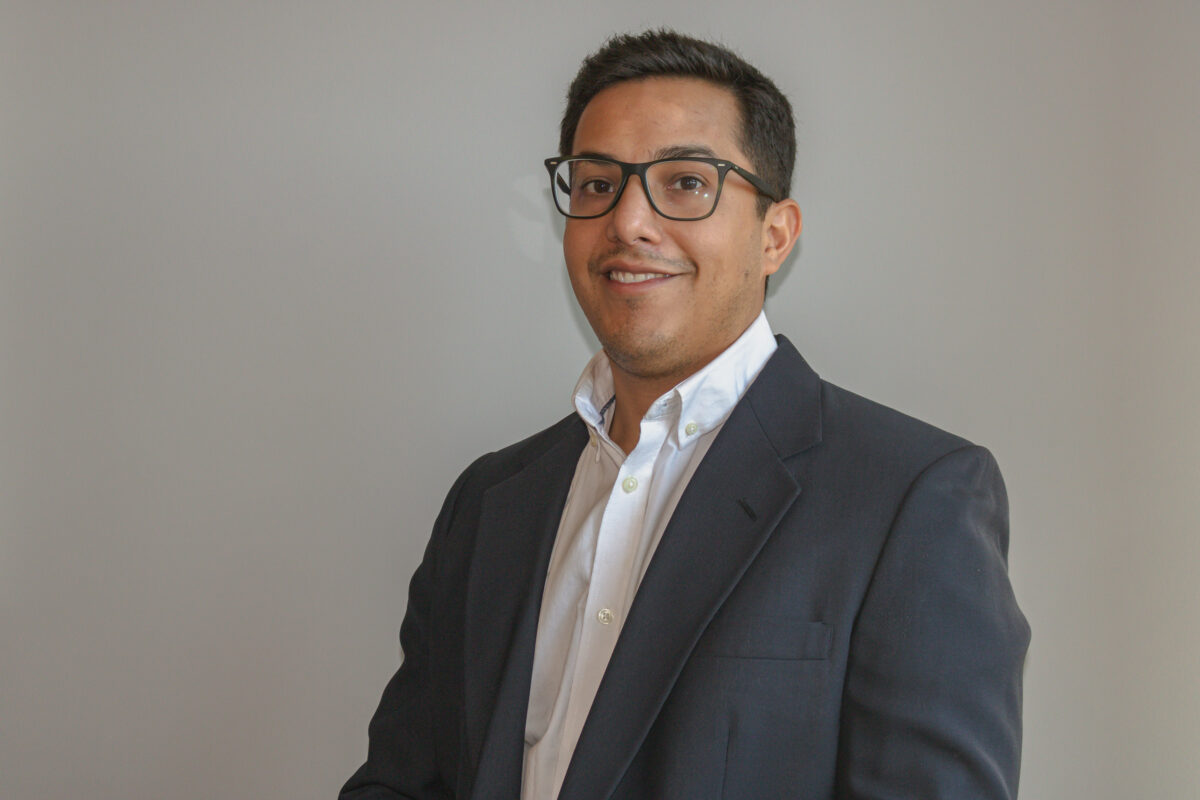
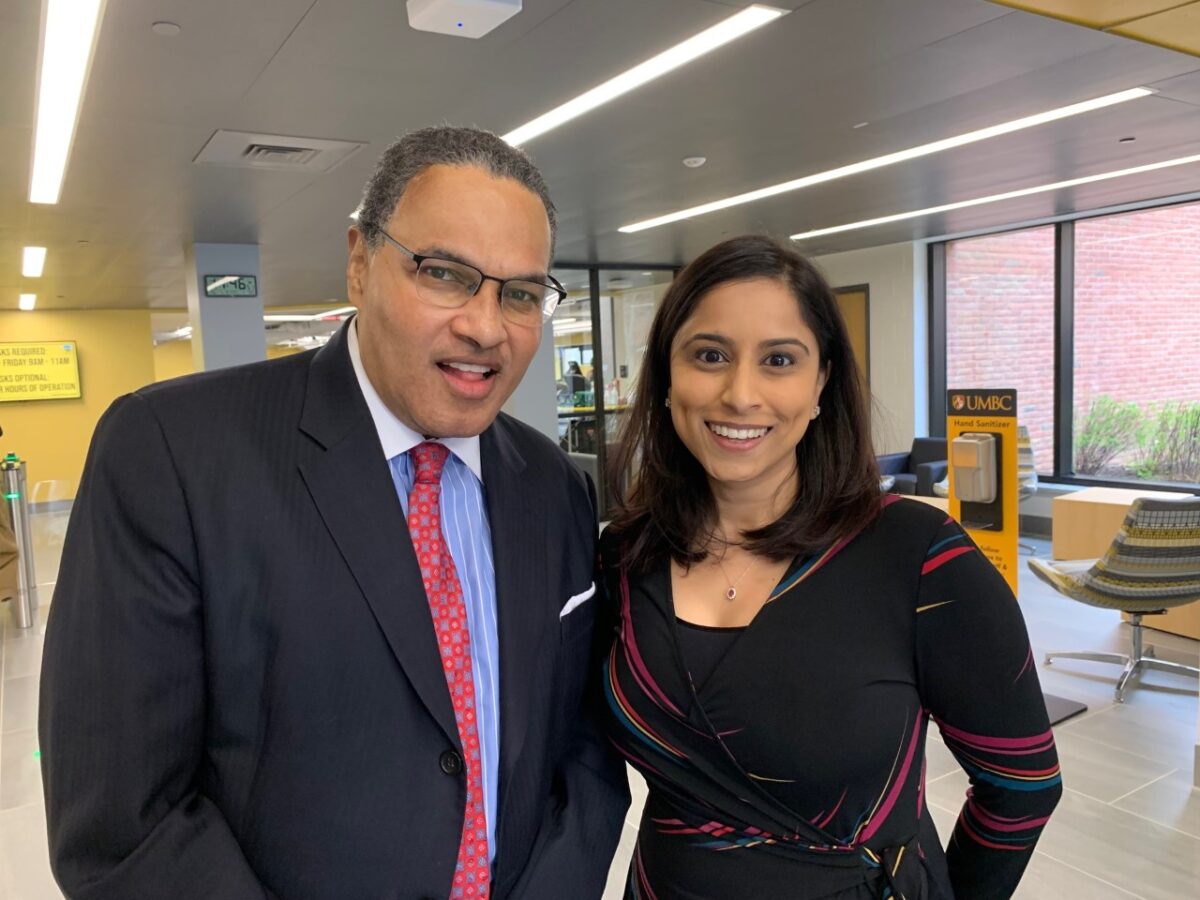
A man wearing glasses and a suit smiles at the camera.

At Montgomery College, Cartagena learned about the UMBC-Shady Grove campus and its political science program. As a full-time working adult, he believed that UMBC-Shady Grove would be a good fit. With an extra push from his wife Cora Trelles Cartagena ’12, social work, Cartagena reached out to Sunil Dasgupta, political science program director and professor at UMBC-Shady Grove, to find out more.

To Cartagena’s surprise, Dasgupta asked a question that would sell him on applying: “Why do you think you can complete this program?” Motivated by the challenge, Cartagena pushed forward and eventually proved that he would do more than succeed—he would lead.

“Francisco is somebody that intuitively knew the importance of politics in transforming and changing our lives,” says Dasgupta. “I think part of the reason that happens is because he comes from an immigrant family. When you’re in that position, you quickly realize you have to master this if you want to help yourself, your family, and your community.”

An uplifting environment

Cartagena saw The Universities at Shady Grove (USG) as a place to practice his role in politics. As one of two students representing UMBC on the Student Government Association’s executive board, he learned more about the funding process at USG, the development of programs on campus, and the ins-and-outs of university partnerships.

“When you have an environment with multiple people from different schools, you can truly see the different backgrounds, their intent, and how people process things,” Cartagena says.
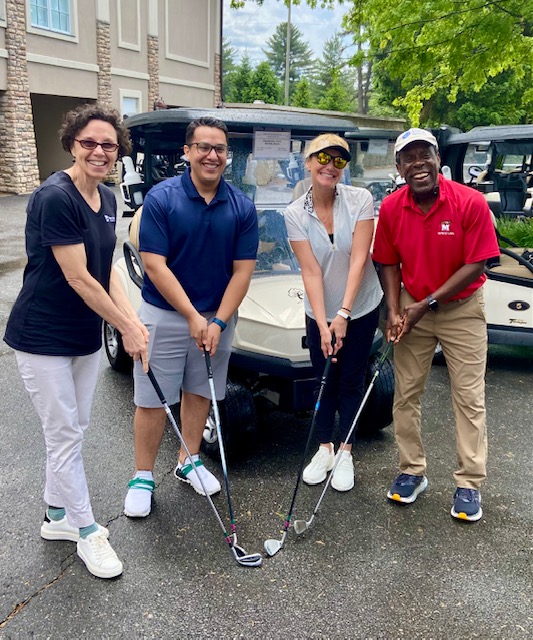
Four smiling people in tennis apparel stand in a semicircle, holding their clubs in front of them.
From left to right: Anne Khademian, USG Executive Director; Cartagena; Crystal Townsend, President & CEO of Healthcare Initiative Foundation; Kevin Beverly, Chair of the USG Board of Advisors.

When Cartagena attended USG’s job fair and spotted a table for Congressman Jamie Raskin’s office staffed by a fellow Latina, he saw a vision for his future. “At the time, a career in government or interning for a government official was so far-fetched, whether because of my status or my prior experiences. It was something I would just dream of,” explains Cartagena, who wound up spending the summer splitting his internship between Raskin’s Rockville office and his congressional office on the Hill—two experiences that propelled his career in government.

“I still pinch myself because I’m a first-generation immigrant who came here from El Salvador with my parents…To be able to represent the county I grew up in—it was a bunch of mixed feelings that were finally culminating into something very positive,” says Cartagena.

In 2018, Cartagena started with a role in the City of Gaithersburg’s human resources department and in 2021, transitioned to his current role as an I.T. project manager. Now, he oversees applications, business needs from different departments, and processes in the technology sector.

Continuing to lead

In 2019, as a master’s student studying cybersecurity at UMBC-Shady Grove, Cartagena continued his ongoing involvement on campus, joining the Graduate School Council and USG’s Advisory Board.

During his final year in the program, Cartagena received a phone call from Dasgupta, who was creating an interactive bot to help Maryland voters identify political candidates most aligned with their values. He hoped that the bot, along with his podcast, I Hate Politics, would serve as informative tools. But realizing that a significant portion of the county was Spanish speaking, he enlisted Cartagena’s help.

“The first person I called was Francisco. And it wasn’t a small job; it was pages and pages of translation,” Dasgupta says, adding that they only had about a couple of weeks to complete the project before elections began. Still, Cartagena took on the translation task without hesitation.
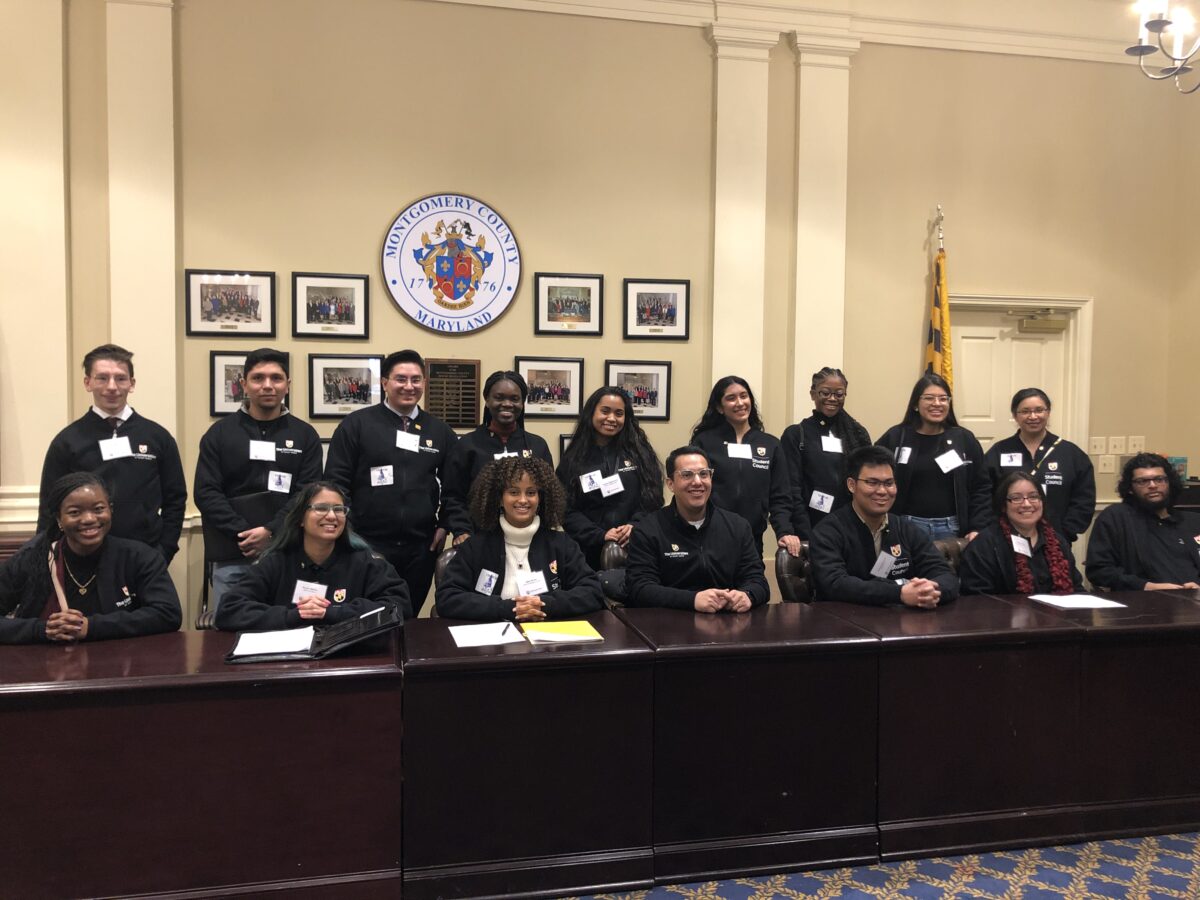
Cartagena and the USG Undergrad and Graduate Student Councils attend the State of Maryland House Appropriations meeting to advocate for the funding of USG by the State.

“That kind of collaboration uplifts UMBC and the community,” notes Dasgupta. “We continue to work with our students and alumni, and those interactions are very revitalizing. We find meaning through those relationships.”

Cartagena notes he wouldn’t have made it this far without the resources and opportunities he found at UMBC-Shady Grove. “If there was a change I could recommend, it would be showing students and adult learners that there are other pathways for you to get that Ph.D., get that bachelor’s, or get that associate degree,” says Cartagena. “I think oftentimes students are afraid; it’s an investment of money and time, and you don’t know if you’re going to make it through…but you will find your niche if you stick it out.”
Carrying on a Philanthropic Legacy

Behind every story of giving lies a story about someone’s generosity. For Hema Gowda01, biological sciences, this story was about continuing a generational legacy through philanthropy. 

“My mom came to this country in the late ’60s, and education was a huge foundation for her in propelling her forward,” says Gowda, a Prince George’s County native who works in pharmaceutical research. 

“When she retired, she set up endowments at [The University of Maryland,] College Park in the name of her parents because they were the ones that pushed her for higher education. She is the person she is today because of them…So I’d always been inspired by that and wanted to give back to UMBC because it was the foundation for my career.”

UMBC’s Alumni Endowment Scholarship Fund presents the perfect opportunity for alumni to give back to the university by directly contributing to the success of students in their undergraduate years. In Gowda’s case, the fund allowed her to follow in her mom’s charitable footsteps by establishing the Gowda Scholarship Endowment for UMBC in 2016 (and a similar scholarship at the University of Maryland School of Pharmacy in 2015) to help students interested in pursuing graduate studies in pharmacy find success at UMBC.

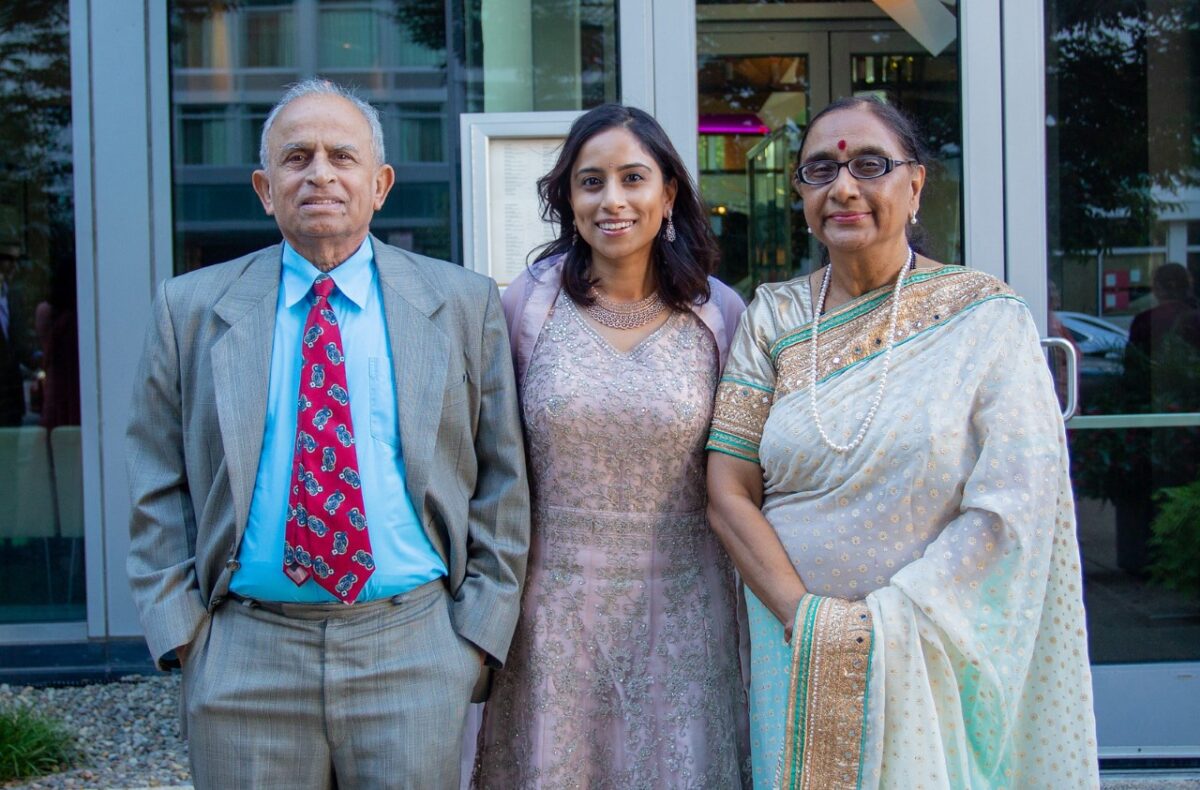
three family members together
Hema Gowda ’01, center, shares a moment with her parents, Mrs. Vijayalakshmi and Dr. Kusumadhara Gowda. (Image courtesy of Gowda.)

Defining her path

Even as an undergraduate, Gowda knew she wanted to give back to her alma mater, but it took her longer to decide what she really wanted to study at UMBC. When it came to deciding a major, she wanted to pursue the sciences after having been involved in a science and technology program at Eleanor Roosevelt High School. But even after deciding that certain routes like medical school were not for her, it took more steps to narrow down what path called out to her most.

Gowda applied to the University of Maryland School of Pharmacy in her senior year at UMBC and entered the next stage of her academic career. Prior to graduation in 2005, she caught sight of a posting for an editorial internship at the American Society of Health-System Pharmacists —an experience that would eventually lead her to a medical writing position at a medical communications agency in the Philadelphia area the following year. There, Gowda collaborated with pharmaceutical and biotechnology companies to help develop their clinical trial publications and scientific communications for products that were marketed or in development.

After about five years at the agency, Gowda joined the biopharmaceutical company, Incyte, and gained experience in the company’s medical affairs and clinical development groups. This latter opportunity allowed her to take advantage of the communication skills and clinical expertise she had gained through her previous positions and educational experience.

In April 2020, a month into the pandemic, Gowda started her new position as a global development scientist director at AstraZeneca. 

“I collaborate with colleagues from many other functions to execute registrational clinical trials in lung cancer. We conduct the trials globally, and gather and submit data for regulatory agencies in hopes of getting new drugs approved for different types of cancers,” explains Gowda.

Gowda’s journey down multiple routes in pharmacy has shown that taking the time to figure out the right path was not at all a setback. Even if it took a bit longer for her to settle on the research route, Gowda did not regret any of the experiences she had gained along the way.

“Each segment of my career helped define my path a little bit better,” Gowda puts it.

Freeman Hrabowsi and Hema Gowda, a man and a woman, stand together
Gowda, right, chats with UMBC president Freeman Hrabowski. (Image courtesy of Gowda.)

Reconnecting to her foundations

The Gowda Scholarship Endowment, open to students interested in pursuing a career in the pharmaceutical sciences, gives preference to students who graduated from a Prince George’s County high school or current residents of the county. On top of wanting to give back to the school system that helped build the foundation for her career, Gowda hopes the scholarship will benefit students who are juggling their responsibilities in the D.C. region.

In describing the time during the pandemic when she met virtually with her first scholar, Adam Kouyate 22, biological sciences, Gowda says, “[My scholar] was brimming with excitement…and to me, it’s a small amount, but I know it’s a lot for them. And maybe 10 or 20 years from now, that might inspire them to do something similar.” 

“Because of this scholarship, I was able to work less hours during the school year and focus more on classes and finding myself.”

– Adam Kouyate ’22

The scholarship lifted a huge burden off Kouyate’s shoulders during a period of burnout. At the time she applied, Kouyate was working at a music store to help pay her tuition. Because she wanted to cover most of the tuition costs on her own, the scholarship allowed her to do so with only $200 coming from her parents. Kouyate was extremely grateful to have been chosen as a scholar, as it also meant she no longer needed to turn to student loans.

“Because of this scholarship, I was able to work less hours during the school year and focus more on classes and finding myself. Though I did end up switching from pharmacy to nursing, this scholarship gave me the peace of mind to focus on what I really wanted to do with my life,” says Kouyate.

Kouyate graduated from UMBC this past spring and will be attending the University of Maryland School of Nursing’s Master’s-Level Entry-Into-Nursing Clinical Nurse Leader program in the fall. 

A second recipient of the scholarship, who graduated from Eleanor Roosevelt High School, is also currently studying at UMBC with plans to pursue a graduate degree in pharmacy.

Setting up lifetimes of success

Gowda’s connection to UMBC isn’t just limited to the endowed scholarship, but can be seen through her interactions with friends from her undergraduate days, connections to relatives interested in attending UMBC, and sponsored events such as the Endowed Scholarship Luncheon that is hosted annually at UMBC.

Now and moving forward, Gowda hopes to echo a legacy of giving that has been modeled by her mother as well as inspired by familiar faces at UMBC. Most importantly, she is eager to pass on a future of giving to her scholars—a future that may consist of trial and error, but also with valuable experiences along the way.

“It’s the gift that I want to keep giving, and I can only hope that this small amount for a semester or a year sets them up for a lifetime of success.”

UMBC Responds to Putin’s War in Ukraine

On February 24, just one day after a Russian holiday celebrating the “defenders of the Fatherland,” Russian President Vladimir Putin ordered his military forces to invade Ukraine. The ensuing assault catalyzed a mass of destruction and action. 

In the classroom of Kyiv-born Vira Zhdanovych, an instructor of Russian at UMBC, students are using their language skills to take in information from different perspectives. Zhdanovych notes that both her students and colleagues from the Department of Modern Languages, Linguistics, and Intercultural Communication (MLLI) reached out to her during the first days of the invasion and have been extremely supportive since.

“Like everyone, I have been very upset and confused by Putin’s invasion of Ukraine,” says Zhdanovych. “This was especially difficult for me because I am from Kyiv and have relatives who were forced to evacuate. Fortunately, my immediate family—my sister, niece and nephew—have made it out, though my brother-in-law remained behind to defend Kyiv. I also have many friends who are still in Kyiv and in surrounding areas and I worry about them each day.”

Additional faces and voices of those impacted have since risen to the surface through several virtual UMBC town halls that highlight Ukrainian American voices as well as faculty experts on the region. 

UMBC professors and students share their expertise

In the early weeks following the initial invasion, UMBC’s Center for Social Sciences Scholarship, History Department, and the Political Science Department hosted a virtual discussion about the history leading up to the current crisis, as well as the political and economic impacts that it is having today on surrounding countries and globally. Present at the panel were Devin Hagerty and Brian Grodsky, professors of political science and affiliate faculty in Asian studies, and Mirjam Voerkelius, assistant professor of history. Joining them were three undergraduate students who shared their personal experiences and reactions to the current climate in Ukraine.

Meredith Oyen

Maria Kutishcheva ’24, political science and MLLI, shared that the conflict has had a devastating effect on her family. With relatives in both Ukraine and Russia, Kutishcheva talked about two sides of the crisis from a personal standpoint, mentioning the divisions that have been deepened by Russian propaganda. She ended her story on a compelling note: inaccurate portrayals of the war cannot keep up with reality, but Ukraine still needs our continued attention and support.

Although it can be difficult to absorb everything that has happened leading up to the crisis, the Retriever community is fortunate to have students and faculty who can provide insight on the subject. Many people, especially those with personal ties to the situation, have been deeply affected and wish to stay informed through their communities—a desire that was again met by UMBC’s second virtual discussion about Asia’s influence on the Russia-Ukraine War in mid-March. 

Brian Carlson, head of the Global Security Team of the Think Tank at the Center for Security Studies, returning panelists Brian Grodsky and Devin Hagerty, and Meredith Oyen, associate professor of history and director of UMBC’s Asian studies program, led the discussion and helped answer attendees’ questions about global relations across Asia and Europe. Carlson opened up the discussion by describing Russia’s ties to China.

“China has played an important, enabling role in Russia’s actions in Ukraine. China and Russia have built a close partnership based on a common desire to oppose the United States in aspects of the existing international order,” says Carlson. “In early February, just weeks before the invasion…they issued a joint declaration in which they said their partnership had no limits and there were no forbidden areas of cooperation.”

Although, he adds, “China has probably been surprised by the ineptitude of the invasion and by the fierceness of the Ukrainian resistance.”

Grodsky, the chair of the political science department, was next to share his expertise about Central Asia’s response, or lack thereof, to the Russian invasion of Ukraine. “Not surprisingly,” Grodsky notes, “Central Asia has been neutral in its reaction to the invasion. Russia expected a lot more support than it got, but this really reflects a long-standing foreign policy to balance stronger powers in the region.”

Grodsky, expanding on an earlier article he wrote about economic sanctions on Russia, added that economic links were becoming more difficult for Central Asian countries to maintain with Russia. These sanctions, he stated, would likely lead to political instability in the region.

Ongoing conversations provide support

Broad conversations about geographic implications of the Russian military aggression combined with personal stories of Ukrainian displacement and resistance are ongoing and they won’t end soon. Students, staff, and faculty, including Zhdanovych and those present at the panels, are speaking from personal and informational standpoints to put a face to the people who are struggling and fighting in Ukraine. But Zhdanovych points out that we also shouldn’t forget about those in Russia.

“I think that it is important to emphasize that not all Russians—particularly those in the U.S.—support this invasion. I know many, many Russians in the greater community and do not know of one who supports this invasion. I think of this as Putin’s invasion of Ukraine, rather than Russia’s invasion,” Zhdanovych says.

With this mindset moving forward, we can strive to build networks of support and to grow together as multiple communities all impacted by this crisis. Though the future ahead remains uncertain, there is strength in the voices and actions that stretch across and beyond UMBC.

UMBC supports Ukrainians: If you’re interested in supporting Ukrainian students, scholars, and artists at risk, UMBC’s Center for Global Engagement recommends giving to an established organization, like IIE.” In April, President Biden announced a new initiative to support Ukrainians. Welcome.us, an organization of which UMBC is a member, has created a new website that contains information about this initiative as well as various ways to help Ukrainians.

******

Header image: Photo on Pexel by Mathias P.R. Reding

The Spirit of Giving

With the newly surging pandemic in 2020, UMBC’s Stay Black and Gold Emergency Fund quickly became a strong source of financial assistance for students and families in need. Poulomi Banerjee ’16, M.P.P. ’21, recalls the moment during last year’s Black & Gold Rush Giving Day when all U.S. states and territories made a donation to UMBC.

Banerjee was just in her first year as the assistant director of Annual Giving when she witnessed firsthand the impact giving could have on students. The 2,782 people who generously donated that year were a testament to that fact. Although the year had also been challenging for her, Banerjee saw that everything she had gone through to plan UMBC’s giving day was worth it to plan and experience something so unforgettable.

“It’s really nice seeing the number of donors keep increasing year after year…It means that people are really invested in the community and they believe in UMBC, and that in turn helps me believe in the university more as well,” Banerjee says.

A Retriever foundation

Outside of yearly Black & Gold Rush activities, people in the UMBC community often give back to the university by donating to programs and scholarships they believe in. Through her role in UMBC’s Annual Giving office, Banerjee embodies the spirit of giving and paving the way for growth at UMBC.

After receiving a bachelor’s in health administration and policy in 2016, Banerjee decided to stay at UMBC to pursue a master’s in public policy while working as the development and alumni coordinator in the university’s Office of Institutional Advancement (OIA). Just before finishing her master’s degree in May 2021, she took on her new position in OIA. As a current Ph.D. student in public policy, Banerjee has to balance both her student and leadership roles at UMBC.

“It’s so hard to wrap my mind around how incredible UMBC is going to be in fifty more years knowing how incredible it is now. It might be unusual to have three degrees from one school, but I wouldn’t change anything,” says Banerjee. 

Staying at UMBC after her undergraduate studies ignited Banerjee’s love for the institution and helped cultivate her passion for public policy and its applications to the nonprofit world. Her commitment to community engagement first began in high school, when she founded a service learning program for high schoolers to engage in conversations about healthy relationships. During an internship in college, Banerjee took the opportunity to oversee the same program. From there, she knew she was passionate about connecting to people in the UMBC community. Developing the necessary leadership skills to do so was just the first step.

While Banerjee attended the SGA-led leadership retreat, STRiVE, during her undergraduate years, she befriended people who taught her how she could make change on both the community and university level. Through her participation and leadership in clubs such as seb and SGA, Banerjee eventually discovered OIA and learned about ways she could contribute to the university as an alumna.

In her first OIA position as the development and alumni coordinator, Banerjee planned alumni receptions across the country and, after her first year in the role, created a plan to turn the events into what is now the RetriEVER Grateful Tour. When Banerjee joined the Chapter of Young Alumni and eventually stepped into the role of vice president, she ran the chapter’s social media account and helped oversee event planning for the chapter’s annual Wine Tasting & Silent Auction fundraiser, a networking event for alumni to reconnect with others in the Baltimore community.

Through these previous experiences with working with and for alumni, Banerjee has learned the importance of networking—a skill that she still finds crucial in her current role involving alumni engagement and fundraising. 

Making a tangible impact

Banerjee’s work as assistant director of Annual Giving involves supporting campus communities through fundraising, including crowdfunding and other forms of student organization fundraising. She interacts with students to help them figure out their organization’s goals, determine how much money is needed to support their endeavors, and brainstorm ways to raise the money. 

Although the task of asking for financial support is not always an easy one, Banerjee mentions that her own background as a student has equipped her with a helpful perspective when reaching out to people in the UMBC community.

“I feel like donations are everyone’s biggest fear when they graduate. They don’t want to hear from me and they don’t want to be asked for money. And I get it—I graduated with loans from UMBC…so when someone emails me back saying ‘I have loans, I can’t give,’ I totally understand. And it’s really helpful for me to talk to them from that perspective,” says Banerjee.

Banerjee with her friend and fellow alumna Emma Muccioli ’14, media and communication studies.

For every person who is able to make a contribution, Banerjee and her colleagues make an active effort to stay connected with them and remain transparent about where their donations are going. During Black & Gold Rush activities, for example, people can make online donations to programs or communities they want to see grow.

“It’s an honor when people do give us their philanthropy, and we have the responsibility to help them know how those dollars are working,” says Greg Simmons, M.P.P. ’04, vice president for Institutional Advancement and someone who Banerjee considers a mentor.

Headshot of Simmons

Tackling a whole new world

Taking on a new role would have been a daunting task for many, but Banerjee dove head first into the unknown. While noting that she didn’t have much fundraising experience prior to the position, she brought up how Simmons believed in her abilities to lead.

“When I asked her to take the role she’s taking now, it was clear to me that everything that everybody had said about her was true,” says Simmons, who has worked at UMBC for more than 25 years. “She was incredibly smart and a fast learner…She throws herself into the work and is not afraid to ask questions. She has a passion for this place, which is so exciting. She tells you the truth, even if it’s sometimes hard for her. And I think the last thing is that she’s got this extraordinary optimism. She’s a realist, but she sees what’s possible with things.”

Simmons is not alone in his praise of Banerjee’s skillset. After her outstanding work with the Stay Black & Gold Emergency Fund in 2020 and 2021—from creating applications for students during the pandemic to overseeing the application reviewal and awarding process—she was awarded the 2022 Rising Star Award this spring for the Council for Advancement and Support of Education (CASE) in the mid-Atlantic district. This award is given to professionals who exhibit leadership potential in various areas including philanthropy and alumni relations. 

Simmons adds that Banerjee’s dedication took center stage during Black & Gold Rush in 2021. From navigating a different technology platform, scaling and communicating the program, and making sure people could easily make contributions online, Banerjee played a pivotal role in getting the fund off the ground on a hard and fast deadline.

The gift of giving marches on

This year, Black & Gold Rush will take place for 36 hours spanning February 16 to 17. In celebration of President Freeman Hrabowski’s retirement from and commitment to UMBC, Black & Gold Rush will feature a new initiative, the Freeman A. Hrawboski, III, Endowment for Student Excellence fund.

“The great thing about Black & Gold Rush is that it is not about how big the gift is. It’s about how many people are involved. So you don’t need to make a $500 gift to make an impact. You can make a $10 gift and still make an impact,” notes Banerjee.

Banerjee at the 2019 Giving Day event.

Moving forward, Banerjee has high hopes for the future of UMBC and is thrilled to take her skills and connections to wherever she may go next. With a particular interest in the nonprofit world, Banerjee is excited to see how she can continue building on what she’s learned as a three-degree Retriever.

“I feel like UMBC helped me get to the point where I will have several doors open for me when I finish this last degree, and I’m going to figure out what that means for me when I’m there,” Banerjee says.

“Poulomi is gaining skills and tools through the things she’s doing, but she’s already got all the ability and wisdom that she needs to be successful in a whole range of opportunities in the future,” says Simmons. “So I can’t wait to watch and see where she ends up.”

******

All photos by Marlayna Demond ’11, unless otherwise noted.

Finding Your Voice in Fanfiction

Headshot of Sauro by Marlayna Demond ’11.

Your favorite heroes are joining forces to fight Thanos in Avengers: Endgame. Suddenly, you watch as one by one, they are dropped off on Sesame Street in New York City. You’re seeing the story unfold on the page because you’re creating a merged universe as an exercise to enhance your English language skills. What will happen next? Only you know.

This interplay of fanfiction in language learning and instruction is what Shannon Sauro, associate professor of education and faculty member in the Teaching English to Speakers of Other Languages (TESOL) program at UMBC, strives to showcase in her reading and writing courses. (Indeed, one of Sauro’s students proved that they could merge the Avengers and Sesame Street into one universe for a fanfiction project.)

Fandoms exist in numerous forms, whether related to movies, TV shows, novels, music, video games, or other aspects of pop culture. But how is it relevant to teaching and learning? As Sauro explains, quoting fan studies scholar Mark Duffett, a fan is “someone who has a strong, positive emotional connection to someone or something famous.” Her students come from different backgrounds with these connections under their belt, which makes it easier for them to form an emotional connection to the work as it unfolds. This ultimately helps them gain new language skills.

Learning for fun

Prior to moving to the U.S., Sauro lived and taught in Sweden, where she noticed that many students used fanfiction to develop their English language skills. These students took part not only in consuming media in English, but also discussing this media in their own fandom communities. 

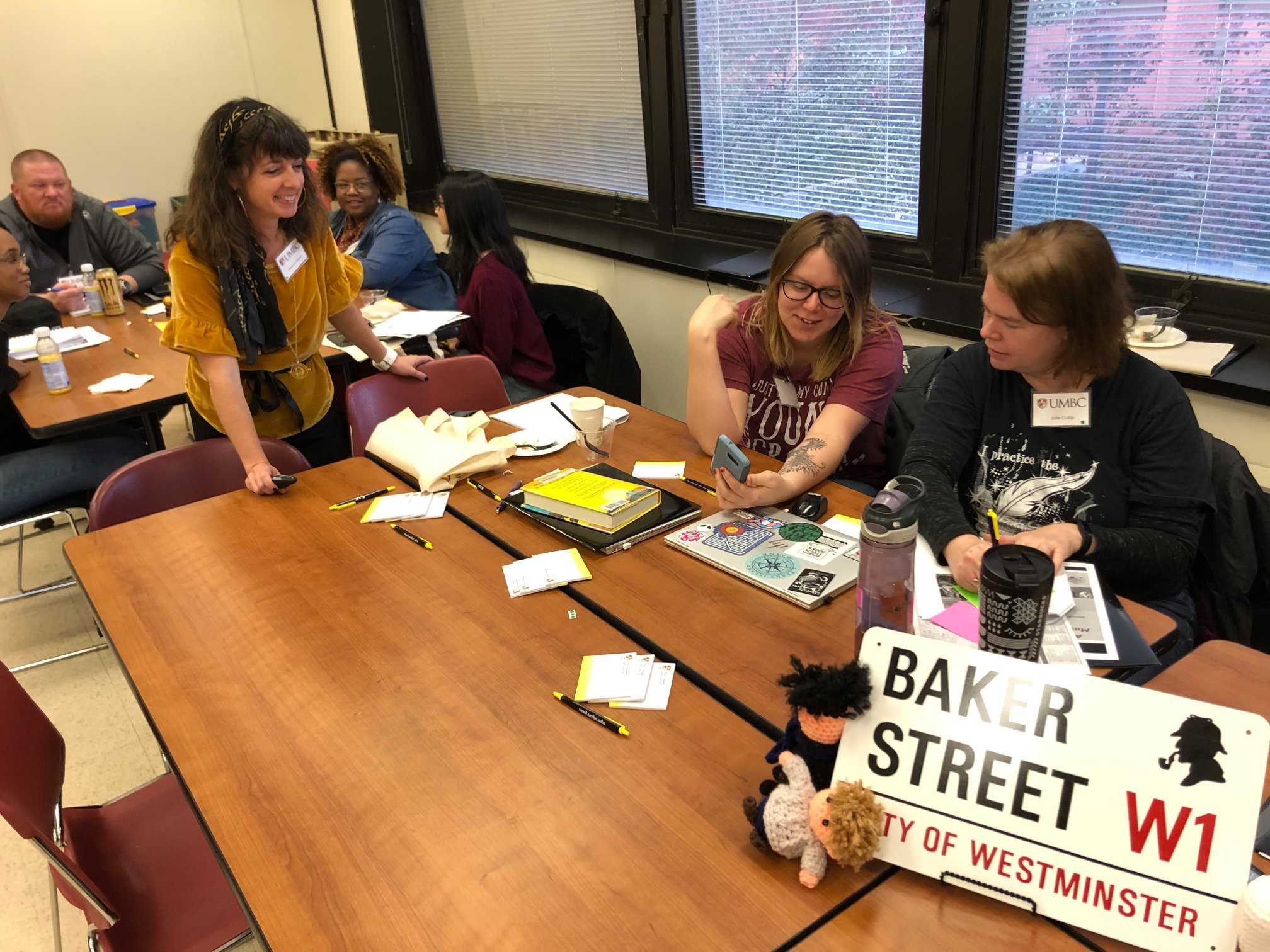
Maryland language teachers take part in a workshop on fanfiction for foreign language teaching held by the UMBC TESOL program in November of 2019. Photo courtesy of Sauro, standing.

“We can see different cultural attitudes around fiction writing, and I found this refreshing in Sweden because in the Swedish national curriculum, they emphasize the learning of foreign languages not just for work, but also pleasure and the consumption of cultural products [and] self-expression,” shares Sauro. “So writing fanfiction is something you do with language. It’s not considered frivolous or not academic.”

In the U.S., this integration of fanfiction into language learning may not look as familiar to students and instructors. But fanfiction can enable students’ creativity while building on necessary reading and writing skills.

Gaining appreciation for the craft

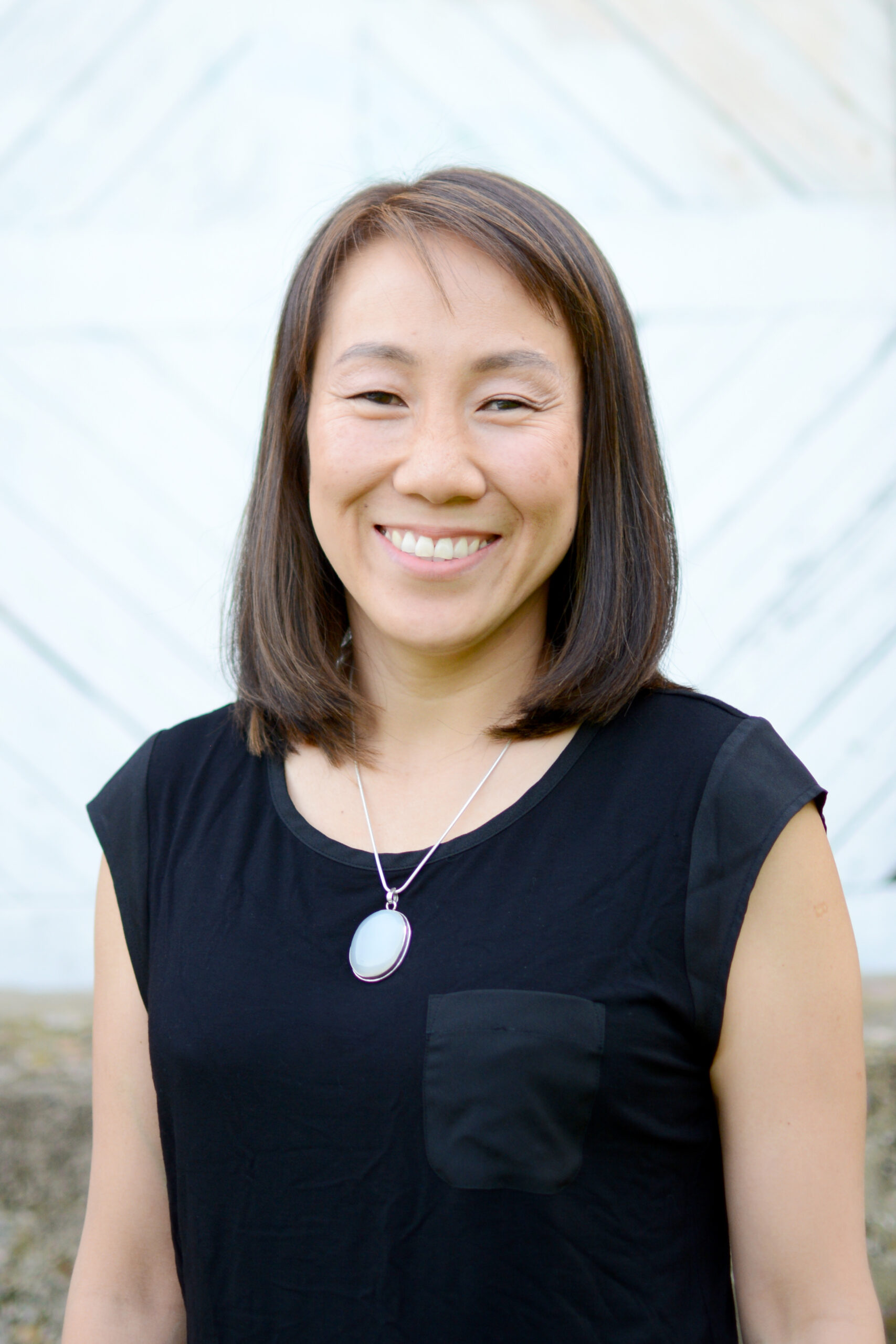
A headshot of BB Kim
Headshot courtesy of BB Kim.

Language-learning classes often stress the importance of reading and analyzing canonical texts to hone skills. But fanfiction allows students to play around with literary tropes, dialogue, plot, and character development—all within the context of their favorite fandom. BB Kim ’22, a TESOL graduate student, would have never guessed that she’d be writing about the Disney film, Frozen, for a fanfiction project in Teaching Reading and Writing to ESOL/Bilingual Students.

As an ESOL instructor herself, Kim saw the potential of fanfiction to engage students in fun, creative ways. But that didn’t mean she wasn’t skeptical at first about the idea of rewriting the plot of an existing movie.

Kim’s realization arrived only after she finished writing her take on Frozen. With a single click, she published her story on a fanfiction website for a real audience to read and leave comments on (imagine if Elsa embraced her powers from the start instead of hiding them away!). Kim wasn’t expecting her work to receive such attention, but seeing it on the website gave her an undeniable sense of accomplishment. 

Kim was especially appreciative of Sauro’s clear and organized instruction, as the students weren’t pushed into the realm of fanfiction without preparation beforehand. “I feel like it was a nice brain break from taking classes that are more theory-based… So it was definitely memorable,” says Kim, adding that Sauro’s teaching style has served as a model for how she conducts her own classes.

Finding yourself in the story

Sauro asks her students to interpret an author’s writing style and incorporate it into their own. Elements like structure and word choice require attention to linguistic detail, making the study of fanfiction quite the endeavor. 

The three-country project, FanTALES, in which Sauro was a contributor, has set out to tackle just this. With the collaboration of researchers and teachers from Sweden, Belgium, and Germany, the project has materialized as an online platform providing learning materials to students and instructors. What sets it apart from traditional language education is its emphasis on storytelling (i.e., fanfiction and interactive fiction), digital literacy, and multilingual avenues of learning and interacting with other language users. Students are given a platform to creatively and critically express their identities and perspectives through writing.

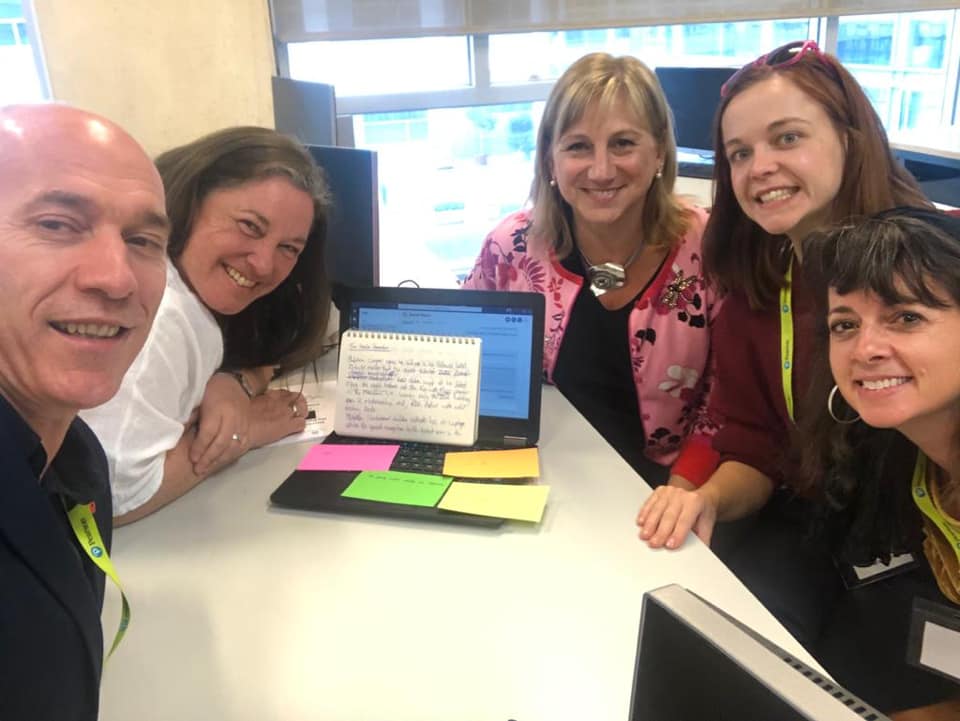
Dr. Sauro alongside participants in the FanTALES workshop
Language teachers and trainers participate in the 2019 FanTALES workshop held in Valencia, Spain, as part of the International Conference on Intercultural Learning in the Digital Age. Photo courtesy of Sauro, right.

“By inviting students to either play with the text, transform it, put themselves in it, or merge it with something they actually like, it gets them more engaged and involved with the text and more likely to commit that time to it,” says Sauro, who incorporates materials from FanTALES into the fanfiction project she assigns to students. Even after the students have written and published their stories, she asks them to reflect on the choices they made throughout the writing process. The bigger takeaways that some students gain reveal the value of personalized storytelling.

“I think for me the takeaway is don’t be afraid to do something different… Don’t be afraid to shy away and be creative and allow students to learn in different ways—to be flexible, to be open-minded,” says Kim.

What Sauro hopes for her students, in addition to increased language skills, is to recognize how they can write themselves into a text to express their truths and experiences. 

“Often when working with language learners, or young people in general with any different background, you can see that there are certain texts that get reified and selected as a canon, but they don’t represent all the lived experiences in society or in the classroom,” says Sauro. “And fanfiction is a way to give students a voice to talk back to that text, to correct that text, and to write themselves into the canon, into the literature, and into the media that their society or their classrooms celebrate and value.”

******

Header image: Sauro connects with a student in her office. Photo by Marlayna Demond ’11.