
All posts by: Tanzila Malik '26


Retrievers gone global: 5 ways UMBC fosters international engagement

As International Education Week 2025 comes to a close, we’ve rounded up a few of the many ways Retrievers engage globally through their work and studies. Even though it has been a particularly trying time for international students, “…more UMBC students studied abroad in Academic Year 2024 – 25 than ever before. Our students are discovering new perspectives, building global connections, and transforming their futures through these life-changing experiences,” says Katie Heird, director of education abroad and global learning at UMBC. Here are a few ways international students and Retrievers who have gone abroad play a role in the lifeblood of UMBC.

1. Who is Fulbright material?

UMBC’s six 2025 – 2026 Fulbright U.S. Student Program recipients share their not-so-secret recipe for success. Deciding to apply for a Fulbright is just the first step, and with the support of UMBC’s Center for Global Engagement, which hosts Fulbright information sessions in the spring for undergraduate, graduate, and recent alumni. Retrievers can apply to earn a master’s, conduct research, or be an English Teaching Assistant in more than 160 countries. With the UMBC 2025 – 2026 Fulbrights already settled in Taiwan, Norway, and Indonesia, Belgium, Israel, and Germany, these alumni are eager to share tips to inspire and prepare the next generations of Fulbright Retrievers.

Four Fulbright college students stand together inside a building on a blue balcony
UMBC’s 2025 – 2026 U.S. Fulbright Program class. (Brad Ziegler/UMBC)

Additionally, this year, four UMBC faculty and staff members received highly competitive Fulbright U.S. Scholar awards to teach, conduct research, and foster cross-cultural connections globally. The recipients span all three UMBC colleges and comprise three faculty members and one staff member. The UMBC awardees are connecting with international partners in areas of shared interest. Augusto Casas, an associate teaching professor of information systems, is working in Colombia; Cynthia Wagner, a teaching professor of biological sciences, went to Kyrgyzstan; Irene Chan, a professor of visual arts, is in Romania; and Tom Penniston, M.A. ’09, TESOL, Ph.D. ’14, language, literacy, and culture, the coordinator of learning analytics in the Division of Information Technology, is working in Croatia.

2. Building intentional international connections

A six-person UMBC team built international connections at the “PIWOT – World of Technology” conference, held in early 2025 in Mumbai, India. The science and technology conference is organized by the alumni association for graduates of the prestigious Indian Institutes of Technology (IITs), and attracts many of the leaders in science and technology in India and around the world. The CEO of Alphabet, Inc. (Google’s parent company), the co-founder of Sun Microsystems, and the CEO of IBM are all graduates of IITs. 
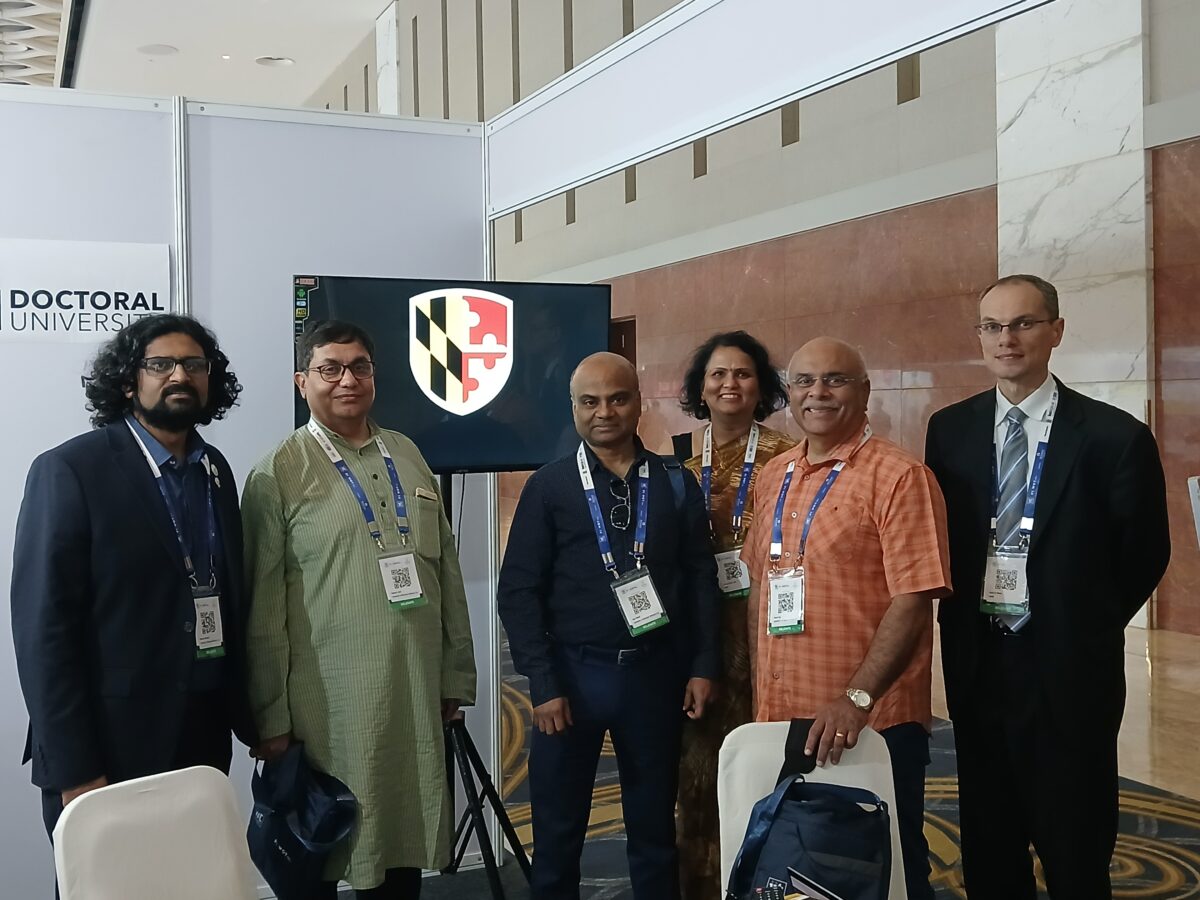
Group of six people at conference booth.
UMBC PIWOT attendees (l-r): Ramana Vinjamuri, associate professor of computer science and electrical engineering and director of the NSF IUCRC BRAIN Center; Joshi; Upal Ghosh, professor of chemical, biochemical, and environmental engineering; Karuna Pande Joshi, professor of information systems and director of the NSF IUCRC Center for Accelerated Real Time Analytics; Govind Rao, director of the Center for Advanced Sensor Technology and professor of chemical, biochemical and environmental engineering; and David Di Maria, associate vice provost for international education at UMBC. (Photo courtesy of Karuna Pande Joshi)

This year’s PIWOT conference focused on the impact of technology across multiple dimensions of life, from the professional to the personal. UMBC’s Anupam Joshi, acting dean of the College of Engineering and Information Technology, took part as a speaker on a panel about the impact of technology on education, and the UMBC booth also displayed the low-cost infant incubator developed by Professor Govind Rao.

3. International research collaboration challenges assumptions

Thanks to funding from the German Academic Exchange Service, Lorenz Kopp and Björn Michelmann, mechanical engineering students from Germany’s Regensburg University of Applied Sciences, came to UMBC to conduct research with UMBC’s mechanical engineering professor, Paris von Lockette. The project was part of a bigger assumption-questioning enterprise—in particular, probing the behavior of materials called soft magnets. Kopp’s and Michelmann’s advisor at Regensburg University of Applied Sciences knew von Lockette through the American Society of Mechanical Engineers, and together they arranged the details of the two-month visit with the help of the Office of International Students and Scholars at UMBC. 
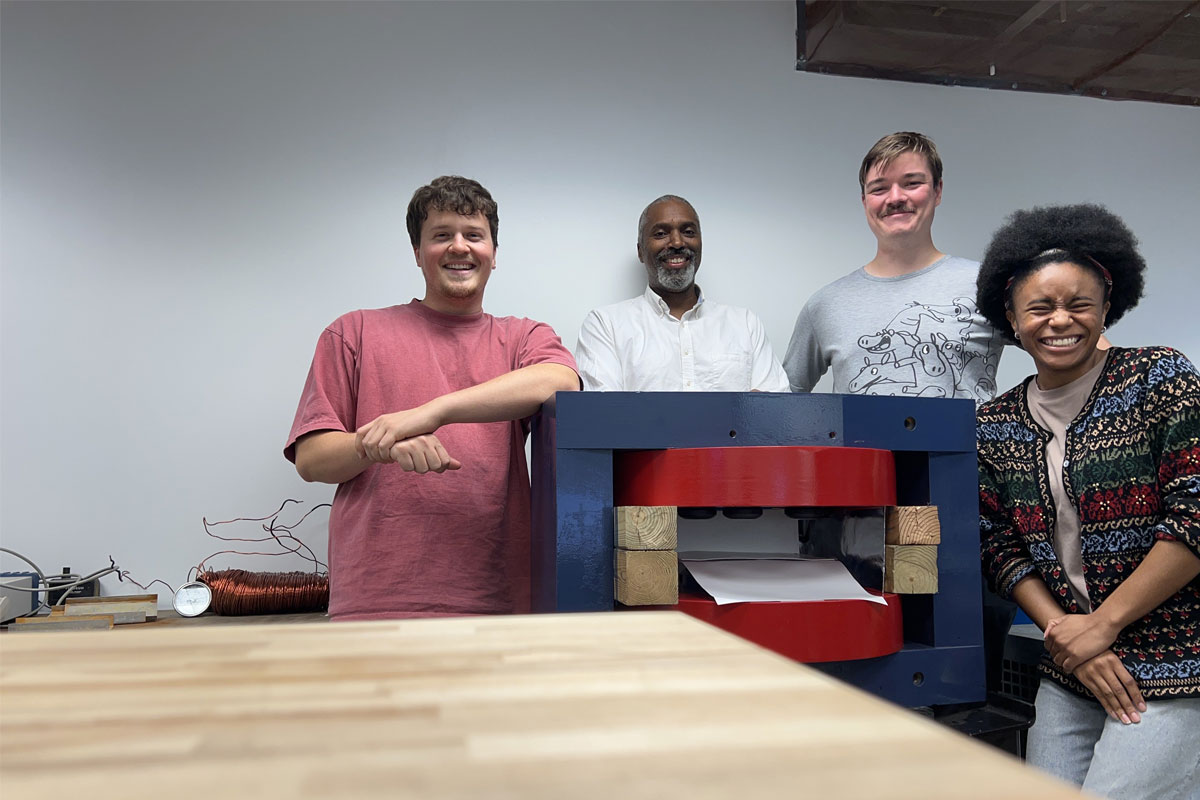
Four people pose in lab near structure with large metal components (magnet).
(l-r): Lorenz Kopp, Björn Michelmann, von Lockette, and Tamia Bowers ’23, mechanical engineering, with the electromagnet they set up in the lab. (Brad Ziegler/UMBC)

While Kopp and Michelmann spent plenty of time in the lab during their visit, they also had chances to explore the areas surrounding UMBC on weekends. They visited the National Aquarium in Baltimore, took in a Baltimore Ravens football game, and drove to Shenandoah National Park in Virginia. They also enjoyed campus life, attending Homecoming weekend, and regularly visiting the Retriever Activity Center to work out.

4. Exploring politics in a global context, virtually

Professor Filomeno’s 2024 Collaborative Online International Learning (COIL) Brazil project on climate change equips students with the technical and interpersonal skills to thrive in professional online international and intercultural environments. COIL makes international scholarship and intercultural learning accessible by removing barriers of cost and travel while preparing students with essential skills for future in-person exchanges. COIL Brazil was part of Filomeno’s Global Citizenship class in collaboration with former colleague Clarissa Dri, a professor of international relations at his alma mater, the Federal University of Santa Catarina, in southern Brazil.
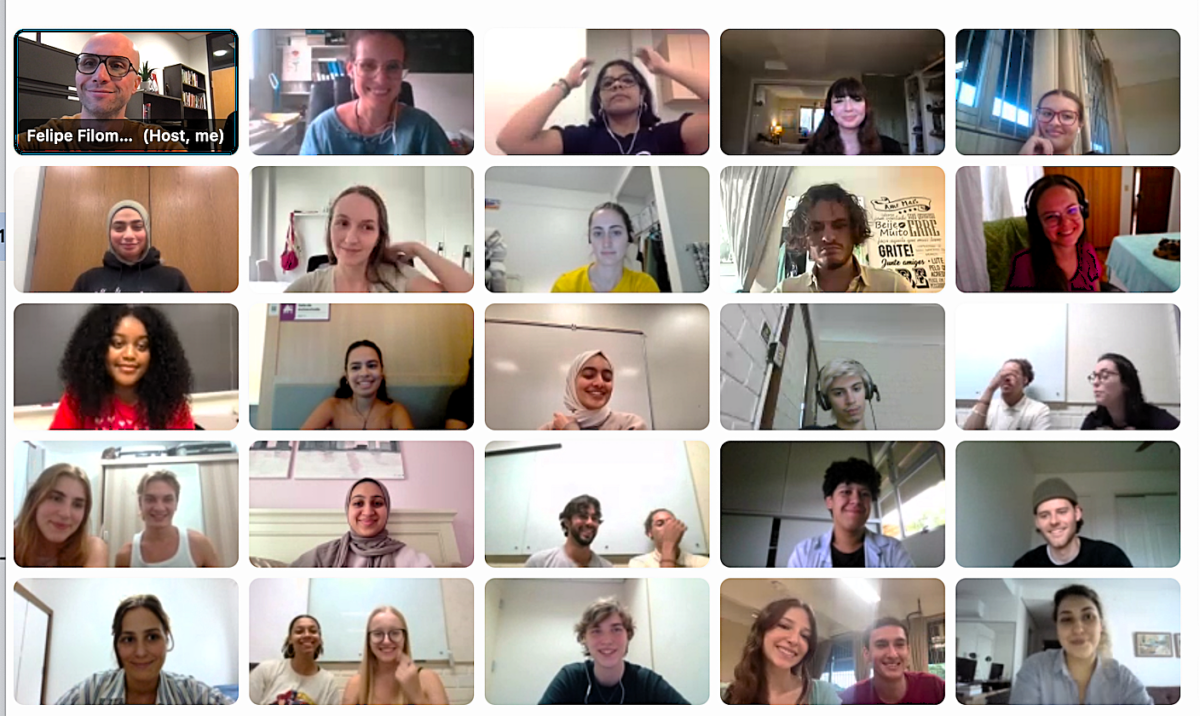
Squares of students meet in a zoom room for global engagement.
COIL Brazil met online so that students from UMBC and the Federal University of Santa Catarina in southern Brazil could participate. (Image courtesy of Felipe Filomeno.)

The ongoing Virtual Tandem Conversation project was created by Susanne Sutton, a teaching professor of German, and Talke Macfarland, a visiting lecturer of German in UMBC’s Department of Modern Languages, Linguistics, and Intercultural Communication. They established the program during COVID-19 to help UMBC students learning German and German students learning English socialize while continuing to improve their language skills.

The actual tandem meetings are entirely student-driven and take place outside of the classroom—each tandem pair arranges virtual meetings according to their schedule. Tandem participants have gone beyond the virtual classroom, such as UMBC Golden ID Program student Rebecca Smith, who, while on a recent trip to France, hopped over to Germany to visit Gertrud Krause-Traudes, her partner in UMBC’s Virtual Tandem Conversation project. After three semesters of virtual conversations in German and English, Smith was happy to meet Krause-Traudes in person.

5. Science that bridges two worlds

In 2020, as the COVID-19 pandemic disrupted lives worldwide, Greema Regmi began her Ph.D. in UMBC’s atmospheric physics program. Studying remotely from her home in Nepal, she navigated a grueling schedule due to the time difference. Now in her fifth year, Regmi’s perseverance has earned her NASA’s prestigious Future Investigators in NASA Earth and Space Science and Technology (FINESST) fellowship, which will provide up to $50,000 annually for up to three years to fuel her research on atmospheric dust.

woman points at research poster while speaking to another person pinned to a corkboard
Greema Regmi discussed her research at a recent poster session at UMBC. (Brad Ziegler/UMBC)

Regmi has been able to accomplish so much in part because of the supportive community she found at UMBC, after finally arriving on campus in fall 2021. Regmi’s journey bridges her unique perspectives as a student in Nepal and the U.S. At UMBC, she’s embraced broader opportunities. “I think here you can push the limit. I don’t even know what the limit is in the U.S. Here you can dream more and be more experimental,” she observes.

Grounded in the UMBC physics department’s community of support, Regmi’s confidence has only grown since her arrival in Maryland. “There’s always a place for my opinion, which is very nice. Because of that, and all of the experiences I’ve had, now I have the confidence to start my own project,” she explains. “And that’s why I think now I’m confident to go back home, lead something there, and be helpful in some small way.”


Learn more about UMBC’s international opportunities.

Fine Arts gets a facelift

Strolling through campus, you might have noticed the blend of architectural styles, with a strong leaning toward brick brutalism (nicknamed “brickalism”), normalized in the 1960s; a typical look for a chemistry or engineering building. But you’ve probably wondered why the Fine Arts building doesn’t look so “artsy”?

From the outside, it may appear like a stereotypical late 60s/early 70s college building. But inside, you’ll find brilliant creative minds hard at work, taking photos, painting, or rendering animations. Now, thanks to UMBC’s new Arts+ initiative, a public art installation by the Cheeky Magpie Collective—made up of more than 20 alumni and current UMBC artists—is transforming the windows of the first four floors of the Fine Arts Building. The bold colors and patterns give visitors an idea of the artistic processes and world-expanding learning that’s going on behind the facade.

“The Fine Arts Building was really integral to our development, not only as designers but as growing students, and now alumni. All the effort we put into this design is a direct reflection of how amazing all the people in the building are,” says Thomas Hammond ’25, design, a member of the artist collective.

Funding for creative endeavors

This fall, UMBC launched Arts+ to celebrate and connect our vibrant and multifaceted arts scene throughout campus and with the region. Through this initiative, funding was allocated for a public art installation. The Cheeky Magpie Collective’s pitch to install a window treatment on the Fine Arts Building, where many of them spent most of their undergraduate career, was accepted. Collective members Gwen Knott ’25, design, and Jayden Rhodes ’25, design, were the lead designers of the project, with administrators Jalen Boyd ’25, design, Hammond, and Ni Truong ’25, design.

“I taught with the students who are now the Cheeky Magpie Collective in one of our capstone design classes,” says Kelley Bell, M.F.A. ’06, imaging and digital arts, the visual arts coordinator for Arts+. “It’s almost magical to see what we at UMBC have taught them in action. This was a fantastic opportunity for visual arts and UMBC to shine and give visitors to the campus and our UMBC community a new way to see our campus.”

Two people talking outside a brick building with colorful abstract window designs in yellow, pink, and black.
Fine Arts Building with new vinyl decals (Photo by Jordan Fisher, courtesy of Cheeky Magpie Collective)

Members of the collective say that by showcasing the Fine Arts Building in an attention-calling way puts a crack in the perception of UMBC as “just a STEM school,” bringing the groundbreaking art by UMBC students and faculty out into the light. The building and the faculty working inside were “great creative inspirations to the collective as student designers,” says Hammond. The art installation highlights this creativity, becoming a beacon of encouragement and inspiration for emerging artists.

A meaningful mark

Close-up of a window mural with yellow wavy lines and pink circles on a dark background.
Cut vinyl decal on the Fine Arts building windows (Photo by Elijah Agurs, courtesy of Cheeky Magpie Collective)

“I knew this project would be perfect to support a group of alums who are doing something exceptional in forming this collective,” says Bell who was the coordinator and art director for the job, “but the design and thinking behind that design was all theirs,” she adds.

“It felt like we were able to really contribute to the university and leave a meaningful mark on what arts can do for a community and how we can use it to build up our already pretty great university,” says Boyd.

The visual style is a fusion of different inspirations, selected for their use of pattern, color, repeating motifs, and geometric and organic forms. The primary inspirations were the Arquitectonica style, and artist Sol LeWitt’s wall drawings which are characterized by their bold use of color and form and exacting geometric precision, and finally, in line with the modern influences of UMBC, the Memphis and post-modern style which was emblematic of the 1980s.

While the design was handled by the members of the Cheeky Magpie Collective, the print and installation was done by the UMBC Facilities Management Sign Shop on cut vinyl.

“UMBC is about the community,” says Truong. “It just makes you feel like it’s home because they’re always trying to give back and looking to support local companies and businesses like the Cheeky Magpie Collective. And this is our way of giving back.”

Sherman Hall’s Phase 1 renovation is complete, creating space for creative collaboration

The west wing of George and Betsy Sherman Hall is open to students and staff again after 18 months undergoing extensive renovations and modernizations. While the renovation on the building’s east wing (adjacent to Academic Row) begins in earnest this semester, west wing residents are settling into their colorful and versatile office set ups and classroom spaces.

Walking into the Sherman Hall atrium, a floating staircase dominates the entryway, but if you take a right and a left and walk past a few brightly colored sitting areas, you’ll find the new offices of Division of Undergraduate Academic Affairs (UAA) and Academic Transition Programs. It’s no longer just the offices of ATP, it’s now also home to the Individualized Study Program (INDS) and the University Innovation Alliance (UIA) as well.

Relocation inspires collaboration

With this exciting new phase for campus, comes disruptions to some normal operations. Laila Shishineh, a new resident in Sherman Hall’s office suites, and the assistant vice provost and assistant dean for UAA, understands the disruption better than most. Shishineh and her team were relocated two years ago because of the renovations to temporary offices that were shared with them by the Academic Success Center. Now as they settle into their new office space—shared with two offices who await their new space in the east wing—Shishineh celebrates the infrastructural improvements and also the new opportunities for collaboration that weren’t possible before.

Under a plan developed by Shishineh alongside Facilities Management, ATP, UIA, and INDS, the new suite space in Sherman Hall’s west wing will be shared by these offices, with hoteling space available for days when employees overlap. This collaboration of 17 people allows flexibility for people to work in the office some days and work from home on other days.

This physical proximity to other departments allows for unique opportunities of collaboration between them. “It’s so nice to have a suite space,” says Shishineh. ”People get to build new relationships and support each other in different ways as opposed to just being ‘doors in a hallway’ somewhere on campus.”

As a former resident assistant in college, Shishineh thought of creating an office-mate agreement, based on the concept of a roommate agreement. Across the three departments, people were paired up based on schedule, personalities, and types of roles. A meet and greet was held so everyone could get to know their officemate, and outline an agreement. The agreements include everything from what days each person is working in the office or from home, to how much shelf space they each get.

Student-centered design

Desk with two storage baskets labeled "Welcome 'Home' Jose!" and "Welcome 'Home' Tim!"
Shared office of Tim Olivella (ATP) and Jose Arenas Gómez (INDS). (Kayla Logue/UMBC)

The new physical structure of Sherman Hall not only allows for more collaboration among the faculty and staff working there, but also for students. A noticeable difference in the layout is the student-centered design: with plenty of collaborative spaces including lounges, conference/study rooms, vending machines, and TVs broadcasting events happening on campus.

“I hope it becomes a place where students come not just for classes, but to hangout, study, and congregate,” says Shishineh. Improvements have also been made to make wayfinding easier in Sherman Hall, since the two wings make some things difficult to find. New signage, room numbering, general space layouts and color-coding help everyone more easily find their way to the other occupied offices in the west wing, including the George and Betsy Sherman Center, which is home to the umbrella of programs that help train up teachers in urban schools that will transform lives in the communities they serve.

A feature to look forward to is the courtyard between the east and west wings of Sherman Hall. This multi-tiered green space with new ramps and stairs will provide gathering places and outdoor classroom opportunities at each level when the entire renovation is complete.

Construction and cost, with a mind for sustainability

At the beginning of the project, UMBC evaluated tearing down Sherman Hall and rebuilding it, versus a significant renovation. It was determined that the structure was still very solid and the cost of a new structure could be as much as 40 percent of the cost of a building, says Stacy Brian, the Facilities Management project manager for the renovation. By renovating instead of starting new, money was saved on excavation, underground utilities to serve the building, new foundations, new steel structure, new stair and elevator shafts and new floor slabs, and more.

But to complete the job, Sherman Hall needed to be gutted down to the bones of the building, with only concrete floor slabs and steel structure remaining. Just about everything else is brand new, says Brian: New elevators, HVAC systems, plumbing, electrical, walls, ceilings, roof, fire alarm and protection systems, finishes, IT/AV, etc.

Besides the bottom-line cost, there were more considerations for taking on the renovation. Believe it or not, but “tearing this building down completely in the heart of campus would also have been much more disruptive than what we are experiencing now,” says Brian.

The campus utility tunnel wraps all around Sherman Hall, so a significant amount of money would have been spent on protecting the tunnel so that heating, cooling, and power across all of campus wouldn’t be disrupted.

people gather around cocktail tables outside a new building with the sky reflected in the windows
Faculty and staff gather together in advance of Homecoming at the new entryway of Sherman Hall. (Brad Ziegler/UMBC)

There were also considerations regarding the environmental sustainability of the project. “It was definitely ‘greener’ (more sustainable) to use as much existing structure as possible to save those items from the landfill, the generation of more embedded carbon, etc.,” says Brian.

Additionally, Sherman Hall is now much more energy efficient, greatly reducing not only UMBC’s carbon footprint but also saving money on utilities. These savings can provide UMBC the opportunity to spend that money on other important upgrades across the campus. Some of the new features include much larger windows, which bring more daylight into the rooms. Students, staff, and faculty can all benefit from more daylight for their mental health and general well-being.

“This project has been a shining example of how all of the different departments from many different UMBC divisions can come together and accomplish a very difficult task,” says John Zahor, assistant vice president for Facilities Management.

From sharing offices, providing earbuds to get through the noise of construction, and putting up with all the other disruptions necessary for a project like this, Zahor says that the building’s returning occupants have remained open and flexible, and that’s made all the difference.  Zahor says without the cooperation of many folks across campus, an already difficult task would have been impossible. Thanks to Craig Goodwin, the director of design and construction, Molly Power, UMBC’s campus planner in charge of the temporary space planning and Elyse Clegg, manager of facilities support services, and Joe Washington, moving/logistics coordinator and the student workforce supervisor,  “This was a job well done,” says Zahor.

“We hope to be done by the beginning of the 2027 spring semester to give this wonderful building back to the campus community without fences and temporary signs, ready for full use,” says Zahor.

This is what it looks like when you’re welcomed into UMBC’s community of change-makers

Menstrual health can be a financial burden that many people quietly carry. On average, menstruating people spend $20 a month on period products, a total of around $18,000 in their lifetime. When I first started attending UMBC, on campus, like most places, I noticed that products aren’t freely accessible in bathrooms, leaving many students struggling to meet basic needs. But I would quickly learn, from my classes and my student work position, that at UMBC, you’re never “just a student,” but also a person who can create change.

That realization first took shape in the spring of 2023, during my freshman year. I was taking Dr. Kate Drabinski’s gender and women’s studies class on feminist activism, in which I worked with a group to advocate for free menstrual health products on campus. Looking for guidance, I reached out to the Women’s, Gender, and Equity Center (WGEC). But what started as a class project turned into a deeper connection with the WGEC, ultimately leading me to apply for a student intern position that would last for four semesters.

Pushing past imposter syndrome

​When I began working at the WGEC, my initial assumption was that my role would primarily involve routine administrative tasks, such as managing the front desk, greeting visitors, and answering phone calls. Instead, as I became more immersed in the role, I was given the space to take on responsibilities that extended beyond administrative duties and required deeper involvement, such as facilitating a discussion group for women of color. After taking on these important tasks, I began to feel a sense of imposter syndrome—I felt unqualified to meet the expectations. Still, I pushed myself to take on the responsibilities of the job.

For the two years I worked there, my supervisors, Lauren Allen, director, and Zoe Brown, program coordinator, consistently encouraged me to go out of my comfort zone and grow both personally and professionally. I picked up skills on public speaking from the various activities the WGEC is involved in—from presenting my research on intersectional feminism at URCAD, to hosting panels, workshops, and discussion circles.

Working at the WGEC also allowed me to put my passion for social justice to use. Such as planning and engaging in the Take Back the Night (TBTN) rally to support survivors of sexual violence and raise awareness on campus. Despite the difficulties of navigating imposter syndrome, UMBC gave me many opportunities to make real change as “just a student worker.”

The skills I developed through working at the WGEC gave me the confidence and abilities to pursue other avenues—another step in learning to elevate my student voice. In March of 2024, I was a participant in the Alternative Spring Break (ASB) trip through the Center for Democracy and Civic Life. Again, I had the opportunity to advocate for causes I was passionate about, in this case, specifically focusing on the incarceration system and improving life after incarceration. The lessons I learned during that five-day trip were invaluable.

I was so impassioned by this experience that I applied to become a leader for next year’s cohort of ASB participants. This time, the group focused on environmental justice and sustainability efforts in Baltimore City. We met with community leaders, organizations, city officials, and local communities directly impacted by the issues.

Discovering my self-reliance

Participating in these opportunities through the WGEC and the Center for Democracy and Civic Life instilled the belief that I could pursue significant endeavors. As a first-year student, I thought of UMBC as just another educational institution. Through participating in campus initiatives, I came to discover that UMBC is a community of change-makers, from our administration, to our faculty and staff, to the students. We’re always pushed to think outside the box and question everything we think we already know.

Taking on leadership roles while being supported by the WGEC has allowed me to transform self-doubt into self-reliance, something I didn’t pick up on until college. I drew confidence from trusting that my supervisors and peers recognized strengths in me that I hadn’t fully seen, which reinforced my belief in my own potential.

Although my project advocating for free menstrual products has yet to come to fruition, the work continues. Through other student groups, SGA committees, and proposals, I have hope that this vision will be realized. In the meantime, the WGEC has many free resources available.

My advice to fellow Retrievers is, get involved. It’s never too late to explore all the opportunities available at UMBC. Always remember that the connections you make and the lessons you learn here will stay with you long after your academic journey is over. Get engaged, ask the big questions, push yourself to achieve your goals, and influence the world. The UMBC community will be right there with you along your journey.


Learn more about UMBC’s Center for Democracy and Civic Life, and the Women’s, Gender, & Equity Center.

Tanzila Malik is a senior majoring in women’s studies and a 2025 UCM intern.