All posts by: Tom Moore


Performing Arts and Humanities Building in The Baltimore Sun

Photo: Ken Wyner

“The just-completed Performing Arts and Humanities Building atop the campus of the University of Maryland, Baltimore County,” says fine arts critic Tim Smith of The Baltimore Sun, “makes quite a statement from almost every angle — the sun-reflecting, stainless-steel-wrapped Concert Hall; the glass-enclosed Dance Cube jutting from the structure; views of the downtown Baltimore skyline from upper floors.”

Smith’s feature, accompanied by photographs by Barbara Haddock Taylor, ran in The Sun on Sunday, August 31, and includes an interview with Scott Casper, dean of the College of Arts, Humanities and Social Sciences.

Click here to read the full article and here to see the photo gallery.

Tom Lagana, Music, in Capital Gazette

tom-lagana-by-larry-melton

Tom Lagana, Music, was interviewed for a feature article in the Capital Gazette on his forthcoming third album, Volume 1. “It’s called Volume 1 because it’s the first record I’m playing all nylon string,” the guitarist told the Capital Gazette.

Also featured on the recording is electric bass play Tom Baldwin, an affiliate artist in the Department of Music.

Click here to read the full story, published on Monday, August 25.

Irene Chan, Visual Arts and Asian Studies, in Women’s Studio Workshop Spotlight

Irene Chan, Visual Arts and Asian Studies, is featured in an interview published by Women’s Studio Workshop (WSW), an arts center she first visited back in 1996 as a studio intern. She speaks about the development of her artwork, her use of materials, and her projects about racial and cultural identity. Read the interview here on WSW’s website.

Maurice Berger’s “Race Story” in The New York Times

In the latest essay for his Race Stories column in The New York Times, Maurice Berger, research professor at the Center for Art, Design and Visual Culture, shares his take on the thousands of photographs flooding out of Ferguson, Missouri. “Historically, photography was integral to the fight against racism and segregation. Leaders from Sojourner Truth to Malcolm X embraced the photograph’s potential as evidence and its ability to combat stereotypes,” writes Berger. “But sometimes, as in Ferguson, the camera has served as a more spontaneous ‘weapon of choice,’ as the photographer Gordon Parks called it, wielded by the oppressed in moments of anger, fear or frustration.”

Read “In Ferguson, Photographs as Powerful Agents” and view the photographs at The New York Times Lens blog.

Linda Dusman, Music, and Eric Smallwood, Visual Art, Awarded TEDCO MII Grant

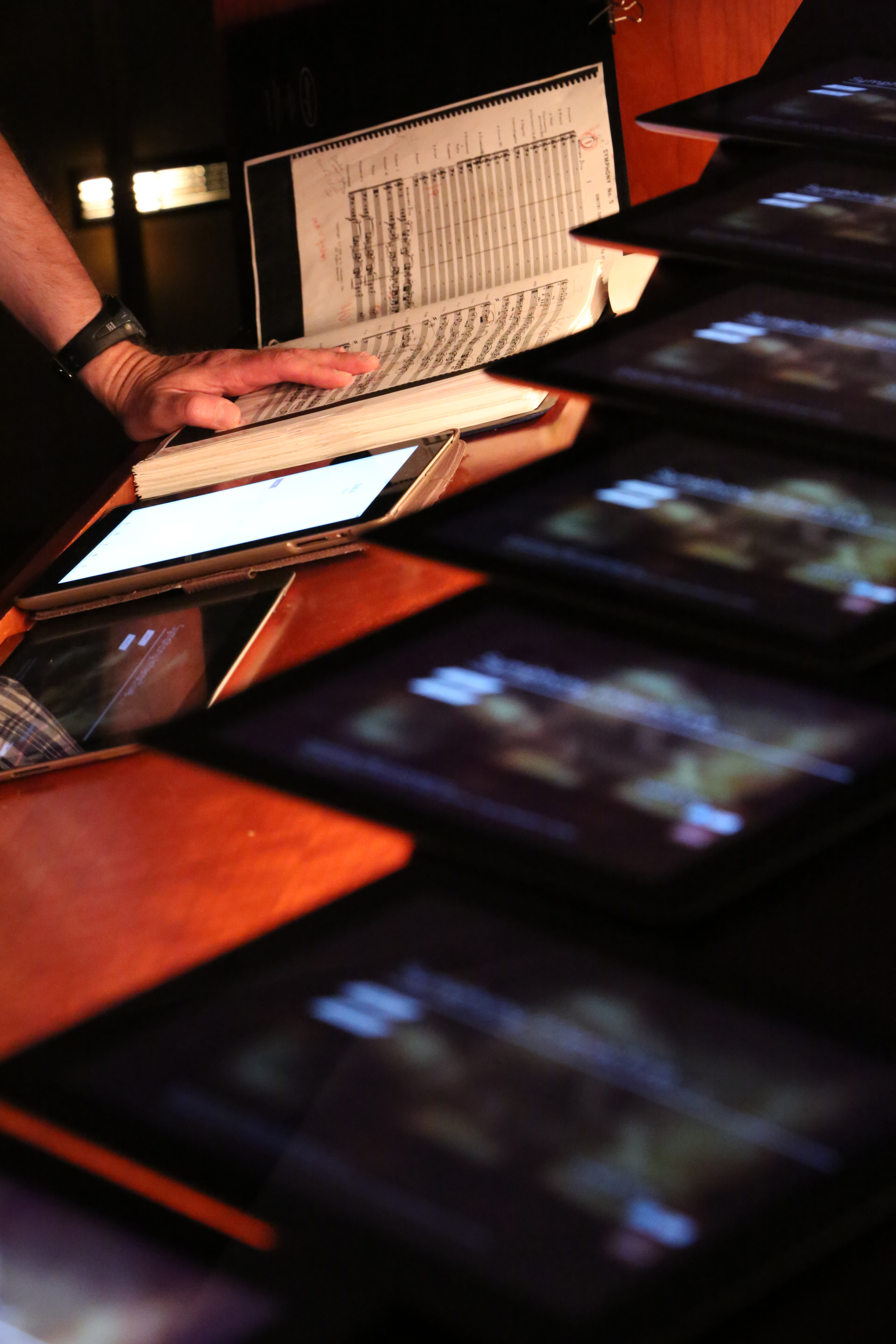
Symphony Interactive Screen

Linda Dusman, Music, and Eric Smallwood, Visual Arts, in partnership with the School of Music at the University of Maryland, College Park, have received a $150,000 Maryland Innovation Initiative (MII) grant for their work on the tablet app, Symphony Interactive. MII was created as a partnership between the State of Maryland and five Maryland academic research institutions (Johns Hopkins University; Morgan State University; UMCP; University of Maryland Baltimore; and UMBC), and is managed by TEDCO, created by the Maryland State Legislature in 1998 to facilitate the transfer and commercialization of technology from Maryland’s research universities and federal labs into the marketplace. The MII program promotes the commercialization of academic research conducted in the partnership universities. Symphony Interactive is only the second project within the humanities ever to receive an award from MII, and the first to be funded in the arts and humanities at UMBC.

SI_CommaderControlSymphony Interactive provides contemporary audiences a novel way to engage with live orchestral performances. Through both text and images presented through a unique interface at the exact moment the information is most pertinent to the music, SI enables an enriched experience for users by allowing them to learn about the music and its cultural history during its performance. Acting as an informed “friend,” the app subtly provides information to enhance engagement, keeping the experience of the live performance paramount. During the grant period, the SI team will create a library for thirty of the most performed orchestral works, producing unique textual and visual information for each piece. Over the next nine months, the grant funding also will enable developing a more fully featured proof of concept application, expanding the social media extensions of the app, and performing valuable market research to aid in the commercialization process.

The Symphony Interactive project has been in development since 2011, with support from the College of Arts, Humanities and Social Sciences and the Office of the Vice President for Research. Development has progressed through collaboration with many faculty, staff and students from Music, Visual Arts, the Imaging Research Center, Human Centered Computing, and the Department of Information Technology. Symphony Interactive has been tested in performances by the UMBC Symphony, and most recently at the National Orchestra Institute at the Clarice Smith Center for the Performing Arts.

Niels Van Tomme, CADVC, Named Curator of the 7th Bucharest Biennale

nielsvt_web1Niels Van Tomme, Visiting Curator of the Center for Art, Design and Visual Culture, has been named Curator of the 7th Bucharest Biennale (Bucharest International Biennial for Contemporary Art), to take place May 26 to July 17, 2016.

The Bucharest Biennale is interested in exploring links between creative practice and social progress, as well as correspondences between local and global contexts. Now in its tenth year, the Biennale continues to build a strong partnership between Bucharest—a geocultural space where the political is reflected in all aspects of life—and the rest of the world. In transcending specific geographical, historical, or political frameworks, it connects to a broader complexity, namely the one of “resistance” within the quotidian realm.

More information about the Biennale is available on its website.

Maurice Berger, CADVC, Latest “Race Story” in the New York Times

In the latest essay for his Race Stories column in The New York Times, Maurice Berger, research professor at the Center for Art, Design and Visual Culture, examines Dawoud Bey’s intimate and powerful 2007 portrait of Barack Obama prior to becoming president. The essay is being co-published by the Hillman Photography Initiative at the Carnegie Museum of Art. “The photograph depicts its famously private and introspective subject only months before he was to step into the abyss of presidential politics. And it defines him free of the stereotypes and myths that have come to characterize his presidency,” observers Berger.

Read “Meditation on President Obama’s Portrait” and view the photograph at the New York Times Lens blog.

Berger’s Race Stories column has featured several essays centered upon race and photography, including Malcolm X as image maker, Ken Gonzales-Day, images of emancipation, the photographs of Deborah Will, and the civil rights work of James Karales.

Richard Spece, Clarinet, and Nancy Beith, Piano (9/13)

On Thursday, September 13 at 8:00 p.m. in the Fine Arts Recital Hall, clarinetist Richard Spece and pianist Nancy Beith join forces to present a program featuring:

  • Five Bagatelles, Op. 23, by Gerald Finzi
  • Concertino by Giuseppe Tartini (arranged by Gordon Jacob)
  • Clarinet Sonata No. 1, Op. 120, by Johannes Brahms
  • Duo Concertant pour Clarinette et Piano by Darius Milhaud

Richard Spece regularly performs on modern and historical clarinets around the country and has several recordings available on Crystal Records. He has been a featured performer on the Smithsonian Recital Series in Washington, D.C., Music in the Mansion Series at the Strathmore in Maryland, Alexander Paley Festival in Virginia, Mozart Society of California Chamber Music Series, the Instituto de la Cultura Festival in Mexico, Cascade Music Festival, Capitol Hill Chamber Music Festival, Garth Newel Chamber Festival, the Embassy Series in Washington, D.C., the National Gallery of Art Chamber Series, and the Festival of Sacred Music in New York City. His teachers included Stan Stanford, William McColl, James Campbell, Alfred Prinz, and Howard Klug. Mr. Spece is a Selmer Concert Artist.

Nancy Beith has been on the music faculty at UMBC since 1980, serving as academic advisor for the department, pianist for both the Camerata and Opera Workshop, and coordinator of the class piano program. She taught for many years in the Preparatory Division of Hood College in Frederick. As a collaborative pianist, Ms. Beith has worked with many area musicians in recital and chamber performances. She has adjudicated piano competitions for Maryland State Music Teachers Association and has been pianist for the International Trombone Workshop in Nashville. Currently she is a pianist for Holy Family Catholic Community in Middletown, Maryland, and the Maryland State Boychoir in Baltimore. Ms. Beith received degrees from Syracuse University and the Peabody Institute. She also studied at the Vienna Academy of Music and Westminster Choir College in Princeton.

$7 general admission, $3 seniors, free for students, free with a UMBC ID. Tickets will be available at the door. Presented by the Department of Music.

Department of Theatre’s “Incorruptible” Reviewed by the Baltimore Sun

Arts critic Mike Giuliano, writing for the Patuxent Papers and The Baltimore Sun, gave high marks to the Department of Theatre’s current production, Incorruptible, in a review published today. “Director Colette Searls ensures that the plot’s zany complications keep coming our way,” he remarked, while also mentioning set and costume design by Elena Zlotescu, associate professor of Theatre; and students Brad Widener, Daniel Friedman, Anderson Wells, Christopher Dews, Samantha Van Sant, Sydney Kleinberg, David Brasington and Jessica Ruth Baker. Read the full review here.

Eric Dyer, Visual Arts, Awarded Fellowship by the Guggenheim Foundation

[vimeo http://vimeo.com/22633568]Eric Dyer, associate professor of Visual Arts, has been awarded a 2012 fellowship for creative arts by the John Simon Guggenheim Memorial Foundation. Professor Dyer is an artist, filmmaker, experimental animator, and educator whose award-winning films have screened internationally at numerous festivals, including the Chicago International Film Festival, the Ann Arbor Film Festival, South by Southwest, and the Ottawa, Annecy, Melbourne, and London International Animation Festivals. His work has also been exhibited at the Exploratorium, the Hirshhorn, the Smithsonian National Gallery of Art, Ars Electronica, and the Cairo and Venice Biennales.

Much of his recent work focuses on the zoetrope, as shown in the video clip above. Dyer comments, “I have dug up the zoetrope, a pre-cinema optical toy, and am using it to create and explore a visual language of loops and spirals. When spun, the complex circular sculptures, dubbed cinetropes, are a blur to the human eye but come to full animated life when viewed through shutter glasses or the lens of a fast-shutter video camera. This video is a compilation of film clips and behind-the-scenes footage from [my zoetropes] Copenhagen Cycles and The Bellows March.”