All posts by: Sarah Hansen, M.S. '15


UMBC faculty celebrate opportunities to expand collaboration across disciplines

“The complex problems we face do not organize themselves neatly into the categories we’re used to,” says Carole McCann, professor and chair of gender and women’s studies. “We need to think beyond those boundaries.”

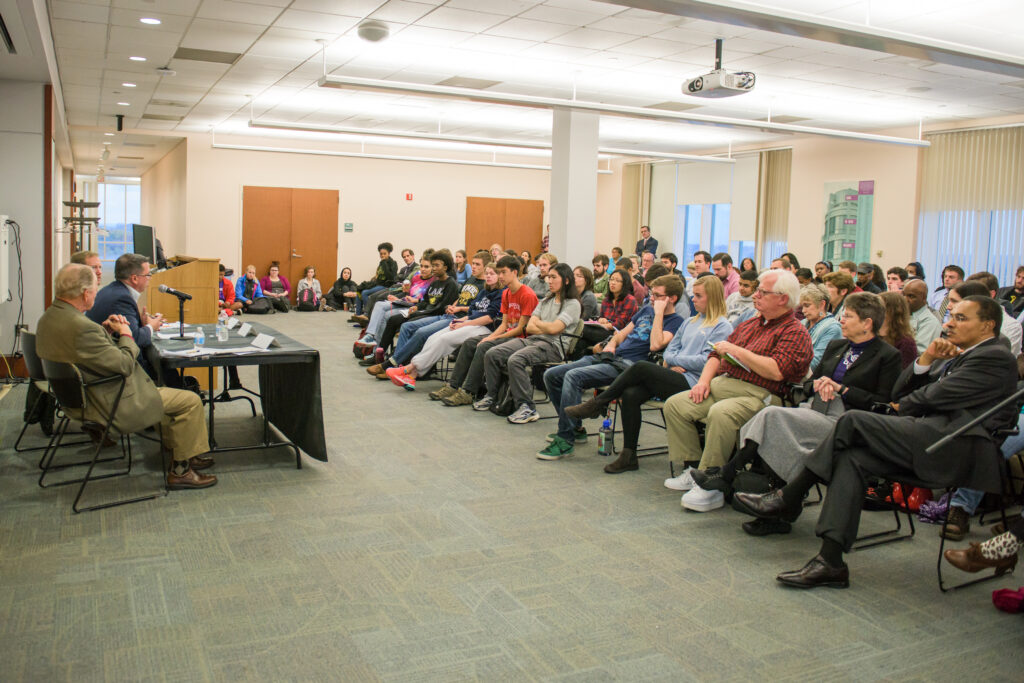
McCann leads the new Provost’s Interdisciplinary Activities Advisory Committee, which just hosted UMBC’s first social hour to bring together faculty from different fields, but with overlapping research and creative interests, to plant the seeds for future collaborations.

Provost Philip Rous shares that this event, and the committee behind it, respond to his conversations with faculty who identified “a real need for additional support in the area of interdisciplinary work.” Having opportunities to get away from the “disciplinary lens” and removing barriers to doing interdisciplinary work, he notes, is what will set UMBC apart as a community focused on solving complex, real-world problems.

Four faculty led informal discussions to start the conversation at this week’s event. Nicole King, associate professor and chair of American studies, discussed her work in Baltimore City, including collaborations with colleagues and students in sociology, visual arts, and media and communication studies. One project centers on a community garden in Curtis Bay, in partnership with a local school. Another focuses on interviews with Baltimore residents about their experiences with the city’s deindustrialization—interviews that students have developed into radio segments airing on WEAA.

For King, interdisciplinary research means “asking big questions, solving big problems, with whatever tools you need,” moving beyond artificial limits imposed by academic disciplines.

interdisciplinary-social16-5330

Amy Hurst, associate professor of information systems, conducts research in human-centered computing, particularly assistive technologies. She sees her field as an amalgam of design, behavioral science, and technology.

For interdisciplinary projects to be successful, Hurst says, “We need to be fluid in the languages of the different fields.” She, like King, emphasized the need to think beyond a single answer to a narrow question or a single technology to solve a narrow problem. She shares that when working with students, collaborators, or end-users, “Rather than giving them a hammer, I like to give them the toolbox.”

Tulay Adali, University Distinguished Professor of computer science and electrical engineering, says interdisciplinary research increases the impact of her work by applying it in new contexts. Rather than continuing to make small improvements to systems that have been in development for decades, applying her research to brand new fields can lead to positive change in leaps and bounds.

“It enriches what you’re doing,” Adali says. “You have to have patience, to invest your energy, but the rewards are huge.”

interdisciplinary-social16-5437

Tim Nohe, professor of visual arts, discussed his work at the interface of the arts and ecology. Nohe uses a variety of art forms to explore how different cultures steward the natural environment. A 10-year project of his, based in Australia, recently culminated with the exhibition Sounding Botany Bay at the Albin O. Kuhn Library. He’s also interested in urban landscapes and empowering Baltimore citizens to put pressure on local government to tackle environmental justice issues. That’s made considerably easier by today’s smartphones, because, Nohe says, “You have the tools of agency right in your pocket.”

“In the arts, which have always connected with a public or audience, we are aware of our responsibility to make our work reach people and move them intellectually and emotionally,” Nohe explains. “There’s knowledge to be discovered when disciplines come together, finding new points of entry into a problem or by finding ‘ah-ha’ moments through attentive and respectful dialogue across disciplines.”

McCann and committee member Rachel Carter, Ph.D. candidate in language, literacy, and culture, intend to extend the social hour into a series. Follow the committee’s myUMBC group to learn about upcoming events.

Banner image: Faculty from all three colleges and a variety of disciplines discuss research, plant the seeds for collaborations, and enjoy fellowship at the first interdisciplinary faculty social hour. All photos by Marlayna Demond ’11 for UMBC.


Life sciences research symposium attracts a record number of students from across the mid-Atlantic

UMBC’s 19th Undergraduate Research Symposium in Chemical and Biological Sciences on October 22, 2016, drew a record number of talented young researchers from across the mid-Atlantic. Of the 647 attendees, 331 were student presenters, including students from UMBC’s own STEM BUILD initiative.

In an introductory address to the students, President Freeman Hrabowski emphasized the importance of asking good questions, rather than always having the right answers. He encouraged the scholars, some of whom travelled hundreds of miles for the event, to have confidence in their ability to achieve great things as scientists, saying, “You have most of the answers you need inside of yourself for what it takes to be successful.”

Two large poster sessions in the University Center Ballroom anchored the day-long event, spotlighting 274 student posters on research topics from cricket behavior to breast cancer to biodegradable polymers. Judging the posters were 74 faculty who selected award recipients in biochemical and molecular biology, biological sciences, and chemical sciences.

Workshops and a plenary speaker provided additional opportunities for attendees to expand their horizons.

Susan Hindle, assistant director of internships and employment in UMBC’s Career Center, led a “Master the Art of Making Connections” workshop. “Academic achievements alone are not enough to be successful in today’s workplace,” she shared. Hindle discussed how to make a good first impression and be an active listener, and she taught attendees the elements of a strong “30-second commercial” about their experience, interests, and goals. She also gave tips for networking at an event like a research conference.

URS Thomas

Jim Thomas, UMBC philosophy lecturer, offered “A Very, Very Short Introduction to Ethics for Scientists.” The workshop encouraged students to examine why they make the ethical decisions they do. “Even if a person disagrees with you, reasons can be understood, maybe even changed or amended, and that creates better understanding, and so a better community, all around,” said Thomas.

Plenary speaker Colleen Burge, assistant professor of marine biotechnology at UMBC, used her talk to offer advice for student researchers in the audience, through the lens of her own work on host-pathogen interactions in marine environments.

Burge discussed her research on oysters, eel grass, and the diseases that affect them as critical both ecologically and economically. She described eel grass as “a foundational species in the ocean,” and explained that sea grasses serve as “ecosystem engineers,” creating habitat for a wide range of species while also providing a food source. A particularly devastating oyster virus she studies “directly impacts the bottom line for farms.”

Burge said students at the symposium “are already winning” when it comes to preparing for research careers, by getting experience early. She encouraged them to follow their passions, but not narrow their focus too soon. “Your career can change as it goes. Be flexible,” she says. “Find that thing that you like and that can move forward with you through your career.”

Preparing for the symposium required a great deal of hard work for each student, but “the value of talking to people about your research and receiving input on things you might have overlooked is priceless,” shared Fatma Abker ’19, chemical engineering. “From Dr. Hrabowski’s invigorating welcoming speech, to the buzz of the ballroom with presenters and judges and spectators, to the plenary talk—it was all worth it.”

Banner image: The University Center Ballroom during the Undergraduate Research Symposium. Photos by Mohammed Arafat ’20, biological sciences.


UMBC honors faculty fellows, recognizing decades of exemplary scholarship and service

On November 1, the UMBC community celebrated faculty who have earned exemplary recognition as fellows by their professional associations and societies. Designation as a fellow is one of the top honors an academic can earn, recognizing a career of accomplishment, often decades in the making. Nearly 50 UMBC faculty members—about 14 percent of the university’s tenure-track faculty—have received this high distinction in their fields, and the number is growing quickly across all three UMBC colleges.

At a special event to honor their achievements, organized by the Office of the Vice President for Research, President Freeman Hrabowski told the faculty fellows, “All of you here today represent the best in your disciplines and we wanted to celebrate what you have done, to make the point that our institution has a wide range of scholars from literature and history, to the sciences and social sciences, to the arts.”

Hrabowski specifically mentioned Michael Summers, Robert E. Meyerhoff Chair for Excellence in Research and Mentoring and University Distinguished Professor of chemistry and biochemistry, who recently became the first UMBC faculty member elected to the National Academy of Sciences.

Jessica Berman, professor of English and director of the Dresher Center for the Humanities, received praise for her editorial work on the Modernist Latitudes book series (Columbia University Press) and service to the board of the American Comparative Literature Association. Robert Provine, professor of psychology, internationally known for his expertise on human behavior, met with hearty applause for his 40+ years of service to UMBC.

Hrabowski highlighted Bimal Sinha, professor of mathematics and statistics since 1985 and founding member of the statistics program at UMBC, and department colleagues Thomas Mathew and Nagaraj Neerchal for their extensive international collaborations, including applied statistics work to address economic challenges in Africa.

Hrabowski also honored Tulay Adali, University Distinguished Professor of computer science and electrical engineering, for research completed in her lab at the intersection of signal processing and medical imaging, and Warren DeVries, professor of mechanical engineering, for his long-term commitment to mentoring students and younger faculty as they launch their careers.

Provost Philip Rous addresses the faculty fellows.

“The recognition that you’ve received from your international peers is one of the most tangible measures of your success as a scholar and a researcher,” shared Provost Philip Rous, “and through that recognition you bring great honor and visibility to our community and our university.” Rous stressed UMBC’s emphasis on excellence in research with impact, and thanked the faculty fellows for their contributions to that trajectory.

Provost Rous also recognized that each honoree’s efforts go far beyond scholarship. “Every one of you who’s here is an outstanding professor, teacher, and dedicated mentor for our students,” Rous shared, “and it’s that combination as well as your incredible achievements in research that makes UMBC such a great place to be.”

The complete list of faculty fellows is available here. It can be sorted by name, department, or professional society.

Banner image, left to right: Scott Casper, dean of College of Arts, Humanities, and Social Sciences; Jessica Berman, professor of English and director of the Dresher Center for the Humanities; President Freeman Hrabowski, III. 

All photos by Marlayna Demond ’11 for UMBC.

Carolyn Forestiere provides innovative framework for student political science research

Carolyn Forestiere, an associate professor of political science, has published a new book that aims to provide a learn-by-doing approach to guide students through their original research projects. The book, titled Beginning Research in Political Science (Oxford University Press 2016), includes data and instructional software tutorials to help guide students through the research process from start to finish.

Forestiere book coverThe text includes recent political science studies to provide context for each research theme outlined in the book and explains how students can best approach writing final research reports as they complete their projects.

“By and large, Forestiere has succeeded in finding that difficult balance between rigor and readability. Very few authors do that well, or are able to sustain the balance through an entire book,”Julio Borquez from the University of Michigan-Dearborn wrote in a review.

In connection with Forestiere’s teaching pedagogy and research, she has recently been nominated to serve on the Pi Sigma Alpha Executive Council of the National Political Science Honor Society. Forestiere is one of just 12 members from around the country selected for the leadership role.

The council meets annually at the American Political Science Association Convention to guide the affairs for the society. Beyond the 12 members, the council consists of a president, president-elect, executive director, newsletter editor, and the three most recent past presidents.

Forestiere researches comparative politics, Western Europe, institutions, and research methodology. She has been heavily involved in promoting student research and civic engagement research and activities through BreakingGround.

Read more about the Pi Sigma Alpha Executive Council on the society’s website, and read more about Forestiere’s new book on the Oxford University Press website.

Image: Carolyn Forestiere. Photo by Marlayna Demond ’11 for UMBC. 

Critical Social Justice celebrates UMBC as a home for learning, activism, and social change

Each year, Critical Social Justice provides a series of interactive events for the UMBC community to explore social justice from a variety of perspectives. In celebration of UMBC’s 50th anniversary and The Women’s Center‘s 25th anniversary, this year’s theme focused on UMBC and Baltimore as places that represent home for many people.

Critical Social Justice week is coordinated by The Women’s Center and Student Life’s Mosaic: Center for Culture and Diversity. Some of the week’s most popular events this year included a social justice activism workshop; a roundtable on challenges LGBTQ youth may face relating to home; a walking tour in Baltimore led by Kate Drabinski, lecturer in gender and women’s studies; and a panel on how the idea of home relates to social justice.

In describing the goals of Critical Social Justice, Jess Myers, director of The Women’s Center, and Megan Tagle Adams, assistant director of The Women’s Center, explained, “As we celebrate and contemplate UMBC as a home for learning, activism, and social change, we embrace the opportunity to invest ourselves in creating meaningful change here on campus in addition to taking our newly gained insights and knowledge with us back home, wherever that may be.”

At the start of a compelling keynote talk on October 25, Maureen Evans Arthurs ’13, gender and women’s studies and political science, and Daniel Willey ’17, gender and women’s studies, shared personal stories about UMBC has helped them to find their home.

UMBC CSJ logo“Throughout Critical Social Justice, we want you to consider where you have found your home, and wherever you find that home, may you find community, healing, and the ability to live authentically and to love,” Evans Arthurs said.

In her keynote talk “Body/ Land/ Home: Disability Justice, Healing Justice and Femme of Color Brilliance,” Leah Lakshmi Piepzna-Samarasinha explained what the idea of home means to her and how lived experiences can provide a foundation for social justice.

“In talking about what home is…I want to focus it on my own experiences as a disabled femme queer person of color and my activism, organizing, and artwork surrounding that and a lot of other people as well,” she shared. “I want to talk about how ableism and disability is so important to everybody, disabled and non-disabled people, when we think about what it means to come home for us.”

Piepzna-Samarasinha is a poet, performer, healer, and activist whose work focuses on underrepresented people, disability justice, queer and trans people of color, and abuse survivors. She spoke thoughtfully about expectations of perfection and about intersectionalities of racism and ableism.

“It takes incredible strength and resilience to continue on in a world that reminds us that we don’t belong here,” she said, adding “communities that don’t shame you for your body and your mind are really important.”

She particularly highlighted the power of support networks for people with disabilities, for sharing experiences and resources and creating events, spaces, and homes that are truly accessible. “We figure out how to offer each other care from where we are,” she said, “and to not leave each other behind.”

The keynote address provided a springboard for additional conversations within the UMBC community.

“It is in this spirit that the fourth annual Critical Social Justice aims to create space and learning opportunities to consider the ways we can challenge, explore, and redefine the concept of home based upon our individual and collective histories as well as our intersecting identities,” said Myers and Tagle Adams.

For more on Critical Social Justice, visit The Women’s Center website.

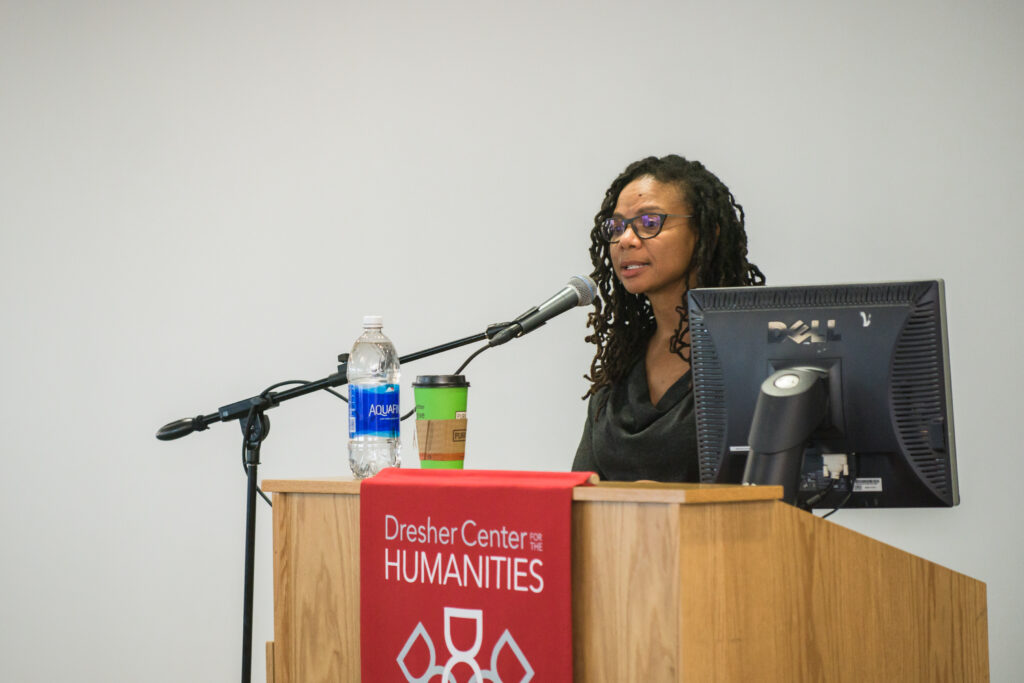
Image: Leah Lakshmi Piepzna-Samarasinha presents the 2016 Critical Social Justice keynote address at UMBC. Photo by Marlayna Demond ’11 for UMBC.  

UMBC faculty comment on how division is impacting the 2016 election

With the 2016 election just days away, UMBC faculty have been in the news discussing voter dissatisfaction with government and the divided political landscape that faces both presidential candidates heading into Election Day.

School of Public Policy Professor John Rennie Short argued in The Conversation that the upcoming election is more about the legitimacy of the political system than deciding who is to govern. In 1964, Short explained that more than two-thirds of Americans trusted the federal government, and just last year that number had fallen to just less than 1 in 5 citizens.

In his article, Professor Short explored the decline of the blue-collar middle class, generational differences, and the financial sector’s influence on politics and society as root causes for the lack of trust in the federal government.

“There are a number of potential crises in democratic capitalist societies. As outlined by German sociologist Jurgen Habermas, they are: fiscal crisis when government expenditure is more than revenue; economic crisis when the economy fails to meet popular expectations; or rationality crisis when there is a failure to make the correct decisions,” Short wrote. “The U.S. may be in the difficult position of undergoing all of these at the same time.”

On Fox News, Political Science Professor and Chair Thomas Schaller talked about why the electorate is so divided and explained that rising polarization goes as far back as the late 1980s and is especially visible in the Bush and Obama administrations.

“Bush ran as a uniter, not a divider,” Schaller said. “He had a national catastrophe, and the country was no more united after eight years than they were before. Obama rides election on the waves of the biggest economic crisis since The Great Depression, and the country is no more united after eight years.”

Schaller also described how the next president will inherit an extremely divided political landscape with both major political parties likely making it difficult to govern.

“Hillary Clinton or Donald Trump, it doesn’t matter who we are talking about, is going to come in with a very difficult ability to lead because I think the two camps, red and blue America, are done with each other, and it’s a war of each against the other,” he said.   

In other news, Schaller also explained how the “roll-off” issue, when people cast a ballot for some races but don’t bother with others, will likely impact the results of the election.

Turning attention to state politics, School of Public Policy Professor and Director Donald Norris was quoted in a Baltimore Sun article about the impact of independent voters in Maryland on the upcoming election.

Find a complete roundup of media coverage below:

The ‘legitimation’ crisis in the US: Why have Americans lost trust in government? (The Conversation) 
How division in America is impacting the 2016 election (Fox News) 
Speaking politics phrase of the week: ‘roll-off’ (Christian Science Monitor) 
Amid partisan acrimony, independent voters on the rise in Maryland (The Baltimore Sun)

Image: John Rennie Short in his office. Photo by Marlayna Demond ’11 for UMBC. 

Michael Eric Dyson headlines Obama Effect 2.0 conference at UMBC

The world will know who the next U.S. president will be after November 8, but leading up to the election it is unclear what the future of President Obama’s legacy will be under the next administration. Scholars and professionals from around the country are gathering at UMBC October 27-29 for the “Obama Effect 2.0″ conference to examine the current president’s impact on a range of core issues before the next president is elected and that legacy takes on new form and meaning.

The event builds on the first “Obama Effect” conference, held in 2008 at the University of Minnesota, which looked at how the election would impact the process of American presidential politics, issues of civil rights, and global/international relations. The result was the book The Obama Effect: Multidisciplinary Renderings of the 2008 Campaign (SUNY 2010). This collection of essays examined how issues discussed during the 2008 presidential campaign would influence the Obama administration in the years ahead.

Kimberly Moffitt, associate professor of American studies, is the lead organizer of the Obama Effect 2.0 conference, along with colleagues Heather Harris, professor of business communication at Stevenson University, and Catherine Squires, professor of communication studies and director of the Race, Indigeneity, Gender and Sexuality Studies Initiative (RIGS) at the University of Minnesota.

“This conference is not only significant to our understanding of the potential legacy of the first self-identified African-American president of the United States, but it is also timely as we approach one of the most contentious and polarizing presidential elections of our country’s history, largely because of issues related to identity, a sense of belonging, and even race—all such matters of intersectionality grappled with by President Barack Obama during his two terms in office,” shares Moffitt.

Professor, author, and radio host Michael Eric Dyson will present the keynote address on Thursday, October 27 at 5 p.m. at the Albin O. Kuhn Library 7th floor. He will speak about his book The Black Presidency, which explores the role of race in shaping President Obama’s identity and groundbreaking presidency. Dyson will talk about his analysis of the president’s remarks, major speeches, and responses to recent incidents to examine issues of identity, race, and culture through President Obama’s own voice.

Following the keynote address, a series of paper presentations, panel discussions, and roundtables will take place on October 28 and 29. They will examine different aspects of the Obama presidency, including media representations, race and the American police state, party politics, and American and global public opinion, among a range of other issues.

Several UMBC faculty will participate in the conference, including Thomas Schaller, professor and chair of political science; Cedric Herring, professor and director of language, literacy, and culture; Nicole King, associate professor and chair of American studies; and David Hoffman ’13, Ph.D., language, literacy, and culture, and assistant director, student life for civic agency.

For more information, visit the Obama Effect 2.0 website and to view media coverage, see below.

The Obama Effect (WEAA’s The Marc Steiner Show) 

Image: Michael Eric Dyson. Photo courtesy APB Speakers. 

Empowering Baltimore communities toward social change

Humanities scholars, cultural organizers, and community representatives will gather on October 29 for a dynamic discussion about building democracy, fostering social justice, and improving Baltimore’s future.

The Dresher Center for the Humanities is leading “Baltimore Coalition Stories,” a community conversation about the importance of coalitions in the life of Baltimore. The event is part of the ongoing Baltimore Stories project, an initiative that shines a spotlight on collaborations of university, community, and non-profit partners in Baltimore neighborhoods.

The Baltimore Stories project has been made possible in part by a major $225,000 grant from the National Endowment for the Humanities and is a partnership among the University of Maryland, College Park; Maryland Humanities; the University of Maryland, Baltimore County; Enoch Pratt Free Library; and the Greater Baltimore Cultural Alliance. The project includes a series of free, public programs that explore the way Baltimore citizens are thinking about the narratives that influence the life and identity of the city.

UMBC’s Dresher Center for the Humanities is a major partner on the grant and organized an interactive public event earlier this year that highlighted stories of identity, belonging, and activism from several Baltimore communities. On December 3, UMBC will host the project’s culminating event: “Reflecting on Baltimore’s Stories.”

“Now more than ever, it is crucial to consider the role of coalitions, forged across boundaries, in practicing public humanities and supporting the work of active and engaged communities,” said Jessica Berman, director of UMBC’s Dresher Center for the Humanities.

Complete event details can be found below. To register, click here.

“Baltimore Coalition Stories”
October 29 | 1-3 p.m.
Brown Memorial Park Avenue Presbyterian Church
1316 Park Avenue, Baltimore, MD 21217
Light refreshments at 12:30PM

Building Coalitions Between Scholars and the Public: Shrinking Gaps Between Knowledge and Policies
Lee Boot, Director, UMBC Imaging Research Center
Lester Spence, Associate Professor, Political Science, The Johns Hopkins University

Internalized Oppression in the Classroom: Changing the Narrative
Jason Loviglio, Associate Professor and Chair, Media and Communication Studies, UMBC
Daria Baylis, Baltimore Speaks Out Media Instructor, Youth Photography Traveling Exhibit Assistant Coordinator & Instructor and Distribution Coordinator

Sexing the City: Building Conversations about Sexual Violence and Consent
Kate Drabinski, Senior Lecturer, Gender and Women’s Studies, UMBC
Kalima Young, Leadership Team for FORCE: Upsetting Rape Culture; Lecturer, Electronic Media and Film, Towson University

Stories of Environment and Daily Life: Speaking to Science about the Legacy of Segregation
Dawn Biehler, Associate Professor, Geography and Environmental Systems, UMBC
Pauline Linthicum, Harlem Park resident
Yinka Bode-George, UMBC ‘16

Image: Baltimore Stories project logo.

Nature spotlights Summers Lab for showing how science can be for everyone

A recent article in Nature asked, “Is science only for the rich?” In the United States, writer Jane J. Lee concluded, there are steep challenges for students from lower-income backgrounds who want to pursue science, but there are also positive examples of people who are working to create opportunities for these students—people like Michael Summers.

Summers is Robert E. Meyerhoff Chair for Excellence in Research and Mentoring and University Distinguished Professor of chemistry and biochemistry at UMBC. His lab is nationally and internationally known for engaging students from all backgrounds in high-level, hands-on research from day one, and further supporting them through intensive faculty and peer mentorship.

Tina Quasney ’17, biochemistry, who is featured in the article, was close to giving up on a science career when she crossed paths with Summers while working at a restaurant. In a conversation that could have ended at small talk, Summers recommended Quasney email him to learn about lab research opportunities. Rather than waiting tables, he said, “You could be getting paid for what you want to do.”

Quasney jumped at the chance to gain lab experience and is now on a path to graduate school. “I’ve learned so much about how to become a researcher,” she shares. As a student with serious concerns about funding her education, learning that Ph.D. students can earn tuition remission and a stipend has made it possible for her to see an advanced degree as a real option.

Roald Teuben ’16, biochemistry, shares a similar experience of connecting with the Summers Lab. He was in the UMBC chemistry building admiring a piece of equipment from the hallway when Summers greeted him with, “You must be here to do research.” “When I picked my jaw up off the floor, I just said ‘Yeah,’” remembers Teuben, who transferred to UMBC from Montgomery College. After two years working in Summers’ lab, he graduated last spring and is now serving as a lab technician while he applies to M.D./Ph.D. programs.

Aishwarya Iyer ’18 and M26, biochemistry, says the lab’s emphasis on a deep understanding of the research, asking good questions, and positive mentorship “made me more confident in my ability to think for myself,” and “really boosted my ability in science.” Iyer plans to pursue an M.D./Ph.D., with a focus on exercise physiology and metabolic conditions.

Hannah Carter ’17, biochemistry, has similar feelings about her UMBC experience. “The mentorship provided by the graduate students in the lab is remarkable,” she shares. Summers handpicks all of his lab members based on interviews that focus on students’ goals and passions, and their enthusiasm for supporting fellow students, rather than simply past achievements on their résumés.

Amalia Rivera-Oven ’16, biochemistry, found her way to the Summers Lab when she introduced herself to President Freeman Hrabowski as the president of the Hispanic Latino Student Union at an event, hoping to discuss how the organization could grow and contribute to the community. He invited her to a meeting, which turned into a discussion of the importance of Latina leaders in STEM fields. Hrabowski helped her see, “By pursuing STEM, I can help to create a role model effect.”

Prior to her work in the Summers Lab, Rivera-Oven struggled with “impostor syndrome,” the experience of feeling that one doesn’t belong despite performing at a very high level. She says President Hrabowski and Professor Summers initially “saw something in me that I didn’t.” Through mentoring other student researchers in the Summers Lab, she grew her sense of self-confidence. She plans to pursue an M.D./Ph.D. after graduating in December.

Stanley Wang ’18 is also passionate about research, but even more so about service. As a first-generation college student whose parents are both immigrants, “College was never really on the radar,” he shares. But with several of his family members affected by gastrointestinal cancer, he says, “What drew me to research was finding solutions.” Wang earned a scholarship to attend UMBC, and plans to pursue Officer Candidate School in the military as well as a Ph.D., to fulfill what he calls his “first obligation” of serving his community.

Summers’ sense of duty as a scientist and educator has long guided his support of students from diverse backgrounds—particularly women, African American and Hispanic students, and first generation students—in becoming scientific research leaders.

Growing up, Summers says, “I knew little about issues that are differentially faced by people from different backgrounds. I went to high school with some very talented women and African Americans, but had no idea the odds of them obtaining a faculty position were so different from my own.”

“Being at UMBC opened my eyes not only to existing disparities in science research and education, but also to possibilities for effecting change,” he reflects. “The satisfaction that goes with helping our students achieve their dreams, and showing colleagues elsewhere new ways that they can approach and support their own students, is a reward without measure.”

Read the original article in Nature: “Is science only for the rich?

Image: Summers (right) works with students in the lab; photo by Marlayna Demond ’11 for UMBC.


Alumni Awards highlight profound impact, drive, and commitment of UMBC alumni and faculty

The UMBC community gathered in the Linehan Concert Hall on October 6 for a moving ceremony to honor the profound impacts and achievements of nine outstanding Retrievers at the 2016 UMBC Alumni Awards.

“This year’s awardees truly capture the depth of our community,” said John Becker ’01, president of the alumni association. Irina Vishnevetsky ’99, chair of the alumni awards committee, shared, “Each year the number of submitted nominations grows, and each year I am amazed by the incredible accomplishments of UMBC alumni.”

Tulay Adlai, electrical engineering, introduced awardee Vincent Calhoun ’02, Ph.D. electrical engineering, as an excellent teacher and mentor, cutting-edge brain researcher, and “a truly genuine human being.”

Today, Calhoun serves as one of the youngest distinguished professors at the University of New Mexico. His primary appointment is in electrical and computer engineering, and, known for his interdisciplinary work, he maintains affiliate appointments with biology, computer science, neuroscience, and psychiatry. In accepting the award, Calhoun emphasized the importance of imagination in scientific research and told the students in the audience, “honesty and integrity in your work will make it endure over the long term.”

Award recipient Ian Ralby ’02, modern languages, linguistics, and intercultural communication (MLLI) and M.A. intercultural communication, was a Humanities Scholar and varsity diver at UMBC, and graduated as valedictorian. He went on to earn a law degree at the College of William and Mary and M.Phil. and Ph.D. degrees at the University of Cambridge, before founding I.R. Consilium, a consultancy that advises governments on international law and policy.

Ralby credits his UMBC humanities education for much of his success in international negotiation, remarking, “I learned to pick up on the subtleties of human interaction, in my own culture and across cultures.” He noted that those skills have “frequently been the deciding factor in whether my work has been merely technically proficient or truly successful.” Thomas Field, MLLI, presented Ralby’s remarks, as he was in Finland at an international maritime security conference and unable to return to the U.S. for the ceremony.

Philip Farabaugh, biological sciences, introduced natural sciences awardee Henry Baker ’78, Ph.D. ’84, biological sciences, who serves as Hazel Kitzman Professor of Genetics, professor of surgery, and chair of molecular genetics and microbiology at the University of Florida College of Medicine, and associate director of the University of Florida Genetics Institute. Farabaugh praised Baker for making the “courageous decision” to change the course of his research when “he recognized the clue to understanding human disease lay in determining how people’s genes change during disease.”

Baker, a Catonsville native, has been proud to watch UMBC grow over the years. “UMBC has truly excelled since its beginning in 1966 up to today, and is headed on to an even higher trajectory,” he shared. “From UMBC, you can get anywhere.”

Alumni_Awards16-4223

Social and behavioral sciences awardee Ruby Lu ’94, economics, traveled from Beijing to attend the awards ceremony. After earning a master’s degree in international economics from Johns Hopkins, she co-founded DCM China, a Beijing-based venture capital firm. She has been named one of the top 50 venture capitalists in China by Forbes magazine, 2011–15. Her approach to venture capital is “to invest in companies she thinks will use technology to bring about positive change to society,” shared her nominator, David Mitch, professor and chair of economics. Lu, who came to study at UMBC from China, was a member of the university’s first class of McNair Scholars and reflected on how faculty profoundly impacted her life as teachers, mentors, and friends, at a time when she was far from home and working hard to learn English while preparing for a career.

LaMar Davis, director of The Choice Program at UMBC, referred to this year’s alumni award winner in social work as “a legend.” “If you don’t know who Joe Jones is,” he said, “you’re likely from out of town.”

Joseph Jones, Jr., ’06, social work, founded the Center for Urban Families in Baltimore City in 1999. The organization has served more than 26,000 Baltimore residents through workforce development and other initiatives, and has placed more than 6,400 in full-time jobs. Jones didn’t intend to get a college degree, but that changed when he met President Hrabowski. At UMBC, Jones shared, he developed “the ability to think about how do we create institutions, how do we move systems forward, how do we agitate in a way that creates change?” That reflection has dramatically benefited the people of Baltimore, shard Davis, noting that through his “steadfast belief and unrelenting drive” Jones has “transformed tens of thousands of lives with impacts that will be felt for generations.”

Tiffany Holmes, MFA ’99, this year’s awardee in visual and performing arts, is now the dean of undergraduate studies at the School of the Art Institute of Chicago. Holmes began her career as a middle school art teacher in Baltimore City and brought her students to tour UMBC’s Imaging Research Center. There, she recalled, “I quickly realized that I was interested in using technology to make art.” After over a decade in the field, she has made a “permanent mark on the canon of this once marginalized and little-understood discipline” and she is known for her “commitment to art that poses unique social challenges,” shared her nominator, Lisa Moren, professor of visual arts.

Alumni_Awards16-4378 - Copy

Ellen Hemmerly, executive director of bwtech@UMBC, was thrilled to introduce Tom Sadowski ’89, political science, as the 2016 Distinguished Service awardee. Sadowski, vice chancellor for economic development for the University System of Maryland, “has always valued relationships and supported partnerships, and has a knack for bringing people together and making things happen,” says Hemmerly. “I believe with Tom at the helm, UMBC and other system campuses will lead the nation in supporting innovation and creating knowledge jobs of the future.”

Accepting his award, Sadowski shared that he’s “just a guy who likes to…help solve problems, help people work as a team and achieve collective goals, or simply help people find that better part of themselves and grow.” Sadowski said that he’s particularly valued his relationship with the university over the past three decades because “UMBC leads its students to believe in themselves, and further, to believe there is nothing they cannot accomplish within themselves and within their communities by working together, with passion, and a deep, heartfelt purpose.”

Judah Ronch, dean of the Erickson School, introduced Galina Madjaroff ’08, psychology, M.A. ’11, aging studies, as the Rising Star awardee. Madjaroff serves as undergraduate program director and clinical assistant professor in the Erickson School, whose undergraduate program has grown from almost 400 in 2011 to almost 1,900 today. Ronch noted, “This is really due to the passion, hard work, leadership, and vision that Galina has brought to the program.” In particular, “Her passion is to help society and our students understand the major issues in cybersecurity and tech use for older people,” which has led her to pursue a Ph.D. in human-centered computing at UMBC. Madjaroff says UMBC is special because of the “faculty who are so nurturing, who reach out and take that extra step,” and she is driven to be that supportive mentor to current and future students.

The alumni association honored Kimberly Moffitt, professor of American studies, with the outstanding faculty award for 2016. “Everyone deserves a Dr. Moffitt—someone who shows them the goodness of the world while asking essential follow-up questions to ensure that they never get complacent,” shared her student, Ngeri Nnachi ’11, American studies. “I consider myself blessed to have such a strong, gifted, beautiful woman as my role model.” Accepting her award, Moffit emphasized, “I want to make sure my students know they have voice. And no matter what space they walk into, their voice matters. They matter.”

Alumni_Awards16-4440

This focus on impact, commitment, and connection emerged again and again throughout the evening, and for good reason, shared President Freeman Hrabowski. “One measures the impact of a university by the research it produces, the questions it asks, the people who are graduates, and what they do,” Hrabowski said. “People you see on this stage are not just amazingly talented, they are good people who have done great work. I can’t think of anything an educator would want more than that: People who care about others, who strive for excellence, and who never, never, never give up.”

Banner image: From left to right: Freeman Hrabowski, Joseph Jones, Tiffany Holmes, Ruby Lu, Tom Sadowski, Galina Madjaroff, Vince Calhoun, Henry Baker, Kimberly Moffitt, John Becker; all photos by Marlayna Demond ’11 for UMBC.

UMBC physicist Sebastian Deffner reimagines the future of computing with biology in mind

“There is no free lunch,” in quantum computing, says Sebastian Deffner, a new assistant professor of physics at UMBC. Every uptick in a computer’s speed, accuracy, or memory comes at the cost of energy. Now, Deffner and a team of colleagues have set out to quantify the trade-offs between the costs and benefits of faster or more powerful computers.

Several studies suggest that quantum computing has the potential to be less energy intensive than classical computing, but no one has demonstrated that yet in a real system. Deffner and his colleagues hope to more clearly define the energy requirements of quantum computing in a new two-year project funded by a National Science Foundation INSPIRE grant.

Quantum computing is cool because you can do infinitely more complex problems,” Deffner explains, but if the costs associated with that ability are too high compared to the benefits, quantum computers—at least as they are currently conceptualized—just might not be worth it. His team’s foundational research into the costs of quantum computing will inform the design of tomorrow’s computers, whether quantum or classical.

One aspect of their work will be investigating “biological computation,” the calculations completed by living cells. They’ll do so by creating computer simulations of information processing that occurs within cells.

Like human-engineered computers, these biological processes also incur costs with improvements in speed and accuracy. For example, the process of copying DNA rarely makes mistakes, because of complex error-correction methods within the cell. Just as added speed in a computer comes at a cost, “correction mechanisms do not come for free in cells,” says Deffner.

Even with those costs, Deffner explains, the biological system is very efficient. Given a few billion years to optimize DNA replication and other biological computation processes, “It seems likely that evolution would have gotten something right,” he says. In fact, estimates suggests that the biosphere taken as a whole operates significantly more efficiently than the best human-made computers.

“By understanding one side of the coin [biological computation], we will better understand the other [human-made computers],” Deffner says. His grant proposal states that this new research will be the “first to give a formal understanding of biological computation from a thermodynamic point of view.” Biologists should be interested in Deffner’s results, too, as they may inform ideas about how thermodynamic tradeoffs impose constraints on natural selection and evolution on Earth.

Only weeks after Deffner received official notification about this new grant, the New Journal of Physics presented him with the Early Career Award, which comes with a cash prize and a trip to London for an awards ceremony. The NJP described Deffner as “an extremely talented young researcher who in his early career has proven leadership qualities.” The honor came as a wonderful surprise. “This award means so much to me,” he shared. “I am simply overwhelmed.”

Recent advances in physics, the opportunity to shape the direction of his new lab at UMBC, the NSF grant, and the prestige that will come with his new award all make it possible for Deffner to forge his own unique path into a promising new research field. He’s driven by the sense that scientists “don’t understand the thermodynamic resources required in quantum computing yet,” and excited to do “a little bit of everything” on a quest that bridges quantum computing and biology to build a solid foundation for future research.

Image: Sebastian Deffner, courtesy Sebastian Deffner.


UMBC faculty discuss state of the presidential campaign in local and national media

With just three weeks to go before Election Day, UMBC faculty have been in the news discussing the state of the presidential campaign.

Kimberly Moffitt, associate professor of American studies, was a guest on The Baltimore Sun‘s “Roughly Speaking” Podcast with Dan Rodricks to analyze the second presidential debate between Hillary Clinton and Donald Trump. She joined other local political analysts in a discussion that covered a range of issues, including the candidates’ appeals to undecided voters.

Kimberly Moffitt

“To me, at this point in time three weeks out of an election, I do not believe NPR’s most recent discussion about there still being about 25 percent of American voters who are undecided,” Moffitt said. “These two candidates are so polarizing that there is no gray area.”

Moffitt explained that compared to prior presidential elections, she thinks that partisan politics are playing a significant role in this year’s election.

“This is not Mitt Romney and Barack Obama where you can find something of a commonality or connection with either of those candidates. These are clear candidates that either you like or you do not like.”

In other news, in an October 11 article published in The Week, Thomas Schaller, professor and chair of political science, discussed the relationship between Donald Trump and Republicans in Congress and how it could produce a “roll-off” effect in the election where people vote for president but do not vote for other offices down the ballot.

Schaller told The Week that in this year’s election, it “raises the prospect that some of these Trump voters will show up on election day, vote Trump, and spite some or all downballot Republican candidates by skipping these contests. This would magnify the normal roll-off effect,” he said. At the same time, “a significant number of reliable Republican voters may skip the presidential [ballot] but vote for some or all of the remaining races.” The result could be “lost votes for Trump at the presidential level and lost votes at the sub-presidential level for all other Republicans. That is the disaster scenario for the GOP.”

For complete coverage, see below.

Roughly Speaking podcast: American Agony, the Trump-Clinton town hall debate (The Baltimore Sun’s Roughly Speaking Podcast with Dan Rodricks)
Welcome to the GOP meltdown (The Week) 

Top image: Thomas Schaller presents at GRIT-X during UMBC’s 50th anniversary celebration. Photo by Jim Burger.