As we return from Spring Break, I want to thank the many members of our community who helped welcome the Middle States Commission on Higher Education (MSCHE) evaluation team earlier this month. It was a busy few days of conversations for the visitors, who hosted open sessions with faculty and staff and met with students and many others across campus as part of the extensive process to reaffirm the university’s accreditation.
While we will receive a final report later this spring, I am happy to share that the visit went very well. In their conversations across the university, the team experienced what so many of us see every day: the clarity of our vision, the excellence of our work, our commitment to inclusive excellence, and our shared dedication to student success and to advancing knowledge through research. It was equally as helpful to hear the areas where we can continue to grow and improve, and we look forward to that work together.
One part of the visit that brought me particular pride was the time the visitors spent with our students. They showed up exactly as they are—thoughtful, authentic, kind, curious, and engaged—and they represented themselves and UMBC so well.
Finally, I would like to recognize and thank the members of our Self-Study Steering Committee and its co-chairs, Associate Vice Provost Connie Pierson ’90, M.A. ’92, Professor Orianne Smith, and Provost Manfred van Dulmen, as well as the members of the core team and the many colleagues whose leadership and preparation made the visit a success.
I recently attended a theatrical reading on our campus that has stayed with me in meaningful ways. The work was a one-trans-woman show about memory, becoming, and transitioning later in life. It was honest, brave, and funny—inviting everyone in the room into reflection, a shared sense of connection, and laughter.
As I sat in the audience, I was reminded that the work of a university is not just to create and acquire knowledge, but to do so in ways that help us grow in our humanity together—to meet one another’s lives and experiences with openness, respect, and care.
I left the show feeling grateful for the profound talent and scholarship within our community, for the power of artistic expression, for the space our campus provides for courageous and meaningful work, and for the joy that emerges when learning brings us closer to one another.
I hope that this reflection of an example of the inspiration I find every day at UMBC brings some comfort and light in these increasingly challenging times for our country and our world.
I am writing to update you on UMBC’s approach to responding to international incidents, specifically in light of any ongoing international conflicts. I understand that these events may cause significant distress and uncertainty, particularly for members of our UMBC community with personal or academic connections to the regions impacted.
The safety and well-being of our students, faculty, and staff are our highest priorities. While incidents occur daily worldwide, we recognize some events can impact the ability of our community members more than others to travel freely, conduct research, complete their studies, or pose a direct threat to personal health, safety, and security. The following are the steps we take when such international incidents occur.
How UMBC Responds to International Incidents
When an international incident occurs, whether that is an armed conflict, a disease outbreak, or a natural disaster, UMBC follows this protocol:
1. Reach Out to Impacted Community Members
Travelers
Per UMBC’s International Travel Policy, all university-affiliated international travel must be registered with the university. This ensures that staff in the Center for Global Engagement (CGE) receive automated notifications when UMBC travelers are impacted by incidents classified by our insurance provider, risk intelligence company, or the U.S. Department of State as high or extreme risk. Additionally, we manually consult the International Travel Registry to confirm students, faculty, and staff currently located in or scheduled to transit through the impacted region.
If UMBC has travelers in an impacted region, CGE staff will reach out to those travelers to confirm their safety, assess their immediate needs, and provide assistance as necessitated by the circumstances. Assistance ranges from simply sharing information to working with our insurance provider to coordinate an authorized medical or security evacuation.
International Students and Scholars
CGE staff message international students, faculty, and staff from impacted countries and whose immigration records are managed by UMBC. In addition to reminding individuals of available campus resources, CGE shares notices regarding any special provisions (e.g., Special Student Relief and Temporary Protected Status) made available to impacted individuals by the U.S. government.
2. Engage Campus Partners
CGE coordinates with campus partners to support UMBC community members impacted by international incidents. A small and agile International Rapid Response Team is available to assess immediate and long-term impacts and identify campus resources available to those impacted.
3. Monitor Developments
Regardless of whether or not UMBC has travelers in an impacted region on university-affiliated travel, we continue to monitor significant international incidents to look for potential escalations or expansion to other areas where university travelers are present. If warranted, we will require requests for university-affiliated travel to impacted regions to be reviewed and approved by UMBC’s International Travel Review Committee, which includes faculty and staff representatives. If it seems evident that risks will spread to neighboring regions, university travelers in those areas may be proactively advised to depart their location. Please note that we do not monitor personal travel.
How UMBC Monitors International Incidents
To ensure our decisions are based on the most accurate and current information, UMBC uses several resources that are not available to the general public:
AlertTraveler: AlertTraveler, which is a component of UMBC’s International Travel Registry, provides real-time alerts to CGE staff when high-threat incidents occur in locations where university travelers are present.
AXA Assistance / Crisis24 Horizon: As part of UMBC’s international travel insurance policy, UMBC is supported by AXA Assistance, which offers 24/7 medical, travel, and technical support, and Crisis24 Horizon, a comprehensive security and travel risk management platform that enables CGE staff to analyze international incidents and assess emerging threats.
Overseas Security Advisory Council (OSAC): This is a partnership between the U.S. Department of State’s Diplomatic Security Service and private sector organizations, including higher education institutions. OSAC provides UMBC with unclassified security analysis, country-specific risk advisories, and direct access to analysts and regional security officers who can help with security assessments and incident response. In addition to receiving a daily update on global health, safety, and security incidents, UMBC belongs to several communities within OSAC focused on specific concerns.
Additional Channels: We also leverage information provided by foreign governments, our network of peer institutions, and international partners to stay current as events unfold and to predict future developments.
Resources for University Travelers
If you are planning international travel, please ensure you utilize the following resources:
AlertTraveler App: All university travelers should download the AlertTraveler App, which integrates directly with UMBC’s International Travel Registry system. AlertTraveler provides real-time security alerts specific to your location. It also includes a “Check-in” button that allows you to instantly notify CGE staff that you are safe during an emergency.
Cultural Insurance Services International (CISI): All travelers going abroad on university-affiliated trips are required to enroll in the CISI international travel insurance policy. In addition to standard medical benefits, CISI provides critical non-insurance services ranging from assisting with replacement of lost medications to authorizing medical and security evacuations. Please download the CISI Traveler App to access your insurance materials and services on your phone. Travelers may also enroll any dependents accompanying them on university-affiliated trips in the CISI international travel insurance policy at their own expense.
Smart Traveler Enrollment Program (STEP): Prior to traveling internationally, all U.S. citizens should enroll in the U.S. Department of State’s free STEP Program. This free service registers your trip with the nearest U.S. embassy or consulate, enabling travelers to receive timely updates and alerts unique to their location. Enrollment in STEP also helps the U.S. Department of State to contact your family in the event of an emergency.
Resources and Support
Like the state of Maryland, UMBC is a diverse and globally-engaged community. Our faculty, staff, and students have family, friends, and academic collaborators worldwide. For many, the concept of home stretches across borders, cultures, and timezones. We recognize that national and world events beyond our campus can have a significant impact on the overall well-being of our community members.
As a community of inquiring minds, it is important that we all remain committed to maintaining a global perspective. Staying informed of world events, seeking to understand viewpoints different from our own, and offering support to classmates and colleagues impacted by incidents that may seem to be a world away are three key ways to assist our global community at UMBC.
Finally, you are encouraged to review the resources mentioned below and utilize these resources if you need assistance or support.
UMBC’s Employee Assistance Program (EAP) provides employees with access to free confidential counseling and connections to attorneys who can help with a variety of issues, including immigration concerns.
Review the U.S. Department of State’s Advice for U.S. Students Abroad, which includes remaining aware of your surroundings, keeping a low profile, avoiding crowds and demonstrations. Also, keep a list of resources, emergency contacts, and your insurance information on your person at all times.
On behalf of the UMBC Strategic Plan Steering Committee, I am writing with an update on our progress developing the strategic plan and to outline next steps for communications and community engagement.
The Five Strategic Plan Pillars and Subgroups
The steering committee and its five pillar subgroups have met this semester to advance our work. The work of each subgroup will be informed by the insights, expertise, ideas, and perspectives of our campus community members. As a reminder, the five strategic plan pillars are:
Grow Student Opportunity and Success
Transform Teaching and Learning
Redefine Excellence in Research and Creative Achievement
Cultivate Organizational Innovation and Vitality
Strengthen Maryland and Its Communities
How to Stay Informed and Participate
Starting this month, the pillar subgroups will offer several engagement opportunities for the community. Here is how you can ensure you are updated and involved:
Follow the myUMBC Strategic Planning group to receive immediate updates on planned community engagement activities as they are scheduled.
Visit our updated strategic planning website. Starting this Friday, March 6, the site will feature a new feedback form to provide a direct way for you to share your voice with the committee.
Look for brief, regular email reminders about strategic planning news beginning this Friday.
Thank you for your interest in this process. The Strategic Plan Steering Committee looks forward to engaging with you and receiving your valuable input as we continue this critical planning process.
Warmest regards,
Charissa Cheah
Professor of Psychology and Asian Studies Faculty Affiliate
L-R: Senator Charles Sydnor, III, M.P.S ’00, Speaker Joseline Peña-Melnyk, and President Sheares Ashby Dear UMBC Community, It was a delight to be joined recently by many students, faculty, and staff at the Annapolis reception that UMBC and our alumni legislators (of which there are many!) co-host each year. The event celebrates the new General Assembly session and our work together in support of UMBC and the State of Maryland. This year’s reception was particularly special, as we honored Speaker Emerita Adrienne A. Jones ’76 and her historic tenure as leader of the House of Delegates. Amid keynote remarks from Speaker Joseline Peña-Melnyk and visits with numerous delegates, senators, cabinet members, and other public officials (including former UMBC vice president, now Secretary of Budget and Management Yaakov “Jake” Weissmann ’06), I heard again and again a deep appreciation for UMBC and its valuable mission in service of Maryland. I hear that same appreciation and support in the many one-on-one meetings I have in Annapolis—meetings that will number more than 50 during this session and are an important part of our advocacy and engagement with lawmakers and officials every year. In this time of intense challenges—ongoing federal pressures, a state budget deficit, and more—these dedicated public servants tell me they are inspired and energized by seeing firsthand the good that UMBC and Maryland’s other universities are doing for our state. In all these meetings and gatherings, throughout many busy days in Annapolis, it is meaningful and joyful to be able to share the stories of the transformative power of UMBC. Sincerely, President Valerie Sheares Ashby
The UMBC Core Team, a team composed of senior leadership that meets weekly to discuss updates related to all facets of federal policy changes, is writing about two items created to provide additional support and clarity regarding federal immigration enforcement: 1) a general information card, should a UMBC community member encounter a federal immigration enforcement agent, and 2) FAQs, which expand upon the items on the card.
You can now find a printable version of the general information card on the Federal Orders and Actions site; you will see a link to the printable card on the “Campus Communications” section of the home page. Click on the yellow box underneath the card that says “View General Information PDF” and you can print it from the screen that displays both the front and back of the card.
The related FAQs are the first questions and answers listed in the FAQs section on the same page.
The general information cards are currently being printed and will be available in several offices across campus soon; once the cards are available, we will send an update to campus.
Thank you.
Regards,
The UMBC Core Team
Valerie Sheares Ashby, President
Manfred H. M. van Dulmen, Provost and Senior Vice President, Academic Affairs
Tanyka M. Barber, Vice President, Institutional Equity and Chief Diversity Officer
D. Paul Monteiro, Vice President, Government Relations and Community Affairs
Paul A. Meggett, Vice President and General Counsel
Kacey Hammel, Chief of Staff to the President
Renique T. Kersh, Vice President, Student Affairs
Karl V. Steiner, Vice President, Research and Creative Achievement
Lisa K. Van Riper, Vice President, University Communications and Marketing
Ana Oskoz, Vice Provost, Faculty Affairs
David L. Di Maria, Vice Provost, Global Engagement
With today’s message, I am doing something slightly different. I do not often focus on a single individual in this space, but I want to share a reflection that reminded me why our work matters so deeply.
Recently, I held my first student office hours of the semester. Sitting with our students is always one of the most meaningful parts of my week. During one of those conversations, I was reminded of the extraordinary journeys unfolding across this campus every day.
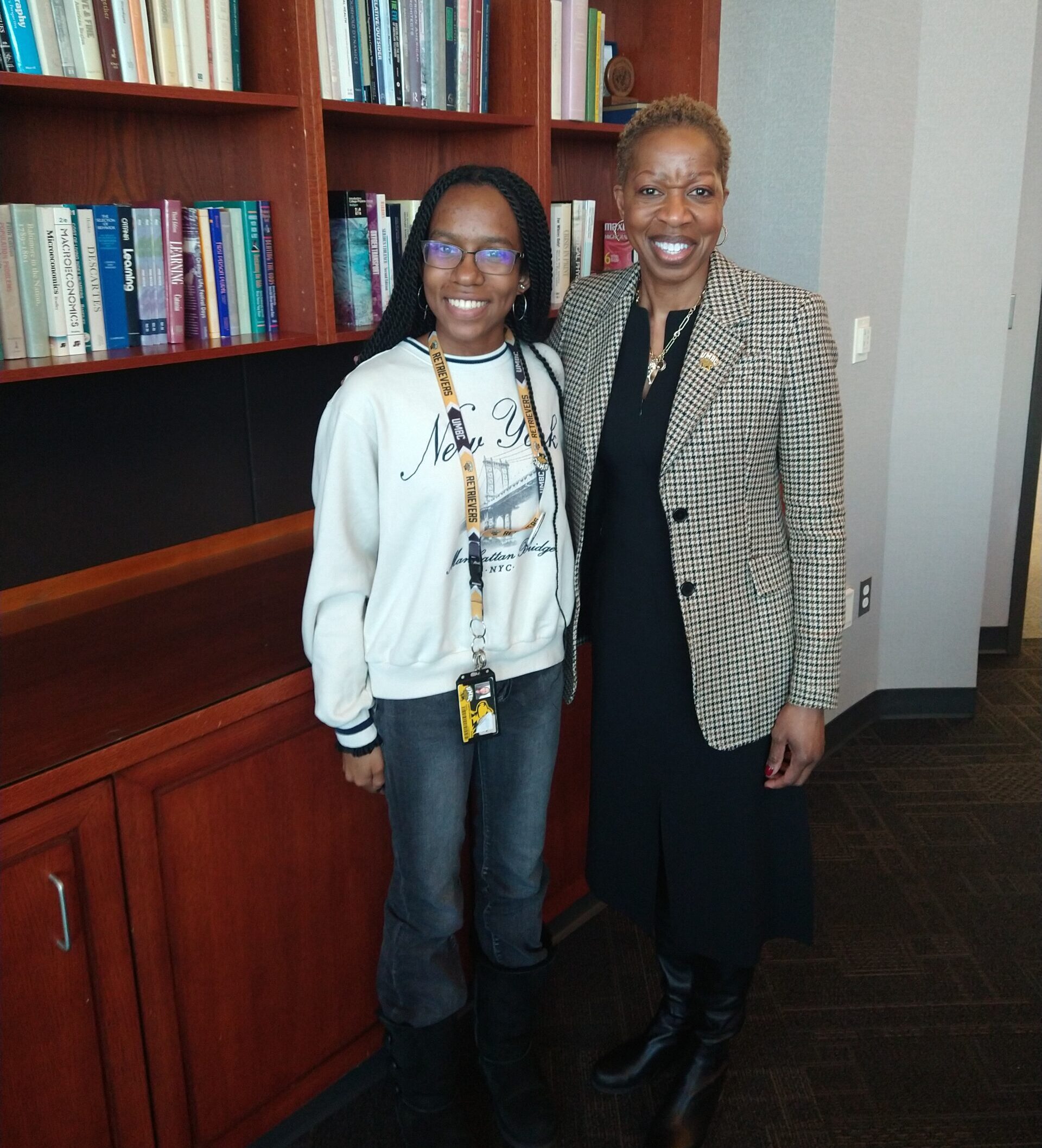
Camryn has visited my office hours in semesters past. She is now a senior, and her first semester at UMBC was also my first. In many ways, we began our UMBC journeys at the same time. Watching her growth over these years has been a privilege. She has found her voice, clarified her intellectual interests, and embraced opportunities with curiosity and courage.
A visual arts major with concentrations in animation and modern languages and linguistics, she has launched a student organization, completed internships, worked as a content developer and videographer, and immersed herself fully in campus life. Her path reflects initiative and imagination. More importantly, it reflects the support of faculty who mentor, staff who guide, peers who collaborate, and a community that makes space for exploration and growth.
Camryn’s story is powerful. But it is not singular. Across UMBC, students are discovering who they are, stretching beyond what they thought possible, and experiencing the kind of transformation that defines higher education at its best. That transformation does not happen by accident. It happens because of the care, commitment, and daily dedication of this community.
Moments like these remind me that what we do here changes lives. And that is something worth celebrating.
This weekend, I had the opportunity to hear Karsonya Wise Whitehead, Ph.D. ’09, widely known as “Dr. Kaye,” who earned her doctorate in language, literacy, and culture from UMBC. She is a powerful voice for equity and community in Baltimore and beyond, and a nationally recognized educator, author, and award-winning radio host. She reminded us of the importance of hoping even when it is hard, staying committed to the long work of building inclusive and just communities, and having the courage to live our values with integrity and purpose.
Her words stayed with me as I reflected on this moment we are living in together. Many people are carrying uncertainty, fatigue, and unease. In times like these, recognizing and honoring one another’s humanity is more important than ever.
I am proud to lead this institution not because we do everything perfectly, but because we are striving to become a place where there is no hierarchy of human value, and I see progress daily. I see large and small efforts to listen, learn, and move us steadily forward. This work happens through teaching and research, service and leadership, and daily acts of care and consideration. It is essential to fulfilling our mission and enabling each member of our community to do their very best work.
In my role, I aspire to lead in ways that will reflect our shared belief in excellence that comes from each of us showing up fully as ourselves and making space for others to do the same. I hope to lead in a way that creates an environment where the value of every individual is clear, where support is real, and where each of you is empowered to thrive in teaching, research, and service.
As we begin this new week, please know this: You belong here. Your work matters. Your presence makes a difference. And this is what gives me hope—not simply naming inclusive excellence, but the actions each of us takes every day to make that a reality. I am excited about the work ahead and honored to be your partner in it.
We humans have long viewed ourselves as the pinnacle of evolution. People label other species as “primitive” or “ancient” and use terms like “higher” and “lower” animals.
This anthropocentric perspective was entrenched in 1866, when German scientist Ernst Haeckel drew one of the first trees of life. He placed “Man,” clearly labeled, at the top. This illustration helped establish the popular view that we are the ultimate goal of evolution.
Modern evolutionary biology and genomics debunk that flawed perspective, showing there is no hierarchy in evolution. All species alive today, from chimpanzees to bacteria, are cousins that each have equally long lineages, rather than ancestors or descendants.
Unfortunately, these outdated notions remain prevalent in scientific journals and science journalism. In my new book, “Understanding the Tree of Life,” I explore why it is fundamentally misleading to view any current species as primitive, ancient or simple. As an evolutionary biologist, I offer an alternative view that emphasizes evolution’s complex, nonhierarchical, interconnected history.
Not primitive, just different
Egg-laying mammals, the monotremes, are frequently labeled the most “primitive” living mammals. This category includes the platypus and four species of echidnas. Indeed, their egg-laying is an ancient characteristic shared with reptiles.
But platypuses also have many unique recent adaptations that make them well suited to their lifestyle: They have webbed feet for swimming and a bill with specialized electroreceptors that detect prey in the mud. Males have spurs with venom that they can use to defend themselves against rivals. If you take a platypus’s view, they’re the pinnacle of evolution for their specific ecological niche.
Echidnas may seem primitive, especially because they lack a capability that humans have—giving birth to live young. Yet they possess many extraordinary traits that humans lack. Echidnas are known for their outer covering of protective spines. They also have powerful claws for digging, a sensitive beak and a long sticky tongue, all of which they use foraging for ants and termites. In a head-to-head competition foraging for prey in a termite mound, an echidna would easily outperform any human.
Other mammals native to Australia also turn up on lists of primitive mammals, such as many species of marsupials – pouched mammals, including kangaroos, koalas and wombats. These species generally give birth to small, minimally developed young that move to the mother’s pouch where they complete development. Pouch development may seem inferior to the human way, but it does have advantages. For example, kangaroos can simultaneously nurture young at three stages of development.
Evolutionary tree appearance depends on focus
Marsupials such as opossums, or monotremes such as the platypus, are often shown at the bottom or left side of an evolutionary tree. However, that does not mean that they are older, more primitive or less evolved.
Evolutionary trees—what scientists call phylogenies—show cousin relationships. Just as your second or third cousin is no more primitive than you are, it is misleading to think of a koala or echidna as primitive because of where they are depicted on these trees.
When scientists and journalists choose which species to include in the evolutionary trees in their publications, it can influence how the public perceives these species. But species shown lower on the page are not “lower” on some evolutionary scale.
Rather, they are placed there because the focus of many of those trees is on placental mammals, such as humans, other primates, carnivores, rodents and so on. When the focus is on placental mammals, it makes sense to include one or two species of marsupials as comparisons for reference.
In contrast, in a tree focused on marsupials, one or two placental mammals could be included at the bottom of the page for comparison.
Why understanding the tree of life matters
Viewing humans as the goal of evolution leads to a misunderstanding of the entire evolutionary process. Since evolution is the conceptual foundation for all biology, this flawed perspective can hinder all biological and biomedical science.
Mastering a modern understanding of evolutionary trees is crucial to advances in fields ranging from animal behavior and physiology to conservation and biomedicine. For example, because rhesus monkeys are much more closely related to us than are capuchins, rhesus monkeys are generally better subjects for preliminary tests of human vaccines. Opossums, incorrectly considered to be primitive, are a great species for providing a broader framework for studies of neurobiology and aging because they are distantly related to us, not because they are lower or more ancestral.
Grasping the profound reality that humans are not the pinnacle of evolution, but one branch among many, is foundational for all modern biology. Understanding the tree of life is central to fully embracing the shared modern status of all animals, from platypuses to people.
With the cold and wintry conditions that delayed the start of in-person classes by a week, it seems strange to refer to this as the spring semester! I hope that you all stayed warm and safe as we worked to resume normal campus operations.
I know that beyond our campus, the challenges in our nation and world are increasingly difficult and felt deeply by members of our community, whether you are affected directly or indirectly. As we begin this new semester together, I hope you will take advantage of every opportunity to lean on and lift up one another, and that the inspiring and essential public mission of UMBC helps sustain us and propel our work every day.
I hope, as well, that each of you found time to rest, reflect, and renew over the winter break. For me—someone who has essentially never left college—such breaks in the academic year are not only a much-needed respite, they also are energizing periods of reflection, planning, and prioritizing for the semester ahead.
After spending a few days with my family in North Carolina—where we gathered in full force, as always—I returned to Baltimore and got down to work. By the end of the break, as usual, my kitchen island was covered with piles of different colored sticky notes, each of them representing different priorities for me and for our leadership team. It looks pretty chaotic, but this is my process for getting to some order. It is what I do to start the semester with a clear sense of the work ahead, what comes next, and what is possible.
When I was a faculty member teaching organic chemistry, I would spend time before every semester thinking about my syllabus and the activities I was going to do in class. I would match pictures from the student directory with the names of those enrolled in my class, so that I would recognize them and be able to call them by name in class.
Today, I think about our students, staff, and faculty and our departments and units across UMBC. I think about our alumni and how I can engage them more deeply in the life of the university. I think about our neighbors in Catonsville and Arbutus, the city of Baltimore, and the state of Maryland, and how we can partner to address challenges and continue to improve our communities. I think about what went well in the last semester and what I could have done better. And I think about our future, mapping out the work I can do to keep us advancing toward our shared vision for UMBC.
Finally, I want to celebrate and amplify a couple of pieces of terrific news: First, UMBC has again been classified as a Carnegie Community Engaged Campus, recognizing the university-wide commitment of our students, faculty, and staff to engage collaboratively in strengthening our communities. Congratulations and thanks to all who contribute to this work that is so deeply embedded in our identity and culture, and to all who played a part in the rigorous effort to achieve this classification from the American Council on Education and the Carnegie Foundation for the Advancement of Teaching.




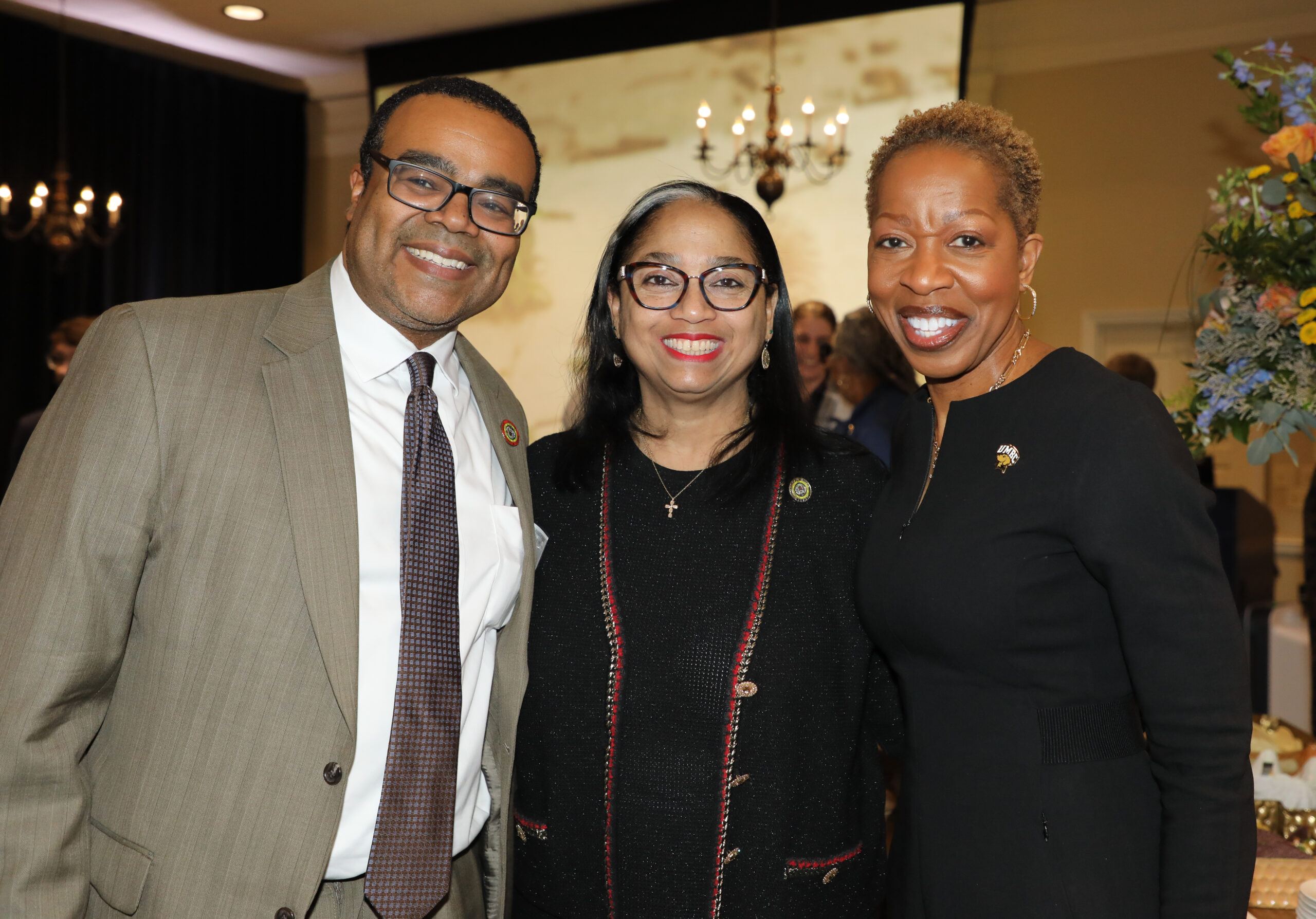 L-R: Senator Charles Sydnor, III, M.P.S ’00, Speaker Joseline Peña-Melnyk, and President Sheares Ashby