All posts by: UMBC News Staff


Last Day of Classes!

Dear UMBC Community,

Happy Last Day of Classes! To our students: I wish you all the best on your final exams, papers, and projects—you are almost there, and I know you can finish strong. To our faculty and staff: Thank you for your dedication to our students and to your work across all departments and every corner of our campus.

To our entire campus community: Congratulations on all you have achieved during this semester and throughout the academic year. I know it has been challenging on many fronts; I hope you all take time to pause and reflect on what you have accomplished and the positive difference you have made for others.

I look forward to joining you in celebrating our graduating students at Spring Commencement next week!

Sincerely,

President Valerie Sheares Ashby

Vunnathi Ankem ’26—finding community and her place at UMBC

For Vunnathi Ankem, psychology, the UMBC experience has been defined by one word: community. As an resident assistant, a researcher, and a multifaceted student leader, she has spent her four years both building community and studying its impact on the human experience. From hosting public service retreats in Baltimore to interviewing members of the South Asian diaspora for her thesis, Ankem’s work bridges the gap between community-centered research and heartfelt advocacy. As she prepares to graduate, she leaves behind a campus made stronger by her leadership and a personal roadmap focused on healing, mentorship, and global research.

Q: What brought you to UMBC?

A: I was really trying to find community, to find a place that fit who I was. And I found that at UMBC. I’ve been welcomed by so many communities here, and that’s not just what brought me to UMBC—it continues to be the reason why I love it. 

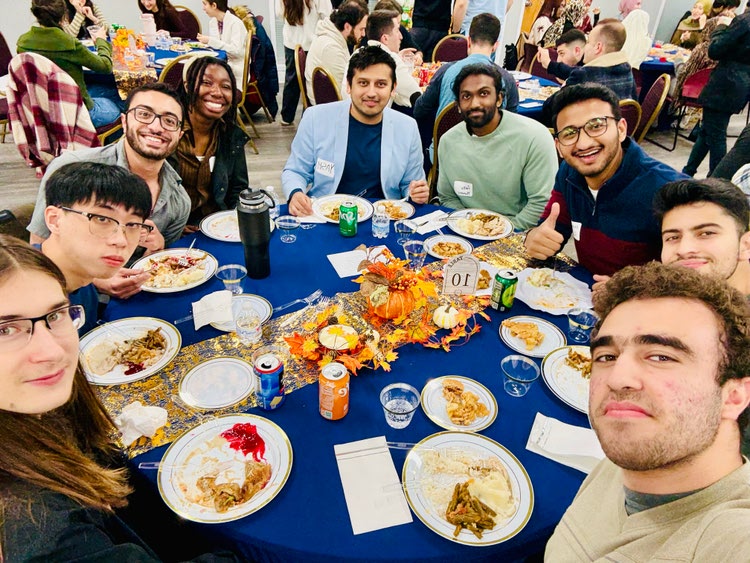
A large group of of students in fancy dress standing outside in front of a building with sunflowers.
Peer mentors from this year’s Shriver LLC floor’s annual Passing of the Torch ceremony.

Q: What drew you to the leadership roles you’ve taken on?

A: The three leadership roles I think about are RA of the Shriver Living Learning Community (LLC), upperclassman chair of the Sondheim Scholars Program Steering Committee, and Honors College Council president. I initially never thought I’d become an RA, but the Shriver LLC floor is something I’m very passionate about. Everyone is always helping each other, and that sort of community is what I love. For Sondheim I was drawn to its public service orientation. I was able to host retreats in Baltimore for first-year students and could make sure they understood how beautiful this city is. My role in the Honors College has become something much deeper after we lost the president and my good friend. She was everywhere and her impact on my life, and on everyone else, continues to be inspiring to me after she’s gone.

Q: What does leadership mean to you?

A: A lot of leadership is serving and listening. As one person, you can’t have all the ideas and you can’t do everything yourself. The best leaders create other leaders because a huge part of leadership is mentorship. You have to always be looking to see who’s interested and giving people the opportunity to grow and blossom and become amazing student leaders. I’ve been lucky to watch that happen in every single role I’ve had on campus. It’s beautiful.

Several students dressed all in red on an athletic filed holding a banner that says "Erickson" for. a community building exercise.
The resident assistant team from Erickson Hall participating in the ResLife tournament over summer training.

Q: Tell us about your honors thesis research.

A: It all started with Alternative Spring Break. The topic was educational justice for youth experiencing intimate partner violence, which inspired me to do research in that field. A psychology grad student from Pakistan, Ellia Khan, in Dr. Christopher Murphy’s lab inspired me with her South Asian perspectives on this research. Our conversations led me to look into what social factors make us believe certain things and develop certain concepts about unhealthy relationships. The South Asian diaspora is an interesting population to study because it’s fast growing and there’s a wide range of experiences. I’ve done about 14 interviews now, and every single person I’ve talked to I’ve learned so much from.

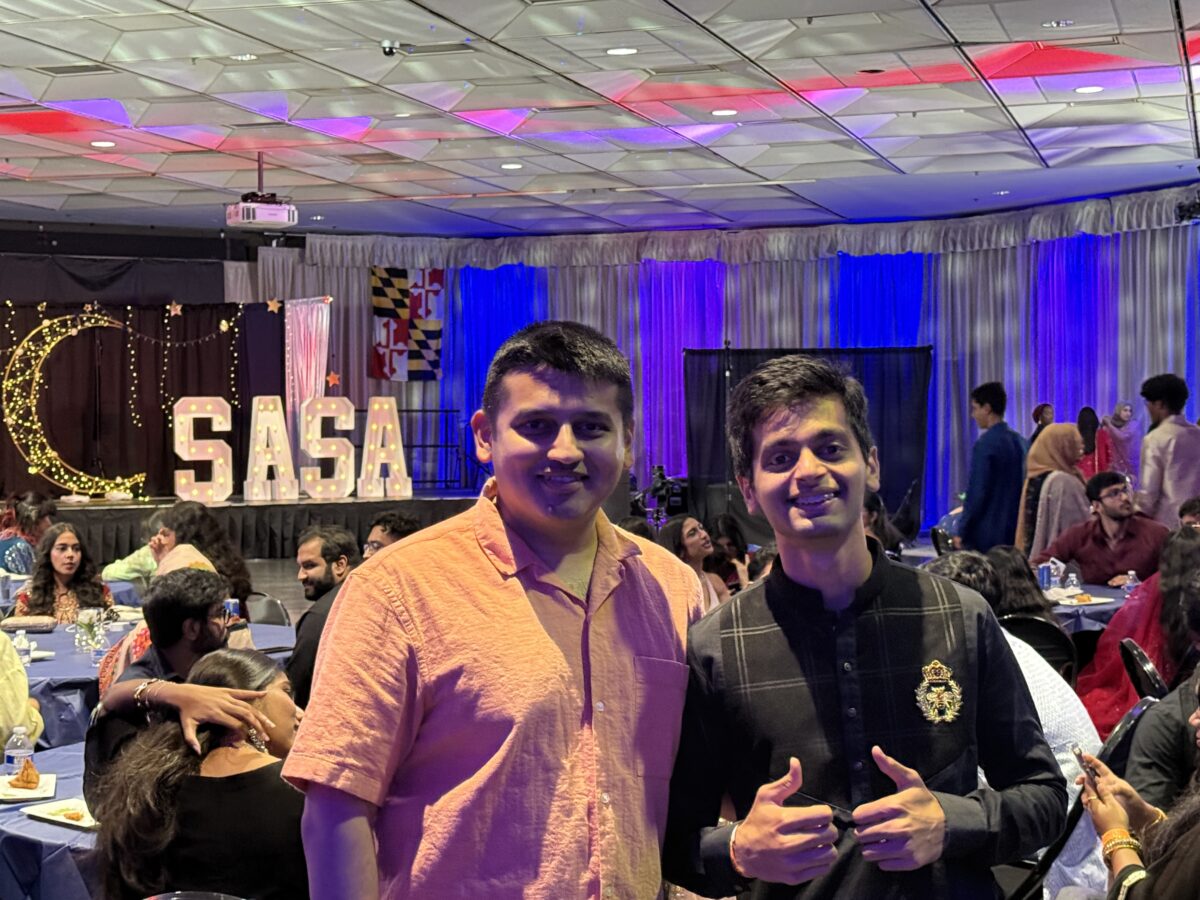
A student in jeans caught mid-dance move with UMBC's president Valerie Sheares Ashby.
Ankem shows President Valerie Sheares Ashby how to dance to the popular Indian song Naatu Naatu.

Q: What advice do you have for incoming students?

A: When I think about what I’m proud of, it’s not the awards, it’s the people. I remember all the people who were there when I needed support—those people meant more to me than any accomplishment. My advice would be to think about what you’ll look back on. It will most likely be community—the people who were there when you weren’t at your best.

Several students gather for a photo in Baltimore's City Hall as they take a moment from the community engagement efforts they volunteered to do.
Ankem, front, right, and others visited Baltimore City Hall during the Alternative Spring Break trip she co-led for the health equity and patient care group.

Q: What does life after UMBC look like?

A: I’ve been thinking about this question for the whole year. I definitely want to pursue a clinical community psychology Ph.D. in the future—that’s the goal.  I was awarded a Fulbright Scholarship, so I’ll be heading to India for a nine-month research project – a sort of extension of my thesis, but with people from different states across India. I’m also excited to return to my Indian classical dancing roots. Something about being on stage and dancing, it’s my ultimate peace.

All photos courtesy of Ankem. Story by Katharine Scrivener, assistant director of alumni and development communications.

Happy Monday: A UMBC Saturday

Dear UMBC Community,

I recently had one of those days that reminded me—through a richly diverse set of experiences—exactly who we are. I had the opportunity to attend three events the first Saturday in May that showcased in different ways the strengths of our community and the contributions UMBC makes to the state of Maryland.

My day began at an open house at the Institute of Marine and Environmental Technology (IMET) in Baltimore’s Inner Harbor, where UMBC faculty, students, and partners are advancing research on the Chesapeake Bay and beyond. The family-friendly open house gave visitors a chance to experience IMET’s research through hands-on science activities, conversations with scientists, and demonstrations exploring marine science. I could see curiosity taking hold in the minds of the attendees.

Then it was on to Maryland History Day, a celebration of the humanities and the culmination of the Maryland History Day contest that we have hosted on our campus for more than two decades. A partnership with Maryland Humanities, the event brought hundreds of middle and high school students whose questions and perspectives are adding to our understanding of history.

I ended the day at the Linehan Concert Hall, listening to “Songs of Freedom,” a concert by the UMBC Jubilee Singers and Gospel Choir. The music was powerful, carrying stories and history and bringing people together. Three different spaces, three different ways of connecting, learning, and contributing to our communities: That is UMBC.

With deep appreciation,

President Valerie Sheares Ashby

UMBC to honor faculty and staff at presidential awards ceremony

UMBC President Valerie Sheares Ashby will host the 2026 Presidential Faculty and Staff Awards Ceremony on Wednesday, May 13, in the University Center Ballroom. The event will take place from 3 to 5 p.m. and will include an awards ceremony and reception recognizing faculty, staff, and university honorees for excellence in teaching, research, mentorship, service, and creative achievement.

Several UMBC community members have received the University System of Maryland Board of Regents awards, including Tara Carpenter for Excellence in Teaching, Michael Summers for Excellence in Mentoring, Curtis Menyuk for Excellence in Scholarship or Research, Brian Kaufman for Excellence in Creative Activity, and Laura Schraven for Outstanding Service for Students.

Other featured honorees include Lindsay DiCuirci, named 2026 – 2029 Presidential Teaching Professor, and Weidong Zhu, selected as 2026 – 2029 Presidential Research Professor. Joby Taylor, Ph.D. ’05, will receive the 2026 Presidential Distinguished Exempt Staff award, while Michele Kimery will be recognized as the 2026 Presidential Distinguished Non-Exempt Staff honoree.

Additional university honors will be presented to David Clurman and Michael Canale, recipients of the 2026 Diane M. Lee Teaching Award; Keith Harmon, recipient of the 2026 Jakubik Family Endowment Staff Award; Maisha Cron, recipient of the 2026 Karen L. Wensch Endowment Award for Outstanding Non-Exempt Staff; Ramana Vinjamuri, recipient of the 2026 Marilyn E. Demorest Award for Faculty Advancement; David Hoffman, Ph.D. ’13, recipient of the 2026 Teresa Lupinek Endowment Award; and Mehdi Benna, recipient of the 2026 UMBC Research Faculty Excellence Award.

Shawn Bearam, Jr. ’26—Getting involved and finding your place on campus

Just tackling the rigors of a college course load on its own can be daunting for any student. But when you add in the additional responsibilities of working and getting involved with co-curriculars, it can become impossible…unless you’re Shawn Bearam, Jr., computer science. Throughout his time at UMBC, he saw how much value this level of involvement and responsibility added to his college career and saw it as his way of giving back.

Q: What drew you to UMBC?

A: I chose UMBC for a few reasons—first because of the scholarships they provided me, and also because of the diversity here. Other schools didn’t have the same diversity UMBC was able to offer. My last reason was the smaller campus. I felt like a smaller campus would allow me the opportunity to connect with professors and I wouldn’t get lost in a large lecture hall. The professors here actually remember me.

Q: Why did you choose your major?

A: I’m a computer science major. I was always considered the tech kid growing up, and in my early college program, one of the pathways was computer science. I discovered that I liked problem solving, seeing what was going wrong, and it became fun for me. 

Q: What inspired you to get so involved in different campus departments?

A: I found communities where it seemed that everyone was having fun together, and I wanted to be a part of that. My first role was working with the events staff in Athletics, then I applied to work with bwtech@UMBC. From there, I applied to work in the Vice President of Student Affairs office as an office assistant and I was promoted to lead office assistant. During my first year I was also hired as a resident assistant, and I was later promoted to lead resident assistant. I also served as a first-year ambassador for SGA.

I started to see that I was able to learn so much here. Overall, I saw people who looked like me in different spaces, and I knew they would be able to understand me, so I wanted to get involved. 

Q: How have your various roles on campus impacted your time at UMBC?

A: My many roles  made me want to stay at UMBC. I had the option to graduate last semester, but I wanted to stay another semester, I didn’t want to leave everyone so soon. I feel safe at UMBC. It also made me want to keep pursuing my education—I knew that being involved in so many different organizations meant I needed to keep my GPA up, so it pushed me to stay focused in my classes so I could keep having fun. 

Q: How did you balance your academic work with your on-campus jobs?

A: It was a struggle at first, but using my Google Calendar helped me manage my time. My employers here also made sure to emphasize the importance of me being a student first.

My community director at Walker Avenue Apartments, LaDonna Wyatt, became a mentor to me while I was searching for internships. I was applying to different places, but it became difficult and I wanted to give up. She pushed me to keep applying and was there for me throughout the process which then led me to getting an internship with the Division of Information Technology for the state. The faculty and staff here really care about the students as a whole. 

Q: What made you decide to join SGA?

A: I was involved in SGA during my early college program at Montgomery College. I felt like I was really making a change while I was there, and I wanted to do the same at UMBC. I started off as a first-year ambassador in SGA here, then I became the director of communications, and I am currently the chief of staff. I knew after my first year that SGA was something I wanted to continue with and I wanted to keep moving up.

Three people talking at a table with food.
SGA’s “Prove It!” event gives UMBC students the opportunity to inspire change on campus. (Brad Ziegler/UMBC)

Q: Through all of your roles on campus, what is one moment that had the biggest impact on you?

A: Being an office assistant in the VPSA office. Everyday they drive me forward, and encourage me with their motto: Strive to unlock potential and transform lives. It really feels like a family. They’ve been asking me about how I feel as I’m getting ready to graduate and making sure that I have everything together. At first, it was a shock to me, but they really care about me even though I’m about to leave, and they care about what I’m going to be doing even after I leave. That role has had the biggest impact on me because they are so invested in seeing me grow and succeed. 

Q: What’s next for you?

A: I was just offered a role with the State of Maryland with the Division of Information and Technology and I will be starting as a project analyst. 

Two people sitting at a table, shaking hands.
Making connections has been at the forefront of Bearam’s UMBC career. (Brad Ziegler/UMBC)

Q: What advice would you give to new students who are curious about getting involved on campus?

A: You may be scared, but sometimes you have to do things while you’re scared too. It may be scary to go to a big (seb) event because there’s so many people, but that may be the place where you find friends. You can be scared while you do things, but still do it. My personal motto is: The worst thing someone can say is “no.” Take those big steps, join the club, and if the club you’re looking for isn’t there—create it! 

My whole experience at UMBC has been amazing—I can be myself here, and I’m not going to be judged. Community is truly the word to describe UMBC. 

Story by Allison John ’24, psychology, graduate coordinator for first-year engagement and anchor programs. All photos courtesy of Bearam unless otherwise noted.

Happy Monday: Honoring the Integral Contributions of Our Support Staff

Dear UMBC Community,

Last week’s Administrative Professionals Day breakfast was a beautiful occasion to honor the integral contributions of UMBC’s administrative support staff. Across campus, their work brings order to complexity and clarity to what needs to happen next. They notice what others might miss, step in where needed, and ensure that the work of the university moves forward with intention and care.

It was a privilege to celebrate our administrative support staff with an inspiring keynote from UMBC’s own Alicia Wilson ’04, vice president for civic engagement and opportunity at Johns Hopkins University. Alicia spoke powerfully to the value of work that gets done, perhaps without ever being noticed—work that supports others, sustains our community, and makes progress possible. She also gave us even more reason to feel proud of UMBC, as she credited this institution and community for so much of her own success.

To our administrative support staff: I hope you felt truly celebrated at the wonderful breakfast co-sponsored by Human Resources and Strategic Talent Management and the Office of Institutional Advancement. I hope you know—every day—that we value you.

Sincerely,

President Valerie Sheares Ashby

Announcing UMBC’s Spring 2026 Commencement Speakers

Dear UMBC Community,

In just a few short weeks, we will come together to celebrate the achievements of our graduates.

Each year, we invite Commencement speakers who reflect the values of our institution and the possibilities before our students. I am excited to introduce the voices who will help mark this important moment.

Please watch this video to learn more about our 2026 Commencement speakers.

I look forward to celebrating together in the weeks ahead.

Warm regards,

President Valerie Sheares Ashby

Spring Updates on Our Work Together

Dear UMBC Community,

It is hard to believe that we are more than halfway through April and a little more than a month away from spring Commencement! I know that everyone has been hard at work inside and outside the classroom, on campus and off, and I see in so many ways the fruits of your labor. 

One recent example was the outstanding news that four UMBC students have been named Barry Goldwater Scholars. Any institution would be thrilled to have one Goldwater Scholar in a given year—as this is one of the most prestigious national scholarships for undergraduates in natural sciences, engineering, and mathematics—but UMBC is celebrating FOUR award winners in one year. Congratulations to Phoenix Bryant, Deeya Mistry, Jessica Slaughter, and Amir Walton-Irvin! We are thrilled that you have received this well-deserved recognition and so excited to see you continue to soar. 

The Goldwater Scholarships honor the achievement and promise of individual undergraduate researchers. For UMBC, they also are a reminder of the importance of our core value of inclusive excellence and our ongoing strategic focus on student success and research excellence. These aims propel our work every day, and they were central in our advocacy in Annapolis during the legislative session that has now concluded. 

Maryland General Assembly Session 

I hope you all have seen the session summary that Paul Monteiro shared with the campus community. I am grateful for Paul’s expertise and his ability to hit the ground running in his first session as UMBC’s vice president for government relations and community affairs. In general, this was a very successful legislative season, and it provided multiple opportunities for UMBC to shine brightly. 

Among those opportunities were the many ways our student legislative interns distinguished themselves in their work, as is the case every year. Another occasion centered around celebrating and honoring Adrienne Jones ’76, who stepped down as speaker of the Maryland House of Delegates after six years at the helm, capping an extraordinary and historic career of service. I am deeply appreciative to Speaker Jones for her steadfast support of UMBC and the collaborative relationship we have enjoyed. I am additionally grateful for the early, enthusiastic support we have felt from Del. Joseline Peña-Melnyynk, who picked up the gavel as Speaker of the House. Our new speaker visited UMBC’s campus just a few weeks before being elected to the leadership role, so she had already gotten a chance to get to know UMBC firsthand—and was impressed!  

Paul’s message about the session offers a comprehensive summary of actions taken by the General Assembly that affect (whether directly or indirectly) UMBC. I would highlight a few outcomes that may be of particular interest. 

I know the budget is of primary concern to many, but first I want to note a couple of measures that go beyond state appropriations. One piece of legislation established the Maryland Artificial Intelligence Partnership in the University System of Maryland (USM), which aims to coordinate and strengthen statewide collaboration in AI research, workforce development, and innovation. We look forward to the development of this partnership and working closely with system leadership and our peers in the USM to realize its promise. 

Another item of significance was legislation passed that would grant collective-bargaining rights to nontenure-track faculty at Maryland’s public higher education institutions, effective July 1, 2026, and, separately, that would grant collective-bargaining rights to graduate assistants at UMBC and University of Maryland, College Park, effective July 1, 2028. To be clear, the legislation does not create new unions; it extends to specific nontenure-track faculty and graduate students the right to organize, should they choose. 

Budget

As for the budget: As a public institution, about a third of UMBC’s budget revenue comes from state appropriations, which is why, as I have said previously, the state’s budget challenges are challenges for us as well—and these are not one-time, one-year pressures. The state’s final budget of $70.8 billion maintains funding for the University System of Maryland at essentially the same level as last year. In practice, that means we will continue operating at our current funding level, while managing the increased costs associated with compensation and other ongoing commitments. Even as we are grateful that no additional cuts were made in the FY27 budget, the current funding level reflects the reduction implemented in FY26.

The challenges before us remain significant as we continue to work through the impact of last year’s reductions. I appreciate all that you have done and continue to do to navigate these changes.

Even in these constrained budget times, I am encouraged by the State of Maryland’s continued commitment to public higher education and to UMBC in particular. We benefit from the strong support of leaders across the political spectrum who understand the role UMBC plays in advancing opportunity and serving the public good—and who see the impact of our work across the state.

In addition to operational funding, that commitment is reflected in the state’s continued capital investments in UMBC. State support remains in place for the completion of Sherman Hall, for the planning and design of a new student services building, and for the future renovation of Sondheim Hall.

Strategic Planning

The realities before us require thoughtful prioritization and intentional investment of our resources. Our strategic planning work comes at the right time, positioning us to make clear choices about where to focus and how to move forward in support of our students; our teaching, research, and service; and our commitment to inclusive excellence. 

I am energized by the progress we have made in recent months. Thank you to our Strategic Plan Steering Committee and to all who have shared in this important work so far, including by participating in the recent strategic plan survey.

Being Accountable to Our Community 

As we move toward a renewed vision for UMBC’s future, we will do so with an inclusive excellence framework and a commitment to living our shared values. Our work toward these aspirations continues every day, sometimes in ways that are visible, and very often in ways that are not. 

Tanyka Barber, vice president for institutional equity, recently shared an update on progress on UMBC’s voluntary agreement with the Department of Justice (DOJ) regarding prevention of and response to sexual misconduct under Title IX. Now two years into the agreement, UMBC has fully implemented all initial provisions and is in the monitoring phase of the agreement. We continue to review and improve policies and processes and strengthen coordination and collaboration among the Office of Equity and Civil Rights (ECR) and campus partners. 

The work falls largely on Tanyka and ECR, but it is appropriately and necessarily the work of all of us. Thank you to Tanyka, ECR, and this entire community for your dedication—not just to satisfying the provisions in the DOJ agreement, which we are doing—but to creating a community that is truly safe, welcoming, and inclusive for all its members and to upholding the highest standards of integrity and accountability. 

Here, I want to acknowledge that some of this work has been the subject of public scrutiny in recent weeks, and I have been asked, among other things, whether I am concerned that news reports of actions taken in our Athletics Department would harm our reputation. Let me be clear: my concern, first and foremost, is for the well-being and safety of our students. I noted above how much progress has been made in addressing the terms of the DOJ agreement. We remain in good standing with the DOJ. Many of you know that we began comprehensive work to strengthen our prevention and response efforts long before the agreement—and that our work goes above and beyond it.

Progress is ongoing, and it will be signaled in part by more reporting of incidents, not less, as community members increasingly trust our processes and know they will be protected and supported through them. So, it is my hope and expectation that over time, our community will be even better and stronger, as will our reputation. 

Likewise, there is more for us to do to be the best possible institutional citizen and neighbor, caring for our campus, our community, and the environment. Recent news stories about the Spring Grove site in Catonsville have caused concern, I know, including reports that UMBC had been cited by the state Department of the Environment for numerous violations related to a stream stabilization project. While I am pleased to report that UMBC has addressed all violations and is now in full compliance with state regulations on this project, there is much more to do—long before we even begin to plan for the future of Spring Grove.

It will require much consultation and much engagement—not one conversation, but many—with our campus community, including faculty with relevant expertise, and with our neighbors, to reach the best-case path forward and outcome. This is my intention, and my promise. 

Staying Informed, Looking Ahead

Widening the view to national and international concerns, we continue to monitor closely numerous issues related to executive orders and actions, international conflicts, and more that are affecting higher education broadly and UMBC specifically. I encourage you to stay informed by reading the periodic updates from our core team (including this one from late March) and visiting the Federal Orders and Actions website, where we are maintaining an evolving list of resources and FAQs.

As we do our best to answer your questions and address your concerns, including about how UMBC responds to international incidents and how we would handle immigration enforcement actions on our campus, we also are navigating uncertainties about federal funding, international student recruitment and retention, and more. 

We expect that the increased challenges for international students to study in the U.S., along with the current political climate, will result in a reduction of international students among incoming undergraduate and graduate students. The size of that reduction is not known at this time, but as we approach National College Decision Day on May 1, UMBC faculty and staff across the university are doing all they can to respond to questions and provide support and opportunities for admitted students to connect and learn about UMBC. 

We do know there is much to look forward to with respect to incoming students this fall. At the graduate level, an exciting new initiative, Free Graduate Application Week, spurred more than 2,100 applications to degree-granting master’s and doctoral programs in one week in January, contributing to a 37 percent increase in domestic applications to master’s programs and a 16 percent increase in international applications to master’s programs compared with the same week in January last year. 

A second Free Graduate Application Week is happening later this spring. As part of our commitment to strengthen Maryland and its communities, the Graduate School and Division of Professional Studies have partnered with the Provost’s Office to offer a special $2,000 master’s program scholarship for Marylanders. These are terrific new efforts that I know will yield great results for our graduate programs, and I am grateful to all who have helped make them happen, including faculty, graduate program directors and coordinators, and, of course, Vice Provost for Graduate Education and Dean of the Graduate School Christa Porter and her entire team.

In undergraduate enrollment news, our first-year applications grew 2 percent over last year, and the admitted student cohort is academically strong and diverse in every way, including geographically. And we continue to grow in our commitment to serve Baltimore City, with a 20 percent increase in applications from Baltimore City students. 

Hats off to Vice Provost for Enrollment Management and Planning Yvette Mozie-Ross ’88 and the Enrollment Management team for their work to attract such outstanding students and serve the state of Maryland. I was delighted to celebrate with them two momentous occasions recently: the opening of the Baltimore Ravens College Track Center—for which we are College Track’s public higher education partner—and our annual Admitted Student Day celebration on April 11. With more than 2,000 newly admitted first-year and transfer students and their families on our campus that day, the energy was palpable, and the optimism and excitement impossible to miss. 

Thank you for all you do for UMBC! I am inspired and honored to be in service with all of you. 

Sincerely,

President Valerie Sheares Ashby

Happy Monday: Over the Rainbow with Corkran Middle Schoolers at UMBC

Dear UMBC Community,

What an absolute delight it was recently to help welcome 200 sixth graders from Corkran Middle School in Glen Burnie for a special performance of The Wonderful Wizard of Oz!

Many of you know that it is a dream of mine that every middle schooler in Maryland will visit our campus. Seeing the Corkran students arrive (on four school buses!) and fill the Proscenium Theatre was a beautiful thing. Even more so was watching them enjoy this brilliant Theatre Department production and engage in a lively Q&A with our students afterward. In their questions, I knew they were imagining that they could do the things they saw our UMBC students doing, whether on stage or behind the scenes.

As I told them, my hope is that their visit to our campus helps them imagine their futures and that one day they may come back to this place as UMBC students. Kudos to our talented students, staff, and faculty for their outstanding creative work and for inspiring so many young minds!

Sincerely,

President Valerie Sheares Ashby

Spring Update on UMBC’s Settlement Agreement with the DOJ

Dear UMBC Community,

I am writing to provide an update on our efforts following UMBC’s 2024 agreement with the U.S. Department of Justice (DOJ) to strengthen and expand initiatives for preventing and responding to reports of sexual misconduct and sex discrimination under Title IX. The agreement followed a lengthy investigation by the DOJ that found systemic failures in the university’s Title IX compliance between 2015 and 2020. 

The agreement is in effect through the 2028 – 29 academic year and commits us to taking many steps to bolster our Title IX office and its work, provide specific support for student-athletes and the Athletics Department, expand training for all members of the community, and provide financial relief to certain individuals, as determined and directed by the DOJ. 

The update provided here shares a report of progress since the fall 2025 update. As required by the agreement, UMBC submitted its fourth monitoring report to the DOJ this winter. The university has fully implemented all of the initial provisions of the agreement and remains in the monitoring phase of the agreement. Thus, the work that we continue to do goes above and beyond what is required under the agreement. It is not the agreement that drives our work, but rather our commitment to uphold the highest standards of care, safety, integrity, and accountability for our campus community. 

Our recent work includes:

  • Increased engagement with our Coordinated Community Response Team to receive feedback on policies, procedures, programming, coordination, and communication efforts;
  • Successful implementation of mandatory Title IX training for students and employees;
  • Expansion of specialized education and training efforts to include offerings for those designated as confidential resources;
  • Targeted support and resources for student-athletes; and
  • Integrated use of restorative practices as an informal resolution method as appropriate.

The Office of Equity and Civil Rights (ECR) in particular bears a significant load of this work.  And, none of this is possible without the dedicated staff who work tirelessly across campus to uphold our commitment. Thanks to the many campus partners who continue to engage and support these efforts.  

Sincerely,

Tanyka M. Barber
Vice President for Institutional Equity and Chief Diversity Officer

Strategic Plan Survey Deadline is this Friday, April 17

Dear UMBC Community,

Thank you to those of you who have already shared your thoughts and feedback with the Strategic Plan Steering Committee. Today, I write to advise you that the deadline for sharing your ideas about UMBC’s strategic plan and pillars via this survey is Friday, April 17. You can choose which sections of the survey to complete. All responses are anonymous and confidential.

We also want to remind you to visit the strategic planning website and complete the feedback form on the homepage.

We encourage those of you who have not yet provided your thoughts to do so; your voice will ensure the UMBC Strategic Plan is as strong as it can be.

Regards,

Charissa S. L. Cheah
Professor, Psychology and Asian Studies Affiliate Faculty
Chair, Strategic Plan Steering Committee

Happy Monday: A Shared Commitment to Shared Governance

Dear UMBC Community,
 
One of the privileges of serving as president of UMBC is that the role gives me a view of the entirety of the institution and the chance to hear voices from all across it, through a regular cadence of engagement with shared governance groups on our campus. 
 
My calendar was particularly full of such opportunities last week, as I participated in meetings of the Faculty Senate Executive Committee, Exempt Staff Senate, and University Steering Committee (whose members represent every UMBC governance group), as well as an all-staff meeting hosted by the Exempt and Nonexempt Staff senates. These meetings and others connect me to all parts of the community and allow me to join you in the work of thinking through current issues and planning for a shared vision for the future. 
 
Through the questions, feedback, and ideas I heard from so many of you, last week’s meetings reflected the richness of experiences and viewpoints across our institution and were a terrific reminder of the strength of shared governance at UMBC. 
 
Sincerely,
 
President Valerie Sheares Ashby