All posts by: Dinah Winnick


UMBC welcomes Katharine H. Cole as vice provost and dean of Undergraduate Academic Affairs

Katharine H. Cole has joined UMBC as vice provost and dean of Undergraduate Academic Affairs (UAA). Cole’s tenure began on August 14, 2017, just ahead of the university’s fall 2017 semester.

“I am truly honored to have the opportunity to join UMBC’s community of outstanding students, innovative and dedicated faculty and staff, and visionary and talented leadership,” says Cole. “UMBC’s comprehensive vision of education, inclusive culture, and uncompromising dedication to student success make working here an exciting and inspiring place to be.”

Cole joins UMBC from the University of Tampa, where she served as associate provost and dean of academic services for five years. Prior to that, she served as associate dean of undergraduate studies at the University of South Florida (2010 2012).

Cole also held faculty positions at the University of Maryland, Baltimore; University of South Florida; and University of Tampa, and, early in her career, was a postdoctoral fellow and a clinical research scientist for the National Cancer Institute at the National Institutes of Health. She holds a B.A. in biological sciences from the University of Delaware, M.A. in zoology from the University of Northern Colorado, and Ph.D. in pathology from the University of Maryland School of Medicine.

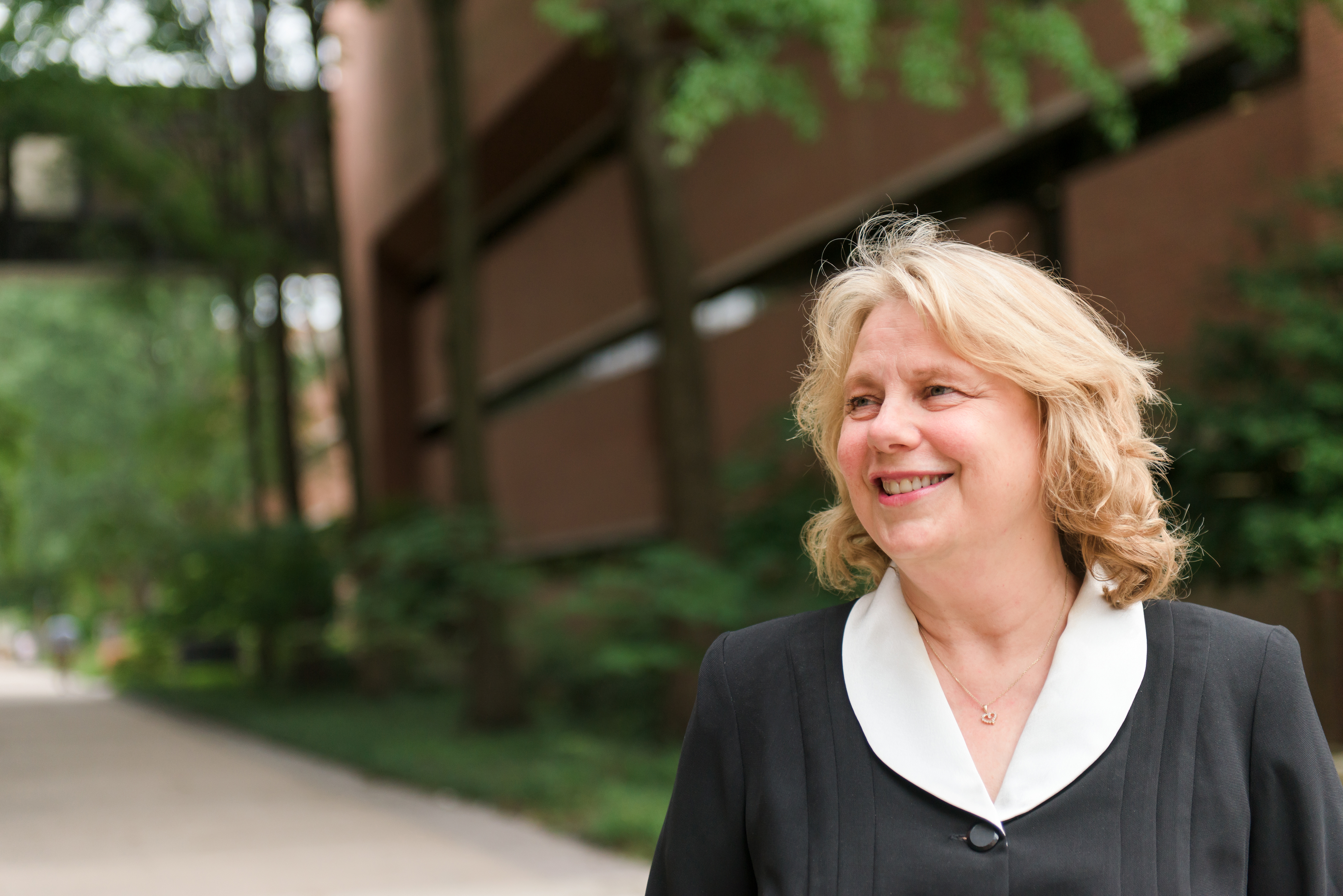
Katharine Cole stands in UMBC's academic row, in front of brick buildings and foliage.
 
To her new role at UMBC, Cole brings extensive experience in research, teaching, and academic administration, as well as an outstanding record of leadership in academic affairs and community engagement. She is deeply committed to ensuring effective participation in shared governance by university staff, faculty, and students. Additionally, she has been recognized for significant contributions to the advancement of student success, advising, and academic standards and integrity.

As vice provost and dean, Cole will lead the Division of Undergraduate Academic Affairs in offering programs that deliver a distinctive UMBC undergraduate experience. She will guide and review curricula, programs, and academic policy, and foster collaborative relationships with both colleagues across campus and external partners, with the goal of supporting the success of all students. Units and programs within the UAA include the Office of Undergraduate Education, Honors College, Interdisciplinary Studies Program, Women’s Center, Learning Resources Center, Meyerhoff Scholars Program, and Sherman STEM Teacher Scholars Program.

CAHSS Dean Scott Casper chaired the vice provost and dean of UAA search committee. He and Provost Philip Rous particularly recognize the essential contributions of Simon Stacey, director of UMBC’s Honors College, who served as interim dean throughout the process, offering steady guidance and leadership.

Now on campus, with the start of the semester just on the horizon, Cole says she is excited to get underway in her new role at UMBC. She shares, “I look forward to working with the dynamic and creative campus community to advance and support the innovative teaching, research, and civic engagement opportunities we offer for our students.”

UMBC selected for national initiative to prepare the next generation of social justice leaders

The Association of American Colleges and Universities (AAC&U) has selected UMBC as one of 10 institutions nationwide to participate in a bold, new initiative designed to “educate, prepare, and inspire the next generation of leaders to advance justice and build equitable communities.”

Participating colleges and universities will establish Truth, Racial Healing and Transformation (TRHT) Campus Centers to engage campus and community stakeholders around issues impacting racial equity, such as conscious and unconscious bias. AAC&U President Lynn Pasquerella shares that this is the first piece of a broader vision “to ensure that higher education is playing a leadership role in promoting racial and social justice” through a future national network of 150 such centers.

Frank Anderson, assistant director of The Choice Program at UMBC, coordinated UMBC’s TRHT proposal, with support from Zeevelle Nottingham-Lemon, associate director. The Choice Program has served more than 25,000 youth from Maryland’s most underserved communities for nearly 30 years, providing 24/7 wrap-around support. The program is based in UMBC’s Shriver Center, which works to realize the vision of Eunice Kennedy Shriver and Sargent Shriver to mobilize higher education to confront and solve major challenges facing urban America today.

“The Shriver Center’s Choice Program at UMBC recognizes that now, more than ever, there exists a need to create platforms for Baltimore City youth, UMBC service-learners, and our communities to voice their truth about systemic racism, and to seek opportunities for transformation,” says Anderson.

UMBC’s proposal focuses on the Shriver Center’s service-learning and community engagement work with youth, artists, advocates and community-serving organizations in and around Baltimore. It also incorporates plans for youth-led community conversations, at UMBC and in Baltimore, around racial equality and transformation. The $30,000 AAC&U grant will support The Choice Program’s Youth in Action group, which unites students and service-learners at UMBC with youth in Baltimore through art and social justice, and college night programming for Baltimore City school students, among other activities.

“Youth are often the most affected by social justice issues, but the least represented when solutions are sought,” says Anderson. He suggests that UMBC is in a strong position to elevate their perspectives, experiences, and ideas given the university’s history of youth mentoring and organizing through The Choice Program, as well as robust partnerships in Baltimore City Public Schools and other youth-serving organizations.

Across the country, 125 institutions applied to participate in this first cohort of TRHT Campus Centers. UMBC is joined by Brown University, Duke University, Spelman College, Rutgers University, and other innovative institutions on the list of 10 sites selected to launch the program’s first stage.

The UMBC TRHT Campus Center team includes Eric Ford, associate director of the Choice Program; Beverly Bickel, clinical associate professor of language literacy and culture; Keisha Allen, assistant professor of education; Charlotte Keniston, associate director of the Peaceworker Program; and Eloise Grose, program coordinator for service-learning in the Shriver Center, in addition to Anderson and Nottingham-Lemon.

“We are honored that UMBC has been selected to help launch this new national program. Our university is dedicated to open inquiry and understands that the diversity of our community is one of our greatest strengths,” says President Freeman Hrabowski. “Preparing today’s young people to serve as the next generation of leaders in creating a more equitable society is core to our mission as a civically-engaged public research university.”

Featured image: Administration Building and flags at the main entrance to UMBC. Photo by Marlayna Demond ’11 for UMBC.

UMBC alumnus Jerome Adams confirmed as U.S. surgeon general

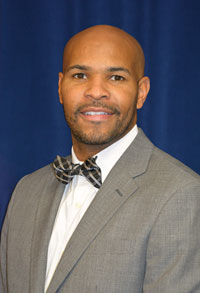
The U.S. Senate has formally confirmed Jerome Adams ’97, M4, biochemistry and molecular biology, for the position of U.S. surgeon general. He replaces Rear Admiral Sylvia Trent-Adams Ph.D. ’06, public policy, who served as acting U.S. surgeon general beginning in late April. Both alumni have prioritized serving vulnerable populations and maintaining connections with local communities throughout their accomplished careers.

In the opening statement for his nomination hearing, Jerome Adams took care to demonstrate his commitment to partnerships and relationship-building, writing that the “Top Doctor” nickname for the surgeon general “doesn’t do justice to the diversity of professions represented in the Health Corps—nurses, pharmacists, therapists, scientists, and many others, in addition to some of the country’s best doctors.”

He has had the opportunity to work with and learn from these varied professionals in his roles as a practicing anesthesiologist, associate professor at the Indiana University School of Medicine, and state health commissioner under then-Indiana Governor Mike Pence. Adams shared in his statement, “In this dual role as both clinician and educator, I see the impact of health policy decisions on both providers and the patients we serve.”

Adams plans to emphasize active engagement with communities as surgeon general, focusing on a need to “learn about their obstacles and successes, share best practices, and help empower them to implement local solutions to their toughest problems.”

Former colleagues attest to Adams’ record in this area. “He has his hands on the pulse of what’s going on in communities,” Virginia Caine, director of the Marin County Health Department, told the Indy Star. “He gets right out there at the grass roots level and really identifies with the folks he needs to serve.”

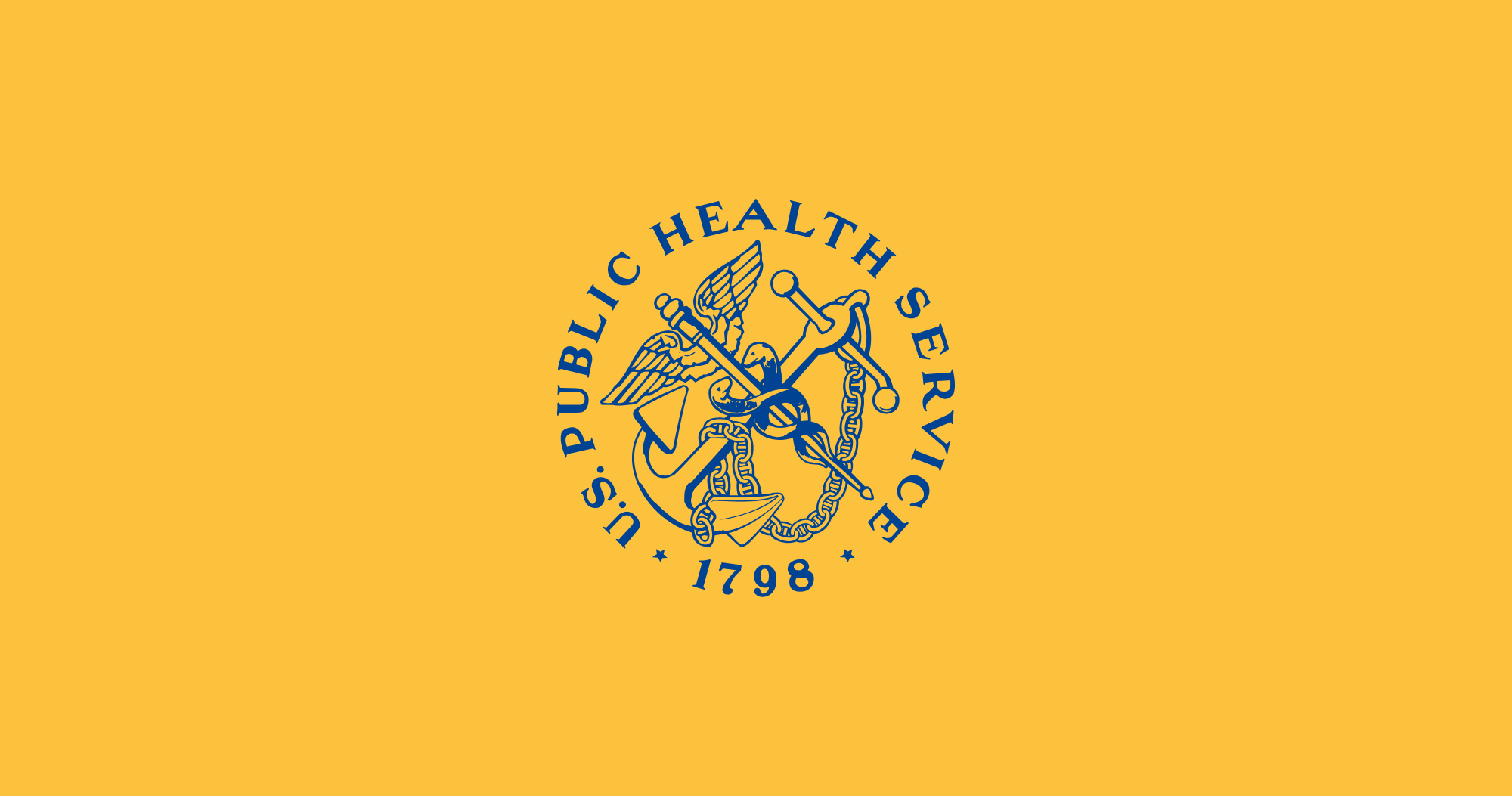
Mustard yellow flag of the Flag of the United States Public Health Service, featuring navy blue United States Public Health Service seal, with ship anchor and Caduceus symbol.

As surgeon general, Adams intends to focus on the opioid crisis—a problem he’s familiar with from his work in Indiana. There, he advocated for legislation that would give family members of people struggling with opioid addiction access to Naloxone, a drug that can reverse the effects of opioid overdose. He wrote in his statement to the senate committee, “The addictive properties of prescription opioids is a scourge in America and it must be stopped.”

Reflecting on his undergraduate years at UMBC as a Meyerhoff scholar, Adams shared with UMBC, “one of my biggest mentors was Dr. Hrabowski, and I still stay in touch with many of my Meyerhoff colleagues and rely on them as a professional support network.” He also pays that support forward, according to Joey Fox, who worked as his legislative director in Indiana. Fox described Adams as a “compassionate leader” and told the Indy Star, “He was always willing to have his door open.”

See previous coverage of Adams’s nomination and additional information on Sylvia Trent-Adams in UMBC News.

Header image: Fully restored U.S. Capitol Rotunda interior, completed in 2016. Photo by Architect of the Capitol.

Princeton Review names UMBC one of the nation’s top universities in 2018 guide

Princeton Review has again featured UMBC as one of the nation’s top universities in its popular undergraduate guide, The Best 382 Colleges, published this week. Put simply, Princeton Review Editor-in-Chief Robert Franek says, “We chose UMBC for this book because it offers outstanding academics.”

UMBC fit into the top 15% of 2,500 colleges Princeton Review considered. Their analysis included 137,000 student ratings of colleges and universities across dozens of categories, from financial aid to career services and the classroom experience. It also incorporated feedback from college administrators and from Princeton Review visits to participating campuses.

Princeton Review’s UMBC profile particularly highlights the quality of teaching found at the university, and faculty’s deep commitment to supporting student success. One student shared that UMBC is home to “extremely intelligent professors that have a knack for inspiring the students.” Others noted, “this is a university where teaching comes first” and “most of the professors are so helpful” when it comes to offering students additional support through office hours.

The guide recognizes UMBC’s solid reputation as a place where “students take education seriously,” referencing the common feeling across the university that “UMBC is a place where it is cool to be smart.” But this level of student engagement isn’t limited to academics, Princeton Review emphasizes. One UMBC undergraduate shared, “almost every student at UMBC is involved with at least a couple of extracurricular activities, which connect them to the campus.”

“Overall, it seems, ‘People fit in [at UMBC] by being intellectually creative and finding a community,'” The Best 382 Colleges guide notes.

Reflecting further on the college experience, one student shared, “UMBC wants to see every student succeed—they provide you with the tools, people, and resources to make sure you get where you want to go in life.” The guide also points out that UMBC “has a strong reputation for diversity and students feel ‘it enriches our school and everyone gets to know everyone despite culture or ethnicity.'”

Specific UMBC programs highlighted in the guide range from the sciences and mathematics to the performing arts, with special recognition going to UMBC’s “technologically advanced” Performing Arts and Humanities Building. The university’s convenient location just outside of Baltimore, near Washington D.C., also received high marks.

In January of this year, Princeton Review also featured UMBC in its 2017 Colleges That Pay You Back guide, which includes the nation’s top colleges that balance “a superb education with great career preparation and at an affordable price.” Most recently, Forbes and Money magazines recognized UMBC as a “great investment” for students, and The Chronicle of Higher Education named UMBC one of the nation’s top academic workplaces for the eighth year in a row. That ranking distinguished UMBC as an “honor roll” institution, as one of just ten large universities nationwide to excel in nearly every measured category.

Header image: UMBC’s Orientation Peer Advisors, summer 2017. Photo by Marlayna Demond ’11 for UMBC.


UMBC’s Tim Hall named president of Division I-AAA Athletics Directors Association

UMBC Athletics Director Tim Hall has been named the new president of the Division I-AAA Athletics Directors Association (ADA) for the 2017 – 18 academic year, beginning this month. Hall is entering his fifth year as the Retrievers’ athletics director. He previously served as ADA 1st vice president in 2016-17, and his elevation to president was confirmed by a unanimous vote at the 2017 NACDA Conference in Orlando, Florida.

This position continues Hall’s national leadership in collegiate athletics. He currently serves on the NCAA volleyball rules committee and previously served on the NACDA Division I-AAA Executive Committee. He was also chair of the NCAA Committee on Women’s Athletics (CWA) for fall 2014, after serving on that committee since 2011, and previously chaired the Disability Subcommittee of the CWA Minority Opportunities and Interests Committee, 2012 – 14.

“I have thoroughly enjoyed my tenure on the executive committee and leadership group of the I-AAA ADA and am thrilled to be chosen as its president for the upcoming year,” said Hall. “There are so many critical issues that athletic directors face in today’s climate and this group has always put the student-athlete in the center of its bulls-eye. I am anxious to get started guiding this committed group of leaders.”

The Division I-AAA ADA is a professional organization that includes Division I athletics directors from across the United States, Canada, and Mexico, specifically from institutions that do not sponsor football. It is administered by the National Association of Collegiate Directors of Athletics (NACDA), which includes more than 12,500 individual members from more than 1,600 institutions.

“Tim Hall’s appointment as president of the I-AAA Athletic Director’s Association is a recognition not only of his role as a leader in intercollegiate athletics, but also of the value he places on collaboration,” said UMBC President Freeman Hrabowski. “I know he will work hard over the next year to advance initiatives critical to all of the association’s institutions.”

Under Hall’s stewardship, the Retrievers have experienced unparalleled success in women’s and men’s soccer, multiple consecutive conference titles in men’s and women’s swimming and diving, and America East titles in men’s cross country (2013) and baseball (2017). He has hired new head coaches in men’s basketball and men’s lacrosse, Ryan Odom and Ryan Moran, who have led their teams through strong initial campaigns.

For additional details on Hall’s new role, UMBC Athletics during Hall’s tenure, and the NACDA, see the announcement at UMBC Athletics.

Photo of AD Tim Hall by Marlayna Demond ’11 for UMBC.

UMBC named one of the nation’s top academic workplaces for 8th consecutive year

The Chronicle of Higher Education has just named UMBC one of the nation’s top academic workplaces for the eighth year in a row. UMBC is one of 18 large universities from across United States to be recognized on the “Great Colleges to Work For” list, and one of just ten large universities to be featured on the distinguished “honor roll” for institutions that excel in nearly every measured category.

The Chronicle develops its list annually based on workplace policies and findings from a robust survey that asks faculty, staff, and administrators to rate their workplaces on a variety of factors. The publication’s 2017 survey received responses from more than 45,000 employees of 155 four-year and 77 two-year institutions nationwide (see methodology).

This is the sixth consecutive year that the Chronicle has featured UMBC on its prized “honor roll” list, thanks to UMBC’s high ratings in the following categories:

  • Collaborative Governance
  • Compensation & Benefits
  • Confidence in Senior Leadership
  • Facilities, Workspace & Security
  • Job Satisfaction
  • Professional/Career Development
  • Respect and Appreciation
  • Supervisor/Department Chair Relationship
  • Teaching Environment (Faculty Only)
  • Tenure Clarity & Process (Faculty Only/4-year Only)
  • Work/Life Balance

This recognition affirms that “UMBC is a community that truly cares about people,” says President Freeman Hrabowski. He shared with the Chronicle:

Our faculty, staff, and students believe that excellence and inclusiveness can — and must — go hand in hand. That conviction forms the core of our teaching-and-learning philosophy and has made us one of the most innovative universities in the country. People know that they can take risks because even if they fail, this community will be supportive.

In other recent rankings news, both Forbes and Money magazines also just recognized UMBC as a “great investment” for students. 

Photo by Marlayna Demond ’11 for UMBC.

Forbes and Money magazines recognize UMBC as a “great investment” for students

Both Forbes and Money magazines have again recognized UMBC as one of the top value universities nationwide, providing one of the best investments that students and their families can make in higher education.

The Forbes 2017 Best Value College ranking assesses which schools “deliver the best bang for the tuition buck based on tuition costs, school quality, post-grad earnings, student debt and graduation success,” using data from the U.S. Department of Education’s College Scorecard and the PayScale salary database. Forbes ranks UMBC as one of the top 200 of all universities nationwide and one of the top 75 public U.S. universities in value.

UMBC’s Forbes profile highlights the university’s unique programs in game development, Asian studies, and naval science. It also notes UMBC’s strengths across a wide diversity of fields, from a major research partnership with NASA to the Center for Art, Design, and Visual Culture.

Money’s 2017 Best Colleges for Your Money ranking, released this week, evaluates 2,400 U.S. colleges and universities across 27 factors, and names UMBC one of the nation’s top 300.

Jeffrey Selingo writes in The Washington Post, “Money magazine was one of the first to use data on the employment outcomes of graduates, and its rankings remain among the best for students and parents to consider.” The measure assesses educational quality, affordability, and alumni success to identify schools that represent a “great investment.”

UMBC “is a young school, but it has built an impressive record since its founding in 1966,” Money’s profile of the university notes. It emphasizes, “UMBC prides itself on its diverse campus and student body.”

Like Forbes, Money highlights UMBC’s diverse array of academic offerings, including graduate programs in human-centered computing, atmospheric physics, and interdisciplinary language, literacy, and culture, and particularly popular undergraduate programs in biology, computer science, and the social sciences. It also highlights the bwtech@UMBC Research and Technology Park’s strengths in the life sciences, clean energy, and cybersecurity; over a dozen research and academic centers across technology, science, policy, and the arts; and a number of living-learning communities for students.

“Professors at UMBC are truly passionate about what they teach and make it a point to help the students understand each and every topic,” notes one student, in the Money profile. Another student calls academics “really where this school shines,” commenting that at UMBC “professors are absolutely great” and the “variety of courses here is unbelievable.”

One student comment focuses specifically on UMBC’s sense of community, sharing, “This school is very much like a cultural melting pot. There are so many different events/organizations to get involved with. This university is very academically focused, however it can also be a lot of fun.”

They also note, “The brightest students in the area come to this school, which is great because you can have meaningful dialogue with people here. […] It’s easy to network and make connections with people within the school, and companies/organizations in the area (we have a great reputation).”

UMBC is joined in Money’s top 300 by three other University System of Maryland schools: Towson University, Salisbury University, and the University of Maryland, College Park.

UMBC and Peru’s Universidad de Piura establish academic collaboration

UMBC and the Universidad de Piura (UDEP) signed a new academic agreement on June 30, 2017, representing the first such partnership between UMBC and an institution of higher education in Peru. This agreement formalizes emerging collaborations between UMBC’s master’s program for teaching English as a second language (TESOL) and UDEP’s Centro de Idiomas (Language Center).

The two universities seek to share TESOL methodologies and best practices, and to benefit from opportunities for cross-cultural exchange. The agreement enables UMBC TESOL students and alumni to provide English language instruction at UDEP, while improving their Spanish language skills and knowledge of Latin American culture. It also outlines plans for visiting scholars to present academic talks or organize international symposia at each of the partner institutions.

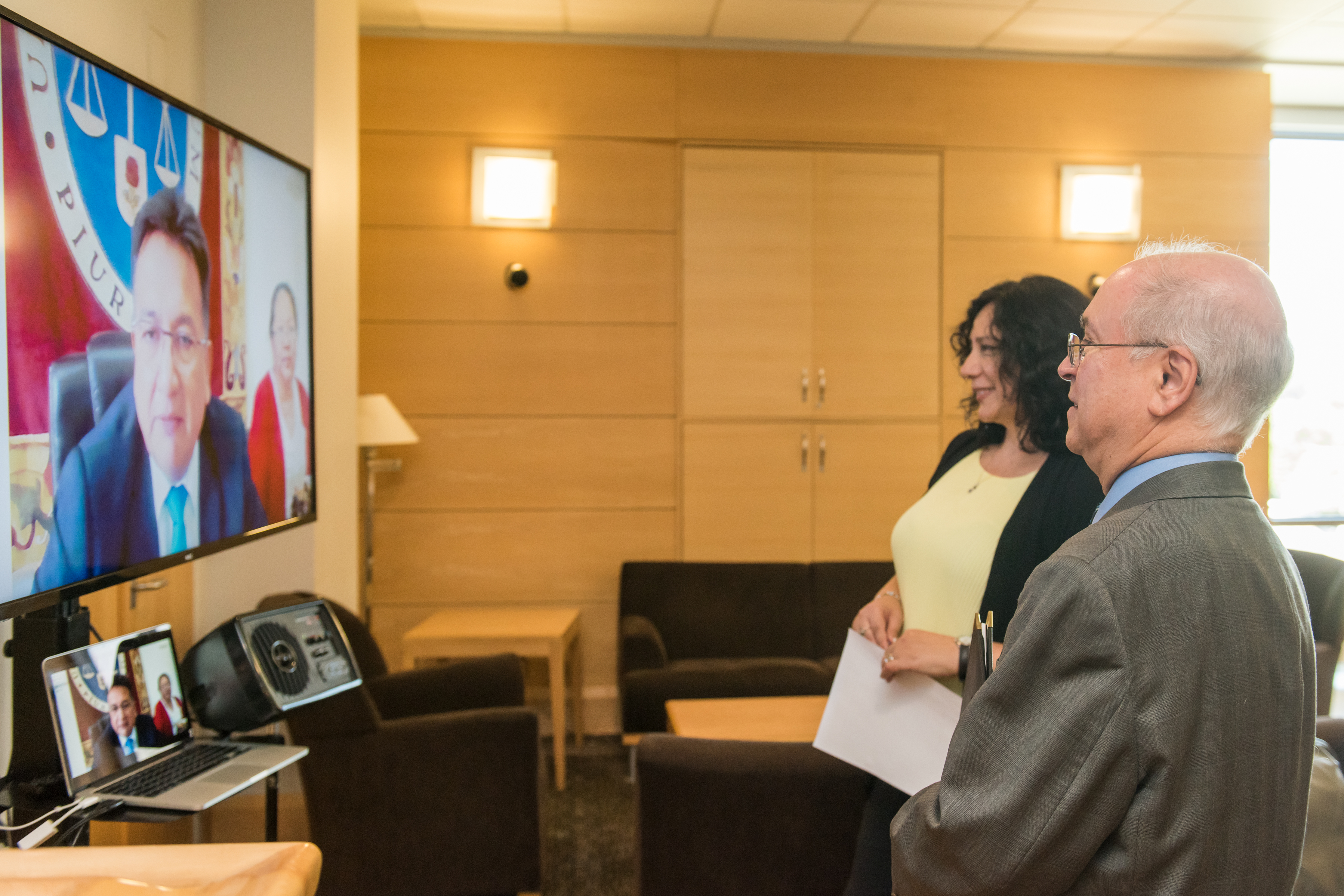
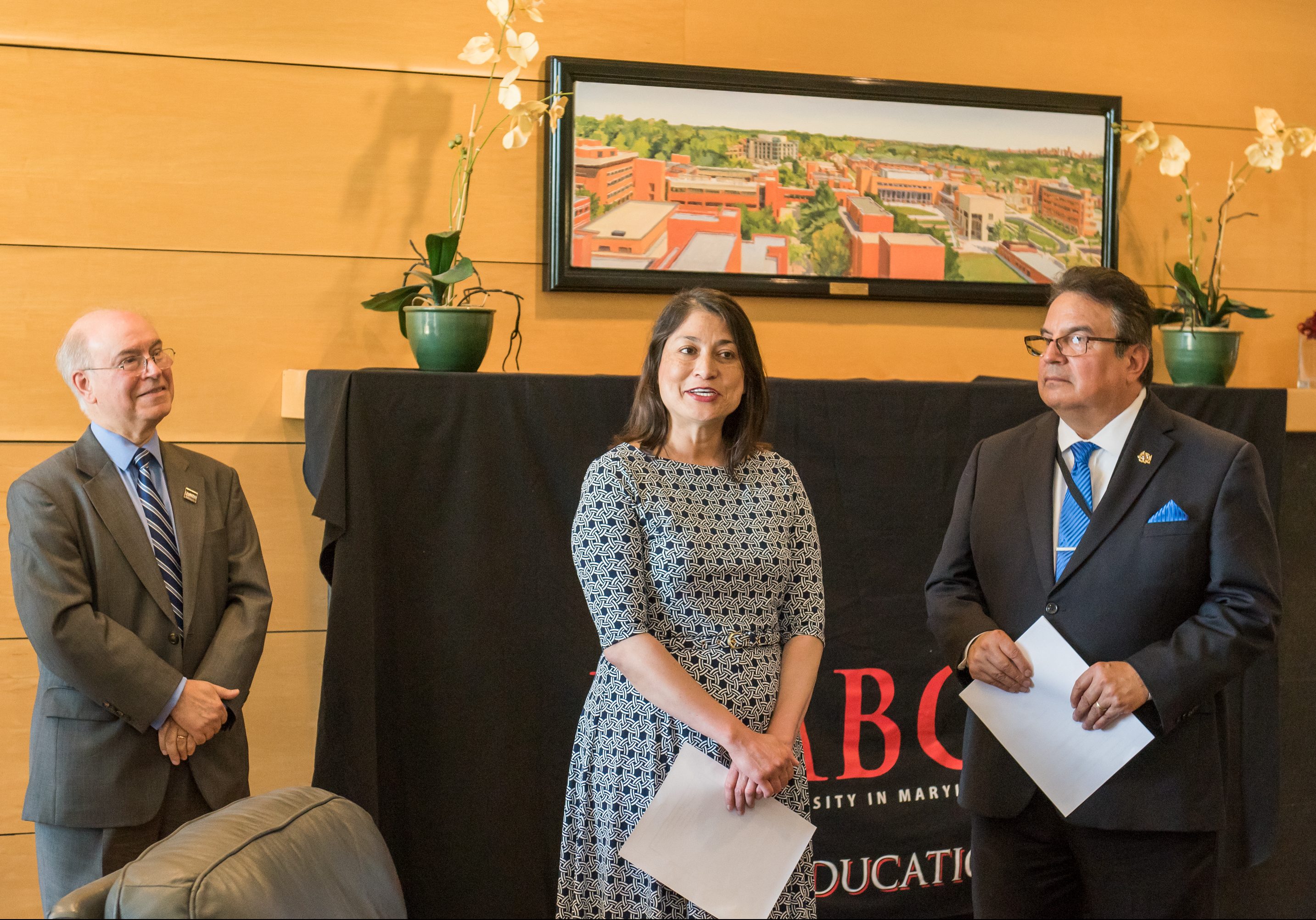
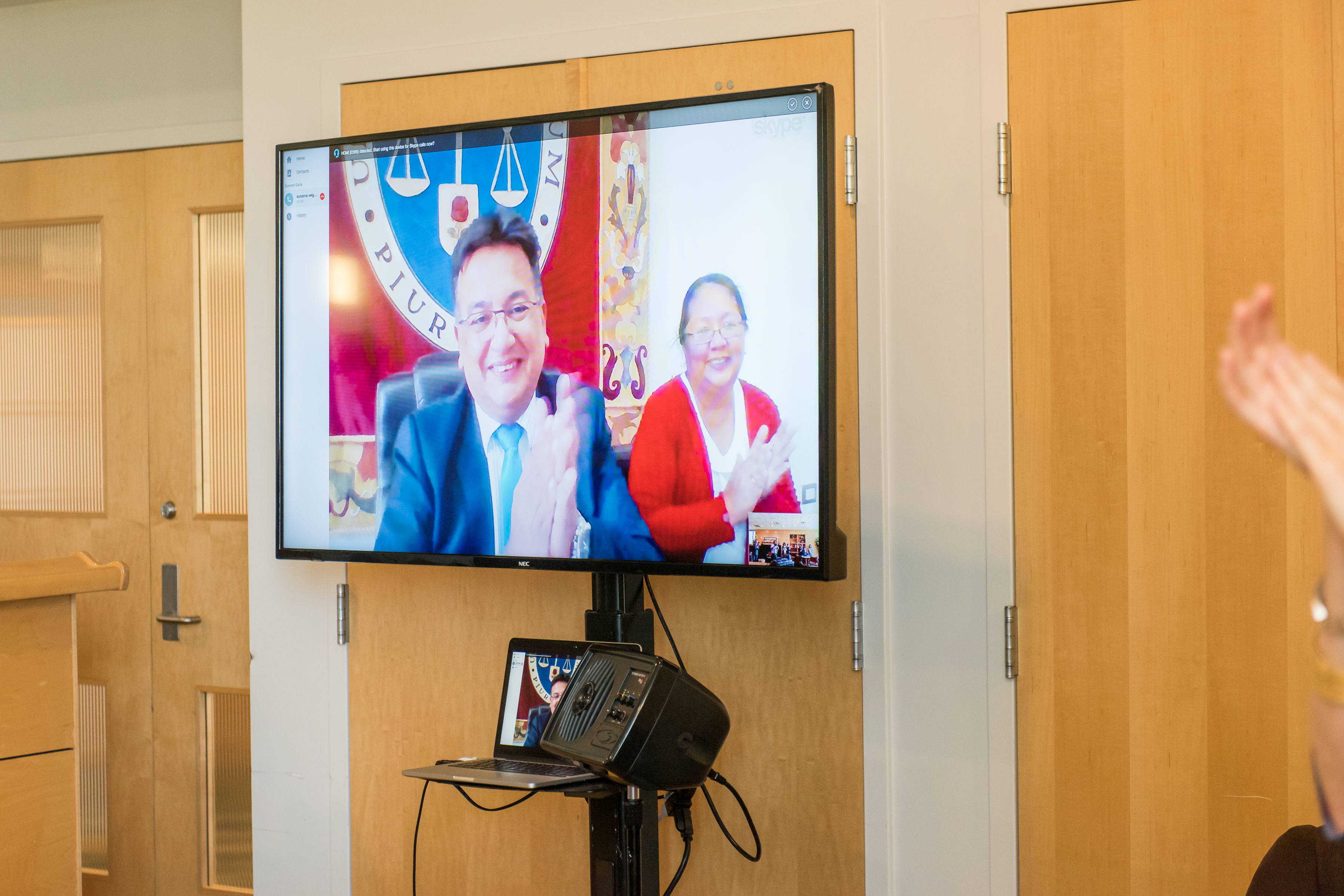
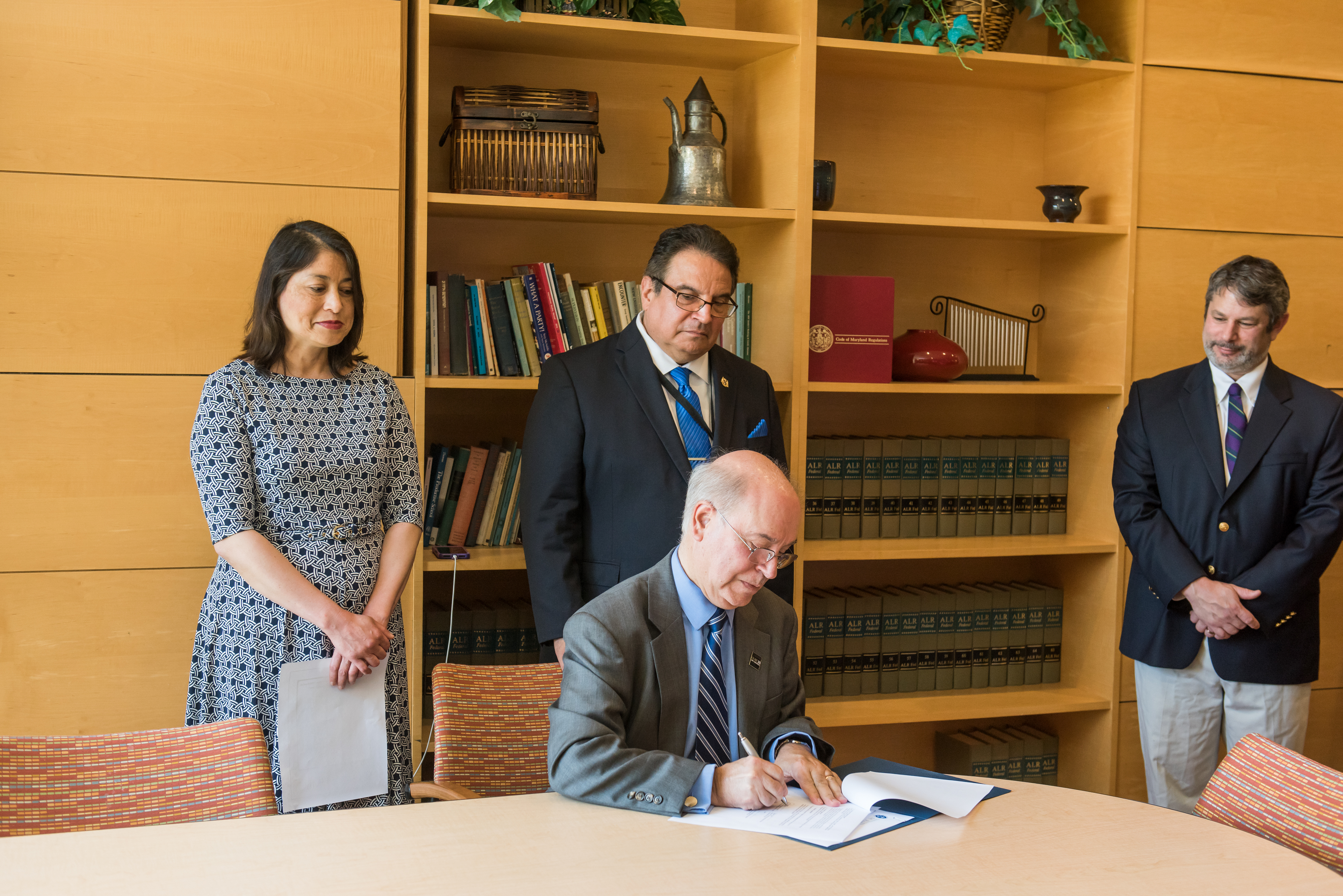
Antonio Moreira, vice provost for academic affairs, signed the agreement on behalf of UMBC in UMBC’s Fireside Lounge and UDEP Rector Sergio Antonio Balarezo Saldaña participated by live video feed.

Balarezo Saldaña (l) and Moreira (r) greet one another ahead of the signing, with Schwartz providing translation support.

Jonathan Singer, associate professor and chair of education; Doaa Rashed, M.A. ’08, TESOL, TESOL director and Ph.D. candidate in language, literacy, and culture; and Mary Tabaa, TESOL instructor, also attended on behalf of UMBC. Additional witnesses included Maryland Deputy Secretary of State Luis E. Borunda; Mary Nitsch, M.A. ’99, TESOL, director of international affairs for the Maryland Office of the Secretary of State; Consul General of Peru in Washington, D.C. Ana Cecilia Gervasi (who has since become consul general in Toronto, Canada); and Susana Vegas, director of international relations for UDEP, as well as Madelaine Pella Schwartz, M.A. ’10, TESOL, chair of the Maryland–Piura Sister State partnership‘s Education Committee.

Gervasi (center) provides remarks on behalf of the Peruvian consulate, as Moreira (l) and Borunda (r) look on.

“For us this is a very special moment, because this is the first palpable result of collaborations we have started with the state of Maryland…through a sister state partnership,” said Gervasi.

Rector Balarezo Saldaña also reflected on the potential of this new relationship, noting specifically (through Schwartz as translator), “This collaboration is the beginning of a partnership that will create more opportunities for development.”

Balarezo Saldaña celebrates the signing via Skype.

Indeed, for Moreira, one of the deep similarities between UMBC and UDEP is how embedded each university is in its home community. Moreira described the new agreement as not just an exciting collaboration in and of itself, but also as the first building block in a new relationship that could expand to include programs from environmental science to engineering.

Speaking directly to Rector Balarezo Saldaña, Moreira shared, “There is a lot that we can do together. Hasta siempre.”

Moreira (front) signs the partnership agreement on behalf of UMBC, joined by Gervasi, Borunda and Singer (l-r).

Additional coverage of the signing ceremony is available through UDEP and the Ministerio de Relaciones Exteriores of Peru.

Featured image includes UMBC’s Tony Moreira (center), surrounded by partnership organizers and honored guests from the U.S. and Peru. Photos by Marlayna Demond ’11 for UMBC.

UMBC kicks off statewide public service scholars programs for summer 2017

UMBC has marked the start of summer by hosting statewide kickoff events for Maryland’s newest group of public service scholars, who will serve at state agencies and nonprofits over the coming months.

The state’s four public service scholar initiatives include the Governor’s Summer Internship Program, Maryland Nonprofit Leadership Program, MDOT Fellows Program, and Public Service Law Fellowship. This year, UMBC hosted welcome events on June 5th for scholars from the first two programs, including students from UMBC, Duke University, the University of Delaware, Penn State, UNC-Chapel Hill, Bowie State University, Johns Hopkins University, and several others, who have all been paired with mentors at leading institutions and agencies in Maryland.
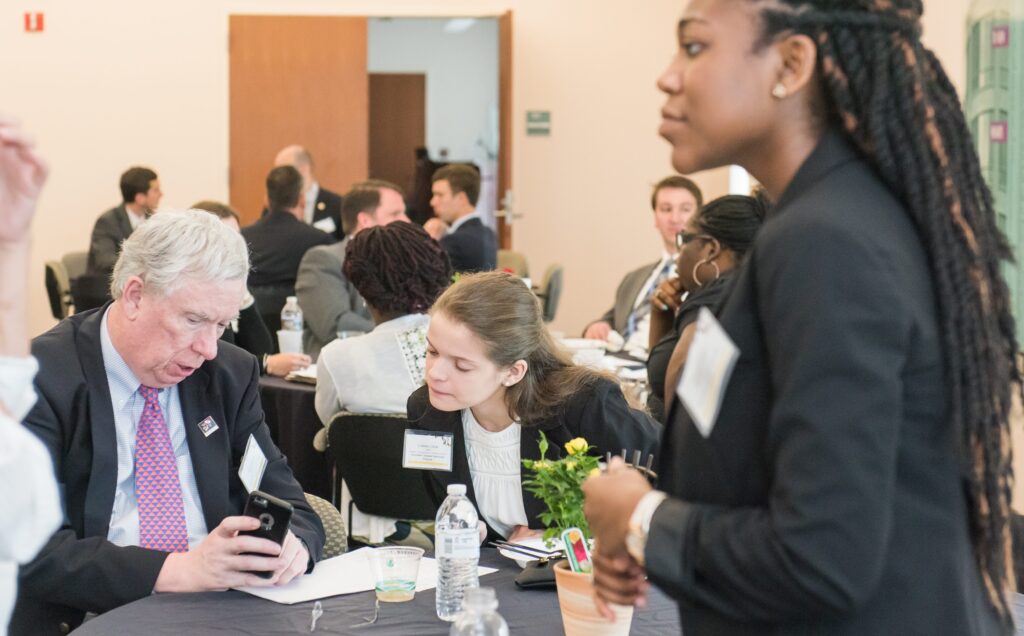
Governor’s Summer Internship Program fellow Carrie Cook (center) of UMBC connects with a participating mentor prior to the start of the kickoff event.

Shriver Center Peaceworker alumna Meghann Shutt, M.P.P. ’11, public policy, offered an opening keynote for the Walter Sondheim Jr. Maryland Nonprofit Leadership Program, which combines full-time paid nonprofit placement under a senior-level mentor with research and reflection exercises, training seminars, and networking opportunities.

Shutt currently serves as chief learning officer for the Baltimore City Department of Social Services. Her remarks focused on advice she has found helpful in moving forward professionally from her own time as a program fellow, as well as how her understanding about what leadership looks like has evolved over time. “This summer I encourage you to think about what leadership means to you, but don’t fixate too much on a single definition,” she told the students, “because…it will grow and change as you grow and change throughout your career.”
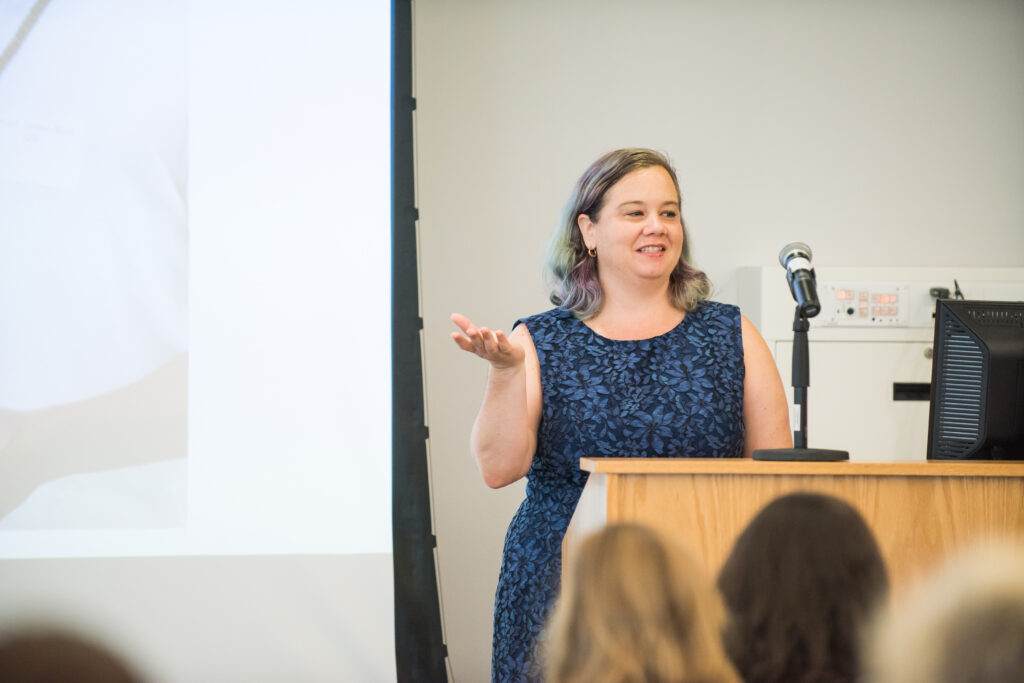
Meghann Shutt speaks at the Walter Sondheim Jr. Maryland Nonprofit Leadership Program kickoff event.

That process of professional growth in a public service career can also include moments of self-doubt about one’s impact and leadership abilities. However, Shutt argued, “The world’s most amazing people always worry that they aren’t enough.”

To move past those difficult moments, she suggested connecting with great leaders to learn from; thinking several steps ahead in your work; knowing when to protect your time and energy by saying “no” to a project; communicating honestly with those around you; appreciating coworkers as full, complex people; and carefully assessing what is and isn’t working, so you can know when to end or transform a project.

In public service work, as in science, “every failure gets you closer to success,” said Shutt. “Be willing to learn. Be willing to be wrong. Be uncomfortable if you want to grow.”

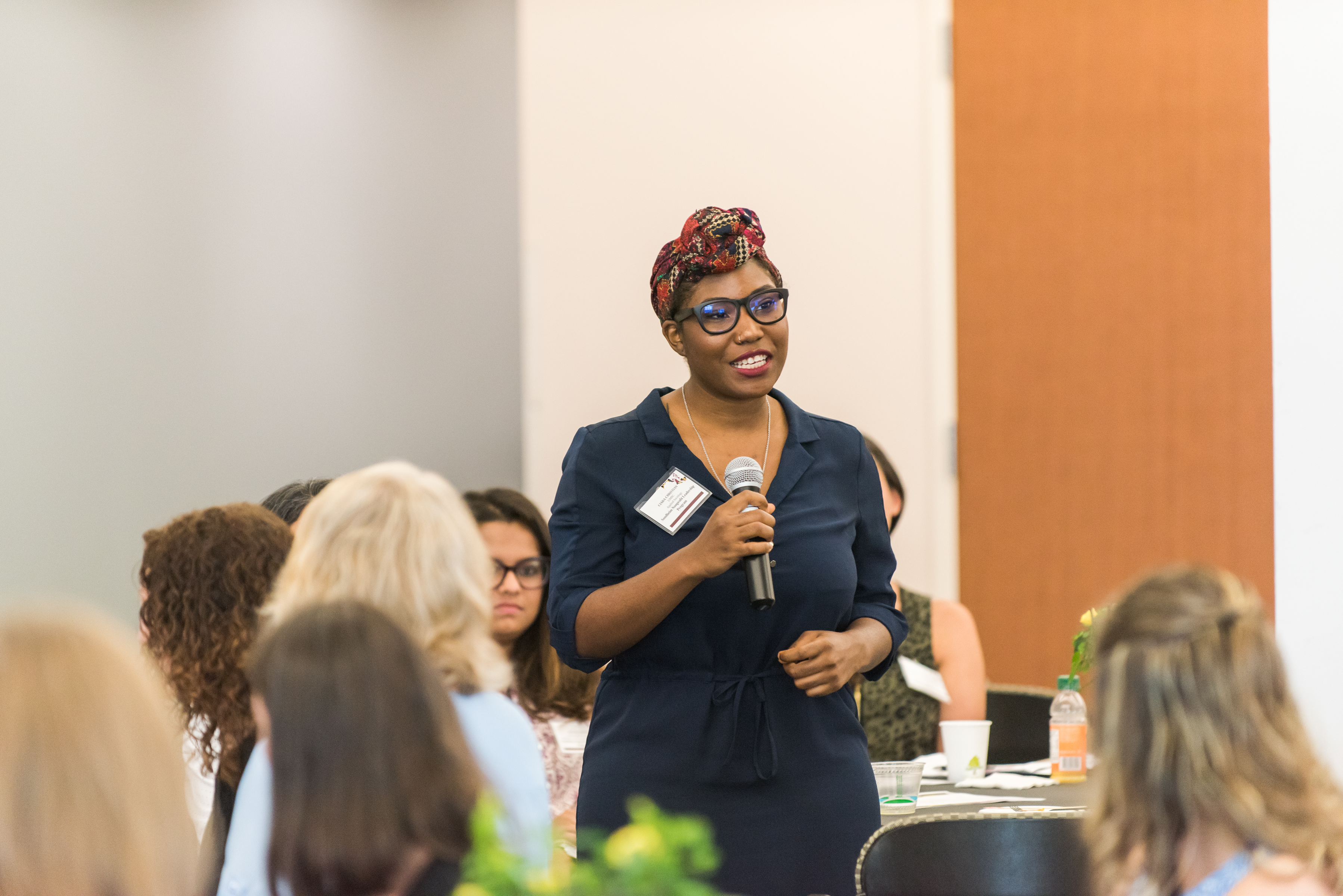
Five UMBC students will serve as Nonprofit Leadership Fellows for 2017. Markya Reed ’18, psychology, will work with CASA of Baltimore, leading the development of LGBT and teen parent resource guides for programs that train foster care advocates. Sarah Bicknell ’18, environmental studies and philosophy, will intern with the Baltimore Community ToolBank, which lends tools to charitable groups. Ciara Christian, M.A. ’18, applied sociology, will assist the Baltimore Neighborhood Indicators Alliance with Baltimore Data Day, where over 300 organizations come together to learn how they can use data to support Baltimore communities. Rebecca Mann ’19, social work and anthropology, will work with the Family Crisis Center of Baltimore County, and Noah Owens ’19, information systems, will serve with Playworks Maryland.
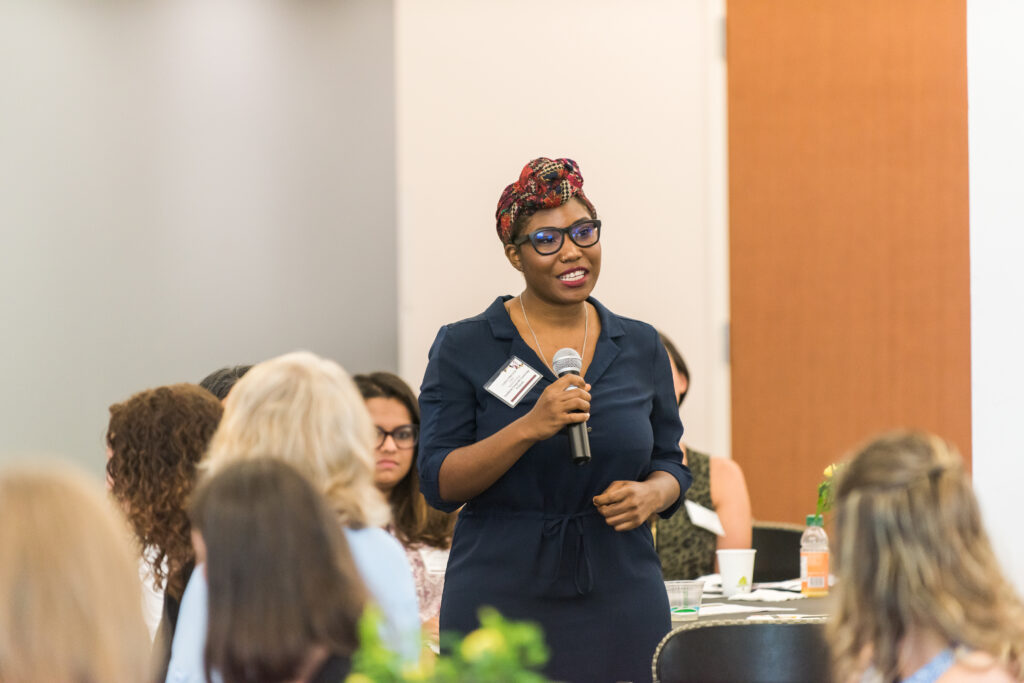
Ciara Christian speaks at the kickoff event for the Walter Sondheim Jr. Maryland Nonprofit Leadership Program.

The Governor’s Summer Internship Program, the state’s first formal public service scholars program, is now in its 30th year. The program includes full-time paid placement with a government agency under a senior-level mentor, seminars focused on state government and policymaking, events and meetings to connect with state leaders, and an opportunity to research and prepare policy analysis and recommendations to present to the governor.
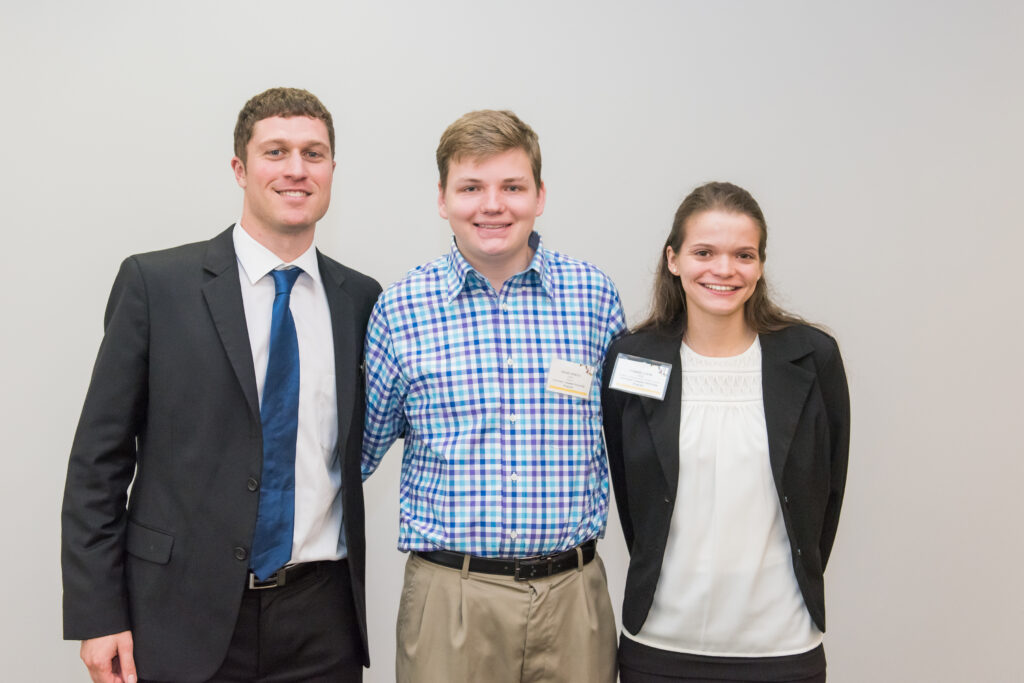
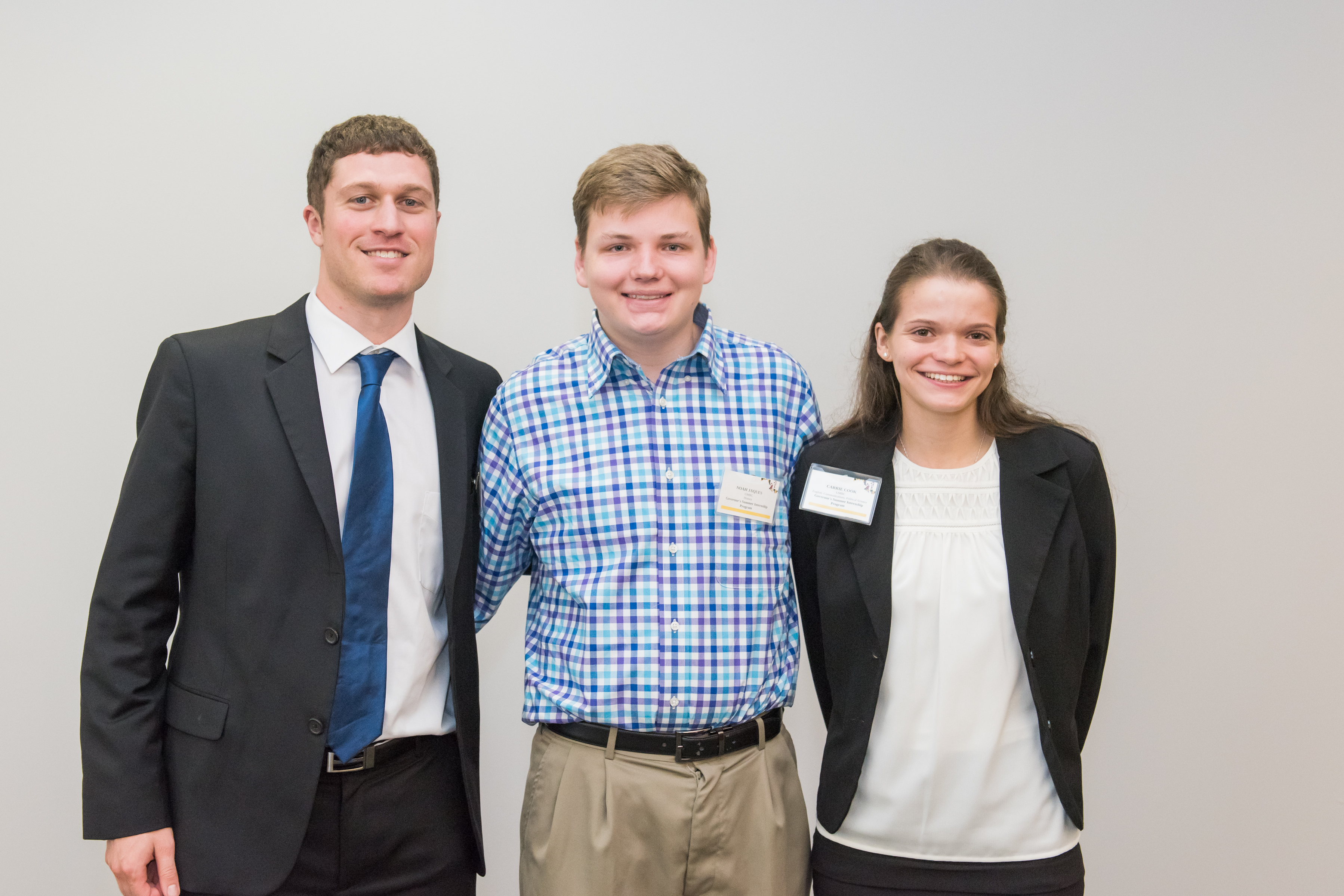
UMBC’s Governor’s Summer Internship Program participants at the kickoff event (l-r): Victor Mercogliano, Noah Jaques, and Carrie Cook.

Three UMBC students will participate in the selective program this year. Carrie Cook ’18, English and political science, will work with the Maryland Higher Education Commission, where she wants to “learn more about educational access and talk with students about the opportunities afforded by higher education.” Noah Jaques ’18, history, will work through the Maryland Historical Trust to make historic markers more publicly accessible, particularly markers relating to African American history. Victor Mercogliano ’18, history, working in the Governor’s Office, is particularly excited to “learn about public administration and how to help the administration be as efficient as possible.”

Victor Mercogliano (center) connects with program interns and mentors at the June 5th kickoff event.

Four additional UMBC students were named MDOT Fellows at a program kick off later in the week, held at the headquarters of the Maryland Department of Transportation. They include Idrissou Adam ’18, social work, in the Motor Vehicles Administration’s Aggressive Driving and Motorcycle Safety Unit; Janiqua Dunn ’17, psychology, working with the Maryland Transportation Authority’s deputy chief financial officer; Ethan Griffin ’18, interdisciplinary studies, working with the urban systems design team at the Washington Area Transit Office; and Jaspreet Kaur ’17 information systems, with the Maryland Aviation Administration’s Office of Safety and Risk Management.

For all of these students, this summer will be a unique opportunity to connect with the “many talented professionals committed to important issues” who are working in government, shared Maryland Secretary of Disabilities Carol Beatty, keynote speaker at the Governor’s Summer Internship Program kickoff. Beatty also thanked all of the mentors who have committed their time to supporting and guiding the interns, recognizing that government needs to “consistently attract the best and brightest in order to best serve the needs of our state’s people.”

After all, said Beatty, these mentors have a lot in common with the incoming summer interns: “They are passionate about the work and the difference they are making in the lives of Marylanders,” and their careers can give today’s students a sense of what they could achieve as public service leaders.

Students interested in exploring these and similar opportunities in the future can contact Hannah Schmitz, the Shriver Center’s program coordinator for applied learning.

Header image: UMBC’s 2017 Maryland Nonprofit Leadership Program fellows Ciara Christian, Markya Reed, Noah Owens, Becca Mann, and Sarah Bicknell. All photos by Marlayna Demond ’11 for UMBC.

UMBC receives Collaborative Opportunity Grant to launch college access program with Baltimore City high schools

The Choice Program at UMBC has received a $50,000 Collaborative Opportunity Grant to launch The Path Before Me, an initiative designed to increase the number of Baltimore City Public School students who are ready to enroll and succeed in college degree programs.

UMBC is one of 12 public institutions nationwide selected to receive such a grant from the Association of Public and Land-grant Universities (APLU) and Coalition of Urban Serving Universities (USU), supported with funding from the Bill & Melinda Gates Foundation. These new grants support programs to boost student success through advancing university-community partnerships.

UMBC’s Choice Program has long been recognized as a national model in providing community-based, family-centered case management for youth. For nearly 30 years, the program has provided 24/7 wrap-around support and job training, reaching over 20,000 youth from Maryland’s highest risk communities. The Path Before Me seeks to build on this strength in community engagement to support greater community empowerment, with youth active in shaping the direction of the program in their own schools.

The project will work with a cohort of 40 students (20 juniors, 20 seniors) from Baltimore City high schools. So far, Ben Franklin High School and Baltimore Polytechnic Institute have joined in the partnership. It will provide exposure to the college experience, mentoring, SAT preparation, and support for the admissions and matriculation processes in a way that responds to how students express their own college readiness needs.

UMBC works with Baltimore City high school students through a number of different programs, including the Choice Program, based in UMBC’s Shriver Center, as well as more recently launched initiatives, like the Sherman STEM Teacher Scholar Program. Through these partnerships, a core group of high school students is emerging voicing an interest in expanding college access as a matter of both social justice and personal opportunity. In addition to supporting these students’ college preparedness, The Path Before Me will work to articulate and grow a culture of service-learning and social justice within partner high schools, taking the lead from students on what social justice means in their communities.

“The aim of this grant fits perfectly with existing pathways we are creating between Baltimore City Schools and UMBC, and its potential impact is far reaching,” explains Eric Ford, director of operations for The Choice Program. “The success of social justice movements,” he suggests, “hinges on providing transformational experiences to young people from underserved communities.”

Beyond impacting the particular students involved in the program, The Path Before Me will also enable UMBC to critically examine university processes and services, working to ensure equitable and sustainable pathways for Baltimore City high school students to enroll in UMBC and successfully earn their degrees.

In awarding UMBC a Collaborative Opportunity Grant, the APLU and USU recognize the university’s deep and sustained commitment to Baltimore, and to creating innovative approaches to boosting student success.

“The public universities receiving these grants have undertaken efforts that represent a sea change in the way we think about student success,” says Shari Garmise, vice president of APLU’s Office of Urban Initiatives and Executive Director of USU. “For decades, institutions have applied a nearly singular focus on addressing academic hurdles students face once they’re enrolled. These institutions are saying that isn’t enough. We have to work with community partners to ensure students have the required resources to apply, the necessary instruction to be prepared for the rigor of college coursework, and the tools they need to thrive in the workforce and drive positive change in their communities.”

In July, representatives of all 12 universities awarded grants, including UMBC, will convene in Washington, D.C. to strategize and collaborate on their initiatives. As the programs move forward, USU and APLU will share key findings to expand their benefits to additional universities, in the form of new partnership models and best practices.

Update (6/27/2017):  

The Choice Program at UMBC has just received a three-year commitment of $40,000 annually in AmeriCorps funding from the Corporation for National and Community Service (CNCS), the federal agency for volunteering and service programs. These funds will support the work of 50 AmeriCorps members through the Choice Community Service Learning Fellowship beginning this fall. UMBC’s 50 Choice AmeriCorps Fellows will also each be eligible to receive a $5,730 educational award at the end of each year of their service, for a total of $286,500 in educational awards granted to Choice fellows annually (up to $859,500 over three years). CNCS has invested in The Choice Program since its inception in 1994.

Additionally, The Annie E. Casey Foundation has selected The Choice Program to receive $150,000 in grant funding for work to support East Baltimore residents as they gain skills and credentials for employment. Choice is one of five nonprofit workforce initiatives to receive these funds, which total $700,000.

Header image: Choice Program participant Daesha Johnson at an event celebrating the launch of a new job training site for participants in The Choice Program. Photo by Marlayna Demond ’11 for UMBC.

UMBC’s spring 2017 commencement honors each student’s story of achievement

The Retriever community came together late last week to celebrate UMBC’s final spring commencement in downtown Baltimore’s Royal Farms Arena. Two decades after outgrowing its original campus home, the ceremony will return to Hilltop Circle next year, taking place in the new Retriever Events Center that will open in late 2017.

Both the undergraduate ceremony on May 25, and the graduate ceremony at UMBC on May 24, featured inspiring reflections from accomplished students and thoughtful advice from honored alumni. The festivities embodied a close-knit community feeling even as they invited thousands of family, friends, faculty and staff, both present and tuning in through a live webcast, to join in celebrating the graduates’ achievements.

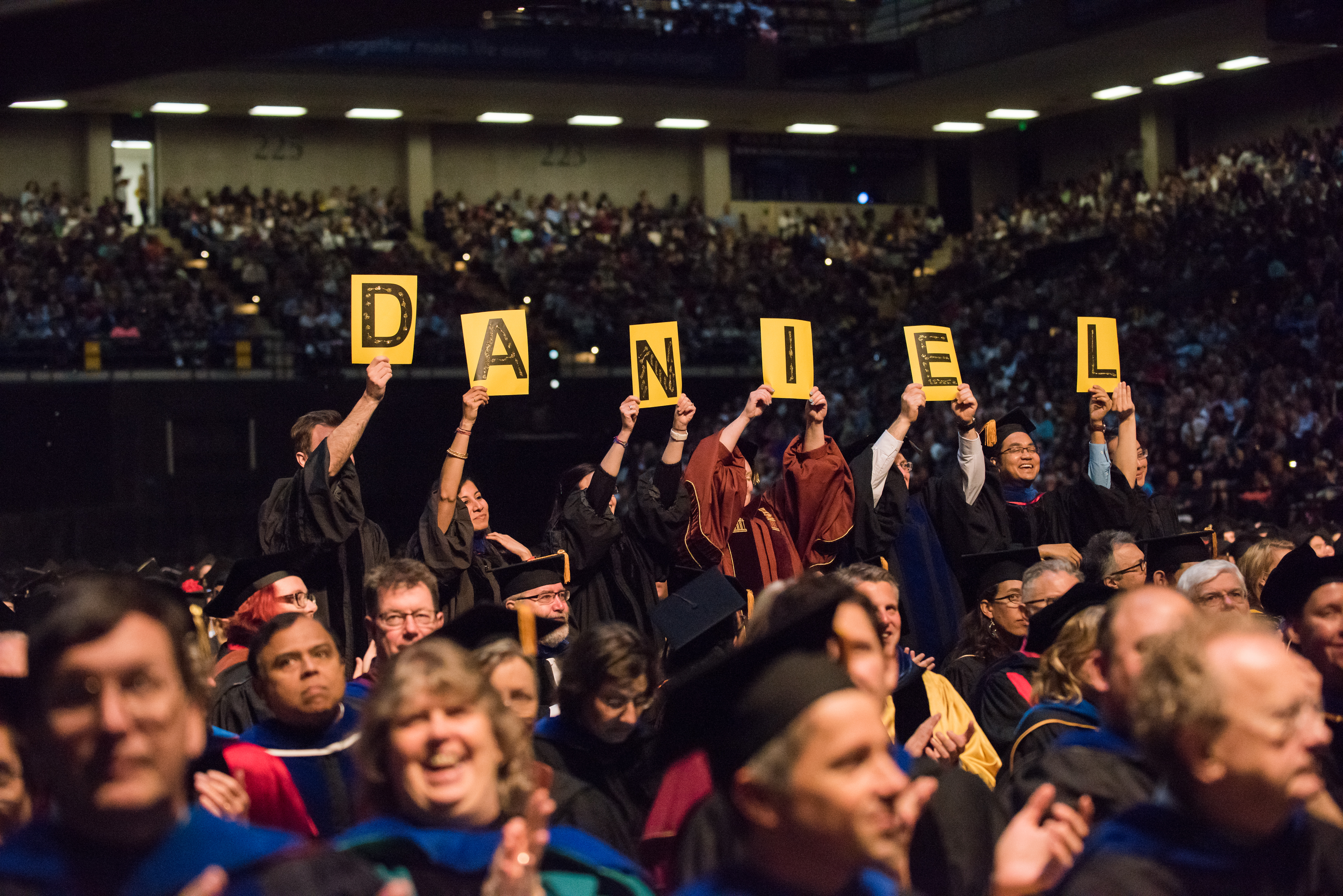
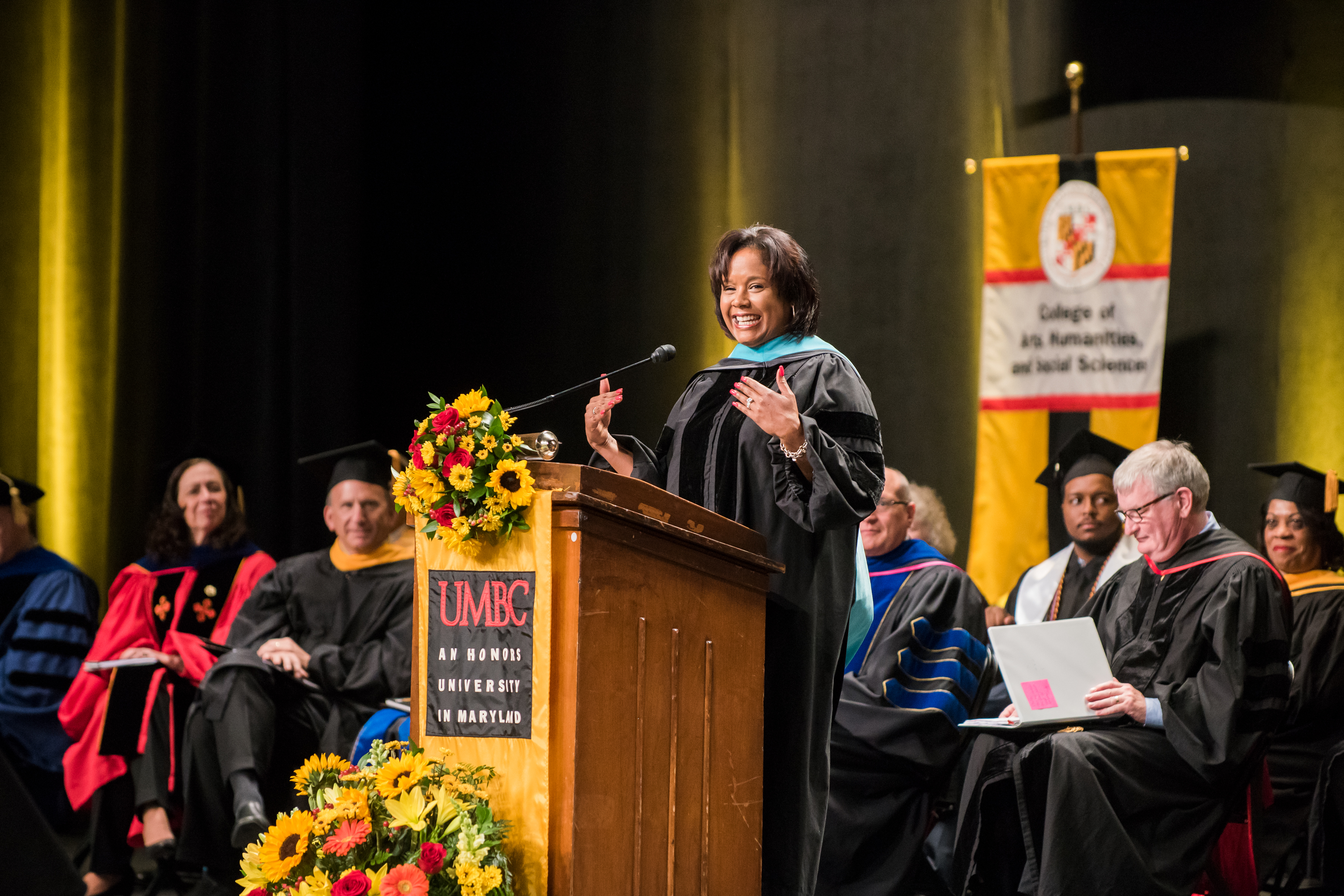
Valedictorian Daniel Ocasio ‘17, chemical engineering, shared in his moving remarks what made the difference in his college experience.

Valedictorian Daniel Ocasio at the podium

Ocasio told his fellow undergraduates, “as a first generation college student and Latino in STEM, I sometimes felt out of place and doubtful of my own abilities. The lack of representation of people from backgrounds like my own in my field has made it difficult for me to envision myself succeeding in it.” But through connecting with supportive mentors and fellow students, he was able to counter that self-doubt with a clear vision of his future.

Ocasio reflected:

…the diverse community at UMBC has helped build my personal confidence and given me hope for the future of the global workforce. At UMBC, people from all over the world, every race, every socioeconomic background, cooperate — not just exist together, but really work together — to better themselves and each other through education. Through mutual support and encouragement, my peers and mentors helped me envision myself not only succeeding in my field, but being a leader in it.

Professors hold signs spelling out D-A-N-I-E-L

Ocasio also described how found his passion for improving access to clean water worldwide, which has set him on a path to pursue a Ph.D. in environmental engineering from the University of California, Berkeley. Speaker Stephanie Hill, who received an honorary doctorate of public service for her deep and longstanding commitment to mentorship, picked up on this idea of identifying your passion in her own remarks.

Hill ‘86, computer science and economics, is now the vice president and general manager of Lockheed Martin’s Cyber, Ships and Advanced Technologies (CSAT) line for Rotary and Missions Systems. Speaking directly to students who may not yet have a clear sense of their career path or intellectual passions, she told graduates:

Focus on infusing purpose into each day of your life, because when you do that you can truly make a difference. […] Remember that purpose does not choose you, you choose it. […] We can all be that beacon of light that helps someone to be better than they are…to do better than they would have done.

Stephanie Hill speaks during the undergraduate ceremony.

Hill also spoke of how proud she was when her own daughter recently graduated from UMBC, a community that embodies the core values of “diversity, excellence, and community.” She shared, “Each time I have the privilege to return to my alma mater, it’s really like coming home.”

UMBC’s graduate commencement ceremony also featured personal, heartfelt advice from another UMBC alumnus who is now a global leader in research and technology. Ralph D. Semmel, ‘92, computer science, director of the internationally-renowned Johns Hopkins University Applied Physics Laboratory (APL), spoke of appreciating what we can each uniquely offer the world after receiving an honorary doctorate of science.

Ralph Semmel speaks during the graduate ceremony.

Reflecting on how he came to value his own unique strengths, and even eccentricities, Semmel told graduates, “Keep striving. Keep learning…Keep nurturing your gifts and your uniqueness…for yourselves…your communities and the world.”

Semmel also spoke of his faith in the graduates’ values and motivations, and how those factors directly impact what it is possible to achieve in one’s career. “At the core of doing great things is doing the right thing, which requires unquestionable integrity,” said Semmel. “Reach beyond the good enough answer and aspire to the great.” After all, he told the graduates, “If you wanted it easy, you wouldn’t be here today.”

President Hrabowski, valedictorian finalists, Semmel, Hill, and student leaders at a special reception recognizing the honorary degree recipients.

During each ceremony, President Hrabowski asked for a moment of silence and reflection “for eradicating hatred from humankind,” in recognition of people who have recently lost their lives to acts of violence in Maryland and worldwide.

President Hrabowski also took time to honor graduating students who will pursue careers in social work and teaching, and encouraged guests to view the personal stories of 34 Retrievers from the Class of 2017 highlighted for their academic excellence and for demonstrating a commitment to a greater good through research, scholarship, creativity, and work with underserved communities.

A faculty mentor congratulates Da’Kuawn Johnson, highlighted in UMBC's Class of 2017.

Even as he highlighted several students for particular accomplishmentsgraduating with a perfect GPA or receiving a Fulbright fellowshipPresident Hrabowski also reminded the thousands of friends and family members in the audience that, “Each student here has a wonderful story.”

As an example, picked up by The Baltimore Sun, he shared the story of Heather Frank ‘17, biochemistry and molecular biology. The first in her family to receive a bachelor’s degree, Frank has already published her research on the HIV genome and will pursue a Ph.D. in biochemistry at Harvard University. Reflecting on her time at UMBC recently, Frank put it simply, “The environment here provided me all the opportunities so I could become my best self.”

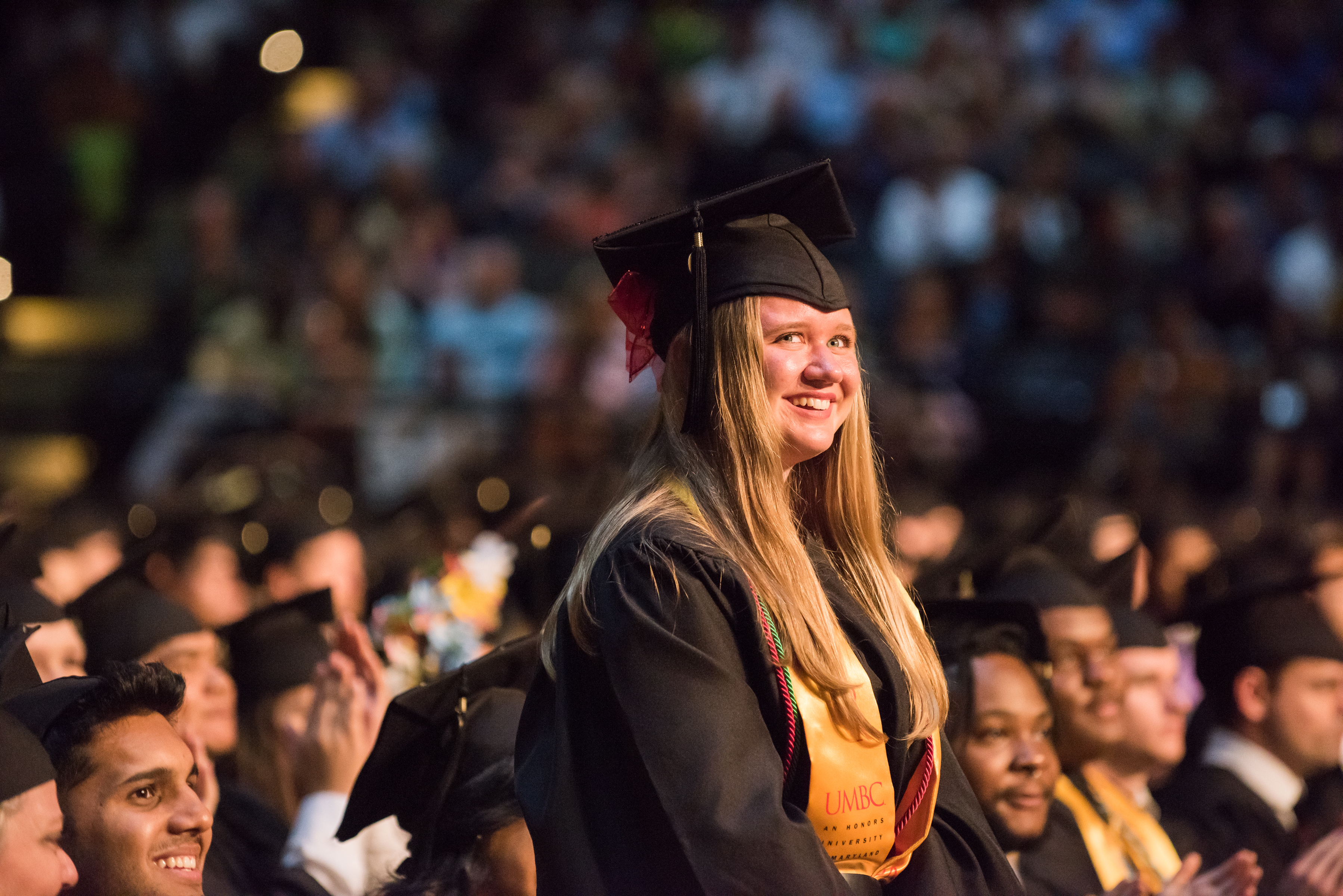
Heather Frank stands during the undergraduate commencement ceremony.

President Hrabowski’s full remarks, as well as those of the honorary degree recipients; valedictorian; Graduate Student Association President Deanna Cerquetti, Ph.D. student in language, literacy, and culture; and others are now available through UMBC’s commencement ceremony videos (full captioning coming soon).

Undergraduate Commencement Ceremony:

Graduate Commencement Ceremony:

Graduates and those cheering them on can share memories, well wishes, and photos through #UMBCgrad, and view UMBC’s Facebook page, Instagram, and Twitter accounts for coverage of the festivities. Media coverage of UMBC’s spring 2017 commencement ceremonies is available in The Baltimore Sun and Catonsville Times.

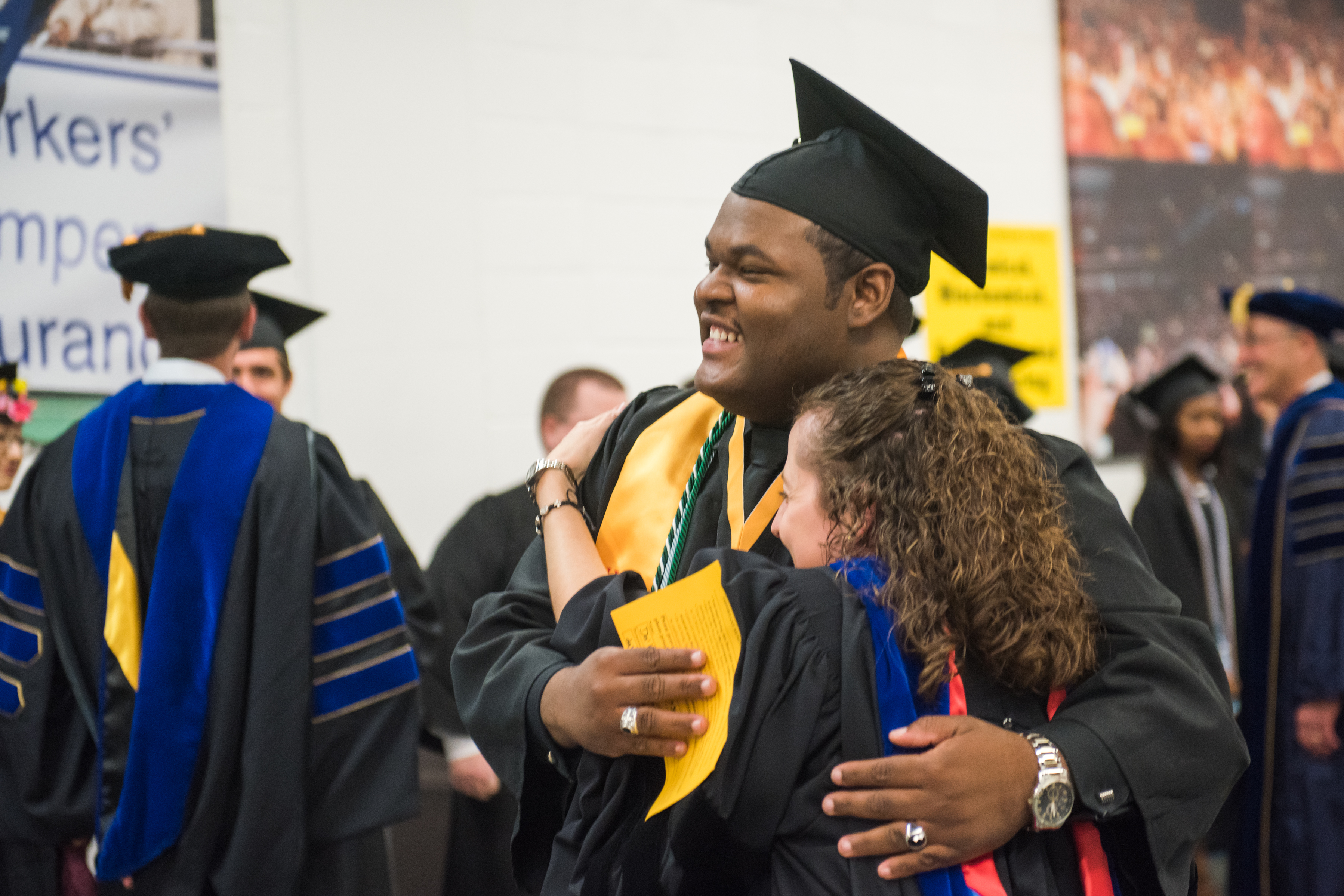
Header image: Professor Tim Nohe congratulates Melissa Cormier upon receiving her MFA degree. All photos by Marlayna Demond ’11 for UMBC.

UMBC Baseball heads to NCAA tournament after winning first America East championship

For the first time in program history, UMBC Baseball has won the America East championship and received an automatic bid to the Winston-Salem Regional for the NCAA tournament.

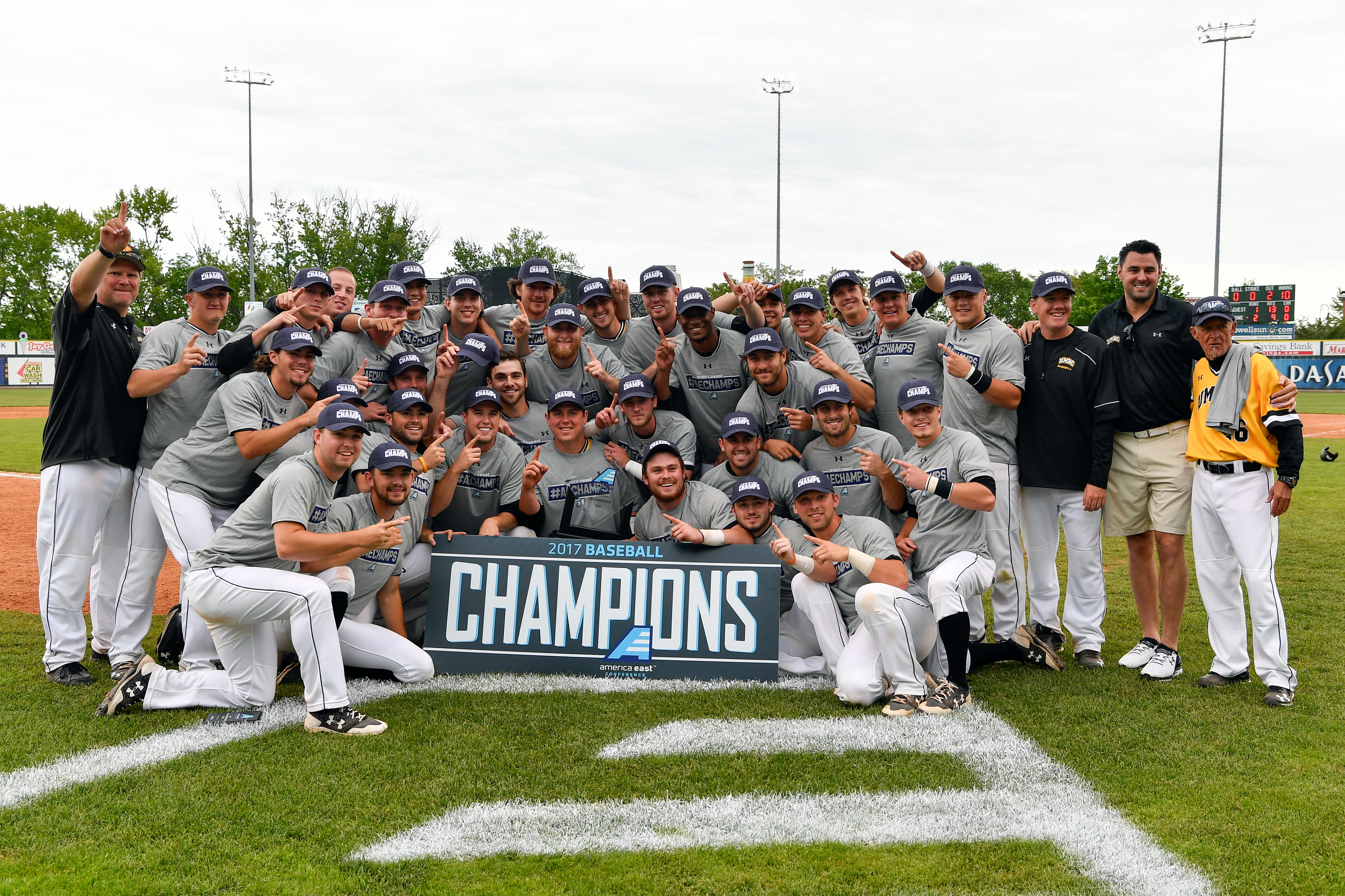
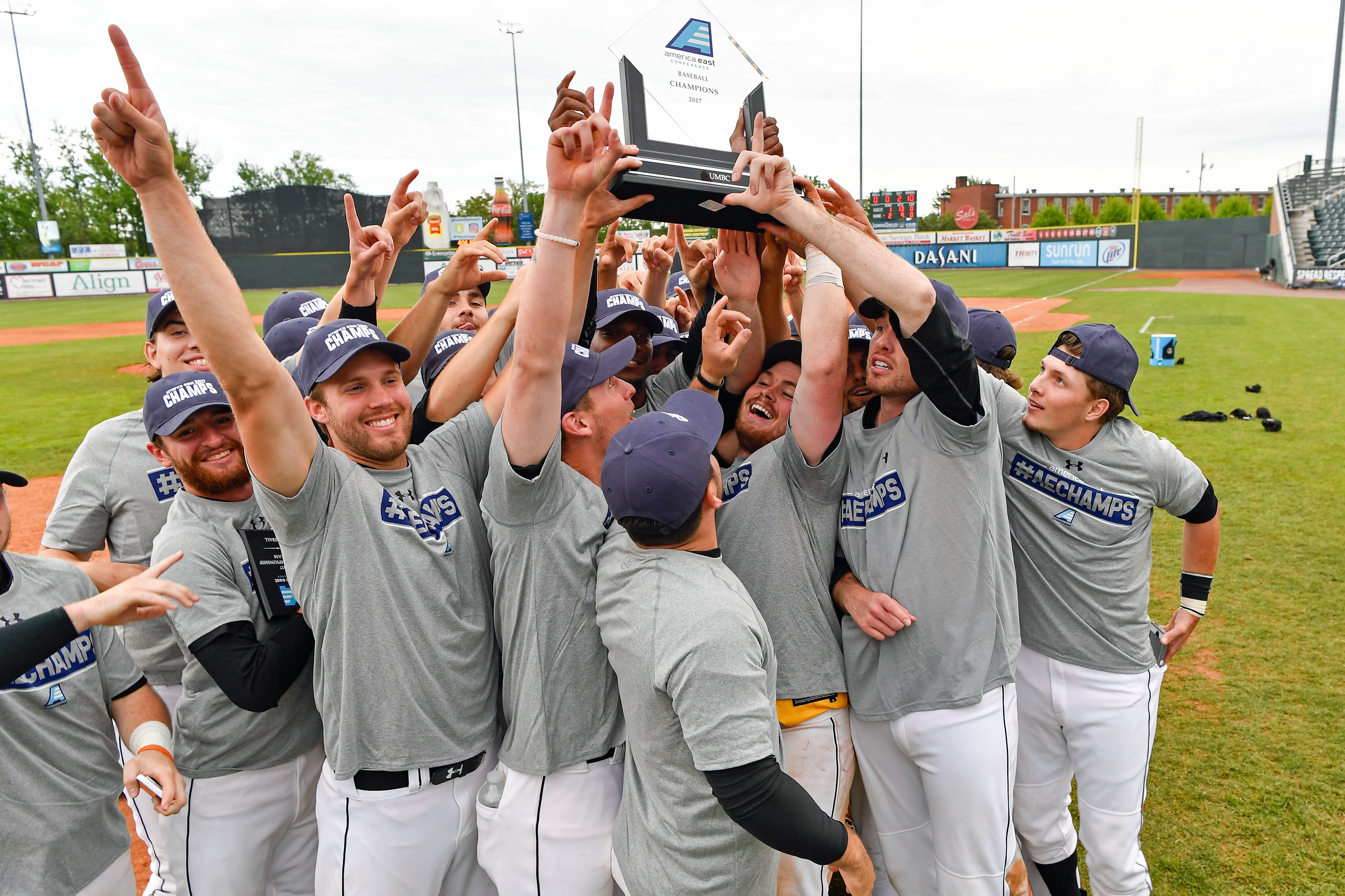
UMBC Baseball wins 2017 America East Championship. Photo courtesy of America East.

The second-seeded Retrievers won the America East title with a 2-1 victory over Maine on Sunday, after designated hitter Zach Bright ‘18, engineering and financial economics, drew a two-out, bases-loaded walk in the bottom of the tenth inning to push shortstop Mitchell Carroll ‘18, media and communication studies, across with the game-winning run.

“What an amazing baseball game,” said Bob Mumma, head coach, after the win over Maine. “I couldn’t be happier for the team and our seniors who worked hard for four years for a moment like this.”

America East baseball championship trophy. Photo courtesy of UMBC Athletics.

The team also defeated Stony Brook, 3-2, and Albany, 9-0, in the same weekend, on their path to capture the title. Following a victorious weekend, catcher Hunter Dolshun ‘17, health administration and policy, was named America East Tournament Most Valuable Player. Pitcher Matt Chanin ‘18, business technology administration; hurler Connor Staskey ‘17, psychology; outfielder Andrew Casali ‘17, economics; and Dolshun were named to the all-tournament team.

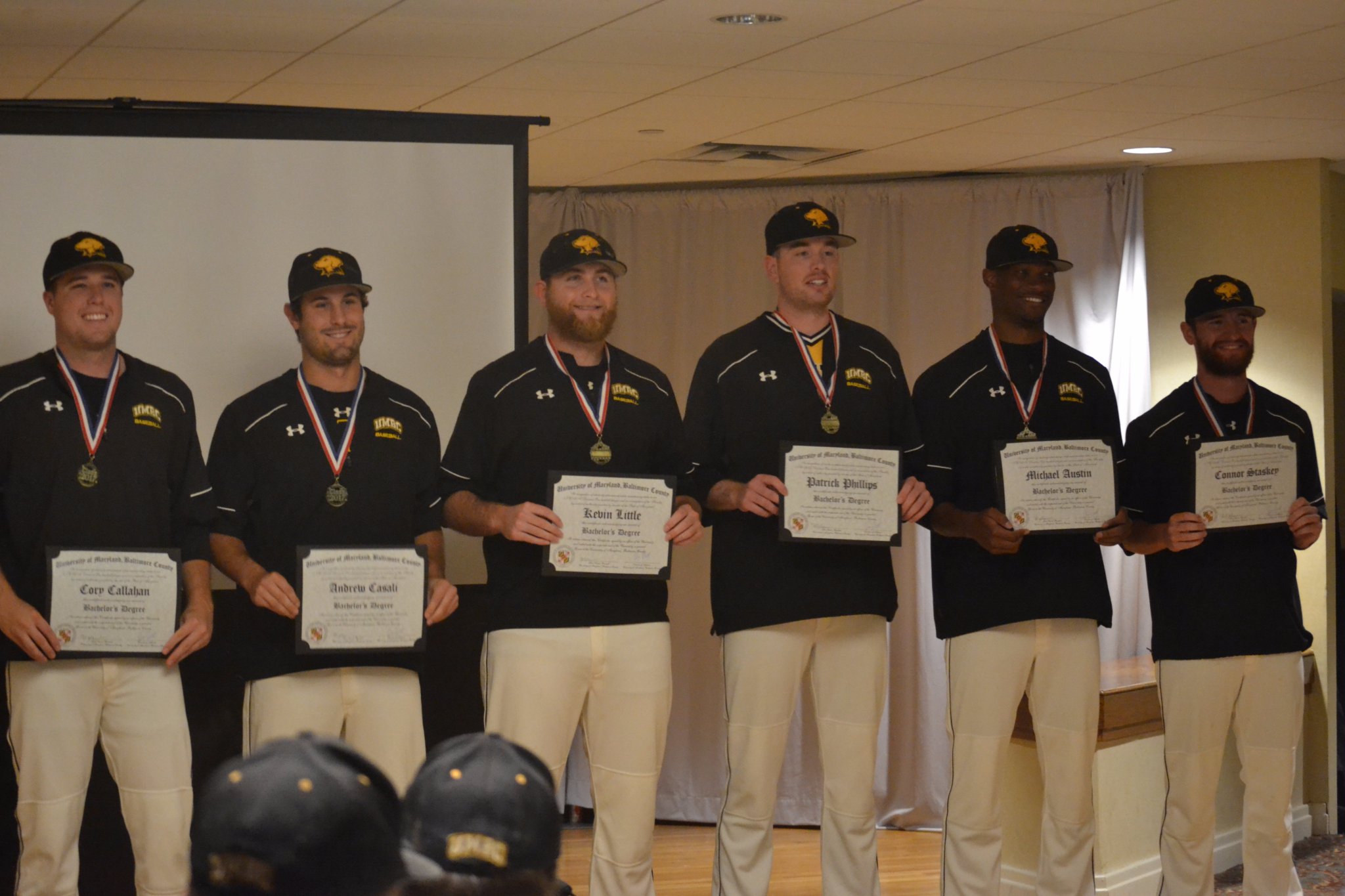
On their path to victory, the Retrievers also took time to celebrate graduating seniors with a special team commencement ceremony on the road.

UMBC Baseball team honors graduating seniors on the road. Photo courtesy of UMBC Athletics.

While this is the team’s first time representing America East in the NCAA Tournament, over the course of 14 league campaigns, it’s the third time in UMBC Baseball’s 31-year NCAA DI history that it will head to the NCAA tournament. Previous appearances were in 1992 (East Coast Conference, at-large bid) and 2001 (Northeast Conference title).

For UMBC Baseball, the 2017 season has been all about steady growth through teamwork. Said Coach Mumma, “Like we have been telling the kids all year, it’s about the process and we kept fighting the whole way. We saved our best baseball for the tournament and the camaraderie of this group showed this week.”

Retrievers celebrate winning the 2017 America East baseball championship. Photo courtesy of America East.

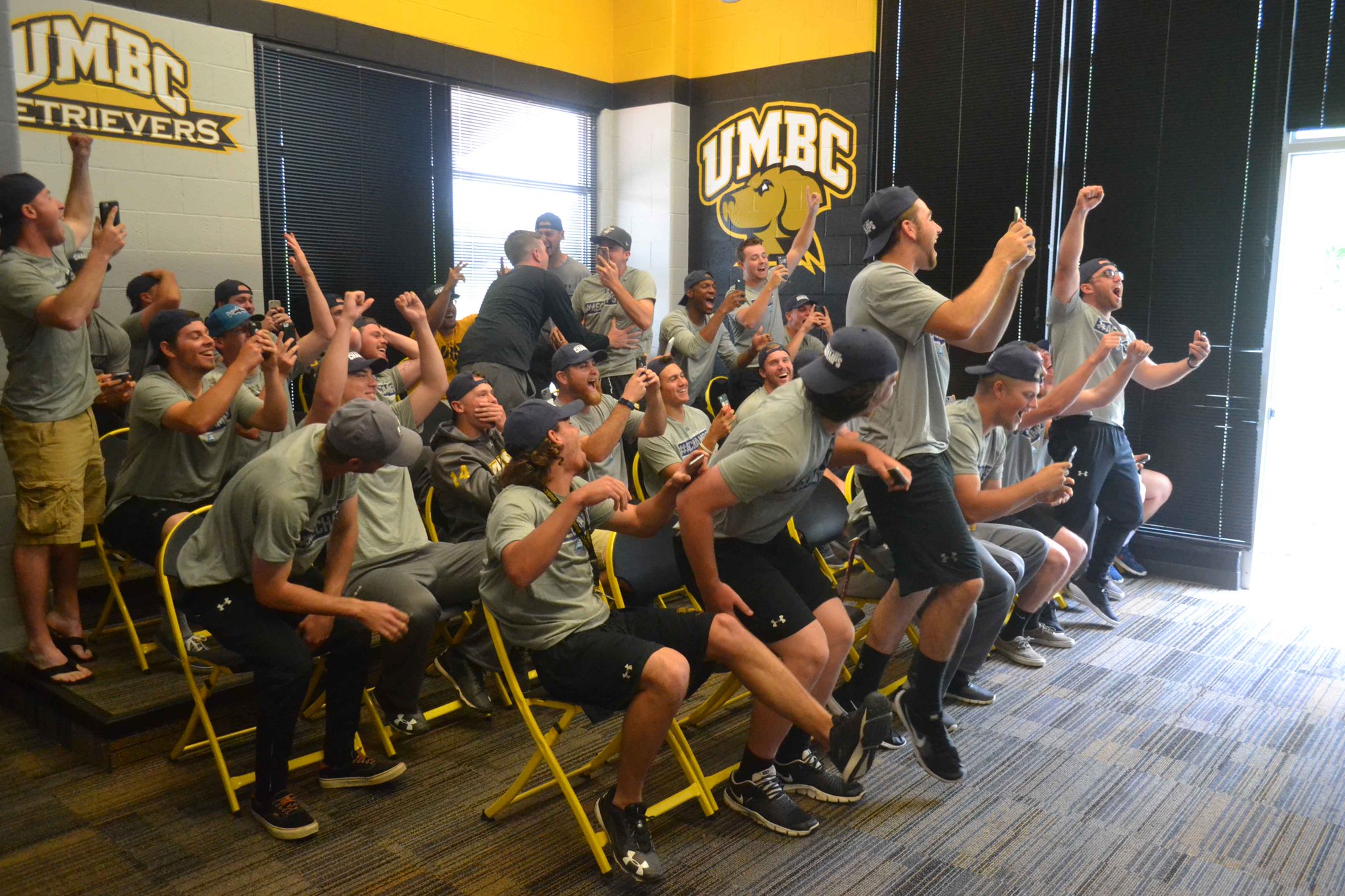
The team gathered on Monday, May 29, to hear a live ESPN2 broadcast announcing 2017 NCAA baseball tournament selection. After the University of Maryland, College Park, and West Virginia open the regional tournament on Friday, June, 2, with a 2 p.m. contest, the Retrievers will take on host Wake Forest on Friday, June 2 at David F. Couch Ballpark, with the first pitch slated for 7 p.m. (tickets available online).

The format for the regional round is a four-team, double-elimination style. The winner will head to a best of three Super Regional the following week. Retriever fans can tune in to ESPN3 for game broadcasts, and can wish the team good luck in person on May 31 at 11 a.m., at the campus welcome circle near the Administration Building, as they board the bus for North Carolina.

Coverage of the Retriever’s America East victory and path to the NCAA tournament is available through the Baltimore Sun.

Header image: Retrievers celebrate winning the America East baseball championship. Photo courtesy of America East.