All posts by: Catalina Sofia Dansberger Duque


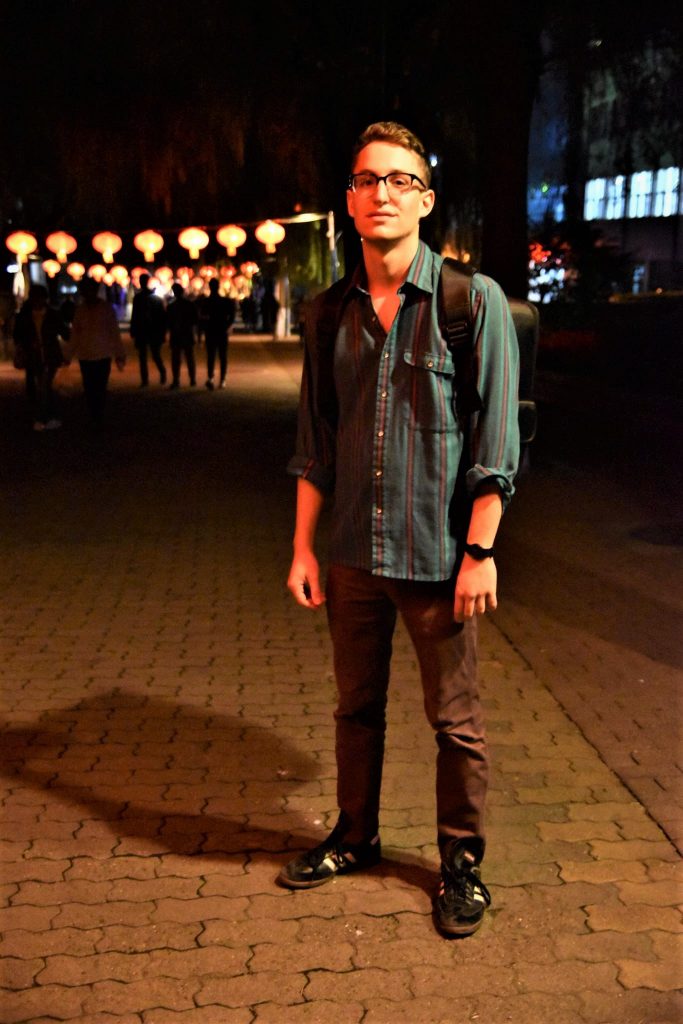
Academic all-star and peer mentor Noah Zazanis pursues research into LGBT health disparities

Noah Zazanis
B.A., Psychology
Summa Cum Laude
Hometown: Germantown, Maryland
Plans: Researcher, Quiton Lab, UMBC

UMBC has given me amazing opportunities for research that have helped prepare me for graduate school and my career and furthered my development as a student and scholar. The mentorship I’ve experienced at UMBC Shady Grove and on main campus has been life-changing.

As an undergraduate researcher, Noah Zazanis is already making waves through a groundbreaking study of the biophysical factors that affect pain perception. Zazanis has been able to pursue their interest in LGBT health psychology through work in the lab of Raimi Quiton, assistant professor of psychology, focusing on the biopsychosocial influences of pain and pain management, including how social environments and social inequality affect health.
“There is not a lot of research in LGBTQIA+ health disparities,” says Zazanis. “UMBC is impressive with the depth of undergraduate research opportunities, and encouraged me to actually spearhead research projects unique to my interests.”

Zazanis presenting at URCAD 2017. Photo courtesy of Zazanis.

Zazanis’s academic excellence and work in the Quiton lab has already earned them the psychology department’s Distinguished Achievement Award, as well as an academic achievement award from UMBC’s psychology program at the Universities at Shady Grove. They’ve also presented research twice at UMBC’s Undergraduate Research and Achievement Day. Beyond academic and research achievement, and advocacy for health equity, Zazanis also supports fellow students through tutoring in statistics, writing, and research methods.
Zazanis will begin work this summer on a new research project at the Quiton lab focused on pain perception among transgender people, with the hope of improving their health care services. With excitement to move forward in the research, they share, “I have developed strong clinical research skills well-suited for a future in the interdisciplinary field of health sciences.”
Portrait by Marlayna Demond ‘11 for UMBC.

Doopashika Welikala to begin Johns Hopkins MSPH after reproductive health research abroad

Doopashika Welikala
B.S., Biological Science; B.S, Anthropology; B.A, Sociology
Magna Cum Laude
Hometown: Gaithersburg, Maryland
Plans: MSPH, Johns Hopkins Bloomberg School of Public Health

As a first-generation college student, I did not know much about navigating college when I started at UMBC. My time at UMBC has shown me that with dedication and perseverance we can achieve anything.

Doopashika Welikala understands the importance of access to opportunity. As the first person in her family to attend college, and someone who has traveled internationally to study health care, she has a very personal perspective on the impact that having access to education, healthcare, and other resources, can have on a person and on a community. She hopes to channel that understanding into a career in public health.
Welikala is already well on her way to developing the knowledge and skills she’ll need to become a global public health leader. She has completed an independent anthropology research project on childbirth and childbearing practices in Sri Lanka.

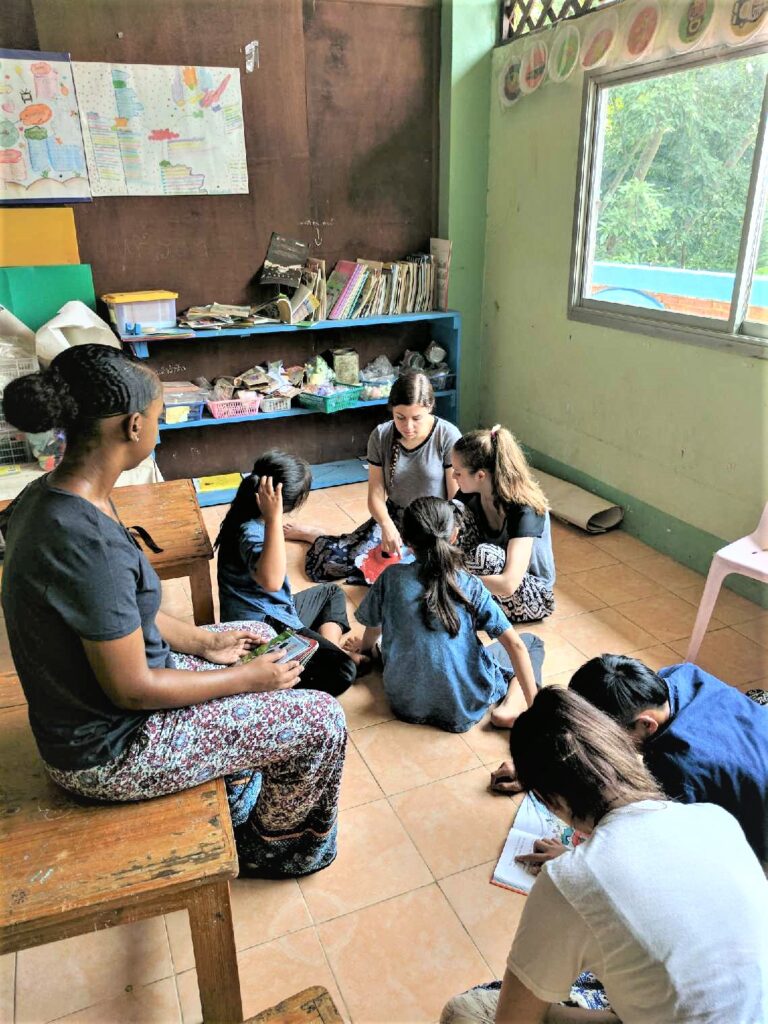
Welikala at Maranyundo Girls School in Kinazi, Rwanda, speaking to young women applying to college. Photo courtesy of Welikala.

She also traveled to Kinazi, Rwanda to conduct research on family planning and contraception use through a National Science Foundation REU Fellowship in summer 2017. While there she spoke with young women at the Maranyundo Girls School who were applying for college about her experience as a first-generation college student, and she continues to stay in touch with them, providing the kind of supportive feedback she has received in her time at UMBC.
“The professors at UMBC were always open to discuss my career options and future plans,” says Welikala. “Professors went out of their way to help me pursue research opportunities that aided me to further my intellectual interests.”
Welikala also participates in community life at UMBC as an institutional review board member, senior advisor to the Sri Lankan Student Association, teaching assistant in chemistry and sociology, and Writing Center tutor.
In the fall Welikala will attend the Johns Hopkins Bloomberg School of Public Health as a graduate student in the population, family, and reproductive health program. She credits her success to the academic rigor at UMBC. “At UMBC I was part of a challenging environment that stimulated my growth and I can proudly say that it has prepared me for the next steps of my life after graduation,” she says.
Portrait by Marlayna Demond ‘11 for UMBC.

UMBC’s Denise Meringolo continues Baltimore Uprising public history project through Whiting Fellowship

Denise Meringolo was teaching her graduate-level Introduction to Public History course in the spring of 2015 when Freddie Gray died in police custody and city residents responded with protest, marching in the streets of Baltimore. The events of that time didn’t just make national headlines, they also sparked difficult conversations in homes, offices, community centers, and classrooms across the city about equality, representation, and safety.

Knowing that history is often told through official documents and representatives, Meringolo, an associate professor of history at UMBC, felt an urgency to help the local community control and document the story of their experience, and she initiated the crowdsourced story and image collection platform BaltimoreUprising2015.org.

“Museums are often not very democratic places,” Meringolo notes, explaining that their collections processes and guidelines often reinforce the voices and experiences of wealthy, white people rather than broader communities in all their diversity. In contrast, the Baltimore Uprising digital collection puts decisions into the hands of the public.

The project offers individuals the opportunity to upload their own materials and decide what they want to become part of the accessible public record. The collection, built and managed in partnership with Joe Tropea, Maryland Historical Society digital projects specialist, now includes 3,000 images, oral histories, and written accounts, and that number continues to grow.

Recognizing the significant potential of this work to have a lasting impact, The Whiting Foundation has awarded Meringolo a $50,000 Public Engagement Fellowship to teach historical understanding through the “Preserve the Baltimore Uprising” project. Meringolo is one of just seven scholars to receive Whiting fellowships in 2018. The recipients represent the diversity of thought and research in the humanities, from history, literature, philosophy, and anthropology to gender studies, and they engage numerous different communities across the United States, particularly groups underrepresented in the humanities.

“The Whiting Fellowship Program is among the nation’s foremost awards for civically engaged research and scholarship,” says Scott Casper, dean of UMBC’s College of Arts, Humanities, and Social Sciences. “Dr. Meringolo’s recognition highlights the importance of her work preserving the archive of the Baltimore Uprising, a signal example of UMBC’s collaboration with communities in greater Baltimore.”

In this next phase of the project, Meringolo seeks to ensure the collection grows and is accessible as a resource for Baltimore City teachers and students. “This is an opportunity to share methods and best practices in conducting oral histories and relevant historical research with the next generation of public historians and their teachers,” she says. Through this work, she hopes to highlight community-based understandings of “the historical roots of racial injustice, economic equality, and social and political unrest in Baltimore.”

Over the next year, Meringolo will collaborate with campus and community partners in this work. As part of the Truth, Racial Healing, and Transformation Centers initiative, Frank Anderson, assistant director of the Choice Program, will lead the UMBC Shriver Center Choice education team in connecting the project with community partners and developing related youth-centered enrichment programs.

Community organizer Denise Griffin Johnson and Lee Boot, director of UMBC’s the Imaging Research Center, will support the initiative in creating story circles programs to guide student scholars in formulating and answering critical questions as they develop their stories. This arts-based component of the project will use materials assembled in the digital collection with and interviews Lee Boot and visual arts graduate students filmed with student protesters after the Baltimore Uprising.

“The work, I believe, will reflect, in particular, the young voices of tomorrow,” says Griffin Johnson. “I believe this action and work is instrumental in capturing the hearts, minds, and voices of people who embrace a community identity of self and others.”

Meringolo’s original collaboration with the Maryland Historical Society will expand to include oral history and interview techniques support by Joe Tropea. Thinking about conservation of the project for future community members, Lindsey Loeper, UMBC special collections archivist, will help the team develop a long-term plan to manage the digital collection.

Meringolo expects to conclude her Whiting Fellowship in a way that carries through her project’s initial vision: doing collaborative public history that honors and amplifies community voices. Participating Baltimore City students will present their research at a neighborhood branch of the Enoch Pratt Free Library.

Ultimately, the project all comes down to the “public” in “public history.” “I want to remind Freddie Gray’s community that the collection exists,” says Meringolo. “That it is theirs.”

Header image: Denise Meringolo. Photo by Marlayna Demond ’11 for UMBC.

UMBC School of Public Policy competes in global pandemic response simulation

The prime minister and minister of public health were in deep discussion about how to solve a major health pandemic, but their situation room wasn’t at the United Nations or in a parliament building, it was in a conference room. The state actors were UMBC students and, fortunately, the pandemic was actually an exercise in public affairs crisis management.

The UMBC School of Public Policy recently participated in its first National Association of Schools of Public Affairs and Administration (NASPAA)-Batten Student Simulation Competition. Representing UMBC were Erica Peery, M.P.P. ‘18, public management; Rebecca Postowski ‘16, geography and environment systems and political science, M.P.P. ‘19, environmental policy, and David Anguish ‘12, political science and modern languages linguistics and intercultural communication, M.P.P. ‘18, public management.

UMBC’s students competed at the Washington, D.C. campus of the Carnegie Mellon University Heinz College of Information Systems, Public Policy, and Management, alongside students from the University of Pennsylvania, Rutgers University, Carnegie Mellon University, and University of Maryland, College Park, broken up into multi-university teams of 5-6 students each. Among the other 560 participants were students at competition sites in nine U.S. states as well as in China, Colombia, Egypt, Hungary, and South Korea. 

David Marshall, NASPAA’s director of development, explains that the goal of the simulation “is to prepare public policy students with issues they are going to encounter in the real world.”

As simulation judge Anand Desai, section head of evaluation and assessment capability at the National Science Foundation, shared, “The competition helps policy students think through a broad range of “what if” scenarios, and the more complex and real the simulation feels, the more effective it will be as a tool to prepare participating students.” With this in mind, each competition takes on a significant area of international policy, and this year the focus was pandemic preparedness.

Each team represented a country, where team members simulated roles such as prime minister, minister of finance, and minister of public health. The teams made decisions based on a situation brief and available data. Each step in the game provided participants with a new opportunity to analyze, forecast, collaborate and provide policy recommendations.

The game was designed by the Center for Simulation and Gaming at the Frank Batten School of Leadership and Public Policy at the University of Virginia, directed by Noah Myung. “Public policy and science go hand in hand,” Myung explains, noting, “We need both to create realistic simulations that can be used across different disciplines and organizations to help create real global solutions by interdisciplinary teams.”

It was that interdisciplinary and global focus that inspired UMBC to join the competition this year. Susan Sterrett, director of UMBC’s School of Public Policy, selected the UMBC members for not only their exceptionally strong academic achievement but also their involvement in interdisciplinary activities.

The teams played four rounds, which also included writing policy briefs and making a final presentation. Postowski’s team advanced to the semifinal round, and she reflects that the simulation experience helped her to more clearly understand the interconnectedness of economic, health, environmental and transportation issues, and the relationship between domestic and international concerns.

“The simulation helps you think broadly and strategically,” the UMBC environmental policy graduate student says. “The key concepts of policy considerations, how they are weighted, considering the stakeholders involved, and measuring those outcomes can be applied to any scenario.”

Banner image by Catalina Sofia Dansberger Duque for UMBC.

UMBC hosts Elect Her leadership training featuring local women in politics

According to the Center for American Women in Politics, in 2017 women held under 20 percent of seats in the United States Congress: 105 out of 535 seats, plus five of six non-voting delegate positions in the U.S. House of Representatives. The UMBC Gender and Women’s Studies Department wants college women to know that increasing the representation of women in government is possible, and that the country’s future leaders can start their journey in college.

“Over the last five years of running the Elect Her program we have had more women running for SGA office, and more women participate who didn’t know they were going to run or join a campaign. That matters,” says Kate Drabinski, senior lecturer in gender and women’s students. “Whether or not women run for office here, the program reminds all of us that we can do it, that we are the leaders we think we need.

“Whether or not women run for office here, the Elect Her program reminds all of us that we can do it, that we are the leaders we think we need,” UMBC’s Kate Drabinski, senior lecturer in women’s and gender studies.

Meghan Lynch ‘18, political science, participated last year after deciding to run for a position in UMBC’s Student Government Association (SGA). She has been an active member of College Democrats since her freshman year and shares that she’s learned a great deal from seeing women be effective leaders both in legislative chambers and boardrooms. “Out of the four SGA executives, three of us are women,” says Lynch. “This fact gives me great pride because I think it is symbolic of UMBC’s commitment to equal representation.”

Elect Her is a nationwide training program begun in 2009 by the American Association of University Women. It is currently led by Running Start, a non-partisan organization working to support equal representation of women in government.

Across the U.S., Elect Her trainings offer women communication and organization strategies to campaign for student government or to pursue other leadership opportunities. Rina Shah, a Republican strategist, media commentator, and entrepreneur, will speak at UMBC’s Elect Her event on March 9, 2018, along with Sarah Elfreth, Democratic candidate for Maryland Senate, District 30. Students interested in attending the event, 10:30 a.m. 3:30 p.m. in Fine Arts 011, can register online.

UMBC Elect Her Speaker
Rina Shah. Image courtesy of speaker.

Shah, who is from West Virginia, grew up listening to her father discuss politics at home and seeing him be involved in a gubernatorial campaign. “My dad immigrated from Uganda and saw civic engagement as the beauty of being American,” she reflects. “I got a sense that being involved in the process was cool because we get to have a say in how our government functions.”

Shah’s path to politics began in college through journalism and leadership, first as an assistant managing editor her campus conservative publication and later as president of her school’s Panhellenic Council. After college, she worked briefly as a field reporter for a local television station. As she interviewed people, she learned more about issues affecting West Virginians, and found herself wanting to advocate for them. “People wanted me to take messages back to government officials, thinking I was somehow involved,” she says.

Shah moved to Washington D.C. for an internship with the National Association of Community Health Centers before going on to become a senior-level aide for two Republican Members of Congress in Capitol Hill in 2011. Seven years later, she opened her own political consulting and government affairs practice and co-founded the Women Influencers Network, which provides campaign training and internships for women interested in running for elected office anywhere in the U.S.

A photo of Sarah Elfreth talking with constituents.
Sarah Elfreth speaks with her constituents. Image courtesy of Bryan Barnes.

Elfreth was raised in New Jersey, where her parents, an engineer and a parole officer, were involved in labor unions, but it wasn’t until she was a student at Towson University that she became involved in government. “I fell in love with the ability to have a voice in the process when I visited Annapolis to advocate for student voting rights,” she says.

Elfreth’s experience in state-level leadership and government grew quickly when, in her senior year of college, then-Gov. Martin O’Malley appointed her to be the student member of the University System Board of Regents. Through that role she met with students and university leaders across Maryland, including UMBC President Freeman Hrabowski. She pursued a career in government relations, including as government affairs director for the National Aquarium, prior to deciding to run for office herself.

Both women were motivated to get involved in government, and to support the next generation of women leaders, to promote democracy and to help their communities. They stress that democratic engagement and leadership development must begin at the local levelon campus, at a place of worship, in a school club or neighborhood association.

“Experience comes through engaging with your community by applying your strengths, whether that be communications, policy, advocacy, fundraising, or technology,” says Shah.

Elfreth is focused on ensuring that government reflects the needs and interests of the people it serves, and she suggests that inspiring and preparing more women to run for office at all levels is key. “In order to shake up this culture for women and people of color, we have to continue to be involved,” she says. “We cannot afford to give up now.”

Banner image by Marlayna Demond ’11 for UMBC

UMBC Dresher Center hosts digital humanities conversation on inclusion in the field

The UMBC Dresher Center for the Humanities will host its second Humanities Teaching Lab (HT Lab) on Thursday, March 8, with a focus on how digital media tools can help boost access to and further equity in humanities education and research. The HT Labs theme “Digital Humanities and Difference in Research and Teaching” extends a conversation already underway in the vibrant humanities community convened through UMBC’s new Inclusion Imperative program, funded by the Andrew W.  Mellon Foundation.

Roopika Risam, assistant professor of English and secondary English education at Salem State University, will deliver the keynote address in the UMBC Dresher Center for the Humanities in the Performing Arts and Humanities Building from, 11:30 1 p.m. Risam, who wrote the book New Digital World: Postcolonial Digital Humanities in Theory, Practice, and Pedagogy, will discuss her new project Mapping W.E.B. DuBois. Joining her will be UMBC faculty panelists Anne Sarah Rubin, professor of history and associate director of the Imaging Research Center; Bryce Peake, assistant professor of media and communication studies; Tania Lizarazo, assistant professor of modern languages, linguistics, and intercultural communication; and Drew Holladay, assistant professor of English.

The expanded use of digital tools has enabled new, visionary kinds of humanities work in formats that would have been impossible ten or twenty years ago. It has also increased the visibility and accessibility of existing humanities research that pushes the boundaries on issues of race, community, equity, access, and agency.

“The way I make sense of the giant field of digital humanities is that it emphasizes human creativity and how people creatively engage with issues of oppression and segregation,” says Peake. On one hand, he explains, “this approach is a way to help students use digital tools to create humanities scholarship through coding.” At the same time, “it is also a way of helping students think critically about existing humanities work through data science analysis by teaching them how to the understand algorithms that guide us to sources, how to talk to data scientists, and how to understand the social media platforms that they rely on to do humanities work.”

Risam, who focuses on what a postcolonial critique brings to the digital humanities, also sees the field as a major opportunity to reach new audiences and revisit questions humanities scholars have been asking for centuries with new tools like digital textual analysis, mapping, and data visualization. “For English majors, who are skilled at being incisive readers, communicating, writing effectively, making arguments, and evaluating evidence, it means having a new medium to critically apply existing skills,” she explains.


This process has allowed Risam to examine in new ways W.E.B. Du Bois’s work and legacy across audiences and disciplines. At the same time, she wants to highlight the importance of not just reexamining historical texts through digital tools, but also taking contemporary texts seriously as objects of research.

“There is so much textual production happening online and if we were to dismiss it we would be missing out on an important moment on how humans are producing text and composing,” Risam says. “We need to look at how these tools are being used and ask the same challenging questions of this new form of composition that we have traditionally asked about alphabetic or published text.”

Panelist Drew Holladay agrees that today’s popular digital platforms are essential to working in the humanities. Holladay’s health research centers on communication, specifically the digital rhetoric of health and medicine, by focusing on the ways in which people with disabilities talk about themselves online compared to how health practitioners describe them. He views platforms like Facebook as not only relevant subjects of or platforms for research, but also as a gateway to connect students with current research on how social media impacts our use of language and how persuasion changes in digital spaces.

“I often hear from students, I didn’t know you could do this in English,” reflects Holladay. “Digital humanities research helps dispel the stereotype that the humanities are disconnected from the way the world is changing right now.”

Through the digital humanities, he notes, English composition moves beyond writing to include composing with video, podcasts, building websites, or utilizing databases—a broader range of forms of cultural expression and communication. For example, Holladay suggests, digital humanities opens avenues for us to examine the multitude of media and public conversations around the film Black Panther: a comic that has become a blockbuster movie, and has now led to new cultural production in many forms, from fan fiction to cosplay.

To study Black Panther, Holladay argues, you must change your methods of analysis as forms of media and culture evolve. “You could analyze the film from a traditional text analysis point of view, but digital humanities also lets you consider the movie as a wider cultural event where narrative, art, culture, and activism come together,” he says. “It is a cultural text that communicates social and political issues of our time and inspires critical conversations in classrooms.”


UMBC broadens access to life-changing international learning experiences

The UMBC Office of International Education Services (IES) hosted its first Passport Caravan this spring to jump-start students’ study abroad journeys. In partnership with UMBC’s study abroad affiliate, the Council on International Educational Exchange (CIEE), and the Baltimore County Public Library, the event, organized by Caylie Zidwick ’08, modern languages, linguistics and intercultural communication, IES assistant director, increased access to study abroad programs by fully funding 40 students’ new passport applications and providing information to students across all majors on how international education can enhance academic and professional opportunities.

The study abroad team (l-r): Caylie Zidwick, assistant director international education services; David Anguish ’12, political science and modern languages, linguistics, and intercultural communication and M.P.P. ’18, public management, international student advisor; Brian Souders, David Di Maria, and Rachel McCloud ’16, Asian studies, study abroad advisor.

Study abroad can involve a complex set of logistics and, while there are certainly support resources available, starting the process can be challenging for students who are juggling many responsibilities. “Getting a passport is often the first step in changing a student’s mindset about international education, to see it as a realistic option for them,” says Brian Souders, Ph.D. ’09, language literacy, and culture, IES associate director.

“Getting a passport is often the first step in changing a student’s mindset about international education, to see it as a realistic option for them.”

UMBC's Brian Souders

The program also highlighted how simply being prepared to travel internationallyby developing cross-cultural communication or foreign language skills, or securing that first passportcan make a new graduate more competitive in the job market.

“It is important for students to apply for a passport now to ensure they are ready for professional opportunities after graduation,” says David Di Maria, associate vice provost for international education. “If their boss needs someone to travel to another country to assist with an important project, we want UMBC graduates to be able to stand up and say, ‘I have my passport. I’m ready to go,’ or even better, ‘I have my passport, and I have prior international experience from studying abroad while a student at UMBC.’”

Heather Moore ‘18, media and communications studies, was thrilled to submit her passport application. She wants to use travel to merge her first career in business with her new focus on communications. “I have not traveled abroad before and it is something I have always wanted to do. I am now one step closer to making it happen.”

Study Abroad 101 student leaders (l-r): Sara Masoudi, Marijka Frazier, and Megan Savastuk.

Beyond the Passport Caravan, UMBC study abroad student leaders also work to share the message that credit-bearing international experiences can open doors for future careers through weekly Study Abroad 101 information sessions.

Marijka Frazier ‘19, social work, studied Spanish in Madrid, while living with a host family to strengthen her language skills. “I plan to go back as an English assistant in schools to further my knowledge of Spanish for a couple of years before continuing to a master’s in social work to become a bilingual play therapist,” she shares.

Megan Savastuk ‘18, emergency health services and global studies, studied Spanish in Costa Rica and will teach English in Japan next fall while studying building code design for national disasters. Sara Masoudi ‘18, computer science, who is also a Center for Women in Technology (CWIT) Scholar, studied computer science in Sweden, and says being part of CWIT and having an international study experience helped her secure a position on Disney’s ESPN web team for after she graduates this spring.

Faculty from CNMS, COEIT, and CAHSS participated in a workshop to learn more about faculty-led international educational experiences.

Zidwick is also working to increase awareness of credit-bearing international educational opportunities among faculty, recently hosting a packed workshop on faculty-led educational experiences abroad with CEA, another study abroad partner. Caroline Forestiere, associate professor and chair of political science, shared her successful experiences leading groups of students to Italy, focused on learning Italian language and politics. Faculty also heard about the work of colleagues like Chuck Eggleton, professor and chair of mechanical engineering, who is exploring bringing students to Colombia after winning a Fulbright award in the country last year, and Preminda Jacob, associate professor of visual arts, who is examining opportunities for arts-focused student experiences in India.

Christine Mallinson, professor of language, literacy, and culture, is already planning to lead a new credit-bearing educational experience in Amsterdam, English as A Global Language, this summer. The program is designed for students interested in studying the roots, development, and globalization of the English language and its many variations.

Students interested in faculty-led international learning experiences for the summer of 2019 should apply by next February. The deadline for individual study abroad opportunities for the summer and fall of 2018 is Saturday, March 10. IES requests that students attend a Study Abroad 101 session before initiating the application process. Sessions are held on Mondays, 12 – 1 p.m., and Thursdays, 3 – 4 p.m., each week during the fall and spring semesters in Administration Building room 218.

All images by Marlayna Demond ‘11 for UMBC.

UMBC’s John Rennie Short proposes sustainable solutions for Olympic host cities

John Rennie Short, public policy, is a fan of all the Olympics represent for individual athletes, teams, and countries vying to be recognized as champions on the global stage. However, his new book, Hosting the Olympic Games: The Real Costs for Cities, goes behind the glamour and prestige of the games to focus on how the events come together at a local level.

John Rennie Short

Rennie Short’s research examines how preparing for a global event on the scale of the Olympics poses significant challenges for host cities, and can have substantial negative impacts for urban communities, from the displacement of marginalized people to environmental harm to shifts in infrastructure investment. The solution? Rennie Short suggests two possibilities: a fixed location or requiring host cities to integrate Olympics proposals into long-term urban development plans.

Rennie Short began to study the Olympics in 2002 when he received a professorship to research globalization and cities at Loughborough University, an institution known for drawing sports scientists because of its large sports library. It was here that his colleagues encouraged him to study the globalization of sport. The Olympics, as the largest global sporting event held in urban areas, was a natural fit with his research.

Two years later Rennie Short received a grant from National Geographic to visit former Olympic host cities struggling to manage the high costs of servicing large, empty sports arenas and hotels, and unemployment in the tourism industry. He took away a trend from these site visits: that many Olympic host cities were using the games for a heightened period of regional development, but that long-term positive impacts often failed to materialize.

“You don’t have to wait long to see the decay unfold. Usually, a journalist will return shortly after the closing of the Olympics and report decaying venues left behind,” says Rennie Short.

Further, to build venues can require destruction as much as construction, he suggests. “In Pyeongchang, parts of ancient forests were cleared and communities were displaced to build ski lifts,” Rennie Short notes. “Who knows what the global impact of disrupting pristine mountain environments will be.”

Rennie Short argues that many of the problems he has found stem from greed and corruption at the local level, with contractors and large landowners often benefiting the most. Once a city wins an Olympic bid, the kinds of investment that follow—building roads to increase access to and from the airport and on clearing land for large sports complexes—tend to benefit Olympics participants and visitors, but not long-term residents. They are also difficult to maintain and take away essential resources from long-term roads, bridges, and buildings with high local use.

Watch John Rennie Short’s interview with NBC Think.

“I feel a social responsibility to taxpayers to inform them of what is happening,” says Rennie Short. “Local communities are not always aware of how their money is being used to take away needed resources for individual gain. But it doesn’t have to be this way.” He draws attention to former host cities like Barcelona, that increased the long-term benefits of hosting by planning years in advance with the local community in mind and exploring ideas for sustainable global tourism plans. He also describes the experiences of cities like London and Sochi, which have emphasized the continued use of existing arenas and event sites.

While arguing for a fixed Olympics location that would decrease the need for intensive planning and investment in different host cities, Rennie Short says these cities offer examples for how to adjust the existing model to make it work for host city residents. “If the games don’t switch to a more sustainable centralized fixed location,” he argues,”then host cities must lead the way in innovative, sustainable, eco-friendly development.”

To read more about the Rennie Short’s thoughts on the urban impact of the Olympics read: “The Olympics should be in Vancouver. Winter and Summer. Every two years.” in Slate; “On rocky road to Rio, the biggest loser may be the glory of hosting Olympics,” in The ConversationandWe should host the Olympics in the same place every time,” in The Washington Post.”

Banner Image: Untitled photo of Beijing Olympic site, November 2012, by Marko Kudjerski (CC BY 2.0)

UMBC honors Frederick Douglass’s legacy with event to transcribe Freedmen’s Bureau papers

The UMBC Dresher Center for the Humanities will host its first Humanities Teaching Lab (HT Lab) on February 14, as part of UMBC’s new Inclusion Imperative program, funded by the Andrew W. Mellon Foundation. The Humanities Teaching Lab: Frederick Douglass Day will commemorate Frederick Douglass’s 200th birthday and Black History Month through a public reading of excerpts from four of his speeches, birthday party, and transcribe-a-thon at the UMBC Albin O. Kuhn Library and Gallery from noon until 2:00 p.m.

“The Dresher Center is thrilled to join forces with the Colored Conventions project at the University of Delaware and the Smithsonian Transcription Center at the National Museum of African American History and Culture to celebrate Frederick Douglass Day at UMBC through the first Inclusion Imperative Humanities Teaching Lab,” says Jessica Berman, director of the Dresher Center for the Humanities. “The transcribe-a-thon shows how innovative digital work in the humanities can help us explore and extend the legacies of Fredrick Douglass and other unsung social justice heroes.”

HT Labs aim to give humanities educators and researchers hands-on exposure to new media tools and methods to teach and learn about the humanities. During the Douglass Day event, participants will join Howard University, Princeton University, and 35 additional universities and colleges nationwide to transcribe two million digitized document from the Freedmen’s Bureau papers. The Bureau of Refugees, Freedmen, and Abandoned Lands was created in 1865 by President Lincoln to administer food, clothing, healthcare, and access to legal services; to assist African American soldiers and sailors in securing back pay, enlistment bounties, and pensions; to promote a system of labor contracts to replace slavery; to promote education; and to protect freedmen and women from intimidation and assault, among other purposes.

Courtney C. Hobson, Dresher Center coordinator and lead organizer of the HT Lab: Frederick Douglass Day notes that crowdsourcing the digital transcription of the Freedmen’s Bureau papers is a way to rapidly expand access to the papers for students, scholars, and African American family historians across the nation and the world. “The transcribe-a-thon adds to the existing digital database of typewritten copies of original records from the post-Civil War era that might otherwise have gone unused due to the quantity and length of time it takes to read handwritten material,” she explains.

Frederick Douglass Day events date back to the time of Frederick Douglass’s death in 1895. The Colored Conventions digital history initiative was founded to share, with a new generation of students and scholars, the history of the Colored Conventions which began in 1830 in Philadelphia as a meeting by the founder of the African Methodist Episcopal Church, Bishop Richard Allen. For sixty years Black women and men came together in state, regional, and national conventions to organize around education, labor, and legal justice through the Civil War and post-war period. In 2017, the project formally reestablished Fredrick Douglass Day by organizing a national, crowdsourced effort to transcribe Convention Minutes.

“Crowdsourced transcription projects like the Frederick Douglass Day Transcribe-a-thon are great ways to bring digital humanities to different audiences,” says Anne Sarah Rubin, associate director of the Imaging Resource Center (IRC) and history professor, who will be teaching faculty how to use crowdsourcing techniques in the classroom. “When students and members of the general public contribute to a project like this, they feel a sense of scholarly connection and ownership that results in deeper engagement with the materials.”

In addition to the transcribe-a-thon, the HT Lab will include a public reading of excerpts from three of Frederick Douglass’s speeches: “On Women’s Suffrage,” “Oration in Memory of Abraham Lincoln,” and “The meaning of July Fourth for the Negro,” as well as “The Color Line,” an article he wrote. Faculty and staff readers will include Courtney Hobson; Scott Casper, dean of the College of Arts, Humanities, and Social Sciences; Derek Musgrove ’97, history; and Joby Taylor ’05, Ph.D., LLC, director of the Peaceworker program. A discussion will follow between faculty, staff, and students about the importance of reading and understanding Fredrick Douglass’s work in the civil rights movement to actively engage in inclusive scholarship that furthers equity, education, and social justice today.

“As a pioneer in the struggle for freedom and equality and an extraordinary writer, Frederick Douglass remains among the most inspiring, powerful leaders in American history,” reflects Scott Casper. “All of us can learn from his actions, words, and example in striving for social justice and inclusive excellence.”

UMBC community members interested in the Humanities Teaching Lab: Frederick Douglass Day can register through the Dresher Center for the Humanities.


Banner image by Marlayna Demond ’11 for UMBC.

David Di Maria, UMBC’s new associate vice provost for International Education, debunks common study abroad myths

When David Di Maria traveled to Estonia for the first time as an undergraduate, he never imagined that he would go on to explore over forty countries, or that his career would center on international learning experiences.

Di Maria is UMBC’s new associate vice provost for International Education. He comes to UMBC after serving nearly three years as the associate provost for international programs at Montana State University, Bozeman. Prior to that, Di Maria was the director of international programs and services at Kent State University.

As a leader in the international education field, Di Maria serves on the executive committee of the Commission on International Initiatives for the Association of Public and Land-grant Universities (APLU) and in leadership roles with the Association of International Education Administrators (AIEA) and NAFSA: Association of International Educators.

In his new role as the head of the international education at UMBC Di Maria is excited to expand the university’s global footprint as an international research institution. By growing the UMBC’s network of global partnerships, he hopes to increase student’s study abroad and research opportunities and faculty-led international courses and partnerships.

This effort also includes growing opportunities for international students, lecturers, researchers, and faculty members, and welcoming sister city partners to UMBC like Ho Park, Ambassador for International Relations from Maryland’s new sister state Jeollanam-do Province of South Korea. UMBC President Freeman Hrabowski met with Ambassador Park on January 31, to discuss a partnership to foster collaboration between UMBC and South Korea.


“The goal is that UMBC students are prepared and engaged to understand the international dimensions of their academic disciplines,” says Di Maria.

“For many students in the humanities, social sciences, and arts, study abroad is an essential, life-changing part of a college education,” says Scott Casper, dean of the College of Arts, Humanities, and Social Science (CAHSS). We are fortunate to welcome a leader with Dr. Di Maria’s wealth and breadth of experience in encouraging and facilitating our students’ endeavors.”

“The trend in research today is interdisciplinary, international, and team-based,” says Bill LaCourse, dean of the College of Natural and Mathematical Sciences (CNMS). “Global experience is of significant value for CNMS students to compete and lead in projects that focus on scientific and societal issues, which transcend physical borders and cultures.”

In the last academic year, 262 students across UMBC chose to deepen their studies in over 30 counties. Among those were eight UMBC students named Fulbright fellows in 2016-17. Six are currently teaching English in Colombia, Mexico, Malaysia, Ukraine, and Bulgaria. Two students are conducting international researchone creating 3D digital models of Viking Age ship rituals at the Viking Museum in Oslo, Norway, and the other conducting physics research at RWTH Aachen University in Germany. 

UMBC is also home to hundreds of international students from around the globe. In the current spring semester alone, UMBC welcomed 60 new international students, from India, China, Pakistan, Hong Kong, the D.R. of Congo, Peru, South Korea, Taiwan, Bangladesh, Iran, Brazil, Saudi Arabia, and Nigeria.


Di Maria’s initial focus is on developing a strategic plan to strengthen and articulate UMBC’s global reputation as a world-class research institution. For universities, internationalization can involve many different kinds of experiences and relationships, he points out, from supporting UMBC students in studying abroad to offering intercultural experiences on campus and bringing international students and faculty to UMBC. “It is also about creating direct connections to research opportunities,” Di Maria says, “because the greatest challenges are global and to solve those researchers need to have diverse perspectives from an international standpoint.”

“UMBC’s Grand Challenge Scholars Program is a great example of how students across disciplines and from all backgrounds can collaborate and learn from each other to address a range of challenges facing our world,” points out Keith J. Bowman, dean of the College of Engineering and Information Technology (COEIT). “There are tremendous benefits to having teams that include people with broad experiences, and I encourage UMBC students from all majors to consider how they can elevate their future accomplishments by improving their global perspectives.”

Even as Di Maria works with university leaders from around the globe to expand students’ international learning opportunities, he knows that supporting students in study abroad often starts with dispelling preconceptions—that it might be too expensive or might not fit into their college plan. He offers these answers to a few common concerns:

Question: Is study abroad always expensive?

Answer: UMBC offers a broad range of study abroad programs that the cost less or the same as studying on campus. There are also scholarships available to UMBC students who are interested in study abroad, ranging from a few hundred dollars to the full cost of the program. Students who participate in study abroad programs led by UMBC faculty during the winter and summer terms can benefit from having up to three credits of their tuition waived. Because these programs typically last only two weeks, students can participate without having to give up their jobs or apartment leases.

Question: Is study abroad just for certain majors?

Answer: All students can benefit from international learning and many describe study abroad as their most impactful college experience. While foreign language majors certainly can be a good fit for study abroad, in reality, a quarter of students studying abroad have STEM majors while just ten percent are majoring in a foreign language. UMBC offers many study abroad programs entirely in English, as well as those in other languages.

Question: Will studying abroad get me off-track academically?

Fact: Studies actually indicate that students who study abroad are more likely to graduate than students who do not, and also tend to graduate with a higher GPA.

Question: How will study abroad impact my career?

Fact: When recruiting for open positions, employers value study abroad. This is particularly the case for employers who earn more than 25 percent of their annual revenue through international sales. According to a 2009 study in International Education, 75 percent of study abroad alumni indicate that study abroad helped their career. Nationally, study abroad alumni have a lower unemployment rate five years after graduation than those who have not studied abroad and the International Education Service notes that 90 percent of study abroad alumni earned admission into their first- or second-choice graduate or professional school.

Question: Where can I study, and is it dangerous to travel abroad?

Fact: UMBC offers programs around the globe. While it is very popular for students from the United States to study in Europe, the percentage of U.S. students studying in Asia and Latin American has increased over the past decade.  The university works with the U.S. Department of State, global insurance companies, and international partners to closely monitor health, safety, and security risks abroad, to make sure students are well-prepared and supported for their international learning experiences.

Students interested in learning more can attend one of several upcoming study abroad events:

International Student Career Conference: Friday, February 2, 9:45-4 p.m. in UC 312

ISEP, UMBC’s newest study abroad opportunity: February 2, 2018, 2:30-3 p.m. in Commons 318

Study Abroad Fair: February 9, 2018, 11 a.m.-2 p.m. in Commons Mainstreet

Summer Study Abroad for Biology Majors, UMBC Summer Faculty-Led Program: Spain Info Session, February 9, 2018, noon – 1 p.m. in Biological Sciences 487

Passport Caravan: February 23, 2018, 10 a.m.-4 p.m. Sign-up is required

Weekly information sessions: Study Abroad 101 on Mondays at noon and Thursdays at 3 p.m. The next sessions will be Monday, January 29, in Administration 529; Thursday, February 1, in Administration 611; Monday, February 5, in Administration 611; and Thursday, February 8, in Administration 611.

Faculty information sessions are coming soon.


All Images by Marlayna Demond ’11 for UMBC.

UMBC hosts “Teaching and Reaching Black Boys in America” conversation

According to the National Center for Education Statistics, the classroom teacher population is more than 75% women — and over 80% white. As school systems examine how best to create classrooms where all students feel represented, engaged, and included, UMBC’s education department is working to address this and other inequalities in education through innovative programs, initiatives, partnerships, and as a platform to amplify critical issues in education.

On January 22, the department will host “Teaching and Reaching Black Boys in America: A Conversation,” a panel discussion based on the book The Guide for White Women Who Teach Black Boys. President Freeman Hrabowski will introduce author and educator Eddie Moore, Jr., who will lead an interactive discussion with several contributors to the book, including Jack Hill and Debby Irving, both renowned nationally for their work in race and education.

The book furthers critical conversations about how whiteness, even enacted by teachers of color, prevents educators from seeing and noticing the brilliance of Black boys,” reflects Keisha Allen, assistant professor of education and the UMBC lead in the Learning Center partnership with Baltimore County Public Schools. “Failing to recognize and build upon the talents and lived experiences of Black boys is a disservice to them, constrains their potential, and is really a national loss.”

It is Allen’s hope that by addressing these topics in the curriculum, evaluation of pre-service teachers, and department programming, education as a whole will also attract Black men who want to become teachers. “In order to fully value and appreciate Black boys and men, teacher candidates need many opportunities to learn from and interact with them as equals before becoming a teacher and assuming a position of power over Black boys,” says Allen.

UMBC education graduates are expected to respect diversity, be leaders in their schools, and advocate for democracy and social change. “This includes the ability to address their own beliefs and attitudes that may perpetuate the injustices and inequalities that persist in our society, and have the courage and wisdom to recognize racism and injustice and to become agents of change,” states Linda Oliva, assistant professor of secondary education.

Faculty across campus engage in the rigorous development and discussion of culturally responsive pedagogy in all undergraduate and graduate programs. This commitment extends beyond teacher preparation to Professional Development Network Sites in twenty-eight schools across all counties which help engage teachers in dialogue and in planning culturally-responsive classrooms and instruction.

UMBC also participates in interdisciplinary collaborations where culturally responsive pedagogy is applied through partnerships like Lakeland Elementary and Middle School with the Sherman STEM Teachers Scholars Program and the new Center for Early Learning in Urban Communities with Baltimore City Public Schools; the STEM partnership with Howard County Public Schools, the STEAM partnership with Digital Harbor Foundation and programs like Hour of Code, the Path Before Me, and the development of the Valuable Voices App that helps teachers create linguistically inclusive classrooms.

Christine Mallinson, professor of language literacy and culture (LLC) and co-creator of the Valuable Voices app has worked with other linguists and educators since 2009 to provide workshops and trainings to hundreds of K-12 teachers across the United States. Through her outreach, she has found it especially important for white female teachers to understand how they communicate with students, especially Black male students, in order to establish strong relationships and create a welcoming environment across gender and racial boundaries.

This is important for everyone who is an educator—not only K-12 teachers, but also those of us who teach in college and university settings, including here at UMBC,” says Mallinson. “ Each of us must bring our intentions as well as our actions to the task of making education inclusive, supportive, and culturally sustaining for our students.”

Events where participants can reflect, plan, and implement the ideas shared during the panel are already scheduled and will continue throughout the year. The first follow-up will be held at the BCPS Learning Center with faculty from the Arbutus Learning Center to further discuss and plan with teachers and members of the BCPS Office of Equity and Cultural Proficiency, which promotes support for equity and fairness for students and teachers in all academic programs. The second will be led by the UMBC education department’s diversity committee, with teacher candidates, administration, faculty, staff, and members of partnerships schools.

The UMBC teaching master’s degree program is accepting applications for summer and fall. Educators interested in creating culturally inclusive classrooms in Maryland can attend the Maryland Education Recruitment Consortium’s 10th annual Teach Maryland Fair on Saturday, March 24, 2018, at UMBC.

Banner image: UMBC students volunteer at Lakeland. Photo by Marlayna Demond ’11 for UMBC.

UMBC celebrates alumni in public service at special Annapolis event

UMBC’s growing network of alumni with state public service careers will gather for the third annual Annapolis Alumni Reception January 25 at the House Office Building.

This informal event offers alumni working for and with the State of Maryland a chance to meet one another, reconnect with faculty, and catch up on the latest developments at UMBC. Alumni can also learn about career-building graduate degree opportunities, from top programs in cybersecurity and public policy to new offerings in entrepreneurship, innovation and leadership and in data science.

“Having UMBC alumni in the Senate, House of Delegates, the Governor’s Office, state agencies, advocacy groups and nonprofits is a great asset,” says House of Delegates Speaker Pro Tem Adrienne A. Jones ‘76, psychology. “As public service professionals, we share the same camaraderie and ‘True Grit’ as we did as UMBC students.”

Along with President Freeman Hrabowski, Jones will co-host the event along with Senator James Mathias ’74, political science; Delegate Haven Shoemaker ’87, political science; Delegate Mark Chang ’99, psychology; Delegate Charles Sydnor, III ’00, policy sciences; Matthew A. Clark ’00, history, Chief of Staff, Office of the Governor; and Tiffany Robinson ’97, political science, Deputy Chief of Staff, Office of the Governor.

“The most rewarding part of this event for me is the opportunity to reconnect with my former students. Each year I leave feeling so proud of the interesting, impactful work they are doing for our state and their willingness to help current UMBC students reach their career goals,” shares Laura Hussey, associate professor of political science.

This year, guests will also hear insights from UMBC’s first Rhodes Scholar, Naomi Mburu ’18, chemical engineering, see the Cyber Dawgs’ national championship trophy, and meet Susan Sterett, the new director of the UMBC School of Public Policy.

“The School of Public Policy faculty looks forward to this event each year,” says Sterett. “We are proud to partner with our alumni to contribute to thoughtful policy-making and informed citizenship in Maryland.”

Current UMBC students serving as interns in the 2018 General Assembly session are also invited as special guests. Students interested in becoming future leaders in Maryland’s public and nonprofit sectors can apply to the summer Public Service Scholars Fellowship Programs coordinated by The Shriver Center (deadline: March 15).

Register for the Annapolis Alumni Reception.

All images by Marlayna Demond ‘11 for UMBC.