We use cookies for analytics and, unless you opt out, advertising.
You can opt out of advertising at any time.UMBC uses essential cookies to run this site. With your permission we would also use analytics cookies (to understand how the site is used) and advertising cookies (to measure and target our ads on other platforms). Nothing else loads unless you accept. You can change your choice any time from Cookie Settings in the footer.Privacy Policy
EssentialRequired for the site to work (login, security, your cookie choice). Always on.
Baltimore magazine recently reviewed “Since You Have No Body,” the latest book of poetry from Michael Fallon, senior lecturer of English.
“These interrelated, elegiac poems dance around the mysteries of death, as they celebrate friendship and ponder the notion that life’s grand waltz eventually slows to a roaring silence that can make even the most avowed atheists and religious devotees flinch,” says John Lewis in a review for the magazine.
The review appeared in the October 2011 issue of the magazine.
Lipitz Professor Leslie Morgan, sociology and anthropology, responded to the announcement that an advocate against elder abuse received a MacArthur “genius” grant through a powerful letter in the Washington Post, recognizing the importance of this advocacy but also the unsung heroes of elder care. “Studies show that 60 million Americans provide care to adult relatives, with an average lifetime economic cost per person of $300,000, mostly from early retirement or reduced work hours… The great majority of these caregivers do exemplary jobs, sacrificing free time, sleep and sometimes their own health,” she wrote.
Morgan went on to reference research she conducted with colleagues at UMBC’s Center for Aging Studies that shows “older people in residential-care settings describe both exemplary paid care providers and some who are mediocre or poor.” She argued, “This positive quality of care, however, is not newsworthy, and most news stories focus on the few, horrific cases where abuse or neglect leads to harm or death. In elder care, there are most certainly a few villains but many, many unsung heroes.”
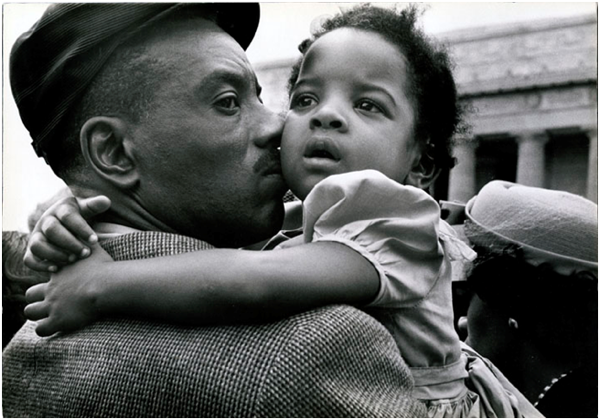
“100,000 Stories, a Selection of Women Photographers from the Photography Collections, in Honor of the 20th Anniversary of the UMBC Women’s Center” will open for public viewing on Wednesday, September 28, noon, in the Library Rotunda. Refreshments will be served.
100,000 people have visited the UMBC Women’s Center and have shared their lives and stories with other visitors and the staff. Equally, that many stories have been told by the women photographers held in the Photography Collections of the Albiin O. Kuhn Library & Gallery. A selection of photographs is presented with the stories of the photographers and their images in honor of the 20th anniversary of the UMBC Women’s Center.
(Photo: “Father and Daughter at the Prayer Pilgrimage for Freedom at Washington, D.C.” by Mildred Grossman, silver gelatin print, 1957, acc. no. 89.25.005)
“By now, hundreds of children’s books about the Holocaust have been published—fiction and non-fiction, as well as hybrids of varying quality: books about hiding, about substitute parents, about successful and failed escapes, attempted rescues and resistance,” writes Ellen Handler Spitz, honors college professor of visual arts, in “Pedagogy in Purgatory,” her latest essay for the New Republic. “Two recent non-fiction books… reveal that the choice of any particular book—and, similarly, the decision to visit a memorial or a museum—may be less important than what surrounds the experience whenever it does occur.”
Spitz goes on to review Ruth Thomson’s “Terezín: Voices from the Holocaust” and Linney Wix’s “Through a Narrow Window,” praising the fact that these books give children and their parents opportunities to discuss the Holocaust, and particularly the situation of children during the holocaust, without the heavy-handed commentary that is often found in children’s books about the time.
The review appeared on the website on September 21.
The Crofton Patch reports that Eric Tedrow ’13, psychology, is the driving force behind a new skate park that will soon open in Crofton.
Tedrow, a rollerblader, saw the need for a place where skaters could practice their sport. “Give children a place where they can push the boundaries of the sport. They need an outlet for that activity,” he told the website.
Tedrow hopes to one day use the psychology skills he is learning at UMBC to research alternative athletes. “What makes them get out there and want to risk it all? There has to be a pattern,” said Tedrow.
September 20, 2011 marked the official end of the the U.S. military’s controversial Don’t Ask, Don’t Tell (DADT) policy, which mandated openly gay and bisexual military service members be discharged from the Armed Forces. Jeremy Johnson ’12, sociology, was one of over 14,000 service members discharged under DADT, and one of many who now plans to return to service.
In an interview on PRI’s “The World,” Johnson describes the impact the policy has had on his life and career, and his current plan to return to the Navy. Until he finishes his degree, Johnson plans to return as a reservist, saying, “Even if it’s only devoting one week a month, I want to get back to it.” When asked why, he responded, “I never really wanted to leave. I felt forced to write [a resignation] letter because I was compromising my integrity and… being treated unequally. Now that that’s gone, I really don’t see any other barriers… I’m ready to go back.”
Johnson is also featured in a Baltimore Sun story on how Baltimoreans have celebrated the repeal of DADT.
Smithsonian Magazinedevoted two pages in its October issue to Research Professor Maurice Berger, curator of the Center for Art, Design and Visual Culture exhibition “For All the World to See.” The exhibition continues on display at the Smithsonian through late November and will visit UMBC in 2012.
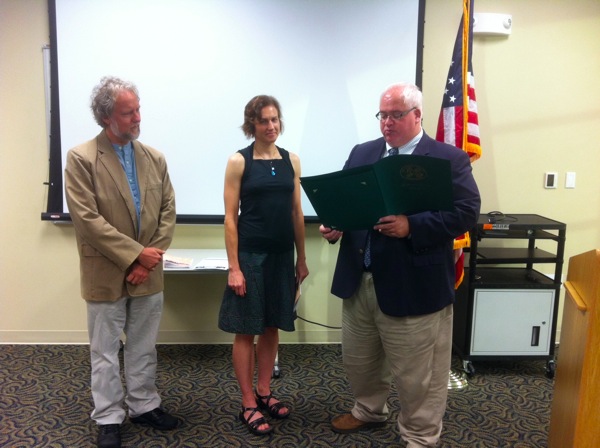
(Above, Bill Shewbridge and Lynn Casabon receive a proclamation from Sam Moxley, representing the county executive. Photo by Vin Grabill.)
In celebration of the new Arbutus Branch of the Baltimore County Public Library, UMBC faculty and students worked with members of the surrounding community to display historic railroad photographs and create a series of digital stories about the area through residents’ eyes.
Lynn Cazabon, associate chair and associate professor of art, worked with students to create a series of mural-sized prints from historical photographs of the railroad in the Arbutus area, which are on permanent display in the new Arbutus Branch.
Intercultural Video Communication students, led by Bill Shewbridge, director of the New Media Studio, collaborated with community residents to combine photos, images and oral history for a series of short films. In “Arbutus Stories,” residents reflect on the community, share experiences and describe their hometown.
Professor of the Practice of English Christopher Corbett will speak at the Smithsonian’s National Postal Museum on Saturday, October 8, at 1 p.m.
Corbett’s talk will commemorate the 150th anniversary of the end of the Pony Express. Corbett is the author of “Orphans Preferred: The Twisted Truth & Lasting Legend of the Pony Express.” A book signing and opportunity to tour the “Pony Express: Romance vs. Reality” exhibit will follow.
This program is free. For more information, contact the National Postal Museum at 202-633-5533 or NPMprograms@si.edu.
Ellen Handler Spitz, honors college professor of visual arts, was mentioned in a September 18 New York Times Sunday Book Review essay entitled “The Children’s Authors Who Broke the Rules.”
Among the authors mentioned in the essay is Shel Silverstein, who wrote “The Giving Tree.” “[‘The Giving Tree’] was embraced by Christians as a parable of selflessness and has been denounced by feminists as a patriarchal fantasy in morality-tale clothing,” writes essayist Pamela Paul. “Ellen Handler Spitz, the author of the classic study ‘Inside Picture Books,’ wrote that the story ‘perpetuates the myth of the selfless, all-giving mother who exists only to be used and the image of a male child who can offer no reciprocity, express no gratitude, feel no empathy—an insatiable creature who encounters no limits for his demands.'”
Sports fans were urged to think carefully about the language they use to describe their teams’ victory in a story that appeared on the Savage-Guilford Patch.com site.
Christine Mallinson, assistant professor of language, literacy, and culture, commented on a number of tweets following the Ravens-Steelers matchup that used the term “rape” to describe the Ravens’ victory. The Maryland Coalition Against Sexual Assault brought attention to these tweets through their own Twitter page.
“The use of the word ‘rape’ in a sports metaphor may be seen as particularly disturbing because it draws a parallel between a rape, a horrifying event, and a positive athletic outcome—the successful domination of one team or athlete over another,” Mallison said.
If you missed the Humanities Forum lecture with history professor Rebecca Boehling, you can read about it on Catonsville’s Patch.com site.
“UMBC Professor Brings Holocaust Story to Life,” which appeared on the site on September 15, recaps the event and the coincidence that brought Boehling and Suzanne Ostrand-Rosenberg, professor of biology, together.
Ostrand-Rosenberg had recently discovered boxes of holocaust-era letters in her aging mother’s closet. “One day I went into the department office, and I was in the Xerox room chatting with a colleague, and she said, ‘You should talk with Rebecca Boehling,” Ostrand-Rosenberg said.
Boehling and her co-author, Uta Larkey of Goucher College, eventually began sorting out a unique and complex correspondence that crossed continents and generations. The result is Boehling and Larkey’s new book, “Life and Loss in the Shadow of the Holocaust.”