All posts by: Kennedy Lamb '20


How To Spot Maryland’s State Bird

With Kevin Omland, professor of biological sciences

UMBC is teeming with wildlife—the infamous frenzied squirrels, the occasional wandering deer, a curious woodchuck or two, and lots and lots of birds. Melodic chirping can be heard from the wee hours of the morning all the way until the last night classes let out. And not just any birds; the areas surrounding UMBC and campus alike are home to a special species, one that is widely revered around the entire state—the Baltimore Oriole.  

Having researched orioles and ravens for decades, it’s not surprising that Kevin Omland, a biological sciences professor, calls himself the mascot biologist for the state of Maryland. Since joining UMBC in 2000, Omland’s work has almost exclusively centered on orioles. Along with members of his lab, the Presidential Research Professor studies a range of topics in avian evolution, behavior, and conservation. We asked the life-long ornithophile how to spot the Baltimore Oriole, our state bird, in its natural habitat.

Tools of the Trade

  • A good pair of binoculars
  • A smartphone or tablet to access the website “All About Birds”
  • A device to play an imitation of the Oriole’s song
  • Patience—and lots of it!

Step One – Pick a Park

Baltimore Orioles can be found all around suburban parks in Baltimore County and City. Omland estimates that there are at least 100 oriole territories between the Inner Harbor and the Pennsylvania/Maryland border. 

“The Baltimore Oriole loves hanging out in local suburban parks,” he notes. “I’ve even seen them in the trees near the entrance to the Maryland Zoo in Druid Park. You have a good chance of seeing them in Patapsco State Park, too.”

To find a Baltimore Oriole on UMBC’s campus Omland suggests scoping out Pig Pen Pond and the Conservation Environmental Research Area (CERA) located south of bwtech, UMBC’s business park. Omland notes that it may be harder to spot Baltimore Orioles on campus due to an increase of construction here in the past twenty years, but it is still possible to find the occasional oriole flying near the green spaces on campus.

Step Two: Look (and Listen!) High in the Sky

After you’ve picked your park, it’s important to know how to find the elusive bird. According to Omland, the state bird may be harder to spot than you think. He recommends looking and listening up toward the treeline. 

“You’ll never see a Baltimore Oriole on the ground to save your life,” he joked, noting that he is also known to be the worst exaggerator in the world. “But in all seriousness, it is very rare to see [them] on the ground. Some particularly adventurous orioles may forage for food on the ground, but it’s rare.”
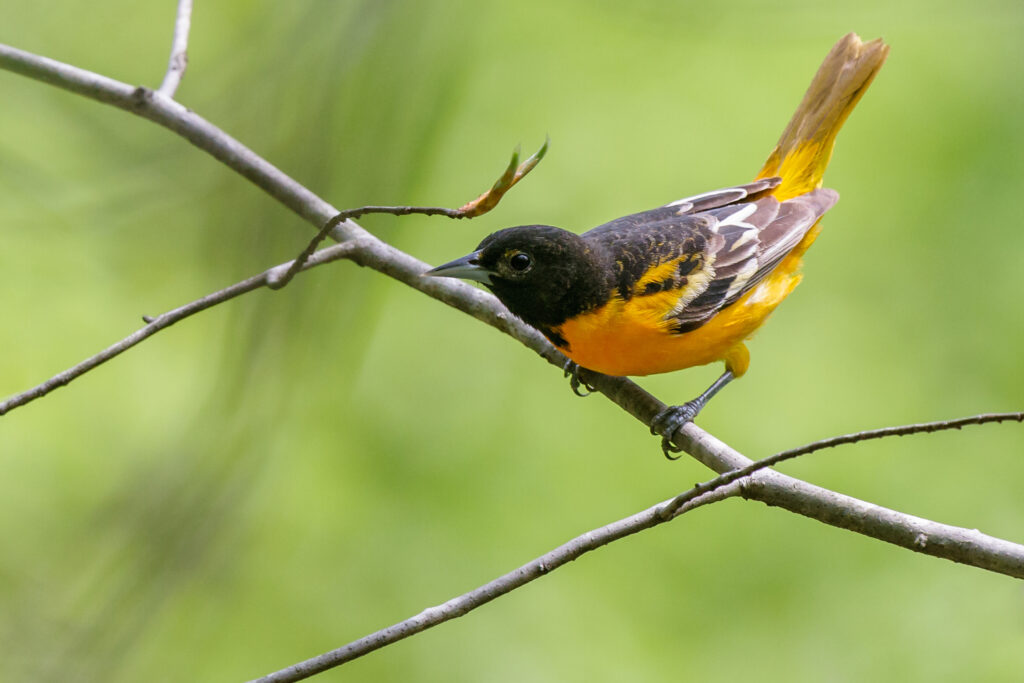
Omland says that your best bet is to grab a pair of binoculars and look in the tops of tall trees near rivers, ponds, and even golf courses. 

As for the signature colors, Omland says that there’s no other bird around that boasts the bright orange coloring complemented by the jet black feathers—it’s unmistakable. He notes that adult males will have vibrant, discernible colors, while females and adolescents will be a bit more muted, but still identifiable.

“You’re sure to recognize the colors. It’s the same ones on the baseball caps for the O’s team,” Omland says. “Historically speaking, it’s called Lord Baltimore’s Orange, and there’s no other bird that carries that indisputable color. If you know that color, you’re on the right track!”

Step Three: Work on Your Whistle

No less important than the distinct colorings of the Baltimore Oriole is the sound that it makes—a low, loud, clear whistle that can often be heard from far distances.

“It is difficult for humans to imitate the sounds of many other birds,” says Omland, “but for the Baltimore Oriole, it can be fairly easy to imitate if you practice. If you get really good at their whistle, there’s a chance that they will answer back!”

Step Four: Take Your Skills Farther Afield

The Baltimore Oriole is just one of more than 30 different species of orioles found all over the world, and Omland doesn’t limit himself to studying just one kind. 

Omland’s research also includes the Bahama Oriole, a critically endangered species native only to Andros Island. Thanks to an International Research Experience for Students grant funded by the National Science Foundation, Omland has been taking students to the remote island in the Bahamas since 2016 to study how climate change is impacting weather patterns and creating natural disasters that have nearly decimated the species. 

“It gives students the chance to be on the front lines of climate change,” Omland says. “This is where climate change is killing people, destroying homes, and eliminating ecosystems…the students care about what happens to these islands and want to make a difference.”

Omland extends the invitation to his students and beyond to participate in what he calls “adventure biology”—getting outdoors and sharing intimate opportunities with the surrounding wildlife, especially in readily accessible areas. “The Baltimore Orioles are one of the many spectacular birds that are here in our forests,” he said. “If people stop, look up, and start paying attention, Maryland has a lot of wonderful diversity to offer us.”

*****
Photos of Omland and his class by Marlayna Demond ’11. Oriole image courtesy of Kevin Omland.
The Rally that Saved UMBC

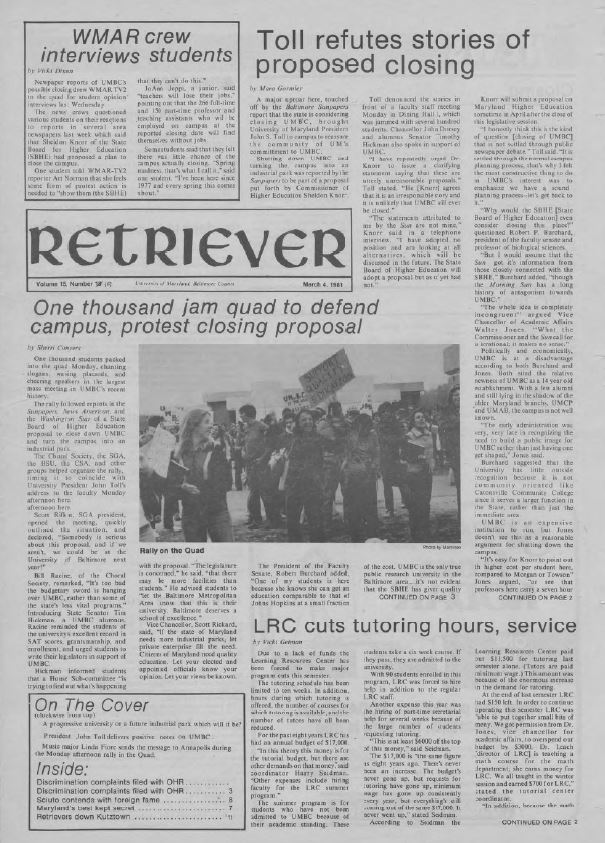
UMBC is so firmly established in the Baltimore region and as the home of over 80,000 Retrievers, it’s hard to believe that only four decades ago, our university was in danger of being permanently shut down. 

Picture this: On March 2, 1981, a thousand UMBC students and faculty gathered in the Quad chanting into megaphones, shouting cheers, and proudly waving poster exclaiming, “SAVE OUR SCHOOL!” Local TV news crews flocked around the protest gathering footage of UMBC’s largest mass meeting to date. “Up your nose, we won’t close!” students cheered as they marched to the dining hall to await a speech from then-Chancellor John Dorsey and UMBC President John Toll to discover the fate of their beloved university. Was UMBC going to be shut down indefinitely?

One of the largest rallies in UMBC’s history was sparked by controversial reports released by the Baltimore Sun Papers, News American, and the Washington Star stating that the State Board of Higher Education (SBHE) may submit a proposal to turn the Catonsville campus into an industrial park. The proposal was put forth by the commissioner of higher education, Sheldon Knorr.

Toll denied that there was any legitimate threat, but students were unsatisfied with such a simple response and clamored for more answers. 

A rally to remember

As reported in the March 4 edition of The Retriever, multiple student groups such as the Student Government Association, Black Student Union, the Chinese Student Association, and others helped organize the rally. SGA President, Scott Rifkin ’81, biological science, shouted his frustrations and roused the crowd of students.

“Somebody is serious about this proposal, and if we aren’t, we could be at the University of Baltimore by next year,” he said followed by deafening roars of approval, according to the student paper.

Students stood on tables, chairs, and each other’s shoulders to get a glimpse of Toll as he delivered his speech to the agitated crowd. 

“The newspaper reports were demoralizing and damaging,” Toll said. “If the threat is real, we are prepared to fight it.” 

Current UMBC archivist Lindsey Loeper ’04, American studies, created an online archive summarizing the raucous event for the university’s 50th anniversary. While gathering the information for the archive, she noted a certain joy in immersing herself in this historical event. 

“There are so many myths and stories about UMBC’s history, and one that I remember hearing was about Chancellor Dorsey standing on the table in the dining hall and addressing the crowd of students—I wish I had a picture of it,” she says. “It was interesting to see the event unfold through the newspaper clippings and administrative records and correspondence. The SBHE proposal really seemed to blindside a lot of people.”

Reason for concern

While the administration denied reports of the university closing at the time, there were many reasons why UMBC may have been on the chopping block. The relatively young 14-year-old university had few alumni and still laid in the shadows of the older Maryland institutional branches. University of Maryland, College Park and University of Maryland at Baltimore had a combined 300 years on UMBC, leaving the school politically and economically disadvantaged. UMBC also lacked a public image, something that then-Vice Chancellor of Academic Affairs Walter Jones asserted, was the early administration’s fault.

“The administration was very, very late recognizing the need to build a public image for UMBC rather than just have one shaped,” Jones said in The Retriever article

The fundamental problem was that the SBHE failed to understand the purpose of a “research-based” university, noted Jones, who asserted that UMBC required a closer student-teacher ratio and that a specialized laboratory open year-round was necessary to the growth of the university. He stressed the importance of a higher education public research institution in the Baltimore area.

The research-based vision continues to guide the development of UMBC, and also defines the current reputation of the institution. UMBC is regularly recognized for its teaching and innovation as well as faculty research

“This event was one of a number in the 1980s that shows how UMBC was trying to figure out where it fit in the academic community in Baltimore, in Maryland, and in the larger national scope,” Loeper asserts. “I think it shows that universities continually go through periods of stability and periods of change.”

 Where would we be without UMBC?

The SBHE would eventually adopt a proposal in April 1981 that left UMBC untouched and allowed the campus to remain open. Nearly 40 years later, UMBC and its alumni have changed the trajectory of countless lives through the years—students have gone on to serve as the U.S. Surgeon General and be voted in as the first African American and first female Speaker of the Maryland House of Delegates; they also work behind the scenes to create the sounds and ambiance that so many of us enjoy in the Star War franchise. Yet none of this would’ve been possible had campus been turned into a bleak industrial park. 


The Man Behind the MCAC

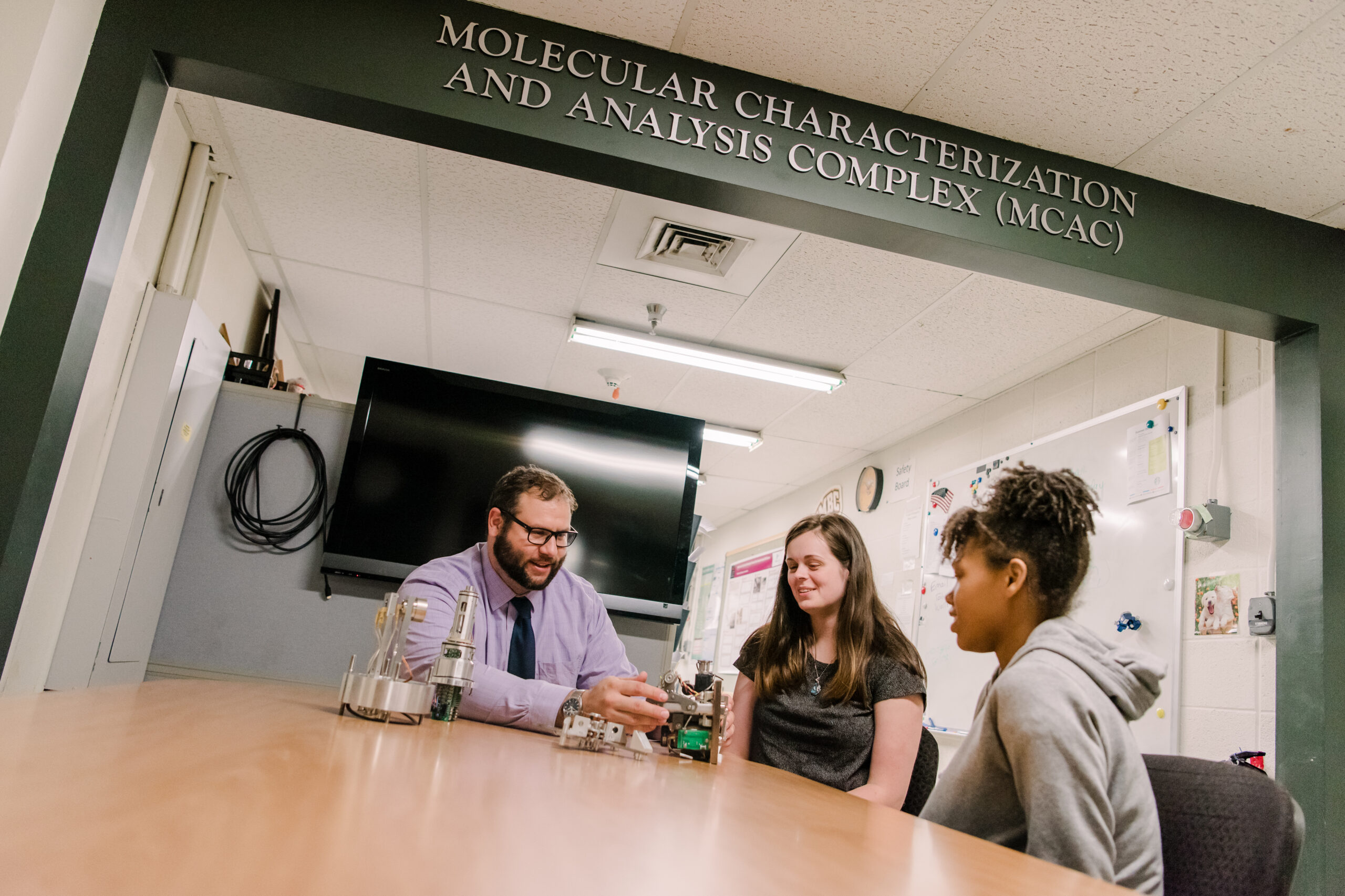
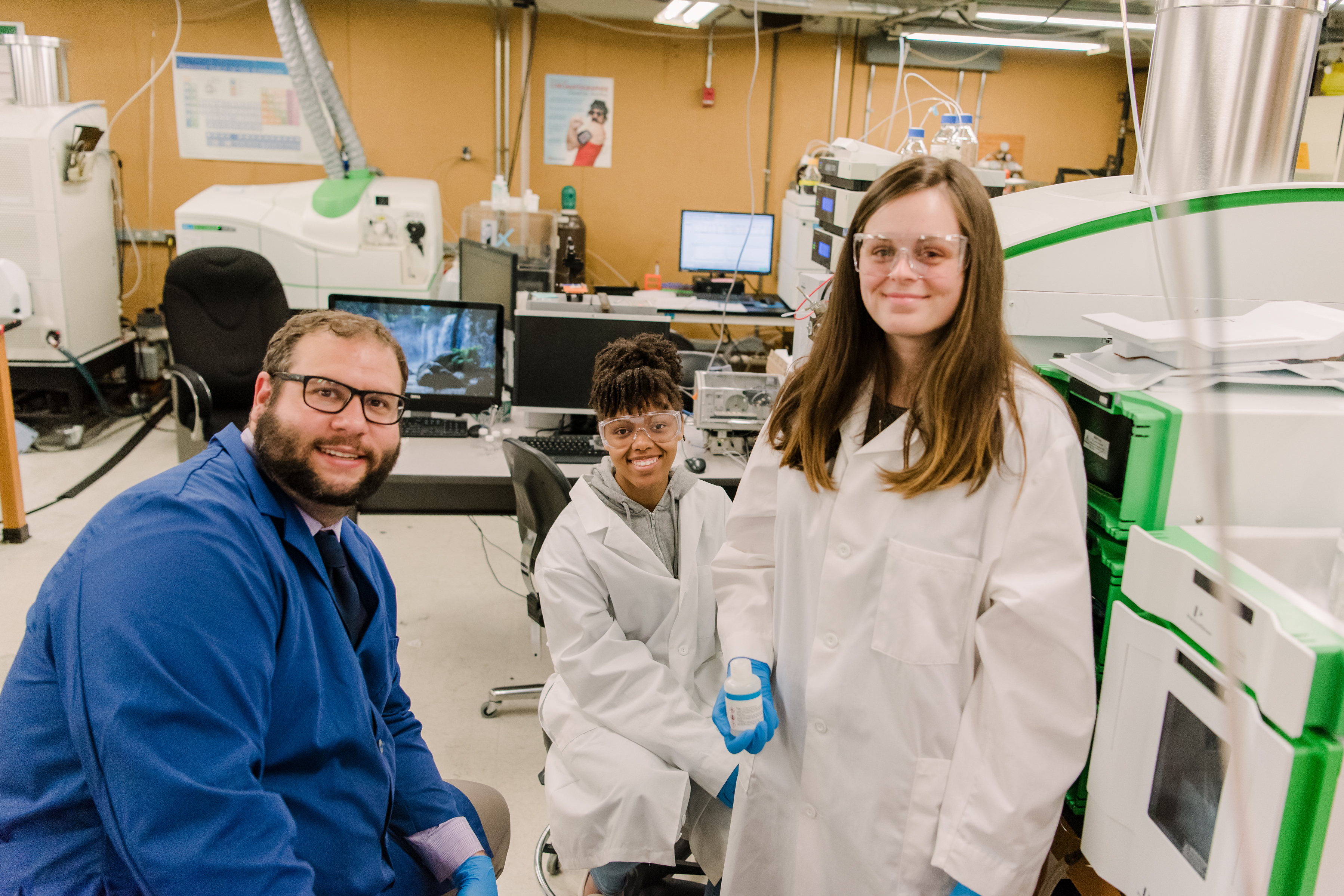
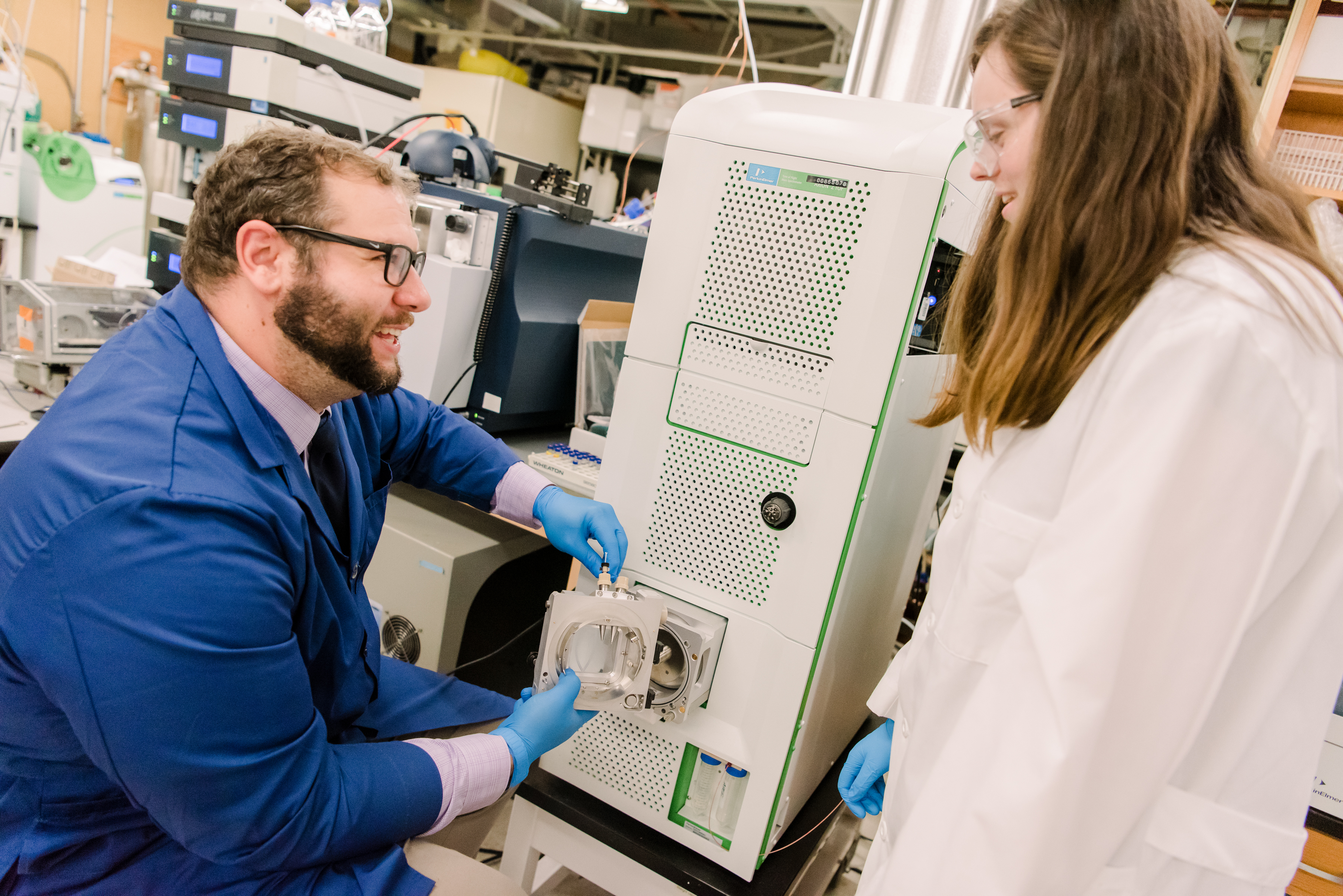
Tucked away in the basement of the Meyerhoff Chemistry Building lies a hidden gem. The Molecular Characterization and Analysis Complex (MCAC) houses a group of self-proclaimed nerds analyzing chemical compounds on instruments that cost upward of a million dollars. Their manager, mentor, and friend, UMBC alumnus Joshua Wilhide M.S. ’10, chemistry, watches over the students—nudging them in the right direction when they need guidance and cracking a joke when they need a mental break. 

By the time lunch rolls around, the group grabs a deck of cards and gathers at a table in the front of the lab to play a round of rummy. Before returning to the humming machines that are separating and sorting complicated chemical mixtures, the students swap stories of any ghost sightings in recent days.

“There’s a running joke that our lab is haunted by a very friendly ghost,” Wilhide chuckles. “Whenever we get new people in the lab we always ask if they believe in ghosts. Whether or not you believe, it’s a fascinating subject that we can always go back to, and we are able to bond over it.”

The profoundly welcoming work atmosphere is a feeling that Wilhide has been working to create for nearly a decade. When he started there full-time, in 2010, the MCAC was just a basement with gritty tile floors, worn down infrastructure, and three mass spectrometers. In 2019, it’s an inspirational learning environment with over 20 pieces of analytical instrumentation, and Wilhide’s home away from home. 

Maryland Born and Bred

Wilhide was first introduced to what would become the MCAC in 2006, when he was an undergraduate at Stevenson University. Knowing that he wanted to become an analytical chemist, he sought out an instrumental lab for his senior capstone project and found one at UMBC. The lab allowed nearly anyone to come in and be trained on any piece of equipment, something that still holds true today at the MCAC.

“I came to UMBC and fell in love with the aspect of figuring out the unknown. It was fascinating to me that you can take a mixture of chemicals and inject it into an instrument and it will give you a unique profile of all the compounds in the chemical,” Wilhide says.

His first few years of research at UMBC included working with DNA and RNA samples and discovering how each interacted with the HIV virus. Those crucial early years gave Wilhide an in depth understanding of how to operate each instrument in the lab and taught him how to modify different instruments so that they interacted properly with the unique chemical makeup of RNA. 

“I came to UMBC and fell in love with the aspect of figuring out the unknown.”
– Joshua Wilhide M.S. ’10, chemistry

After Stevenson, Wilhide was working toward his Ph.D. at UMBC when his mentor, Dan Fabris, decided to move his research to the University at Albany. Wilhide initially followed Fabris to upstate New York, but after two months, decided to return home and graduate with his master’s in chemistry at UMBC.

“The decision was difficult, but I was born and raised in Maryland, and I love my Old Bay and my crabs,” he admits. “I’m truly a Maryland boy at heart.” 

Shortly after Wilhide’s graduation in 2010, the dean of UMBC’s College of Natural and Mathematical Sciences, William LaCourse, offered Wilhide a managerial position at the MCAC. Having worked intimately with the equipment for several years, LaCourse believed that Wilhide was the perfect candidate for the job. 

Unique Approach to Learning

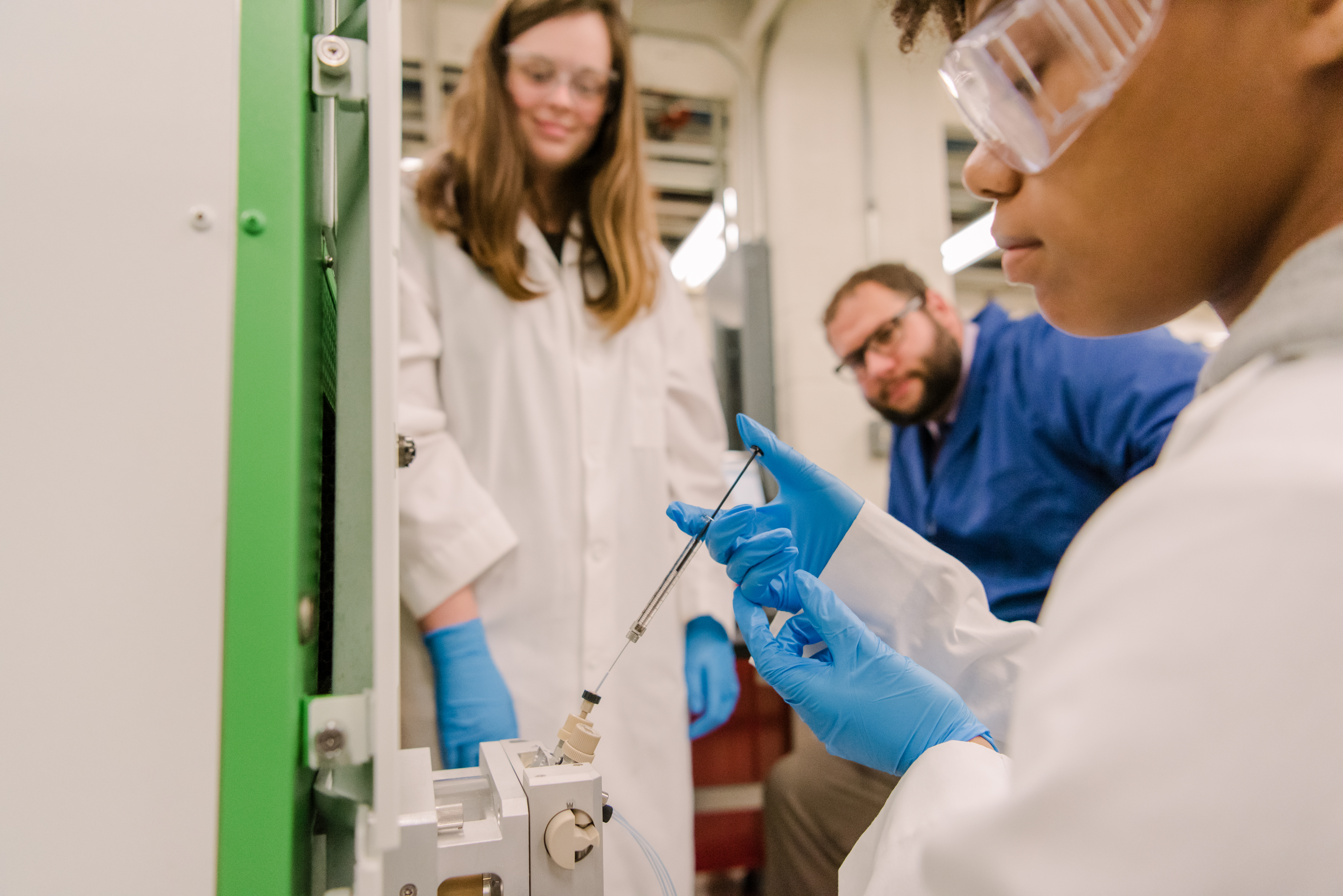
Wilhide describes the MCAC as a unique “jack of all trades” facility that works on general analytics. Other universities have core facilities that specialize in a certain subsection of analytical chemistry, which he says limits their ability to solve certain problems. On the other hand, the MCAC has more than 20 pieces of instrumentation that allow samples to be run through an instrument specially formulated for their specific molecular make-up. 

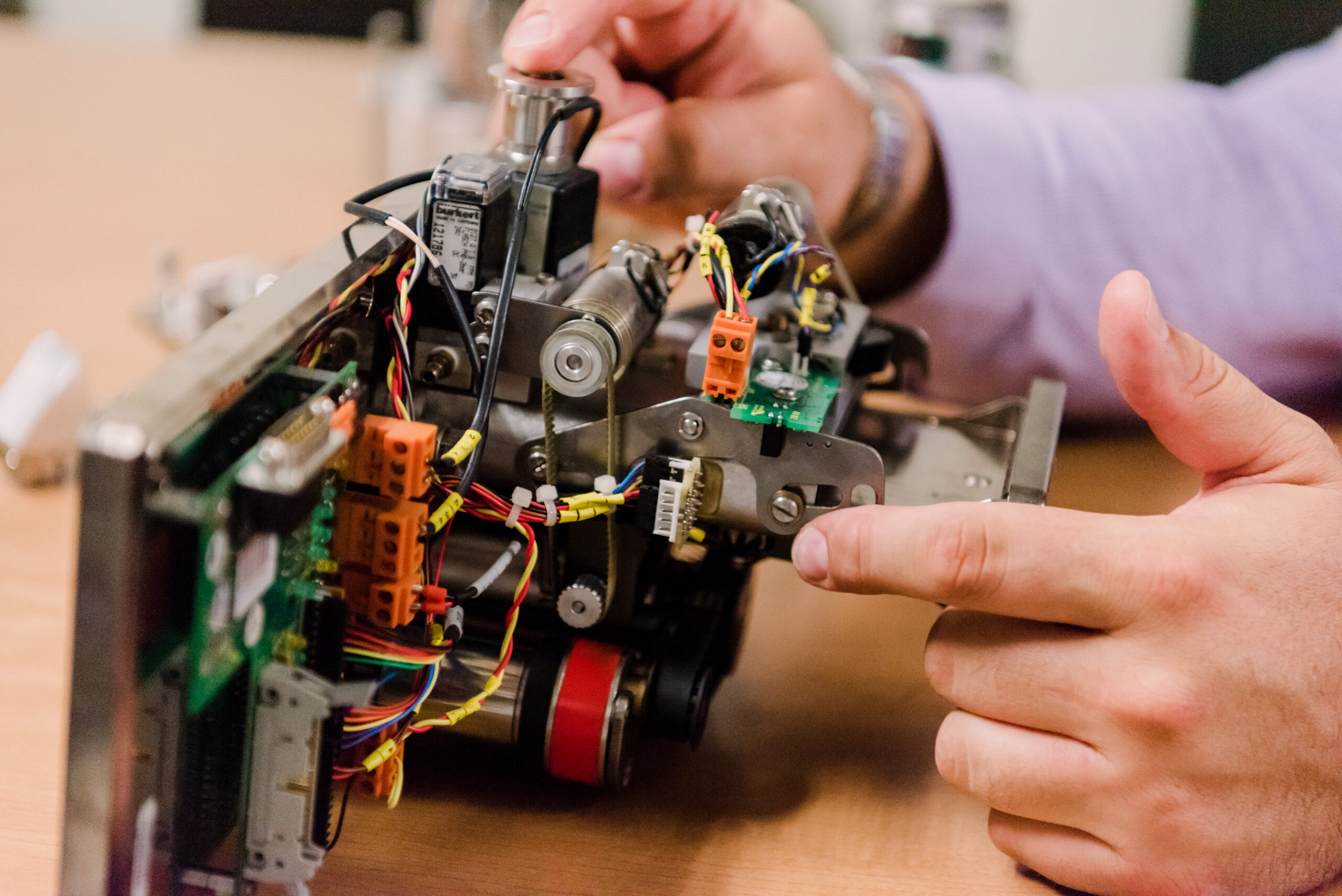
One area of expertise that the lab has developed over the last several years is ambient ionization mass spectrometry. In layman’s terms, this involves Wilhide and other MCAC members building and designing a platform to test a range of unique samples (some examples of what they have tested include ink on paper, a piece of fruit, art from various museums) and determining their molecular make-up in a matter of seconds. Wilhide explains that the technology can be used to determine pesticides on foods, discover groups of chemicals in plastics, and was once even used to uncover the chemical differences between Coca-Cola and Pepsi.

fixing instrument

“We are processing analytical problems that other core facilities can’t analyze because they don’t have the instrumentation nor the proper analytical techniques. Because the MCAC is so diversified in personal backgrounds as well as instruments,” Wilhide explains, “we can usually find a way to solve these issues, and that’s what makes us so unique.”

And students directly benefit from the MCAC’s diverse instrumentation. Wilhide personally trains all of his undergraduates on all of the instruments, even the $2 million mass spectrometer. If a trainee breaks any instrument, Wilhide sees this as an opportunity to show them how to fix it. 

Open Access Advantage

Most analytic chemistry facilities have equipment behind closed doors where samples are put in a dropbox, tested by the lab’s staff, and results are emailed to the recipient weeks later. But Wilhide takes pride in the open access aspect of the MCAC, noting that anyone can come into the lab and be trained on any instrument. Another unique feature of the lab is the opportunity for undergraduates to run samples. Not only are the students learning how to analyze the data, but they are learning to run the instrumentation, thereby increasing their skill sets and marketability in the workforce. 

“That’s how we feed back into that loop of a university education,” Wilhide says. “The students have access to equipment that many people don’t have and because of that will be able to get a job almost anywhere. It’s a unique opportunity to train students from the ground up.”

Students are trained on every piece of instrumentation in the MCAC.

Chemistry major, Maddie Schuch ’21, currently works in the MCAC studying water quality analysis. She uses the lab’s instrumentation to detect and determine how much of a certain ion or compound is in a specific water sample, thus revealing the water quality. Her time working at the MCAC solidified her plans to pursue a Ph.D. in analytical chemistry when she graduates. Schuch notes that the fun work environment Wilhide creates has led to her ongoing success as an undergrad. 

“It’s almost like having a little family here at the lab,” she says. “Josh truly cares for everyone and is very supportive—he never puts you down for not understanding something. Not only do I love the science that I get to do here, but I love the people.”

Keeping Alumni Close to Home

Wilhide is grateful that his professional odyssey brought him back to where he started: UMBC. Dean of the College of Natural and Mathematical Sciences, William LaCourse, understands the importance of keeping alumni like Wilhide on campus. 

“There’s no better feeling than the joy of making room for one more member of the UMBC family,” LaCourse says. “In doing so, we are better equipped to meet our challenges and celebrate success as we deepen the inclusive excellence and community of our UMBC.” 

LaCourse is impressed by how Wilhide has breathed life into the MCAC over the years. Wilhide’s commitment to growth and discovery on both a scientific and a personal level leaves a lasting impact on his students and is something that LaCourse wants to keep at UMBC.

“Alums on campus bring with them an insight into the culture of UMBC and a devotion to its mission and ethos—all of which enriches the student experience and working environment. Their loyalty and love for UMBC and all we do shines through as a beacon of inspiration for others to follow,” he says.

MCAC team smiling for picture

UMBC as a Cornerstone

The Maryland boy continues to stay loyal to UMBC and acknowledges how much he has grown throughout his many years working in the MCAC. 

“UMBC has been an anchoring point for me. Every stage of my life, from being a rookie grad student at 21, all the way to now being married with a stable career, the university has been there for me. I see it as a home and a place to grow, all while standing on the shoulders of giants and utilizing the connections I’ve made,” Wilhide says. 

Wilhide emphasized that he has grown alongside his students, too. He recalls when he was dating his future wife, students would offer him advice on proposals and engagement rings around the lunch table. Now, conversations revolve around raising his toddler. 

“UMBC is a place to grow, and the MCAC is always growing… I’m always growing,” he says. “If you would’ve told me nine years ago that we were going to set up this facility, I would’ve laughed. But we took it one day at a time and look where we are now.”

The MCAC will continue expanding when the new Interdisciplinary Life Sciences Building (ILSB) opens in fall 2019. The university recently purchased a $1.3 million multiple instrument package for the ILSB, designed to expand the university’s ability to study the function of proteins and peptides. Wilhide says that these new instruments will help bring back UMBC faculty who had to use other facilities to complete their lab work. He notes that this new equipment is a big step out of their comfort zone and will bring many new challenges, but will certainly be worth it. 

“That’s the thing about Josh, he loves a good challenge,” LaCourse says. “He is a brilliant scientist and an overachiever. He cares about the students and is always ready to help build the university as a whole.” 


*****

Header image: Wilhide showing students a piece of a mass spectrometer

Students pictured: Shirley Wolz ’20, biochemistry, and Sanaa Jones, an incoming first year student getting a jump start on research.

All photos by Marlayna Demond ’11.


CoLab Continues to Inspire Collaborative Creativity

In a dimly lit room in UMBC’s Fine Arts building, two environmental science majors, a biology major, and a theatre-turned-individualized studies major watch weeks worth of coding, compiling videos, and map making come to life on a 4-foot spinning sphere called the Magic Planet. 

A captivated audience watches in awe and anguish as videos of global warming glide across the spherical screen. Melting glaciers strand polar bears on thin ice, rising sea levels disrupt the homes of native Greenland tribes, and increased carbon dioxide in the oceans wipes out species of animals. 

But not all hope is lost. 

“It’s easy to feel hopeless,” says environmental science major Lauren Patel ’20. “There are times when we feel hopeless, too. But we can make all can make a difference.” Images of climate research and activism begin to spin around the sphere as the group explains how the individual actions of environmentally sustainable habits can add up. 

The students’ “Stories on a Sphere” project, which focused on raising awareness of climate change in the arctic, was one of three Interdisciplinary CoLab research experiences offered to students over the summer. Throughout the four-week internship, each student brought their own variety of expertise to the table to create maps of temperature changes in the arctic, compile informational videos about melting ice caps, and write a compelling script for their 12-minute video illustrating the devastating effects of a warming northern hemisphere. The students also had to properly format the video onto a spherical structure which required learning new coding and video editing techniques. 

NOAA SOS globe

“It’s been amazing to watch the students collaborate and learn from each other,” says Ben Daniels, a current UMBC geography and environmental systems Ph.D. student and co-leader of the team. “Creating this product is something that none of them could have done independently. They each had to bring their own diverse sets of skills to the table to complete this task.”

A Unique Teaching Environment 

For the second consecutive summer, UMBC’s Interdisciplinary CoLab provided students with an innovative team-based applied learning opportunity through a three-credit paid internship in narrative-based research. The program focuses on giving interdisciplinary student teams a professional research experience while learning how to tell effective stories and ultimately create a final product for a client. 

“The CoLab is continuing to provide undergraduates with a unique experience of working across disciplinary lines,” says founding director of the CoLab and chair of gender, women, and sexuality studies, Carole McCann. “This experience gives students a sense of what kind of skills they can bring to a project and what they can learn from others.” In the future, she would love to see more faculty propose projects that connect students with organizations in the Baltimore area so that they can tell stories about the surrounding communities.

Kate Drabinski, a gender, women, and sexuality studies professor took the plunge and co-led “The Neighborhood: A State of Mind” project with media and communications professor, Donald Snyder. Drabinski cherishes her experience with the CoLab as one of the best teaching experiences she’s ever had. 

“With the CoLab, faculty have the amazing chance to take an idea and give it to students and see it develop in ways we have never imagined, and we don’t get to do that very often as instructors,” Drabinksi says. “This is the kind of teaching that I want to do, and the CoLab gives me the resources to do it.” 

Community Engagement

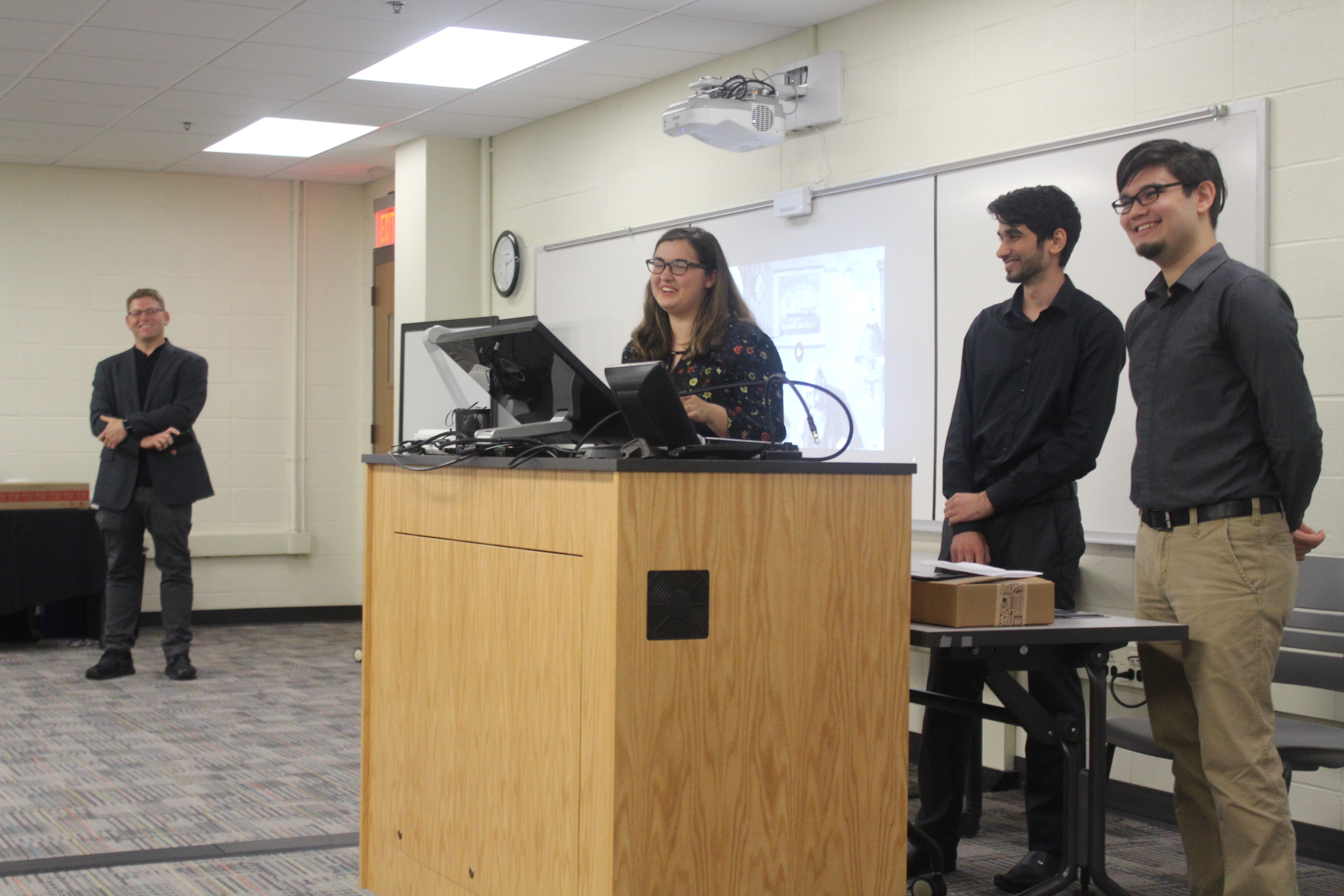
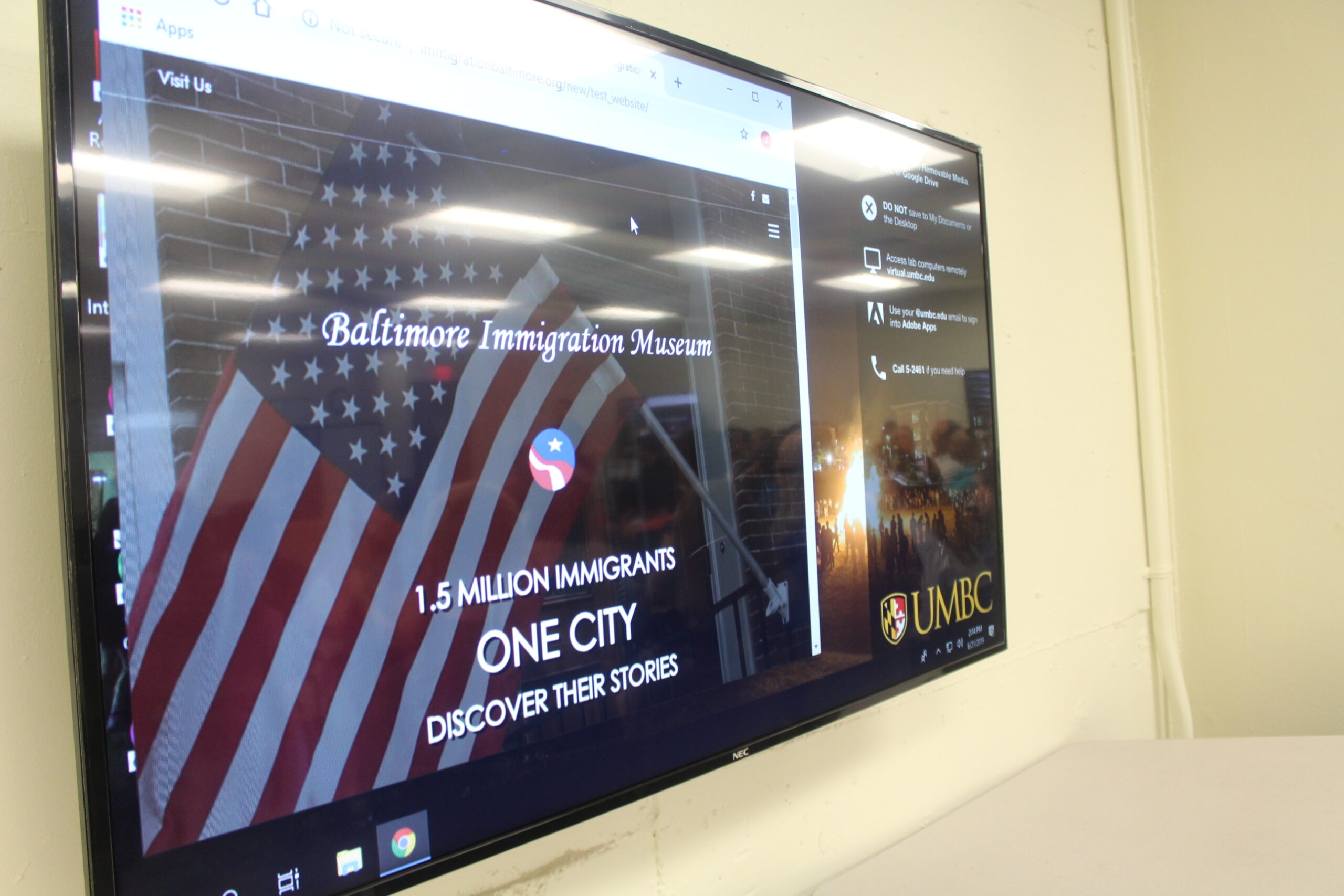
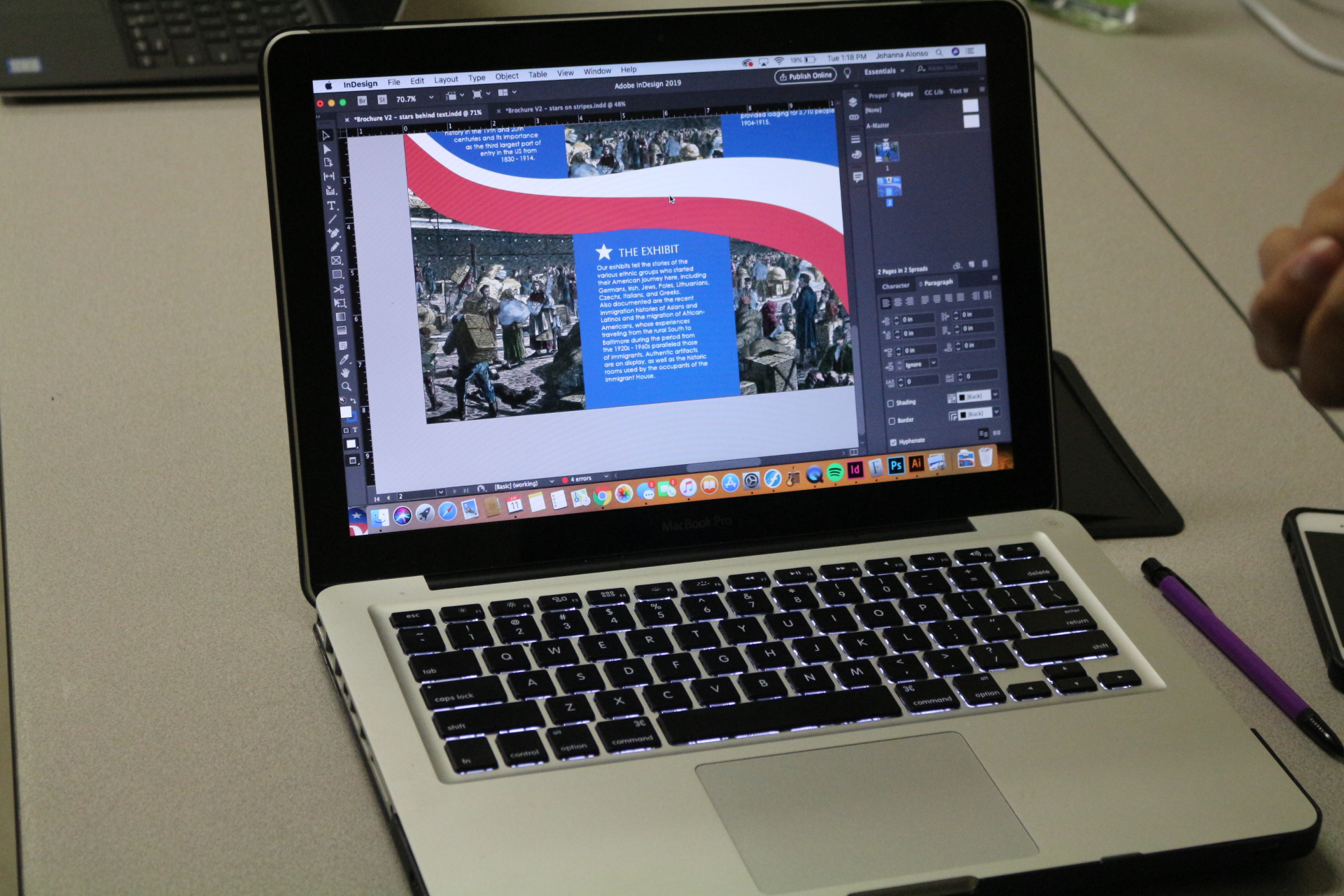
Have you wondered how Baltimore’s Little Italy, Greektown, and Chinatown came to be? For “Baltimore: The Second Ellis Island” project, three CoLab students uncovered the city’s rich immigration history and shed light on the little known Baltimore Immigration Museum. The team collaborated to design a new brochure and revamp the museum’s outdated website in an effort to bring the hidden gem more publicity. 

English major Johanna Alonso ’20 used her story-telling skills to demonstrate how immigrants shaped Baltimore’s past. Alonso played a large role in the creation of the museum’s new brochure, while also composing original music for the interactive audio clips of letters written by immigrants on the website. 

“Our group’s project demonstrated that the story of Baltimore is the story of its immigrants. Understanding their stories is imperative to having a complete understanding of the city,” she says. “I wasn’t aware of the museum prior to my internship, and I think the real benefit of the CoLab is that it exposes students to people, places, programs, and projects we may never have encountered otherwise.”

Immigration Museum Project at final presentations

Community engagement has been a key principle since the conception of the CoLab. Co-founder Rachel Carter notes that this is one of the ways that the CoLab adheres to the University’s and the Provost’s mission for interdisciplinary research. She hopes to continue the trend of creating local partnerships and encourages faculty to keep Baltimore communities in mind as they craft new proposals for next summer. 

“The Baltimore Immigration Museum project was the first real attempt at community engagement for the CoLab,” says Carter. “We hope that in the years to come we will expand our partnerships and increase our commitment to the areas surrounding UMBC.”

Digging Deep in the Archives

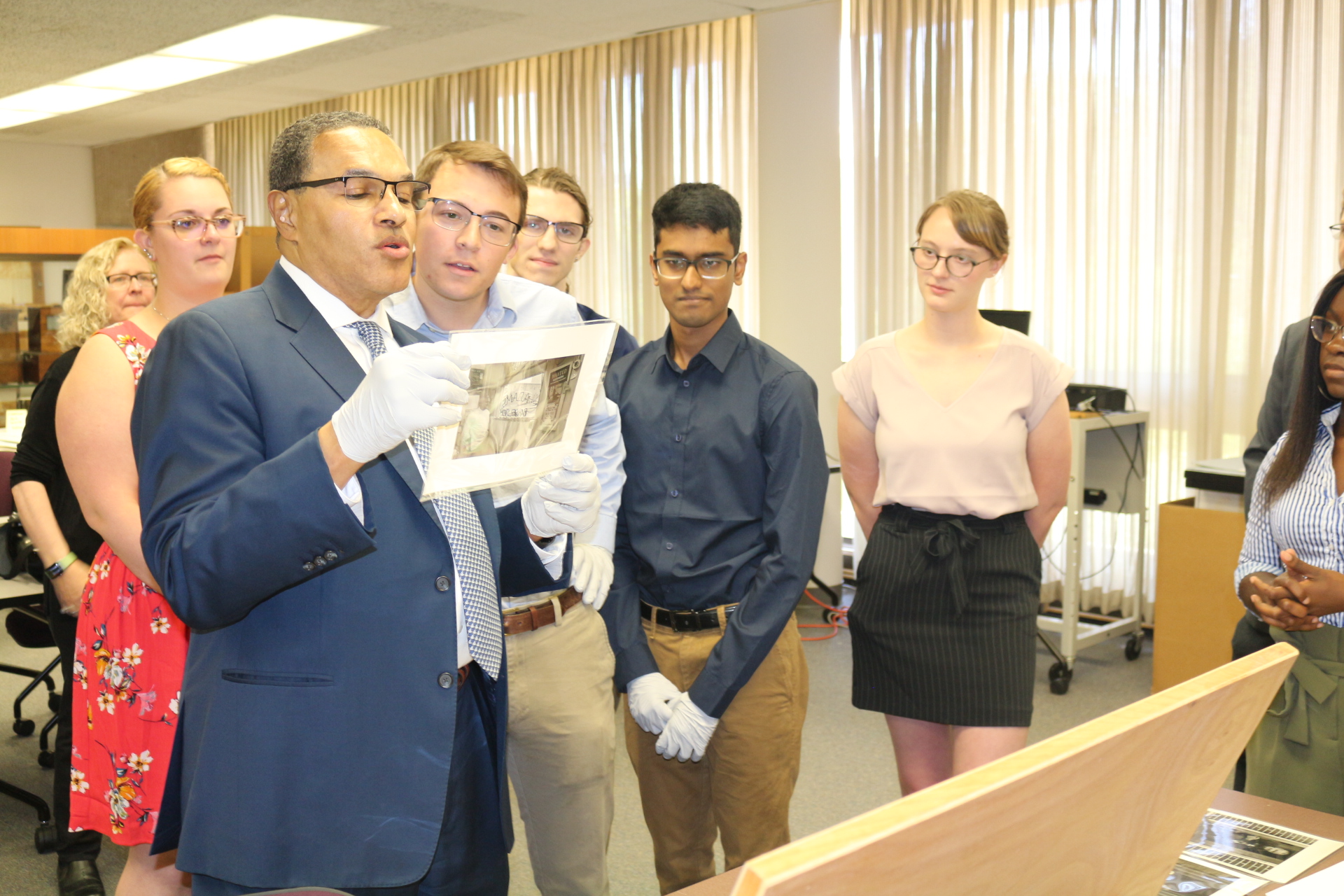
A third project includes a six-person team and over 10,000 photos, hundreds of interview transcripts, and over 50 audio clips documenting various communities in East Baltimore in the 1970s. “The Neighborhood: State of Mind” project required students to sift through the archives of the East Baltimore Documentary Photography Project (EBDPP) housed in UMBC’s Special Collections. Conducted by three photographers at Maryland Institute College of Art from 1976 to 1980 and donated to UMBC in 2019, the sizable archive served as the basis for an online exhibit the students created for the Special Collections website.

Ian Feldmann ’20, a media and communication studies major with minors in entrepreneurship, photography, and information systems, headed up the creation of the website, but stresses that the final product was only possible with the help of every single teammate. 

“Working with students from different majors makes you think more creatively,” he says. “The final product came from meshing together two or three different ideas to make it the best that it could be.”

The CoLab is a little nod to the reality we face: real-world problems do not fit neatly into disciplines,” says Lee Boot of UMBC’s Imaging Research Center. “I’m so thankful that UMBC is doing something to prepare students for this.”

The students picked out important themes they discovered while sifting through the EBDPP and dedicated their time to telling those stories in a variety of ways. The ideas for these topics came straight from the EBDPP proposal written in 1976, as well as common themes observed by the students while going through the photos and interviews from the collection. 

The online exhibit features three research essays about cleanliness, social life, and family structure in East Baltimore. For another aspect of the project, one student created a six-minute video about the neighborhood’s unique history of decorating window sills. Yet another section of the exhibit examines photographs of important geographic locations and features photos taken by the CoLab students. The students embedded an interactive map on the website so users can click on a popular East Baltimore landmark and see side-by-side pictures by the photographers from the EDBPP and modern day pictures taken by the CoLab students collected on a day-long walking tour of East Baltimore.  

President Hrabowski visits CoLab's Neighborhood Project

Real World Applications

The final products for the 2019 CoLab spanned much further than UMBC’s campus. The “Stories on a Sphere” team created the video not only to be presented on the Magic Planet at UMBC, but also for the “Science on a Sphere” screen at the National Oceanic and Atmospheric Administration (NOAA). The video will be archived at NOAA and used during informational sessions for visitors.

“We hope that our spherical presentation is used in classrooms and museums to inspire and engage future students and scientists to learn more about the impacts of climate change,” said biology major Sangita Ramaswamy ’20 at the NOAA presentation in June.  

Stories on a Sphere Project at NOAA

Marveling at the final presentations, former CoLab project leader and director of UMBC’s Imaging Research Center, Lee Boot, explains the importance of the skills the students have learned by being a part of this internship. 

“This generation of students is coming through universities at a time when more and more institutions are being held accountable for the good they are doing in this world. The CoLab is a little nod to the reality we face: real-world problems do not fit neatly into disciplines,” he says. “I’m so thankful that UMBC is doing something to prepare students for this.”

*****

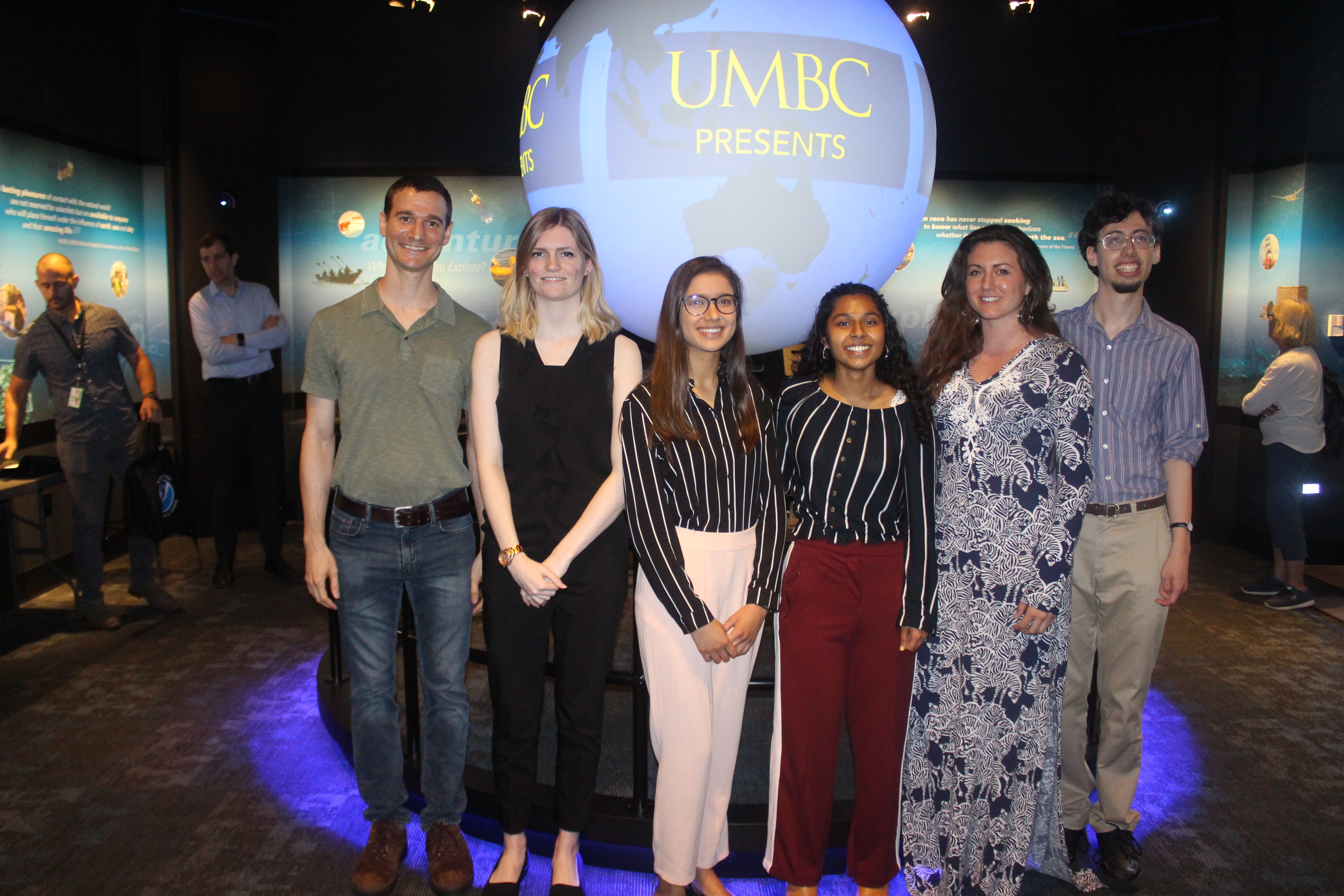
Header image: Stories on a Sphere project in a research lab. Photo by Marlayna Demond ’11. All other images by Kennedy Lamb ’20.

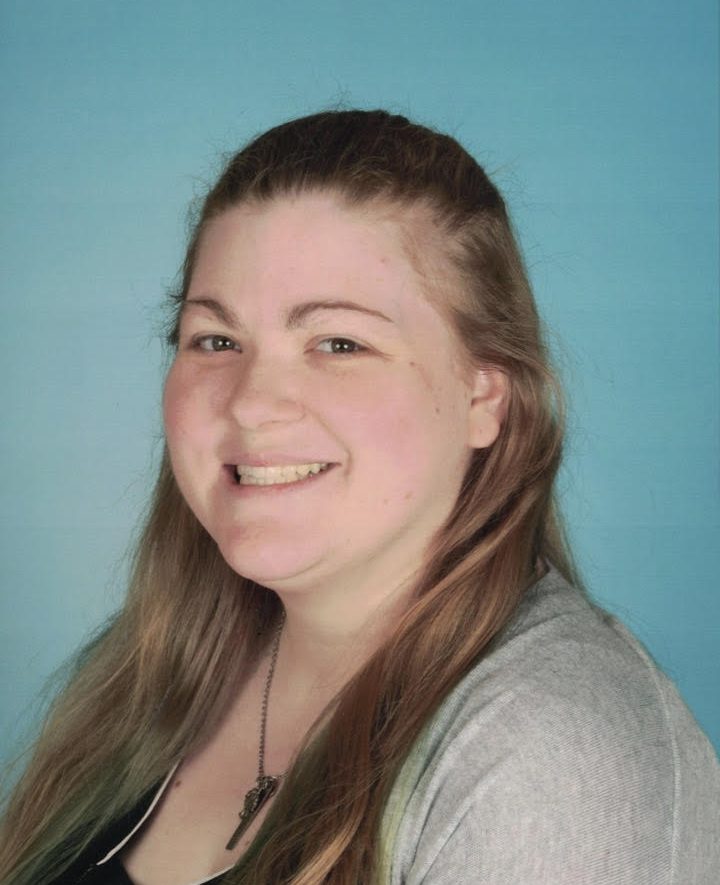
Kennedy Lamb splits her time as an editorial intern for the UMBC Magazine and a marketing intern for the CoLab. 


Alumna Wins 2019 Young Entrepreneur of the Year

The Maryland Small Business Administration recently named UMBC alumna Samantha Walls ’12, psychology, the 2019 Young Entrepreneur of the Year for her outstanding work in growing her daycare establishment, Leaps Ahead Learning Center. 

Walls attributes her success to the lessons she learned as an undergraduate. “UMBC gave me the skills I needed to interact in a professional work environment and helped me develop multitasking skills that continue to aid me in owning a business. This award is symbolic of the great teachers I had.” 

She notes that seven years post-graduation, her childhood developmental psychology class sticks with her and is still helpful as she works with children each day. In addition, while taking an education class with Dr. Susan Blunck, Walls volunteered at the Maryland Science Center where she further developed her skill set for playfully and instructionally interacting with children. 

When Walls was just 23, she opened the Halethorpe-based daycare and has dedicated the past five years to best serving her families, staff, and the children who attend. She prides herself in providing enriching activities for the children, maintaining close communication with the families, and creating a positive work environment for her staff. 

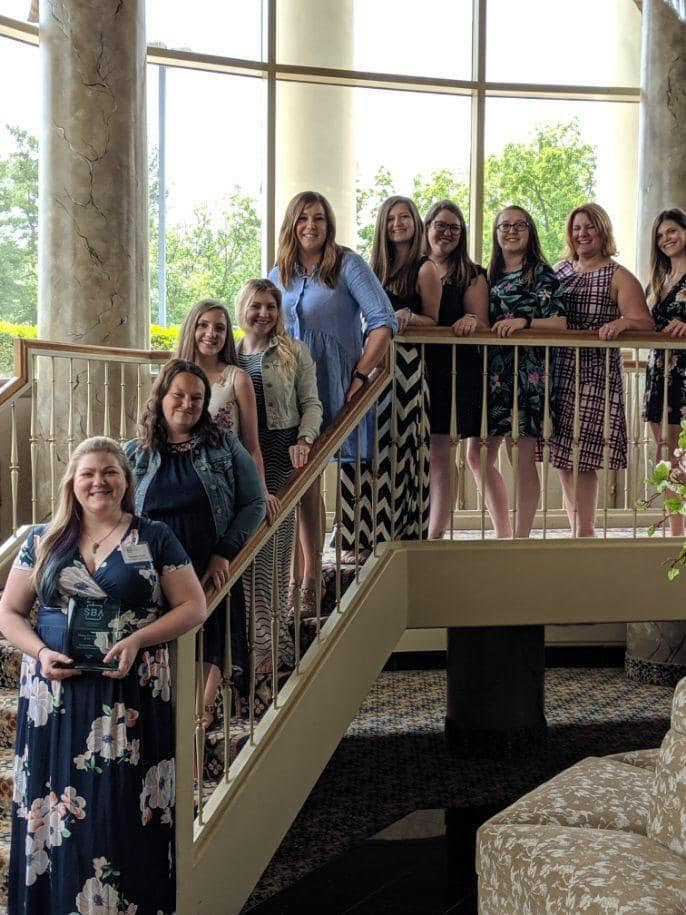
Walls is joined by some of the teachers at her daycare at the award celebration. Photo courtesy of Samantha Wells.

As a business owner, Walls explains that she sometimes questions herself, but that this award solidifies her dedication to the program and that shows she is “helping people and making the center as successful as possible.” She notes that her staff, two of which are current UMBC students, work diligently to support her and the growth of the program. 

Her husband, Erik Walls ’13, geography, also graduated from UMBC.

Walls attended the 2019 Maryland Small Business Week Award Luncheon in Woodlawn, Maryland, on June 6, to receive her award. She was joined by several other outstanding Maryland entrepreneurs and small business advocates.

*****

Header image: Samantha Walls receives her award with members of the SBA Committee. Photo courtesy of Walls.