All posts by: Briana Franco '19


From Real Estate to Covert Agent

Most days, Steven O’Farrell ’92, economics, uses the left side of his brain. As a real estate appraiser, O’Farrell’s livelihood depends on his ability to construct well-written, compelling reports. Remembering his time at UMBC quite fondly, he believes that his success is a direct result of his time spent as a Retriever. “My experience at UMBC was outstanding. I really credit a lot of the things that have happened to me afterward as part of these, you know, sort of formative years, when you’re young,” says O’Farrell. “I still use the calculator that I used at UMBC.”

A new calling

But it was O’Farrell’s creative right brain that took over two and a half years ago while on vacation with his family in Bethany Beach, Delaware, when O’Farrell’s niece pleaded with him to give her a spy name like the other children of the family. Without hesitation, the name Simone LaFray flew from his lips. For the rest of the vacation, he would fixate on the name. Little did O’Farrell know that this one comment would lead to a short story, which would eventually become the published book Simone LaFray and the Chocolatiers’ Ball.

It wasn’t until family and friends encouraged him to expand his short story into a book that O’Farrell took on this new endeavor. “Writing a book of fiction was one of those things that I always wanted to try to do even when I was a little kid,” O’Farrell says. “But, you know, sometimes you prioritize your career over these things. When I wrote the book I was 45. It was time for my next move because time slips away quickly.

For the next two years, O’Farrell’s life became a jumble of long nights, re-writes, and collaboration with Brandylane Publishers, a group of individuals who he says “want to talk about how things feel”—a refreshing change of pace for the appraiser.

Discovering Simone

Developing the voice of 12-year-old LaFray proved challenging for O’Farrell, a father of two boys, who relied on the help of his wife, Emily O’Farrell ‘92, psychology, for a female perspective. Once O’Farrell understood who Simone was at her core, the story quickly evolved from there, bringing the young spy to life: a dutiful daughter of a world-famous patisserie chef doubling as a covert agent for the Ministry of Foreign Affairs. LaFray lives the best of both worlds until a vengeful thief returns to Paris in search of LaFray’s mother, leaving LaFray to question whether her two worlds are as separate as she once believed.

Released on May 13, 2019, The Chocolatiers’ Ball tracked on the Barnes & Noble Top 10 in preorders and was reviewed by two of UMBC’s faculty members: Writing Center Director Elaine MacDougall, and Maria De Verneil, the coordinator for French language teaching.

Although just recently released, there are plans to turn the book into a series. “I know exactly how I want it to all go, it’s just about connecting all the points to the final,” says O’Farrell.

Exercise your muscles

Though O’Farrell spends most of his days putting together what he calls “dry” appraisals, he fully acknowledges that this sort of writing has prepared him for the author life. Every workday provides him new opportunities to master his technical skills, leaving him with freedom in his downtime to let his creativity flow. And according to O’Farrell, any writing is good writing as long as you’re doing it.

To the students of UMBC or anyone in general thinking about writing their first book, O’Farrell offers the following: “Have persistence and believe in yourself. What you’re writing will find its audience. Just try to align yourself with good people to get you there.”

*****

Learn more about Simone LaFray and the Chocolatiers’ Ball at brandylanepublishers.com.

Photos provided by Steven O’Farrell.

The Threads that Bind Us

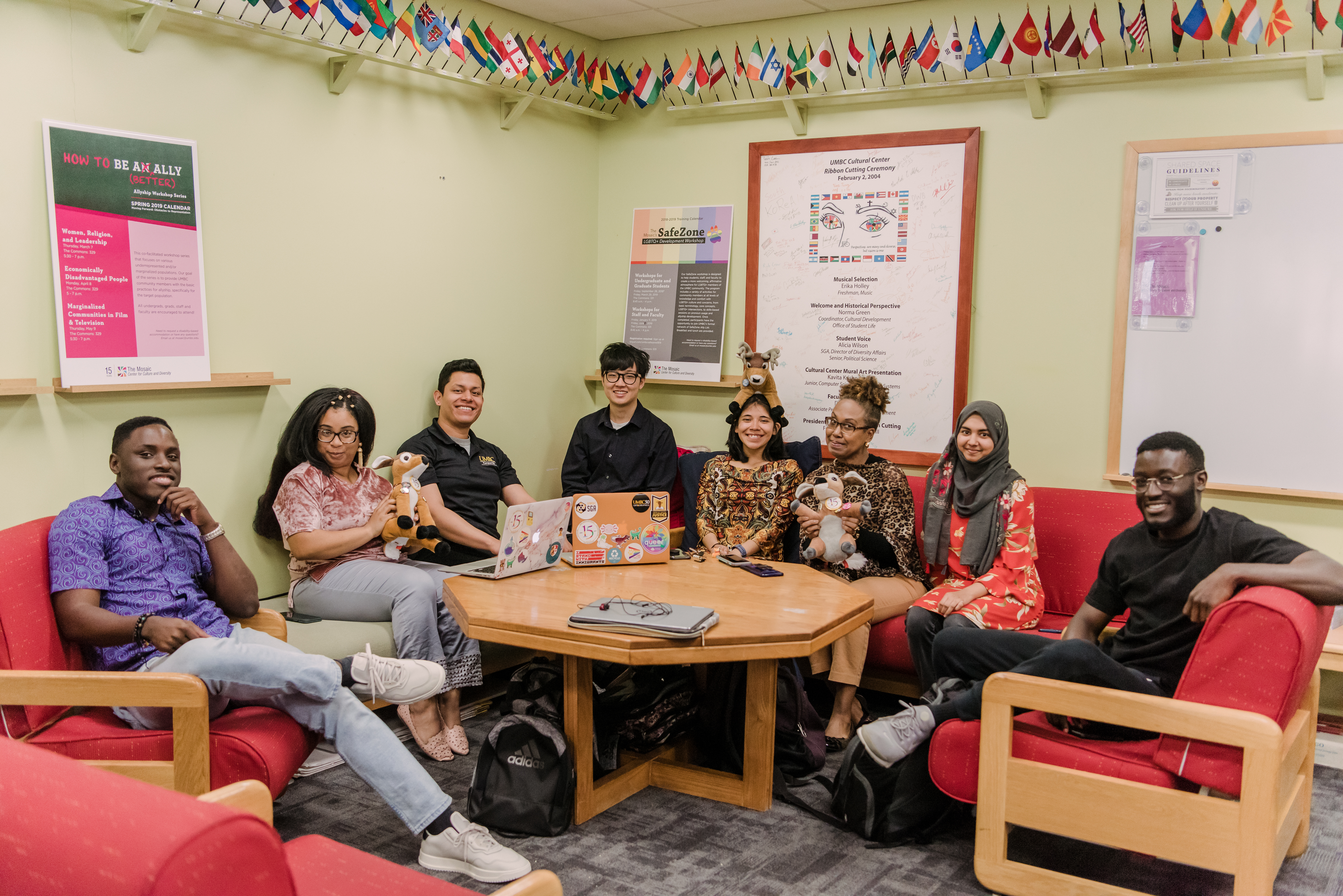
It’s a cozy space decorated in lively yellows, blues, and reds, a perfect representation of the dynamic individuals present and the discussions taking place here, coloring the UMBC campus. The Mosaic: Center for Culture and Diversity makes its home on the second floor of The Commons and has been an influential presence, shaping conversations at UMBC for the past 15 years.

Immediately behind the front desk sits a roundtable areaan inviting corner for group meetings, events, or simply a spot where students can come chat and unwind in between classes. On this day, eight of the center’s interns sit in its space, offering up generous amounts of finger-snaps and support as they each recall what initially drew them to The Mosaic. While each intern differs in graduation year, major, and internship specialization, the thread that binds them together is the warmth and immediate acceptance they felt when first introduced to Mosaic and its community.

For Sylvia C. Anokam ’20, gender, women’s, and sexuality studies, and Mosaic Intern for Black and Africana Student Engagement, the center is integral in helping to develop her sense of purpose both in and outside of UMBC. “As I started working at Mosaic, I started thinking about all the various identities that I hold,” said Anokam. “I know I’m a woman and I’m a black woman, but I never thought of my immigrant identity and how it played a role in my life.” This past February, Anokam participated as a panelist in the Mosaic’s Fifteenth Anniversary Celebration where she shared her journey with other students, faculty, alumni, and guests.

Students gather to celebrate The Mosaic's 15th anniversary in February 2019.

In its 15 years, The Mosaic has grown to include Associate Director for Student Diversity and Inclusion Lisa Gray; two Coordinators for Student Diversity and Inclusion, Carlos Turcios 15, psychology and sociology, M.A. ’17, applied sociology, and Erin Waddles; 10 student staff; and two additional sister spaces—Campus Life’s Interfaith Student Lounge and Campus Life’s Queer Center.

Turcios, who originally joined The Mosaic as the first Intern for Hispanic and Latinx Student Community Outreach, believes UMBC’s practice of inclusive excellence, as well as the sociopolitical challenges present in our country over the past few years, have helped to bring focus to the crucial social justice and intersectional based work being done by The Mosaic. As students and their families affected by travel bans and Deferred Action for Childhood Arrivals (DACA) deal with the ongoing policy changes, The Mosaic has maintained an inclusive and supportive environment for anyone looking for a place to speak freely. And while The Mosaic stresses that the staff are not counselors, they believe in fully supporting their student community however they can.

Among the many educational, outreach, and training programs developed by The Mosaic, there is What’s the T? A Social Justice Dialogue Series and How to Be a Better Ally: Workshop Series, both of which use Brave Space Guidelines as their foundation. Originally created by The Women’s Center, The Mosaic’s key partner, Brave Space Guidelines assist in fostering meaningful, social justice-based conversations that promote accountability and learning from a place of positive intent. “[Brave spaces] allow us to address things that might seem small to the folks who are saying it but have a larger impact if they keep using those terms,” said Turcios.

Going forward in the next 15 years, Waddles, Turcios, and Gray hope that the growing recognition The Mosaic is receiving will result in increased staffing and resources, all of which will aid them in providing larger spaces and innovative programming for their students and community.

“My hope is that we work our way out of a job.” says Gray, who has led The Mosaic’s mission for more than 12 years. “There will not need to be a need for these spaces anymore, because the entire campus will be The Mosaic.”

As the interns wrap up their group discussion for the day and head to other obligations, Hispanic, Latinx, and Indigenous Student Engagement Intern Karina Aquiahuatl Villagran ’19, individualized studies, offers one final sentiment, perfectly summing up the empowered collective voice of The Mosaic community: “I love The Mosaic because I can have real conversations here. Society has normalized keeping the difficult conversations to ourselves, but Mosaic is a part of society and it can branch out from this space to whatever we do in the future.”

Students and staff pose with The Mosaic's mascot plushies.

*****

Header photo: The Mosaic staff and students gather to talk regularly. All photos courtesy of Marlayna Demond ’11.

A Conversation About the End

March of this year marked an important month for Marylanders— it saw the passing of a bill that would have put terminally ill patients in control of their own fate. Passed through the House of Delegates on March 7th before a highly amended version met its defeat on March 27th, the End-of-Life Act would have allowed terminal patients to peacefully end their lives at a time and place of their choosing.

Over the years, my own personal experience with death has helped to create my strong and continued support of the laws which give and protect a terminal person’s right to choose how they live and end their life. With only six states and Washington, D.C. recognizing physician-assisted dying as law, it’s clear the idea is a controversial one, but one I, and many others, believe deserves more attention.

Mark’s story

I was eighteen when my father passed away unexpectedly. He was there and then he wasn’t –  his heart attack leaving behind a trail of confusion, along with a desire to understand why. A few years later, my closest friend from high school lost her father Mark*, but for her family, his death was preceded by years of suffering.

Although diagnosed with Multiple Sclerosis (MS) while we were still in high school, Mark did not pass until we were in our early twenties. MS causes the body’s immune system to attack the central nervous system, and while some may have mild or moderate symptoms, easily managed through medications, others deal with a monstrous disease which progressively robs both the body of its ability to function normally and the afflicted person of their independence. Mark experienced the latter. MS may not take your life directly, but it will deteriorate the body, causing a host of other issues that can.

Over the life of his diagnosis, I watched Mark go from a healthy, vital man to someone who could no longer walk or feed himself without assistance, someone who lived with daily pain. Barely able to function without support from those around him, slowly losing his awareness, I witnessed his quality of life drastically diminish in his final months while those around him struggled to see their father, husband, best friend, lose his life. Losing a parent, regardless of circumstance, leaves a hollowness inside of you. While the death of my father still hurts and confuses me to this day, I can’t help but feel grateful that his pain was short-lived. My father was brought swiftly to peace, something many have shared they wished for Mark.

Because MS by itself is not terminal, it’s considered a chronic disease and is not covered under the physician-assisted dying umbrella of illnesses, although many advocates are currently attempting to add certain degenerative diseases, such as the late stage MS and Parkinson’s, to the approved list. Knowing if an end-of-life option would have been the right choice for Mark and his family is impossible, but having the option is a right I wish had been granted not only to Mark but other terminally ill patient’s living outside of the scope of physician-assisted dying laws.

Death with dignity

Until Mark’s passing in 2009, I was unaware that these laws existed within the United States. It wasn’t until I stumbled across the documentary How to Die in Oregon that I was introduced to the first approved Death with Dignity Act passed in that state back in 1994. While watching the documentary, it became clear that those considering end-of-life options are not doing so rashly – a common misconception.

Often missing among legal rhetoric surrounding the various physician-assisted-dying laws is the viewpoint of the patient and their families, a crucial perspective. Death with Dignity laws are not about wanting to escape life — they’re about putting power back into the hands of the terminally ill, giving them options and control. Those who choose physician-assisted-dying desire to end life on their own terms, in a physical and mental state that offers peace to themselves, as well as to their families. 

The passing of the Maryland End of Life Act through the House of Delegates generated a great deal of criticism over the past weeks. Viewing them as a “slippery slope,” those in opposition of laws believe they are likely to erode our society. Misinformed about of how physician-assisted-dying functions, many are unaware that there are safeguards which protect from abuse.

What it is

Maryland’s Richard E. Israel and Roger “Pip” Moyer End-of-Life Option Act allowed residents 18 years or older and diagnosed with a terminal illness to request aid-in-dying medication from a physician. Seeking this end of life option would have required residents to ask their physician on three separate occasions (once in writing and witnessed by two other individuals) to prescribe a lethal dose of medicine that would end their lives peacefully, in a place and time of the patient’s choosing.

What it isn’t

End-of-life acts are not euthanasia. While a physician must perform a mental health assessment, as well as provide a prescription, they do not administer any medication. To comply with the act, the patient requesting the prescription must ingest the medication themselves and often does so surrounded by family and under the guidance of an end-of-life counselor.

Why the conversation matters

This is the fourth time an attempt to bring physician-assisted dying to Maryland has been defeated, but many still hold hope. As Del. Shane Pendergrass said, “Every person is one bad death away from supporting the bill.” For me, that death was Mark’s.  Currently awaiting the expected signature of Governor Murphy, New Jersey recently passed their own version of death with dignity, a fact which I applaud.

I understand the uncomfortable nature of discussing the end of life. Often, our unwillingness to explore this sensitive topic has much to do with our own relationship to death and the loneliness that goes along with it. Allowing the terminally ill to leave this earth gracefully and with dignity is not selfish. We owe it to each other, to the ones we love, to exhaust every option in pursuit of a peaceful and comfortable end. We owe it to each other to keep the conversation going.

*Name has been changed

****

Briana Franco ’19 is an editorial intern for UMBC Magazine. These are her opinions.

Header image courtesy of Arvin Chingcuangco on Unsplash.

Video courtesy of Capital News Service.

Get Out and Explore DC: In Peak Bloom

Editorial intern Briana Franco ‘19 explores a unique art installation just a metro ride away from campus. Pictured above, Hana Fubuki by artist Akiko Yamashita.

Finally making an appearance, Washington D.C.’ s Sakura cherry blossoms recently reached their full bloom on April 1st. With boldness and vulnerability wrapped up into one much-anticipated flower, their arrival was an unforgettable sight.

Alas, their delicate petals will be gone before most have had the chance to witness them, but along with the cherry blossoms comes the warm, breezy weather of spring and the opportunity to easily and comfortably venture off of the UMBC campus to experience Artechouse’s current art exhibition: In Peak Bloom.

In Peak Bloom explores the life of the Sakura tree and our connection to its short life and fragile beauty. If you are unable to visit DC in time to witness the city painted in shades of rosy pink, the blossoms of Artechouse, showing until May 27th, could just be the next best thing.

Located a short walk from the Smithsonian metro station, and open since 2017, Artechouse offers visitors “experiential and technology-driven work” created by celebrated artists who push the boundaries of immersive art. A modern, edgy space, with clean lines, crisp white interior and purple fluorescents illuminating its corridors, the building works as a blank canvas, preparing the audience for complete absorption into the installation experience.

This season’s exhibit of In Peak Bloom highlights women in the arts as they pay artistic tribute to the “ephemeral” quality of the blossoms. Boasting five unique spaces, the venue invites its guests to soak up the entrancing work at their own pace and in a way which suits them.

Hang out in the interactive gallery where your body creates Hana Fubuki or a “cherry blossom blizzard,” by artist Akiko Yamashita. Step into the Enchanted Garden where augmented reality (AR) brings Japanese folklore to life. And if you happen to be over 21, check out Artechouse After Hours, where their bar serves up delicious cocktails in an innovative AR setting.

If you’re an art or technology buff or if you’re simply looking for something different to do in our nation’s capital, and possibly get some social media worthy pics, Artechouse will not disappoint.

To get to Artechouse, jump on the UMBC bus to BWI Marc train station and take it into Union Station where you can transfer to the Smithsonian stop. It’s just a few minutes walk from there. Click here to check out the website for ticket information.

Photographs by Briana Franco ’19 for UMBC Magazine.