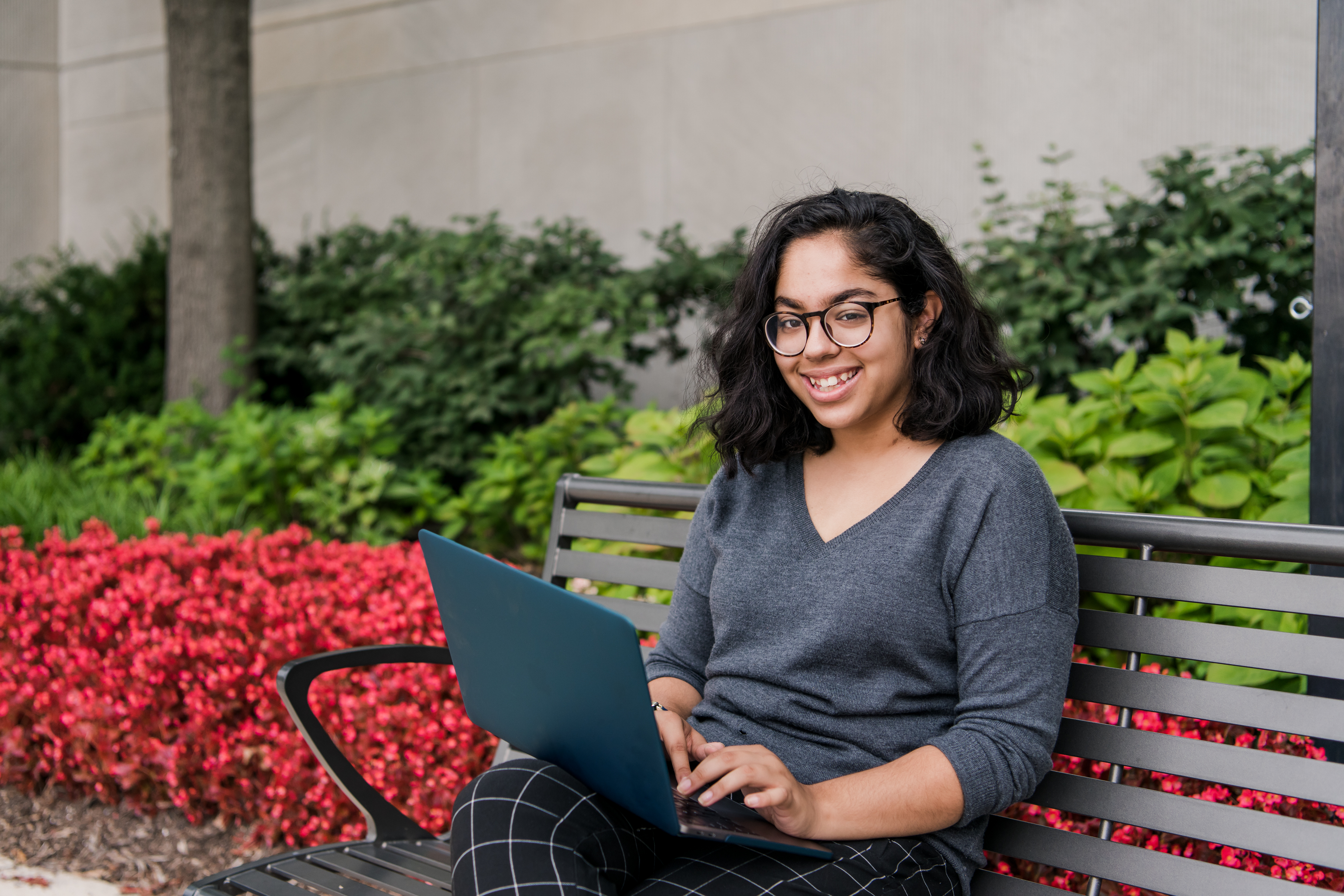
All posts by: Anjali DasSarma '21


Special Edition

Under normal circumstances, print news like UMBC’s student newspaper The Retriever binds the campus community together. College students reach for the paper because they know their friend wrote a feature on the front page, or they spot one of their favorite professor’s research on the second page. In a world that has morphed into a socially distanced, spaced-out reality, it turns out that we’re all still yearning for community.

That was my focus as the editor-in-chief of The Retriever during the 2020 – 2021 school year. Every staff member had to make the UMBC community the priority while reporting on all sorts of serious topics. It was learning on the go. Jokes have roamed Twitter about “BC,” or before coronavirus. “BC” for The Retriever was filled with staff meetings twice a week, production meetings to roll out the paper every other week, and continuous in-person interfacing. When we were forced to scatter up and down the East Coast, our editors continued publishing online and in print. We all worked diligently to produce relevant and informative articles. The staff is filled with resilient and strong people, and I am very proud to have had the opportunity to lead them through this tumultuous time.

Newspaper life is frenetic in general, though, so I was excited to be able to connect with two editors from The Retriever’s past—Juan Carlos Ordóñez ’91, philosophy, and Alex Pyles ’09, English—to get their perspectives. Ordóñez shared his experience leading The Retriever while the paper was daily and production days were filled with all-nighters and lively conversation. Pyles described the impact of the internet and the recession on the paper. Our conversation was filled with friendly anecdotes and plenty of shared experiences even given the 32-year gap between our times of leadership. And though our challenges varied, as did our staffs, we all shared one thing in common: our love for The Retriever and our love for the UMBC community.
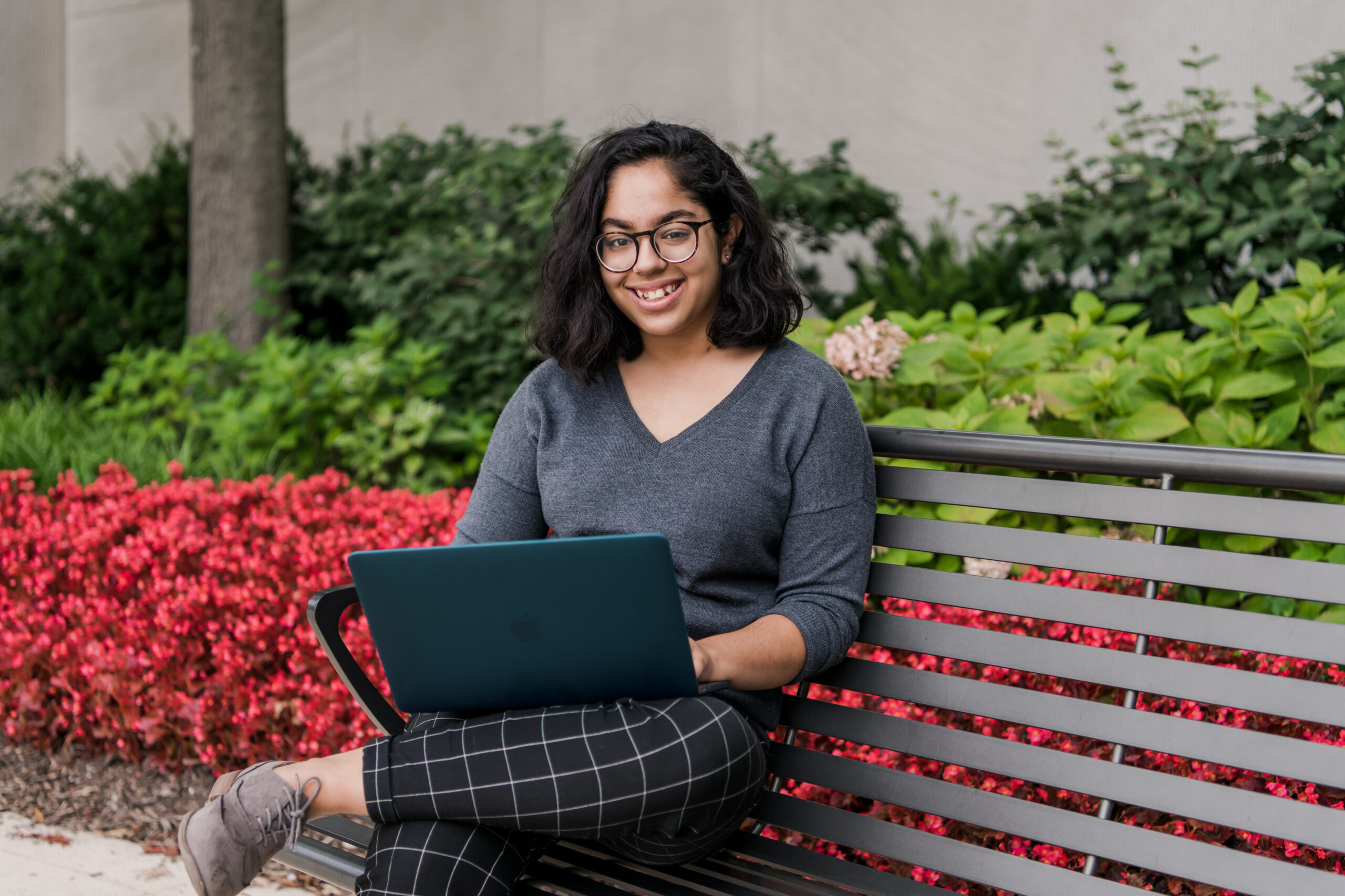
DasSarma in front of the A.O.K. Library. Photo by Marlayna Demond ’11.

Where are they now?

Anjali DasSarma: Hi, everyone, I’m Anjali and I’m about to hand off the editorship at The Retriever, but I’ve been the editor in chief since last April so I had the pandemic year….I’m going to Brown University in the fall and I’m going to be studying journalism and inequity and community distrust. I majored in media communication studies. Can you tell me about your careers and how you got there?

Juan Carlos Ordóñez: I was editor of the paper in ’89 and ’90, so quite a while ago. It’s before the paper was in any sort of digital form, which is kind of interesting. After leaving UMBC, I attended law school. I went to Harvard and practiced law for about seven years in New York City, where I did commercial litigation. I got tired of the rat race. I left New York City, left the practice of law and moved back to Guatemala, where I was born. I did some freelance journalism; I volunteered in a number of community organizations; and I met my wife who was from Oregon. So, around 12 years ago, I moved to Oregon and I ended up getting a job at a think tank. We do tax and budget economic policy at the state level. And I’m the communications director, a position I’ve held ever since I got to Oregon, so it’s been over 10 years now. And I have to say that each of those steps—since I left UMBC, my experience from the paper, especially writing—has been invaluable. 

Alex Pyles: I’m Alex, and I was the editor of the paper in ’08 and ’09, which was the recession year, which is not a pandemic year, so I’m not comparing the two. But I went from there, and started working in journalism immediately. I was a freelancer for the Wilmington Delaware News Journal and then I went to the University of Maryland to start my master’s degree in journalism. While I was there, I started working for patch.com as a sports editor [and later on] local editor and city editor roles with the same company. I spent a couple of years with Patch and went from there to the Maryland Daily Record where I covered the Maryland State House for two years. I then spent four years at the Baltimore Sun—two years in the sports department, two years in Metro covering as the political editor for Maryland state government in Baltimore City Hall. I left the paper in 2017 to go back to where I got my master’s degree, the Philip Merrill College of Journalism at UMD, where I was the communications director for about two years. And then I joined the faculty and now lecture in the college teaching audience engagement and digital design and editing investigative projects for the Howard Center for investigative journalism. 

Deadlines and all nighters

DasSarma:  It’s really helpful to see the framework of where you guys went after the paper. Now, I’d like you both to think back on some of your achievements, or things that really stuck out to you, during your time as an editor. 
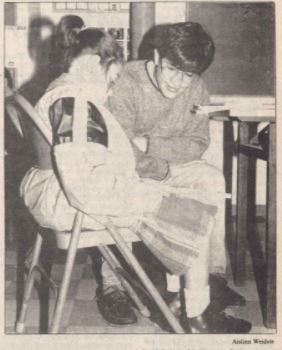
Ordóñez, tutoring a school child in a 1987 issue of The Retriever.

Ordóñez:  This may sound sort of mundane, but I don’t think we ever missed a deadline in terms of publishing the paper or getting the paper out on time. I don’t know how often the paper comes out these days, back then we were weekly.

DasSarma:  Well it was bi-weekly before the pandemic and in print, and then I had to make some adjustments given that no one was on campus.

Ordóñez: I can only imagine the obstacles. I just remember we would pull all nighters. Back then we would have to lay it out by hand. We would have to cut it and lay out the whole thing on these big boards because it was a broadsheet. And I remember all nighters on weekends and we would get the paper to the printer early Monday morning and, yeah, I don’t think we ever missed a deadline. So that was kind of an achievement, I would say.

Pyles:  I had been the sports editor for two years before I became the editor in 2008. And my memory is a little bit foggy, and I don’t want to take credit for something that I didn’t do, but I remember us more or less redesigning and relaunching the website sometime during my years. When I was editor of the paper we were thinking a lot more about putting more things online but we were still thinking about the website as this place where we just sort of dumped the stories that were in the paper, and we more or less just did it whenever the paper went to production. 

DasSarma: I definitely built off of what you guys built, especially with digital. Obviously during the pandemic I had grand plans for cultural changes and inviting people to gather more as a group, but obviously that all disappeared when the pandemic hit. But during the summer, I worked at the Baltimore Sun as the editorial intern and then in the evenings I worked on a contingency plan for Retriever to sort of move to digital and how we would [meet as a staff]. In January the pandemic started getting wild, so we created these regularly branded social media channels to share the things that you really need now. And we publish digitally every day now. And I also created the advisory board, which has some local journalists and local media experts and then we also hired a media lawyer. I think if you’re doing good journalism you’re going to make some people angry. So I wanted to have a lawyer on our side especially as we covered some more sensitive topics.

Challenges faced

DasSarma:  So that sort of segues into my next leading question, which is, what are some of the biggest challenges that you all faced? And then how did you overcome them?

Ordóñez: I was managing editor my junior year and I had sort of a fallout with the then-editor. And so I ended up leaving and then at the end of my junior year I applied to be the editor against the incumbent and I prevailed. So I came in and some people left, but I actually managed to retain most of the existing staff. But one of the challenges was that they had ordered this new machine… this massive computer. I mean, it was like three big desks put together where you would sort of type in your stories and it would sort of print out these sheets that you would actually cut out and then lay it out…I was sort of handed the keys and given the password for this brand new machine and it was like, here you go, go figure it out. And fortunately I had a brother who was very tech savvy and helped me through it.

DasSarma:  Where was The Retriever located at that point? Has it always been in the University Center for you all?

Ordóñez: I mean, I don’t know if the University Center has changed since then, but we were where there was a cafeteria down below and upstairs were some administrative offices, and we were just right on the very end. And there was kind of a big open space. We had a dark room back then, I mean, that’s not something that you would need these days. So I don’t know what happened to that space.

Pyles in front of M&T Bank Stadium in Baltimore. Photo by Marlayna Demond ’11.

Pyles:  I can tell you what happened to the dark room because I was there when we took it out. It became the business office. Is it still the business office?

DasSarma:  Yes it is.

Pyles: And technology is still right next door?

DasSarma: Yes.

Pyles: All right. And then production sort of down the hall to the right, if you’re walking out of one of those offices?

DasSarma: Yes. So I didn’t even get to have the editor in chief office; our ceiling fell down actually. There was water damage and some of it went into the editor in chief office. I imagine it would have been nice to have an office.

Pyles: It was pretty cool at 21 to have an office, like oh, ‘I’m an adult now with the rickety torn chair.’ So I mentioned I was editor as the recession started. In the years when I was the sports editor, the editor in chief at the time said, “My goal is that the Retriever can be independent from the university, accept no SGA funding.” We weren’t close at the time, but working toward it. And the fall of my senior year when I was the editor, there was still national advertising coming in from Verizon and large companies. And we were getting large print advertising in the newspaper and then it just dried up, just like that, it was just gone. And I remember really arguing over a $100 here and there in the budget when we went to submit the next budget to the SGA. I know the paper struggled financially for years after that. So I didn’t solve that problem, and I just got to walk away. But it was stressful and it was sad because it felt like we were moving toward independence and it was taken away.

DasSarma: Yeah. I mean, if it makes you feel any better, we’re definitely on better financial standing, I mean, guess it’s bittersweet, right? Because we’re nowhere near being independent. I don’t know Juan Carlos, if you guys ever discussed anything on those lines.

OrdóñezOur finances were in pretty good shape. I mean, it’s kind of funny that on paper we were doing great, with a lot of advertising. As editor in chief you’re both responsible for the content and managing staff and then you’re ultimately responsible for the business end of it. So you’re handling all these responsibilities for which you were never really trained and you’re sort of learning as you go. And my strength was definitely as the news editor and then managing editor for a time, and so it was really on the content side where my strengths were. And then on the business side on paper, wow, it looks great. And then only towards the end of the year did it really dawn on me, well, we just haven’t been collecting a lot of that revenue, I mean on paper, it’s supposed to be coming in. So it was more of a shortcoming, I guess, on my end of not staying on top of it.

DasSarma: We haven’t been able to have advertising similar to Alex. People haven’t been spending money right now and especially local businesses; it would have been nice. And I think our advertising has not been our priority. The previous editor in chief trained me as much as she could but also I was inheriting a completely different world. I could go on and on about the challenges, but I also feel really lucky that my staff has been super self-sufficient. I gave them a lot of autonomy in terms of meetings. We do weekly editorial meetings on Zoom but I don’t ever really see the writers anymore. I did one general body meeting at the beginning of the year, last semester, and then one during this semester. But it doesn’t make sense to have everyone in the same room anymore because it’s kind of a waste of time for them. 

OrdóñezYeah. It must be tough because I mean, one of the things that I remember most about the paper was sort of that social aspect of being in the same room and that sort of comradery, it’s hard to replicate it online.

DasSarma: A lot of our staff is very new and so all they know is the Zoom newsroom. But there is camaraderie. I remember we were even sitting in the newsroom when the WHO declared it a global pandemic. And we were all like, oh no, because I sort of sniffed it out early on and I had been working with administration and requesting our pandemic plan and everything and then we got sent home and the previous editor in chief had to sort of clean up. And then I took over in April and then I was like, oh no, we’re not ready for the next year. But all negatives aside, I want to hear your favorite part of the job or favorite parts.

The bright side
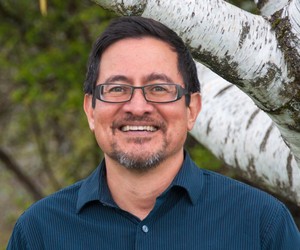
Ordóñez’s headshot courtesy of the Oregon Center for Public Policy.

Ordóñez:  I mentioned it already, but those all nighters that we would pull together, I still remember them really fondly because I was with some of my closest friends in college working together on a deadline so it was work but it was fun at the same time. And that’s really one of the things that I most remember from college actually and I look back fondly. I mean, the Retriever office was where we got our work done but it was also the place we would hang out between classes.

Pyles: When I was a senior the men’s basketball team went to the NCAA tournament for the first time and we covered that. I drove two sports writers and a photographer to Raleigh, North Carolina, to cover the game and the tournament and it’s a memory that I’ll never forget. There was just something about knowing that you have that place to go and to learn and to be around people who talk seriously about how to tell stories. That was really fun and I think that experience helped me realize what I wanted to do for a career.

DasSarma: I’ve always loved talking to people and journalism makes a lot of sense, for people who want to listen to other people and hear their stories. And I think one of my favorite parts is just talking to my editors. I think that they’re the most brilliant people in the world. And when I say I’m editor in chief of this paper, I think so much of this role is so managerial and delegating and talking to everyone.

Lessons learned

DasSarma: What are some lessons that you learned as editor in chief and how have you taken those with you where you’ve gone?

Pyles: I think this is where I really learned how to be a good manager, to be able to work with people and get them to work with me. I remember very early on losing my temper with a writer who had missed deadline after deadline. They happened to be a friend and I lost my temper with them and the story got filed but then we had a conversation later on and he said something that is probably pretty obvious, but I couldn’t see it in my anger. I felt betrayed—how could a friend be missing a deadline? And he said, you’re going to be able to work with people much more effectively if you don’t lose your cool. If you’re able to lead with understanding and kindness and ask more questions than make statements. 

Ordóñez:  I would share something similar. I think it’s sort of learning from the mistakes I made back then. As a news editor I dealt with just a few reporters; I would give them assignments and then we would talk about the edits and whatnot. But really managing a staff was a whole other ball game for which I was not trained and sort of had to figure out on my own and I made a lot of mistakes in that process. I remember not doing it well, not communicating it well at all, and that was a real learning experience for me. And then another positive experience was just learning how to stick with it. Sometimes it really seemed impossible that we were actually going to get the paper out and as a team we really pushed forward and we always got the paper out on time. 

DasSarma: I feel like resiliency is something that I’ve learned in addition to understanding. I think I hold myself to extremely high standards and I learned that people have things going on in their personal lives that are outside of the newsroom, and you have to learn to be more understanding, which is just echoing what you guys are saying. And then of course resiliency and understanding people’s limitations….And responsibility, too, like learning how to stay organized for 40-something people and making sure that things get done on time. And when things go wrong, I take responsibility for everything.

Ordóñez:  Well, when I look back at my time in college…without a doubt, my experience at the Retriever was by far the most enriching part of my college experience. I mean I loved my classes, I had a great time and did well. But what I learned for the paper, that practical experience and learning how to write, has carried through my whole life.

Pyles:  We talked about some of it certainly, but going through the adversity, not only of the business issues, and you’re trying to think about what a budget looks like, and how to adapt to changing circumstances that are beyond your control, and how to deal with different kinds of people while still putting out a good product. And I think one of my favorite parts of the job was getting to talk to Christopher Corbett—he was faculty advisor—every week. I just loved doing that.

DasSarma:  The paper really connects you to the campus, too, in a way that I think it’s totally unique. Having to keep track of everything that’s happening. I think this will probably be my favorite part about being at UMBC. 
Double Dribble

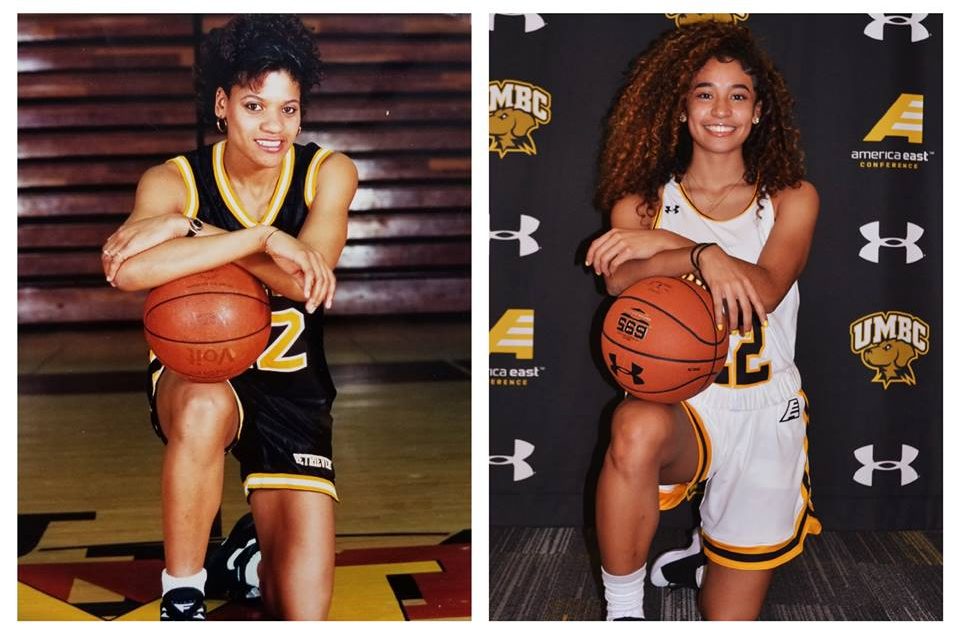
Karyn Swann ’92, sociology, never imagined that her daughter, Lyric, would attend UMBC, let alone follow in her basketball-shoe footsteps. And Lyric had no idea when she was cheering at the Homecoming games and attending UMBC Nike Basketball Camp in 8th grade that she would one day leave her own legacy on the same court.

Lyric, who signed with UMBC in December 2018, began playing basketball when she was eight after Swann put her in a clinic with her twin sister. She will start playing in the fall.

“It was my UMBC teammate, Angel, who told me about a clinic that she was putting her daughter in, and she suggested I put my twins in” says Swann. “I was hands-off. I never dreamed that I was going to be coaching her. Two years after being in the clinic, she joined a league, and I’ve been coaching her ever since.”

Both Lyric and her mother are left-handed, so Swann’s coaching was key. Lyric quickly became an outstanding athlete, playing both basketball and soccer. After she was named Most Valuable Player at the UMBC Nike Basketball Camp, recruiters started taking note.

“Her sophomore year going into last year, she had a phenomenal summer. So [UMBC] said, ‘Oh gosh, we have got to get this girl before these top top programs get her. The tournament wasn’t even over and they wanted to schedule a visit with her. That’s when it was first surreal, like she could really go here,” says Swann.

Currently finishing her senior year at Long Reach High School, Lyric is the top point guard in the area and was the 2017 – 18 Howard County Player of the Year. When it came to making a decision, she had to pick between many schools recruiting her, including Yale.

“She’s a very prolific player. The coach here knows she could have played at a higher level. She realizes that academics are important, and there’s so much that UMBC has to offer in helping you beyond graduation,” says Swann.

When UMBC offered Lyric a full scholarship, she accepted it the same day.

“I was considering some other schools, but I felt like this one was the best fit for me because my mom went here and it’s close to home, and it’s like a home to me. Last year, I verbally committed to this school. This year, I did early signing,” says Lyric. “It was nice because it was a confirmation that I’m here and that my education is secured and my athletic career is secured, and I was just excited to go to college, you know?”

Karyn and Lyric Swann. Photo courtesy of UMBC Athletics.

Swann, who wasn’t recruited, but became a walk-on-turned-scholarship athlete, remembers a very different UMBC, one that was much smaller, but one that she loved nonetheless. “I had so much fun when I was here. There were a lot of people from my high school here, so it felt really comfortable,” she says. “I loved going to the dining hall and going to some of the parties on Hilltop, and of course I spent a lot of time in the gym and running around the loop for conditioning.”

Incoming women’s basketball head coach Johnetta Hayes said she was thrilled to learn about Lyric well as her mother’s history with the team.

“Lyric will get a chance to create her own story, and I’m excited about that,” Hayes said. “I am thrilled to know she has passion for UMBC. This is home for her. It’s great for her family, and it’s great for UMBC, as well.”

Lyric already knew she wanted to stay in-state so that her mom could come to watch her play. “UMBC is a good school. I’m looking forward to going to an honors school. The people who go here are really smart and focused and they put their future first, as a priority for them. They’re trying to go places in life, and I’m excited to be surrounded by these people,” says Lyric.

She plans to major in graphic design. “I’m looking forward to playing here because basketball is my passion,” says Lyric. “I’m looking forward to making an impact here at UMBC and having fun doing it.”


*****

Header image courtesy of UMBC Athletics.

What’s in a name (pronunciation)? A lot, actually.

I have a secret. No one actually pronounces my name right. It’s not like it’s one person’s fault, don’t worry. There’s more than enough blame to go around. Including a little dose for me. Let me start from the beginning.

Having an “ethnic” sounding name, I’ve had people mispronouncing my name since I was a baby. It’s an unfamiliar name to many people in America, and I’ve never had any resentment towards people who squinted at my name on name tags, or spouted a completely incorrect pronunciation. Unfortunately, I’ve done the same thing with others. To be fair, my name is actually pronounced different ways in different parts of India. And, growing up in America, being mixed race, I have never felt strong roots to India (of my own accord) and so I never fully understood the actual pronunciation. As you can see, my name is highly nuanced.

But there came a point when I realized that my name, as my mom and dad called me, didn’t fit in people’s mouths quite correctly. Ever. So I modified it a little. It’s just an inflection change, and I accepted that everyone, besides my parents, would pronounce it the way that would be easier for them.

And thus, instead of “Uhn-Jah-Lee,” my name to all of my close friends, acquaintances and professors became “Ahn-Jah-Lee.”

And I like both pronunciations. I think my name is pretty, and I do get my fair share of compliments for it. But those compliments are nowhere near the majority.

“I refuse to feel nervous about correcting other people.
My name is the most personal thing I have, and I deserve
to have people make an effort to say it correctly.”

One thing I know is that even though I’ve modified my name to fit in others’ mouths, people still can’t, and sometimes refuse to attempt to pronounce it. And that’s where I place blame on others.

When I was in high school, I dreaded the substitutes who would run down the list until they reached my name, and there was that awful pause, and they would laugh and say “Oh god. I’m not even going to try!” Cue 16-year-old Anjali, who would raise her hand and clearly pronounce her name, and the endless substitutes who would just check her name off. No offer of apology for negating my identity, and giving up on my hopelessly foreign name. Nothing.

In college, I decided to go by the nickname my mom gave me when I was very young. “Anj.” I’ve always had an affinity for the familiarity that goes along with a nickname. And, to be honest, how hard can it be to pronounce three letters? Apparently “Anj” is also an impossible name.

After ordering a bagel on campus, I waited for the cashier to call my name and hand it to me. “A-N-J?” she called out, spelling it out, letter by letter, like my name was a confusing word in an elementary school spelling bee. I was appalled. I would 100% rather people mispronounced my name than make no effort at all.

To make matters worse, as a woman, I’ve been conditioned to feel like I’m inconveniencing others to correct someone. I’m afraid I’ll offend my coworkers and teachers, or come off rude by saying “actually, it’s pronounced…”

No one is expecting every person to know how to pronounce every name. That’s an unattainable goal for everyone, myself included. But I will stand up and say that if you find an unfamiliar name on your roster as a teacher, or you’re a cashier handing a hot coffee over the counter, the absolute least you can do it make an attempt to pronounce it. I refuse to feel nervous about correcting other people. My name is the most personal thing I have, and I deserve to have people make an effort to say it correctly. “I’m not even going to try,” isn’t going to fly with me anymore.

Anjali DasSarma ’21 is an editorial intern for UMBC Magazine.

Header image by Raquel Hamner ’20. Inset image by Marlayna Demond ’11 for UMBC Magazine.

Chew-MBC Aims to Help Students Eat Healthier

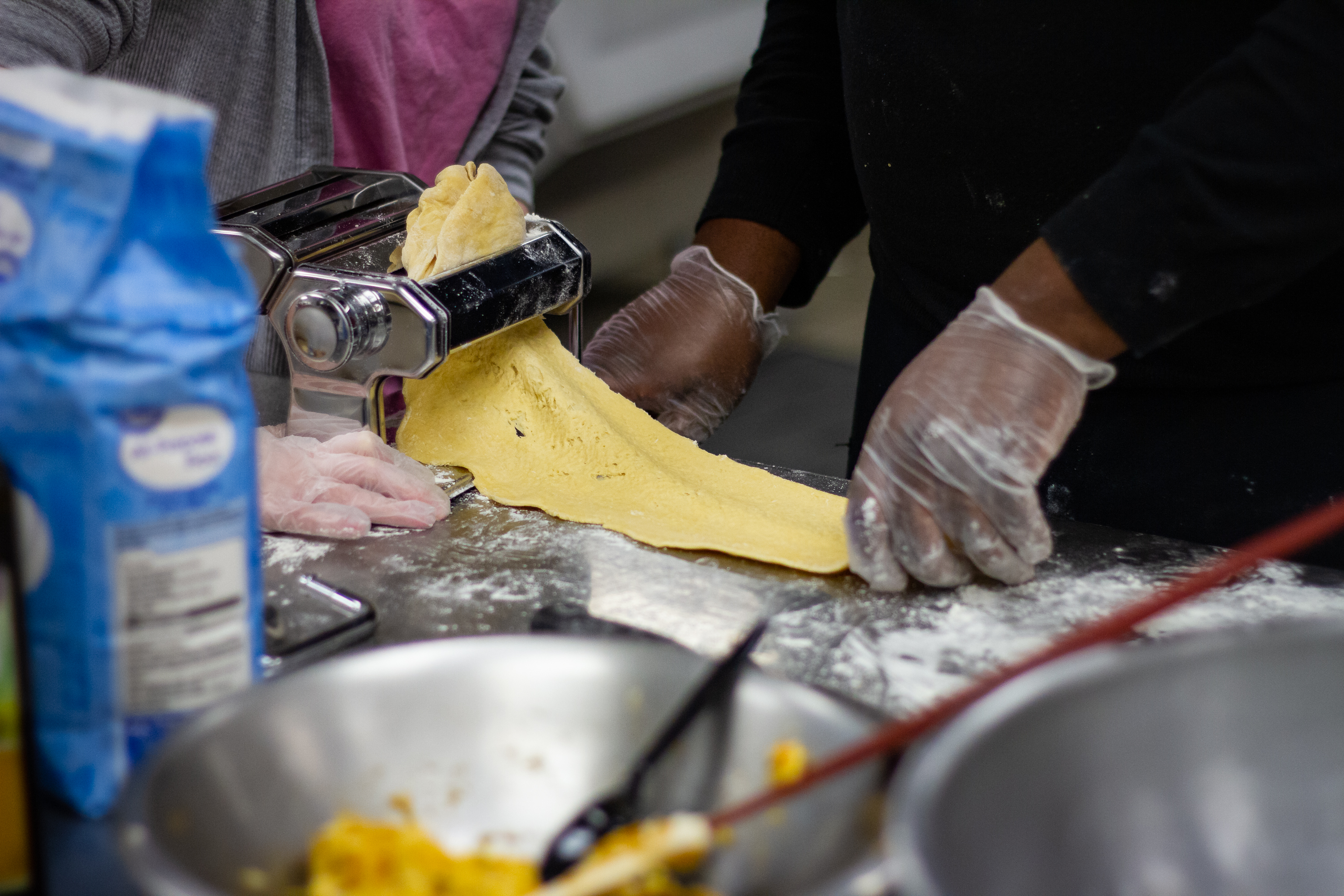
For many students who only experience home economics in middle or high school, college “cooking” becomes reduced to heating year-old ramen on the common room stovetop or chowing down on burnt Hot Pockets from a low quality microwave.

Founder and president of UMBC’s cooking club, Chew-MBC, Tola Abu ’20, chemistry, believes that college cooking should be different. “It’s such a fun, risky, and innovative craft. It’s also one of the few passions that has results that [are] shared with others,” said Abu.

In college, many students develop poor eating habits, or simply snack more than they eat nutritious meals, purely stemming from convenience. “Our goal is to teach UMBC students about the culinary arts and diet tips in a fun, easy, cheap, and healthy way,” said Abu, who counts cooking among his favorite hobbies.

Abu partnered with campus Dining Services, which provided space in The Commons for the students to practice food preparation and cooking every week, and offers guidance around cooking techniques, as well as access to campus executive chef Tim Dunn.


“Students should be able to gain a good understanding of nutrition during their college years,” said Tom DeLuca, Resident District Manager for Chartwells. “The habits that they form during college will continue after they graduate.”

Over the course of a semester, students make all types of delicious foods, and even took a trip to Baltimore’s famous Lexington Market.

“We made blueberry pancakes [the other] week and those were amazing. We baked some hash brown casserole and bacon…and last semester, we made macaroni and cheese, burgers, and brownies,” said club secretary Alexis Richardson ‘20, a computer science major with a minor in biology.

“What I like the most about Chew-MBC is that, after cooking, we can sit down, relax and enjoy  our food with other people who share the same interest,” said Richardson.

– Anjali DasSarma ‘21

Photos by Kiirstn Pagan ’11 for UMBC Magazine.

Finding Your Niche – Emilie Llenado M.P.S. ’12

When Emilie Llenado, M.P.S. ’12, professional studies, first moved to Maryland from Kansas City, Missouri, she didn’t know a soul,  and was working as a server at Longhorn Steakhouse. But, she was hopeful, and she knew she wanted to do great things, so she enrolled in UMBC at the Shady Grove campus. Four years later in 2012, she graduated from the Industrial/Organizational Psychology program with life-long friends, and a new job at Freddie Mac.

“When I first moved to Maryland, I didn’t know anyone. I came right out of my undergraduate degree. I didn’t know what it would take to succeed at school,” said Llenado, who recently joined the UMBC Alumni Association Board of Directors. “I made three goals, as I knew they would help me be a happier person, and the best version of myself.”

Pillars of Success

Those three goals, or the pillars of success as she called them, were “academic excellence, career enhancement, and interpersonal relationship growth.” With that in mind, she made the most of every moment at the Shady Grove campus.

“If there was a job fair, I would go. If there was a luncheon, I would be there. If a professor would offer up special office hours or a group study session, I would participate. You definitely get out of the program what you put into it,” she said.

At Shady Grove, she said, she built a network of faculty and friends who all encouraged her to succeed. “As I started studying more and getting more involved in my classes, I became closer with my classmates and teachers, who in turn became not just friends, but critical resources in building out my future career,” said Llenado.

Years later, she remains close with the friends she made during her time on campus. They go on an annual beach trip to Ocean City. “We go to the beach, boardwalk, and get crab toast, every year, rain or shine!” said Llenado. “We’ve all been close since the year I moved to Maryland, and this past year marked our 7th annual beach trip.”

For their 10th anniversary, they have big plans for a cruise or a resort to “celebrate our friendship, and tradition in style!”

The spring before she graduated, Llenado was offered a job at the Federal Home Loan Mortgage Corporation, also known as Freddie Mac. After graduating on her birthday in December of 2012, she received another offer to advance at the company. After yet another offer and a promotion, she is now a multifamily underwriting senior associate.

“All of my daily activities, throughout my career, in Freddie Mac have directly aligned with skills learned through UMBC,” she said. UMBC gave her the ability to serve as a leader, collaborate with others, prepare presentations and more.

Giving Back as an Alumni Leader

In addition to her busy days at work, Llenado was invited to join UMBC’s Alumni Association Board of Directors (AABOD), a group that plans events and recognizes outstanding alums, all while creating a community atmosphere among UMBC’s 77,000-plus alumni. With the start of her term this spring, Llenado became the first Shady Grove alum representative on the board.

“It is important for us in alumni relations that UMBC at Shady Grove alumni see themselves in the work we do,” said Stanyell Odom, director of alumni relations. “Having an alumna on the board of directors that represents that voice will be instrumental as we develop strategic initiatives to thoughtfully organize events and initiatives that will speak to this community of alumni.”

Llenado believes that with the support of UMBC’s Shady Grove community, she was able to find success, which is a big part of why she now gives back as a part of the AABOD. “UMBC gives you all the tools you need to succeed, and that investment and engagement definitely works both ways!”

Trax on Wax: A Staple of Catonsville’s Music Scene

Small business building with a sign that reads "Trax on Wax"

Enjoy this peek inside one of the most interesting spots in neighboring Catonsville (AKA, “Music City Maryland”), as told and photographed by UMBC editorial intern Anjali DasSarma ’21.  

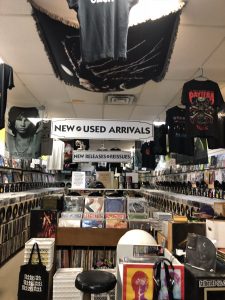
Tucked between a dive bar and a pretty pink beauty parlor lies Catonsville’s resident vinyl store: Trax on Wax. The light smell of incense hangs in the air of the store, emanating from bottles stacked neatly on the display shelves. The owner, Gary Gebler, has been selling records since he was 15 years old. Gebler is 60 now. He stands behind the counter, brown fedora perched jauntily on his head with thin silver hoops in each ear. His white scarf is tied in a loose knot around his neck and his black shirt underneath has the logo for the shop emboldened across the front, as he carefully wraps records in bubble wrap. The shop is packed with records in blue and green crates and wooden shelves, birds made of vinyl crafted by a local artist, bowls made of warped records, and anything else related to the vinyl industry.
Right when customers enter the store, they are greeted by rows of photographs of Gebler with icons like Tina Turner, all in the same style of thin black frames. Some are slightly tilted, and others are faded, but they all show the same thing: Gebler, with a slight smile on his face, standing next to an artist (oftentimes holding their own record proudly).

A Picture is Worth a Thousand Words

A bright yellow-green wall covered with framed portraits of people, with a shelf full of boxes of vinyl records sitting in front.

Each of the photos has a story behind it. One photo from around 1987 shows a young Gebler with a ginger beard next to Tina Turner. Gebler now sports whiskery white stubble, but the look in his pale blue eyes is the same as in the photo. “I met Tina Turner and she was huge at the time. We were instructed not to look her in the eye but then when we met her she was like ‘oh those guys, they do that all the time’ so she was really cool,” he says.
In the past, he was oftentimes invited out on stage to “just jam out” with artists like Bob Seger at Merriweather Post Pavilion. “Back in the day, I got to go out on the stage and play with him. I don’t play anything, they just put me behind the congas,” he says.
Gebler has an effortless way of talking, the kind of ease that only comes with years of experience. “The first day I went in and [sold records], I was still in high school. I thought to myself ‘well this is what I’m gonna do with the rest of my life,’ and I knew it! My day is still exactly the same day as when I was 15,” he says.
Silk tapestries and woven blankets hang from the ceiling alongside t-shirts with sayings like “Rocknroll Motherf&*er.” Next to the counter, there is a listening station, complete with a shiny leather stool and a pair of worn gray headphones plugged into a record player.

Growing Up With Vinyl

Trax on Wax has now been open for nine years. “When I first opened up, it was a bunch of old people like me, and so the people would come in and talk about their first concert. Then as the years progressed, there’s been a lot of younger people who are digging the store which is cool too. We get a lot of high school and college kids now and they come back on a regular basis, and it’s really cool to see them grow up,” he says.
Gebler doesn’t run Trax on Wax alone. His store manager, Jeff Ball, has been working in the vinyl industry, selling records or working in the entertainment section of department stores since 1986. He has been working at Trax on Wax for five years. He, like Gebler, found his interest in records early on, milling around vinyl shops as a teenager.

He took the summer off from working one year, and found himself at a party, where he ran into an old friend who encouraged him to come work at Towson’s Record and Tape Traders. “He said ‘I guarantee you’ll have a job right from the start.’ And it was true,” he says. The store manager, John Lewis, hired him on the spot. “I never filled out an application for a company that I worked for over twenty years. At that store, within a month or two I was manager.”
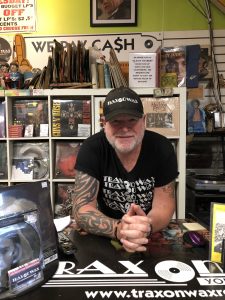
Ball now stands behind the counter wearing light blue jeans with a worn hole in the left knee and a green flannel casuallydraped over his black t-shirt with the Trax on Wax logo. He is ringing up a young woman who can’t be older than 25, who sets ten incense sticks on the glass surface. Ball taps the charge into the gray cash register, hitting the keys deliberately, before reading out the cost. The girl hands him the bills, and tells him to keep the change. He waves her back to the incense stand and tells her to “take a couple more sticks!” before she and her long-haired boyfriend leave the store.
Every store has its regulars, and Ball recalls one man named Danny from the “CD era… probably 1991” who would arrive every Tuesday when the store Ball worked at, Waxie Maxie’s, would get new arrivals and buy one of every single CD. “He had a good job, but he was quite the character. His car was loaded with bags and newspapers and you couldn’t even see out the back window, and my suspicion was that he was a hoarder. It was all great, but then suddenly Danny lost his job,” Ball says, his eyes widening a little. “He’d be begging his mother for money on the phone. It was like his drug, you know? I don’t know what happened to him after that.”

An Element of Danger

A man with a very tattooed arm standing at a desk.

Even though both Gebler and Ball have followed similar routines their entire lives in the business, Ball’s involvement in the selling of bootleg records added an element of danger and excitement. Bootleg records are unauthorized, unreleased songs that are sold with no profit to the artist. Ball first heard about bootleg records at “rebellious” music store, Music Liberated. “They would actually go and slide a door open under the counter,” he says, gesturing to the smooth counter in front of him. “It was run by a bunch of hippies, and they had an F-U attitude to a lot of things.”
Ball himself was involved in the selling of bootlegs, especially Bruce Springsteen bootlegs, as the owner had a soft spot for his music. “Springsteen’s label had been in touch, because they got wind about how big we were. We even sent out mailers filled with nothing but bootlegs! One Monday, we had just opened. My employee showed up, hungover as usual. This guy walked into the store, bought a one dollar record and walks right out, doesn’t say a word. A couple minutes later, I’m standing at the counter, and I see the same guy walking up, and he’s got a state trooper with him, and I’m like ‘we’re going to get busted.’” he says, with a sly smile.
“This one guy comes out and says ‘picture time!’ and hands us each a bootleg. And I’m like ‘I’m not having my picture taken.’ And he goes, ‘oh really? Then let’s get in the car. We’re going downtown.’ And I said ‘where’s that record?’” Ball says, snatching a Smithereens album and holding it up like he would an identifier in a mugshot.
When it comes down to it though, excitement or not, Ball cherishes the feeling of listening to records. He, like Gebler, believes that vinyl makes the listener value the surrounding experience more than other forms that music takes on.
Gebler appreciates the aforementioned. “It just sounds good. It’s just a real interactive experience. Don’t get me wrong, I’m not a snob, I’ve got an iPod, I listen to CDs in my car,” he says, laughing. “But when I really wanna sit down and experience music, [vinyl is] how I prefer to do it. And luckily there’s enough people who want to do that too to keep me in business.”
And Gebler knows the value of history. Hanging above the door, facing inwards is a sign for the “Kozy Korner Record Shop” that closed in the late 70s. Gebler bought all of their old records when they closed down, but he left the sign up in Trax on Wax. “It’s good to keep that bit of history alive,” he says.

Beyond the Loop: Adventures Off Campus

The communities surrounding UMBC are rich and full of culture and fun — as well as very accessible! From Baltimore to Catonsville, to Washington, D.C., and everywhere in between, UMBC students are exploring new places off campus to eat, play, and enjoy time with friends. Getting off campus is key to taking full advantage of your college experience. So, get out there and have fun!

Bustling B’more

Baltimore is full of fun things to do — with delicious food, cultural activities, and plenty of professional sports options to enjoy. And the UMBC bus makes it easy to get right into the heart of the Inner Harbor with the Downtown Route. Art lovers will enjoy the gorgeous Walters Art Museum, the contemporary and provocative American Visionary Art Museum, as well as the comprehensive Baltimore Museum of Art, where you can get into the special exhibit for free with your UMBC Red Card. Walk among fish and sharks – and even a sloth! – at the National Aquarium, or listen to a masterpiece at the Baltimore Symphony Orchestra at a discounted price as a student. And don’t miss a game at Camden Yards and M&T Stadium to watch the Baltimore Orioles or the Ravens!

In Little Italy, try hidden gem Isabella’s Brick Oven Pizza, and Panini for a great slice. Flying Fruit Fantasy is a dessert and juice bar for after dinner treats. And, if you’re sticking around town in the summer, Artscape, in June, is the largest free arts festival in the country! During the spring semester, Light City lights up the April night sky. Take the UMBC bus into the city and wander around, enjoying local art and the city as an exhibit of light art.

Our Own Backyard

Right in UMBC’s backyard, Catonsville, Arbutus, Ellicott City, and Halethorpe all just a quick UMBC bus ride away. The UMBC shuttle is a great free resource for all students (with your red card, of course). In Catonsville, local vinyl store Trax on Wax supplies a plethora of new and used records, as well as an interesting history. If you’re feeling hungry, the Catonsville Farmers Market, located at the Christian Temple, has been around since 2002, serving up fresh foods to the whole community. In May, Arbutus’ Food Truck Festival, one of the biggest one-day festivals in Maryland, showcases more than just food. It also features local art, restaurants and crafts! Also opening soon in Arbutus will be Ocamocha, a student-run cafe where you can hang out and enjoy a latte.

Ellicott City is the perfect place to go if you’re looking to get outside when the weather’s nice. The Outdoors Club takes trips to Patapsco Valley State Park, and you can also go solo or with friends to hike and enjoy nature (when you’re not studying, of course). For music lovers of all sorts, Merriweather Post Pavilion is less than 20 minutes from UMBC by car, and hosts great artists and even a whole music festival, Sweetlife.

Our Nation’s Capital

There are about one million guides of what to do in Washington, DC, but in addition to the National Mall, and all the amazing Smithsonian museums to explore, there’s so much more. It’s not difficult to get into DC from UMBC with public transit. The UMBC bus goes to the BWI MARC train station, and that goes straight into Union Station, where the metro can take you anywhere you need to go. The music scene in DC is incredible and varied. From the 9:30 Club, to the U Street Music Hall, to the Anthem and the Songbyrd Record Cafe, many of your favorite artists come to DC to perform.

The National Zoo is free, apart from parking, and the Phillips Collection offers some free days to explore the beautiful art there, including the iconic Luncheon of the Boating Party by Renoir. For more art, head to the National Portrait Gallery to see the famous portraits of Barack and Michelle Obama. If you’re interested in journalism, walk to the Newseum, where you can interactively learn about the stories covered by journalists and view Pulitzer Prize-winning photographs. The Newseum offers 15% off their ticket price for students. And among the many delicious eateries, Jeni’s Ice Cream, Ben’s Chili Bowl, Georgetown Cupcakes and &Pizza are standouts.

Water and Wonder in Annapolis

Maryland’s capital, Annapolis, is a short drive from campus offering a charming waterside experience rich in history. Explore Main Street, or go to the Maryland State House to see democracy in action. Vida Tacos Bar is a great eccentric restaurant specializing in flavorful tacos with twists. Sofi’s Crepes offer delightful sweet or savory crepes like The Nutty Banana or The Turtle.

Quick Links

Not sure about the transportation situation? These quick links will make it easy for you to get up and go!

UMBC Campus Shuttle

Campus Zip Cars 

Metro Schedules

MARC Train

* * * * *

Photos by Marlayna Demond ’11 for UMBC Magazine.

Why the Shooting in Annapolis Makes Me Want to Become a Journalist Even More

The attack on the Capital Gazette newspaper in Annapolis earlier this summer shattered a community, and the hearts of so many. Not only is Annapolis our state capital, but the heartless, thoughtless, and horrific attack was an attack on an entire livelihood, one I consider to be an important part of democracy.

Watching journalists’ lives being taken, cutting their voices short – especially after they’d chosen such a valiant career – was horrific. I couldn’t help but feel a tug at my heart, and the feeling of needing to continue their legacies. Making the choice to go into journalism is making the choice to speak for others, for whole communities, and for people who otherwise would not be represented. It’s making the choice to spread facts and inform people. This is what I want to do with my own work.

Annapolis isn’t my hometown. The Capital Gazette isn’t my local newspaper. But it’s not hard to imagine these shootings happening in my own area, after growing up watching them happen my whole life.

I want to do everything I can to honor the victims of the Annapolis shooting, and victims of gun violence everywhere, in perpetrating honest, good journalism, and advocating for those who no longer can.

Witness From a Young Age

In the year I was born, 1999, the Columbine High School shooting occurred, and the amount of mass shootings I’ve lived through has continued to climb. When I was 12 years old, I watched with horror as the shooter at Sandy Hook Elementary School took the lives of innocent children in Newtown, Connecticut. The children were barely half my age, just babies. At the time, I thought that change must happen soon. How could we just sit idly by as children were slaughtered in their classrooms?

When I was 14 years old, my mother didn’t let me go to the mall. She just told me no, and I wailed and complained. I had an article due in a week for my high school newspaper, about my friend’s cupcake stand, and I needed to go interview her at the Columbia Mall. An hour later, I turned on the news, to see that a shooter had taken the lives of two other people at the very mall I had grown up visiting.

When I was 15, sitting in my high school chemistry class, my teacher told us that in the event of an active shooter, she would protect us with the acid from the chemicals cabinet. We all knew she was joking, but to a certain extent, she also wasn’t. I found myself thinking about where I would hide in every classroom if a school shooter came in. I’m sure my classmates shared my sentiments.

When I was 16 years old, I came downstairs to see the TV already on, reporters on scene at the Orlando club shooting. I wondered to myself if any place was truly safe anymore.

When I was 17, I cried myself to sleep after one of my favorite teachers was shot and killed by her boyfriend. She was four months pregnant. I had just started college here at UMBC, and I had no experience dealing with murders, as no one my age (or any age) should.

Today, I am 18. I was at work and my phone chimed, informing me about a shooting taking place in Parkland, Florida. This was one of the deadliest school shootings in the United States to date, with more deaths than Columbine’s 15.

The Kind of Journalist I Want to Be

Anjali Dassarma

And just weeks ago, another man armed with a gun took the lives of five brave journalists, traumatized so many more, ripping apart families. The attack at the Capital Gazette hit me hard. I’ve always wanted to write, and when I took my first journalism class as a freshman in high school, at just 13 years old, I knew it was the career for me.

I’ve always been well aware that journalists face surmounting difficulties because of their career choice. From being sent into hurricanes and war zones, to being berated mercilessly by politicians, journalists rarely have a quiet day at the office. The Newseum has a journalist’s memorial dedicated to those who lost their lives reporting the news. And we also mustn’t forget the many lives taken by gun violence daily who aren’t mentioned in the media, in communities where violence is somehow expected and remains tragically unreported and unacknowledged.

But, the danger for journalists I didn’t expect was gun violence. Of course, I should have known better, considering the instances mentioned above.

I’ve always had a little bit of spite in me. I learned how to ride my bike because my mom told me I couldn’t. That spiteful fire reared up as I scrolled through article after article describing the repulsive shooter and his motive of revenge.

The worst thing I feel I could do as an aspiring journalist is let maniacs dissuade me from pursuing my dream. Journalism is the past, the present, and the future. It catalogs the happenings and the lives and the dreams of so many people. It’s a changing field, there can be no doubt, but the need for honest, real people giving the news and the features we need and want will never fail to exist.

That’s the kind of person I want to be. And that’s why I want to do everything I can to honor the victims of the Annapolis shooting, and victims of gun violence everywhere, in perpetrating honest, good journalism, and advocating for those who no longer can.

Anjali DasSarma is a media and communications student at UMBC, and an intern with UMBC Magazine. She hopes to work in journalism after she graduates.

Photos by Marlayna Demond ’11 for UMBC Magazine.