



About
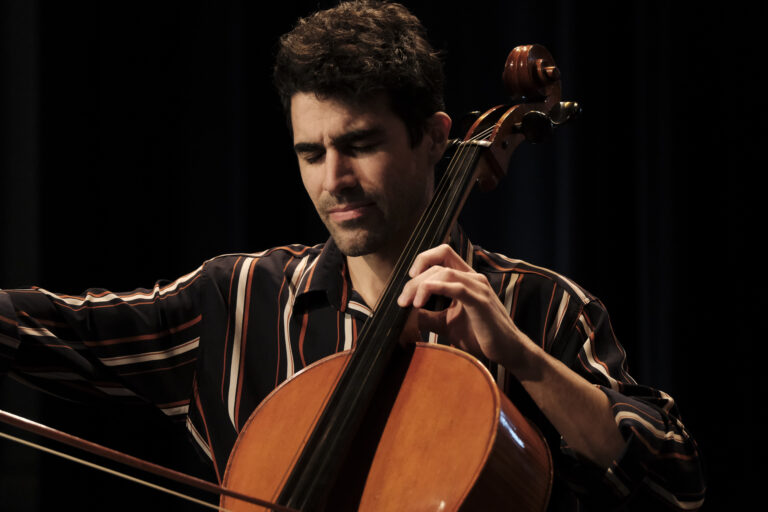
Juan Sebastián Delgado is an acclaimed Argentinian cellist, recipient of the 2024 Prix Opus Artist of the Year. He is a finalist for the prestigious 2024 Charles Biddle Award presented by the Ministry of Immigration of Quebec to honor outstanding artistic contributions by immigrant artists. Delgado holds a Doctorate in Cello Performance from McGill University, where he specialized in contemporary music and Nuevo Tango working with world renowned cellist Matt Haimovitz. A passionate advocate for expanding the cello’s expressive possibilities, Delgado is known for commissioning and premiering innovative works that push the boundaries of the instrument.
Delgado’s artistic research was featured nationwide by CBC Radio Ideas, and he was the featured cellist in the episode Virtuoso Brain of the TV program Découverte. His work has taken him to 28 countries leading numerous creation projects, including three cello concertos written for him; Pájaro contra el borde de la noche for cello, ensemble and electronics by Luis Naon (commissioned by Radio France in 2017), Cinco Tangos Apócrifos for cello and strings by Jorge Bosso (2016), and The Night of a Capricious Dawn (2022) for cello and orchestra by Jason Noble. He has also collaborated with renowned composers including Kaija Saariaho (Creative Dialogues in Finland), Alcides Lanza, and Chuck Israels, legendary double bassist of Bill Evans’ trio. He recently performed as soloist with the Obiora Ensemble (Montreal), the UMBC Chamber Orchestra (Baltimore), the Baroque Orchestra of Mendoza, the San Juan Symphony Orchestra (Argentina), and the Quito International Cello Festival’s ensemble (Ecuador, 2025).
A founding member of the duo Stick&Bow with percussionist Krystina Marcoux (2024 Prix Opus, International Achievement), they have performed in some of the top music festivals across Canada, including the Bach Festival Montreal, Festival de Lanaudière, Festival Classica, and La Viree Classique, well as international tours in France, Argentina and Colombia (JMC and JMF). They have recorded 3 albums; “Resonance” music for marimba and cello (2019), “Bach’s trio sonatas” together with Luc Beausejour (2021), and “Veni, Vola, Veni” (2022) together with tango piano legend Gustavo Beytelmann (ex-pianist of Astor Piazzolla).
Research interests
My research centers on the performance practice of contemporary tango, with a particular focus on its transformation through collaboration with living composers and its intersection with experimental and interdisciplinary artistic practices. I investigate how tango—traditionally rooted in oral transmission, embodied gesture, and improvisation—can be reimagined within contemporary music contexts, expanding its expressive, technical, and cultural boundaries.
A core aspect of my work involves close collaboration with composers to develop new repertoire that situates the cello within evolving tango idioms, integrating elements such as alternative notation, extended techniques, and improvisatory frameworks. Through these partnerships, I seek to challenge conventional hierarchies between composer and performer, positioning the performer as an active co-creator in the compositional process. This approach not only generates new works but also contributes to a redefinition of tango performance practice in the 21st century.
At the same time, I explore how contemporary tango can intersect with technology and interdisciplinary creation. My projects incorporate interactive systems, real-time sound processing, and gesture-based control, examining how the physicality and expressive nuances of tango performance can be extended through digital means. These investigations are often situated within collaborative environments that bring together musicians, dancers, and media artists, further reinforcing tango’s inherently embodied and relational nature.
Grounded in my academic training and research-creation experience, my work bridges tradition and innovation, connecting the cultural heritage of tango with contemporary experimental practices. Ultimately, my research aims to establish new frameworks for understanding and performing tango as a living, evolving art form, shaped through dialogue with composers, technology, and interdisciplinary collaboration.
Teaching interests
I approach teaching as an opportunity to cultivate artistic excellence, critical awareness, and social engagement. My work bridges performance, research-creation, and pedagogy, emphasizing interdisciplinary exploration, creative risk-taking, and inclusive practices. I strive to create environments where students from all backgrounds can develop confidence and originality, encouraging them to “think outside the box” and experiment with new approaches, skills that are essential in the 21st century, where opportunities for meaningful artistic careers are competitive and constantly evolving. I am committed to fostering an inclusive and decolonized approach to classical music, providing students with access to under-explored, however powerful repertoire that is unfamiliar or overlooked by mainstream programming, expanding their creative horizons and broadening the cultural impact of their work. Throughout this process, I encourage students to ground their artistic practice in values that resonate with them; socially, culturally, and in relation to gender and identity, while helping them connect their work to broader historical and cultural contexts. In doing so, they develop not only as imaginative and versatile performers, but also as socially aware artists who understand the larger frameworks in which their work exists.
I have gained diverse experience as a teacher, which has allowed me to develop new skills and approaches in both the studio and classroom. I have led workshops with children from underprivileged communities facing social and economic challenges in Natal, Brazil (as the recipient of the 2011 Davis Projects for Peace) and in Manizales, Colombia (recipient of the McBurney Fellowship for a social project) among many other projects. I have also served as guest faculty at summer festivals and major institutions in North America, including the Boston Conservatory, Banff Centre for the Arts (Stick&Bow), and Orford Academy (with Collectif9), among others. These experiences have strengthened my commitment to social impact, artistic growth, and mentorship across diverse contexts, while also prompting me to rethink my own priorities as an artist, recognizing that the pursuit of “musical perfection” alone does not fully validate our need to create meaningful and expressive art.
Because of my own career path and life experiences, having lived in four different countries and studied with a wide range of mentors and professionals, I have become highly adaptable and a fast learner. I approach new situations and environments with curiosity, seeking to understand not only how I can find my own voice, but also how I can connect with those around me in meaningful ways. This adaptability has been essential in navigating different teaching scenarios, where every student, interaction, rehearsal, and performance presents its own unique challenges and opportunities for growth.
Ultimately, my teaching philosophy is rooted in the core values I hold as an artist; curiosity (open to experimentation), integrity (understanding and valuing our history), and creative courage (finding our own voice), which I strive to model and instill with care, confidence, and passion, whether guiding a doctoral student through advanced research or introducing a beginner to the cello for the first time. Through this human exchange, I hope to help students equip themselves to thrive as artists, critical thinkers, and socially conscious performers in an ever-evolving and complex artistic landscape.
Education
- Postdoc, Research-Creation — Universite de Montreal (2023)
-
Ph D, Music Performance
— McGill University (2017) Imaginary Tangos
- MA, Music Performance — McGill University (2013)
- BA, Music Performance — The Boston Conservatory (2011)