All posts by: Katharine Scrivener


Darcie Adams ’23, M.P.S. ’25, builds on the power of restorative practices at UMBC

Darcie Adams ’23, political science and gender, women’s, and sexuality studies, came to UMBC unsure of what he wanted to study—but through involvement in student organizations and a passion for restorative practices, he found his calling. Graduating this May with a master’s degree in community leadership, Darcie reflects on the mentors, communities, and values that shaped his journey.

Q: Can you tell me a little bit about what brought you to UMBC?

A: UMBC’s Community Leadership MPS program was a perfect fit for me because it offered a blend of theory and practical application. It’s a program where you can dig into complex problems and think critically, but also be part of a community that really pushes you to apply your learning in real-world contexts. I felt like it was a place where I could really grow and develop, both personally and professionally.
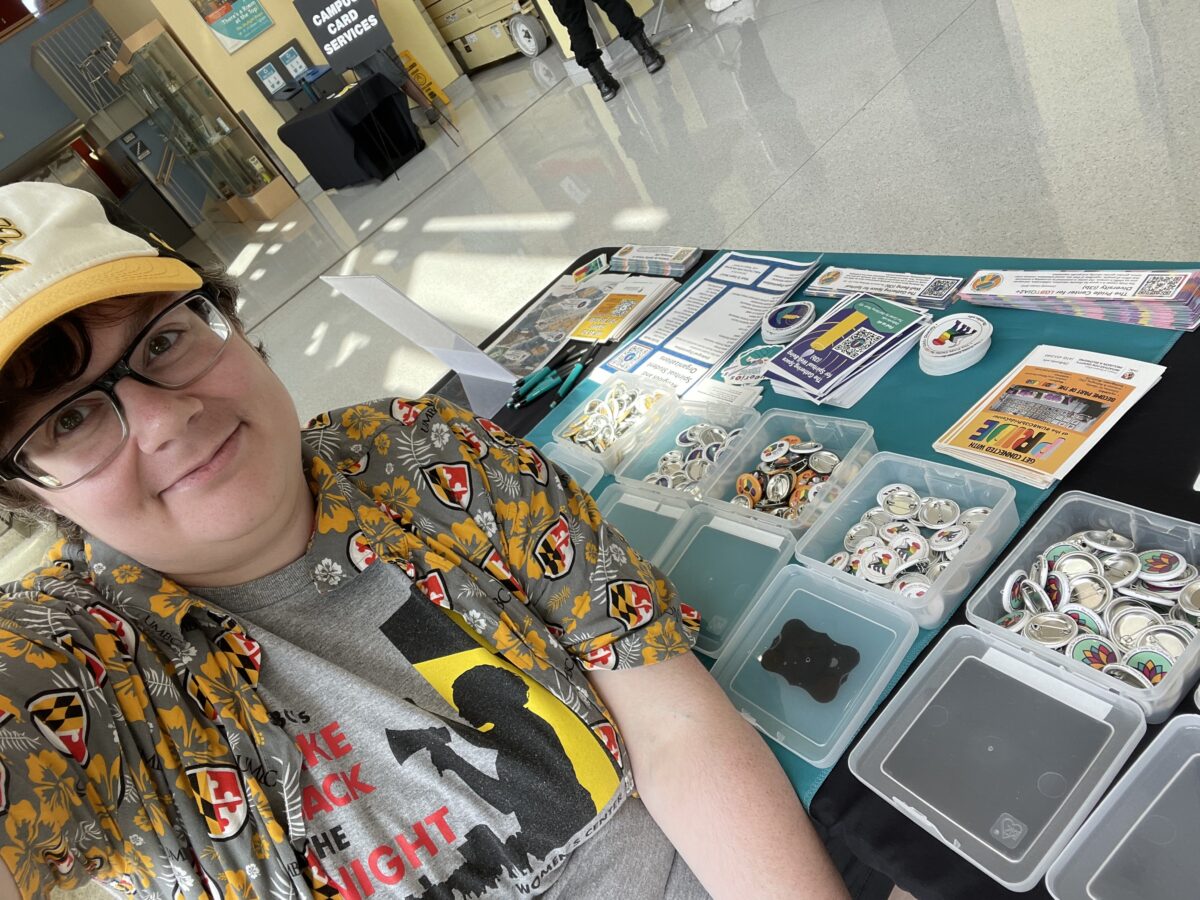
Person wearing a UMBC button-down shirt and hat at a table with various UMBC stickers
Adams taking UMBC pride to a whole new level while tabling. (Unless otherwise noted, all photos courtesy of Adams)

Q: How did your graduate coursework intersect with your advocacy and co-curricular work?

A: My graduate program has an introductory and capstone community partner project, and I also chose to do an independent study with a community-partner aspect to it. All of my community work in restorative practices has been with on-campus partners, including my master’s capstone project with Vice President of Institutional Equity Tanyka Barber.

This has allowed me to focus on a community-led dialogue method I’m really passionate about, and I’ve been able to use restorative practices in both my work and advocacy, in tandem with deepening my skills and knowledge. It’s not often you get to learn something and do it simultaneously, and the combination of both was incredibly impactful—it gave me a deeper understanding of the work and how to do it effectively.

Q: How has your understanding of leadership evolved during your time at UMBC?

A: I’ve come to realize that leadership is less about position and more about influence and the ability to connect with people. I’ve learned that effective leadership is about listening, being present, and creating spaces where others feel empowered to share their thoughts and ideas. Leadership is about collaboration and helping others see their potential, not just pushing your own agenda forward.

Q: You’ve worn so many hats on campus—if you had to describe the through-line or core mission of your time at UMBC, what would it be?

A: My time here has been about building community and creating spaces where people feel heard, valued, and supported. A lot of the work I’ve done, from advocacy to restorative practices, has been about making sure that people can come together in a way that’s authentic and supportive of one another.
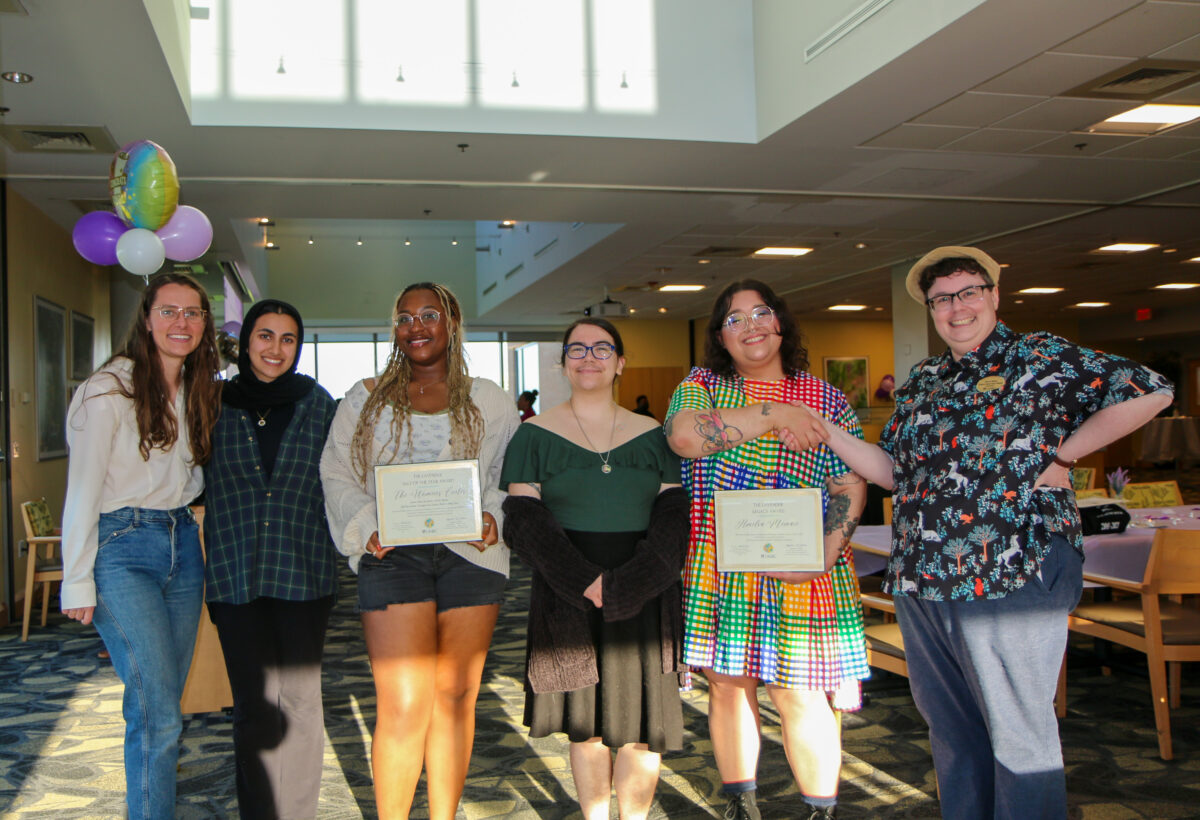
Six people in a row, two holding certificates, in a bright room with patterned carpet.
Adams with awardees at the annual Lavender Celebration and Awards.

Q: What have been some of the most meaningful relationships or moments during your time at UMBC?

A: I’ve always been drawn to spaces where people are passionate about their work, and I’ve had the privilege of building relationships with people who truly care about making a difference in the world. I’ve really benefited from the mentorship of Matt Hoffman, who has been my supervisor in the Gathering Space for Spiritual Well-Being for the last two years. I’ve learned so much from him about what empathetic leadership and radical love looks like.

He’s empowered me to be an active creator and leader in our space and across UMBC, and he will forever be my role model for how to create inclusive spaces. There’s been too many great moments to count, but I know that I, and many others, value the warmth and depth he brings to all of his relationships.
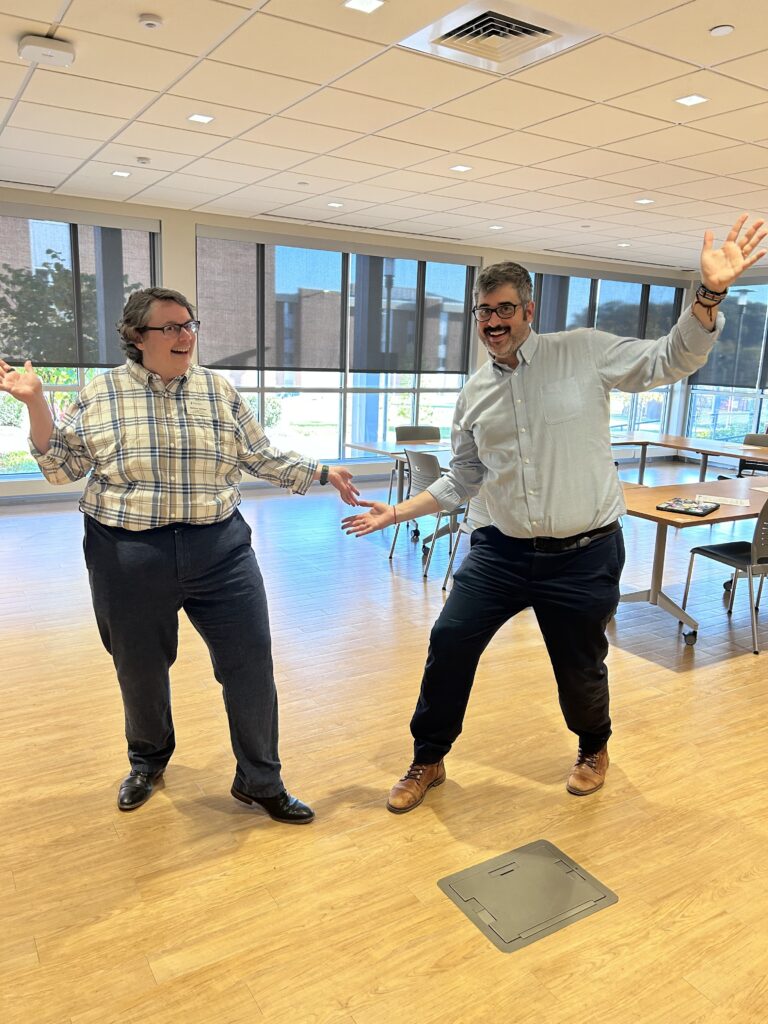
Two UMBC employees stand with arms and hands gesturing in the air as they take a break from their restorative practice work
Adams dressed as Hoffman for Halloween. Imitation IS the sincerest form of flattery.

Q: What advice would you give others considering your master’s program?

A: This program is fantastic for people who are already doing community work and want to skill up. The hands-on nature of the program and how embedded it is in the Baltimore community means it offers real-world skills in real time. This program adds theory and historical context to the focus on learning by doing in a way that will help you mold yourself into a well-rounded community practitioner by the time you’re finished. If that sounds like something you could benefit from, you should take a look at community leadership!

Q: Your work was published in the UMBC Review—can you reflect on what that experience meant to you both academically and personally?

A: Having my work published in the UMBC Review was an incredibly rewarding experience, especially because I spent most of my first year as a graduate student editing it for publication! The article turned into something that went beyond what I initially anticipated, and to have it published has been a highlight of both my undergraduate and graduate experiences at UMBC. It’s been fun and wild to have students approach me and tell me they’ve talked about my article in class, and I’m glad it’s been something people have been able to connect with.

Q: What’s one UMBC space you’ll always remember fondly?

A: I’ve spent a lot of time in our cultural affinity centers—The Mosaic; The Pride Center; The Gathering Space; and the Women’s, Gender, and Equity Center—and participated in their initiatives and events. Through these spaces I’ve met so many friends in the last six years and have found more support for my advocacy work and passion projects than I could ever name.

Q: What would your dream role in higher education look like?
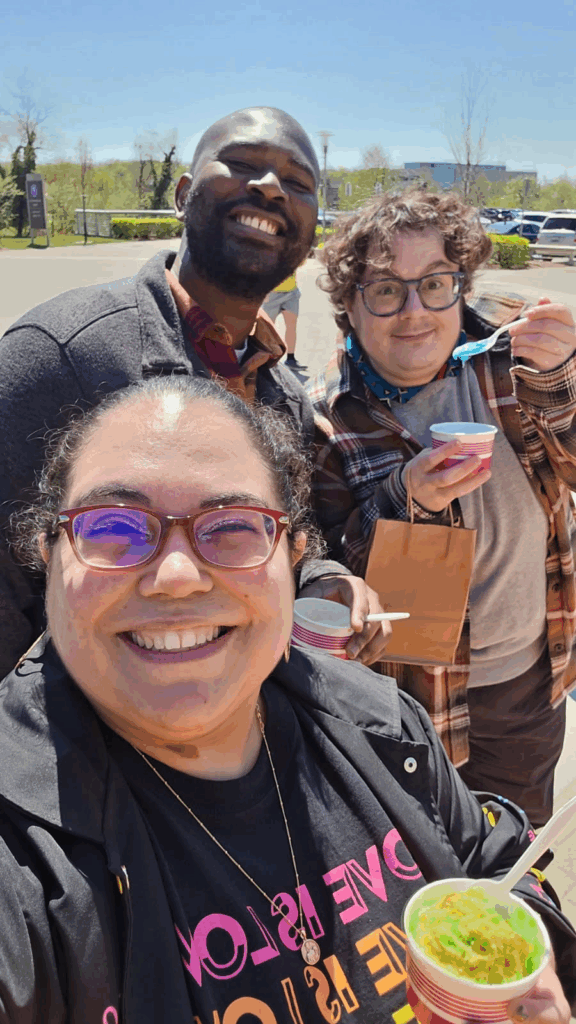
Three people smiling outdoors, holding cups of colorful frozen dessert on a sunny day.
Adams with Irene Vizcarra and Steve Wambo Kanga at a Pride Week event.

A: One where I’m able to work with students and staff to create more inclusive and restorative campus environments. I would love to work in a leadership position where I could help bridge the gap between different communities on campus and foster a culture of care and support. It’s about finding ways to incorporate restorative practices into all aspects of campus life—whether that’s through conflict resolution, mentorship, or simply creating a safe space for students to grow and thrive.

Q: What’s the one thing you’d want someone who hasn’t joined the UMBC community to know about the support you find here?

A: The support here at UMBC is real and it’s transformative. It’s not just about academic resources, but about the people who truly care about your growth—whether that’s faculty, staff, or peers. The UMBC community is dedicated to seeing you succeed, not just as a student but as a person, and that makes all the difference. There’s a commitment to inclusion, belonging, and helping each other out.
Read more Commencement 2025 stories.

Renaissance woman: Khadijah Ali-Coleman ’95 lends her varied voice to the Maryland humanities

Early mentorship at UMBC, layered with her continued education and formative life experiences, has shaped Ali-Coleman’s voice and purpose. From her transformative years at UMBC—where she wrangled her array of interests into a self-designed major—to her current varied roles,  Ali-Coleman’s commitment to the arts, education, and advocacy is clear. Her most recent project was launching the nonprofit Black Writers for Peace and Social Justice, which emerged from her experiences and inspirations gathered from a recent trip to Cuba. 

Ali-Coleman’s entrepreneurial spirit is evident in her earlier work as well. In 2008, she founded an arts organization called Liberated Muse, driven by a passion for artistic expression and community engagement rather than immediate financial gain. Her leadership roles in various nonprofits provided her with the skills to formalize her initiatives with integrity and a systems mindset, she says. Collaborations with fellow UMBC alum Maceo Thomas ’93, biochemistry and molecular biology, arose from her desire to create spaces for artistic expression.

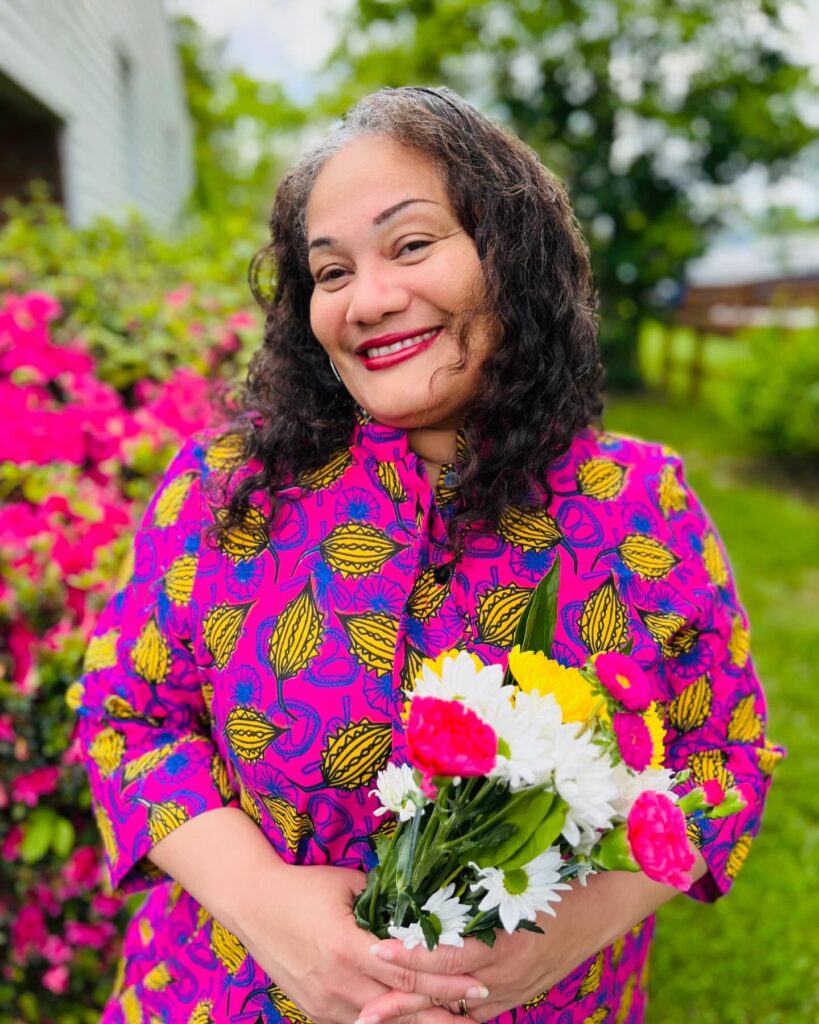
A woman smiling wearing a brightly patterned pink dress, holding a bouquet of flowers, while standing in front of flowers.
Ali-Coleman stops the smell the roses (and a few other flowers). Photo courtesy of Ali-Coleman.

As the second poet laureate of Prince George’s County, Maryland, Khadijah Z. Ali-Coleman embodies the role’s commitment to both the arts and community. She describes the work as an ambassador for literature and writing, creating courses and spaces for writers to share their voices. “What I’ve found the greatest joy in,” says Ali-Coleman ’95, interdisciplinary studies , “is partnering with local libraries and schools to share the different literary eras that have impacted our world.” Through this position, she has launched a symposium series, focusing on the Black Arts Movement, with plans for an exploration of the Harlem Renaissance in 2025.

Listening to her mother’s voice

Ali-Coleman’s path to UMBC was heavily influenced by her mother, who encouraged her to stay local, despite initially being set on applying to schools across the country. However, during a family tour of UMBC, she felt an unexpected connection. It was, as she describes it, “love at first sight,” enamored by the warmth of the campus community and the support from then admissions counselor Yvette Mozie-Ross ’88.

Now the vice provost for enrollment management and planning, Mozie-Ross was present when Ali-Coleman won the UMBC 2024 Outstanding Alumni Award. “It’s great to see that the same passion and compassion for the genuine well-being of others that ignited and drove Khadijah as a student leader has not waned a bit,” says Mozie-Ross. “Her work in our communities continues to reflect her deep sense of humanity. We (UMBC) couldn’t be more proud of her.”

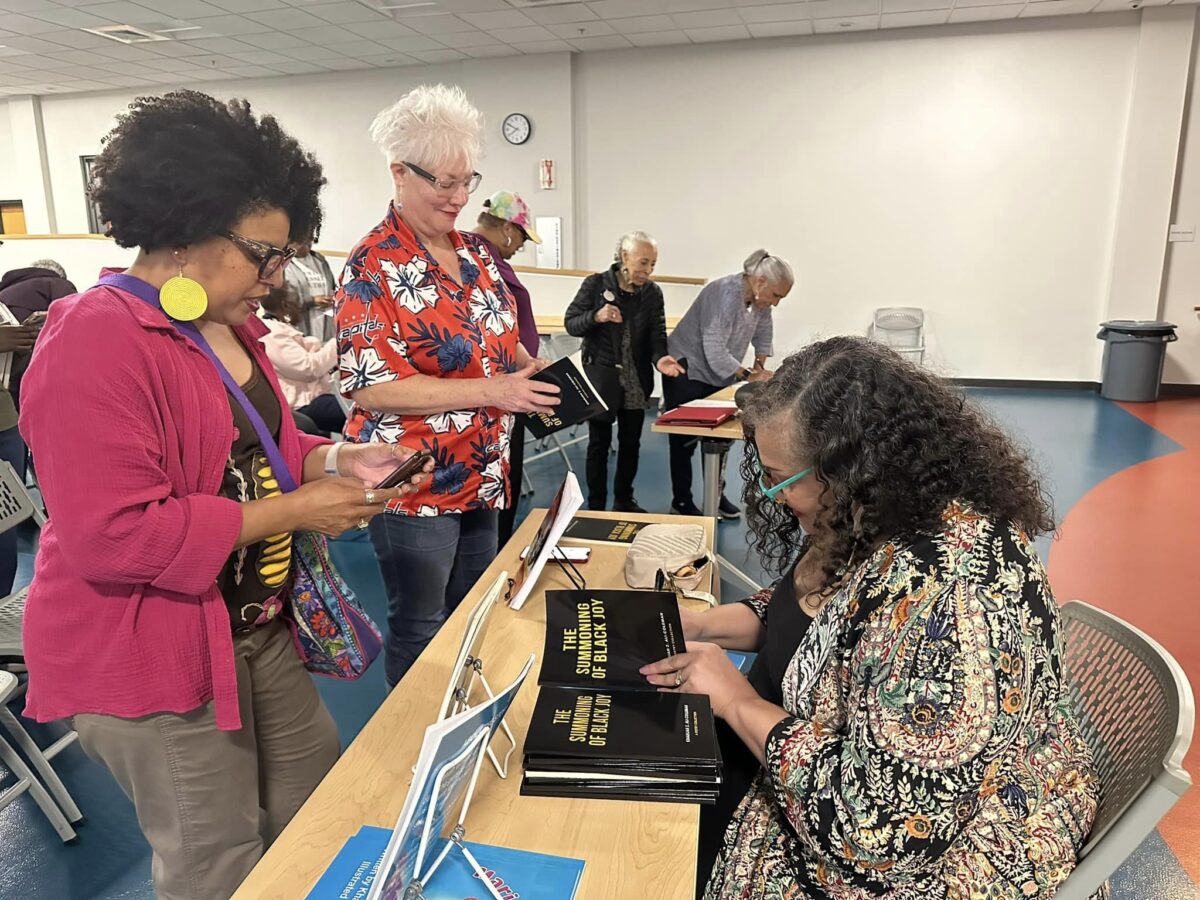
A woman signs a book at a table during a presentation for an audience member.
Ali-Coleman signs a copy of her poetry book The Summoning of Black Joy. Photo courtesy of Ali-Coleman.

Once at UMBC, Ali-Coleman faced the challenge of narrowing down her diverse academic interests—ranging from social work and mass media to African American history and English. She quickly realized that a traditional major wouldn’t fit her needs, and after reading the entire course catalog, she discovered the interdisciplinary studies (INDS) program, which allowed her to create a personalized curriculum. This flexibility enabled her to weave courses from African American studies, American studies, and English into a unique educational path that laid the groundwork for her future in communications and education.

Key figures at UMBC also played a significant role in shaping her journey. One of her favorite classes was Acklyn Lynch’s course on the Black Experience, where Ali-Coleman formed a lasting friendship with William Honablew ’95. This course not only stimulated intellectual discussions but also fostered ongoing connections among both students and Lynch long after graduation. Another influential mentor was Jamie Washington, who taught Ali-Coleman during her time as a student peer advisor. Washington’s ability to facilitate difficult conversations around racial tolerance during pivotal moments—such as the Rodney King trial verdict—left a lasting impression on Ali-Coleman. She often finds herself wishing she could emulate his approach as a facilitator and teacher. “Jamie Washington is by far the most impacting role model and person that I think of,” she says.

Making herself at home

Ali-Coleman draws on her inspiring mentors in her own classrooms as an associate professor of English at Coppin State University. “Baltimore is really my second home,” she shares, which started with her time at UMBC, followed by earning her master’s from Towson University, and her doctorate from Morgan State University. As someone familiar with area institutions, Ali-Coleman calls UMBC a “gem.” Aside from having high academic standards, she said it was also ahead of its time. 

“Many aspects we now take for granted—like diversity, equity, and inclusion—were already being prioritized at UMBC,” says Ali-Coleman. “The university created a culture around inclusion, which was evident during my time as both an employee and a student.” As a member of the second cohort of UMBC McNair Scholars, Ali-Coleman experienced firsthand UMBC’s commitment to supporting underrepresented students in pursuing doctoral degrees. “I realized how ahead of the curve UMBC was,” said Ali-Coleman. “It didn’t sacrifice academics or cultural experiences. I don’t think people fully appreciate that.” 

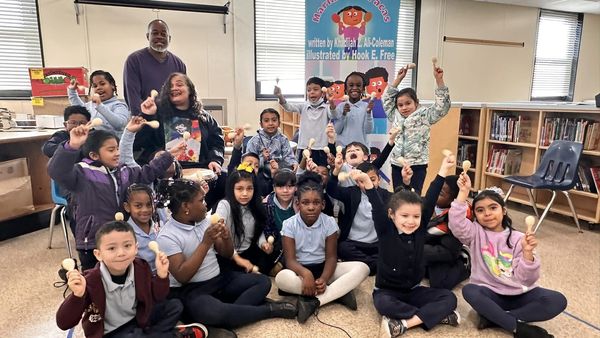
Khadijah Ali-Coleman with elementary students
Ali-Coleman gathers with students at Chillum Elementary. Photo courtesy of Ali-Coleman.

Ali-Coleman, who was named an Outstanding Alumni at the 2024 Alumni Awards, says that her career trajectory reflects her experiences at UMBC, where she honed skills that would later serve her in various opportunities. After defending her dissertation on African American homeschool students who were dual enrolled just days before the onset of the COVID-19 pandemic, she recognized an urgent need for support among families navigating homeschooling for the first time. This led her to found Black Family Homeschool Educators and Scholars in 2020, an organization created to assist parents struggling with the transition to remote learning.

As she continues to navigate her role as poet laureate, professor, and nonprofit leader, her story showcases how pivotal moments, resilience, and a little bit of serendipity have shaped her path. “UMBC was one of the best experiences I’ve ever had, and it has been incredibly impactful,” Ali-Coleman reflects. “I’ve drawn from my time there in countless ways in all different areas of my life.”