
All posts by: Kaushiki Pavuluri '20


Like Mother, Like Daughter

As a kid, global studies major Zena Smith often heard her mother, Nicole Smith ’02, mathematics, talk about her years at UMBC. But until she visited—and experienced campus life in person—she never really considered becoming a Retriever herself.

“There were many factors that went into why I chose UMBC,” says the younger Smith, who originally had been adamant about not attending UMBC because her mother had gone there.  But after visiting campus, “I was completely sold, and understood why my mom loves this school so much.” 

While most mothers and daughters share some things in common, it’s a special bond to carry on the Retriever legacy. And while UMBC continues to grow by building new structures, creating a new brand, and extending its global influence, no matter how much has changed, that Retriever bond is what makes our community at UMBC feel like family for so many. Even more so if you’re actually family.

The Smiths are certainly not alone in this. When it was time for her to choose a college, UMBC sophomore Miranda Sadtler, psychology, decided on UMBC because she really liked the atmosphere and knew the reputation of the psychology program here. But the stories her mother, Kim Sadtler ’82, told her about her alma mater also influenced her decision.

Sadtler majored in psychology and minored in health science and policy. After graduation, she attended the University of Maryland School of Nursing and worked as a psychiatric nurse. She attributes an internship through the psychology department at UMBC in collaboration with the University of Maryland Hospital for helping her solidify her career path as a psychiatric nurse.

Kim with her brother on graduation day 1982. Photo courtesy of the Stadtler family.

Taking her mother’s experiences into account, Miranda is choosing a slightly different route and hopes to establish a career on the clinical research side of psychology, which her mother agrees is perfect for her. “Compassion comes second nature to Miranda,” says Sadtler. 

Despite pursuing similar degrees from UMBC, Miranda’s time on campus has differed from that of her mother, who worked as the first student athletic trainer under the head athletic trainer, Cindy Stout. During this time, Sadtler got to know the athletes, traveled with them, and shadowed Stout, who was a role model and friend. 

While Sadtler was centered on athletics, Miranda works on campus as a desk staffer, and helps the Environmental Task Force clean up trash on campus every week. “I’m really glad I joined different clubs and organizations. Both my job as a desk staffer and a member of the Environmental Task Force have really made my time at UMBC better because of the great friends and opportunities I’ve had so far.” 

Despite choosing the same college, Sadtler and Miranda have many differences between them—different fashion sense, different laugh, different smiles—but the one thing they share are the fond memories they have of campus, where they both met some of their best friends.

Sadtler’s favorite memories of 1980s UMBC center on the dorms and friendships with suitemates and roommates, sporting events, and spending time on the Quad. “UMBC gave me opportunities to expand my knowledge, take dance classes, work as a student athletic trainer, learn about policy, and enter the healthcare field,” says Sadtler. Her time at UMBC helped her figure out what her dreams were. This has turned out to be no different for her daughter.

Both women feel that going to UMBC has brought them closer together, and they love that they can share stories about how much UMBC has grown since 1982. “Whenever she visits, my mom will tell me about how things have changed and what’s still the same. UMBC feels somewhat small to me now; I can’t imagine how small it must’ve felt to her when she attended!” Miranda says. Before Miranda’s freshman year, she was pleasantly surprised to find out that she would be living in Patapsco Hall, where her mother lived for four years. 
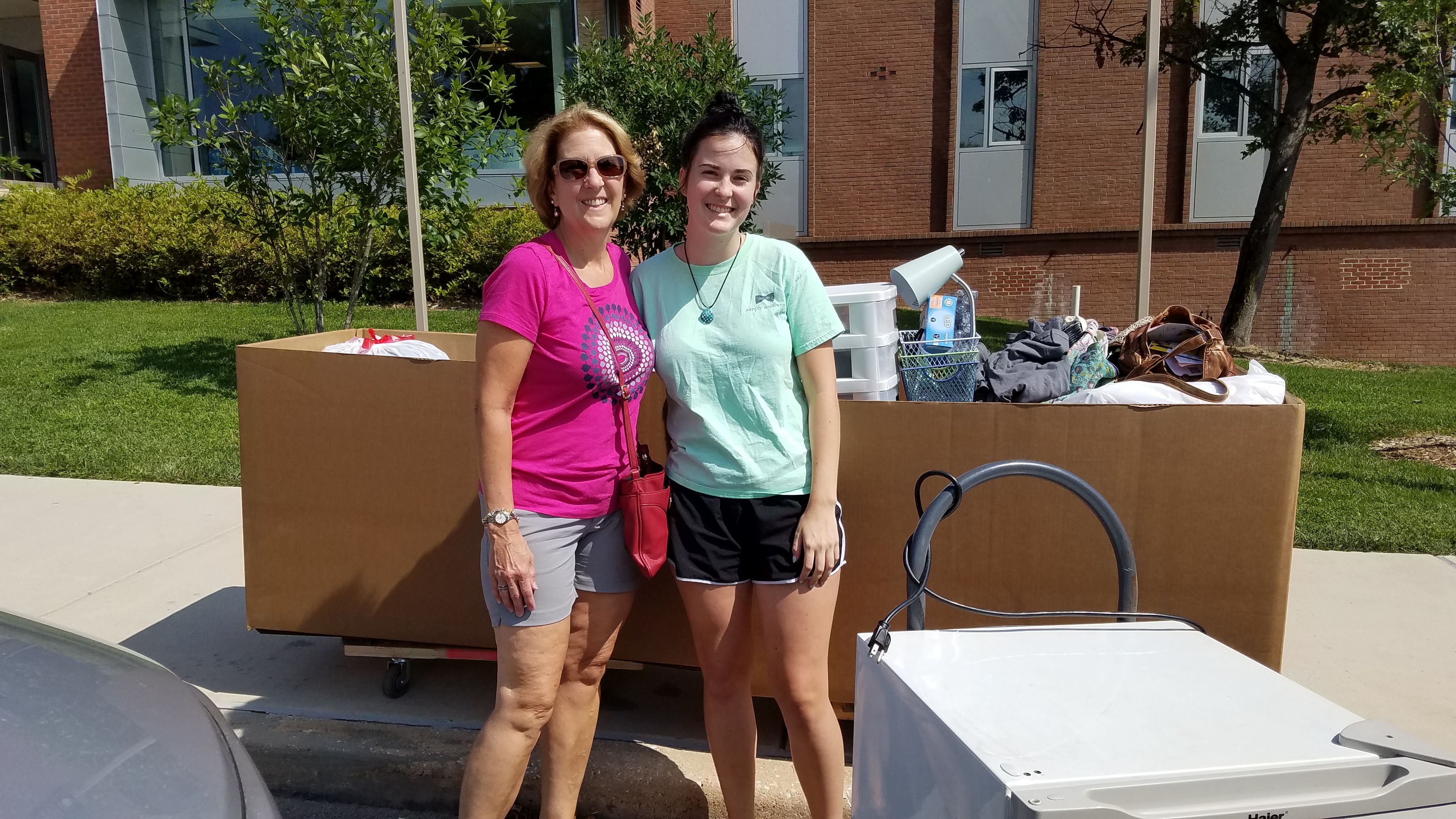
Kim joins her daughter Miranda on freshmen move-in day. Photo courtesy of the Stadler family.

Sitting together in their cozy living room, Smith shares her first impressions of UMBC with her daughter Zena.

“I fell in love with UMBC during my visit. The atmosphere was so inviting and the staff was welcoming,” she says. But Smith was looking for an electrical engineering program, which UMBC lacked at the time. It was President Freeman Hrabowski who advised Smith to complete her associate’s degree in engineering first, so Smith started out at University of Maryland, College Park. After spending two semesters at UMD, Smith decided to change her major to mathematics, “and transferred to the school I first fell in love with, UMBC.”

Having attended multiple institutions, Smith says that some of the best benefits at UMBC were the smaller class sizes and the fact that you were able to meet with your professor directly if you had questions regarding the class, instead of a TA. 

“My professors at UMBC were the most giving of their time. If a student needed help outside of office hours, they made it a point to stay after class to ensure that the student got the assistance they needed,” says Smith.  “They always put the needs of their students before theirs. They made sure that you understood the material before you left the session, no matter how long it took. That’s true dedication.” 

Dr. Hrabowski congratulates Nicole Smith on graduation. Photo courtesy of the Smith family.

Along with the professors and staff members, Smith also loved how welcoming students at UMBC are. “As a transfer student, I thought it would have been difficult to connect with the students that had already bonded during freshman year,” she says, “but that was so far from the truth.” 

Now, as an alumna, Smith gets the pleasure of watching her daughter experience and fall in love with UMBC the same way she did. “Not that Zena would remember, but when she was younger she would always say that she wanted to attend UMBC,” says Smith, “but as she got older UMBC was not on her radar. All of that changed when she finally decided to visit UMBC. The inviting atmosphere and the welcoming staff and students that she encountered on her walk to the RAC all made her feel like she was at home.” Smith was so proud when Zena made her college decision.

Both of the Smiths feel that UMBC helped bring them closer together because of their shared experiences. While Smith was a working student, and wasn’t able to join many clubs and organizations, she really pushed Zena to find her place on campus. “Going to the same school really helped us bond over our similar experiences or similar classes we have taken,” says Zena. “UMBC is a part of our lives that we are always going to share.”
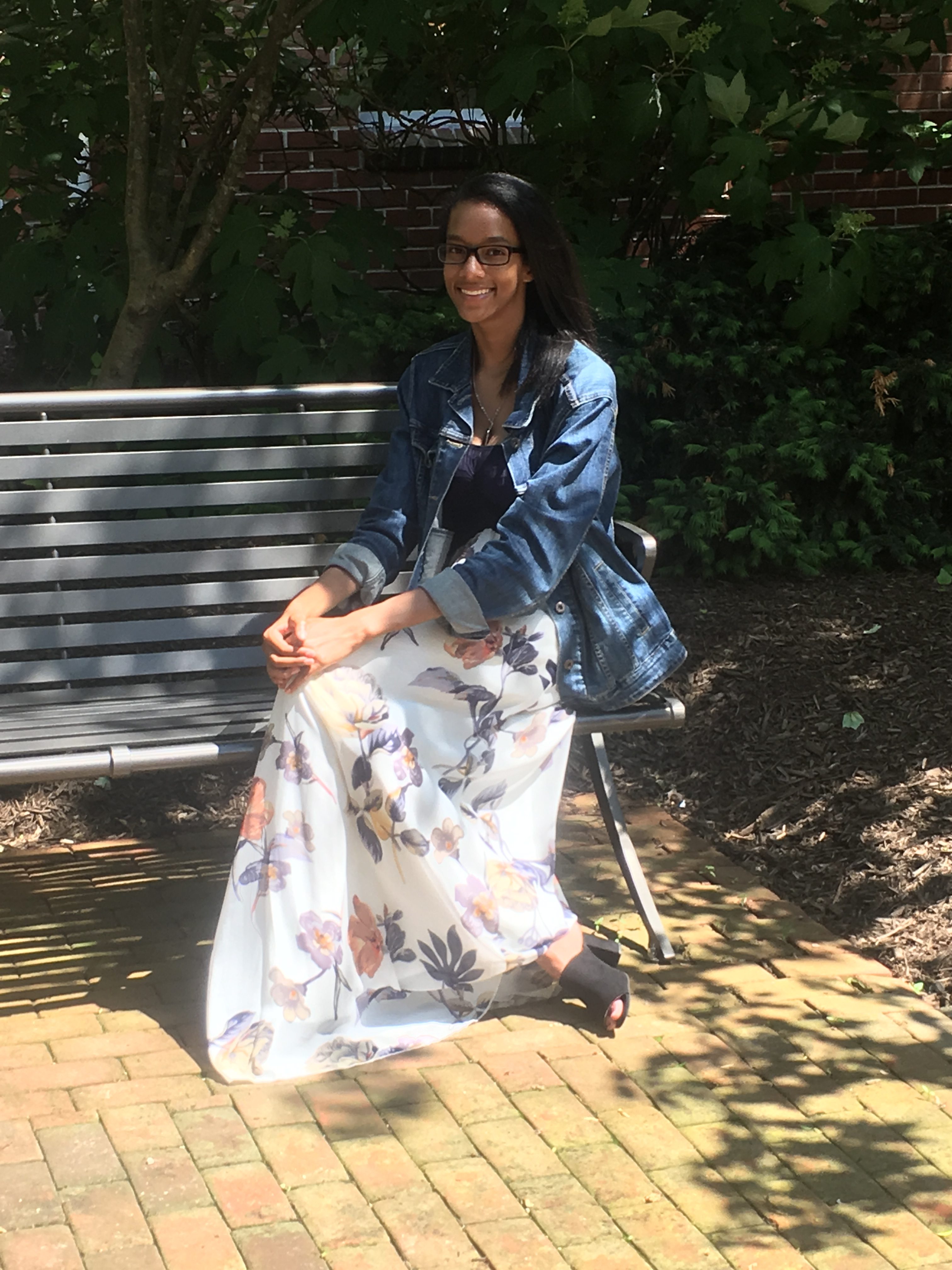
Zena Smith on campus. Photo courtesy of the Smith family.


*****

Header image: Nicole and Zena Smith with the Baltimore skyline. Photo courtesy of the Smith family.
A Historian’s Journey to Finding Kate

For this UMBC-trained historian, a walk in the park led her on a 10-year journey to publishing her book Finding Kate.

Driven by her passion for history with support from her family, Meryl Carmel, M.A. ’94, history, dedicated 10 years of her life on a mission to Finding Kate. Her journey, which led her to write a book about philanthropist Kate Macy Ladd, was something full of unexpected moments ultimately connecting her and her future book subject.

On an inauspicious Sunday, Carmel decided to take a stroll in a park, a former grand estate located several miles from her home. On her walk, she came across a kiosk which held pamphlets about the woman who built the estate—called Natirar—and opened a convalescent home for working women there in the early 1900s.

This information reignited an early flame of interest for Carmel. The story of an affluent heiress who experienced great loss and still chose to use her life to help others spoke to a childhood question Carmel had never quite let go of.

Growing up in Philadelphia, Carmel discovered her love of history early on and spent much time as she could reading historical biographies. Even at the age of seven, she quickly realized that there weren’t many biographies written about women. One book in particular stood out to her, a biography of Betsy Ross. As Carmel learned more about Betsy, her curiosity led her to wonder why it seemed that only men did great things that were written about in books.

Decades later, her graduate work in women’s studies and history would focus on the accomplishments and contributions of our nation’s women, helping to answer the questions she had when she was younger.

For Carmel, publishing her book Finding Kate, was the culmination of a decade of research that took her to three different countries. Along the way, she discovered that her life was more tangled with Ladd’s story than she could have ever imagined.

When Carmel moved from Maryland to New Jersey, she was intrigued to learn that the nearby estate, Natirar, was owned by the King of Morocco. That surprising piece of trivia was only the tip of the iceberg of what she would soon learn.

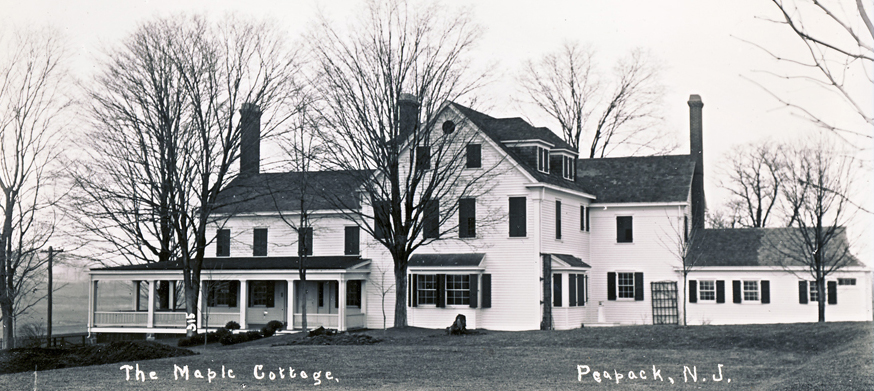
Who exactly was the woman whose house was eventually bought by royalty? Ladd was raised in a Quaker family, her values steeped in charity and doing good for others. As an outpouring of her generosity, she opened a convalescent home for women called Maple Cottage on her 1,000-acre estate.This home was established in a comfortable setting where working women could stay for free for up to three weeks, to recover from an illness, surgery, or work-a-day weariness. Ladd saw a need to give women an opportunity to restore their health in a time when there were few similar options. What had inspired this act of philanthropy?

Maple Cottage on Ladds property. Photo by Edith Van Dorn, courtesy of Meryl Carmel.
Maple Cottage on Ladd’s property. Photo by Edith Van Dorn, courtesy of Meryl Carmel.

To answer this question, Carmel used typical historical methodology, such as consulting census records and secondary sources. But she also came up with a back door approach: tracking down some of distant descendants and descendants of her past employees. Carmel successfully located about 10 individuals with a connection to Ladd all over the country and even in Ireland, so she began traveling and gathering more information.

While many of the living relatives knew they had a very wealthy and generous ancestor, Carmel met one 92-year-old woman who actually knew Ladd.  This connection allowed Carmel to borrow many primary sources such as old photographs and boxes of random things, including old journals, diaries, and memorabilia. What Carmel didn’t expect to find along the way was her own personal tie to Ladd.

Along the way, Carmel discovered the name of the nurse who managed Maple Cottage. The long deceased nurse was buried in Meridian, New York, a place where Carmel and her husband had once spent a summer. It was the home of an old friend from her days as a student in Wisconsin.

It hit Carmel that the nurse and her friend—one buried in Meridian, one alive in Meridian—shared the same last name: Dudley. With a bit of investigating, Carmel discovered that Kate Macy Ladd’s nursing supervisor, Estelle Dudley, was actually the great-great aunt of Carmel’s friend Milli Dudley Lake. This came as a complete surprise to Lake.

This fortuitous coincidence was an exciting breakthrough for Carmel. Her luck increased even more when her former roommate uncovered a ledger book that belonged to her great-great aunt. It was filled with recipes for the food prepared for the guests at Maple Cottage. In that moment of human connection, Carmel knew that no matter what, she was determined to write her book.

Along the way, she learned that Ladd also created a foundation dedicated to health, the Josiah Macy Jr. Foundation, which still operates in New York City. In addition, a greatly enlarged version of her convalescent home operated in her mansion house for 34 years after her death. More than 22,000 women received free state-of-the-art care at what was called the Kate Macy Ladd Convalescent Home.

Carmel was able to tell Ladd’s story, she says, because she followed through with her childhood curiosity of the role America’s women have played since the country’s founding by earning a master’s degree in history from UMBC. During her time at UMBC, Carmel continued to be a full time mom to two little boys while her husband was a professor at University of Maryland, College Park. She found time to work as a teaching assistant, and often sought guidance from her advisor Dr. Jean R. Soderlund, one of her very few female professors. Carmel remembers Professor Soderlund as a meticulous researcher and an inspiring woman, who helped guide her through her graduate program with excellent grades, fond memories, and ultimately the ability to see her research through to publishing a book.

*****

To find out more about Carmel’s journey and the little known story of Kate Macy Ladd, please check out her website.

All photos, including the header image, courtesy of Meryl Carmel.